
By The Roofing Brief Team | Last reviewed: October 2026
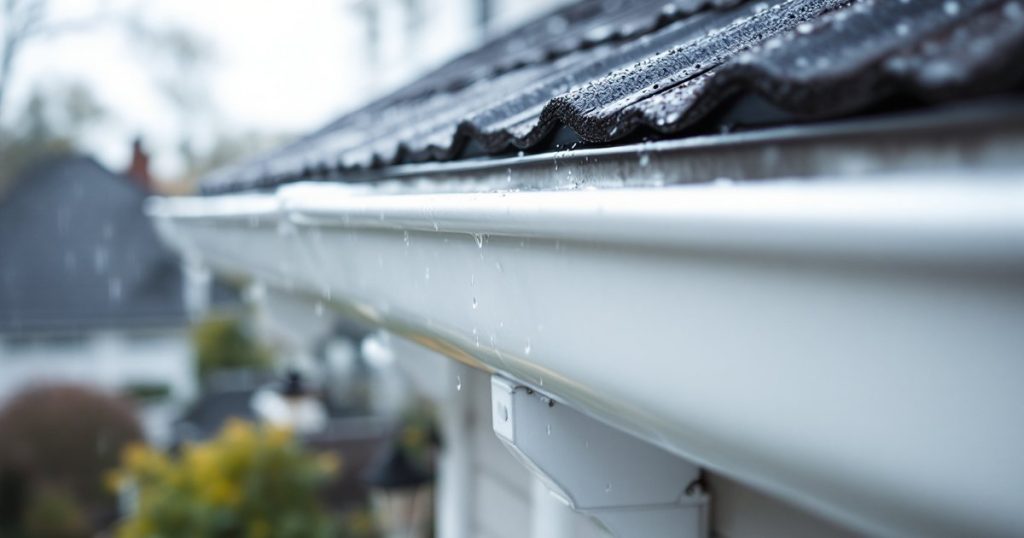
K-Guard gutters are a complete hooded gutter system, not a guard that clips onto the gutter you already have. A licensed K-Guard dealer removes your old gutters and roll-forms a new 6-inch seamless aluminum (or copper) gutter and a separate curved hood on site, then hangs both on polymer hangers set every 24 inches. K-Guard publishes no prices because each independent dealer sets its own, and the lifetime no-clog warranty comes from the dealer, not from K-Guard.
The pages that rank for this search are mostly dealer sites, plus a retailer listing, a video, one contractor comparison and a forum thread. This review fills what they leave out: who actually designed and makes the system, what the patent record shows, what three dealers’ warranty documents really say, what homeowners have reported paying, and where hood-style gutters run into trouble with heavy rain and pine needles.
K-Guard key numbers at a glance
These are the figures most buyers want before a K-Guard estimate. Every row names its source. Manufacturer figures are K-Guard’s own claims, not independent test results, and prices are reports from individual homeowners and dealers, not a price list.
| Figure | Value | Source |
|---|---|---|
| Gutter size | 6-inch seamless gutter, 3 x 4 inch downspouts | kguard.com, How It Works page |
| Material | Coated aluminum 0.027 to 0.032 in. thick (3105-H16 to H24), or 16 oz and 20 oz copper | kguard.com, About Us and How It Works pages |
| Hanger spacing and strength | Polymer hangers every 24 in.; 35 lb per foot of vertical load at the gutter front (70 lb per hanger) | kguard.com, FAQ page (manufacturer’s computer-based engineering study) |
| Rated rainfall | At least 22 inches per hour | kguard.com, How It Works page (test method not published) |
| Dealer network | 48 independent dealers in 28 states; 35 million+ feet installed | kguard.com, homepage and About Us, October 2026 |
| Reported price | $6,100 for about 200 ft (about $30.50 per foot), 2021; about $5,000 for a “standard home”, per one dealer | r/HomeImprovement post, Aug. 27, 2021; K-Guard of Central Ohio blog |
What is K-Guard, and who makes it?
K-Guard is a two-piece leaf-free gutter system designed by Gary Knudson of Knudson Manufacturing in Broomfield, Colorado. K-Guard’s own history says the concept was established in 1996, first manufactured in 1997, and received its patent and signed its first licensed dealer in 1998. Today independent dealers make it: each licensee forms the gutter and hood on site with K-Guard’s roll-forming machines.
That last point matters more than it sounds. K-Guard’s dealer FAQ states that “dealers manufacture K-Guard gutters themselves using patented roll-forming equipment exclusively available to licensed dealers,” and that dealers choose which colors and materials to offer. Dealers are independent licensees, not franchisees. They pay no royalties, set their own prices and receive exclusive territories. In practice, your K-Guard experience depends heavily on the specific dealer that holds your territory.
The patent K-Guard cites on its site is US Patent 5,845,435, “Fastening support devices and systems for shielded gutters,” with Gary A. Knudson as inventor. Google Patents lists a filing date of September 5, 1997, an issue date of December 8, 1998, K-GUARD LLC as current assignee, and lists the patent as expired, with an anticipated expiration date of March 27, 2015. Google notes that status is an assumption, not a legal conclusion. K-Guard’s pages still call the hangers and machines “patented,” so ask the dealer which active patents apply if that claim weighs in your decision.
Knudson Manufacturing still operates as a roll-forming machinery builder. Its current site (knudsonmfg.com) focuses on light-gauge steel framing and metal roofing machines and says the company has built roll formers for over 60 years.
How does the K-Guard hood work?
K-Guard relies on surface tension, also called liquid adhesion. Rain running off the shingles lands on the curved hood, clings to it as it wraps around the rounded nose, and drops into the gutter. Leaves and twigs cannot follow that tight curve, so they slide off the front edge. A second, rear drainage channel lets water enter along the back of the gutter as well.
The patent abstract describes the support hardware: a hanger with upper and lower arms that nest inside the gutter and hold the front edge at a fixed height, with a fastener through the back wall into the fascia. The two-piece design lets the hood be formed separately and “readily connect to and be detached from” the gutter channel, which is why K-Guard advertises a removable hood. Here is the water path K-Guard describes, step by step:
- Runoff reaches the hood. Water leaves the shingle edge and lands on the textured hood, which mounts below the roofline and does not touch the shingles.
- Water follows the curve. Surface tension holds the water to the hood as it rounds the nose and falls into the 6-inch trough.
- Debris falls away. Leaves, twigs and, per K-Guard, pine needles slide off the front edge to the ground.
- The rear channel catches backflow. Wind-driven water that reaches the back of the hood enters through the rear drainage channel instead of running under the roof edge.
- Downspouts flush small debris. The 3 x 4 inch downspouts are meant to carry out any small particles that get past the hood.
K-Guard’s FAQ also says the hangers attach to the fascia board and rafter tails, so nothing goes under the shingles. Homes without a fascia board may need what K-Guard calls “a simple fascia build-out.” The company also states that a K-Guard hood cannot be added to existing gutters.
K-Guard specs: size, gauge and materials
K-Guard’s current site lists a full 6-inch gutter that holds 0.70 gallons of water per foot, coated aluminum from 0.027 to 0.032 inches thick, or copper in 16 and 20 ounce weights. The hood and gutter come in the same material and color, and colors vary by dealer. The table below lists each published spec and where it appears.
| Spec | K-Guard’s published figure | What it means for you | Source |
|---|---|---|---|
| Trough width | 6 in. | Larger than the common 5-inch residential K-style gutter | kguard.com, How It Works |
| Capacity | 0.70 gal per foot | A 200 ft system holds about 140 gallons when full (Roofing Brief arithmetic: 200 x 0.70) | kguard.com, How It Works |
| Gutter bottom | 3-1/4 in. wide | Sized to accept a 3 x 4 inch downspout | kguard.com, FAQ |
| Aluminum thickness | 0.027 to 0.032 in. (3105-H16 to H24 alloy and temper) | Ask which thickness your dealer runs; it is a range, not one gauge | kguard.com, About Us |
| Copper | 16 oz and 20 oz | Availability depends on the dealer | kguard.com, How It Works |
| Hood load | 60 lb per sq ft (load and uplift) before flexing | Relevant for snow and ice regions | kguard.com, FAQ |
| Paint coating life | “Will easily last 20 years” | A manufacturer expectation, not a warranty | kguard.com, FAQ |
One inconsistency is worth knowing. The visible FAQ on kguard.com describes a 6-inch gutter, but the FAQ structured data embedded in the same page, which search engines read, still says “A full, 5-inch wide gutter (same capacity as standard, k-style gutters).” At least one dealer page, K-Guard of Central Ohio, also describes a five-inch trough. Measure the gutter sample at your estimate, and put the trough width and metal thickness in the contract. Our guide to 5-inch vs 6-inch gutters explains why that inch matters for capacity.
How much do K-Guard gutters cost?
K-Guard does not publish prices. Its FAQ says “each dealer determines the fair market price in his or her local area,” based on material cost, location, competition and labor. The only figures available are reports from individual homeowners and dealers. Treat them as data points, not a price list, and get a written quote that includes the footage.
| Reported figure | What it covers | Per-foot math | Source |
|---|---|---|---|
| $6,100 | About 200 ft of K-Guard, quote before any further discount | About $30.50 per ft (Roofing Brief arithmetic: $6,100 / 200) | u/Thraex_Exile, r/HomeImprovement, Aug. 27, 2021 |
| About $5,000 | “Average installation cost” for a standard home | Not stated (footage not given) | K-Guard of Central Ohio, dealer blog |
| $21.67 to $39.59 per ft | LeafGuard, a comparable replacement hood system, for comparison | $4,334 to $7,919 for 200 ft | This Old House surveys (Nov. 2025 and Jul. 2026), via our LeafGuard cost guide |
| $7 to $13 per ft | Plain 6-inch seamless K-style aluminum gutters, no guard, for comparison | $1,400 to $2,600 for 200 ft | The Roofing Brief, 5-inch vs 6-inch gutters |
A K-Guard quote replaces two line items at once: the gutters themselves and a guard. That is why the total runs well above a plain seamless gutter job. Using the 2021 Reddit quote as an example, the premium over plain 6-inch gutters for the same 200 ft works out to about $3,500 to $4,700 (Roofing Brief arithmetic: $6,100 minus $1,400 to $2,600). Against professional cleaning at $250 to $450 per visit for a two-story home, twice a year, that premium pays back in roughly 4 to 9 years. For a one-story home cleaned once a year at $150 to $300, payback stretches to roughly 12 to 31 years. Cleaning prices come from our gutter cleaning cost guide. The 2021 Reddit quote also predates current aluminum prices, so a 2026 quote for the same footage may differ.
Several things push a K-Guard quote up or down: total footage, the number of inside and outside corners, downspout count and length, story height, copper versus aluminum, and any fascia repair or build-out. The dealer’s warranty terms are also part of what you are paying for, so compare quotes on the same written warranty, not only on price per foot.
What does the K-Guard warranty actually cover?
K-Guard itself does not issue the warranty. Its FAQ says “all warranties are offered through our independent dealers, not by K-Guard directly.” Most dealers advertise a lifetime no-clog guarantee, but the paint, pull-away and transfer terms differ from one dealer’s document to the next. Read the actual certificate before you sign.
We read the published warranty language from three K-Guard dealers. The differences are real:
| Term | K-Guard Cleveland (Clog Free Gutters of Ohio / DunRite) | Southern’s Ultimate Gutter Guard | K-Guard Rocky Mountains |
|---|---|---|---|
| No-clog promise | Free cleaning or repair “for as long as you own your home,” provided the gutters and 3 x 4 downspouts are not externally damaged | Guaranteed not to clog with leaves, pine needles or other organic debris | “100% lifetime no-clog guarantee” |
| Paint finish | Lifetime: refinish or replace if the finish chips, flakes or peels from a manufacturing defect | 20-year paint warranty | “Guaranteed paint-finish warranty” (term not stated in FAQ) |
| Workmanship | Installation defects remedied at no cost for the lifetime of the home | Lifetime workmanship warranty | Whole system (hood, base, brackets) “guaranteed for life” |
| Transfer | Clog warranty transferable “one time to a new home owner”; the same page also says all CFG warranties transfer “for the LIFETIME of the property” | Not stated in the excerpt we read | “Everything is transferrable to a new home owner” |
| Exclusions and conditions | No consequential damages from a clog; no obligation until paid in full; $150 inspection fee if a claim is found not covered | Not stated in the excerpt we read | Not stated in FAQ |
| Source | kguardcleveland.com/warranty | Ultimate Gutter Guard warranty PDF, hosted at southernsidingcolumbia.com | kguardrockymountains.com/faq |
Two practical points follow. First, a dealer warranty is only as durable as the dealer, because K-Guard does not stand behind it directly. Ask how long the dealer has held the territory and what happens to your warranty if the dealer closes or sells. Second, the Cleveland document excludes damage caused by a clog, so the no-clog promise covers cleaning the gutter, not repairing water damage.
K-Guard reviews, BBB records and complaints
There is no single BBB profile for K-Guard as a manufacturer. BBB files each dealer separately, so the record you should check is the one for the dealer that will install your system. BBB listings show several long-standing dealers as accredited, but ratings and complaint counts change, so look up the current profile yourself.
| Dealer (as named by BBB) | Location | BBB accreditation shown |
|---|---|---|
| Virginia Gutter, Inc. | Roanoke, VA | Accredited since 10/4/2005 |
| DunRite Exteriors/K-Guard Clog Free Gutters | Macedonia, OH | Accredited since 6/1/2009 |
| K-Guard Kansas City | Overland Park, KS | Accredited since 5/26/2016 |
| K-Guard of Iowa LLC | Dallas Center, IA | Accredited since 7/31/2017 |
| KGuard | Greenwood Village, CO | Accredited since 5/7/2021 |
| K Guard Gutter of Boston | Pembroke, MA | Not BBB accredited |
Source: BBB business profile listings at bbb.org, as indexed in October 2026. Accreditation is a BBB membership status, not a product rating. K Guard Gutter of Boston does not appear on kguard.com’s current dealer list.
Homeowner commentary is mixed and mostly about cost and heavy rain. In a 2021 r/HomeImprovement thread, the poster balked at the $6,100 quote, and one commenter warned that in “very heavy rains” leaf guards can make water “dump over the gutters.” In a 2024 r/Roofing thread about a K-Guard quote in the Seattle area, one commenter called the product “pretty good” but added “if you get a lot of big rain storms probably not,” and another flagged a metal roof as a possible concern. These are individual opinions, not test results.
RoofSmart, a Seattle-area roofing contractor that compared LeafGuard, K-Guard and Gutter Helmet, reported seeing debris collect at the rear opening of K-Guard installs on “several homes we’ve inspected,” while noting that not every install has the issue. K-Guard presents the same rear channel as a feature that keeps wind-blown water out from under the roof edge. If your roof drops a lot of fine debris, ask the dealer to show you how the rear channel is serviced.
K-Guard vs LeafGuard vs Gutter Shutter vs Gutter Helmet
All four are hood-style systems that rely on surface tension, are sold only as professionally installed systems, and promise no-clog performance. The main split is that K-Guard, LeafGuard and Gutter Shutter replace your gutters, while Gutter Helmet is a cover installed over new or existing gutters. Each cell below comes from that brand’s own published pages; rain ratings are manufacturer claims with test methods not disclosed.
| Feature | K-Guard | LeafGuard | Gutter Shutter | Gutter Helmet |
|---|---|---|---|---|
| System type | Full replacement: new gutter plus separate removable hood | Full replacement: one-piece seamless gutter and hood | Full replacement: seamless gutter with integrated rolled hood | Cover fitted over new or existing gutters |
| Gutter size | 6 in. | Not stated on product pages | 6 in. | Whatever gutter you have |
| Metal | Aluminum 0.027 to 0.032 in., or copper | 0.032 in. aluminum (“20% thicker”) | 0.032 in. aluminum | Aluminum with horizontal stiffening ribs |
| Support | Polymer hangers every 24 in. into fascia and rafter tails | Internal hanging brackets about every 2 ft into fascia | “Strongest gutter bracket”; patented one-piece end caps | Heavy-duty mounting brackets |
| Rain rating claimed | 22 in./hr minimum | 32 in./hr | Not found on pages we could read | 22 in./hr |
| Warranty (as published) | Issued by each dealer; typically lifetime no-clog | Englert lifetime finish warranty; no-clog claims handled by the installing dealer | Lifetime no-clog, no-pull, 20-year paint | “Triple Lifetime” (material, performance, service) for the original purchaser; transferable with conditions |
| Who sells it | 48 independent licensed dealers | Company branches; a Great Day Improvements brand (introduced by Englert in 1993) | Dealer network; company founded 2003 | Dealer network |
| Source | kguard.com | leafguard.com (How It Works, FAQ, Warranty, Our Story) | guttershutter.com (Benefits, Warranty, About Us) | gutterhelmet.com (FAQ and warranty articles) |
On the LeafGuard warranty, the Englert certificate is precise: the lifetime finish coverage lasts while the original owner owns the property. It can pass to a later buyer if Englert gets notice within 30 days of the sale, but it then becomes a prorated schedule capped at 50 years from the original installation. It also excludes installs within half a mile of the seacoast. For pricing, see our LeafGuard cost breakdown, and for its complaint and warranty record, read our LeafGuard review.
On Gutter Helmet, one Gutter Helmet article says transfer requires an inspection by an eligible dealer and a $150 fee, and another gives a 45-day window to register the transfer. A 2004 Washington Post report described Gutter Helmet anchored under a row of shingles and over the gutter lip, which is the main installation difference from the three fascia-mounted systems. Our Gutter Helmet guide covers cost and installation.
On Gutter Shutter, the company publishes no prices and sells only through independent authorized dealers, much like K-Guard. For its warranty wording, Better Business Bureau record and heavy-rain limits, read our Gutter Shutter review.
Where hood-style gutters struggle: heavy rain and pine needles
Hood systems do well with large leaves and poorly with fine debris and fast-moving water. Pine needles, seed pods and shingle granules can ride the water around the nose and into the slot, and very fast runoff can shoot past the nose instead of curving in. A rainfall rating in inches per hour does not capture either failure, because the problem is runoff speed and concentration at one spot, not total volume.
Why a 22-inch rating does not settle the heavy-rain question
The heaviest rain on record is about 12 inches in 42 minutes at Holt, Missouri, on June 22, 1947, per the National Weather Service in Kansas City. Code design storms are far lower. The 2021 International Plumbing Code, Section 1106.1, says storm drainage sizing “shall be based on the 100-year hourly rainfall rate indicated in Figures 1106.1(1) through 1106.1(5),” and New York City’s code sets that rate at 3 inches per hour. So total volume is rarely what overwhelms a well-sized 6-inch gutter.
The weak point is how water arrives. A valley concentrates two roof planes onto a few feet of hood. Here is a Roofing Brief estimate using 1 inch of rain on 1 sq ft = 0.623 gallons:
| Roof condition at 3 in./hr | Roof area draining | Gutter length receiving it | Flow per foot of hood |
|---|---|---|---|
| Straight eave | 600 sq ft | 40 ft | About 0.47 gal per minute per ft (600 x 0.25 ft x 7.48 gal / 60 / 40) |
| Valley discharge | 400 sq ft | About 3 ft | About 4.2 gal per minute per ft (400 x 0.25 ft x 7.48 gal / 60 / 3) |
That is roughly nine times the flow per foot at the valley, before you account for a steep pitch or a slick metal roof that speeds the water up. Overshoot is most likely in exactly these spots, which is why a Reddit commenter flagged a K-Guard shopper’s planned metal roof as a possible issue. Ask any hood-system dealer how they handle valleys, for example with a diverter or a short open section.
Pine needles, fine debris and moss
Every brand here says its hood keeps out pine needles, and their no-clog guarantees cover it. Independent sources are more cautious. In a 2004 Washington Post report, gutter contractor Randy Spears of Action Sheet Metal said “pine needles are the number one problem,” and the column cited a test by Tim Carter of Ask the Builder in which a closed gutter cover deflected large paper “leaves” while small ones “were sucked into the gutter.” The same report noted that algae or moss on a shaded hood can interfere with the water adhesion these systems depend on.
RoofSmart reached a similar conclusion for fir- and pine-heavy lots in the Pacific Northwest, recommending a quality micro-mesh guard over hood systems there. For a side-by-side of the two designs, see our micro-mesh vs reverse-curve comparison and our list of the best gutter guards for pine needles. The Washington Post report also noted that a LeafGuard branch manager said solid-top systems are not suitable for flat-roofed buildings.
Is K-Guard right for your house?
K-Guard makes the most sense when your existing gutters need replacing anyway, your trees drop mostly broad leaves, and a local dealer has a long track record. It makes the least sense when your current gutters are sound, your lot is full of pines, or your roof has steep valleys or metal panels that send water off fast. Use this table to match your situation:
| Your situation | What usually fits | Why |
|---|---|---|
| Old gutters leaking or sagging, broadleaf trees | K-Guard or another replacement hood system | You pay for new gutters either way, and hoods shed broad leaves well |
| Gutters in good shape | A guard added to existing gutters | Replacing sound gutters to get a hood adds cost with little gain |
| Heavy pine, fir or seed-pod fall | Micro-mesh guard | Fine debris can ride into a hood’s slot (Washington Post 2004; RoofSmart) |
| Steep pitch, metal roof or big valleys | Hood only with a valley plan, or micro-mesh | Fast, concentrated runoff is where overshoot happens |
| Snow and ice country | K-Guard’s published 60 lb per sq ft hood rating is worth comparing | Strong hangers matter; no guard prevents ice dams on its own |
| Planning to sell soon | Whichever system has a written, transferable warranty | Transfer terms differ by dealer and brand |
For an overview of every guard style, including screens, foam and brush inserts, see our guide to the types of gutter guards.
How to evaluate a K-Guard quote
Because every K-Guard dealer sets its own price and writes its own warranty, the quote and the warranty certificate are the product you are buying. Run through these steps before you sign:
- Confirm the footage. Divide the total by the linear feet of gutter so you can compare per-foot cost with other bids.
- Get the specs in writing. Trough width (5 or 6 inch), aluminum thickness or copper weight, downspout size and count, and hanger spacing.
- Read the actual warranty certificate. Check paint term (lifetime or 20 years), transfer limits, exclusions, inspection fees and whether clog damage is covered.
- Ask about valleys and steep sections. Find out how the dealer prevents overshoot where runoff concentrates.
- Check the dealer, not the brand. Look up that dealer’s BBB profile and ask how long it has held the territory.
- Get one competing bid. A quote for plain 6-inch seamless gutters plus a separate micro-mesh guard shows what the integrated system is costing you.
Frequently asked questions about K-Guard gutters
How much do K-Guard gutters cost?
K-Guard does not publish prices, because each independent dealer sets its own. Reported figures include a 2021 quote of $6,100 for about 200 feet, roughly $30.50 per foot, posted on r/HomeImprovement, and a dealer estimate of about $5,000 for a standard home from K-Guard of Central Ohio. Because the price includes new 6-inch gutters and the hood, compare it with a full gutter replacement plus a guard, not with a guard alone.
Which is better, LeafGuard or K-Guard?
Neither is better for every house. Both replace your gutters with a hooded system. LeafGuard is a one-piece 0.032 inch aluminum design rated by the maker for 32 inches of rain per hour, with an Englert finish warranty. K-Guard is a two-piece system with a removable hood, a 6-inch trough and polymer hangers, and its warranty comes from the local dealer. Compare written quotes and warranty certificates side by side.
Are K-style gutters more expensive?
K-style is a gutter shape, not the K-Guard brand. Plain seamless K-style aluminum gutters cost about $5 to $10 per foot installed for 5-inch and $7 to $13 for 6-inch, per The Roofing Brief’s gutter size guide. A K-Guard system costs more than plain K-style gutters because it adds a hood, hidden hangers and a dealer no-clog warranty to a new 6-inch gutter.
Which brand of gutter guard is considered the best in the USA?
No independent standard crowns one brand. A 2004 Washington Post report noted there were no established industry standards for gutter protection, and manufacturer rainfall ratings use undisclosed test methods. The best choice depends on debris type and roof: hood systems such as K-Guard, LeafGuard and Gutter Helmet shed broad leaves well, while micro-mesh guards generally handle pine needles and fine grit better.
Can K-Guard be installed on existing gutters?
No. K-Guard states that its hood cannot be added to existing gutters, because the hood, 6-inch gutter and hangers are designed and formed as one system. A dealer removes the old gutters and roll-forms new ones on site. If your gutters are still in good condition, a guard that attaches to the existing gutter is usually the lower-cost route.
Do K-Guard gutters keep out pine needles?
K-Guard says pine needles slide off its hood, and dealer no-clog guarantees typically cover them. Independent sources are more cautious about hood designs in general: a gutter contractor quoted by the Washington Post called pine needles the number one problem, and a Seattle contractor reported needle buildup on hood systems. On heavily wooded lots, compare a K-Guard quote with a micro-mesh guard.
Who makes K-Guard gutters?
K-Guard was designed by Gary Knudson of Knudson Manufacturing in Broomfield, Colorado, and signed its first licensed dealer in 1998, according to K-Guard. Today the gutters are manufactured on site by independent licensed dealers using K-Guard’s roll-forming machines. K-Guard lists 48 dealers in 28 states, and Google Patents lists K-GUARD LLC as assignee of the cited patent.