
By The Roofing Brief Team | Last reviewed: November 2026
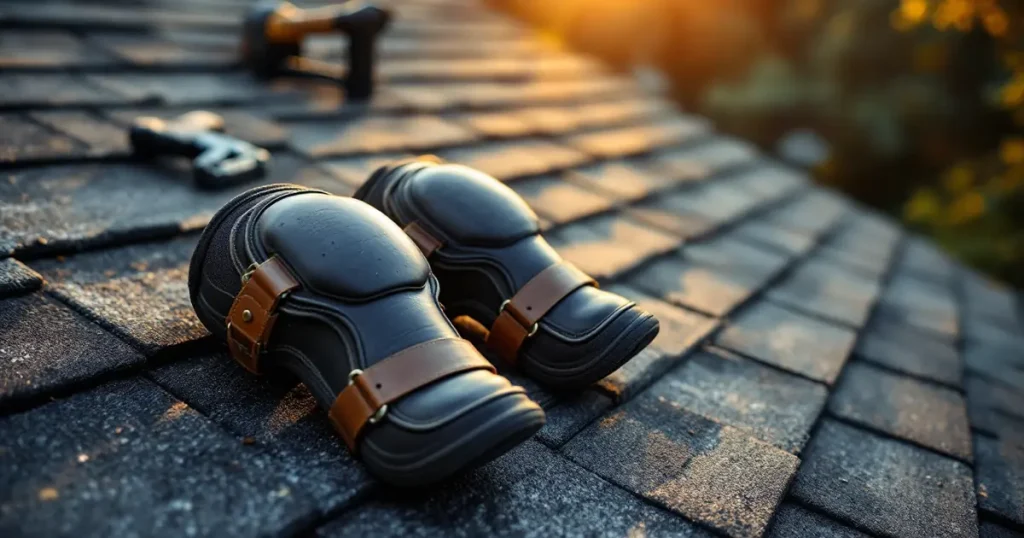
The best roofing knee pads have a wide, flat, slip-resistant cap that will not rock on a 4:12 to 8:12 slope, and on metal, tile, slate or single-ply membrane the cap must also be non-marring rubber or leather rather than hard plastic. In November 2026 maker listings, purpose-built roofer pads run from $39.08 (Sellstrom KneePro S96350, 1.25 lb per pad) to $74.99 (Primegrip Knee Saver 43-114), and NIOSH lab work on shingle installation found knee pads reduced extreme knee rotation during nailing.
Every spec and price below was compiled from maker product pages, retailer listings and published research, dated November 2026. The Roofing Brief did not wear, test or measure any of these pads.
What makes a knee pad a roofing knee pad
A roofing knee pad differs from a flooring or concrete pad in three measurable ways: the cap footprint, the cap material and heat handling. A rounded hard cap acts as a pivot on a 6:12 slope, while a flat cap spreads the load. Sellstrom describes its S96350 roofer pad as “ultra-dense, non-marring rubber” with serrated inner foam channels that “dissipate heat”, built for “kneeling onto heated surfaces”.
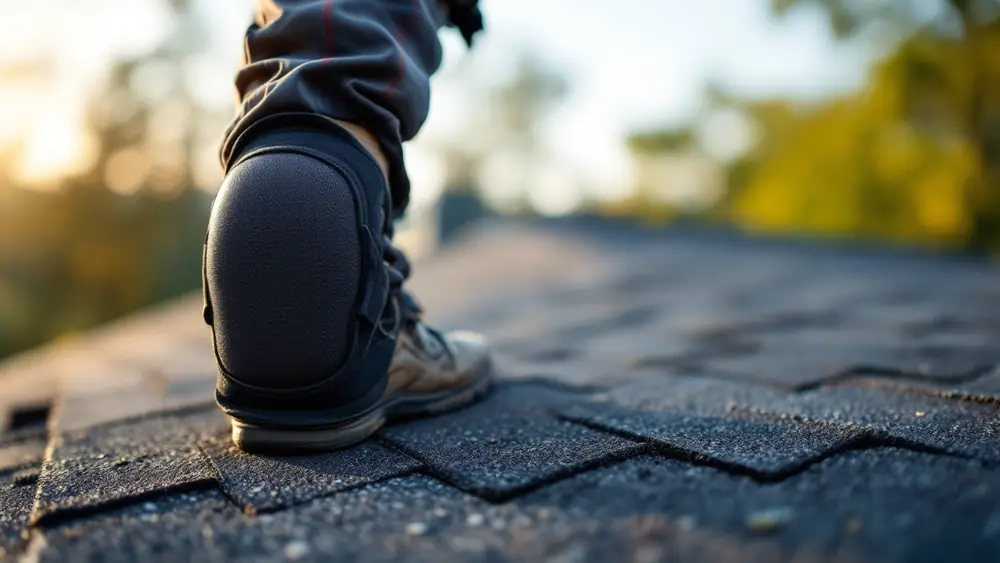
Cap material decides what the pad does to the roof. Hard PVC or TPR shells grip concrete and granules but can scuff painted steel; Klein Tools marketed its 60846 pad as non-marring to “prevent scarring and marking on finished surfaces”, and ToughBuilt sells a pliable Non-Marring SnapShell (TB-KP-G203) for the same reason. On fresh asphalt shingles in summer heat, a soft rubber or leather cap also spreads pressure over more granules than a narrow hard point.
| Cap type | Typical construction | Grip on shingle granules | Risk to finished metal, tile or membrane | Source |
|---|---|---|---|---|
| Solid sponge or dense rubber | Primegrip Roofer’s Knee Pad 43-112: natural sponge rubber with “power mesh”, 3/4 in leather straps | High; maker lists “cement, masonry, asphalt and other roof surfaces” | Low; Sellstrom S96350 rubber is listed as “non-marring” | Primeline 43-112; Sellstrom S96350 listing |
| Leather cap over felt | Primegrip Leather Knee Pads 43-123: top-grain leather, 1/2 in water-repellent felt lining | Medium; leather wears on granules | Low; maker calls it “non-marring” | Primeline 43-123 |
| Pliable non-marring shell | ToughBuilt GelFit Non-Marring TB-KP-G203; NoCry LightGuard+ (EN 14404:2024 Level 1) | Medium | Low by maker claim | ToughBuilt TB-KP-G203; NoCry LightGuard+ |
| Hard shell with rubber overmold | ToughBuilt GelFit Fanatic TB-KP-G3: “double-injected shell with non-slip rubber”, 1680D fabric | High | Higher; plastic shell, not sold as non-marring | ToughBuilt TB-KP-G3 |
| Hard PVC or TPR cap | NoCry KneeGuard (PVC hard cap), KneeGuard Professional (TPR shell) | High on concrete per maker | Higher; maker lists concrete, tile, dirt and decking, not finished metal | NoCry KneeGuard |
Roofing knee pads compared: maker specs and November 2026 prices
Eight pads that makers or retailers describe for roofing or non-marring use are listed below with the published weight, cap and strap details. Prices are as listed November 2026 on the linked page and change often; ToughBuilt’s own site shows no price, so none is given for its models.
| Pad (model) | Cap and padding | Closure | Published weight or size | Listed price, Nov 2026 | Source |
|---|---|---|---|---|---|
| Sellstrom KneePro roofers (S96350) | Ultra-dense non-marring rubber; serrated foam with air channels | Buckle straps placed along the calf curve | 1.25 lb (0.6 kg) per pad | $39.08 (Global Test Supply) | listing |
| Primegrip Roofer’s Knee Pad (43-112) | Natural sponge rubber, “power mesh” reinforced | 3/4 in leather straps, adjustable buckles | 8.25 x 5.25 x 3.00 in; 3.0 lb per pair | $55.99 (Primeline Tools, USD) | maker |
| Primegrip Knee Saver Knee Pads (43-114) | Foam rubber, mesh tread, concave shape | Leather straps with built-in Knee Pit Saver sleeves | 10.50 x 13.50 x 4.00 in; 2.50 lb | $74.99 (Primeline Tools, USD) | maker |
| Primegrip Leather Knee Pads (43-123) | Top-grain leather, 1/2 in felt lining, riveted | Leather straps, steel buckles | 9.00 x 6.00 x 4.00 in; 1.75 lb | $50.99 (Primeline Tools, USD) | maker |
| ToughBuilt GelFit Fanatic (TB-KP-G3) | Gel and foam; double-injected shell with non-slip rubber; thigh support | Elastic, EVA and buckle thigh and calf straps | Not published on maker page | No maker price shown | maker |
| ToughBuilt GelFit Stabilizer (TB-KP-G205) | Gel and foam; wide-footprint SnapShell “prevents scratching and marring” | EVA elastic leg straps | Not published on maker page | No maker price shown | maker |
| NoCry LightGuard+ Flooring Foam | EVA foam, non-marring shell, 600D polyester; EN 14404:2024 Level 1 per maker | Slip buckle | Not published | $26.99 (1 pack, nocry.com) | maker |
| NoCry SupportGuard Pro Soft Cap | Gel and foam; PVC leather soft cap | Straps with silicone lining | Not published | $29.99 (1 pack, nocry.com) | maker |
Klein Tools’ Non-Marring Semi-Hinged Knee Pad (catalog 60846), still named on several roofing lists, is marked “no longer in production” on Klein’s product page as of November 2026. Klein’s spec sheet lists 9.01 oz (255 g) per pad, a 25% TPR and 15% EVA build, and a warning that it contains natural rubber latex.
Weight adds up over a shift. The Primegrip 43-112 weighs 3.0 lb per pair and the Sellstrom S96350 weighs 2.5 lb per pair (1.25 lb x 2), so the sponge-rubber pad carries 0.5 lb more on the legs, about 20% heavier, in exchange for a thicker rubber body. Knee pads also count toward what a roofer carries up a ladder alongside a loaded roofing tool belt. The rest of the kit is priced in the roofing tools and equipment list.
Do roofers wear knee pads? What NIOSH research measured
Yes, and NIOSH has measured why. A 2019 NIOSH and West Virginia University study in Applied Ergonomics had nine participants simulate shingle installation on a slope-adjustable platform and found roof slope and working posture changed knee flexion, abduction and rotation, the angles linked to knee musculoskeletal disorders.
The follow-up, Zerin et al., American Journal of Industrial Medicine, 2025, compared four conditions at 0°, 15° and 30° slopes: no device, knee pads only, knee savers only, and both. Knee pads alone and pads plus savers were the most effective at reducing knee rotation during phase 5, nailing shingles, which the authors call one of the riskiest phases. Knee savers here are calf-mounted wedges placed behind the knee, the device baseball catchers use, and are different from Primeline’s product named “Knee Saver Knee Pads”.
The study’s limits are stated in the full text: nine male participants, a lab platform rather than a real roof, and no test of whether pads or savers change fall risk. An earlier NIOSH paper, Breloff et al., 2019, reached the same cautious conclusion for deep kneeling on slopes and said more testing was needed before a firm recommendation.
The study slopes convert to the pitches roofers quote with rise = 12 x tan(angle). The arithmetic below is a Roofing Brief calculation, not a figure from the paper.
| Slope in study | Rise per 12 in run | Nearest common pitch | Why it matters for knee pads |
|---|---|---|---|
| 0° | 0 in | Flat or low-slope (below 2:12) | Rounded or hard caps stay stable; membrane scuffing is the main concern |
| 15° | 12 x 0.268 = 3.2 in | About 3:12 to 4:12 | Typical low-slope shingle range; cap grip starts to matter |
| 30° | 12 x 0.577 = 6.9 in | About 7:12 | The study found pads helped most “on steeper slopes”; a rocking cap is a balance problem |
| 33.7° (reference) | 8 in | 8:12 | Above the study range; roof brackets and planks become the main footing |
Pitch above 8:12 changes the job more than the pad does. The Roofing Brief’s steep pitch roof guide covers where roof jacks and fall arrest become standard. Bracket spacing and plank sizes are in the roof bracket how-to.
Is there a safety standard for roofing knee pads?
The only dedicated knee-protector standard is European: EN 14404, revised in 2024 into six parts. TÜV Rheinland states that from December 1, 2024, EU type examination is possible only under EN 14404 Parts 1 to 6 of 2024, replacing EN 14404:2004+A1:2010. ANSI/ISEA publishes no comparable knee protector standard, and OSHA’s construction PPE rule names no knee pad test.
EN 14404 splits knee protection into four types and four puncture levels. KAN, the German commission for occupational safety and standardization, describes the types; SATRA lists the performance levels.
| EN 14404:2024 item | What it covers | Requirement | Source |
|---|---|---|---|
| Type 1 (Part 2) | Strap-on knee pads worn independently of clothing | Most roofing knee pads fall here | KAN 4/25 |
| Type 2 (Parts 3 and 4) | Foam inserts worn in trouser knee pockets; Part 4 adds interoperable pads and trousers tested separately | Garment and insert must be certified | KAN 4/25; SATRA |
| Type 3 (Part 5) | Kneeling mats and cushions laid on the surface | Not worn on the body | KAN 4/25 |
| Type 4 (Part 6) | Kneeling systems with an added function, such as a kneeling seat | Worn on the body | KAN 4/25 |
| Level 0 | No penetration protection claimed | Flat, even surfaces only | SATRA |
| Level 1 | Penetration resistance above 100 N | Flat, even surfaces | SATRA |
| Level 1U (new in 2024) | Penetration resistance above 100 N | Uneven surfaces; force distribution under 30 N per TÜV Rheinland | SATRA; TÜV Rheinland |
| Level 2 | Penetration resistance above 250 N | Uneven surfaces | SATRA |
For a roof, Level 1U or Level 2 is the meaningful claim, because a shingle course, a ridge vent or a nail head is an uneven surface. NoCry states EN 14404:2024 Level 1 for LightGuard+, which is rated on flat ground; most US roofer pads in the comparison table publish no EN 14404 level at all.
In the US, OSHA 29 CFR 1926.95(a) requires protective equipment “for eyes, face, head, and extremities” wherever hazards are “capable of causing injury or impairment”, and 1926.95(d)(1) says PPE used to comply with Part 1926 “shall be provided by the employer at no cost to employees”. The rule does not name knee pads, so whether an employer must supply them turns on the employer’s hazard assessment. Harnesses, anchors and other required roof PPE are covered in the roofing safety equipment guide.
Which roofing knee pads fit your roof?
| If the roof or job is | Then choose | Example from maker listings |
|---|---|---|
| Asphalt shingles, 4:12 to 7:12, summer tear-off and install | Wide sponge or dense rubber cap with heat-venting foam | Sellstrom S96350 ($39.08) or Primegrip 43-112 ($55.99) |
| Painted steel standing seam or exposed-fastener panels | Non-marring rubber, leather or pliable shell; no hard plastic | Primegrip 43-123 leather or ToughBuilt TB-KP-G203 |
| Clay or concrete tile, slate | Soft non-marring cap plus kneeling boards; pads do not replace load spreading | Primegrip 43-123 leather |
| TPO, PVC or EPDM single-ply | Non-marring cap with no exposed rivets or grit-loaded tread | ToughBuilt TB-KP-G205 Stabilizer (maker says it prevents marring) |
| Long nailing days with knee pain at the back of the knee | Pads plus calf-mounted knee savers, per the 2025 NIOSH study | Knee pads with a separate knee saver wedge |
| Latex allergy | Avoid natural rubber; check the label | Klein 60846 lists natural rubber latex; Primegrip 43-112 is natural sponge rubber |
| Pitch above 8:12 | Roof brackets and planks first, then pads | 2x planks on roof brackets, per the bracket guide below |
On metal, the shoe matters as much as the knee. The Roofing Brief’s tools for metal roofing list and metal roofing shoes guide cover soft-sole footwear that keeps from scratching painted panels.
How to pick and fit a roofing knee pad before going up
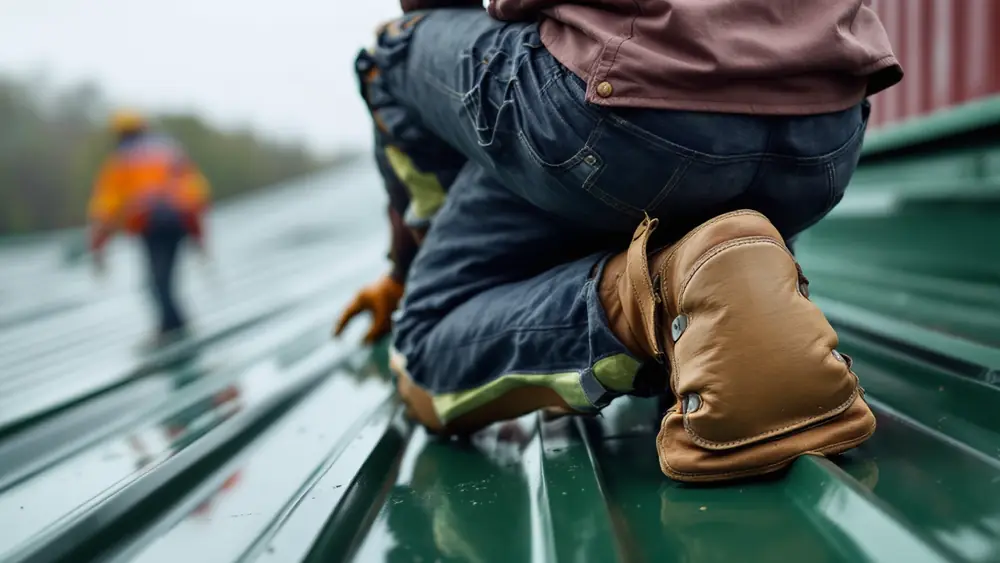
- Match the cap to the roof surface using the decision table: rubber or leather (Primegrip 43-123) for metal, tile and membrane; dense rubber (Sellstrom S96350) or a textured shell for asphalt shingles.
- Check the cap footprint. A flat, wide cap such as ToughBuilt’s Stabilizer SnapShell, which the maker says “eliminates tipping-over”, resists rocking on a 6:12 slope better than a rounded cap.
- Check the weight per pair against the day: 2.5 lb for Sellstrom S96350, 3.0 lb for Primegrip 43-112.
- Set strap position. Sellstrom places straps along the calf curve so they hold “without pinching the knee joint”, and EN 14404:2024 requires that restraint straps must not compromise venous drainage in the leg.
- Read the label for latex and for an EN 14404 type and level; Level 1U or 2 means the pad was tested on an uneven surface.
- Kneel on a scrap of the actual roofing for 2 minutes before the job and look for scuffs or granule loss on the scrap.
- Replace the cap or pad when the tread is worn smooth or the foam no longer springs back; Primeline sells a $7.99 Knee Pad Insert (43-148) and $7.99 replacement strap (43-111) for its roofer pad.
Knee pads vs roofing pants with knee pad pockets
Pocket pads are EN 14404 Type 2, and under the 2024 revision the trouser and insert must be certified together (Part 3) or as interoperable parts (Part 4), per SATRA. Strap-on Type 1 pads such as the Sellstrom S96350 move between pants and need no matching garment. The Roofing Brief’s roofing pants guide compares work pants with knee pad pockets.
A Type 2 pocket insert and a Type 1 strap-on pad can be worn together, which doubles padding at the cost of heat: the Primegrip 43-112 alone adds 3.0 lb of rubber per pair against the shin. Summer heat is the larger risk: using Oak Ridge National Laboratory’s 50 to 70 degree shingle-to-air gap, the Roofing Brief’s roofer heat illness report puts a shingle surface at roughly 145 to 165 degrees F on a 95 degree F day, which is the surface a knee pad cap sits on.
Frequently asked questions
What is the best knee pad for roofing?
For asphalt shingles, a wide rubber roofer pad such as the Sellstrom KneePro S96350 (1.25 lb per pad, $39.08 as listed November 2026) or Primegrip Roofer’s Knee Pad 43-112 ($55.99) matches what makers design for roofing. For painted metal, tile or membrane, pick a non-marring leather or pliable shell, such as Primegrip 43-123 or ToughBuilt TB-KP-G203.
Do roofers wear knee pads?
Yes, and roofing tool makers such as Primeline and Sellstrom sell pads built for roofers. A 2025 NIOSH and West Virginia University study of simulated shingle installation at 0°, 15° and 30° slopes found knee pads, alone or with knee savers, reduced extreme knee rotation during nailing, though the lab study used nine participants and did not test fall risk.
What do roofers use to not slip?
Roofers rely on soft rubber-sole roofing boots, roof brackets with planks on steep pitches, and fall protection. OSHA 29 CFR 1926.501(b)(13) requires guardrails, safety nets or personal fall arrest for residential construction work 6 feet or more above lower levels. A flat rubber knee pad cap also grips better than a rounded hard cap.
What can I use instead of knee pads?
EN 14404 recognizes kneeling mats and cushions as Type 3 knee protectors, so a foam kneeling pad such as the NoCry ComfortGuard Pro ($26.99, 1 pack, November 2026) works on low-slope roofs. On pitched roofs a mat can slide, so roof brackets and planks are the usual alternative.