
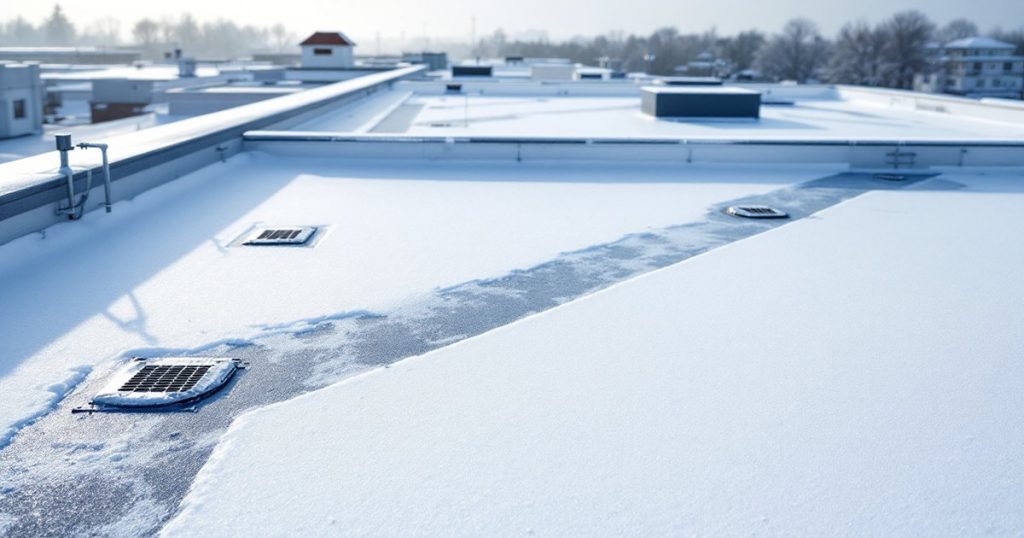
The best flat roof system for cold climates is, in most cases, an EPDM or TPO single-ply membrane (or a two-ply SBS modified bitumen) installed over a warm roof assembly, with the insulation above the deck and tapered to the drains. The membrane choice matters less than most buyers expect, because the ASTM standards for EPDM, TPO and PVC already require each sheet to survive about -40°F. What tends to fail in cold climates is the assembly under the membrane, frozen drainage, and adhesives applied below their rated temperature.
This page is the system-selection guide: which membrane, which assembly, and which winter installation limits the manufacturers themselves publish. For insulation types, R-value per inch and insulation cost, see our flat roof insulation guide.
By The Roofing Brief Team. Last reviewed: October 2026.
Key numbers at a glance
These six figures decide most cold-climate flat roof specifications. Each one comes from a published standard, code table or industry body, and each can shift with the code edition your jurisdiction has adopted or the specific product data sheet. Confirm the current values with your local building department and the membrane manufacturer before a specification is finalized.
| Figure | Value | Source |
|---|---|---|
| EPDM membrane brittleness temperature | -49°F | EPDM Roofing Association (ERA), ASTM D746 test |
| TPO low-temperature impact requirement | No cracking at -40°F | ASTM D6878, as summarized by Carlisle SynTec |
| Maximum allowable cold-flexibility temperature, modified bitumen | 0°F for SBS, 32°F for APP | ASTM product standards, per NRCA’s Mark Graham, Professional Roofing, May 2012 |
| Rigid insulation above the deck for condensation control (hybrid assembly) | R-20 (Zone 5) up to R-35 (Zone 8) | 2021 IRC Table R806.5 |
| Polyiso design R-value for thermal calculations | R-5.0 per inch | NRCA in-service R-value recommendation |
| Minimum design slope for membrane roofs | 1/4 inch per foot (2 percent) | IRC R905.11.1, R905.12.1, R905.13.1 |
Which flat roof membrane is best for a cold climate?
For heating-dominated climates, EPDM is the most common default because the rubber stays pliable well below zero and can be installed and patched in cold weather. TPO and PVC are close behind, since their hot-air welded seams do not depend on adhesive cure. SBS modified bitumen suits roofs that take foot traffic or shoveling. APP modified bitumen is the weakest fit for freeze-thaw regions.
All three single-ply sheets carry a cold-temperature rating in their ASTM standard, so the sheet itself rarely cracks from cold alone. The practical differences show up at the seams, during winter installation, and when a roof has to be repaired in January. The table below sets the membranes side by side on those points.
| Membrane | Cold rating | Seam method | Cold-climate strengths | Cold-climate watch-outs | Source |
|---|---|---|---|---|---|
| EPDM (black rubber) | Brittleness at -49°F | Primer plus seam tape | Stays flexible in extreme cold; patches with tape and primer; dark surface absorbs solar heat | Seams are the weak point; bonding adhesives and primers are temperature limited | ERA; Holcim Elevate Cold Weather Application Guidelines (Nov 2025) |
| TPO | No cracking on impact at -40°F (ASTM D6878) | Hot-air welded | Welded seams do not rely on adhesive cure; widely available in 60 and 80 mil | Sheet stiffens in the cold; Elevate requires test welds at daily startup and whenever conditions change | Carlisle SynTec; Holcim Elevate |
| PVC | Low-temperature bend pass at -40°F (ASTM D4434) | Hot-air welded | Welded seams; resists grease and many chemicals | Usually the costliest single-ply; Elevate’s water-based PVC bonding adhesive needs 50°F held for 48 hours | Sika Sarnafil G 410 data sheet; Holcim Elevate |
| SBS modified bitumen | Cold flexibility of 0°F or lower required by ASTM | Torch, hot asphalt, cold adhesive, or self-adhered | Two or more plies add redundancy; tolerates foot traffic and careful shoveling | In NRCA and MRCA testing only 4 of 13 SBS products met the cold-flex requirement; Elevate limits mod-bit to 40°F and rising | Professional Roofing (May 2012); Holcim Elevate |
| APP modified bitumen | Cold flexibility of 32°F required by ASTM | Torch applied | Good heat endurance | Allowed to be stiff at freezing, so a poor match for freeze-thaw cycling | Professional Roofing (May 2012) |
| Built-up roof (BUR) | No single cold-flex rating; depends on bitumen and felts | Hot-mopped plies | Multi-ply redundancy; gravel surfacing resists foot traffic | Elevate sets a 420°F minimum mopping temperature, which cold air erodes quickly; gravel adds dead load ahead of snow | Holcim Elevate |
Why EPDM is the usual cold-climate default
EPDM is the usual cold-climate default because the EPDM Roofing Association puts its brittleness temperature at -49°F and notes the sheet stays pliable in extreme cold. That flexibility matters on a roof that cycles through freeze and thaw repeatedly over a winter, and it lets a crew unroll, fit and repair the membrane when TPO would be stiff.
The trade-off is the seam. EPDM seams rely on primer and seam tape, and the ERA says adhesives, flashings and tapes should be kept at room temperature, typically in rooftop hot boxes. A cold-applied seam that never reached proper tack can open years later. Manufacturers sell EPDM in thicknesses up to 90 mil, and the extra thickness adds puncture margin for roofs that get shoveled. For a fuller head-to-head, see our EPDM vs TPO comparison.
When TPO or PVC is the better cold-climate choice
TPO or PVC often makes more sense in cold climates when the roof is large, the owner wants welded seams, or summer cooling loads are also high. A hot-air weld fuses the two sheets, so seam strength does not depend on an adhesive curing in cold air. PVC is the usual pick over restaurants and other roofs exposed to grease.
Cold makes thermoplastics stiffer and changes how the welder behaves, which is why Holcim Elevate requires test welds at the start of every day and whenever conditions change. Reflectivity is not a code driver in most cold regions: the 2021 IECC (Section C402.3) applies its low-slope roof solar reflectance requirement only in Climate Zones 0 through 3, so a building in Zones 4 through 8 can choose a white or dark membrane on other merits.
SBS vs APP modified bitumen in freeze-thaw climates
SBS modified bitumen is the cold-climate version of mod-bit; APP generally is not. The ASTM product standards cited by NRCA allow SBS sheets a maximum cold-flexibility temperature of 0°F, while APP sheets are only required to bend at 32°F. In a region that sits below freezing for months, that 32-degree gap is the difference between a sheet that flexes and one that can crack.
The same NRCA and MRCA field sampling, reported by Mark Graham in Professional Roofing in May 2012, found that only 4 of 13 SBS products tested met the cold-flex requirement. For a cold-climate mod-bit roof, ask the manufacturer for the product’s tested low-temperature flexibility value, not just the product category. More on the system itself is in our modified bitumen roof guide.
Warm roof vs cold roof systems: which assembly works in a cold climate?
A warm roof, with all insulation above the structural deck and under the membrane, is generally the safest assembly for a cold climate because the deck stays near indoor temperature and above the dew point. Cold roof systems, with insulation between the joists and a ventilated gap above it, carry the highest condensation risk. A hybrid assembly and an inverted roof are the two other workable options.
| Assembly | Where the insulation sits | Cold-climate verdict | Main cold-weather risk |
|---|---|---|---|
| Warm roof | All of it above the deck, under the membrane | Preferred for new work and full tear-offs | Air leaks at the deck and a missing or poorly lapped vapor retarder |
| Hybrid (cold roof upgraded) | Rigid board above the deck plus air-permeable insulation between the joists | Acceptable retrofit when rigid board meets IRC Table R806.5 | Too little rigid insulation above the deck, so the deck underside runs cold |
| Cold roof (ventilated) | Between the joists, with a vented air gap above | Last resort in heating climates | Condensation on the cold deck; snow and parapets block the cross-ventilation it depends on |
| Inverted (protected membrane) | XPS boards above the membrane, held by ballast or pavers | Strong for terraces and green roofs | Ballast weight consumes structural capacity before any snow lands |
Source note: assembly definitions follow 2021 IRC Sections R806 (ventilation) and R806.5 (unvented assemblies). For venting rules on an existing cold deck, see our flat roof ventilation guide.
Why a cold roof insulation system struggles in heating climates
A cold roof insulation system puts the deck on the outside of the insulation, so in winter the underside of the deck sits near outdoor temperature. Any warm, moist indoor air that leaks past the ceiling can condense there. The design depends on continuous ventilation across the roof, which snow cover and parapet walls often defeat on a flat roof.
The IRC ventilation baseline is 1 square foot of net free vent area per 150 square feet of ceiling, reducible to 1 per 300 under conditions such as balanced upper and lower venting (IRC R806.2). On a low-slope roof boxed in by parapets, achieving that cross-flow is often impractical, which is a large part of why low-slope roofs in cold regions are mostly built warm or hybrid.
How much rigid insulation does a hybrid flat roof need to prevent condensation?
Under the 2021 IRC, a hybrid assembly with air-permeable insulation (batts or blown) directly below the deck needs rigid board directly above the deck at the R-value in Table R806.5 for its climate zone. That ranges from R-15 in Zones 4A and 4B to R-35 in Zone 8. The rigid layer keeps the deck underside warm enough to stay dry.
| IECC climate zone | Example cities | Minimum rigid board R-value above the deck | Source |
|---|---|---|---|
| 4C | Seattle, Portland (OR) | R-10 | 2021 IRC Table R806.5 |
| 4A, 4B | Baltimore, St. Louis | R-15 | 2021 IRC Table R806.5 |
| 5 | Chicago, Boston, Denver | R-20 | 2021 IRC Table R806.5 |
| 6 | Minneapolis, Burlington (VT) | R-25 | 2021 IRC Table R806.5 |
| 7 | Duluth, northern Maine | R-30 | 2021 IRC Table R806.5 |
| 8 | Interior Alaska (Fairbanks) | R-35 | 2021 IRC Table R806.5 |
City examples follow the IECC climate zone map. Two code details matter. Footnote a says these values contribute to, but do not replace, the energy code insulation requirement in Section N1102. Footnote b allows a calculated alternative: enough rigid insulation to keep the monthly average deck-underside temperature above 45°F, assuming 68°F indoors and the average outdoor temperature of the three coldest months. The City of Duluth, Minnesota, all in Zone 7, illustrates the math in its permit handout: R-30 rigid board above the deck plus R-19 below reaches R-49 total.
Polyiso is the most common rigid board, and NRCA recommends designing with an in-service value of R-5.0 per inch, below the roughly R-5.7 label value, because polyiso loses thermal resistance in cold weather. Code compliance is judged on labeled R-value, but in a cold climate many designers carry the NRCA figure for condensation margin: 4 inches of polyiso to deliver about R-20 in service, rather than about 3.5 inches at label value. Board-by-board detail is in our flat roof insulation guide.
Snow, ice and ponding: what a cold-climate flat roof has to survive
A cold-climate flat roof has to drain while partly frozen and carry snow it cannot shed. Water that ponds in fall freezes, expands and stresses seams; drains and scuppers can ice shut; and the snowpack sits on the roof for weeks. Slope, drain layout and structural capacity matter as much as the membrane brand.
Ponding, ice and frozen drains
The IRC requires a design slope of at least 1/4 inch per foot (2 percent) for modified bitumen, thermoset and thermoplastic roofs (Sections R905.11.1, R905.12.1 and R905.13.1). On a dead-flat deck, that slope usually comes from tapered insulation, which also lets the insulation package do double duty in a warm roof.
Interior drains that sit over heated space tend to stay open longer than perimeter scuppers and exterior gutters, which freeze first. Where a parapet would trap water if the primary drains block, the International Plumbing Code (Section 1108) calls for secondary, or emergency overflow, drains or scuppers. In ice-prone regions, heat tracing at drain bowls and scupper throats is a common add-on, though it requires power and periodic checks.
Snow load and the cold roof penalty
Under ASCE 7-16, the flat roof snow load is calculated as pf = 0.7 Ce Ct Is pg, and the thermal factor Ct rises from 1.0 for a heated building to 1.1 for a cold, ventilated roof with more than R-25 between the vented space and the heated space. A well-built cold roof therefore carries about 10 percent more design snow load than a warm one.
That is because heat escaping through a warm roof melts some snow from below, while a cold roof keeps it. Ballast on an inverted or ballasted single-ply roof adds dead load before any snow arrives, so any assembly change on an existing building should be checked against its structural capacity by an engineer. The full method, including drift and rain-on-snow surcharges, is in our roof snow load design guide, and safe clearing methods for membranes are in our guide to flat roof snow removal.
Can you install a flat roof in winter? Manufacturer cold-weather limits
Yes, a flat roof can usually be installed in winter, but only inside the temperature limits each manufacturer publishes for its adhesives, primers and membranes. Holcim Elevate (formerly Firestone Building Products) recommends cold-weather procedures whenever ambient and substrate temperatures fall below 40°F. Self-adhered sheets and induction welding push the floor much lower than bucket adhesives. For repairs rather than new installs, see our guide to winter roof repair.
The figures below come from manufacturer bulletins and data sheets. They are minimum application temperatures, usually “and rising,” and they can change between bulletin revisions, so the current document for the exact product governs, along with any warranty conditions tied to it.
| Product or material | Manufacturer | Minimum application temperature | Source |
|---|---|---|---|
| InvisiWeld induction welding (TPO and PVC) | Holcim Elevate | 0°F; no moisture or condensation on plates or membrane | Elevate Cold Weather Application Guidelines, Nov 2025 |
| RubberGard EPDM SA and ULTRAPLY TPO SA (self-adhered) | Holcim Elevate | 20°F | Elevate Cold Weather Application Guidelines, Nov 2025 |
| EverGuard SA TPO (self-adhered) | GAF | Adhesive retains bonding power down to 20°F | GAF EverGuard SA TPO product page |
| Sarnafil G 410 SA (self-adhered PVC) | Sika | 20°F ambient and substrate | Sika product data sheet |
| Sure-Weld SAT TPO (self-adhered) | Carlisle SynTec | 25°F | Carlisle Sure-Weld SAT product page |
| I.S.O. Twin Pack insulation adhesive | Holcim Elevate | 20°F and rising | Elevate Cold Weather Application Guidelines, Nov 2025 |
| Jet Bond Spray Adhesive (thermoplastic membranes) | Holcim Elevate | 25°F and rising; not in winds of 15 mph or higher | Elevate Cold Weather Application Guidelines, Nov 2025 |
| Jet Bond PVC Spray Adhesive (Elevate PVC and Elevate MAX PVC only) | Holcim Elevate | 35°F and rising; not compatible with Elevate PVC KEE or Elevate XR | Elevate Cold Weather Application Guidelines, Nov 2025 |
| EPDM Solvent-Free Bonding Adhesive | Holcim Elevate | 40°F and rising; not if freezing is expected within 12 hours | Elevate Cold Weather Application Guidelines, Nov 2025 |
| SBS, APP modified bitumen and BUR materials | Holcim Elevate | 40°F and rising; use within 4 hours of leaving heated storage | Elevate Cold Weather Application Guidelines, Nov 2025 |
| PVC water-based bonding adhesive | Holcim Elevate | 50°F and rising, held for 48 hours | Elevate Cold Weather Application Guidelines, Nov 2025 |
| Flexible FAST two-part urethane adhesive | Carlisle SynTec | Best performance at 70°F material temperature or rising | Carlisle TecTopics, Feb 2020 |
The pattern is consistent: self-adhered membranes and induction-welded attachment are the cold-weather options, water-based and solvent-free adhesives are warm-weather options, and two-part urethane adhesives depend on keeping the material itself warm, which Carlisle addresses with hot boxes and heated blankets.
Winter installation checklist
A winter flat roof installation that follows the manufacturer’s cold-weather bulletin step by step is far less likely to produce open seams or poorly bonded sheets in spring. The sequence below is drawn from Holcim Elevate’s November 2025 Cold Weather Application Guidelines, and most other manufacturers publish similar rules for their own products.
- Store liquids warm. Keep adhesives, primers and sealants at 60°F to 80°F until use, and bring them to the roof 1 to 4 hours before application.
- Rotate from hot boxes. Swap containers between a hot box or warm storage area and the roof as they cool during the day.
- Prepare a dry substrate. Surfaces must be clean, dry and free of frost before any adhesive or membrane goes down.
- Relax the sheet. Unroll membranes and let them relax 30 to 60 minutes; Elevate highly recommends no-fold panels in cold weather.
- Test-weld thermoplastics. Run test welds on TPO and PVC at daily startup and whenever temperature, wind or sun conditions change.
- Watch for blushing. Evaporating solvent can chill an adhesive surface to the dew point; midday application in sunlight reduces the risk.
- Respect the wind limit. Do not apply spray adhesives when wind speeds reach 15 mph or higher.
- Do not overheat asphalt. Hot asphalt needs at least 420°F at mopping, and the bulletin says not to overheat it to compensate for cold weather.
How to choose a flat roof system for a cold climate
Choosing a flat roof system for a cold climate works best in a fixed order: confirm the climate zone and snow load, settle the assembly, then pick the membrane and attachment method that suit the season you will build in. Deciding the membrane first, as most quotes do, tends to skip the steps that cause cold-weather failures.
- Confirm the climate zone and ground snow load. Get the IECC climate zone and the design ground snow load from your local building department, since adopted code editions vary.
- Choose the assembly before the membrane. Default to a warm roof. If joist-cavity insulation must stay, size rigid board above the deck to IRC Table R806.5 for your zone.
- Design the drainage. Provide at least 1/4 inch per foot of slope, tapered to drains, plus secondary overflow drains or scuppers where parapets would trap water.
- Pick the membrane by use. EPDM for flexibility and simple repairs, TPO or PVC for welded seams, PVC for grease exposure, SBS mod-bit for foot traffic and redundancy. Avoid APP in freeze-thaw regions.
- Match the attachment to the install season. For work below 40°F, favor self-adhered sheets rated to 20°F to 25°F, mechanical attachment or induction welding over bucket adhesives.
- Get the cold-weather terms in writing. Ask the contractor which manufacturer bulletin applies and whether the warranty has conditions tied to installation temperature.
Which flat roof system should you pick?
The right cold-climate flat roof depends on the building, the use of the roof and when the work will happen. The decision table below maps common situations to a starting recommendation. Treat each row as a starting point for a conversation with a contractor and, where structure or condensation is in question, a design professional.
| Your situation | Starting recommendation | Why |
|---|---|---|
| Home addition, porch or garage roof in Zones 5 to 7 | Fully adhered or self-adhered EPDM over polyiso above the deck (warm roof) | Flexible in deep cold, simple tape repairs, keeps the wood deck warm |
| Existing flat roof with batts between the joists | Hybrid: add rigid board above the deck to IRC Table R806.5, then re-roof | Fixes the cold deck without gutting the ceiling |
| Large commercial roof, reflectance not required | TPO or EPDM, chosen on seam type and contractor experience | 2021 IECC cool roof rules apply only in Zones 0 to 3 |
| Roof over a restaurant or grease exhaust | PVC | Grease resistance; welded seams |
| Roof that is shoveled or carries equipment traffic | Two-ply SBS modified bitumen, or a thicker single-ply with walkway pads | Extra plies or thickness add puncture margin |
| Rooftop terrace or green roof | Inverted (protected membrane) roof with XPS above the membrane | Membrane is shielded from freeze-thaw and foot traffic; check structural capacity first |
| Replacement that must happen in midwinter | Self-adhered membrane rated to 20°F to 25°F, or induction-welded TPO or PVC | Avoids adhesives that need 40°F or more |
| Building near its structural snow-load limit | Lightweight adhered single-ply; avoid adding ballast | Ballast consumes capacity before snow arrives |
Frequently asked questions
What is the best flat roof material for cold climates?
EPDM is the most common choice for cold climates because the EPDM Roofing Association rates its brittleness temperature at -49°F and it stays pliable for winter repairs. TPO and PVC also meet -40°F requirements under their ASTM standards and offer welded seams. SBS modified bitumen suits roofs with foot traffic. In every case, a warm roof assembly and good drainage matter as much as the membrane.
Is EPDM or TPO better for snow and ice?
Both can perform well under snow. EPDM stays more flexible in deep cold and is easier to patch in winter, while TPO’s hot-air welded seams do not rely on adhesive cure. TPO stiffens in cold weather, so manufacturers such as Holcim Elevate require test welds at startup and when conditions change. Seam quality, slope and drain design usually decide snow performance more than the membrane type.
What is a cold roof system?
A cold roof system is a flat roof assembly with the insulation between the joists, below the deck, and a ventilated air gap above it, so the deck stays at roughly outdoor temperature. In heating climates it carries a high condensation risk, and parapets or snow can block the ventilation it depends on. Most cold-climate low-slope roofs are now built as warm roofs or hybrid assemblies instead.
Can a flat roof be installed in winter?
Yes, within manufacturer limits. Holcim Elevate recommends cold-weather procedures below 40°F, and many bucket adhesives are rated only to 40°F and rising. Self-adhered membranes from Elevate, GAF and Sika are rated to about 20°F, Carlisle’s Sure-Weld SAT TPO to 25°F, and Elevate’s InvisiWeld induction welding to 0°F. Substrates must be free of frost, and warranty terms may depend on following the bulletin.
Should a flat roof in a cold climate be black or white?
In most cold regions it is the owner’s choice. The 2021 IECC applies its low-slope roof reflectance requirement only in Climate Zones 0 through 3, so buildings in Zones 4 through 8 are generally not required to use a white roof. A dark membrane absorbs winter sun, while a white one reduces summer cooling load. Local codes and utility programs can add requirements, so check before choosing.
How much insulation does a cold-climate flat roof need to avoid condensation?
For a hybrid assembly with batts below the deck, the 2021 IRC Table R806.5 requires rigid board above the deck of R-20 in Zone 5, R-25 in Zone 6, R-30 in Zone 7 and R-35 in Zone 8. A warm roof with all insulation above the deck avoids the cold-deck problem altogether. Energy code totals are a separate, usually higher, requirement.