
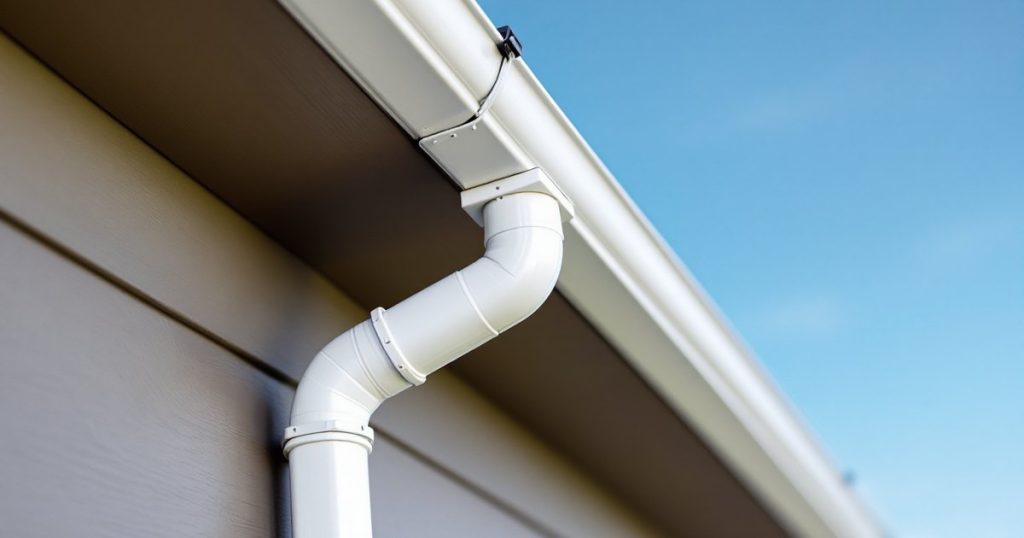
Gutter wedges are angled spacers that sit between a gutter and a sloped (angled) fascia board so the gutter hangs plumb instead of tipping forward. When rafter tails are cut square to the rafter rather than plumb, the fascia leans out at the same angle as the roof pitch, and a gutter screwed flat against it rotates outward. A wedge cut to that angle restores a vertical mounting face at each hanger. This guide shows how to measure the angle, size the wedge, install it, and when an adjustable hanger, strap hanger, or plumb strip is the better fix.
By The Roofing Brief Team · Last reviewed: October 2026
Gutter wedges: key numbers at a glance
The figures below are the ones that decide a gutter wedge purchase: how much a fascia tilts at common roof pitches, how far the gutter’s front lip drops without correction, how often wedges go in, and what they cost at retail. Geometry rows are The Roofing Brief’s own calculations; product rows cite the seller’s posted listing as of October 2026.
| Figure | Value | Source |
|---|---|---|
| Fascia tilt on a square-cut 4/12 eave | About 18.4 degrees from plumb | The Roofing Brief calculation (arctan of 4/12) |
| Front-lip drop, 5-inch K-style gutter on that 4/12 fascia with no wedge | About 1.6 inches below the back edge | The Roofing Brief calculation (5 in. x sin 18.4 degrees) |
| Wedge taper needed | Equals the roof pitch ratio: 4/12 pitch means about 1/3 inch of thickness per inch of wedge height | The Roofing Brief calculation (tan of the pitch angle = rise/run) |
| Wedge spacing | One wedge at every hanger, about 24 inches on center (tighter in snow regions) | GutterAll 5 in. and 6 in. wedge install notes |
| Retail price, fixed aluminum or adjustable steel wedge | $9.99 each (posted list price) | GutterAll product listings, October 2026 |
What is a gutter wedge?
A gutter wedge is a tapered block, bar, or clip, usually aluminum, galvanized steel, or copper, that fills the angled gap between the back of a gutter and a fascia that is not vertical. Installers also call it a fascia wedge, fascia angle adapter, or gutter spacer. One wedge goes at each hanger, and the hanger screw passes through the gutter back, then the wedge, then into the fascia and ideally the rafter tail.
The term covers two different parts, and buyers mix them up. The first is the angled-fascia wedge for K-style gutters, built to a fixed angle (for example, GutterAll sells a 5-inch version listed at 20 degrees for 3/12 to 4/12 pitch and a 6-inch version listed at 25 degrees for 5-1/2/12 pitch) or as an adjustable bracket. The second is the half-round wedge, a spacer that bridges a round-bottomed gutter to a flat fascia so the gutter does not tip under water or ice load, such as the 16 oz solid copper wedge GutterAll sells for half-round systems.
The problem is old enough to have its own patent trail. U.S. Patent 5,067,675, granted in November 1991 to Anthony W. Brant for a “fascia angle adapter for an eavestrough system,” describes fascia boards as often perpendicular to the sloped roof and proposes a cam-adjusted adapter covering 3/12 through 6/12 pitch.
Why an angled fascia tips a gutter forward
An angled fascia tips a gutter forward because the gutter’s back is designed to hang against a vertical surface. When rafter tails are cut square to the rafter, the fascia face leans out at the top by exactly the roof pitch angle. Pull a K-style gutter’s back flat against that face and the whole profile rotates the same amount, dropping the front lip below the back edge and shrinking usable capacity.
The table below models that drop for a rigid gutter rotating about its back top edge. On a 5-inch K-style gutter, the front lip falls about 1.6 inches at 4/12 and about 2.2 inches at 6/12. Because a 5-inch K-style trough is only a few inches deep, a front lip that low can let water spill over the front well before the trough is full, which is the overflow and fascia-soaking pattern described in our guide to why water goes behind or over a gutter.
| Roof pitch (fascia cut square to rafter) | Fascia tilt from plumb | Front-lip drop, 5 in. K-style | Front-lip drop, 6 in. K-style | Source |
|---|---|---|---|---|
| 2/12 | 9.5 degrees | 0.8 in. | 1.0 in. | The Roofing Brief calculation |
| 3/12 | 14.0 degrees | 1.2 in. | 1.5 in. | The Roofing Brief calculation |
| 4/12 | 18.4 degrees | 1.6 in. | 1.9 in. | The Roofing Brief calculation |
| 5/12 | 22.6 degrees | 1.9 in. | 2.3 in. | The Roofing Brief calculation |
| 6/12 | 26.6 degrees | 2.2 in. | 2.7 in. | The Roofing Brief calculation |
| 8/12 | 33.7 degrees | 2.8 in. | 3.3 in. | The Roofing Brief calculation |
Method: tilt = arctan(rise/12); front-lip drop = nominal gutter width x sin(tilt). This is a simplified rigid-profile model; real gutters flex, and actual drop depends on how the hanger seats. Use it to judge severity, not as a structural rating.
Not every leaning fascia comes from a square-cut rafter. A fascia that is out of plumb on an otherwise plumb-cut eave usually points to sagging rafter tails, a rotted sub-fascia, or a board pried loose by a heavy gutter. A wedge hides that kind of tilt without fixing it, so probe the wood first, as covered in our guide to how fascia boards and gutters connect and fail.
Do you need gutter wedges? How to measure the fascia angle
You need gutter wedges, or another angle correction, when the fascia leans more than a few degrees from plumb, which on a square-cut eave happens at nearly every pitch above about 2/12. Measure the fascia itself rather than assuming from the roof pitch, because rafter tails may be cut plumb, square, or somewhere between. A torpedo level and a tape measure are enough.
- Pick a sound spot. Choose a section of fascia away from corners, with no soft wood or bowing, so the reading reflects the framing rather than damage.
- Hold a level plumb against the fascia. Set a 9- or 24-inch level vertically so its top edge touches the top of the fascia and the bubble reads plumb.
- Measure the gap at the bottom. Measure the horizontal gap between the level and the fascia face at a known distance down, for example 6 inches below the contact point.
- Convert the gap to pitch. Equivalent pitch = 12 x gap / height. A 2-inch gap over 6 inches equals 4/12, about 18.4 degrees. A digital angle gauge read against plumb gives the angle directly.
- Repeat at two or three more points. Readings that differ by more than a degree or two along one run suggest movement or damage, not just rafter-cut angle, and point to repair before wedging.
Which gutter wedge angle matches your roof pitch?
The right gutter wedge angle equals the fascia’s tilt from plumb, which on a square-cut eave equals the roof pitch angle. A 4/12 roof needs about 18 degrees of correction, a 6/12 roof about 27 degrees. Because the wedge taper equals the pitch ratio, a 3-inch-tall wedge on a 4/12 fascia is about 1 inch thick at the thick end and tapers to nothing.
| Roof pitch | Correction angle needed | Wedge taper (in. per in. of height) | Thick end of a 3 in. tall wedge | Closest listed fixed wedge | Source |
|---|---|---|---|---|---|
| 3/12 | 14.0 degrees | 0.25 | 0.75 in. | GutterAll 5 in. wedge, listed 20 degrees for 3/12 to 4/12 (over-corrects about 6 degrees) | Calculation; GutterAll listing |
| 4/12 | 18.4 degrees | 0.33 | 1.0 in. | GutterAll 5 in. wedge, listed 20 degrees (within about 1.6 degrees) | Calculation; GutterAll listing |
| 5/12 | 22.6 degrees | 0.42 | 1.25 in. | Between fixed sizes; adjustable bracket or custom wedge | Calculation |
| 5-1/2/12 | 24.6 degrees | 0.46 | 1.4 in. | GutterAll 6 in. wedge, listed 25 degrees for 5-1/2 pitch | Calculation; GutterAll listing |
| 6/12 to 9/12 | 26.6 to 36.9 degrees | 0.50 to 0.75 | 1.5 to 2.25 in. | Adjustable T-Wedge (5 in. model flat to 49 degrees; 6 in. model flat to 59 degrees) | Calculation; GutterAll T-Wedge listings |
A wedge that is steeper than the fascia over-corrects and tilts the gutter back toward the house. On a 3/12 fascia, a 20-degree wedge leaves about 6 degrees of back-tilt, which raises the front lip roughly half an inch above level on a 5-inch gutter. That sends any overflow behind the gutter toward the fascia, the opposite of what you want. Under-correcting by a degree or two is the safer error; a front lip slightly below the back edge spills outward.
Gutter wedge types and materials compared
Gutter wedges come as fixed-angle aluminum clips, adjustable galvanized steel brackets, heavy bar-stock wedges in copper or aluminum, and field-made beveled strips in wood or PVC. Fixed wedges are cheapest per piece but only fit a narrow pitch band. Adjustable brackets cover almost any pitch with one part. Match the wedge metal to the gutter metal to avoid galvanic corrosion.
| Wedge type | Material | Angle range | Fits | Trade-off | Source |
|---|---|---|---|---|---|
| Fixed-angle clip wedge | Aluminum (6 in. size also in galvanized steel; brown, white, or galvanized finishes) | One angle per part, e.g. 20 or 25 degrees | 5 in. or 6 in. K-style; snaps to gutter back at each hanger | Cheap and fast, but over- or under-corrects off its pitch band | GutterAll 5 in. and 6 in. wedge listings |
| Adjustable T-Wedge bracket | Galvanized (zinc-coated) steel, about 1 lb each | Flat to 49 degrees (5 in.); flat to 59 degrees (6 in.) | 5K and 6K K-style; also valley and A-frame eaves | One part covers every pitch; heavier and more visible from below | GutterAll T-Wedge listings |
| Heavy bar-stock wedge | 3/16 in. bar stock, copper or powder-coated aluminum, stainless bolt and lock nut | Made to the roof pitch; not offered for 1/12 or 2/12 | K-style, box, and half-round; about 4-1/4 in. of vertical pitch adjustment in 1/8 in. steps with the maker’s #15 hanger | Strongest, made to order; hangers sold separately | K&M Sheet Metal Universal Gutter Wedge spec sheet |
| Half-round wedge | Solid copper, 16 oz per wedge (also aluminum) | Fills curve-to-flat gap rather than fascia angle | Half-round gutters with hidden hangers, one per hanger | Solves tipping, not fascia tilt; use adjustable shank brackets for that | GutterAll half-round wedge listing |
| Continuous plumb strip (wood) | Beveled board ripped to the fascia angle | Any, cut on site | Any gutter profile; gives a full-length vertical face | Must be primed and painted on all sides; adds screw length; can trap water if top edge is not sealed | Field practice; geometry per this guide |
| Vinyl or PVC plumb strip | Vinyl (e.g. Amerimax Universal Fascia Fixer, T0539 white, T1539 brown) or ripped cellular PVC trim | Any | Amerimax’s part is sold to give a vertical surface for its vinyl gutter hook system | Will not rot; PVC holds screws less well than wood, so fasteners must reach framing | Amerimax listings at Home Depot |
Material pairing follows the same rule as hangers: aluminum wedges with aluminum gutters, copper with copper, and galvanized steel kept off copper. The fastener matters as much as the wedge, because the screw now has to cross the wedge’s thickness before it reaches wood; our guide to gutter screw types and lengths covers sizing.
How to install gutter wedges step by step
Installing gutter wedges adds three tasks to a normal gutter hang: measuring the fascia angle, seating a wedge at every hanger, and lengthening each screw by the wedge thickness. The slope line, hanger spacing, and downspout layout stay the same as any K-style install. Plan wedge positions to land on rafter tails wherever possible.
- Confirm the fascia is sound. Press a screwdriver into the bottom edge every few feet. Replace soft sections before hanging anything, because a wedge concentrates load on each screw.
- Measure the angle at several points. Use the level-and-gap method above and choose a fixed wedge within a degree or two, or set adjustable brackets to the reading.
- Snap the slope line. Chalk the back-edge line at about 1/4 inch of fall per 10 feet toward each downspout, the same pitch used in our rain gutter installation guide.
- Mark hanger and wedge positions. Locate rafter tails, then lay out one hanger about every 24 inches, tightening toward 16 to 18 inches in heavy-snow regions. See how many gutter hangers you need per 10 feet for the count.
- Seat the wedges. Clip-style wedges snap onto the back of the gutter at each hanger location before lifting, per GutterAll’s instructions. Bolt-on or bracket wedges fasten to the fascia first, along the chalk line.
- Hang the gutter and drive the screws. Lift the run, engage each hidden hanger, and drive its screw through the gutter back and wedge into the fascia. Add the wedge thickness to your usual screw length so the threads still bite solid wood or the rafter tail.
- Check plumb and lip height. Hold a torpedo level against the gutter face at several hangers. The face should read plumb, and the front lip should sit level with or slightly below the back edge.
- Water-test the run. Run a hose at the high end and watch for ponding, overflow at the front, or drips behind the gutter before calling the job done.
How many gutter wedges you need and what they cost
You need one gutter wedge per hanger, so the count is the run length in inches divided by hanger spacing, plus one for the end. A 100-foot run at 24-inch spacing takes about 51 wedges; at 16-inch spacing it takes about 76. At GutterAll’s posted $9.99 per wedge, that is roughly $510 to $760 in wedges alone before gutters, hangers, or labor.
| Gutter run | Wedges at 24 in. spacing | Cost at $9.99 each | Wedges at 16 in. spacing | Cost at $9.99 each | Source |
|---|---|---|---|---|---|
| 40 ft (one side of a small ranch) | 21 | About $210 | 31 | About $310 | Count: The Roofing Brief calculation; price: GutterAll listing |
| 100 ft | 51 | About $509 | 76 | About $759 | Count: The Roofing Brief calculation; price: GutterAll listing |
| 150 ft (typical full single-story perimeter) | 76 | About $759 | 114 | About $1,139 | Count: The Roofing Brief calculation; price: GutterAll listing |
Prices are a single seller’s posted retail list price in October 2026 and may differ by finish, quantity, and supplier; GutterAll’s 6-inch wedge carries a 5-piece minimum. Contractors buying through a gutter supply house often pay less per piece, and a continuous plumb strip may cost less in material but more in labor and painting.
Alternatives to gutter wedges
The main alternatives to gutter wedges are adjustable-angle hangers, roof-mounted strap hangers, a continuous plumb strip that makes the whole fascia vertical, and, on some one-piece gutter jobs, bending the gutter’s back to match the fascia. Each solves the same tilt problem at a different point in the assembly, and the best choice depends on whether the roof is coming off and how steep the pitch is.
Adjustable-angle hangers and brackets
Adjustable brackets such as the T-Wedge set a hinged or slotted angle at each support, so one part covers flat through 49 or 59 degrees depending on size. For half-round gutters, adjustable-pitch brackets with an extended shank do the same job; our guide to half-round gutter installation covers that setup.
Roof straps and strap hangers
Strap hangers run up over the drip edge and fasten to the roof deck under the first shingle course, so the fascia angle stops mattering. The trade-off is that they are installed before or during roofing and put fasteners through the roof plane. Our comparison of the four gutter bracket types covers strap load and spacing.
Continuous plumb strip
A beveled wood or PVC strip ripped to the fascia angle and fastened along the whole run gives every hanger a vertical face and lets the gutter back sit flat for its full length. It suits long, uniform runs and re-sides, but it adds a layer that must be sealed at the top edge and fastened into framing, not just the fascia board.
Bent-back gutter flange
Some one-piece gutter installers skip wedges by bending the gutter’s back to match the fascia angle and using longer screws and heavier hangers. The practice is debated: supporters cite no gap for wasps to nest in and easier fascia painting; skeptics question long-term hold. Ask any contractor proposing it what hanger and screw they use and what workmanship warranty applies.
Which one should you pick?
Pick a fixed gutter wedge when the fascia angle is uniform and lands within a couple of degrees of a stock size, an adjustable bracket when the pitch falls between sizes or varies, and a strap hanger when a reroof is already underway. Fix the framing first whenever the tilt comes from rot or sag rather than rafter cut.
| Your situation | Recommended fix | Why |
|---|---|---|
| Square-cut eave at about 4/12 or 5-1/2/12, sound fascia, K-style gutter | Fixed-angle aluminum wedge at each hanger | Stock angle matches within a couple of degrees; lowest cost per support |
| Pitch between stock sizes (e.g. 3/12, 5/12) or steeper than 6/12 | Adjustable galvanized T-Wedge style bracket | Avoids over-correction; one part covers flat to 49 or 59 degrees |
| Copper or heavy-gauge gutters, snow country | Heavy bar-stock wedge in matching metal | 3/16 in. bar and bolted hanger carry more load; no galvanic mismatch with copper |
| Roof being replaced now | Strap hangers fastened to the deck | Fascia angle becomes irrelevant; load goes to the deck |
| Long uniform runs, fascia being re-clad anyway | Continuous beveled plumb strip | Full-length vertical face; gutter back bears along its length |
| Fascia tilt varies along the run or the wood is soft | Repair fascia and rafter tails first, then re-measure | Wedges hide structural movement instead of fixing it |
| Half-round gutter on vertical fascia | Half-round wedge at each hidden hanger | Stops the round profile from tipping under water and ice load |
For more on the board every one of these options screws into, including materials, rot signs, and replacement cost, see our fascia board guide.
Gutter wedges: frequently asked questions
What is a gutter wedge used for?
A gutter wedge is used to hang a gutter plumb on a fascia board that leans out of vertical, usually because the rafter tails were cut square to the rafter. The wedge fills the angled gap at each hanger, so the gutter’s front lip stays level with or just below the back edge instead of tipping forward and spilling water before the trough is full.
How do I know what angle gutter wedge I need?
Measure the fascia, not the roof. Hold a level plumb against the top of the fascia, measure the gap at a known distance down, and convert: equivalent pitch equals 12 times the gap divided by the height. A 2-inch gap over 6 inches is 4/12, about 18.4 degrees. Choose a wedge within a degree or two, or an adjustable bracket.
How many gutter wedges do I need?
Plan one gutter wedge per hanger. Divide the run length in inches by the hanger spacing and add one: a 40-foot run at 24-inch spacing needs about 21 wedges, and a 100-foot run needs about 51. In heavy-snow regions, where hanger spacing often tightens to about 16 inches, a 100-foot run needs about 76 wedges.
Can I make my own gutter wedges out of wood?
You can cut wedges or a continuous beveled strip from wood, ripped on a table saw to the fascia angle. Prime and paint every face, seal the top edge so water cannot sit behind it, and use screws long enough to pass the wood and bite the rafter tail or sub-fascia. Metal wedges avoid the rot risk and match gutter finishes.
Do half-round gutters need wedges?
Half-round gutters often use a wedge even on a vertical fascia, because the round bottom touches a flat board along a single line and can tip under load. A half-round wedge, such as a 16 oz copper wedge, bridges that gap at each hidden hanger. On an angled fascia, adjustable-pitch half-round brackets with an extended shank are the usual fix.
What happens if gutters are hung on angled fascia without wedges?
Without correction, the gutter rotates with the fascia and its front lip drops below the back edge. On a 5-inch K-style gutter at 4/12 pitch, that drop is about 1.6 inches, enough to spill water over the front in heavy rain well before the trough fills. The overflow can soak the fascia, siding, and foundation the gutter is meant to protect.