
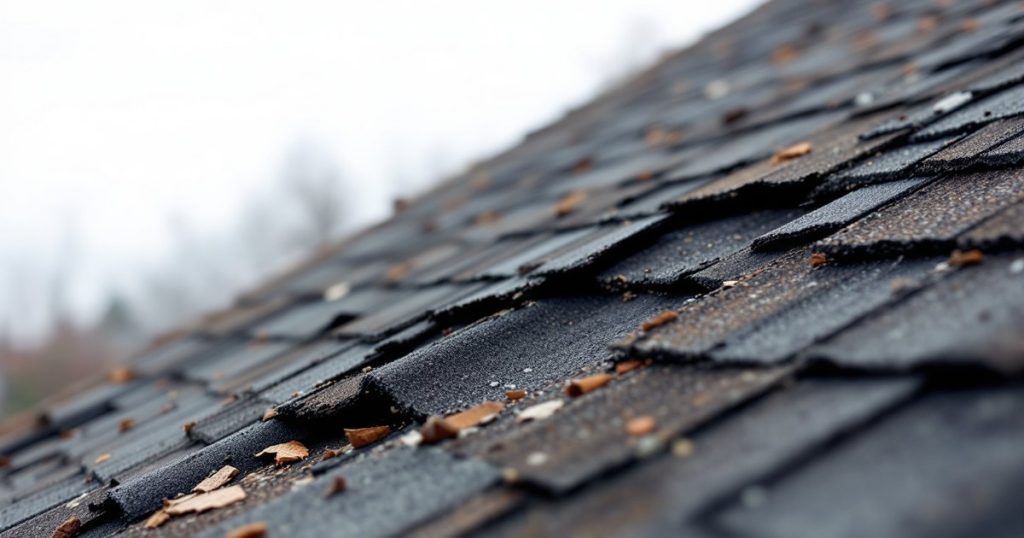
A roof missing shingles is usually an urgent repair rather than an emergency, as long as the underlayment under the gap is intact and no water is reaching the attic. Cover the opening before the next rain, photograph everything, and get the shingles replaced: HomeGuide prices 3 to 25 replacement shingles at $100 to $300, with a typical $150 to $300 minimum service call. Bare wood decking or a ceiling stain makes it a same-day job.
By The Roofing Brief Team. Last reviewed: October 2026.
This guide is the triage: how fast to act, what to cover, whether a claim makes sense, what the fix costs, and when a patch stops being worth it. The hands-on swap of a single shingle is covered step by step in our shingle replacement guide.
Key numbers at a glance
| Question | Figure | Source |
|---|---|---|
| Cost to replace 3 to 25 missing shingles | $100 to $300 | HomeGuide roof shingle repair cost guide (2026 edition) |
| Typical roofer minimum service call | $150 to $300 | HomeGuide |
| Professional roof tarp, standard job | $175 to $700, average near $450 | HomeGuide roof tarp cost guide |
| UV rating of common synthetic underlayments | 90 days (GAF FeltBuster) to 180 days (GAF Tiger Paw, CertainTeed RoofRunner Air); not a temporary roof | GAF and CertainTeed product pages |
| Top shingle wind classes | ASTM D3161 Class F: 110 mph fan test; ASTM D7158 Class H: up to 194 mph design wind speed | NRCA Professional Roofing (2018); ARMA |
| Manufacturer wind coverage period | 15 years from installation on Owens Corning Duration, GAF WindProven and CertainTeed Landmark | Owens Corning warranty (Jan. 2026), GAF and CertainTeed product pages |
How urgent is a roof missing shingles?
Urgency depends on what is showing through the gap, not on how many shingles are gone. Intact synthetic underlayment buys you days, torn felt buys you a day or two, and bare wood decking or any water inside means cover it today. Missing shingles at an eave, rake or ridge rank higher than a gap mid-slope because wind design standards assign the highest uplift pressures to roof edges and corners.
| What you see | What it means | Act within | First move |
|---|---|---|---|
| Gray, white or printed synthetic sheet in the gap, dry attic | The secondary water barrier is intact but was never designed as a finished roof | A few days, before the next rain | Book the repair; tarp if rain is forecast |
| Black felt paper, wrinkled or torn | Older underlayment with no published exposure allowance on most roofs | 24 to 48 hours | Tarp, then repair |
| Bare OSB or plywood decking | No water barrier at all over that spot | Same day | Tarp now |
| Ceiling stain, drip or wet attic insulation | Water is already inside the house | Now | Tarp, move belongings, call your insurer |
| Missing ridge cap or shingles along an eave or rake | Edges take the highest uplift, and the next row tends to peel from there | 48 hours | Repair edges first |
| Tabs lifted or creased but still attached | Seal broken; the next gust may take them | 1 to 2 weeks | Hand-seal or replace |
When water is already inside, the first call is not always a roofer. Our guide on who to call for a roof leak covers when to ring the insurer, a water-mitigation company or a plumber first.
How long can a roof go with missing shingles?
No manufacturer publishes a safe number of days for a roof with a shingle gap. Synthetic underlayments carry UV ratings of 90 to 180 days, but GAF states those ratings are “NOT related to withstanding water, snow, or wind.” Treat a missing-shingle gap as a repair to finish within days to a couple of weeks, and cover it before any rain.
| Underlayment | Published UV exposure rating | Maker’s caveat | Source |
|---|---|---|---|
| GAF FeltBuster | Up to 90 days | UV rating is “NOT related to withstanding water, snow, or wind” | GAF FeltBuster product page |
| GAF Tiger Paw | Up to 180 days | “water resistant, it is NOT WATERPROOF. DO NOT USE Tiger Paw Roof Deck Protection as a temporary roof” | GAF Tiger Paw product page |
| CertainTeed RoofRunner Air | 180 days | Product page lists “180 Days UV Exposure”; makes no temporary-roof claim | CertainTeed product page |
| Asphalt-saturated felt (#15 or #30) | No exposure rating on most rolls | Assume it needs cover before the next rain | Roofing Brief guidance |
Those ratings describe new, properly fastened sheets. Underlayment under a blown-off shingle may have old nail holes or tears from the same gust, and you often cannot identify the product from the ground, so plan around the shortest window.
What happens to a roof without shingles?
A roof without shingles over a section loses its weathering layer, so rain hits the underlayment directly and runs toward every open nail hole. Once water reaches the deck, OSB can swell and plywood can delaminate, and damp attic insulation loses much of its value. The shingles next to the gap are also at risk, because the course above has lost the shingle it was sealed to.
What should you do in the first 48 hours?
Document first, then protect, then fix. Your homeowners policy requires you to protect the property from further damage and keep records of what you spend, and the photos you take before anyone touches the roof are the strongest evidence you will have if you file a claim. The sequence below works whether or not you end up claiming.
- Stay off a wet, icy or steep roof. Inspect from the ground with binoculars or a phone zoom, and walk every side of the house.
- Photograph every slope, the debris in the yard and the attic. Include wide shots and close-ups, and note the date. Save the local weather report or National Weather Service storm report for that day.
- Check the attic under the gap in daylight. Look for daylight through the boards, wet decking, stained rafters and damp insulation.
- Cover the opening if rain is forecast. Use a tarp or hire one, and keep every receipt.
- Collect one fallen shingle. Keep it for color and product identification. Do not nail it back on.
- Find your paperwork. Look for the installer’s workmanship warranty, the manufacturer’s warranty registration and any leftover bundles in the garage or attic.
- Get a repair estimate before you decide on a claim. Compare it with your deductible using the math further down this page.
- Schedule the permanent repair. A tarp is a bridge, not a fix.
Temporary fixes that work, and ones that do not
A properly anchored tarp is the only temporary fix that reliably keeps water out of an open shingle gap. HomeGuide puts a professional tarp at $175 to $700 with an average near $450, DIY materials at $50 to $350, and a standard tarp’s life at up to about 3 months, while a heavy 10 mil tarp can last up to 2 years. Pricing by roof size and emergency rates is broken down in our roof tarping cost guide.
- Works: a tarp that runs up and over the ridge, anchored with wood strips fastened through the tarp, so water sheds over it rather than under it.
- Works for lifted tabs: a few dabs of asphalt roof cement under a shingle that is still attached but has lost its seal.
- Does not work: caulk, duct tape or roof cement smeared over an open gap, or an old shingle nailed back into place. A shingle that tore off usually has torn nail holes and a dirty sealant strip.
Why do shingles blow off a roof?
Shingles blow off for three reasons: the sealant strip never bonded or let go, the nails were placed or driven wrong, or the wind exceeded what the shingle was rated and installed for. On a roof under about 15 years old in a moderate storm, the first two are the usual suspects. Our guide to shingles blowing off a roof walks through diagnosing which one you have.
Seal strip failure
Every asphalt shingle relies on a factory sealant strip that bonds it to the course below, and that bond needs heat. Owens Corning’s January 2026 limited warranty says its sealant “requires direct warm sunlight for several days (Thermal Sealing)” and that shingles that never get adequate surface temperatures “may never achieve Thermal Sealing.”
Owens Corning also states it is “not responsible for any blow-offs or wind damage that might occur prior to Thermal Sealing having occurred.” In practice, roofs installed late in the fall, shaded north slopes and slopes under trees are where unsealed shingles turn up after the first strong wind.
Nailing errors
The 2021 International Residential Code, section R905.2.6, requires the number of fasteners in the manufacturer’s instructions “but not less than four fasteners per strip shingle.” Section R905.2.5 calls for roofing nails with a minimum 12 gauge shank and 3/8 inch head that penetrate at least 3/4 inch into the sheathing, or through it where the sheathing is thinner.
Placement matters as much as count. Nails driven above the manufacturer’s nailing zone can miss the double-thickness area of a laminated shingle, and over-driven nails cut the mat. Owens Corning’s own warranty shows the effect: Oakridge carries a 110 mph wind warranty with 4 nails and 130 mph only “with 6-nail application and Owens Corning Starter Shingle products application along eaves and rakes.”
Wind beyond the shingle’s rating
Shingle wind ratings come from two ASTM tests, and the bundle wrapper tells you which class you have. Building codes require asphalt shingle packaging to carry a label showing the ASTM D7158 or D3161 classification, so a leftover bundle in the garage answers the question faster than any inspection.
| Standard | Class | Wind speed | How it is set | Source |
|---|---|---|---|---|
| ASTM D3161 | A | 60 mph | Fan-blown air across a test deck for 2 hours | NRCA Professional Roofing, Sept. 2018 |
| ASTM D3161 | D | 90 mph | Same fan test, higher speed | NRCA Professional Roofing |
| ASTM D3161 | F | 110 mph | Same fan test, top class | NRCA Professional Roofing |
| ASTM D7158 | D | Up to 116 mph design wind speed (3-second gust) | Measured sealant-strip uplift resistance compared with calculated wind load | Asphalt Roofing Manufacturers Association (ARMA) |
| ASTM D7158 | G | Up to 155 mph design wind speed | Same method | ARMA |
| ASTM D7158 | H | Up to 194 mph design wind speed | Same method | ARMA |
D7158 classes are often marketed as 90, 120 and 150 mph, the older basic wind speed scale. The Asphalt Roofing Manufacturers Association lists the same classes against ultimate design wind speeds of 116, 155 and 194 mph, the scale the 2024 IRC and IBC use. Under 2021 IBC Table 1504.2, a D3161 shingle must be Class F where the design wind speed reaches 142 mph, and a D7158 shingle must be Class H at 168 mph and above.
A rating is a tested capability of a correctly installed, fully sealed shingle. A Class H shingle with an unsealed strip or high nails can lose tabs in a storm well below its class.
What the manufacturer wind warranties actually cover
GAF, Owens Corning and CertainTeed each warrant shingles against blow-off up to a stated wind speed for 15 years from installation, and the higher speeds usually depend on using the brand’s starter strip, ridge cap or nailing pattern. If your roof is inside that window and the storm was below the warranted speed, the manufacturer may owe you the repair rather than your insurer.
| Shingle | Standard wind warranty | Enhanced coverage | Wind coverage period | Source |
|---|---|---|---|---|
| GAF Timberline HDZ | 110 mph | 130 mph with GAF starter strips; WindProven: no maximum wind speed when installed with four qualifying GAF accessories | 15 years (WindProven) | GAF Timberline HDZ product page |
| Owens Corning Duration series | 130 mph | None listed beyond 130 mph | 15 years | Owens Corning limited warranty, Pub. No. 10023873-H (Jan. 2026) |
| Owens Corning Oakridge | 110 mph with 4 nails | 130 mph with 6 nails plus Owens Corning starter at eaves and rakes | 15 years | Owens Corning limited warranty (Jan. 2026) |
| CertainTeed Landmark | 110 mph | Upgrade to 160 mph available | 15 years | CertainTeed Landmark product page |
Will homeowners insurance cover missing shingles?
Homeowners insurance usually covers shingles torn off by wind or a falling limb on a roof that was sound before the storm, minus your deductible. It usually does not cover shingles lost to age, wear or a bad installation. Whether a claim is worth filing for a handful of shingles comes down to the deductible, which often exceeds the repair bill.
The standard ISO homeowners form, HO 00 03 05 11, in the copy posted by the Maine Bureau of Insurance, insures the dwelling on an open-perils basis: “We insure against direct physical loss to property described in Coverages A and B.” That coverage then excludes “Wear and tear, marring, deterioration,” and the exclusions section removes loss caused by “Faulty, inadequate or defective” workmanship, though it states that “any ensuing loss” not otherwise excluded is covered.
For belongings inside the house, wind is a named peril, and rain damage counts only if “the direct force of wind or hail damages the building causing an opening in a roof or wall.” Your own policy controls: many carriers add endorsements such as roof payment schedules, cosmetic damage exclusions or a separate wind and hail deductible, so read the declarations page first.
What the policy expects you to do
The same HO-3 form lists your duties after a loss, including “Protect the property from further damage” and, where repairs are needed, “Make reasonable and necessary repairs to protect the property” and keep “an accurate record of repair expenses.” Its Reasonable Repairs additional coverage pays “the reasonable cost incurred by you for the necessary measures taken solely to protect covered property,” which is how a tarp usually gets reimbursed within the claim.
Deductible math: when does a claim make sense?
A claim pays only the part of the loss above your deductible. The Insurance Information Institute notes that percentage wind deductibles typically run from 1 to 5 percent of a home’s insured value, so a few missing shingles almost never clear one. The scenarios below are Roofing Brief estimates using a $1,000 flat deductible, a 2 percent wind and hail deductible on $350,000 of dwelling coverage ($7,000), and the cost figures cited on this page.
| Scenario | Loss | Deductible | Possible payout |
|---|---|---|---|
| Up to 25 shingles replaced, no interior damage | $300 (top of the HomeGuide range) | $1,000 flat | $0 |
| Same shingles plus an assumed $2,500 ceiling and insulation repair | $300 + $2,500 = $2,800 | $1,000 flat | $1,800 |
| Wind-damaged roof replaced, 2,000 sq ft architectural asphalt | $10,000 to $16,000 | $7,000 (2% of $350,000) | $3,000 to $9,000 |
| Same roof, 1% wind and hail deductible | $10,000 to $16,000 | $3,500 | $6,500 to $12,500 |
The replacement range uses the $5 to $8 per square foot architectural asphalt baseline from our 2026 roofing cost report. Payouts assume replacement cost settlement; a roof settled at actual cash value pays less. Whether a small claim affects your renewal varies by carrier and state, so ask your agent before filing a claim that may pay nothing. The full claim process is in our guide to wind damage roof insurance claims.
How much does it cost to replace missing shingles?
Replacing a few missing shingles costs $100 to $300 for 3 to 25 shingles, per HomeGuide, but the roofer’s minimum service call of $150 to $300 often sets the real floor. Replacing about 20 shingles runs roughly $165 to $505 by our estimate, and a 100 square foot section runs $200 to $600. Steep pitch, a second story or damaged decking push the price up.
| Job | Typical cost | Basis |
|---|---|---|
| DIY, 1 to 3 shingles | About $44 to $52 for one bundle, plus nails and roof cement | GAF Timberline HDZ at $43.97 (Home Depot) and $51.98 (Lowe’s), listings checked October 2026; 33.33 sq ft per bundle |
| Pro, 3 to 25 shingles | $100 to $300, with a $150 to $300 minimum call often applying | HomeGuide |
| Pro, about 20 shingles | About $165 to $505 | Roofing Brief estimate: 2 roofers x 2 to 2.5 hours x $30 to $80 per hour ($120 to $400) plus 1 to 2 bundles ($44 to $104) |
| Pro, 100 sq ft section | $200 to $600 | HomeGuide |
| Leak repair including underlayment | $350 to $1,000 | HomeGuide |
| Full replacement, 2,000 sq ft architectural asphalt | $10,000 to $16,000 | Roofing Brief 2026 cost report ($5 to $8 per sq ft) |
HomeGuide lists billed roofing labor at $30 to $80 per hour. For context, the Bureau of Labor Statistics May 2025 occupational estimates put the median roofer wage at $26.65 per hour, so the billed rate covers wages plus insurance, the truck, travel time and overhead. That overhead is why one shingle and twenty shingles can cost almost the same.
Will new shingles match the old roof?
Replacement shingles rarely match perfectly on a roof more than a few years old. Sun weathers the granules, color blends shift between production runs, and older product lines get discontinued. On a back slope a near match is fine; on the street-facing slope a visible patch is the most common reason homeowners end up replacing a whole slope.
Start with what you have. A leftover bundle from the original job is the best match available, and its wrapper names the brand, product line and color. Without one, take the shingle you collected to a roofing supplier and compare it in daylight against current stock. Where the match is poor, some roofers move shingles from a hidden slope to the visible gap and put the new ones out of sight.
Insurance can help with matching on a covered loss. The HO-3 form settles dwelling losses at “the replacement cost of that part of the building damaged with material of like kind and quality and for like use.” Florida goes further for homeowners policies that settle at repair or replacement cost, unless the policy provides otherwise: section 626.9744(2) of the Florida Statutes says that when “the replaced items do not match in quality, color, or size, the insurer shall make reasonable repairs or replacement of items in adjoining areas.” Matching rules in other states vary by regulation and court decision, so ask your adjuster to put any matching decision in writing.
Does a repair affect your shingle warranty?
A spot repair does not by itself void a manufacturer’s shingle warranty, but the warranty terms decide whether the manufacturer pays for the blow-off in the first place. Check three things before you pay out of pocket: the roof’s age against the 15-year wind period, whether the storm stayed below the warranted speed, and whether your installer’s workmanship warranty is still running.
Owens Corning’s January 2026 warranty, for example, says it “will be liable only for the reasonable cost of replacing blown-off Shingle Products” during its labor coverage period, plus “the reasonable cost of manually sealing the unsealed Shingle Products remaining on the roof.” The same warranty excludes non-Owens Corning components such as flashing, fasteners and decking. GAF’s WindProven coverage requires GAF starter strips, roof deck protection, ridge cap shingles, and leak barrier or attic ventilation.
Nailing and starter-strip mistakes are installation problems, which manufacturers generally leave to the contractor. On a roof installed in the last few years, call the original installer first and keep your photos, because a repair by a different crew can make it harder to show what the original nailing looked like.
When should you replace the whole roof instead?
Replace rather than patch when the missing shingles are a symptom of a roof-wide problem: an aging roof whose shingles crack when lifted, repeat blow-offs across several storms, damage on multiple slopes, or a patch that would cost a meaningful share of a $10,000 to $16,000 replacement. Spot repairs make sense on a sound roof with a few shingles gone.
Which path fits your roof?
| Your situation | Recommended path |
|---|---|
| 1 to 3 shingles gone, roof in good shape, deck dry | Spot replacement, DIY or pro; skip the claim if the bill is below your deductible |
| Felt or bare decking exposed and rain within 48 hours | Tarp now, then repair |
| Several slopes damaged after a documented windstorm | Photograph everything, get an estimate, then file a claim |
| Shingles keep blowing off a roof under 15 years old | Ask the installer and the manufacturer to inspect for unsealed strips or nailing errors |
| Brittle, curling or bald shingles near the end of their life | Get replacement quotes; a patch buys little time |
| Street-facing slope where no match exists | Price a full slope replacement against living with the patch |
| Florida home, more than 25 percent of a roof section affected | Confirm whether the existing roof was permitted under the 2007 or later Florida Building Code |
The 25 percent rule
The 25 percent rule is a Florida Building Code provision. Section 706.1.1 of the existing building code states that not more than 25 percent of a roof area or roof section may be repaired, replaced or recovered in any 12-month period unless the entire roofing system or roof section conforms to current code. Since 2022, section 553.844(5) of the Florida Statutes exempts roofs built, repaired or replaced in compliance with the 2007 Florida Building Code or later, so only the repaired portion must meet the current code.
Frequently asked questions
How long can a roof go with missing shingles?
No shingle maker publishes a safe number of days. Synthetic underlayments such as GAF FeltBuster and Tiger Paw carry 90 and 180 day UV ratings, but GAF says those ratings are not related to withstanding water, snow or wind. Plan to finish the repair within days to a couple of weeks, and tarp the gap before any rain, especially if you see felt paper or bare wood.
What should I do if my roof is missing a few shingles?
Photograph the roof and the debris, check the attic under the gap for water, and tarp the opening if rain is coming. Keep one fallen shingle for color matching, then get a repair estimate. Compare that estimate with your deductible before filing a claim, and call your installer first if the roof is young enough to be under a workmanship warranty.
How much does it cost to replace missing shingles on a roof?
HomeGuide prices replacement of 3 to 25 missing shingles at $100 to $300, but most roofers charge a minimum service call of $150 to $300, which often sets the real price. Our estimate for about 20 shingles is $165 to $505. A DIY repair of one to three shingles costs about one bundle, roughly $44 to $52 at Home Depot or Lowe’s.
Will my insurance company cover missing shingles?
Usually yes, if wind or a falling object tore them off a roof that was in sound condition, because the standard HO-3 form covers direct physical loss to the dwelling. Shingles lost to wear, age or poor installation are excluded. In practice a few shingles rarely exceed the deductible, so a claim makes more sense when interior damage or several slopes are involved.
What happens to a roof without shingles?
Rain hits the underlayment directly and runs toward old nail holes, so water can reach the deck, swell OSB, delaminate plywood and soak attic insulation. The neighboring shingles also lose the course they were sealed to, which lets wind lift the next row. A small gap left through a stormy season often turns into a much larger repair.
Can I put the shingles that blew off back on the roof?
It is better not to. A shingle that tore off usually has torn nail holes and a sealant strip covered in dirt and grit, so it cannot seal or hold fasteners the way a new shingle does. Keep one for color matching and install a new shingle from the same product line, hand-sealed with asphalt roof cement if the weather is cool.
What is the 25% rule in roofing?
It is a Florida Building Code rule: if more than 25 percent of a roof or roof section is repaired or replaced within 12 months, the whole roof or section must meet current code. Since 2022, Florida law exempts roofs already built to the 2007 Florida Building Code or later, so only the repaired portion must comply. It is specific to Florida; other states handle partial reroofing under their own adopted codes.