
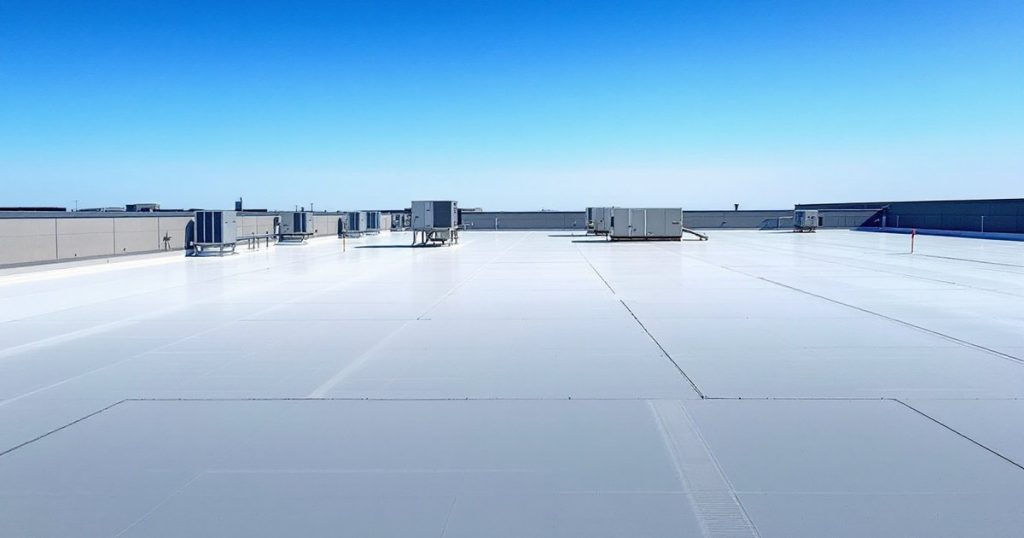
TPO roof repair is done with heat, not glue: the damaged area is cleaned back to weldable membrane, then a patch of new TPO is hot-air welded over it, extending at least 2 to 3 inches past the damage on every side, with rounded corners and a continuous weld of at least 1.5 inches. Holcim Elevate and Johns Manville both publish that rule set in their TPO application guides. Whether the patch holds usually depends less on the welder than on two earlier steps: diagnosing the right failure, and getting a weathered sheet clean enough to accept a weld.
This page is the repair procedure. For inspection schedules and routine cleaning, see our TPO roof maintenance guide. For deciding between patching, coating and replacement across every flat roof type, see flat roof repair options. For welder temperature and speed settings, see our TPO seam welding guide.
By The Roofing Brief Team. Last reviewed: October 2026.
Key numbers at a glance
These are the figures that govern a TPO patch, taken from current manufacturer application guides and a published field study of aged TPO. Requirements differ between manufacturers, and the warranty holder’s written instructions take priority on any roof still under coverage.
| Figure | Value | Source |
|---|---|---|
| Patch overhang past the damaged area | 2 in. minimum (Elevate); 3 in. minimum (JM) | Holcim Elevate UltraPly TPO XR Application Guide, April 2026; JM TPO Installation Guide |
| Smallest patch for a pinhole | 4 in. x 4 in. | Holcim Elevate UltraPly TPO XR Application Guide |
| Continuous weld around the patch | 1.5 in. minimum on all sides | JM TPO Installation Guide |
| Hand-welded seam width | 2 in. minimum | Holcim Elevate UltraPly TPO XR Application Guide |
| Exposure after which membrane must be cleaned before welding | 12 hours (Elevate); 24 hours (JM) | Holcim Elevate and JM application guides |
| Ply adhesion, new TPO welded to 12 to 18 year old TPO | 44.7 lbf/in to the top surface; 58.8 lbf/in to the underside (new 60 mil TPO averages about 40 lbf/in) | Keegan and Taylor, IIBEC Interface, July 2020 (GAF field study of 20 roofs) |
What failed? Diagnosing a TPO roof by failure type
Most TPO leaks trace to one of seven failures: an open or cold-welded seam, a puncture, a T-joint void, a flashing detail, membrane bridging at a wall or curb, scorched membrane from an earlier repair, or wet insulation spreading water under a sound surface. Each has its own sign on the roof and its own fix, so name the failure before buying materials. The drip inside the building is often well away from the breach.
| Failure | What you see on the roof | How to confirm it | Standard repair |
|---|---|---|---|
| Open or cold-welded seam | Lifted lap edge, wrinkle or fishmouth along a seam | Drag a blunted probe (JM names a scratch awl or cotter key puller) along the seam edge; the tip slides under where the weld is open | Clean inside the lap and re-weld, or strip in with new membrane |
| Puncture, cut or hail fracture | Hole, slit or star crack, often near rooftop units and walk paths | Visual check; press around it for soft, wet insulation | Welded patch, 2 to 3 in. past the damage, rounded corners |
| T-joint void | Small channel where three layers of membrane overlap | Probe the step at the intersection | T-joint patch; JM recommends a 7 in. rounded piece of reinforced membrane |
| Flashing failure | Open laps at curb corners, loose termination bar, cracked sealant at pipe boots or pitch pans | Probe flashing laps; check counterflashing and sealant pockets | Re-weld or replace the flashing piece; refill pockets with manufacturer sealant |
| Bridging at an angle change | Membrane stretched across the wall-to-deck corner, base flashing tented | Press the membrane at the base of the wall; a taut, hollow span means it is bridging | Relieve tension, add securement at the angle change, re-flash |
| Scorched membrane from earlier work | Discolored, melted or brittle area around an old weld | Visual check; a test peel shows a burned weld | Cut out 1 in. beyond the burn, patch 3 in. beyond the cut (JM) |
| Wet insulation | Soft or spongy membrane, ceiling stain far from any visible defect | Infrared survey per ASTM C1153 or electronic leak detection per ASTM D7877 | Cut out and replace wet insulation before patching |
Sources: JM TPO Installation Guide; Holcim Elevate UltraPly TPO XR Application Guide (April 2026); ASTM C1153 (infrared location of wet roof insulation); ASTM D7877 (electronic leak detection in membranes). For tracing water from a ceiling stain back to the roof, see our guide to finding and fixing a flat roof leak.
Bridging and shrinkage: when a patch is the wrong fix
When TPO pulls tight at walls and curbs, the sheet spans the inside corner instead of lying in it and the base flashing tents. A patch welded over that corner tends to tear again because the stress that caused the first tear is still there. Manufacturers treat this as a securement problem: Holcim Elevate requires membrane securement wherever the membrane changes angle by more than 1 in 12, which typically means roof edges, curbs and walls.
Products exist specifically for this condition. IKO’s InnoviFlash TPO Reinforced Perimeter Strip, a 6 in. reinforced TPO strip with 3 in. pressure-sensitive tape, is marketed to reduce membrane bridging. Whether the cause is membrane shrinkage, missing securement or building movement, the repair sequence is the same: release the tension, secure the sheet at the angle change, then weld new flashing over it.
Why caulk, roof cement and asphalt products do not belong on TPO
TPO bonds permanently only to TPO, through heat. Holcim Elevate’s application guide states that oil-based or bituminous-based roof cement, mastics or caulks must not be used in direct contact with its UltraPly TPO membrane, and Carlisle’s Sure-Weld specification warns that petroleum-based products may not be compatible with its TPO system. A tube of hardware-store sealant also contaminates the exact surface a later weld needs.
The cost shows up at the next repair. Elevate requires a seam contaminated with asphalt to be stripped in with an 8 in. wide piece of TPO of the same or greater thickness, rather than welded directly. JM’s guide treats cutting away the affected sheet and replacing it as the last resort when contamination will not clean off. JM also warns that fumes from coal tar pitch roofs can affect TPO and requires the two to be separated by insulation of at least R-10 and 1.5 in. thick.
TPO is a polyolefin, the plastic family that includes polypropylene, and polyolefins are hard to bond with general-purpose adhesives. That is why the manufacturers’ tape-based repair products require their own TPO primer and a scrub pad before anything sticks.
| Product | Use on TPO? | What the manufacturer literature says |
|---|---|---|
| Asphalt roof cement or plastic cement | No | Elevate: no bituminous-based roof cement in direct contact with the membrane |
| Asphalt or SBS flashing cement and mastics | No | Elevate: no bituminous-based mastics in direct contact |
| Oil-based caulk | No | Elevate: no oil-based caulks in direct contact |
| General-purpose caulk from a hardware store | Not as a permanent repair | Not listed as a repair material in the Elevate, JM or Carlisle TPO literature reviewed for this page |
| Manufacturer-approved silicone patch | Yes, where approved | Elevate approves GacoPatch Silicone Roof Patch for non-warranted repairs to UltraPly TPO |
| Primed TPO tape patch | Yes, per the product instructions | Elevate QuickSeam patches require QuickPrime primer and a QuickScrubber pad (TIS 1425, September 2025) |
| Heat-welded TPO patch | Yes, the standard repair | Elevate, JM and Carlisle repair and welding guidance |
For a wider comparison of tapes, patch kits and sealants across EPDM, TPO and modified bitumen, see our breakdown of flat roof repair materials.
Is the old TPO still weldable? The aged-membrane test
In most cases, yes, once it is properly cleaned. In a GAF field study of 20 roofs aged 12 to 18 years, new TPO welded to the aged top surface averaged 44.7 lbf/in of ply adhesion, and welded to the underside averaged 58.8 lbf/in, against about 40 lbf/in for new 60 mil TPO. Both repair methods beat the new-membrane baseline. The only way to know about a specific roof is a test weld on that roof.
The study, by Jennifer Keegan and Thomas J. Taylor in IIBEC Interface (July 2020), counted a weld as proper when more than 70 percent of the peeled area showed a film-tearing bond, meaning the TPO film tore away from the scrim rather than the weld letting go. Some contractors still report aged TPO that will not take a weld, so run the test below before committing to a repair method.
- Pick a test spot next to the repair. Use membrane with the same age, color and sun exposure as the area you will patch.
- Clean it with the full in-service procedure. Scrub, rinse and solvent-wipe as described in the cleaning section below, then let the area dry completely.
- Weld a strip of new membrane to it. Use TPO of the same type as the roof and hand weld at least 2 in. wide, adjusting heat to produce a shiny surface without burning, which is JM’s description of the correct setting.
- Let the weld cool, then peel it. Pull the new strip back by hand, or cut 1 in. strips across the weld and peel those.
- Read the result. Film tearing off the scrim across most of the weld is a pass. A clean separation between the old and new surfaces is a fail.
- If it fails, clean harder and retest once. The Western States Roofing Contractors Association (WSRCA) guidelines call for scrubbing with a relatively abrasive pad and the manufacturer’s solvent to remove embedded dirt.
- If the top surface still fails, test the underside. WSRCA’s guidelines describe underside patch placement and reverse-side welding when the existing top surface cannot be welded; the GAF study found the underside gave the stronger bond.
- If both fail, stop patching. A sheet that will not weld top or bottom is a candidate for section replacement or a full replacement evaluation.
Holcim Elevate adds two cautions for aged sheets. The existing membrane may need more heat allowance, but neither membrane should be overheated or scorched. And if blisters form during heat welding, the area was not dry enough and welding should stop.
How to clean TPO before a repair
Every TPO manufacturer requires the existing membrane to be cleaned before new material is welded to it, and on a weathered roof the cleaning is the repair’s weakest link. The common pattern is a detergent scrub with a non-metallic pad, multiple rinses, full drying, then a solvent wipe with the manufacturer’s cleaner. Elevate calls the final solvent wipe the most critical step in getting a new-to-existing weld to hold.
| Manufacturer | Wash step | Solvent or cleaner step | Notes | Source |
|---|---|---|---|---|
| Holcim Elevate | Detergent and water, a water-soluble granular cleaner such as T-M-T, polypropylene scouring pad; rinse several times and dry fully | Second wipe with denatured alcohol on a clean cotton rag | Never use steel wire brushes; liquid cleaners can leave a film that interferes with the weld | UltraPly TPO XR Application Guide, in-service membrane procedure |
| Johns Manville | Low-sudsing soap and water | JM Single Ply Membrane Cleaner | Required on membrane exposed more than 24 hours or dirty; cut out and replace as last resort | JM TPO Installation Guide |
| GAF | Mildly abrasive scrubbing pad with EverGuard TPO Cleaner on weathered or oxidized membrane | White cloth moistened with EverGuard TPO Seam Cleaner | Seam cleaner is marketed to revitalize aged or weathered membrane | GAF EverGuard TPO Seam Cleaner product literature |
| Carlisle | Not specified in the data sheet | Weathered Membrane Cleaner | Required on Sure-Weld membrane exposed to the weather before hot-air welding | Carlisle Sure-Weld TPO data sheet |
Clean a wider area than the patch will cover so the weld zone never sits on a dirty margin. On a roof under warranty, use the product the warranty holder names, since substitutions can complicate a later claim.
How to repair a TPO roof with a hot-air welded patch
A standard TPO patch takes ten steps: confirm the membrane and warranty, find and size the damage, cut a matching patch with rounded corners, clean, test weld, weld the perimeter, probe, seal cut edges, and record the job. Most of the steps below come straight from the Holcim Elevate and Johns Manville repair sections, and the sequence is the same whether the damage is a nail hole or a 6 in. tear.
- Confirm the membrane and the warranty. Check that the roof is TPO rather than PVC, and find out who holds the warranty. Richard Fricklas, former technical director of the Roofing Industry Educational Institute, has warned that repairs by the owner or an unapproved contractor may void the warranty.
- Find the breach and check below it. Mark the defect, probe nearby seams, and press for soft insulation. Wet insulation gets cut out and replaced before any patch goes on.
- Cut out scorched or brittle membrane. For burned areas, JM requires cutting away damaged material at least 1 in. beyond the burned edges.
- Cut the patch. Use TPO of the same type as the field membrane, sized at least 2 in. (Elevate) or 3 in. (JM) past the damage in every direction. Round every corner, because square corners peel.
- Clean the existing membrane. Follow the manufacturer’s in-service procedure over an area larger than the patch, then let it dry completely.
- Run a test weld. Set the hand welder on scrap first, then confirm on the existing sheet using the aged-membrane test above.
- Tack the patch, then weld the perimeter. Insert the welder nozzle fully, move slowly, and roll behind the heat with a silicone roller from the inside edge outward. JM requires a continuous weld of at least 1.5 in. on all sides; Elevate requires hand-welded seams of at least 2 in.
- Let it cool and probe the entire edge. JM allows probing as soon as the weld cools. Any spot where the probe enters is a void to re-weld.
- Seal cut edges. A patch cut from reinforced membrane exposes scrim at its edges. JM and Elevate both require cut-edge sealant to stop water wicking into the weld.
- Record the repair. Photograph the patch, note the date, products and location, and keep it with the roof’s warranty file.
A tool note: a 2 in. silicone roller is the standard partner to a hand welder on TPO patches. Our seam roller comparison covers silicone versus steel.
Repairing an open seam: re-weld or strip in
An open TPO seam with a clean, intact lap can often be re-welded with a hand welder after cleaning inside the lap. A lap that is dirty, contaminated with asphalt or caulk, or too brittle to fuse gets covered with a strip of new membrane welded on both sides. Elevate’s guide states that all welds must be probed and re-welded or stripped in as required, and it specifies an 8 in. strip of same-or-thicker TPO for asphalt-contaminated seams.
Re-weld and probe the full length of a failed seam, not just the visible opening. A seam that opened in one spot from a cold weld is often marginal along much of its run.
Can you repair a TPO roof without a welder?
Yes, within limits set by each manufacturer. Holcim Elevate approves GacoPatch Silicone Roof Patch for non-warranted repairs to UltraPly TPO cuts and punctures, says it will not void existing Elevate warranty coverage, and recommends a primer on UltraPly TPO installed less than two years. Tape-based patches such as Elevate’s QuickSeam line require TPO primer and a scrub pad. Both apply only to the brand that approves them.
The QuickSeam T-Joint Patch instructions (TIS 1425, September 2025) show the pattern: clean the membrane with QuickPrime primer and a QuickScrubber pad, wait for the primer to pass a touch-push test, center the patch, roll it with a 2 in. silicone roller from the center outward, and warm the membrane slightly with a hot-air welder so the patch conforms.
Two cautions apply. Approval by one manufacturer does not carry over to another brand’s TPO, so check the roof’s own manufacturer list. And any non-welded patch leaves material on the sheet that has to be removed or worked around if that spot is later welded, which is a reason to treat these products as the right repair for some situations rather than the default.
Which TPO repair should you pick?
Match the repair to what the diagnosis and the test weld told you. A clean, weldable sheet with a single defect takes a welded patch. Contamination calls for a strip-in or a cut-out. A sheet that fails both test welds is past patching. Anything still under a manufacturer warranty starts with a call to the warranty holder.
| Situation | Recommended repair | Who should do it |
|---|---|---|
| Roof under a manufacturer NDL warranty, any damage | Report it to the manufacturer or its authorized contractor first | Authorized contractor |
| Puncture or cut, membrane passes a test weld | Welded patch, 2 to 3 in. past the damage, rounded corners | Roofer with a hand welder |
| Open seam, clean lap | Clean inside the lap, re-weld, probe the full seam | Roofer with a hand welder |
| Seam or area contaminated with asphalt or caulk | Strip in with new TPO (Elevate specifies 8 in. for asphalt) or cut out the section | Roofer |
| Top surface fails the test weld, underside passes | Underside patch with reverse-side welding | Contractor experienced in thermoplastic repair |
| Both test welds fail; chalky, crazed sheet | Section replacement, or a full replacement evaluation | Roofing contractor |
| Flashing tented or bridged at walls and curbs | Add securement at the angle change and re-flash | Roofer |
| Soft or wet insulation under the damage | Cut out, replace insulation, then patch | Roofer |
| Active leak, no welder available | Manufacturer-approved silicone or primed tape patch, then schedule a welded repair if needed | Owner or roofer, per the manufacturer’s approval list |
When damage is widespread or the membrane is near the end of its service life, the comparison shifts from patch methods to coating or replacement, which our flat roof repair options guide covers by membrane.
What does TPO roof repair cost?
National cost guides do not break TPO out separately, but Fixr’s flat roof repair guide (updated January 2026) puts typical flat roof repairs at $300 to $1,100 with a national average of about $700, patching at $150 to $1,500 or more, and professional seam repair at $200 to $1,000. Actual TPO pricing can sit outside those ranges depending on access, membrane age and what is found under the damage.
| Repair type | Typical range | Source |
|---|---|---|
| Flat roof repair, overall | $300 to $1,100 (average about $700) | Fixr, Flat Roof Repair Cost, January 2026 |
| Patching | $150 to $1,500 or more | Fixr, Flat Roof Repair Cost, January 2026 |
| Professional seam repair | $200 to $1,000 | Fixr, Flat Roof Repair Cost, January 2026 |
| Per square foot of repaired area | $2 to $10 | Fixr, Flat Roof Repair Cost, January 2026 |
Four factors tend to push a TPO repair bill up:
- Aged membrane. Extra cleaning passes, a failed top-surface test weld, or an underside repair add labor.
- Wet insulation. Cutting out and replacing saturated board turns a patch into a small section replacement.
- Locating the leak. An infrared or electronic leak detection survey may be billed separately on larger roofs.
- Prior bad repairs. Asphalt cement or caulk on the sheet has to be stripped in or cut out before a weld will hold.
Warranty status changes the math. A covered leak on a roof under a manufacturer warranty may be repaired at no charge to the owner, depending on the warranty terms, which is another reason to call the warranty holder before anyone else touches the roof.
Frequently asked questions
Can you patch a TPO roof yourself?
You can, but a durable TPO patch needs a hot-air hand welder, a silicone roller, the manufacturer’s cleaner and a probe to check the weld. Without that kit, the realistic owner repairs are manufacturer-approved tape or silicone patches. On a roof under warranty, repairs by the owner or an unapproved contractor may void coverage, so check with the warranty holder before starting.
Can you use roof cement or caulk on a TPO roof?
Not asphalt or oil-based products. Holcim Elevate’s application guide says oil-based or bituminous-based roof cement, mastics and caulks must not be used in direct contact with its TPO, and Carlisle warns petroleum products may not be compatible. Contaminated areas may later need an 8 in. TPO strip-in or a cut-out before a proper weld will hold.
Can you weld new TPO to old TPO?
Usually, after thorough cleaning. A GAF field study of 20 roofs aged 12 to 18 years found new TPO welded to the aged top surface averaged 44.7 lbf/in of ply adhesion and to the underside 58.8 lbf/in, both above the roughly 40 lbf/in typical of new 60 mil TPO. Run a test weld on the actual roof first, and try the underside if the top fails.
How big should a TPO patch be?
Holcim Elevate requires a patch to extend at least 2 in. past the damage in every direction, so a pinhole needs at least a 4 in. x 4 in. patch. Johns Manville specifies at least 3 in. past the damage with a continuous weld of at least 1.5 in. on all sides. Both require rounded corners, because square corners tend to peel.
What should you clean TPO with before welding a patch?
Use the roof manufacturer’s in-service procedure. Holcim Elevate calls for a detergent scrub with a polypropylene pad, several rinses, full drying, then a denatured alcohol wipe. JM uses low-sudsing soap followed by its Single Ply Membrane Cleaner, and Carlisle requires its Weathered Membrane Cleaner on exposed Sure-Weld TPO. Never use steel wire brushes, and weld only on fully dry membrane.
How much does it cost to repair a TPO roof?
National guides do not price TPO separately, but Fixr (January 2026) puts flat roof repairs at $300 to $1,100 with an average near $700, patching at $150 to $1,500 or more, and professional seam repair at $200 to $1,000. Wet insulation, aged membrane that needs underside welding, and leak detection surveys can raise the total. Covered repairs under warranty may cost the owner nothing.
Can you put silicone on a TPO roof?
Only products the roof’s manufacturer approves. Holcim Elevate approves GacoPatch Silicone Roof Patch for non-warranted repairs to its UltraPly TPO cuts and punctures, with primer recommended on membrane under two years old. Approval does not carry across brands, and silicone on the sheet has to be dealt with before any later heat weld in that spot.
Sources
- Holcim Elevate, UltraPly TPO XR Roofing Systems Application Guide, April 2026: membrane repair, in-service cleaning procedure, seam widths, precautions.
- Holcim Elevate, Technical Information Sheet 1425, UltraPly QuickSeam T-Joint Patch, September 2025.
- Holcim Elevate bulletin, GacoPatch approved for non-warranted repairs to Elevate RubberGard EPDM, APP and UltraPly TPO roof systems.
- Johns Manville, JM TPO Installation Guide: membrane repair, seam testing, scorched membrane repair, coal tar separation.
- Carlisle SynTec, Sure-Weld TPO data sheet and Weathered Membrane Cleaner product data sheet.
- GAF, EverGuard TPO Seam Cleaner product literature.
- Jennifer Keegan and Thomas J. Taylor, “Testing Field-Aged TPO Roofs: Demonstrating Real-World Performance,” IIBEC Interface, July 2020.
- Mark S. Graham, “Tech Today,” Professional Roofing, August 2011, summarizing WSRCA’s TPO Roof Membrane Repair and Maintenance Guidelines.
- Buildings.com, “TPO Repair Tips,” quoting Richard Fricklas and Carlisle SynTec.
- IKO, InnoviFlash TPO Reinforced Perimeter Strip product data.
- Fixr, Flat Roof Repair Cost, updated January 27, 2026.
- ASTM C1153, Standard Practice for Location of Wet Insulation in Roofing Systems Using Infrared Imaging; ASTM D7877, Standard Guide for Electronic Methods for Detecting and Locating Leaks in Waterproof Membranes.
Reviewed by The Roofing Brief Team. Last reviewed: October 2026. Manufacturer requirements cited here come from published guides and may change; on any roof under warranty, the warranty holder’s current written instructions take priority.