
By The Roofing Brief Team | Last reviewed: October 2026
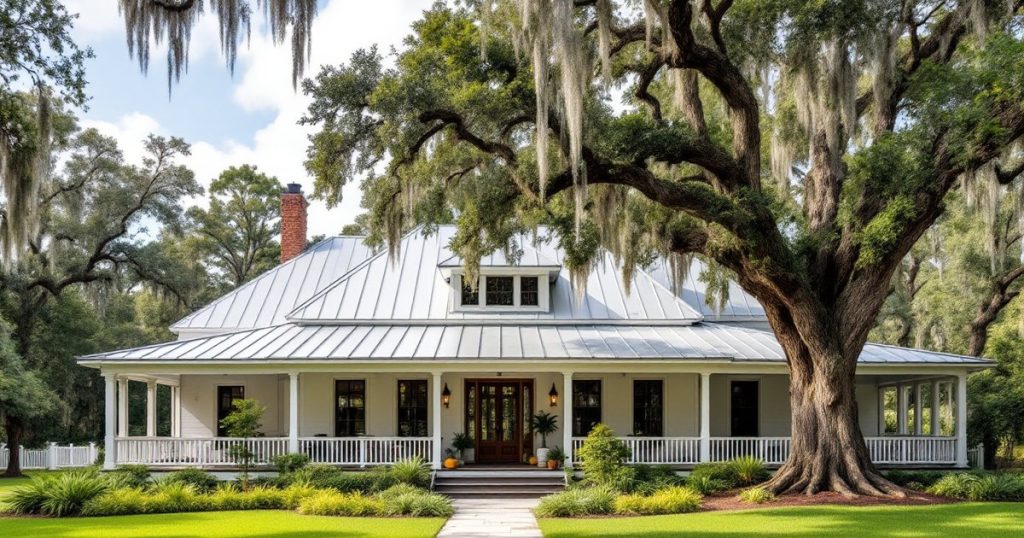
5V metal roofing (also sold as 5V crimp or V crimp) is an exposed-fastener steel panel with five small V-shaped ribs: two at each side seam and one down the center, leaving wide flat pans between them. MBCI, McElroy Metal and Union Corrugating all publish it at 24 inches of coverage with 1/2 inch ribs and a 3:12 minimum slope, and it is most often installed over a solid plywood deck. It is the traditional look on Southern farmhouses, coastal cottages and Florida homes.
Every page ranking for this term is a manufacturer or supplier product page. This guide puts their data side by side, then adds what the product pages leave out: how fastener spacing changes the wind rating in a Florida product approval, what the panel actually costs per square foot at a named supplier, and when R-panel, PBR or standing seam is the better buy.
5V metal roofing: key numbers at a glance
The figures most buyers come for are the coverage width, the gauge, the minimum slope and the price. The table below collects each one from a named manufacturer document or supplier listing. Treat prices as a snapshot: steel panel pricing moves with coil prices and freight, so a current quote from a local supplier is the number to budget against.
| Spec | Typical value | Source |
|---|---|---|
| Net coverage width | 24 in (sheet is about 26 in before the side lap) | MBCI, McElroy Metal, Union Corrugating data pages; Fabral 26 in sheet listing at The Home Depot |
| Rib height and spacing | 1/2 in ribs, major ribs 12 in on center | MBCI 5V Crimp and McElroy 5V product pages |
| Gauges | 29 ga standard, 26 ga optional; 24 ga from some suppliers | MBCI 5V Crimp page; Best Buy Metals 5V-Crimp page |
| Minimum slope | 3:12 | MBCI, McElroy Metal, Union Corrugating, Best Buy Metals |
| Material price, 29 ga bare Galvalume | $3.88 per linear foot, about $1.94 per sq ft of coverage | Michiana Building Supplies price quick-reference guide (accessed October 2026) |
| Florida design uplift (one approval) | -71.25 psf with screws 16 in o.c.; -127.5 psf at 8 in o.c. | TAMCO 5V Crimp, Florida Product Approval FL16667-R4 evaluation report |
What is 5V metal roofing?
5V metal roofing is a low-profile, through-fastened steel panel named for its five V-shaped crimps. Best Buy Metals describes the layout as five 1/2 inch ribs, two on each side and one in the middle; the paired edge ribs nest over the neighboring panel to form the side lap. Screws go through the flat pans next to the ribs, so the fastener heads stay visible on the finished roof.
The shallow ribs are the point. A 5V roof reads as flat sheets with crisp lines rather than the deep trapezoids of commercial R-panel or the waves of corrugated. McElroy Metal positions its 5V for residential and light commercial roofs and for coastal buildings that want a traditional look, and MBCI now sells both a striated version and the traditional non-striated version.
Because the ribs are only 1/2 inch tall, the panel has little stiffness of its own. That is why MBCI states that all 5V Crimp panels must be installed over a solid roof deck with a waterproof underlayment, and why McElroy lists solid deck as the installation surface. Union Corrugating is the outlier among the manufacturers checked, listing its 5V as suitable for solid decking or open frame.
Why is it called 5V or V crimp?
The name counts the ribs. Each sheet carries five V-shaped crimps across its width, so suppliers write it as 5V, 5-V, 5 V crimp or five V. “V crimp” without the number usually refers to the same profile. Regional roll formers do vary the details (Premier Metal’s Florida approval lists a 3/8 inch rib rather than 1/2 inch), so confirm rib height and coverage width on the quote before ordering trim and closures.
How wide is a 5V panel, and how much does it cover?
Most 5V panels cover 24 inches of roof, but the sheet itself is wider. Retail listings describe the sheet size, such as the Fabral “26 in. x 8 ft.” 5V Crimp panel at The Home Depot and the Metal Sales “2.2-ft” wide 5V-Crimp sheet at Lowe’s, because about 2 inches disappear into the side lap. Order by coverage width, not sheet width.
One panel covering 24 inches means 50 linear feet of panel per roofing square (100 sq ft) before waste. That conversion makes supplier quotes comparable: multiply the per-linear-foot price by 50 to get a per-square material cost. Coverage is not universal, though. Our metal roof panel widths and coverage guide found 21 inch coverage 5V sold in some markets, so get the coverage figure in writing.
Which gauge and coating should you choose?
For a house, 26 gauge Galvalume or painted 26 gauge is the safer default; 29 gauge is the economy option common on barns and sheds. Every Florida product approval reviewed for this guide (FL16667, FL24397 and FL30343) was written for minimum 26 gauge steel, so a 29 gauge panel may not have a statewide approval for a Florida house. Lower gauge numbers mean thicker steel.
| Gauge | Weight | Typical availability | Best fit | Source |
|---|---|---|---|---|
| 29 ga | 0.62 lb per sq ft | MBCI standard gauge; McElroy offers 29 ga in galvanized bare only | Sheds, barns, budget outbuildings | Best Buy Metals 5V-Crimp page; MBCI and McElroy product pages |
| 26 ga | 0.78 lb per sq ft | MBCI optional; McElroy 26 ga Galvalume; Union 26 ga Galvalume Plus or Signature 200 paint | Houses, coastal and high-wind sites | Best Buy Metals; MBCI, McElroy, Union Corrugating product pages |
| 24 ga | 1.02 lb per sq ft | Listed by Best Buy Metals; less common at retail | Heavier dent resistance, premium residential | Best Buy Metals 5V-Crimp page |
For a deeper look at the thickness trade-off across all profiles, see our comparison of 26 vs 29 gauge metal roofing.
Galvalume vs galvanized vs painted 5V
Galvalume 5V is steel coated with a 55 percent aluminum-zinc alloy under ASTM A792 (AZ50 is the coating weight cited in two of the Florida approvals reviewed here). Galvanized 5V carries a zinc coating under ASTM A653, with G90 the grade the TAMCO approval accepts. Painted 5V adds a finish system over a metallic-coated substrate and carries the longest published finish warranties.
| Finish | What it is | Published warranty examples | Watch-outs | Source |
|---|---|---|---|---|
| Bare Galvalume (Galvalume Plus) | ASTM A792 aluminum-zinc coated steel, often with a clear acrylic coat | 25 years (Best Buy Metals, Galvalume) | The 1st Coast Florida certification report requires the panel to be isolated from concrete, lead, copper and corrosive treated lumber | Best Buy Metals; Keystone Certifications report 11030-001-KCI (FL24397-R6) |
| Galvanized | ASTM A653 zinc-coated steel (G90 in the TAMCO approval) | Varies by seller; often sold bare at big-box stores | Big-box 5V is frequently 29 ga galvanized (Gibraltar 13343 at The Home Depot; Metal Sales 5V-Crimp at Lowe’s) | Retailer listing titles; FL16667-R4 evaluation report |
| Painted SMP | Siliconized polyester, for example Union’s Signature 200 | 45-year limited finish warranty (Union Corrugating painted panels); 40 years paint (Best Buy Metals) | Union offers 26 ga Signature 200 in select colors only | Union Corrugating 5V page; Best Buy Metals |
| Painted PVDF (Kynar 500) | Fluoropolymer finish with stronger fade resistance | Offered by McElroy on 5V; warranty terms per McElroy documents | Confirm color and gauge availability on the quote | McElroy Metal 5V page |
Near salt water, read the warranty exclusions before choosing. Coating warranties for Galvalume and painted steel often carry distance-from-coastline or salt-spray conditions that vary by manufacturer, so the warranty document for the specific coil, not the product page, decides what is covered.
Is 5V metal roofing good?
5V is a good roof for a 3:12 or steeper house roof over solid plywood when the buyer wants a traditional look at an exposed-fastener price. It carries strong third-party ratings: McElroy lists UL 2218 Class 4 impact and UL 263 Class A fire for its 5V, and Best Buy Metals lists UL 580 Class 90 wind uplift, UL 790 Class A fire and UL 2218 Class 4 impact for its 5V-Crimp.
The trade-offs come from the exposed fasteners and the flat pans. Every screw is a penetration sealed by a rubber washer, and those washers age faster than the steel, so periodic fastener inspection is part of owning any exposed-fastener roof. Wide flat pans also show oil canning, which McElroy’s 5V installation manual calls inherent in metal and “not a cause for rejection,” recommending striated panels to reduce it. Our guide to striated vs flat metal panels covers that choice.
- Strengths: traditional look, 24 inch coverage that suits house-scale roofs, Class 4 impact and Class A fire listings on named products, lower installed cost than standing seam.
- Limits: 3:12 minimum slope at MBCI, McElroy and Union; solid deck required by most makers; exposed screws to maintain; oil canning visible on flat pans.
Where is 5V crimp most common?
5V crimp is concentrated in the Southeast, Florida and Gulf Coast markets, which shows in the supply chain: several Florida roll formers, including TAMCO in Tampa, 1st Coast Metal Roofing Supply in East Palatka and Premier Metal in Summerfield, hold their own Florida product approvals for 5V. It is also the standard choice when a farmhouse, cracker-style or coastal cottage design calls for a metal roof with a quieter profile than R-panel.
Outside the Southeast, 5V shows up mainly on cabins, porches and agricultural buildings, often in 29 gauge from big-box stores. AW Graham Lumber in Kentucky, for example, stocks 29 gauge Galvalume Plus 5V in 8 to 16 foot lengths. In most northern and western markets, ribbed panels such as R-panel and the various 3/4 inch residential ribs are the default exposed-fastener profiles instead.
Florida product approval and wind uplift for 5V
In Florida, a 5V roof needs a product approval (statewide under Rule 61G20-3, or local) that matches the deck, fastener and spacing actually installed. The approval sets the allowable design uplift pressure, and the screw spacing is what moves that number. In the TAMCO 5V Crimp evaluation report for FL16667-R4, halving the spacing from 16 inches to 8 inches raises the allowable pressure from -71.25 psf to -127.5 psf.
Product pages rarely show this. They print “Florida Building Code approved” as a logo, which tells you an approval exists, not whether it covers your roof height, wind speed and corner zones. The three approvals below are public on floridabuilding.org; all three are limited to areas outside the High Velocity Hurricane Zone (HVHZ, which covers Miami-Dade and Broward counties).
| Approval | Panel and deck | Fastener | Allowable design uplift | HVHZ |
|---|---|---|---|---|
| FL16667-R4, L.V. Thompson Inc. (TAMCO), evaluation by CREEK Technical Services, issued April 3, 2020 | Min. 26 ga ASTM A792 AZ50 or ASTM A653 G90 steel, 1/2 in rib, max 24 in coverage; min. 15/32 in plywood at max 24 in span | #9-15 x 1.5 in hex washer head wood screw, 0.5 in sealing washer, min. 3/16 in through the deck | -71.25 psf at 16 in o.c.; -127.5 psf at 8 in o.c. (2:1 safety margin) | Not for HVHZ |
| FL24397-R6, 1st Coast Metal Roofing Supply, Keystone Certifications report 11030-001-KCI | Min. 26 ga ASTM A792 Grade 50, AZ50; nominal 7/16 in OSB; min. slope 3:12 | #9-15 x 1-1/2 in Woodbinder ST-XL hex head screw with EPDM washer | -52.5 psf (anchor pattern A) or -63.5 psf (pattern B), tested to UL 580 and UL 1897 | Not for HVHZ |
| FL30343, Premier Metal, evaluated by Locke Bowden, P.E. | 26 ga steel, 24 in wide, 3/8 in rib; 15/32 in APA plywood over supports at 24 in o.c. | #10 x 1 in Hi-Lo hex washer head with sealing washer, min. 1/4 in through the plywood | -63.5 psf at 16 in o.c.; -86 psf at 12 in o.c. (UL 580, Intertek) | Non-HVHZ |
Approval documents are revised as the Florida Building Code changes editions, and the FL16667-R4 and FL30343 reports reviewed here were written to the 2017 code while FL24397-R6 references the 2020 code. Before permitting, look up the current revision of the exact product on floridabuilding.org; the building official decides what is accepted.
Does fastener spacing change where 5V is allowed?
Yes, and by a wide margin. The TAMCO FL16667-R4 report converts its two allowable pressures into maximum mean roof heights by wind speed, exposure and roof zone. At 16 inch spacing, a 5V roof in Exposure C at the corner zone (Zone 3) is limited to 33 feet at 140 mph and is not allowed at 160 mph; at 8 inch spacing the same zone allows 60 feet up to 170 mph.
| Basic wind speed (Vult), Exposure C | 16 in o.c., Zone 2 (edges) | 16 in o.c., Zone 3 (corners) | 8 in o.c., Zone 2 (edges) | 8 in o.c., Zone 3 (corners) |
|---|---|---|---|---|
| 140 mph | 60 ft | 33 ft | 60 ft | 60 ft |
| 150 mph | 60 ft | 19 ft | 60 ft | 60 ft |
| 160 mph | 60 ft | Not allowed | 60 ft | 60 ft |
| 170 mph | 33 ft | Not allowed | 60 ft | 60 ft |
| 180 mph | 19 ft | Not allowed | 60 ft | 48 ft |
Source: CREEK Technical Services evaluation report LVT17001.2c for FL16667-R4, gable and hip roofs 2:12 to 6.1:12, enclosed buildings without overhangs, effective wind area of 10 sq ft or less. For hip roofs from 2:12 to 5.6:12 the report treats Zone 3 as Zone 2. Zone 1 (the field of the roof) allows 60 feet at every listed speed in Exposure C under both patterns. A licensed design professional should confirm the wind loads for any specific house.
The practical takeaway: on a coastal Florida house, a 5V quote should name the approval number and the screw spacing in the edge and corner zones, not only in the field. Our Florida roof replacement cost guide covers how those code requirements show up in total project prices.
How is 5V metal roofing installed?
5V goes on over a solid deck and underlayment, starting at the eave with trim and closures, with screws through the flats in the pattern the manufacturer or product approval specifies. McElroy Metal’s 5V installation manual details each step, using #10-15 x 1-1/2 inch Woodgrip HiLo ZAC screws for panels, with one fastener pattern at eaves, ridges and endlaps and a second pattern for intermediate rows.
- Check slope and deck. Confirm the roof is at least 3:12 and the deck meets the approval in use, such as minimum 15/32 inch plywood in the TAMCO report or 7/16 inch OSB in the 1st Coast report.
- Install underlayment. MBCI requires a waterproof underlayment under 5V; in Florida, the 1st Coast report points to the underlayment table in Florida Building Code Section 1507.1.1.1. Our felt vs synthetic underlayment guide compares the options.
- Set eave trim and closures. McElroy fastens eave trim at 5 feet on center, runs 3/32 x 1 inch tape sealant along the eave, sets inside foam closures on it, and adds butyl sealant on top of the closures at the ribs.
- Lay the first panel and work across. Start at the end that puts the overlapping edge away from the prevailing wind, which is the common exposed-fastener practice; confirm the direction in the manufacturer’s sheet-laying detail.
- Fasten through the flats. Use the pattern for each zone: the manufacturer’s eave and endlap pattern at panel ends, the intermediate pattern in the field, and tighter spacing in edge and corner zones where the approval requires it.
- Make endlaps on sealant. McElroy runs a continuous bead of tape sealant across the lower panel about 4 inches from its end, then lays the upper panel over it and fastens through both.
- Finish rakes and ridge. McElroy fastens rake trim at 1 foot on center, stops panels 1 inch short of each side of the ridge, sets outside closures in tape sealant, and fastens ridge flashing with 1/4-14 x 7/8 inch lap screws at each major rib.
Driving screws to the right depth matters as much as spacing: an overdriven screw can split its washer and an underdriven one may never seal. Our screw pattern for metal roofing guide covers layouts for 5V and other exposed-fastener profiles.
Can 5V go over existing shingles?
Sometimes. The 1st Coast certification report for FL24397-R6 allows its 5V in re-roofing and re-covering over a single layer of existing shingles under Florida Building Code Sections 1507.4 and 1511, with screws fully penetrating the OSB deck. Other approvals do not say this, so the specific product approval and the local building department decide whether a recover is permitted.
How much does 5V crimp metal roofing cost?
5V material runs about $2 per square foot at named supplier pricing, and installed prices in Florida run roughly $6 to $10 per square foot. Michiana Building Supplies lists 29 gauge bare Galvalume 5V at $3.88 per linear foot, which works out to about $1.94 per sq ft of 24 inch coverage, or about $194 per square before trim, screws and waste.
| Cost item | Price | Per sq ft of roof | Source |
|---|---|---|---|
| 5V panel, 29 ga bare Galvalume | $3.88 per linear ft | About $1.94 (24 in coverage) | Michiana Building Supplies price quick-reference (accessed October 2026) |
| 5V panel material, Central Florida range | $300 to $600 per square | $3.00 to $6.00 | Mid-Florida Metal Roofing Supply cost article |
| Installed 5V roof, 1,500 sq ft house, Central Florida | $9,000 to $15,000 | About $6 to $10 | Mid-Florida Metal Roofing Supply cost article |
| Labor and extras as a share of material | 40 to 60 percent of material cost | Varies by roof complexity | Mid-Florida Metal Roofing Supply cost article |
Price drivers are predictable. Moving from 29 to 26 gauge, from bare to painted, or from SMP to PVDF paint each raises the per-foot price. Tighter screw spacing for high-wind zones adds screws and labor, and complex roofs with valleys and hips add trim and cutting waste. Tariff effects on steel panel prices are tracked in our metal roofing tariff report.
5V vs R-panel, PBR and standing seam
5V sits between R-panel and standing seam: a house-scale look with exposed screws. R-panel and PBR cover 36 inches with 1-1/4 inch ribs, can span open framing and go to lower slopes with sealant, while standing seam hides its fasteners. At Michiana Building Supplies, 29 gauge 5V costs about the same per square foot of coverage as 26 gauge PBR and less than 16 inch standing seam.
| Feature | 5V crimp | R-panel / PBR | Standing seam | Source |
|---|---|---|---|---|
| Coverage width | 24 in | 36 in | 16 in (SL-16); 12 to 18 in typical | MBCI, McElroy, Michiana Building Supplies |
| Rib or seam height | 1/2 in | 1-1/4 in | 1 in (SL-16) | McElroy 5V and R-Panel pages; Michiana |
| Fasteners | Exposed, through the flats | Exposed, through the flats | Concealed | Manufacturer product pages |
| Minimum slope | 3:12 | 1:12 with sealant; 3:12 without (McElroy R-Panel) | As low as 1/4:12 under IBC Section 1507.4.2; per system data sheet | McElroy Metal; MBCI; IBC 1507.4.2 |
| Substrate | Solid deck (most makers) | Solid deck or open framing | Per system; residential systems are commonly installed over solid deck | McElroy Metal and MBCI product pages; manufacturer data sheets |
| Material price per sq ft of coverage | About $1.94 (29 ga bare Galvalume) | About $1.70 (26 ga bare PBR); about $2.10 (26 ga painted PBR) | About $2.39 (29 ga SL-16); about $2.78 (26 ga SL-16) | Michiana Building Supplies per-linear-foot prices divided by coverage |
| Typical look | Farmhouse, coastal cottage, Florida residential | Barns, shops, commercial and agricultural | Modern and high-end residential | Manufacturer application listings |
For profile-by-profile detail, see our guides to R-panel roofing, the PBR panel, corrugated metal roofing and the full lineup in types of metal roof panels. If you are comparing 5V with a 36 inch, 3/4 inch rib residential panel instead, see our guide to the MasterRib panel.
What makes a standing seam (inseam) roof better than 5V?
A standing seam roof, sometimes called an inseam or concealed-fastener roof, has no screws through the weather surface. Panels attach with clips under the seams, so the roof has fewer penetrations to maintain and the panels can move with heat. 5V keeps its screws exposed, so washers need periodic checks, but material and labor usually cost less. Our standing seam vs exposed fastener comparison breaks down the cost and lifespan gap.
Which one should you pick?
Pick by slope, deck, wind zone and look. 5V wins on a house with a solid deck at 3:12 or steeper where a traditional look matters. R-panel or PBR wins on open framing and lower slopes. Standing seam wins when you want no exposed screws, or when an HVHZ or high-wind design calls for a system with the right approval.
| Your situation | Better choice | Why |
|---|---|---|
| Farmhouse or coastal house, plywood deck, 4:12 to 12:12 slope | 26 ga 5V, Galvalume or painted | Traditional profile at exposed-fastener cost; Florida approvals are written for 26 ga |
| Pole barn or shop on open purlins | R-panel or PBR | 36 in coverage and 1-1/4 in ribs span framing; most 5V needs solid deck |
| Porch or addition at 2:12 | R-panel with sealed laps, or standing seam | 5V is limited to 3:12 by MBCI, McElroy and Union |
| Florida coastal home outside the HVHZ | 5V with an approval that covers your wind speed and roof height, fastened at the approval’s edge and corner spacing | Fastener spacing changes allowable uplift by roughly 80 percent in FL16667-R4 |
| Miami-Dade or Broward County (HVHZ) | A product with an HVHZ approval or Miami-Dade NOA, confirmed by the permit office | The three Florida 5V approvals reviewed here exclude the HVHZ |
| Low maintenance is the priority | Standing seam | No exposed screws or washers to inspect |
Frequently asked questions
What is a 5V metal roof?
A 5V metal roof uses steel panels with five V-shaped ribs, two at each side seam and one in the center, screwed through the flats into a solid deck. MBCI, McElroy Metal and Union Corrugating publish 24 inches of coverage, 1/2 inch ribs and a 3:12 minimum slope. It is a traditional look on Southern farmhouses and Florida coastal homes.
Is 5V metal roofing good?
For a house at 3:12 or steeper over plywood, 5V is a strong choice. McElroy lists UL 2218 Class 4 impact and UL 263 Class A fire ratings for its 5V, and one Florida approval (FL16667-R4) reaches -127.5 psf uplift with 8 inch screw spacing. The drawbacks are exposed screws that need periodic checks and visible oil canning on the flat pans.
What is the price of 5V crimp metal roofing?
Michiana Building Supplies lists 29 gauge bare Galvalume 5V at $3.88 per linear foot, about $1.94 per square foot of coverage. Mid-Florida Metal Roofing Supply cites $300 to $600 per square for material and $9,000 to $15,000 installed for a 1,500 square foot Central Florida home. Gauge, paint, trim and wind-zone fastening move the final price.
What makes an inseam metal roof better than a 5V metal roof?
An inseam or standing seam roof hides its fasteners under raised seams and clips, so there are no screw penetrations through the panel face and the panels can expand and contract more freely. That usually means less maintenance and longer weathertightness warranties. 5V costs less to buy and install but leaves every screw and washer exposed to weather.
What gauge is 5V metal roofing?
5V is sold in 29, 26 and 24 gauge. MBCI makes 29 gauge standard and 26 gauge optional, and Best Buy Metals also offers 24 gauge at 1.02 pounds per square foot. For houses, 26 gauge is the common choice, and the Florida product approvals reviewed here (FL16667, FL24397, FL30343) all specify minimum 26 gauge steel.
Is 5V metal roofing approved in Florida?
Many 5V panels hold Florida product approvals, including TAMCO’s FL16667, 1st Coast’s FL24397 and Premier Metal’s FL30343. Each approval is tied to a specific gauge, deck, screw and spacing, and all three reviewed here exclude the High Velocity Hurricane Zone. Check the current revision on floridabuilding.org and confirm with the local building department before permitting.