
By The Roofing Brief Team | Last reviewed: October 2026
The best attic insulation for Florida in most existing homes is an air-sealed attic floor topped with blown-in fiberglass or cellulose to at least the Florida Building Code minimum, R-30 in the seven South Florida counties of Climate Zone 1 and R-38 everywhere else. Add a radiant barrier when existing insulation is thin or the air handler sits in the attic. Choose closed-cell or open-cell spray foam on the roof deck only when you want the ducts inside a sealed, conditioned attic and can meet the tighter rules that come with it.
This page is the Florida and hot-humid version of the question. The national material ranking lives in our guide to the best insulation for an attic in any climate. Here the focus is the Florida code text, measured Florida Solar Energy Center (FSEC) data, the state’s unvented-attic statute and the utility rebates Floridians can actually claim in 2026.
Key numbers at a glance
These are the figures most Florida homeowners search for, each tied to a named source. Code values are minimums for new work under the 8th Edition (2023) Florida Building Code, Energy Conservation (FBCEC), which governs permits applied for through December 30, 2026.
| Figure | Value | Source |
|---|---|---|
| Ceiling R-value, Climate Zone 1 | R-30 | FBCEC 8th Ed. Table R402.1.2; Form R402-2023 |
| Ceiling R-value, Climate Zone 2 | R-38 (R-30 deemed to comply if full depth extends over the wall top plate) | FBCEC 8th Ed. Table R402.1.2 and Section R402.2.1 |
| ENERGY STAR retrofit target | R-30 in Zone 1, R-49 in Zone 2 (uninsulated attic) | ENERGY STAR recommended home insulation R-values |
| Unvented attic path | Minimum R-20 air-impermeable insulation, plus four conditions | Section 553.9065, Florida Statutes |
| Radiant barrier cooling savings, Florida homes | About 9% (3.6 kWh per day) and 420 W lower summer peak demand | FSEC-CR-1231-01 (Parker, Sherwin, Anello, 2001) |
| Blown-in insulation, installed | $0.90 to $2.40 per sq ft | HomeGuide attic insulation cost (January 2026) |
What is the best attic insulation for Florida’s heat and humidity?
For a typical vented Florida attic, the best value is air sealing plus blown-in fiberglass or cellulose to R-38 or more, because loose fill reaches code depth at the lowest cost per R-value and fills around trusses without gaps. Spray foam on the roof deck wins only when it moves the air handler and ducts inside the conditioned space. Radiant barriers are a supplement, not a substitute.
Florida flips the usual attic problem. The attic is a heat source for most of the year, and the Florida Department of Agriculture and Consumer Services (FDACS) notes that more heat per square foot travels through the ceiling than through any other part of a house. The material matters less than three things around it: a sealed ceiling plane, the full code depth, and where the air handler and ducts sit.
| Option | R-value per inch | Depth for R-38 | Installed cost | Florida fit | Source |
|---|---|---|---|---|---|
| Blown-in fiberglass (vented attic floor) | About R-2.8 | 13.5 in (Owens Corning AttiCat chart) | $0.90 to $2.40 per sq ft | Best value for most existing homes; fiber does not absorb water | Owens Corning AttiCat data sheet (May 2026); HomeGuide |
| Blown-in cellulose (vented attic floor) | About R-3.2 | 11.97 in initial, 10.77 in settled (Greenfiber INS541LD) | $0.90 to $2.40 per sq ft | Denser, slows air leaks; paper-based, so replace it if a roof leak soaks it | Greenfiber coverage chart; HomeGuide |
| Fiberglass batts | R-2.2 to R-4.0 (FDACS range for fiberglass) | Varies by product | $0.80 to $2.60 per sq ft | Leaves gaps at trusses and wiring; weakest real-world result | FDACS; HomeGuide |
| Open-cell spray foam (roof deck) | R-3.5 to R-3.7 | Not typical; R-20 path needs about 5.4 to 5.7 in | $1.50 to $3.50 per sq ft | Brings ducts inside; watch sheathing moisture in humid climates | HomeGuide spray foam cost (December 2025) |
| Closed-cell spray foam (roof deck) | R-5.8 to R-6.8 | Not typical; R-20 path needs about 2.9 to 3.4 in | $3.00 to $5.00 per sq ft | Vapor retarder and air barrier in one layer; highest cost | FDACS; HomeGuide |
| Radiant barrier (under rafters) | No R-value; reflects radiant heat | Not applicable | $0.30 to $2.00 per sq ft | Biggest payoff over thin insulation or an attic air handler | FSEC-EN-15; HomeGuide radiant barrier cost (September 2023) |
Foam depths for the R-20 path are Roofing Brief arithmetic (20 divided by the published R-value per inch). Use the exact product’s data sheet, because foam R-values vary by brand.
What R-value does Florida require in an attic?
The 8th Edition (2023) FBCEC sets a ceiling minimum of R-30 in Climate Zone 1 and R-38 in Climate Zone 2 under the prescriptive Table R402.1.2. Climate Zone 1 covers Broward, Collier, Hendry, Lee, Miami-Dade, Monroe and Palm Beach counties. Every other Florida county, including Orange, Hillsborough, Duval and Escambia, is Climate Zone 2.
Section R402.2.1 adds a useful allowance: where the table calls for R-38, “installing R-30 over 100 percent of the ceiling or attic area requiring insulation shall be deemed to satisfy the requirement for R-38 wherever the full height of uncompressed R-30 insulation extends over the wall top plate at the eaves.” That usually means a raised-heel truss. On a standard truss, insulation thins out over the top plate, so the full R-38 applies.
| Climate zone | Counties | FBCEC ceiling minimum | ENERGY STAR retrofit target | Source |
|---|---|---|---|---|
| Zone 1 (1A) | Broward, Collier, Hendry, Lee, Miami-Dade, Monroe, Palm Beach | R-30 | R-30 uninsulated; add R-25 over 3 to 4 in existing | FBCEC 8th Ed. Table R301.1 and R402.1.2; ENERGY STAR |
| Zone 2 (2A) | All other 60 counties | R-38 | R-49 uninsulated; add R-38 over 3 to 4 in existing | FBCEC 8th Ed. Table R301.1 and R402.1.2; ENERGY STAR |
The code number is a floor for new work, not an efficiency target. ENERGY STAR’s retrofit table, built on the 2021 IECC, asks for R-49 in Zone 2, a full step above the Florida minimum. FDACS states that a home with less than R-19 will probably benefit from adding more.
What changes with the 9th Edition (2026) Florida Building Code?
The 9th Edition (2026) FBCEC takes effect December 31, 2026, per the Florida Building Commission. The Commission’s published analysis of residential changes lists no change to the ceiling R-value column, so R-30 and R-38 carry forward. The changes that touch attics are the unvented-attic exception, gasketed attic hatches and lower skylight limits.
| Item | 8th Edition (2023) | 9th Edition (2026) | Source |
|---|---|---|---|
| Ceiling R-value | R-30 Zone 1, R-38 Zone 2 | No change listed | Florida Building Commission, Analysis of Changes, 9th Edition FBC Energy Residential |
| Unvented attic, R-20 air-impermeable path | Added by 2024 Supplement (statute) | New Exception 3 to R402.1 | Same analysis; Section 553.9065, F.S. |
| Attic hatch and pull-down stairs | Sealed and insulated | Must use “gasketing materials that allow for repeated entrance over time” | Same analysis, Table R402.4.1.1 |
| Skylight U-factor maximum | 0.75 Zone 1, 0.65 Zone 2 | 0.60 in both zones | Same analysis, Table R402.1.2 |
| Skylight SHGC maximum | 0.30 | 0.28 | Same analysis, Table R402.1.2 |
Permits are generally worked under the edition in effect on the application date. A job applied for in late December 2026 may fall under either edition, so confirm with your building department. Our breakdown of Florida Building Code roof requirements covers the reroofing side of the same changeover.
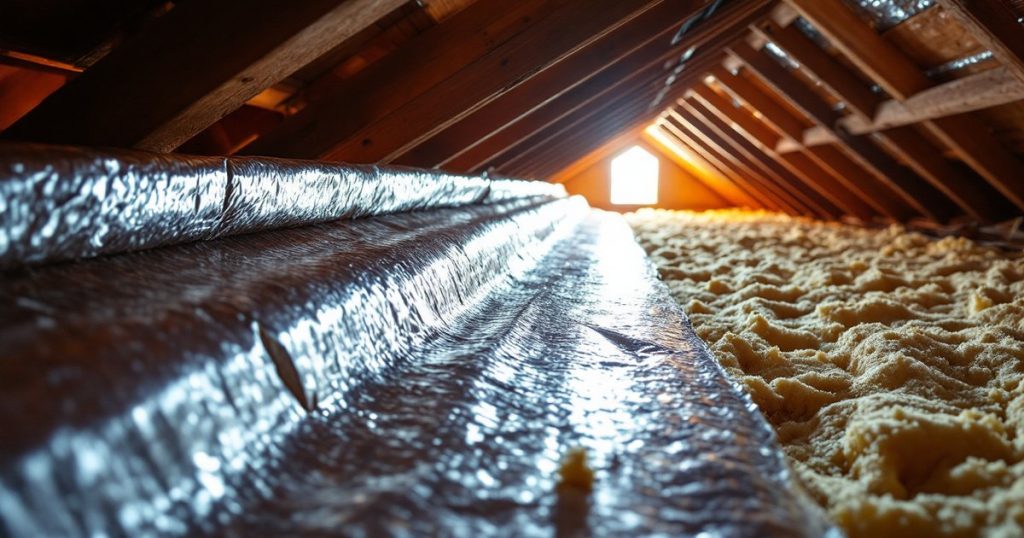
Does a radiant barrier work in a Florida attic?
Yes, but its payoff shrinks as insulation gets deeper. In an FSEC pilot for Florida Power Corporation, radiant barriers cut cooling energy about 9% (3.6 kWh per day) across eight monitored Florida homes and lowered summer afternoon peak demand by 420 W. FSEC found the largest savings in homes with lower ceiling insulation and with air handlers in the attic.
| FSEC finding | Value | Source |
|---|---|---|
| Cooling energy savings, retrofit | 3.6 kWh per day, about 9% | FSEC-CR-1231-01 (2001), 8 homes |
| Summer afternoon peak demand reduction | 420 W, about 16% | FSEC-CR-1231-01 |
| Peak attic temperature | About 8 degrees lower (daily summer maximum) | FSEC-CR-1231-01 |
| Ceiling heat flux reduction in prior Southeast studies | 25% to 50% | Cited in FSEC-CR-1231-01 |
| Heat flow from attic into the house | About 40% lower | FSEC-EN-15, Radiant Barriers: A Question and Answer Primer |
| Annual cooling cost savings, Southeast | 8% to 12% | FSEC-EN-15 |
FSEC-EN-15 is blunt about the limit: “if your attic is insulated to R-30 or better, there is very little heat flow to reduce.” Install foil facing down toward the attic, facing an air space, on the underside of the truss top chords. Foil laid on top of insulation collects dust, which FSEC says can negate the radiant barrier effect. Product picks and emittance specs are in our best radiant barrier guide.
Why more R-value pays less in a Florida attic
Heat flow through a ceiling falls with the inverse of the R-value, so each added inch saves less than the one before. The table below is Roofing Brief arithmetic for 1,000 sq ft of ceiling, assuming 130 degrees F attic air over a 77 degree F room. It is a simplified steady-state model that ignores framing, ducts and radiant effects, so read it for the shape of the curve, not exact bills.
| Ceiling insulation | Heat gain (Btu/h per 1,000 sq ft) | Cut from previous step | Radiant barrier at 40% cut saves |
|---|---|---|---|
| R-11 | 4,818 | Not applicable | 1,927 Btu/h |
| R-19 | 2,789 | 2,029 Btu/h | 1,116 Btu/h |
| R-30 | 1,767 | 1,022 Btu/h | 707 Btu/h |
| R-38 | 1,395 | 372 Btu/h | 558 Btu/h |
| R-49 | 1,082 | 313 Btu/h | 433 Btu/h |
Method: heat gain equals area times temperature difference (53 degrees F) divided by R-value. The 40% figure is FSEC-EN-15’s estimate. The pattern matches FSEC’s field result: a radiant barrier over R-11 removes more than four times the heat it removes over R-49, so topping up thin insulation usually comes first.
Is spray foam a good idea in a Florida attic?
Spray foam makes sense in Florida when it creates a sealed, unvented attic that puts the air handler and ductwork inside the thermal envelope. It costs more per square foot than blown-in fill and covers the larger roof-deck area, so it rarely pays on insulation value alone. The case for it rests on the ducts, airtightness and humidity control around them.
Florida homes commonly have the air handler and ducts in the attic. Research summarized by Oak Ridge National Laboratory (ORNL) cites a survey of 91 Florida homes with average measured duct leakage of about 10% of supply and return airflow, and the FBCEC prescriptive path in Section R403.3.6 states that “air-handling units shall not be installed in the attic when a home is brought into code compliance by Section R402.” Moving the attic inside the envelope removes that heat and leakage penalty in one step.
Florida’s R-20 unvented attic rule
Section 553.9065, Florida Statutes (chapter 2024-191), says an unvented attic or enclosed rafter assembly insulated and air sealed with at least R-20 air-impermeable insulation meets FBCEC Section R402 when four conditions are met. The 9th Edition adds the same rule as Exception 3 to R402.1. It is a code compliance path, not a recommended R-value.
| Condition under 553.9065(1) | What it means on the job |
|---|---|
| (a) Blower door result under 3 ACH50 | The whole house must test tight, not just the attic |
| (b) Positive input, balanced or hybrid whole-house mechanical ventilation | A fresh-air system is required, which adds cost |
| (c) Exposed rafters covered with at least R-3 air-impermeable insulation | Unless covered by a finished ceiling or the deck has continuous insulation above it |
| (d) All heating, cooling, ventilation equipment and ductwork inside the thermal envelope | The point of the whole assembly |
Open-cell foam needs care in Florida’s humidity. A study by ORNL and the University of Florida, funded by the Florida Building Commission and the Florida Roofing and Sheet Metal Contractors Association, instrumented four sealed open-cell attics in Zones 1A and 2A from June 1, 2016. The researchers measured moisture cycling between the roof sheathing, the foam and the attic air each day, and identified airtightness and indoor moisture as the biggest drivers of sheathing durability. The construction rules for these assemblies are in our guide to unvented conditioned attic code requirements, and the foam types are compared in open-cell vs closed-cell spray foam attic insulation.
How much does it cost to insulate a 2,000 square foot attic in Florida?
Topping up a 2,000 sq ft vented attic with blown-in insulation runs about $1,800 to $4,800 at HomeGuide’s $0.90 to $2.40 per sq ft installed. Removing old insulation and replacing it runs about $4,000 to $12,000. Spray foam on the roof deck of the same house can reach about $3,350 to $11,200, depending on open-cell or closed-cell.
| Job (2,000 sq ft attic floor) | Rate used | Area | Estimated range | Source |
|---|---|---|---|---|
| Blown-in top-up to R-38 or more | $0.90 to $2.40 per sq ft | 2,000 sq ft | $1,800 to $4,800 | HomeGuide (January 2026) |
| Remove old insulation and replace | $2 to $6 per sq ft | 2,000 sq ft | $4,000 to $12,000 | HomeGuide |
| Air sealing the attic floor | Flat range | Whole attic | $350 to $3,000 | HomeGuide |
| Radiant barrier under rafters | $0.30 to $2.00 per sq ft | 2,236 sq ft of roof deck | $670 to $4,470 | HomeGuide (September 2023) |
| Open-cell foam at roof deck | $1.50 to $3.50 per sq ft | 2,236 sq ft | $3,350 to $7,830 | HomeGuide (December 2025) |
| Closed-cell foam at roof deck | $3.00 to $5.00 per sq ft | 2,236 sq ft | $6,710 to $11,180 | HomeGuide (December 2025) |
Roof deck area is Roofing Brief arithmetic: 2,000 sq ft times a 6/12 pitch factor of 1.118, before gable walls, which add more. HomeGuide’s foam rates do not state a thickness, so get quotes priced to the R-value you need. Our attic insulation cost guide breaks out national pricing by attic size.
Which Florida utility rebates cover attic insulation?
The three largest investor-owned utilities each publish an attic or ceiling insulation rebate, and each requires a home check or approved contractor first. Federal tax credits are not part of the math: the 25C credit for insulation ended for property placed in service after December 31, 2025, under Public Law 119-21, so check current IRS guidance and a tax professional before counting on any credit.
| Utility | Rebate as published | Key conditions | Source, date checked |
|---|---|---|---|
| Florida Power & Light (FPL) | $220 instant rebate | Existing insulation below R-8; FPL-approved Participating Independent Contractor; attic access for verification | FPL ceiling insulation page, October 13, 2026 |
| Duke Energy Florida | Up to $800 instant rebate (single-family) | Free Home Energy Check first; eligible measure within 24 months | Duke Energy news release, June 9, 2025 |
| Tampa Electric (TECO) | “$0.16 per square foot per R-11 insulation installed” | Pre-approval attic inspection; rebate certificate valid one year; owner-installed allowed | Tampa Electric ceiling insulation page, October 13, 2026 |
FPL’s posted program standards (effective November 2, 2020) also require installing to R-30 in Miami-Dade, Broward and Monroe and R-38 in the rest of FPL territory. That older map puts Palm Beach, Lee and Collier homes at R-38 for the rebate even though the current code minimum there is R-30, so confirm the target with FPL before you sign. Municipal utilities and co-ops such as JEA, OUC and Gainesville Regional Utilities run separate programs, and terms change often.
How to upgrade a Florida attic, step by step
The order matters more than the brand. Fix moisture and air leaks before adding depth, and decide where the ducts belong before you choose a material. These steps apply to a vented attic in an existing home.
- Measure what you have. Read the depth at several spots with a ruler, then convert it using the product type. If it is under R-19, FDACS says you will probably benefit from more.
- Book the utility check first. FPL, Duke Energy Florida and TECO all require a home analysis, inspection or approved contractor before the work, or the rebate is lost.
- Look for wet or damaged insulation. Stains on the deck or matted insulation point to roof leaks, often after a storm. Fix the leak and remove wet material before adding more.
- Air seal the ceiling plane. Seal top plates, wiring and plumbing holes, light fixtures and the duct boots. Seal and insulate the hatch or pull-down stairs with gasketing.
- Keep soffit vents open. Install baffles at the eaves, as FBCEC Section R402.2.3 requires for air-permeable insulation in vented attics.
- Add a radiant barrier if it fits. It pays most over thin insulation or an attic air handler, and during a reroof, when radiant-barrier sheathing can go on with the new deck.
- Blow in to full depth. Use the bag chart for your product. Owens Corning lists 13.5 inches and 19 bags per 1,000 sq ft of AttiCat for R-38.
- Keep the paperwork. Save the R-value certificate, bag count and invoice for the rebate and for any future home sale.
Which attic insulation should you pick in Florida?
Match the choice to your attic, not to a ranking. Most Florida homes land on the first or second row of the table below. Spray foam belongs to the narrower group of homes rebuilding the attic around the ducts.
| If your attic has… | Do this | Why |
|---|---|---|
| Less than R-19, vented, ducts in attic | Air seal, blow in to R-38 or more, consider a radiant barrier | Largest savings per dollar; FSEC’s best radiant barrier results came from this group |
| R-30 or more in good shape | Air seal and top up to R-38 to R-49 only if cheap; skip the radiant barrier | FSEC: very little heat flow left to reduce |
| Wet, moldy or rodent-damaged insulation | Fix the roof leak, remove, then reinsulate | Wet insulation loses R-value |
| Air handler and ducts in attic, new roof planned | Price an unvented attic with foam at the deck | Brings ducts inside; reroof is the cheapest time |
| Low-slope or no attic access | Insulation above the roof deck at reroof | No space to blow in from inside |
| Home in Palm Beach, Lee or Collier using the FPL rebate | Confirm FPL’s R-value target before signing | FPL standards use an older Zone 1 map |
What about hurricanes and Florida roofs?
Insulation does not add wind resistance, but storm season changes the timing and the risks. A roof leak after a hurricane can soak attic insulation, and wet material should be dried or removed before mold sets in. A reroof is the cheapest moment to add radiant-barrier sheathing or roof-deck insulation, because the deck is already exposed.
Spray foam is easy to confuse with code compliance. The Florida Building Code, Existing Building, Section 706.7.1.2 recognizes a tested closed-cell urethane adhesive applied to the joint between sheathing and framing as a roof deck attachment method, which is a structural product, not attic insulation. Ask any foam contractor which one they are quoting. For the national comparison of materials, see our guide to insulation for attic projects.
Frequently asked questions
What type of insulation is best for an attic in Florida?
For most existing Florida homes with a vented attic, air sealing plus blown-in fiberglass or cellulose to at least R-38 gives the most comfort per dollar. Add a radiant barrier when insulation is thin or the air handler sits in the attic. Spray foam at the roof deck fits homes that want ducts inside a sealed, conditioned attic.
What is the recommended R-value for an attic in Florida?
The 8th Edition (2023) Florida Building Code, Energy Conservation requires R-30 in Climate Zone 1 (Broward, Collier, Hendry, Lee, Miami-Dade, Monroe and Palm Beach) and R-38 in the rest of the state. ENERGY STAR’s retrofit target is higher in Zone 2 at R-49. The 9th Edition, effective December 31, 2026, lists no change to ceiling R-values.
Should you insulate your attic in Florida?
Yes, in most homes. The Florida Department of Agriculture and Consumer Services says more heat per square foot moves through the ceiling than any other part of a house, and that a home with less than R-19 will probably benefit from adding more. Air seal first, then add depth, because leaks carry humid air and heat past the insulation.
How much would it cost to insulate a 2,000 square foot attic?
At HomeGuide’s January 2026 range of $0.90 to $2.40 per square foot installed, blown-in insulation over a 2,000 square foot attic runs about $1,800 to $4,800. Removing old insulation first raises it to about $4,000 to $12,000. Spray foam at the roof deck of the same house can run about $3,350 to $11,200 before utility rebates.
Is a radiant barrier worth it in Florida?
Often, if existing insulation is thin. A Florida Solar Energy Center pilot measured about 9 percent cooling savings and a 420 watt drop in summer peak demand across eight Florida homes, with the largest gains in homes with low insulation or attic air handlers. FSEC also notes that at R-30 or better there is very little heat flow left to reduce.
Is R-30 insulation good enough for an attic in Florida?
R-30 meets the code minimum in Climate Zone 1, the seven southernmost counties. In Climate Zone 2 the minimum is R-38, though Section R402.2.1 accepts R-30 when its full uncompressed depth extends over the wall top plate at the eaves. For an existing home, ENERGY STAR suggests R-49 in Zone 2, so R-30 is a floor rather than a target.
Is spray foam a good idea in a Florida attic?
It can be, when it creates a sealed attic that puts the air handler and ducts inside the thermal envelope. Florida Statutes section 553.9065 accepts R-20 air-impermeable insulation in an unvented attic only with a blower door result under 3 ACH50, whole-house mechanical ventilation, rafter coverage and all ductwork inside the envelope. Open-cell foam also needs humidity control.
Sources
- Florida Building Code, Energy Conservation, 8th Edition (2023): Table R301.1, Table R402.1.2, Sections R402.1, R402.2.1, R402.2.3, R402.2.4 and R403.3.6; Form R402-2023.
- Florida Building Commission, Analysis of Changes for the 9th Edition (2026) Florida Codes: Florida Building Code, Energy Conservation, Residential.
- Section 553.9065, Florida Statutes (2025), Thermal efficiency standards for unvented attic and unvented enclosed rafter assemblies; chapter 2024-191, Laws of Florida.
- Florida Building Code, Existing Building, 8th Edition (2023), Section 706.7.1.2.
- D.S. Parker, J.R. Sherwin and M.T. Anello, FPC Residential Monitoring Project: Radiant Barrier Pilot Project, FSEC-CR-1231-01, Florida Solar Energy Center (January 2001).
- Florida Solar Energy Center, Radiant Barriers: A Question and Answer Primer, FSEC-EN-15.
- W.A. Miller et al. (Oak Ridge National Laboratory) and D.O. Prevatt et al. (University of Florida), A Field Study Setup of Four Homes having Non-Ventilated and Semi-Conditioned Sealed Attics.
- Florida Department of Agriculture and Consumer Services, My Florida Home Energy: Insulation.
- ENERGY STAR, Recommended Home Insulation R-Values.
- Owens Corning, AttiCat PINK Blown-In Insulation product data sheet, Pub. No. 10011273-L (May 2026); Greenfiber INS541LD coverage chart.
- HomeGuide cost guides: attic insulation (January 13, 2026), spray foam insulation (December 1, 2025) and radiant barrier (September 1, 2023).
- Florida Power & Light ceiling insulation rebate page and Residential Ceiling Insulation Program Standards (effective November 2, 2020); Tampa Electric ceiling insulation page; Duke Energy news release of June 9, 2025. Utility pages checked October 13, 2026.
- Internal Revenue Service, Energy Efficient Home Improvement Credit; Public Law 119-21.
Code citations are for reference and do not replace review by your building department. Rebate terms and prices are dated and change often; confirm with your utility and get written quotes.