
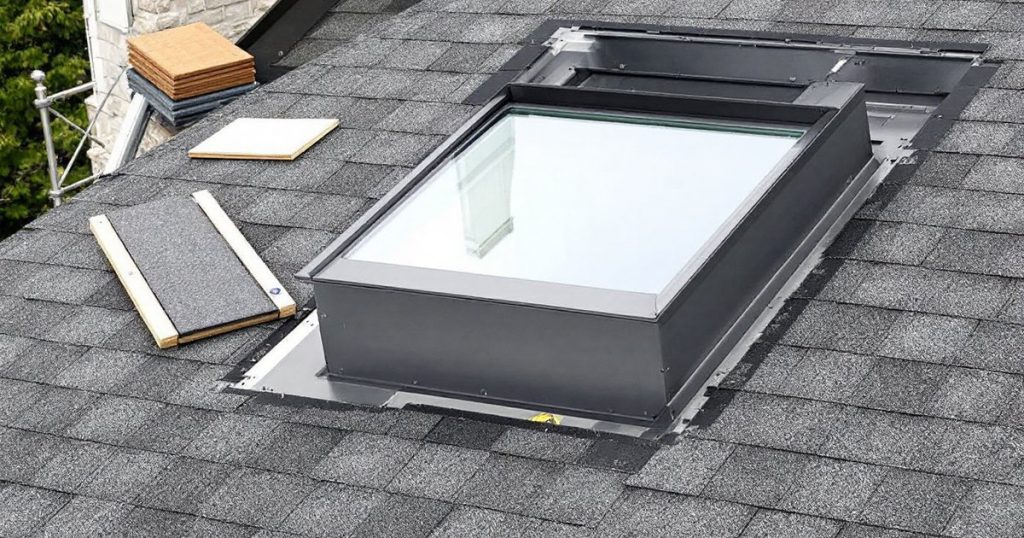
Should you replace skylights when reroofing? In most cases, yes: replace any skylight that is 10 or more years old, fogged, leaking, a plastic bubble, or past its maker’s leak warranty, because the shingles around it are already off and doing it later means cutting into a new roof. Keep a newer, dry, covered unit only if it gets a new manufacturer flashing kit, since VELUX excludes leaks after a reroof that skips its flashing.
By The Roofing Brief Team · Last reviewed: October 2026
Key numbers at a glance
These are the figures the replace-or-keep decision turns on, each taken from the maker document, code or cost guide named in the last column. Warranty terms are summarized from the documents in force in October 2026, and prices are dated reference points rather than quotes for your house.
| Question | Answer | Source |
|---|---|---|
| VELUX leak (installation) coverage | 10 years from purchase, only with VELUX flashing, on the original installation, over one layer of roofing; reinstallation capped at $1,000 per unit | VELUX Limited Warranty XUS 20194 (products bought on or after May 1, 2026) |
| VELUX reroof exclusion | Leaks from re-roofing without re-wrapping in VELUX adhesive skylight underlayment and VELUX approved flashing are not covered | VELUX Limited Warranty, section 3.1.7 |
| Sun-Tek glass skylight coverage | 20 years; 100% of material for years 1 to 10, then 75%, 50% and 25% credits; no removal or reinstallation costs | Sun-Tek Insulated Glass Skylight Limited Warranty |
| Standalone replacement cost | $800 to $2,400 average; VELUX lists $2,000 to $3,600 for a fixed VELUX skylight system | HomeGuide (Feb. 5, 2026); VELUX USA project calculator (Oct. 2026) |
| Parts for a like-for-like VELUX swap during a reroof | About $805 (FS C06 fixed skylight $686.27 plus EDL C06 flashing kit $119.00) | Retailer listings via Google Shopping, Oct. 13, 2026 |
| Remove a skylight and roof over the opening | $350 to $1,000 | HomeGuide (Feb. 5, 2026) |
Should I replace skylights when reroofing? The short rule
Replace the skylight during the reroof when it fails any one of four tests: it is 10 or more years old, it shows fogging, leaks or a cracked or yellowed dome, its maker’s leak or product warranty has expired, or it is a plastic bubble on a site-built curb. If it passes all four, keep the unit and have it reflashed with that maker’s current flashing kit.
The age cutoff comes from simple arithmetic. HomeGuide says most companies recommend replacing a skylight after about 30 years, and VELUX says its skylights often last 30 years or longer. Standard asphalt shingles carry a service-life estimate of about 20 years in both the InterNACHI life-expectancy chart and the NAHB home components study, as compiled in our roof lifespan by material report. A skylight that is already 10 years old will reach 30 before a 20-year roof wears out.
| Skylight age today | Age when a 20-year asphalt roof wears out | Past the 30-year mark? | Reroof call |
|---|---|---|---|
| 3 years | 23 years | No | Keep and reflash, if dry |
| 8 years | 28 years | No, but close | Keep only if dry and still under warranty |
| 10 years | 30 years | At the limit | Replace |
| 15 years | 35 years | Yes | Replace |
| 25 years | 45 years | Yes | Replace (or remove) |
Source: Roofing Brief arithmetic using the 30-year replacement guidance from HomeGuide and VELUX and the roughly 20-year asphalt service-life estimate from InterNACHI and NAHB. A 30-year architectural shingle or a metal roof stretches the horizon further and makes the case for replacement stronger.
What do VELUX and Sun-Tek warranties say about reroofing?
Both major brands tie coverage to how the skylight is flashed and handled, and a reroof touches both. VELUX excludes leaks after a reroof that does not re-wrap the unit in VELUX adhesive underlayment and VELUX flashing. Sun-Tek voids its warranty if a skylight is removed from the roof before Sun-Tek has inspected a claimed defect, and it never pays removal or reinstallation costs.
VELUX: flashing, one layer of roofing, and the original installation
VELUX promises that its deck-mounted FS, VS, VSE and VSS skylights and curb-mounted FCM, VCM, VCE and VCS skylights will not leak for 10 years when installed with VELUX flashing (EDL, EDW, EDM, EKL, EKW, ECL or ECW). The promise holds only for the original installation, on a residential building with one layer of properly installed roofing, installed strictly to VELUX instructions.
That wording comes from the VELUX limited warranty for products bought on or after May 1, 2026 (document XUS 20194). VELUX’s professional site adds that the installation warranty applies “no matter who installs the skylight,” but only VELUX skylights installed with VELUX flashing qualify.
Four clauses matter on a reroof. Section 3.1.7 excludes leaks caused by “re-roofing without re-wrapping using VELUX adhesive skylight underlayment and VELUX approved and related flashing.” Section 3.2.2 voids coverage on FS, VS, VSE, VSS, FCM, VCM, VCE and VCS units if adhesive or sealant is applied to the skylight during installation, so a roofer caulking the frame can cost you coverage. Section 5 says a warranty repair does not restart the clock. Section 6 caps reinstallation cost on a no-leak claim at $1,000 per unit and excludes labor on product claims.
Sun-Tek: prorated glass coverage and the removal rule
Sun-Tek Manufacturing of Orlando, Florida, covers its insulated glass skylights for 20 years from purchase or delivery, paying 100 percent of material cost for the first 10 years and then a prorated credit of 75 percent (years 11 to 13), 50 percent (14 to 16) and 25 percent (17 to 20). Its PolyDome polycarbonate skylights carry 10 years, or 5 years on SF models. Neither warranty covers removal, reinstallation or condensation.
The clause that bites during a reroof is the validation procedure: on installed skylights, the owner must contact Sun-Tek for instructions before removing the unit, because “removal of skylight from roof before inspection will void warranty.” Claims must be filed in writing within 30 days of discovering the defect, with photos and a receipt. If you suspect a defect in a Sun-Tek skylight, photograph it and contact Sun-Tek before the tear-off crew reaches it.
| Warranty term | VELUX (deck or curb glass skylights) | Sun-Tek glass (FGC, CMG and similar) | Sun-Tek polycarbonate (PolyDome) |
|---|---|---|---|
| Leak or installation coverage | 10 years, VELUX flashing required | None; covers materials and fabrication only | None; covers materials and fabrication only |
| Product coverage | 10 years | 20 years, prorated after year 10 | 10 years (SF: 5 years) |
| Insulated glass seal | 20 years | Within the 20-year product term | Not applicable |
| Removal and reinstallation labor | Up to $1,000 per unit on a no-leak claim | Not covered | Not covered |
| Reroof trap | No re-wrap with VELUX underlayment and flashing; sealant on the unit | Removing the unit before Sun-Tek inspects | Removing the unit before Sun-Tek inspects |
| Source | VELUX Limited Warranty XUS 20194; pro.veluxusa.com | Sun-Tek Insulated Glass Skylight Limited Warranty | Sun-Tek PolyDome Limited Warranty; Sun-Tek 2026 catalog |
Your roofer’s own workmanship warranty is a separate document. Some contractors exclude reused skylights or ask the owner to sign a waiver, a practice Glass Doctor and Happy Roofing both describe, so ask how the skylight perimeter is treated before signing. Our guide to manufacturer versus workmanship roofing warranties explains how the two layers differ.
How much warranty is left on your skylight in 2026?
Read the age off the skylight before the reroof, because the remaining warranty often settles the question. A VELUX bought in 2016 or earlier has used up its 10-year leak and product coverage and keeps only the 20-year glass seal term. A Sun-Tek glass unit past year 10 is down to a partial material credit. Once leak coverage is gone, keeping the old unit saves the purchase price but carries all of the leak risk.
| Age in 2026 (purchase year) | VELUX coverage still running | Sun-Tek glass coverage | Sun-Tek polycarbonate coverage |
|---|---|---|---|
| 0 to 5 years (2021 to 2026) | Leak, product, glass seal; shades and controls (5 years) | 100% of material | Yes (SF models up to 5 years) |
| 6 to 10 years (2016 to 2020) | Leak and product until year 10; glass seal | 100% of material | Other models up to year 10; SF expired |
| 11 to 13 years (2013 to 2015) | Glass seal only | 75% material credit | Expired |
| 14 to 16 years (2010 to 2012) | Glass seal only | 50% material credit | Expired |
| 17 to 20 years (2006 to 2009) | Pre-2010 VELUX warranty applies; current terms do not | 25% material credit | Expired |
| 21 years or more | None under current terms | Expired | Expired |
Source: Roofing Brief reading of the VELUX USA warranty page (current terms cover products bought from January 1, 2010) and the Sun-Tek glass and PolyDome warranties. Each warranty runs from the purchase date on the receipt, so exact coverage depends on your paperwork. VELUX skylights carry an ID tag that identifies the model and size; our VELUX size code guide shows where to find it and how old three-digit codes map to current sizes.
Can the roofer reuse the old skylight flashing?
Usually not, and the building code points the same way. The 2021 International Residential Code requires existing flashings that are rusted, damaged or deteriorated to be replaced during reroofing, and requires flashings to be reconstructed to the manufacturer’s installation instructions. For a VELUX unit, those instructions mean a VELUX flashing kit, which listed at about $119 for a C06 size in October 2026.
| 2021 IRC section | What it says | What it means for a skylight on a reroof |
|---|---|---|
| R908.3 Roof replacement | Roof replacement includes removing existing layers of roof covering down to the deck | The skylight perimeter is fully exposed, the cheapest point to swap the unit |
| R908.5 Reinstallation of materials | “Any existing flashings, edgings, outlets, vents or similar devices that are a part of the assembly shall be replaced where rusted, damaged or deteriorated” | Tired skylight flashing has to go |
| R908.6 Flashings | “Flashings shall be reconstructed in accordance with approved manufacturer’s installation instructions” | Use the skylight maker’s flashing method, not improvised coil stock |
| R903.2.2 Crickets and saddles | A cricket is required on the ridge side of any penetration more than 30 inches wide; unit skylights flashed to the manufacturer’s instructions are exempt | A wide skylight with improvised flashing may need a cricket that a factory kit avoids |
Source: 2021 IRC Chapter 9 as reproduced in the New Jersey adoption on UpCodes. Your jurisdiction may use the 2024 edition or local amendments, so confirm with the building department.
Mount type decides how much reuse is even possible. A curb-mounted skylight lifts off its wood curb, so the curb can be reflashed and the unit set back on top. A self-flashing unit such as the Sun-Tek FGC has a flange bedded in sealant and woven into the shingle courses; Sun-Tek’s instructions say the deck and felt should already be installed before the unit goes on, and that the bottom flange must sit on top of the shingles. On a tear-off, that unit generally has to come off with the old roof.
What does replacing a skylight during vs after a reroof cost?
Replacing a skylight during the reroof costs mostly the parts, because the tear-back and reshingling around it are already in the roofing price. Doing it later means paying for a standalone replacement, which HomeGuide puts at $800 to $2,400 on average and VELUX’s calculator puts at $2,000 to $3,600 for a fixed VELUX skylight system. Keeping a tired skylight now and replacing it later adds roughly $114 to $1,714 per unit.
| Path for one fixed deck-mounted skylight | Cost now | Cost later | Total |
|---|---|---|---|
| A. Replace during the reroof (VELUX FS C06 plus EDL kit) | $805 parts plus $15 to $160 labor = about $820 to $965 | $0 | About $820 to $965 |
| B. Reflash the old unit now, replace it in a few years | $119 kit plus $15 to $160 labor = about $134 to $279 | $800 to $2,400 standalone (HomeGuide) | About $934 to $2,679 |
| B, priced with VELUX’s own replacement range | About $134 to $279 | $2,000 to $3,600 (VELUX calculator) | About $2,134 to $3,879 |
| C. Remove the skylight and roof over the opening | $350 to $1,000 standalone (HomeGuide); often less inside a reroof | $0 | $350 to $1,000 or less, plus interior drywall |
How the numbers were built: parts are the October 13, 2026 retailer listings for a VELUX FS C06 2004 fixed skylight ($686.27) and an EDL C06 flashing kit ($119.00). Labor uses VELUX’s professional estimate of 30 minutes to 2 hours per skylight replacement, priced at HomeGuide’s $30 to $80 per hour skylight repair labor rate. The deferral penalty is the later standalone price minus the $686 skylight you would have bought anyway: $800 minus $686 is $114, and $2,400 minus $686 is $1,714. This is a Roofing Brief estimate in today’s dollars; it leaves out contractor markup, permits, interior trim and inflation, so real bids usually run higher on every line.
The arithmetic does not capture three soft costs of path B. The new roof is cut open around the skylight, the patched shingles may not match a weathered field, and the work may fall outside your roofer’s workmanship warranty if another company does it. For a full breakdown by unit type and brand, see our skylight replacement cost guide.
When should you keep, replace or remove a skylight?
Match the skylight’s age, condition, warranty and mount type to one of the rows below. Replacement wins whenever the unit is old, failing or out of leak coverage. Keeping wins only for newer, dry, covered units that can be properly reflashed. Removal makes sense when the room no longer needs the light or the skylight sits where it causes recurring problems.
| Your situation | Recommendation | Why |
|---|---|---|
| Skylight 10 or more years old, any brand | Replace during the reroof | It will pass 30 years before a 20-year asphalt roof is due again |
| Fogging between panes, cracked or yellowed dome, any active leak | Replace | Failed seals and domes cannot be restored by reflashing |
| Plastic bubble on a site-built curb | Replace with a glass unit, or remove | Short plastic warranties; see our guide to plastic bubble skylights |
| VELUX under 10 years old, dry, no fogging | Keep and re-wrap with a new VELUX flashing kit and VELUX adhesive underlayment; no sealant on the unit | Preserves the remaining 10-year leak coverage (sections 3.1.7 and 3.2.2) |
| Sun-Tek unit you suspect is defective | Photograph it and contact Sun-Tek before removal | Removal before inspection voids the warranty |
| Curb-mounted unit, sound curb, newer glass | Lift off, reflash the curb, reset | Curb mounts are the most reusable; Sun-Tek sells 3 1/2 inch step flash kits for site-built curbs |
| You plan a roof-over instead of a tear-off | Replace or remove, and confirm with the maker | VELUX leak coverage assumes one layer of roofing |
| Room no longer needs the light, or chronic ice damming at the unit | Remove and deck over during the reroof | HomeGuide prices removal and roofing over at $350 to $1,000 |
| Tile or metal roof | Order the roof-specific kit (VELUX EDW for tile, EDM for metal) | Shingle kits do not fit; Sun-Tek step flash kits are not for metal roofs |
How to handle skylights in your reroof contract
Settle the skylight plan in writing before the tear-off starts, because the crew makes the call on the roof if you do not. The steps below turn the decision into specific contract lines so the price, the parts and the warranty treatment are clear for every skylight on the house.
- Identify each unit. Find the brand, model and size on the ID tag or receipt, and note the purchase year. VELUX tags sit at the interior bottom left of deck-mounted frames.
- Inspect from inside. Look for fogging between panes, stains on the light shaft, cracked or yellowed domes and rot at the curb. Any of these moves the unit to replacement.
- Check the warranty clock. Use the coverage table above. If a Sun-Tek unit may be defective, contact Sun-Tek before anyone removes it.
- Choose keep, replace or remove. Use the decision table, and price replacement units at the same visit so the comparison is like for like.
- Write each skylight as its own line item. List the new model and size, the flashing kit part number (for example VELUX EDL C06), the adhesive underlayment, interior trim work and any framing repair allowance.
- Ask how the workmanship warranty treats the skylight. Get any exclusion or waiver for a reused unit in writing before you sign.
- Keep the paperwork. Save the new skylight’s receipt and model tag photo, since VELUX and Sun-Tek both start the warranty clock at purchase.
Is replacing during a reroof always the right call?
No. A dry, recently installed skylight with years of leak coverage left can be kept, and replacing it adds the cost of a new unit for little gain. The advice to always replace comes largely from sellers: VELUX’s roofer page tells contractors that replacing a skylight can raise job profit 28 to 36 percent compared with only reflashing, so weigh that guidance alongside your unit’s actual age and condition.
The strongest case for keeping is a VELUX deck-mounted unit under about eight years old with no fogging, re-wrapped with a new VELUX kit. The strongest case for replacing is everything else on an older house. For the full replacement process, from tear-back to reshingling, see our roof skylight replacement guide.
Frequently asked questions
Should you replace your skylights when you get a new roof?
Replace them if they are 10 or more years old, fogged, leaking, plastic bubbles, or out of their maker’s warranty, because the shingles around them are already off and later replacement means opening the new roof. Keep a newer unit that is dry and still covered, but have it reflashed with a new manufacturer flashing kit. VELUX excludes leak claims when a reroof skips its own flashing and adhesive underlayment.
What is the average cost to replace a skylight?
HomeGuide puts a standalone skylight replacement at $800 to $2,400 on average (February 2026), and VELUX’s own calculator lists $2,000 to $3,600 to replace a fixed VELUX skylight system with installation. During a reroof the added cost can be much lower, because the shingle tear-back is already in the roofing price. Bids vary with size, roof pitch, unit type and interior finishing.
Can I replace skylights without replacing the roof?
Yes. Skylights are replaced on their own all the time; VELUX says a single replacement typically takes a couple of hours. The installer removes the shingles around the unit, swaps the skylight and its flashing, then reshingles. The catch is cost and patching: you pay for that shingle work separately, and newer shingles woven in around the opening may not match a weathered roof exactly.
Does reroofing void my skylight warranty?
It can. The VELUX limited warranty (May 2026 edition) excludes leaks caused by re-roofing without re-wrapping the skylight in VELUX adhesive underlayment and VELUX approved flashing, and voids coverage on deck-mounted models if sealant is applied to the skylight. Sun-Tek’s warranty is voided if a skylight is removed from the roof before Sun-Tek inspects a claimed defect.
Can a roofer reuse the old skylight flashing?
Usually not. The 2021 IRC says existing flashings that are rusted, damaged or deteriorated must be replaced during reroofing (R908.5) and that flashings must be reconstructed per the manufacturer’s instructions (R908.6). For VELUX units, those instructions mean a VELUX flashing kit. A new VELUX EDL kit listed at about $119 at major retailers in October 2026, so reusing old flashing saves little.
Do roofers usually install skylights?
Many do. VELUX’s installer locator lists roofing companies that also install skylights alongside skylight-only specialists, and VELUX trains roofers through its Pro Partner program. Ask your roofer whether they install the brand you want and whether their workmanship warranty covers the skylight perimeter. Some contractors exclude reused skylights or ask the owner to sign a waiver.
What is the 25% rule in roofing?
The 25% rule is a Florida Building Code provision: Section 706.1.1 of the Existing Building volume limits repairs to 25 percent of a roof or roof section in any 12-month period unless that roof or section is brought to current code. Florida Statutes 553.844(5) exempts roofs built to the 2007 code or later, so only the repaired portion must meet current code.
Why aren’t skylights popular anymore?
Skylights lost favor in the 1990s and 2000s because cheaply installed units leaked, faded furniture and lost heat, according to a July 2025 Realtor.com report. The same report says modern double-glazed, low-E skylights have brought them back. Most of the bad reputation belongs to old plastic bubbles and site-built flashing, which is why a reroof is a good moment to replace those units.