
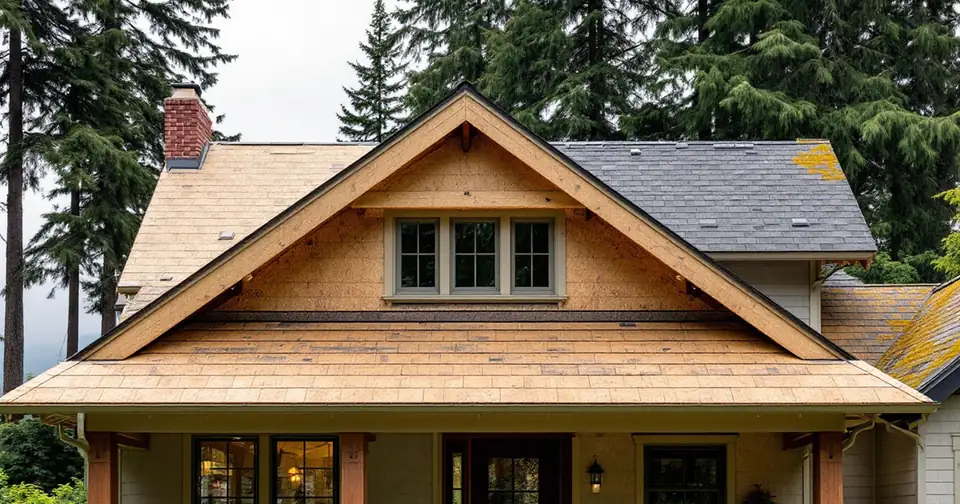
Roof replacement cost in Oregon runs from about $7,200 on This Old House’s modeled average to $10,700 to $16,800 for a 2,000 sq ft architectural shingle tear-off in Roof Cost Data’s 2026 model, and $27,786 for a fully specified 30-square asphalt job in Medford (Cost vs. Value 2025). Oregon roofers earn about 6 percent more than the U.S. average, and about 15 percent more in the Portland metro.
By The Roofing Brief Team. Last reviewed: October 2026. Wage figures are BLS Occupational Employment and Wage Statistics (OEWS) May 2025 estimates pulled from the BLS public data API; code text was read from the Oregon Building Codes Division’s posted 2026 Oregon Residential Specialty Code (ORSC) chapters; climate figures are NOAA 1991 to 2020 normals.
Oregon roof replacement cost: key numbers at a glance
These are the figures an Oregon homeowner usually needs before the first estimate. Each comes from a named source, and each cost is a range that moves with roof size, pitch, material, tear-off layers and region. Use them to test whether a bid sits in a normal band, not as a price any contractor owes you.
| Figure | Oregon value | Source |
|---|---|---|
| Modeled statewide average replacement | $7,225 (range $5,639 to $18,173) | This Old House, Oregon roof replacement cost (RSMeans data, updated June 8, 2026) |
| 2,000 sq ft architectural shingle roof with tear-off | $10,700 to $16,800 statewide; $11,200 to $16,400 in Portland | Roof Cost Data, Oregon model (May 11, 2026) |
| Full-spec 30-square asphalt tear-off, Medford | $27,786 job cost; 75.2 percent recouped at resale | Cost vs. Value Report 2025, Medford, Oregon |
| Oregon roofer mean hourly wage vs U.S. | $29.57 vs $27.95 (about 106 percent) | BLS OEWS, May 2025, SOC 47-2181 |
| Portland metro roofer mean hourly wage | $32.13 (about 115 percent of the U.S. mean) | BLS OEWS, May 2025, Portland-Vancouver-Hillsboro OR-WA |
| Building permit for a like-for-like reroof | Generally not required when added dead load is 4 psf or less (exceptions apply) | 2026 ORSC Section R105.2, item 15 (effective Oct. 1, 2026) |
| Contractor license, bond and insurance | CCB license; $20,000 bond and $300,000 per-occurrence insurance for a residential specialty contractor | Oregon CCB Endorsement Chart (11/2024) |
How much does a new roof cost in Oregon in 2026?
A new roof in Oregon costs roughly $4.56 to $9.26 per square foot installed for asphalt shingles, depending on which source you use and what the job includes. This Old House models the low end, Roof Cost Data lands a typical 2,000 sq ft architectural roof at $10,700 to $16,800, and the Medford Cost vs. Value job works out to $9.26 per square foot.
The sources are not contradicting each other. They price different jobs. This Old House builds its estimate from RSMeans cost data and puts the Oregon median home at 1,946 sq ft, or about 19.5 roofing squares, so its average reads like a basic, simple-roof price. Cost vs. Value prices one demanding, fixed scope: a 3,000 sq ft (30-square) hip roof torn off to the deck, with new underlayment and flashing. Roof Cost Data applies a local labor index to a 2,000 sq ft architectural shingle roof with tear-off.
| Source | What it measures | Oregon figure | Date |
|---|---|---|---|
| This Old House | Modeled statewide average, all materials | $7,225; range $5,639 to $18,173; asphalt $4.56 per sq ft | Updated June 8, 2026 |
| Roof Cost Data | 2,000 sq ft architectural shingle roof, tear-off included | $10,700 to $16,800 statewide; Portland $11,200 to $16,400; Beaverton $10,900 to $16,000; Hillsboro $10,700 to $15,800 | May 11, 2026 |
| Interstate Roofing (Oregon contractor calculator) | Average-size Oregon home (1,780 sq ft), asphalt | $9,300 to $27,200; composition asphalt $9,309 to $15,521; designer asphalt $16,305 to $27,163; Portland $9,600 to $13,000 | Undated, accessed October 2026 |
| Cost vs. Value Report | 30-square asphalt tear-off, Medford | $27,786 (Pacific region $36,391; U.S. $31,871) | 2025 |
| Cost vs. Value Report | Metal roof replacement, Medford | $45,577 (Pacific region $62,152; U.S. $51,865) | 2025 |
| The Roofing Brief national baseline | Architectural asphalt, installed | $5 to $8 per sq ft | 2026 roofing cost report |
Medford is the only Oregon market in the 2025 Cost vs. Value data, and its asphalt job priced 12.8 percent below the national figure ($27,786 against $31,871). For how Oregon compares with other states, see our national roof replacement cost guide and the roof replacement cost by metro ranking.
Oregon roof cost by roof size
Roof size sets the base of every Oregon estimate, and it is measured in roof area, not floor area. One roofing square is 100 sq ft. The table applies three published rates to common roof sizes, including the 2,200 sq ft size many searchers ask about, so you can see the gap between a basic job, a typical architectural job and a full-spec Medford job.
| Roof area | Squares | At $4.56/sq ft (This Old House asphalt) | At $5 to $8/sq ft (Roofing Brief baseline, architectural) | At $9.26/sq ft (Cost vs. Value, Medford rate) |
|---|---|---|---|---|
| 1,500 sq ft | 15 | $6,840 | $7,500 to $12,000 | $13,893 |
| 2,000 sq ft | 20 | $9,120 | $10,000 to $16,000 | $18,524 |
| 2,200 sq ft | 22 | $10,032 | $11,000 to $17,600 | $20,376 |
| 2,500 sq ft | 25 | $11,400 | $12,500 to $20,000 | $23,155 |
| 3,000 sq ft | 30 | $13,680 | $15,000 to $24,000 | $27,786 (reported) |
Source note: Roofing Brief calculation. The $9.26 rate is the Medford Cost vs. Value job cost ($27,786) divided by its 3,000 sq ft; only the 30-square figure is a reported job cost. A house’s floor area understates roof area once pitch and overhangs are counted, so measure the roof. Our guides to calculating roof square footage, the 2,000 sq ft roof cost and the cost to replace a roof on a 1,500 square foot house walk through the math.
Price per square: a quick way to compare Oregon bids
Dividing a bid by its measured squares turns any Oregon quote into a number you can compare. The published sources above translate to roughly $456 to $926 per square for asphalt, with most architectural shingle jobs in the $500 to $820 band. A bid far outside that band is not automatically wrong, but it should come with a reason.
| Published figure | Arithmetic | Per square | Source |
|---|---|---|---|
| This Old House asphalt rate | $4.56 x 100 sq ft | $456 | This Old House (2026) |
| Roofing Brief architectural baseline | $5 to $8 x 100 sq ft | $500 to $800 | 2026 roofing cost report |
| Roof Cost Data, Portland, 2,000 sq ft | $11,200 to $16,400 / 20 squares | $560 to $820 | Roof Cost Data (May 2026) |
| Roof Cost Data, Oregon statewide, 2,000 sq ft | $10,700 to $16,800 / 20 squares | $535 to $840 | Roof Cost Data (May 2026) |
| Cost vs. Value, Medford, full spec | $27,786 / 30 squares | $926 | Cost vs. Value 2025 |
| Cost vs. Value, Pacific region average | $36,391 / 30 squares | $1,213 | Cost vs. Value 2025 |
Oregon roof cost by material
Material changes an Oregon roof price more than any other choice. On a 2,000 sq ft roof with tear-off, Roof Cost Data’s 2026 Oregon model puts architectural asphalt at $11,100 to $16,300, standing seam metal at $21,600 to $31,800 and natural slate at $48,600 to $71,400. Architectural asphalt also meets Oregon’s optional wildfire roofing section, which keeps it the default in most of the state.
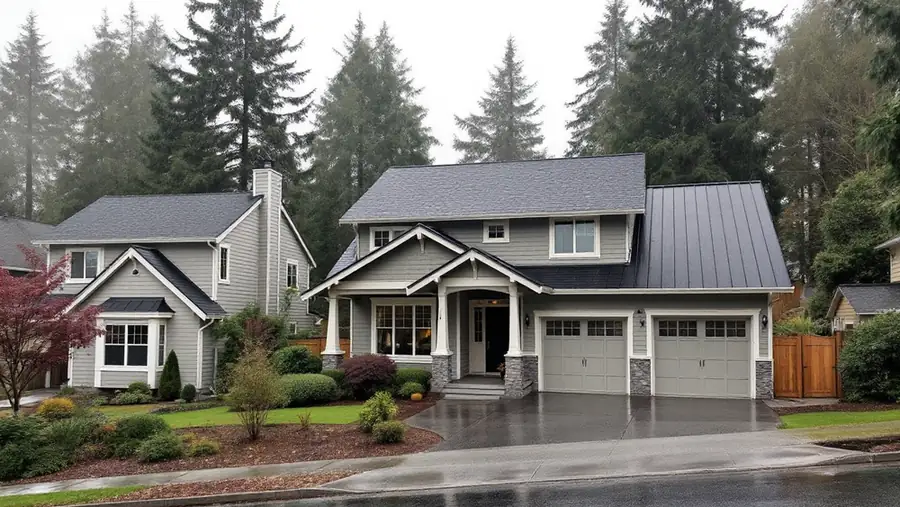
| Material | Per sq ft installed (This Old House, Oregon) | 2,000 sq ft roof with tear-off (Roof Cost Data, Oregon) | Oregon note | Source |
|---|---|---|---|---|
| 3-tab asphalt | Asphalt $4.56 | $9,400 to $13,800 | Lowest first cost | This Old House (2026); Roof Cost Data (2026) |
| Architectural asphalt | Asphalt $4.56 | $11,100 to $16,300 | Named as compliant roofing in ORSC R327; BCD estimates it at about $4 per sq ft | Roof Cost Data (2026); 2026 ORSC R327.3; BCD cost sheet |
| Impact-resistant asphalt | Not listed | $12,700 to $18,600 | Hail is a minor driver in most of Oregon; buy it for other reasons | Roof Cost Data (2026) |
| Corrugated metal panel | Metal $8.80 | $13,600 to $20,000 | Common on rural and east-side outbuildings | This Old House (2026); Roof Cost Data (2026) |
| Standing seam metal | Metal $8.80 | $21,600 to $31,800 | Sheds snow; ORSC R908.4 lets a complete, separate standing seam system that carries loads to the structure go on without removing the old covering | Roof Cost Data (2026); 2026 ORSC R908.4 |
| Wood shakes | Wood $10.33 | $20,300 to $29,800 | Not permitted on new homes in areas covered by a local R327 adoption | This Old House (2026); Roof Cost Data (2026); ORSC R327.3 |
| Concrete tile | Not listed | $21,200 to $31,200 | Weight can trigger a permit (see the 4 psf rule below) | Roof Cost Data (2026); ORSC R105.2 |
| Clay tile | Clay $14.64 | $27,000 to $39,700 | Same weight caveat as concrete tile | This Old House (2026); Roof Cost Data (2026) |
| Natural slate | Slate $14.70 | $48,600 to $71,400 | Heaviest option; structural check advised | This Old House (2026); Roof Cost Data (2026) |
| Flat or membrane roofing | Not listed | $17,800 to $26,200 | Low-slope sections on modern infill homes | Roof Cost Data (2026) |
The two sources differ because This Old House reports a modeled per-square-foot average while Roof Cost Data prices a full 2,000 sq ft job with tear-off and a local labor index. For more on the main upgrade, see our metal roof cost guide.
Why Portland roofs cost more than Eugene or Medford roofs
Labor is the clearest reason Oregon prices differ from the rest of the country and from one Oregon city to the next. Oregon roofers earned a mean $29.57 an hour in May 2025, about 106 percent of the $27.95 U.S. mean, per BLS. In the Portland metro the mean was $32.13 (115 percent), while Eugene ($25.55) and Medford ($25.82) sat below the national figure.
The median shows the same split: $28.35 an hour statewide against $26.65 nationally, a ratio of about 1.06 to 1. On an annual basis the Oregon mean was $61,510, compared with $58,140 for the U.S. BLS counted about 3,430 roofer jobs in Oregon. Our roofer salary by state report ranks every state on the same data.
| Metro (BLS area) | Roofer jobs | Mean hourly wage | Median hourly wage | Mean vs U.S. | Contractor shortlist |
|---|---|---|---|---|---|
| Portland-Vancouver-Hillsboro (OR-WA) | 2,280 | $32.13 | $29.43 | 115 percent | Best roofers in Portland |
| Bend | 230 | $29.51 | $28.84 | 106 percent | Best roofers in Bend |
| Grants Pass | 40 | $28.43 | $24.71 | 102 percent | Not yet covered |
| Salem | 390 | $28.12 | $25.33 | 101 percent | Best roofers in Salem |
| Albany | 160 | $26.34 | $24.27 | 94 percent | Best roofers in Albany |
| Medford | 150 | $25.82 | $24.01 | 92 percent | Best roofers in Medford |
| Eugene-Springfield | 280 | $25.55 | $23.00 | 91 percent | Best roofers in Eugene |
| Oregon statewide | 3,430 | $29.57 | $28.35 | 106 percent | U.S. mean $27.95, median $26.65 |
Source: BLS Occupational Employment and Wage Statistics, May 2025, roofers (SOC 47-2181), state and metropolitan area estimates, retrieved from the BLS public data API. The Portland area includes Clark County, Washington; for prices on that side of the Columbia River, see our Washington roof replacement cost guide. Wage is one input to a bid; overhead, insurance, equipment and margin sit on top, so a 15 percent wage gap does not translate into a 15 percent price gap. The Medford data point fits the pattern: wages about 8 percent below the U.S. mean, and a Cost vs. Value asphalt job about 13 percent below the national job cost.
What changes the price of a roof replacement in Oregon
Most of the spread between two Oregon quotes for the same house comes from a short list of local factors: labor in your metro, rotted decking from years of rain, moss prep, how many old layers come off, a change to a heavier roof, wildfire rules where a city or county has adopted them, and the disposal line. The table maps each driver to its effect and the source behind it.
| Driver | Effect on the quote | Source |
|---|---|---|
| Metro labor rates | Portland metro wages run about 15 percent above the U.S. mean; Eugene and Medford run 8 to 9 percent below | BLS OEWS, May 2025 |
| Rotted or wet decking | Structural repairs of $700 to $2,800 in This Old House’s Oregon model, found only after tear-off | This Old House (2026) |
| Tear-off of the old roof | $1,100 to $3,000 in This Old House’s Oregon model | This Old House (2026) |
| Two or more existing layers | A recover is not allowed; full tear-off to the deck | 2026 ORSC R908.4, exception 3 |
| Moss and shade | Moss can lift asphalt shingles and let water reach the layers underneath; heavy growth adds cleaning and prep | Oregon State University Extension (2023, reviewed 2025) |
| Switching to a heavier roof | Added dead load over 4 psf takes the job out of the permit exemption, which can add a permit and a structural review | 2026 ORSC R105.2, item 15 |
| Local wildfire code (R327) | Homes originally built under a local R327 adoption need a reroof permit; wood shakes are barred on covered new homes | 2026 ORSC R105.2 and R327.3 |
| Snow load in the Cascades and east side | Prescriptive design starts at a 30 psf ground snow load and rises with elevation; loads above 70 psf need engineering | 2026 ORSC R301.2.3 |
| Permit, where one is needed | $150 to $500 in This Old House’s Oregon model | This Old House (2026) |
Do you need a permit to reroof in Oregon?
Usually not, for a detached house. Chapter 1 of the 2026 Oregon Residential Specialty Code, effective and mandatory October 1, 2026, exempts reroofing from a building permit, including replacement of damaged sheathing, where the increased dead load is 4 psf or less. Townhouses, solar roof coverings and homes built under a local wildfire code are exceptions.
The exemption is statewide, which sets Oregon apart from states such as Utah and California, where cities commonly require a reroof permit. The City of Portland applies the same logic: its residential permit guide says reroofing with a roofing material of similar weight does not need a building permit, including replacement of some or all existing roof sheathing. Separate plumbing, electrical or mechanical permits may still be required for work tied to an exempt reroof, the code adds.
| Your Oregon reroof | Building permit? | Source |
|---|---|---|
| Detached house, like-for-like asphalt, added dead load 4 psf or less | Generally no, including damaged sheathing replacement | 2026 ORSC R105.2, item 15 |
| Change to a heavier roof (more than 4 psf added) | Yes; expect a structural question | 2026 ORSC R105.2, item 15 |
| Townhouse or attached stacked two-family dwelling | Yes | 2026 ORSC R105.2, item 15, exception 1 |
| Building-integrated solar roof panels or other photovoltaic roof coverings | Yes | 2026 ORSC R105.2, item 15, exception 2 |
| Home originally required to meet R327 under a local adoption | Yes | 2026 ORSC R105.2, item 15, exception 3 |
| Portland home in a city wildfire zone | Yes | Portland Permitting and Development, residential permits guide |
The 4 psf line is easy to check: 4 psf equals 400 pounds per 100 sq ft square of added weight. Compare the installed weight per square on the old and new product data sheets, and remember a recover adds the full weight of the new layer. Our shingle weight per square by brand table helps with the asphalt side of that math.
Which code edition applies to an Oregon reroof in late 2026?
The 2026 ORSC, based on the 2024 International Residential Code, took effect October 1, 2026 with a six-month phase-in that ends with mandatory use on April 1, 2027, according to the Building Codes Division. During the phase-in, the 2023 ORSC (based on the 2021 IRC) may still be used for every chapter except Chapter 1, which carries the permit rules above.
For a reroof the practical code points are in Chapter 9. Section R908.3 says a roof replacement includes removing existing layers down to the deck. Section R908.4 bars a recover over a water-soaked or deteriorated roof, over slate, clay, cement or asbestos-cement tile, or over a roof that already has two or more applications of any roof covering.
Rain, moss and snow: how Oregon’s climate splits roof costs
Oregon is two roofing climates. West of the Cascades, NOAA normals show 37 to 70 inches of rain a year and 90 to 131 days with at least a tenth of an inch, which feeds moss and rots decking. East of the mountains, Bend gets 10.6 inches of precipitation but 21.6 inches of snow, so snow load and ice detailing matter more than moss.
| Station | Annual precipitation (in) | Days with 0.10 in or more | Annual snowfall (in) | January mean temp (F) |
|---|---|---|---|---|
| Astoria (coast) | 70.26 | 131.1 | Not reported | 43.7 |
| Eugene | 40.83 | 89.8 | Not reported | 41.4 |
| Salem | 40.08 | 91.5 | Not reported | 42.1 |
| Portland International Airport | 36.92 | 93.3 | 4.2 | 41.9 |
| Medford | 18.43 | 51.0 | 3.4 | 40.4 |
| Pendleton | 12.83 | 41.9 | 15.7 | 34.9 |
| Bend | 10.62 | 29.7 | 21.6 | 33.6 |
Source: NOAA National Centers for Environmental Information, U.S. Climate Normals 1991 to 2020, annual and monthly station normals. “Not reported” means the station has no published snowfall normal.
Moss in western Oregon
Moss is a cost driver west of the Cascades because it holds water against the roof. Oregon State University Extension says moss does not directly damage roof materials, but it traps soil and debris that keep surfaces wet, and on asphalt and metal roofs it can lift shingles and let water reach the layers underneath. The lasting fix is more sun, usually by trimming trees.
For control, OSU Extension describes zinc sulfate and potassium salts of fatty acids applied after cleaning, and warns that zinc corrodes copper gutters, downspouts and flashing. A long-handled scrub brush is the safer cleaning tool; pressure washing can damage shingles. Ask whether a bid includes moss removal before tear-off and whether the new roof’s warranty covers algae. Our roof moss removal cost guide and roof algae by region report cover upkeep after the new roof goes on.
Snow loads and ice barriers in the Cascades and east side
Oregon writes its own snow rules into the ORSC. In the 2026 text, Section R301.2.3 sets a minimum ground snow load of 30 psf for prescriptive design, points designers to the Oregon Design Criteria Hub for site values, and requires engineered design where the ground snow load exceeds 70 psf. Table R301.2.3.1 adds load with elevation: 0.07 psf per foot in the Cascades and Coast Range, 0.04 in the Willamette Valley.
Ice barrier is a local call. ORSC R905.1.2 requires it where the average daily January temperature is 25 F or less, or where the local Table R301.2 entry records a history of ice damming. No station in the table above meets the 25 F test, so the requirement turns on your building department’s entry. Where it applies, the membrane runs from the eave to at least 24 inches inside the exterior wall line. Our ice and water shield guide covers the product.
When to schedule an Oregon reroof
Western Oregon’s dry window is short. NOAA normals put Portland’s July and August rain at 1.05 inches combined, against 16.25 inches from November through January; Eugene’s December normal alone is 7.21 inches. Booking a summer install reduces the risk of rain delays and open-deck exposure, though demand also peaks then. No public source shows a reliable seasonal discount, so compare bids rather than assume one.
Wildfire rules after SB 83: where Oregon roofs must meet R327
Oregon no longer has a statewide wildfire hazard map that drives home hardening rules. Senate Bill 83 (2025) repealed the map and the state-level defensible space and home hardening requirements tied to it, replacing them with codes local governments can choose to adopt, according to Oregon’s Division of Financial Regulation. The roofing rules now live in ORSC Section R327, by local opt-in.
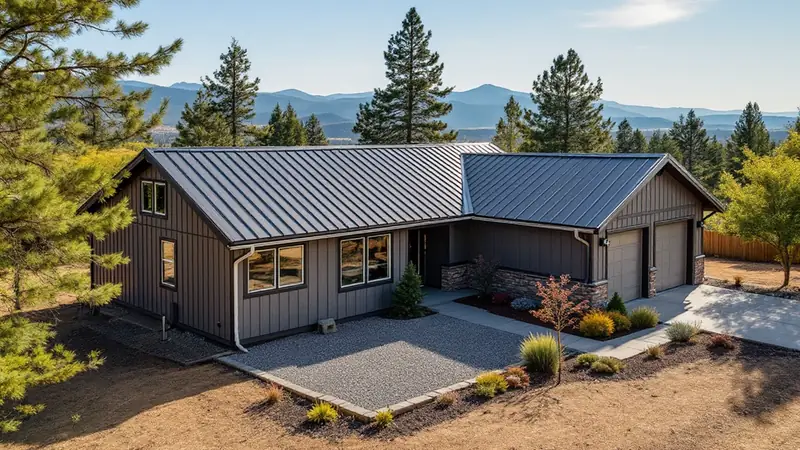
As of October 2026 the Building Codes Division lists five adopters: Ashland, Bend, Deschutes County, Grants Pass and Sisters. Where adopted, R327 applies to new dwellings and certain accessory structures in areas the local government designates. Elsewhere in Oregon, BCD describes R327 as voluntary guidance that can be followed when replacing exterior elements of an existing home.
| R327 item | What the code says | Effect on a roof budget | Source |
|---|---|---|---|
| Roof covering | Asphalt, slate, metal, clay or concrete tile, or other roofing equivalent to at least a Class B assembly | Architectural asphalt already complies; no material upgrade needed | 2026 ORSC R327.3 |
| Wood shingles and shakes | Not permitted on structures within the scope of R327 | Rules out cedar shake on covered new homes | 2026 ORSC R327.3 |
| Open-profile roofs (tile, some metal) | Gaps at the eave must be fire-blocked, or a 72-pound mineral-surfaced cap sheet installed over the deck | Adds a cap sheet or eave closures | 2026 ORSC R327.3 |
| Valley flashing | No. 26 gage galvanized metal over a 36-inch-wide 72-pound cap sheet running the full valley | Adds valley material and labor | 2026 ORSC R327.3 |
| Gutters and downspouts | Noncombustible, with an approved way to keep leaves out | Aluminum gutters and guards; BCD estimates $9.55 and $7.66 per linear foot | 2026 ORSC R327.3.1; BCD cost sheet |
| Attic vents | Mesh of 1/16 to 1/8 inch or ember-resistant vents; no underside-of-eave vents below 12 feet unless approved | BCD estimates fire-rated vents at $100 to $200 each | 2026 ORSC R327.3.2; BCD cost sheet |
| Reroof permit | Required where the original construction had to comply with R327 under a local adoption | Adds a permit fee and inspection | 2026 ORSC R105.2, item 15, exception 3 |
BCD’s own estimate puts R327 hardening at about 2 to 11 percent above standard new construction, and notes that about 80 percent of Northwest homes already use compliant asphalt shingles. For a reroof in Ashland, Bend, Grants Pass, Sisters or unincorporated Deschutes County, ask the building department whether your lot was designated. For how Class A and Class B assemblies are tested, see our guide to Class A fire-rated roofs.
Oregon CCB licensing, bonds and the notices your roofer must give you
Oregon does not issue a separate roofing license; roofers work under a Construction Contractors Board (CCB) license, and the CCB’s endorsement chart uses roofing as an example of residential specialty work. A residential specialty contractor must carry a $20,000 residential bond and $300,000 per occurrence in liability insurance. A residential general contractor carries a $25,000 bond and $500,000 per occurrence, per the CCB endorsement chart.
The bond is limited. The CCB’s Consumer Protection Notice says the bond provides a limited amount of financial security in contract disputes and is not a safety net, and that liability insurance does not cover poor workmanship. If the contractor is not licensed, the CCB bond and dispute resolution services are not available to you.
| Requirement | Oregon rule | Source |
|---|---|---|
| Who licenses roofers | Construction Contractors Board; check the license at oregon.gov/ccb | CCB Consumer Protection Notice (ORS 701.330) |
| Residential specialty contractor (RSC) | $20,000 residential bond; $300,000 per occurrence insurance | CCB Endorsement Chart (11/2024) |
| Residential general contractor (RGC) | $25,000 residential bond; $500,000 per occurrence insurance | CCB Endorsement Chart (11/2024) |
| Written contract | Required when the contract price is more than $2,000 | CCB Required Notices chart |
| Consumer Protection Notice | On or before the contract date when the contract exceeds $2,000 | ORS 701.330; OAR 812-012-0130 |
| Notice of Procedure | Explains steps before arbitration or a lawsuit; same timing | ORS 701.330 |
| Information Notice to Owner about Construction Liens | Explains lien law and “pay twice” risk; a contractor that skips it can lose lien rights | ORS 87.093; ORS 701.992 |
| Complaint window | Within one year of substantial completion, per the CCB notice form | CCB Consumer Protection Notice |
Keep the signed notices with your contract. The CCB requires the contractor to keep proof of delivery for two years, and the lien notice matters most when subcontractors or suppliers are involved, since an unpaid supplier may otherwise file a lien on your property.
Roof age, insurance and wildfire rules for Oregon homeowners
Unlike Florida, Oregon’s homeowners insurance laws summarized by the Division of Financial Regulation include no roof-age rule, so how an insurer treats a 20-year-old roof depends on the policy and the company’s underwriting. State law does shape the conversation: insurers must consider home hardening and defensible space, and must explain the main reasons behind a premium increase.
| Oregon law | What it does for a homeowner | Source |
|---|---|---|
| SB 82 (2023) | Requires insurers to consider home hardening and defensible space in rating and underwriting; requires fuller information in cancellation, nonrenewal and premium increase notices | Oregon Division of Financial Regulation |
| SB 83 (2025) | Repealed the state wildfire hazard map; insurers may still use their own proprietary wildfire models | Oregon Division of Financial Regulation |
| HB 2563 (2025) | On renewal, premium increase or written request, the explanation must list up to four significant factors behind an increase; effective Sept. 1, 2026 | Oregon Division of Financial Regulation |
| Oregon FAIR Plan | Residential coverage limit raised from $400,000 to $600,000 | Oregon Division of Financial Regulation |
If a renewal notice raises your premium, the HB 2563 explanation is the place to see whether roof age or condition is one of the listed factors. Keep the invoice, product data and any R327 or Class A documentation from a new roof; it is the evidence an insurer would need to credit mitigation. Our roof age and insurance non-renewal report compares how roof age affects coverage across states.
Does a new roof pay back at resale in Oregon?
In Medford, the only Oregon market in the 2025 Cost vs. Value Report, an asphalt roof replacement recouped 75.2 percent of its $27,786 cost at resale, above the 67.5 percent national figure. A metal roof recouped 57.3 percent of $45,577. Both beat Seattle, the closest Northwest comparison, where asphalt recouped 42.8 percent.
| Project (Cost vs. Value 2025) | Medford job cost | Medford resale value | Medford recouped | Pacific region recouped | U.S. recouped |
|---|---|---|---|---|---|
| Roofing replacement, asphalt shingles | $27,786 | $20,908 | 75.2 percent | 76.2 percent | 67.5 percent |
| Roofing replacement, metal | $45,577 | $26,137 | 57.3 percent | 51.0 percent | 50.1 percent |
Source: Cost vs. Value Report 2025, Medford, Oregon; Pacific region and national averages as published on the same page. Resale value is an estimate by real estate professionals, not a sale price. A homeowner selling within a few years may get more back from asphalt; metal’s case rests on lifespan and snow shedding over long ownership.
Tax credits and rebates for an Oregon roof in 2026
No federal tax credit pays toward an ordinary Oregon roof replacement installed in 2026. The federal 25C credit does not apply to property placed in service after December 31, 2025, and the 25D clean energy credit ended for expenditures made after that date (Public Law 119-21, secs. 70505 and 70506). Check current IRS guidance and a tax professional before counting on any credit.
Oregon’s own solar incentive is not a reliable offset either. The Oregon Department of Energy reopened its Solar + Storage Rebate Program on June 15, 2026 with $1.1 million, and reported that all of it was reserved within minutes; ODOE says it is no longer accepting applications. If you pair a reroof with solar shingles or panels, price the job without a rebate and ask your utility about any program before assuming one exists.
Which roof should you pick in Oregon?
The right Oregon roof depends on which side of the Cascades you live on, how much shade and moss the roof gets, whether your lot sits in a local R327 area, and how long you plan to stay. This decision aid maps common Oregon situations to a starting recommendation; confirm each with a CCB-licensed contractor and your building department.
| Your situation | Starting recommendation | Why (source) |
|---|---|---|
| Selling within about five years | Architectural asphalt | 75.2 percent recouped in Medford vs 57.3 percent for metal (Cost vs. Value 2025) |
| Shaded Willamette Valley or coast roof with heavy moss | Asphalt with an algae-resistant warranty, plus tree trimming; no zinc if you have copper flashing | Moss lifts shingles; zinc corrodes copper (OSU Extension) |
| Bend, Sisters or Cascades foothills, staying 25 years or more | Standing seam metal with snow retention over doors and walkways | Snow load rises with elevation (ORSC R301.2.3) |
| Lot designated under a local R327 adoption | Asphalt, metal or tile; avoid wood shakes; noncombustible gutters | ORSC R327.3 and R327.3.1 |
| Switching from asphalt to concrete or clay tile | Get the added weight per square first; expect a permit if it exceeds 4 psf | ORSC R105.2, item 15 |
| Existing roof already has two layers | Full tear-off; do not price a recover | ORSC R908.4, exception 3 |
| Portland metro budget is tight | Get three bids priced per square; Portland labor runs about 15 percent above the U.S. mean | BLS OEWS, May 2025 |
How to check an Oregon roof replacement quote
A fair Oregon quote is itemized, matches the roof’s measured squares, and names the license, permit and code items that apply locally. Use these steps to compare two or three bids line by line instead of on the total alone, and to keep the protections Oregon law gives a homeowner.
- Measure the roof in squares. Ask each bidder for the roof area it priced, then divide the bid by the squares and compare against the $500 to $820 per square band most architectural shingle sources point to.
- Verify the CCB license. Look the contractor up on the CCB license search and confirm an active residential endorsement, bond and insurance.
- Collect the three notices. On a contract over $2,000, you should receive the Consumer Protection Notice, the Notice of Procedure and the Information Notice to Owner about Construction Liens, along with a written contract.
- Check the tear-off line. Confirm how many layers come off; two or more existing layers rule out a recover under ORSC R908.4.
- Get decking priced per sheet. Rotted sheathing is common after years of rain, and a per-sheet price keeps change orders honest.
- Ask about moss prep and ventilation. Confirm moss removal before tear-off and the intake and exhaust venting the shingle warranty requires.
- Settle the permit question in writing. A like-for-like reroof is usually exempt; a heavier roof, a townhouse, solar roofing or a home built under local R327 needs a permit, and the contractor should pull it.
- Stick to the payment schedule. The CCB advises never paying in full before the work is complete; keep proof of every payment and every lien release.
Find a vetted roofer in your Oregon metro
We publish hand-researched contractor shortlists for six Oregon metros. Start with your metro, then check every bidder’s CCB license, bond and insurance yourself on the CCB license search before signing, and collect the three required notices with the contract.
- Best roofers in Portland, Oregon
- Best roofers in Salem, Oregon
- Best roofers in Eugene, Oregon
- Best roofers in Bend, Oregon
- Best roofers in Medford, Oregon
- Best roofers in Albany, Oregon
To compare Oregon with neighboring states, see our pages on roof replacement cost in California and roof replacement cost in Utah.
Verified roofers in Oregon metros
Pricing a roof is half the job; the other half is choosing who installs it. The Roofing Brief ranks manufacturer-certified roofers in 6 Oregon metros, scoring each on a published formula and checking the leaders against state licence and BBB records.
- Best roofers in Portland, OR: five certified contractors ranked and checked against licence and BBB records, led by J&J Roofing & Construction, Inc. (TRB Score 91.4).
- Best roofers in Salem, OR: two certified contractors ranked and checked against licence and BBB records, led by Dakota Roofing NW (TRB Score 95.0).
- Best roofers in Eugene, OR: five certified contractors ranked and checked against licence and BBB records, led by Expert Roofing Services (TRB Score 91.6).
- Best roofers in Bend, OR: two certified contractors ranked and checked against licence and BBB records, led by All Concepts Exteriors (TRB Score 66.7).
- Best roofers in Medford, OR: five certified contractors ranked and checked against licence and BBB records, led by JAM Roofing (TRB Score 81.6).
- Best roofers in Albany, OR: one certified contractor ranked and checked against licence and BBB records, led by Renaissance Roofing (TRB Score 92.0).
Frequently asked questions
How much does it cost to replace a roof on a 2,200 square foot house in Oregon?
A 2,200 sq ft roof (22 squares) runs about $10,032 at This Old House’s $4.56 Oregon asphalt rate, $11,000 to $17,600 at a $5 to $8 architectural baseline, and about $20,376 at the Medford Cost vs. Value full-spec rate. A 2,200 sq ft house usually has more roof area than floor area once pitch and overhangs are counted, so ask for the measured squares.
What is the 25% rule for roofing?
The 25 percent rule is a Florida Building Code provision on when a partly damaged roof must be fully replaced; Florida changed it in 2022 through SB 4-D. The Oregon Residential Specialty Code has no 25 percent trigger. In Oregon, replacement scope turns on the damage, your policy terms and code rules such as the two-layer recover limit in ORSC R908.4. Our Florida roof replacement cost guide explains the original rule.
Will insurance cover a 20 year old roof in Oregon?
It depends on the policy and the insurer. The Oregon insurance laws summarized by the Division of Financial Regulation set no roof-age cutoff, so some insurers may pay actual cash value or surcharge an older roof. Under HB 2563 (2025), effective September 1, 2026, a premium increase explanation must list up to four significant factors, which shows whether roof age is one of them.
Is $30,000 too much for a roof in Oregon?
It depends on the roof’s size. The 2025 Cost vs. Value Report priced a 30-square asphalt tear-off in Medford at $27,786, about $926 per square, so $30,000 can be in line for a large, fully specified roof, especially in the Portland metro. On a 20-square roof, $30,000 is $1,500 per square, well above the $560 to $820 per square Roof Cost Data models for Portland.
Do I need a permit to replace my roof in Oregon?
Usually not for a detached house. The 2026 Oregon Residential Specialty Code, Section R105.2, item 15, exempts reroofing, including damaged sheathing replacement, where the added dead load is 4 psf or less. A permit is required for townhouses, solar roof coverings, a heavier new roof, and homes originally built under a local R327 wildfire code. Portland also requires one in its wildfire zones.
What is the average lifespan of a roof in Oregon?
This Old House’s Oregon guide lists asphalt shingles at 20 to 30 years, wood shingles at 25 to 35, metal at 45 to 70, clay tile at 50 to 75 and slate at 100 or more. In western Oregon, shade, moss and wet decking can shorten asphalt life, while east-side roofs face snow and freeze cycles. Inspect after each winter and clear moss early.
When is the best time of year to replace a roof in Oregon?
Late spring through early fall gives the fewest rain delays west of the Cascades. NOAA normals put Portland’s July and August rainfall at 1.05 inches combined, against 16.25 inches from November through January. Summer is also peak demand, and no public source documents a reliable seasonal discount, so book early and compare bids rather than waiting for one.
Sources
- This Old House, The Cost of a Roof Replacement in Oregon (RSMeans data from Gordian, updated June 8, 2026).
- Roof Cost Data, Roof Replacement Cost in Oregon (2026), last updated May 11, 2026.
- Interstate Roofing, Oregon Roof Cost Calculator (accessed October 2026).
- Journal of Light Construction, Cost vs. Value Report 2025: Medford, Oregon; Seattle, Washington; Pacific region and national data.
- U.S. Bureau of Labor Statistics, Occupational Employment and Wage Statistics, May 2025, roofers (SOC 47-2181), Oregon and metropolitan area estimates.
- Oregon Building Codes Division, 2026 Oregon Residential Specialty Code, Chapters 1, 3 and 9 (Sections R105.2, R301.2.3, R327, R905.1.2, R908); ORSC adoption page; Home hardening and wildfire hazard mitigation page; Estimated cost of hardening your home.
- City of Portland, Permitting and Development, Residential permits: do you need a permit.
- Oregon Construction Contractors Board, Endorsement Chart (11/2024), Required Notices for Residential Construction Projects, Consumer Protection Notice (ORS 701.330).
- Oregon Division of Financial Regulation, Wildfires: insurance legislation (SB 82, SB 83, HB 2563, FAIR Plan).
- Oregon State University Extension Service, How to control roof moss and prevent long-term damage (published February 2023, reviewed 2025).
- NOAA National Centers for Environmental Information, U.S. Climate Normals 1991 to 2020.
- Oregon Department of Energy, Funds fully reserved for ODOE’s Oregon Solar + Storage Rebate Program (June 16, 2026).
- Public Law 119-21, secs. 70505 and 70506.