
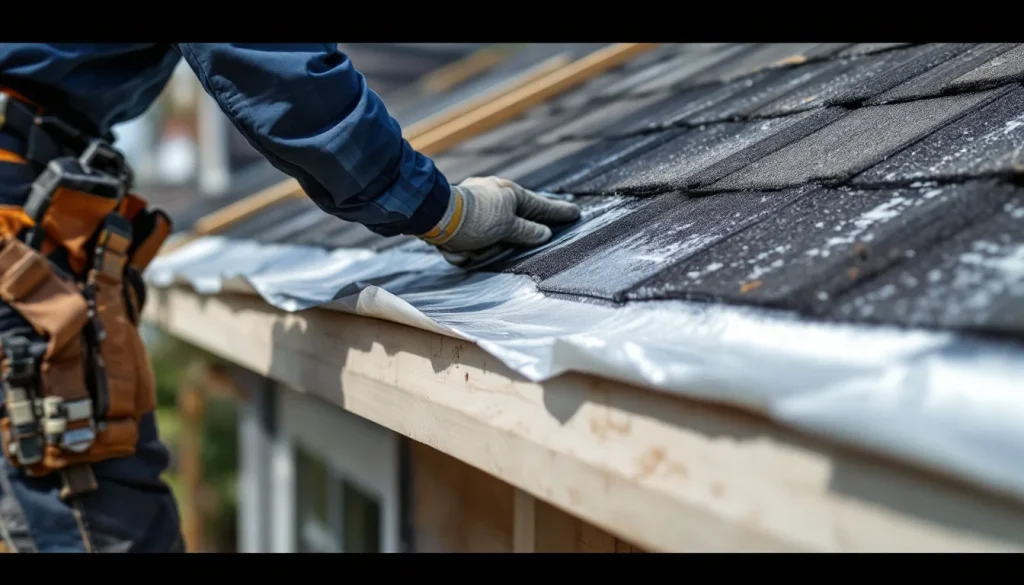
Ice (see our ice dam protection membrane code requirements) and water shield in 2026 costs $50 to $120 per square ($0.50 to $1.20 per square foot) installed and is required by IRC R905.1.2 in any region where the average January temperature falls below 25 degrees Fahrenheit. The peel-and-stick rubberized asphalt membrane prevents ice-dam-driven backflow from leaking into the home by self-sealing around every nail penetration and bonding directly to the roof deck. Code-minimum coverage is the first 24 inches past the interior wall line at the eaves, but every roofer who has chased a leak in a cold climate will tell you 36 to 48 inches is the realistic minimum. Here is the full code, install, brand, and warranty breakdown on ice and water shield.
The short version
- Ice and water shield costs $50 to $120 per square installed ($0.50 to $1.20 per sq ft), or about $250 to $720 for the code-minimum eave coverage on a 2,400 sq ft home.
- IRC R905.1.2 requires it in any region where January average is below 25 F, extending from the eave to a point 24 inches past the interior wall line.
- It must also be installed in valleys, around penetrations (chimneys, skylights, plumbing vents), and at sidewall transitions.
- Major brands: GAF WeatherWatch and StormGuard, Grace Ice and Water Shield (the original), Owens Corning WeatherLock, CertainTeed WinterGuard.
- High-temperature variants (rated to 240 F) are required under metal roofs because standard membrane melts under hot metal panels.
- Most code-following installers extend coverage to 36 to 48 inches past the wall line on northern roofs, especially over heated living space.
Short answer: what ice and water shield costs and why it is required
Ice and water shield is a self-adhered, rubberized asphalt waterproofing membrane that goes between the roof deck and the primary underlayment at the most leak-prone areas of the roof. The 2026 installed cost breaks down as: material at $35 to $75 per square (a roll covers 1.5 to 2 squares and costs $90 to $145 at supply), and labor at $15 to $45 per square depending on access and complexity.
The reason for the IRC code requirement is ice damming. In freezing climates, snow on the roof melts from heat loss through the attic, runs down to the colder eave, and refreezes. The ice ridge that builds up at the eave traps additional meltwater behind it. That trapped water creeps up under the field shingles by capillary action and gravity, often reaching 2 to 4 feet up-slope from the gutter line. Standard shingles and felt underlayment cannot stop water moving uphill. Ice and water shield, because it self-seals around nail penetrations and bonds to the deck, can.
IRC R905.1.2 code requirements explained
The International Residential Code, Section R905.1.2 (Ice Barriers), is the controlling federal-model code adopted by 49 states. The full requirement:
“In areas where there has been a history of ice forming along the eaves causing a backup of water, an ice barrier shall be installed for asphalt shingles, metal roof shingles, mineral-surfaced roll roofing, slate and slate-type shingles, wood shingles and wood shakes. The ice barrier shall consist of not fewer than two layers of underlayment cemented together, or a self-adhering polymer modified bitumen sheet, shall be used in place of normal underlayment and extend from the lowest edges of all roof surfaces to a point not less than 24 inches inside the exterior wall line of the building.”
What this means in practice:
- “Areas where there has been a history of ice forming” is interpreted by most jurisdictions as any climate zone where the January mean temperature falls below 25 F. That is most of the country north of a line from northern California to northern Texas to northern Georgia.
- The 24-inch measurement starts at the interior face of the exterior wall, not the gutter or the fascia. For a typical 18-inch eave overhang, that puts the up-slope edge of the membrane 42 inches up from the drip edge.
- “Self-adhering polymer modified bitumen sheet” is the modern peel-and-stick membrane every brand in the table below.
- The double-layer felt alternative is technically still legal but virtually no roofer uses it because it does not self-seal around nail holes.
| IRC zone | Climate | Code minimum coverage | Practical recommended coverage |
|---|---|---|---|
| 1-3 (hot) | FL, southern TX, southern CA | Not required by R905.1.2 | Valleys, penetrations, low slopes |
| 4 (mixed) | NC, TN, AR, OK, NM, AZ northern | Required if local AHJ adopts | 24 in past wall + valleys |
| 5 (cool) | VA, KY, MO, KS, CO, UT, NV northern | Required | 36 in past wall + valleys + penetrations |
| 6 (cold) | OH, PA, NY, IL, IA, NE, WY, OR eastern | Required | 48 in past wall + valleys + penetrations + rakes |
| 7-8 (very cold) | MN, WI, MI northern, ME, ND, MT, AK | Required | Full deck coverage often spec’d |
Where it must go: eaves (24 inches past the wall)
The eave is the critical zone. Code-minimum coverage is measured from the drip edge up the roof slope to a point 24 inches past the interior wall line. On a typical 2,400 sq ft home with 18-inch eave overhangs, that equates to 42 inches of horizontal coverage measured up the slope from the drip edge. On a steeper pitch, the linear length measured up the slope is longer than the horizontal projection (because the slope itself is angled), so a 6/12 pitch needs 47 actual inches of membrane, and a 12/12 pitch needs 59 actual inches.
Installation sequence at the eave:
- Install drip edge on the eave first.
- Lay the first course of ice and water shield over the drip edge, covering the metal flange and extending up the slope per code.
- If the eave coverage requires more than one course of membrane, lap the upper course over the lower with a 6-inch overlap.
- Run synthetic underlayment over the top edge of the ice and water shield with a 6-inch lap.
Where it must go: valleys, penetrations, skylights
Eave coverage is the minimum, but valleys and penetrations are equally code-mandated by R905.1.2 in cold zones and by manufacturer install specs in every zone.
Valleys. A 36-inch wide strip of ice and water shield runs full-length down every valley, centered on the valley line. This protects against ice dam buildup in the valley (where snow stacks deepest) and against general water concentration. Valley membrane is installed before any field underlayment and before any valley metal flashing.
Penetrations. Plumbing vent stacks, B-vent flues, electrical masts, satellite mounts, and any other roof penetration gets a 12 to 18 inch perimeter of ice and water shield around the penetration. The membrane goes down first, the field underlayment goes over it, and the boot or flashing goes on top.
Skylights. A 12 to 18 inch perimeter of ice and water shield wraps the skylight curb on all four sides. The membrane laps up the curb 4 to 6 inches and is sealed with the manufacturer’s flashing kit on top.
Sidewalls. Where a roof plane meets a vertical wall (a dormer side, a chimney side, a step-up roof), ice and water shield runs up the wall 6 to 10 inches and laps onto the deck 6 to 10 inches. The step flashing and counter-flashing go over the membrane.
Kickout zones. Where a sidewall meets an eave (the spot where kickout flashing is required), ice and water shield wraps around the corner and extends up the wall and along the eave for at least 18 inches in both directions.
Low-slope sections. Any roof pitch below 4/12 should get full-coverage ice and water shield on the entire low-slope portion, because shingle warranties are typically void below 4/12 without it.
Brand comparison: the major ice and water shield products
The product category was invented by Grace Construction (now part of GCP Applied Technologies, now Saint-Gobain) in 1980. Grace Ice and Water Shield is still the reference standard, but every major shingle manufacturer now sells a competitive product designed to maintain their system warranty.
| Brand product | Manufacturer | Thickness (mils) | Roll size | Warranty | Retail per roll (2026) |
|---|---|---|---|---|---|
| Grace Ice and Water Shield | Saint-Gobain (formerly GCP) | 40 | 225 sq ft (3 ft x 75 ft) | 20 yr material | $135-$165 |
| Grace Ultra (high-temp) | Saint-Gobain | 40 | 200 sq ft | 20 yr material, 240 F rated | $185-$225 |
| GAF WeatherWatch | GAF | 40 | 200 sq ft | Per GAF Golden Pledge / System Plus | $98-$135 |
| GAF StormGuard | GAF | 32 | 200 sq ft | Per GAF System Plus | $78-$110 |
| Owens Corning WeatherLock G | Owens Corning | 40 | 200 sq ft | Per OC Platinum / Preferred | $118-$148 |
| Owens Corning WeatherLock Flex | Owens Corning | 34 | 200 sq ft | Per OC Preferred | $95-$125 |
| CertainTeed WinterGuard HT | CertainTeed | 45 | 200 sq ft, 240 F rated | Per CertainTeed SureStart Plus | $148-$185 |
| CertainTeed WinterGuard | CertainTeed | 40 | 225 sq ft | Per CertainTeed SureStart Plus | $108-$138 |
| Atlas WeatherMaster | Atlas Roofing | 40 | 200 sq ft | Per Atlas Signature Select | $92-$118 |
The 40-mil thickness is the industry workhorse. The 32 to 34 mil “budget” products (GAF StormGuard, OC WeatherLock Flex) are acceptable for code-minimum eave coverage but should not be used in valleys or on low slopes where puncture resistance matters.
High-temperature variants for metal roofs
Standard ice and water shield is rated to about 220 F surface temperature. Under a dark metal roof in direct summer sun, panel surface temperatures regularly hit 160 to 200 F, and at panel seams or under solar gain the temperature can push higher. Standard membrane will soften, ooze, and bleed asphalt through the panel.
High-temp ice and water shield (Grace Ultra, CertainTeed WinterGuard HT, Carlisle WIP 300HT) is formulated with a higher-melt-point asphalt blend and is rated to 240 F continuous surface temperature. It is required for use under all standing seam and concealed-fastener metal panel systems, and recommended under exposed-fastener corrugated and ribbed panels.
The upcharge for high-temp variants is $40 to $80 per roll over standard. On a metal roof project, the high-temp membrane is typically run as code-minimum eave coverage and in valleys, with synthetic underlayment over the rest of the deck.
Installation: when in the roof sequence
Ice and water shield is the first weather-resistive layer installed on the deck, going down before any felt or synthetic underlayment. The full sequence:
- Inspect the sheathing for soft spots, loose fasteners, or rot. Replace as needed.
- Install eave drip edge.
- Install ice and water shield at eaves (code-minimum coverage).
- Install ice and water shield in valleys (36-inch strip down the valley centerline).
- Install ice and water shield around penetrations and at sidewalls.
- Install synthetic underlayment over the rest of the deck, lapping over the top edge of the ice and water shield.
- Install rake drip edge over the underlayment.
- Install starter shingles.
- Install field shingles, step flashing, kickout flashing, ridge cap.
The peel-and-stick application requires a clean, dry deck above 40 F. Manufacturer specs warn against application below 40 F because the adhesive does not bond properly. In cold-weather installs, the membrane is often staged in a heated truck or garage and applied in small sections, with a roller used to press the membrane into the deck.
Self-adhered vs torch-down vs nail-down
The peel-and-stick (self-adhered) format is the residential standard. Two other formats exist:
| Format | Application | Use case | Cost premium |
|---|---|---|---|
| Self-adhered (peel-and-stick) | Strip release liner, press to deck | Residential shingles, metal, slate | Baseline |
| Torch-down (heat-applied) | Propane torch melts back surface, adheres to deck | Commercial low-slope, parapet walls | +30-50% labor |
| Mechanically fastened (nail-down) | Nailed and lapped with sealant | Cold-weather temporary install | +10-20% labor, less reliable seal |
For residential roof replacement, the self-adhered format is what every manufacturer specifies. Torch-down is a commercial product and creates fire risk on a residential job. Nail-down is a workaround for cold-weather installs but loses the self-sealing property at every nail penetration.
Cost per square installed
| Coverage zone | Material cost / sq | Labor cost / sq | Installed cost / sq | Typical area on 2,400 sq ft home |
|---|---|---|---|---|
| Eave (code minimum, 24 in past wall) | $35-$50 | $15-$25 | $50-$75 | 4-6 squares |
| Eave (extended, 48 in past wall) | $35-$50 | $15-$25 | $50-$75 | 7-10 squares |
| Valley | $40-$60 | $20-$35 | $60-$95 | 1-2 squares |
| Penetrations + skylights | $45-$65 | $25-$40 | $70-$105 | 0.5-1 square |
| High-temp under metal roof | $55-$75 | $25-$45 | $80-$120 | Per project |
| Full-deck coverage (low slope or cold climate) | $35-$55 | $15-$30 | $50-$85 | 20-24 squares |
Warranty implications: GAF, Owens Corning, CertainTeed positions
Like ridge cap and starter, ice and water shield is part of the manufacturer’s branded system warranty. The same brand-matching rule applies:
- GAF Golden Pledge: requires GAF WeatherWatch (or StormGuard) plus four other GAF accessories. Without it, the 50-year non-prorated drops to standard limited warranty (10 years prorated).
- Owens Corning Platinum Protection: requires WeatherLock G or Flex plus four other OC accessories.
- CertainTeed SureStart Plus / 4-Star / 5-Star: requires WinterGuard.
- Grace Ice and Water Shield is the only third-party membrane that GAF, OC, and CertainTeed have historically accepted as warranty-compliant, because of its 40-year track record. Check your specific warranty document; the brand-only requirement has tightened year over year.
The cost math is the same as it is for ridge cap: a $200 to $400 saving on a generic membrane forfeits a $4,000 to $8,000 warranty. Use the matched product.
Climate-specific recommendations
| Climate | Eave coverage | Valley | Penetrations | Sidewalls | Rakes |
|---|---|---|---|---|---|
| Hot (FL, southern TX, AZ low desert) | Not required, valleys only | Yes, 36 in strip | Yes, perimeter | Optional | No |
| Mixed (NC, TN, OK) | 24 in past wall (code minimum) | Yes | Yes | Yes | Optional |
| Cool (VA, MO, CO front range) | 36 in past wall | Yes | Yes | Yes | Optional |
| Cold (NY, PA, OH, IL) | 48 in past wall | Yes | Yes | Yes | Recommended |
| Very cold (MN, ME, MI UP) | 72 in past wall or full deck | Yes | Yes | Yes | Yes |
| Coastal (FL Keys, NC OBX) | Eave coverage for wind-driven rain, not ice | Yes | Yes | Yes | Yes, for wind |
When to extend beyond code minimum
The 24-inch past-the-wall code minimum was set in the 1990s based on average attic insulation and average snowfall. Modern homes have more living space, more interior heat loss patterns, and many regions are seeing larger ice events. Five situations call for extending coverage:
- Cathedral ceilings or vaulted attics. No attic buffer means more direct heat loss to the roof and more aggressive ice damming. Extend coverage to 48 to 72 inches.
- Inadequate attic ventilation. Older homes with no ridge vent and minimal soffit vents hold heat at the ridge and lose it at the eave. Extend coverage.
- Heated gutters or heat cables. If you are running heat cable, you already have an ice problem. Extend membrane coverage to 60+ inches.
- North-facing slopes. A north slope sees little sun, holds snow longer, and refreezes harder. Extend coverage on the north slope only.
- Wide eave overhangs (24+ inches). The cold-eave zone is longer, so the membrane must be too. The 24-inch rule starts at the interior wall, so a wider overhang automatically requires more linear coverage.
The cost of extending from 24 inches to 48 inches on the eaves of a 2,400 sq ft home is $200 to $400 of additional membrane and labor. The cost of a single ice-dam leak that soaks ceiling insulation, drywall, and hardwood floors is typically $3,000 to $15,000. The math is straightforward.
Ice and water shield brand product warranties and what they actually cover
The manufacturer warranty on the ice and water shield product itself is separate from the broader system warranty on the roof. The product warranty covers the membrane against manufacturing defects (delamination, asphalt bleed-through, adhesive failure) for 10 to 25 years depending on brand. What it does not cover:
- Installation errors (cold-weather application, dirty deck, wrong direction laps)
- UV exposure (the product must be covered by shingles within 30 to 60 days of installation, varies by brand)
- Punctures from foot traffic or dropped tools
- Movement of the underlying deck (cracked OSB, loose nails)
The system warranty (GAF Golden Pledge, OC Platinum, CertainTeed 4-Star) covers leaks caused by the membrane in service. The two warranties stack: the manufacturer covers the product, and the installer covers the workmanship through the system warranty.
Common ice and water shield installation mistakes
- Cold-weather application. Below 40 F the adhesive does not bond, and the membrane lifts in the first heat cycle. Use a high-tack winter-grade product or stage the install for above 40 F.
- Wrinkles and air pockets. The membrane must be rolled out flat with a roller. Wrinkles create tunnels that channel water under the membrane.
- Wrong-direction laps. Upper course must lap over lower (water-shedding direction). The opposite direction creates a wick path.
- Skipping the valley. Eave-only coverage is the most common shortcut. Valleys collect more water than any other roof zone and must always be covered.
- Bonding to a dirty deck. Dust, sawdust, and old asphalt residue all reduce adhesion. The deck should be swept and dry before application.
- Leaving the membrane exposed too long. UV degrades the asphalt within 30 to 60 days; the shingles must go on within that window.
Ice and water shield in the context of a full roof replacement
If your existing roof is 18 to 25 years old and you have had ice dam leaks, the membrane question is part of the replacement scope. Spec the membrane explicitly in the contract: brand name, thickness, square footage of coverage, and the location list (eaves, valleys, penetrations, sidewalls). Generic language (“ice and water shield as needed”) gives the installer room to use the cheapest product at the minimum coverage. See our guide on choosing a roofing contractor for contract-spec checklists.
Frequently asked questions
How much ice and water shield do I need?
For code-minimum eave coverage on a 2,400 sq ft home (about 200 LF of eave), you need approximately 4 to 6 squares (800 to 1,200 sq ft) of membrane. Add 1 to 2 squares for valleys, and 0.5 to 1 square for penetrations and sidewalls.
Can I install ice and water shield over existing shingles?
No. The membrane must bond directly to the roof deck. Installing it over shingles is not a valid use of the product and voids the manufacturer warranty.
What temperature is needed for proper installation?
Most manufacturers specify a minimum 40 F deck and ambient temperature for adhesion. Below 40 F, the peel-and-stick adhesive does not bond properly and the membrane can lift. Some high-tack products are rated to 25 F; check the data sheet.
Does ice and water shield work on a metal roof?
Yes, but only the high-temperature variants (Grace Ultra, CertainTeed WinterGuard HT, Carlisle WIP 300HT). Standard membrane melts under metal panels in summer heat.
How long does ice and water shield last?
The product itself is rated 20 to 40 years by the manufacturer, but once covered by shingles and protected from UV, it typically outlasts the roof above it. Failures are almost always installation issues (wrinkles, cold-weather application, dirty deck) rather than material aging.
Is ice and water shield the same as underlayment?
No. Underlayment (felt or synthetic) is a water-resistant layer covering the whole deck and is mechanically fastened. Ice and water shield is a waterproof self-adhered membrane covering only the high-risk areas. The two work together: ice and water shield first in critical zones, then underlayment over the rest of the deck.
Do I need ice and water shield if I live in Florida or Arizona?
You do not need it for ice damming because there is none, but the manufacturer system warranty and many local codes still require it in valleys and around penetrations because of wind-driven rain. Spec it for those locations even in hot climates.
Can I install it myself?
Yes, with care. The membrane is heavy (about 60 lb per roll), tacky, and unforgiving (once stuck, removing it tears the surface). DIY work is feasible on the eave but is risky in valleys and around penetrations. If you are not already comfortable on a roof, leave this to a pro and focus your DIY budget on simpler tasks.