
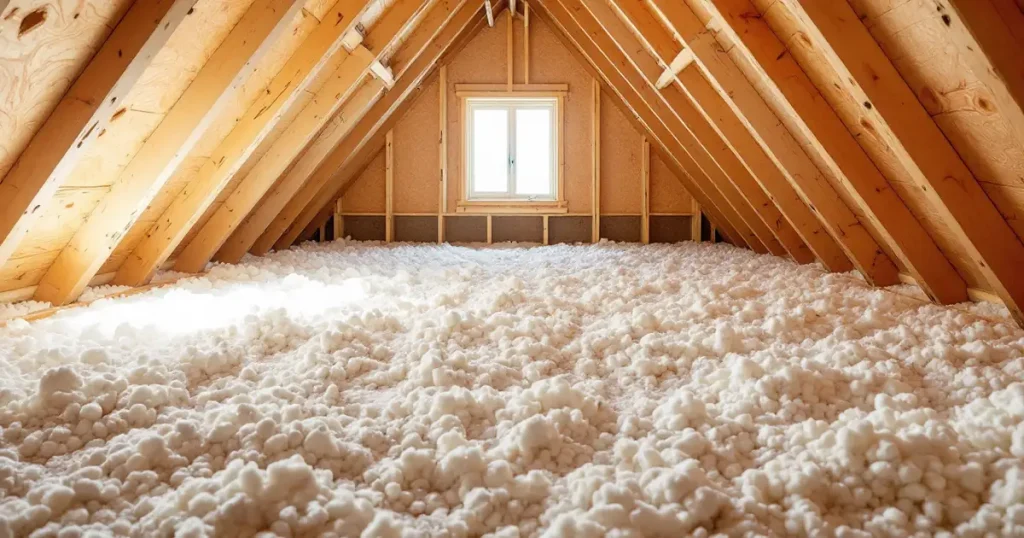
The cheapest attic insulation is loose-fill cellulose or fiberglass that you blow in yourself with a free rental blower. At October 18, 2026 retail listing prices, Greenfiber SANCTUARY cellulose works out to about $1.13 per square foot of attic at R-49 and Owens Corning AttiCat fiberglass to about $1.27. That is roughly 2.3 to 2.6 cents per R-value point per square foot. Unfaced fiberglass rolls and batts cost about twice as much per R, stone wool batts about four to five times as much, and a DIY closed-cell spray foam kit more than ten times as much.
Two things beat even cheap insulation on cost. A few cans of foam sealant on attic-floor leaks cost under $5 each, and income-eligible households may get the whole job free through the U.S. Department of Energy’s Weatherization Assistance Program. The federal 25C insulation tax credit no longer applies to work placed in service after December 31, 2025. This page ranks the options by cost per R-value. Full project budgets with labor and removal are in our attic insulation cost guide.
By The Roofing Brief Team. Last reviewed: October 2026.
Cheapest attic insulation: key numbers at a glance
These are the figures a budget attic job turns on. Prices are single retailer listings checked through Google Shopping on October 18, 2026, before tax. Coverage comes from the manufacturers’ own charts. Your store and week may differ, so rerun the arithmetic with your shelf price.
| Figure | Value | Source |
|---|---|---|
| Cheapest material per R-value | Greenfiber SANCTUARY cellulose, $15.97 per 25 lb bag: about $1.13 per sq ft at R-49 (2.3 cents per R) | Home Depot listing; Greenfiber SANCTUARY Attic Card Rev K 05/26; Roofing Brief arithmetic |
| Close second | Owens Corning AttiCat fiberglass, $50.86 per 27.5 lb bag: about $1.27 per sq ft at R-49 (2.6 cents per R) | Lowe’s listing; Owens Corning AttiCat Product Data Sheet, May 2026 |
| Bags for 1,000 sq ft at R-49 | 70.8 SANCTUARY bags (no framing adjustment) or 25 AttiCat bags | Manufacturer coverage charts |
| Free blower threshold | Home Depot: first day free with 10 or more bags. Lowe’s: free 24 hours with 20 bags of SANCTUARY | Home Depot rental listings; Lowe’s SANCTUARY listing |
| Professional installed price | $1.50 to $2.45 per sq ft, average $1.80 | Home Depot Attic Insulation Installation Cost Guide |
| Attic target, uninsulated | R-30 in Zone 1, R-49 in Zones 2 and 3, R-60 in Zones 4 through 8 | ENERGY STAR Recommended Home Insulation R-Values |
| Federal tax credit for 2026 work | None. 25C ended for property placed in service after December 31, 2025 | IRS; Public Law 119-21, sec. 70505 |
What is the cheapest attic insulation per R-value?
Blown-in cellulose is the cheapest attic insulation per R-value at October 2026 retail prices, with blown-in fiberglass a close second. Divide each product’s price by the area it covers at a stated R-value, then divide again by that R-value. Loose fill lands near 2.3 to 2.6 cents per R per square foot. Batts land near 4.3 to 5.6 cents, and stone wool and spray foam far higher.
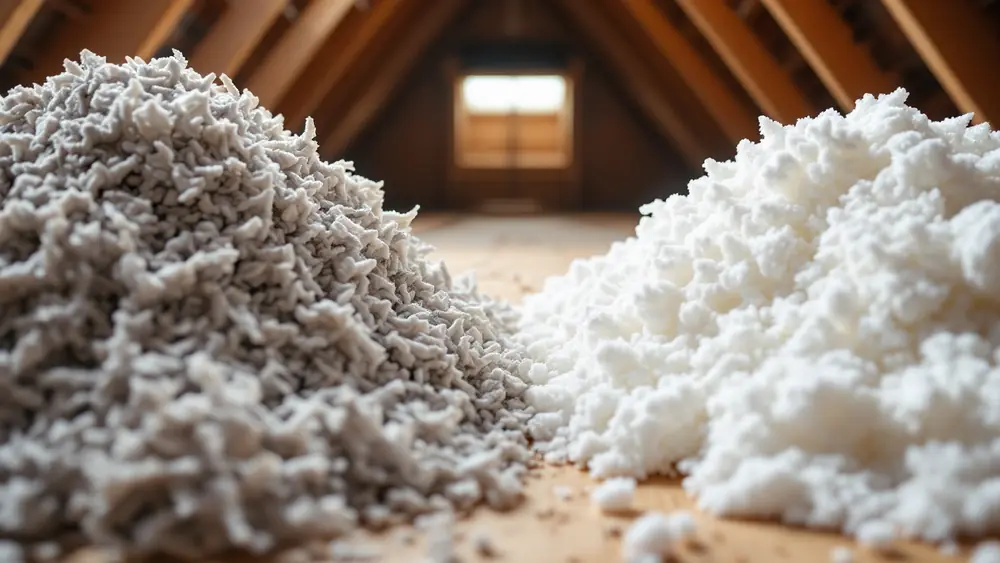
Sticker price per bag or roll misleads because the products cover very different areas at very different R-values. The table puts eight common attic products on one scale: cents of material per square foot for each point of R-value. That is the number that tells you what an R-49 or R-60 attic floor will actually cost in material.
| Product | Listing price | Coverage basis | Material cost per sq ft | Cents per R per sq ft | Source |
|---|---|---|---|---|---|
| Blown cellulose: Greenfiber SANCTUARY, 25 lb | $15.97 per bag (Home Depot) | 70.8 bags per 1,000 sq ft at R-49 | $1.13 at R-49 | 2.3 | Greenfiber Attic Card Rev K 05/26 |
| Blown fiberglass: Owens Corning AttiCat, 27.5 lb | $50.86 per bag (Lowe’s) | 25 bags per 1,000 sq ft at R-49 | $1.27 at R-49 | 2.6 | OC AttiCat data sheet, May 2026 |
| Unfaced fiberglass roll: Owens Corning R-30, 15 in by 25 ft | $40.00 per roll (Lowe’s) | 31.25 sq ft per roll | $1.28 at R-30 | 4.3 | Lowe’s listing |
| Unfaced fiberglass batt: Owens Corning R-38, 16 in by 48 in | $2.10 per sq ft as listed (Home Depot) | Per-sq-ft price printed on listing | $2.10 at R-38 | 5.5 | Home Depot R-38 listing |
| Kraft-faced fiberglass batt: Owens Corning R-30, 24 in by 48 in | $149.00 per bag (Home Depot) | 88 sq ft per bag | $1.69 at R-30 | 5.6 | Home Depot listing |
| Stone wool batt: ROCKWOOL Comfortbatt R-30, 24 in by 47 in, 4-pack | $109.99 (True Value) | 31.3 sq ft per pack | $3.51 at R-30 | 11.7 | True Value listing |
| Closed-cell spray foam kit: DuPont Froth-Pak 200 | $384.00 to $555.58 per kit (AWarehouseFull, Wind-Lock) | About 200 sq ft at 1 in, R-6.2 per DuPont | $1.92 to $2.78 at R-6.2 | 31 to 45 | DuPont Froth-Pak product page |
| Radiant barrier: Reflectix perforated, 48 in by 125 ft | $72.48 per roll (Lowe’s) | 500 sq ft per roll | $0.14 | Not comparable: no bulk R-value toward the attic target | Lowe’s and Home Depot listings |
Method: material cost per sq ft is the listing price divided by coverage, using the coverage the manufacturer states for that R-value. Cents per R divides that by the R-value. Listings were checked through Google Shopping and retailer search results on October 18, 2026, and exclude tax, delivery and bulk discounts. The SANCTUARY figure uses Greenfiber’s coverage column with no framing adjustment, the more conservative of its two columns.
Loose fill also holds its price advantage as you go deeper. AttiCat costs 2.5 cents per R at R-30 and 2.7 cents at R-60, so the per-R price barely moves. An attic floor has open height above the joists, which lets cheap, bulky material reach R-60 where a wall cavity could not. For the head-to-head on the two loose fills, see our blown-in insulation guide.
Why do cheap-looking options cost more per R?
Products with a low sticker price often deliver little R-value per dollar. A radiant barrier roll costs about $0.14 per square foot but does not count toward an R-49 or R-60 attic target. A spray foam kit covers only about 200 square feet at one inch. Rigid foam board is efficient per inch but costly per R compared with loose fill on an open attic floor.
The ranking is not new. The U.S. Department of Energy’s Guide to Home Insulation (DOE/EE-0340, October 2010) priced each material per square foot per R-value. Its spray foam and board figures are far above loose fill, and the October 2026 listing arithmetic keeps the same order.
| Material | DOE 2010 cost per sq ft per R | October 2026 listing arithmetic, material only | Cheaper or dearer per R than loose fill? |
|---|---|---|---|
| Loose fill (fiberglass, cellulose, mineral wool), professionally installed | $0.03 | $0.023 to $0.026 (SANCTUARY, AttiCat) | Baseline |
| Fiberglass batt, R-13 to R-30 | $0.02 to $0.03 (retail) | $0.043 to $0.056 | Dearer in 2026 listings |
| Expanded polystyrene board, 1 in | $0.07 | Not priced here | Dearer |
| Extruded polystyrene or polyiso board, 1 in | $0.10 | Not priced here | Dearer |
| Open-cell spray foam, 3.5 in, installed | $0.17 | Not priced here (professional product) | Dearer |
| Closed-cell spray foam, 1 in, installed | $0.25 | $0.31 to $0.45 (Froth-Pak 200 kit) | About 12 to 20 times dearer |
Source: DOE, Guide to Home Insulation, DOE/EE-0340 (2010); DOE notes its loose-fill and spray foam prices include professional installation. The 2026 column is Roofing Brief arithmetic from the listings in the table above.
Spray foam earns its price in other jobs: sealing air leaks in one pass and insulating the underside of a roof deck for an unvented attic built under IRC Section R806.5. Reaching R-49 with a closed-cell kit rated R-6.2 per inch would take about 7.9 inches, or roughly $15 to $22 per square foot in kit material alone. Our spray foam attic insulation guide covers when that trade makes sense.
Radiant barriers work differently. Some Reflectix rolls are listed with a range of “R-3.7 to R-21” rather than a single R-value, so check the manufacturer’s installed-assembly details before counting any of it. DOE’s 2010 guide describes radiant barriers as especially useful in hot, sunny climates. Use one as a hot-climate add-on, not in place of the R-value your zone calls for.
How many bags of blown-in insulation do you need?
Bag count comes straight from the manufacturer’s coverage chart printed on the bag. For a 1,000 square foot attic floor at R-49, Owens Corning calls for 25 AttiCat bags at 17 inches, and Greenfiber calls for 70.8 SANCTUARY bags at 14.3 inches initial installed thickness, before framing adjustment. Install both the bag count and the thickness, or the stated R-value is not reached.
| Target R-value | AttiCat bags per 1,000 sq ft | AttiCat minimum thickness | AttiCat cost per 1,000 sq ft at $50.86 | SANCTUARY bags per 1,000 sq ft | SANCTUARY initial installed thickness | SANCTUARY cost per 1,000 sq ft at $15.97 |
|---|---|---|---|---|---|---|
| R-30 | 14.6 | 10.75 in | $743 | 38.6 | 8.9 in | $616 |
| R-38 | 19 | 13.5 in | $966 | 52.6 | 11.2 in | $840 |
| R-49 | 25 | 17 in | $1,272 | 70.8 | 14.3 in | $1,131 |
| R-60 | 31.5 | 20.5 in | $1,602 | 86.0 | 17.3 in | $1,373 |
Sources: Owens Corning AttiCat PINK Blown-In Insulation Product Data Sheet (May 2026); Greenfiber SANCTUARY Attic Card, PM-6.3329 Rev K 05/26, loose-fill column with no framing adjustment. Costs are Roofing Brief arithmetic at the October 18, 2026 listing prices, before tax.
Greenfiber also prints a column adjusted for 2 by 6 framing on 16 inch centers, which lowers R-49 to 68.5 bags per 1,000 square feet. It warns that job conditions, technique and machine settings can change actual coverage by as much as 10%. Owens Corning adds extra bags and inches for Minnesota, where state rules require the stated R-value at winter design temperatures. Our blow-in insulation calculator walks through the rounding.
Topping up or starting from zero: what does your zone need?
Most attics already hold some insulation, and ENERGY STAR sets a lower add-on target for them. With 3 to 4 inches already down, it recommends adding R-25 in Zone 1, R-38 in Zones 2 and 3, and R-49 in Zones 4 through 8. Buying only the top-up is the cheapest legitimate path. In Zones 2 through 8 it saves roughly $240 to $330 of material per 1,000 square feet against an empty-attic fill.
| Climate zone | Empty attic target | Material per 1,000 sq ft (SANCTUARY / AttiCat) | Add if 3 to 4 in exists | Top-up material per 1,000 sq ft (SANCTUARY / AttiCat) |
|---|---|---|---|---|
| Zone 1 | R-30 | $616 / $743 | R-25 | $616 / $641 (priced at the next chart rows up: SANCTUARY R-30, AttiCat R-26) |
| Zones 2 and 3 | R-49 | $1,131 / $1,272 | R-38 | $840 / $966 |
| Zones 4 through 8 | R-60 | $1,373 / $1,602 | R-49 | $1,131 / $1,272 |
Source: ENERGY STAR, Recommended Home Insulation R-Values (retrofit table for existing wood-framed homes). Material costs are Roofing Brief arithmetic from the coverage charts and October 18, 2026 listings above.
Measure before you buy. Depth alone does not give R-value unless you know the existing material, so identify it first. ENERGY STAR says you do not have to match the existing type: loose fill can go over fiberglass batts, and the reverse, as long as the old layer is dry. Our guide on how much insulation to add to an attic covers reading what is already there.
How much does it cost to insulate a 1,000 or 2,000 sq ft attic the cheap way?
Doing it yourself with cellulose, a 1,000 square foot attic floor costs about $1,134 in material at R-49 and $846 for an R-38 top-up, at October 18, 2026 listing prices. A 2,000 square foot attic floor runs about $2,268 at R-49. Home Depot’s installation cost guide puts professional work at $1.50 to $2.45 per square foot, so DIY material can come in well under a pro quote.
| Attic floor and target | DIY SANCTUARY cellulose | DIY AttiCat fiberglass | Professional, Home Depot guide range |
|---|---|---|---|
| 1,000 sq ft, add R-38 | 53 bags: $846 | 19 bags: $966 | $1,500 to $2,450 |
| 1,000 sq ft, R-49 | 71 bags: $1,134 | 25 bags: $1,272 | $1,500 to $2,450 |
| 1,500 sq ft, R-49 | 107 bags: $1,709 | 38 bags: $1,933 | $2,250 to $3,675 |
| 2,000 sq ft, add R-38 | 106 bags: $1,693 | 38 bags: $1,933 | $3,000 to $4,900 |
| 2,000 sq ft, R-49 | 142 bags: $2,268 | 50 bags: $2,543 | $3,000 to $4,900 |
Method: area times the chart’s bags per 1,000 sq ft, rounded up to whole bags, times $15.97 (SANCTUARY, Home Depot) or $50.86 (AttiCat, Lowe’s). The professional column multiplies area by Home Depot’s published $1.50 to $2.45 per sq ft range, which does not state an R-value. HomeGuide’s blown-in cost guide gives a wider $1.00 to $2.80 per sq ft. DIY figures are material only: add foam sealant, baffles, depth rulers and a respirator.
Attic floor area is usually close to the home’s footprint, not its finished square footage. A 2,000 square foot two-story house may have an attic floor near 1,000 square feet, so measure the ceiling below the attic rather than using the listing size.
Be wary of very low “insulate your attic for a few hundred dollars” figures. At $15.97 a bag, $300 buys about 19 SANCTUARY bags. Greenfiber’s chart puts 1,000 square feet at 15.2 bags for R-13 and 22.6 bags for R-19, so that budget reaches roughly R-13 to R-19, well short of ENERGY STAR’s targets.
How do you get the insulation blower rental free?
Buy enough bags at the store that rents the machine. Home Depot’s rental listings say the first day is free with 10 or more bags of fiberglass insulation, or 10 bags of Greenfiber cellulose for its cellulose blower. A Lowe’s SANCTUARY listing offers a free 24-hour machine rental with 20 bags. A full 1,000 square foot attic clears every one of those thresholds.
| Store | Machine | Free rental terms as listed | Source |
|---|---|---|---|
| Home Depot | Fiberglass insulation blower (AttiCat or Knauf) | First day free with 10 or more bags of fiberglass insulation | Home Depot Fiberglass Insulation Blower Rental listing |
| Home Depot | Greenfiber cellulose insulation blower | First day free with 10 bags of cellulose loose fill; Greenfiber cellulose only | Home Depot Greenfiber Cellulose Insulation Blower Rental listing |
| Lowe’s | Blowing machine for Greenfiber SANCTUARY | Free 24-hour machine rental with purchase of 20 bags | Lowe’s SANCTUARY product listing |
Terms vary by store and season, so confirm at the rental desk before loading the truck. The machine must match the material: AttiCat bags run through the AttiCat machine, and cellulose runs through a cellulose blower.
Small jobs are the exception. A 300 square foot section topped up to R-38 needs about 6 AttiCat bags (300 times 19 per 1,000, rounded up), below a 10-bag threshold. There, unfaced rolls laid by hand may be cheaper than paying rent. Our insulation blower rental guide lists the paid-rental cases.
Air sealing: the cheapest attic upgrade per dollar
Seal the attic floor before adding any insulation. The U.S. Environmental Protection Agency estimates that homeowners can save an average of 15% on heating and cooling costs, or 11% of total energy costs, by air sealing and adding insulation in attics, floors over crawl spaces and basements. A 12 oz can of Great Stuff Gaps and Cracks foam was listed at $4.48 at Home Depot on October 18, 2026.
Loose fill and batts slow heat conducted through them. They do little to stop air pushed through holes in the ceiling, and that air carries heat straight past them. ENERGY STAR’s attic project guidance says EPA recommends air sealing the attic before adding insulation. Common leak points on the attic floor include:
- Top plates of interior walls, where drywall meets framing.
- Plumbing vent stacks and wiring holes drilled through the top plates.
- Recessed light housings and bath fan housings.
- Dropped soffits over kitchen cabinets, which ENERGY STAR says to cover with foil or rigid foam blocking sealed with caulk or adhesive.
- Gaps around furnace flues and chimneys, which ENERGY STAR says to seal with aluminum flashing and high-temperature caulk, not canned foam.
- The attic hatch or pull-down stair. Our attic hatch insulation guide covers weatherstripping and covers.
Seal first, because once 15 inches of loose fill is down, finding a top plate means digging through it. The full sequence is in our guide to air sealing an attic.
Cheapest way to insulate an attic, step by step
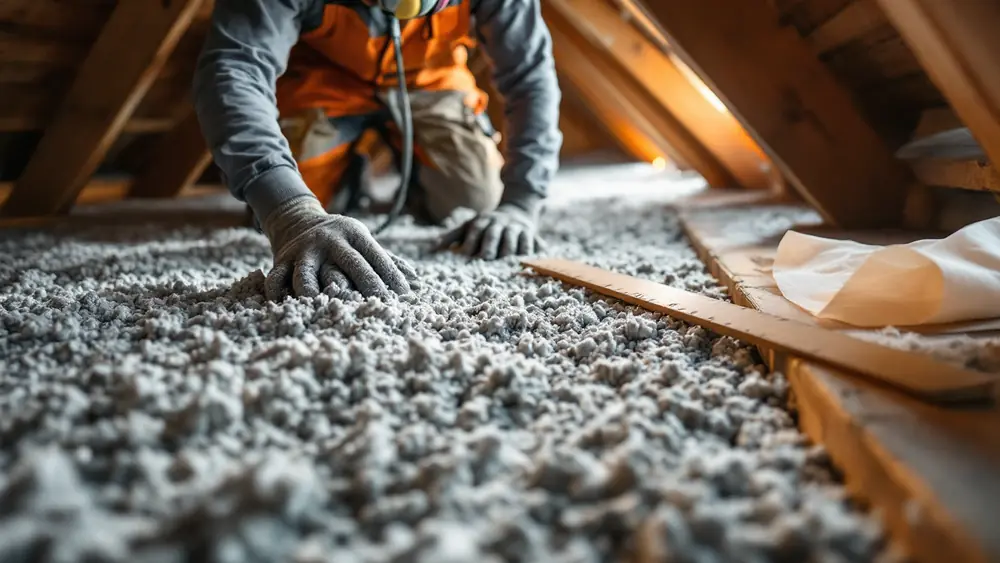
The cheapest sound sequence is check, measure, price per R, seal, then blow. Rule out hazards that would make DIY unsafe, measure the floor and the existing depth, pick an ENERGY STAR target, price the job per R at your store, and buy enough bags for the free rental. Then air seal, set baffles and depth markers, and blow to both the bag count and the depth.
- Rule out the stoppers. ENERGY STAR says not to disturb vermiculite until a lab confirms it has no asbestos. It also flags wet insulation from a roof leak, mold, fans venting into the attic, and knob-and-tube wiring as reasons to call a professional first. See our vermiculite attic insulation guide.
- Measure the attic floor. Multiply length by width for each section and add them up. Measure existing depth in several spots.
- Pick the target. Use the ENERGY STAR empty-attic or top-up figure for your climate zone from the table above.
- Price per R at your store. Divide each bag price by its chart coverage at your target R-value and buy the cheaper loose fill your store stocks.
- Buy enough for the free blower. Check the store’s bag threshold and the machine type before checkout.
- Air seal the floor. Foam the wiring and plumbing holes, seal top plates, and close flue gaps with aluminum flashing and high-temperature caulk, as ENERGY STAR advises.
- Keep the vents open. Staple baffles at each rafter bay over the soffit vents so the new fill cannot block intake air. Our attic insulation baffles guide covers sizing.
- Protect fixtures. Owens Corning’s data sheet says not to insulate on top of or within 3 inches of recessed lights unless they are rated IC, and to keep insulation out of air spaces around metal flues and chimneys.
- Set depth markers. 2021 IRC Section N1101.10.1.1 calls for at least one marker per 300 square feet, showing the minimum initial installed thickness and facing the attic access.
- Blow from the far end toward the hatch. Stop only when both the bag count and the marker depth are reached. Then insulate and weatherstrip the hatch.
Two people make the job faster: one feeds the machine and one runs the hose. The full walkthrough with machine settings is in our guide on how to blow insulation in an attic.
Free and subsidized attic insulation in 2026
The cheapest attic insulation is the kind someone else pays for. The U.S. Department of Energy says some families may qualify for free weatherization services through its Weatherization Assistance Program, and DOE reports that served households save an average of $372 or more a year. Utility rebates vary by ZIP code. The federal 25C tax credit no longer applies to work placed in service after December 31, 2025.
| Route | What it can cover | Who qualifies | Source |
|---|---|---|---|
| DOE Weatherization Assistance Program | An energy audit, then the most cost-effective energy measures for the home, delivered by local providers | Households at or below 200% of the federal poverty guidelines or receiving SSI; states may use LIHEAP’s 60% of state median income. Owners and renters can apply; waitlists apply | energy.gov, How to Apply for Weatherization Assistance |
| Utility and state rebates | Varies: some utilities offer rebates for home energy assessments, air sealing and insulation | Set by each utility or state program | ENERGY STAR Rebate Finder; DSIRE database |
| Federal 25C credit | Nothing for 2026 work | Property placed in service after December 31, 2025 does not qualify | IRS Energy Efficient Home Improvement Credit page; Public Law 119-21 |
Check rebate terms before you start. Some programs require a participating contractor or a pre-approval, which can rule out a DIY job. Details on the expired credit and claiming 2025 work are in our attic insulation tax credit guide.
Which cheap attic insulation should you pick?
For an open, walkable attic floor, pick whichever loose fill your store prices lower per R and do it yourself with the free blower. Choose rolls for small or tidy sections under the rental threshold, and hire out when access, hazards or the roofline make DIY impractical. The table maps common situations to the cheapest sensible choice.
| If your attic… | Cheapest sensible choice | Why |
|---|---|---|
| Is an open floor you can walk on joists | DIY blown cellulose or fiberglass with a free rental | Lowest cost per R (2.3 to 2.6 cents) and it fills around wires and blocking |
| Needs only a small area, under the bag threshold | Unfaced fiberglass rolls laid perpendicular to the joists | No machine needed; ENERGY STAR says a second layer should be unfaced |
| Already has 3 to 4 inches of dry insulation | Top up to ENERGY STAR’s add-on target only | Saves roughly $240 to $330 of material per 1,000 sq ft versus an empty-attic fill in Zones 2 through 8 |
| Has low headroom, a tiny hatch or no floor to stand on | Get two or three bids for blown-in installation | Pro crews price access into the job; DIY risk rises |
| Contains vermiculite or knob-and-tube wiring | Test or fix before anyone insulates | ENERGY STAR advises testing vermiculite and flags old wiring as a hazard |
| Sits in a hot, sunny climate and already meets its R target | Consider a radiant barrier as an add-on | DOE describes radiant barriers as especially useful in hot, sunny climates |
| Will become conditioned space or has ducts you want inside | Spray foam at the roofline, priced by a pro | Not the cheap route, but the right assembly under IRC R806.5 |
| Household is income-eligible | Apply to your state’s Weatherization Assistance Program | DOE says eligible families may get free weatherization services |
Our best insulation for attic guide ranks the same materials on performance rather than price.
Where cheap attic insulation goes wrong
Most budget attic jobs fail on installation, not material. The usual mistakes are short-bagging the chart, blocking soffit vents, burying non-IC light housings, insulating over a roof leak, and adding faced batts on top of existing insulation. Each one either wastes the money spent or creates a moisture or fire problem that costs more than the insulation saved.
- Short-bagging. Fluffing fewer bags to the right height leaves the R-value short. Both makers say bag count and thickness must both be met.
- Blocked soffit vents. Fill pushed into the eaves cuts intake air. Baffles cost far less than a moisture problem in the roof deck.
- Buried non-IC lights. Keep insulation at least 3 inches from fixtures not rated for insulation contact, per Owens Corning’s data sheet and ENERGY STAR guidance.
- Insulating over a leak. ENERGY STAR treats wet insulation as a sign of a leaky roof. Fix the roof first, because new insulation will soak up the same water.
- Faced batts on top. ENERGY STAR says a second layer should be unfaced, with no paper or foil backing.
- Stepping between joists. ENERGY STAR warns to walk on joists or truss chords, not ceiling drywall.
Frequently asked questions
What is the cheapest way to insulate my attic?
Air seal the attic floor with canned foam, then blow in loose-fill cellulose or fiberglass yourself using a store’s free rental blower. At October 18, 2026 listing prices, Greenfiber SANCTUARY cellulose cost about $1.13 per square foot at R-49 and Owens Corning AttiCat about $1.27, roughly half the per-R cost of batts or less. Buy enough bags to clear the free-rental threshold, typically 10 to 20 bags.
How much does it cost to insulate a 1000 sq ft attic?
Done yourself to R-49, a 1,000 sq ft attic floor needs about 71 bags of SANCTUARY cellulose ($1,134 at $15.97 a bag) or 25 bags of AttiCat ($1,272 at $50.86), using the makers’ charts and October 2026 listings. Home Depot’s installation cost guide puts pro attic insulation at $1.50 to $2.45 per sq ft, or $1,500 to $2,450 for the same area.
What is the cheapest but most effective insulation?
On an open attic floor, blown-in loose fill is both. It costs about 2.3 to 2.6 cents per R-value point per square foot at October 2026 prices, flows around wiring and joists that batts gap around, and the attic has room for the depth. Effectiveness depends on air sealing first and on installing both the bag count and the minimum thickness the bag chart lists.
How much does it cost to insulate a 2000 square foot attic?
For a true 2,000 sq ft attic floor taken to R-49, DIY material runs about $2,268 for 142 bags of SANCTUARY cellulose or $2,543 for 50 bags of AttiCat at October 2026 listing prices. Home Depot’s guide range of $1.50 to $2.45 per sq ft gives $3,000 to $4,900 installed. A 2,000 sq ft two-story house often has only about a 1,000 sq ft attic.
Is there a tax credit for insulating your attic in 2026?
No federal one. The 25C Energy Efficient Home Improvement Credit, which covered insulation and air sealing materials, does not apply to property placed in service after December 31, 2025 under Public Law 119-21. Some utilities and states still offer rebates, so check the ENERGY STAR Rebate Finder and the DSIRE database for your ZIP code, and confirm terms with a tax professional.
Is a radiant barrier a cheap substitute for attic insulation?
No. A foil radiant barrier costs only about $0.14 per sq ft (Reflectix 500 sq ft roll, $72.48 at Lowe’s), but it does not supply the bulk R-value behind ENERGY STAR’s R-30 to R-60 attic targets. The U.S. Department of Energy describes radiant barriers as especially useful in hot, sunny climates. Treat one as an add-on after the attic floor reaches its R-value target.
Can I get attic insulation for free?
Possibly. The U.S. Department of Energy says some families may qualify for free weatherization services through its Weatherization Assistance Program. Households at or below 200% of the federal poverty guidelines, or receiving Supplemental Security Income, are eligible under DOE guidelines, and both homeowners and renters can apply. Your state’s weatherization administrator lists the local providers and the waitlist process.
Sources and method
We compiled manufacturer documents, federal guidance and dated retailer listings. We did not test products or survey contractors. Prices are single listings checked on October 18, 2026 and will move.
- Owens Corning, AttiCat PINK Blown-In Insulation Product Data Sheet, Pub. 10011273, May 2026.
- Greenfiber, SANCTUARY Attic Card, PM-6.3329 Rev K 05/26, and SANCTUARY product page.
- DuPont, Froth-Pak 200 Foam System product page (yield and R-value per inch).
- ENERGY STAR, Recommended Home Insulation R-Values; Attic Insulation Project; Why Seal and Insulate.
- U.S. Department of Energy, Guide to Home Insulation, DOE/EE-0340 (October 2010); Weatherization Assistance Program pages.
- IRS, Energy Efficient Home Improvement Credit; Public Law 119-21, sec. 70505.
- International Code Council, 2021 International Residential Code, Sections N1101.10.1.1 and R806.5.
- Home Depot, Attic Insulation Installation Cost Guide and rental listings; HomeGuide, blown-in insulation cost guide.
- Retail listings via Google Shopping, October 18, 2026: Home Depot (SANCTUARY, Owens Corning R-30 and R-38 batts, Great Stuff), Lowe’s (AttiCat, Owens Corning R-30 roll, Reflectix), True Value (ROCKWOOL Comfortbatt), AWarehouseFull and Wind-Lock (Froth-Pak 200).