
By The Roofing Brief Team | Last reviewed: October 2026
A whole house fan pulls cool outdoor air through open windows and exhausts hot air through the attic: size it at 1.5 to 3 CFM per square foot of floor, with 1 square foot of attic vent per 750 CFM.
Key takeaways
- Sizing: the effective range is 12 to 23 air changes per hour, which works out to about 1.5 to 3 CFM per square foot of floor with 8-foot ceilings, per the DOE Building America Solution Center whole-house fan guide (PNNL, accessed Oct 2026).
- Attic vents: plan at least 1 square foot of net free vent area per 750 CFM. PNNL, QuietCool’s Stealth Pro owner’s guide and California’s CF2R-MCH-02 installation form all use the same 1:750 ratio.
- Use the certified number: the QuietCool Stealth Pro 4.8X is sold as a 4,280 CFM fan, but its HVI-916 rated airflow is 3,130 CFM, or 73% of the headline (QuietCool 4.8X spec sheet, Rev. 10/2/24).
- Running cost: 408 W on high versus about 2,517 W for a 3-ton central AC at the 14.3 SEER2 floor in 10 CFR 430.32: $0.60 versus $3.69 for an 8-hour night at the July 2026 US average of 18.31 cents per kWh (EIA Table 5.6.A).
- Installed cost: $600 to $2,300, with a $1,500 national average, per HomeGuide’s whole-house fan cost guide (August 29, 2025).
- Safety: PNNL does not recommend a whole house fan in a home with room-air combustion appliances or a standing pilot unless a switch prevents both from running at once.
The table below collects the numbers that decide most whole house fan jobs. Each row names the document it came from.
| Figure | Value | Source |
|---|---|---|
| Effective air change rate | 12 to 23 air changes per hour | PNNL Building America Solution Center |
| Airflow per square foot, 8-ft ceilings | About 1.5 to 3 CFM | PNNL Building America Solution Center |
| California minimum airflow | 1.5 CFM per sq ft of conditioned floor area | CEC form CF2R-MCH-02 (2019 Residential Compliance) |
| Attic net free vent area | 1 sq ft per 750 CFM | PNNL; QuietCool owner’s guide; CEC CF2R-MCH-02 |
| Open window area | At least 4 sq ft of screened opening per 1,000 CFM | PNNL Building America Solution Center |
| Screens and louvers | Cut net free area by about 50% | PNNL Building America Solution Center |
| Best climate signal | Night lows below about 67°F, day to night swing of about 25°F | PNNL, citing Givoni 1991 |
| Installed cost | $600 to $2,300 (average $1,500) | HomeGuide, August 29, 2025 |
How is a whole house fan different from an attic fan?
A whole house fan pulls air out of the living space and pushes it into the attic, so it cools the rooms and the attic together, but only with windows open. An attic fan moves attic air alone. QuietCool’s Stealth Pro line runs from 1,479 CFM (1.5X) to 6,996 CFM (7.0X), and every ducted model ships with R5 insulated damper doors to seal the ceiling when it is off.
| Question | Whole house fan | Attic fan | Source (whole house fan column) |
|---|---|---|---|
| Where the air comes from | Living space, through open windows | Soffit and gable intake | PNNL whole-house fan guide |
| What it cools | Rooms, building mass and the attic | Attic air only | PNNL whole-house fan guide |
| Mounting | Attic floor, through the top-floor ceiling | Roof deck or gable wall | QuietCool Stealth Pro spec sheets |
| Sizing basis | House volume: 12 to 23 air changes per hour | Attic, not house volume | PNNL whole-house fan guide |
| Ceiling seal when off | Insulated damper or cover required | Not applicable | PNNL; QuietCool R5 dampers |
If the goal is a cooler attic rather than cooler bedrooms, the right comparison is an attic fan installation, a solar attic fan, or passive exhaust, weighed in our guide to ridge vent vs power attic fan.
What size whole house fan do you need?
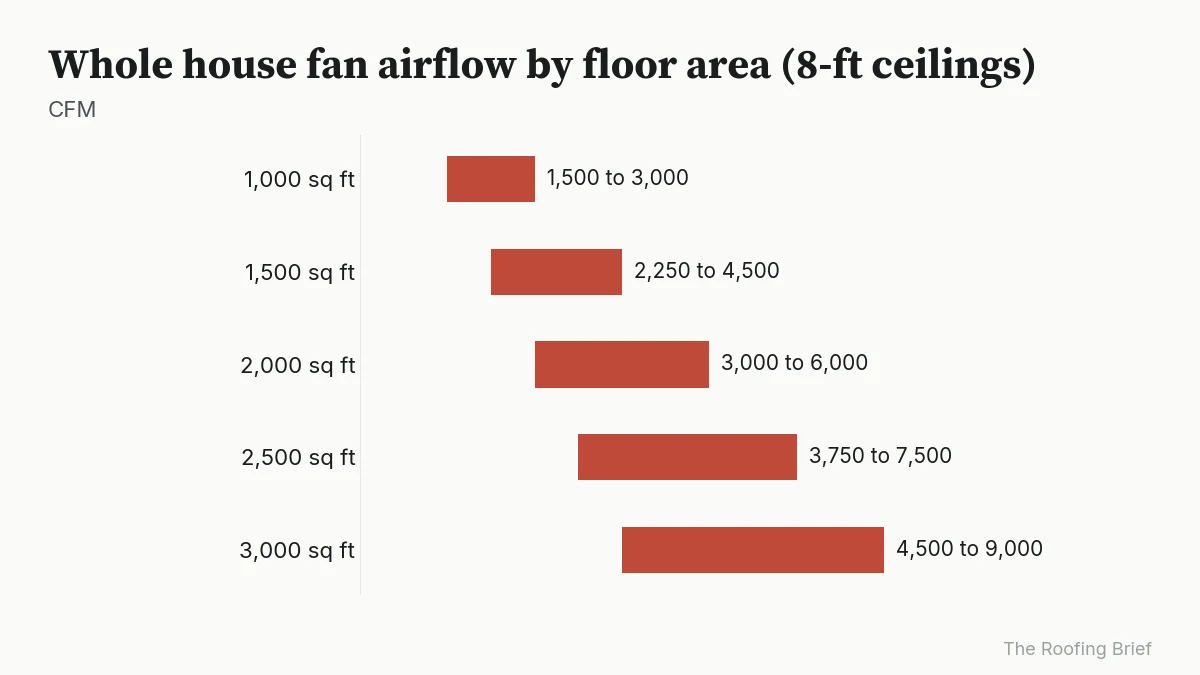
Size a whole house fan at 1.5 to 3 CFM per square foot of floor for 8-foot ceilings, which equals 12 to 23 air changes per hour, per PNNL. For taller ceilings, use volume: multiply floor area by ceiling height, then by 0.2 to 0.375 CFM per cubic foot. PNNL’s own example, a 1,500 sq ft home with 9-foot ceilings (13,500 cubic feet), lands at 2,700 to 5,060 CFM.
Compare fans on HVI-916 airflow, the Home Ventilating Institute test PNNL tells buyers to use, because box numbers run higher. AirScape labels its headline figure “Q-CFM” and states it “is NOT HVI-916 ‘as-installed’ airflow”: the Ventura 3400 shows 4,518 Q-CFM against 3,342 CFM HVI-916 on high (AirScape model comparison).
| Floor area (8-ft ceilings) | PNNL low end (1.5 CFM/sq ft) | PNNL high end (3 CFM/sq ft) | Open window area at the high end |
|---|---|---|---|
| 1,000 sq ft | 1,500 CFM | 3,000 CFM | 12 sq ft |
| 1,500 sq ft | 2,250 CFM | 4,500 CFM | 18 sq ft |
| 2,000 sq ft | 3,000 CFM | 6,000 CFM | 24 sq ft |
| 2,500 sq ft | 3,750 CFM | 7,500 CFM | 30 sq ft |
| 3,000 sq ft | 4,500 CFM | 9,000 CFM | 36 sq ft |
The window column applies PNNL’s rule of at least 4 sq ft of screened open window per 1,000 CFM. Only the open part counts, and PNNL notes that sliding windows usually open to only one third to one half of their total area, so a 3 by 5 foot slider gives roughly 5 to 7.5 sq ft. The low-end column also equals California’s 1.5 CFM per sq ft minimum.
How much attic vent area does a whole house fan need?
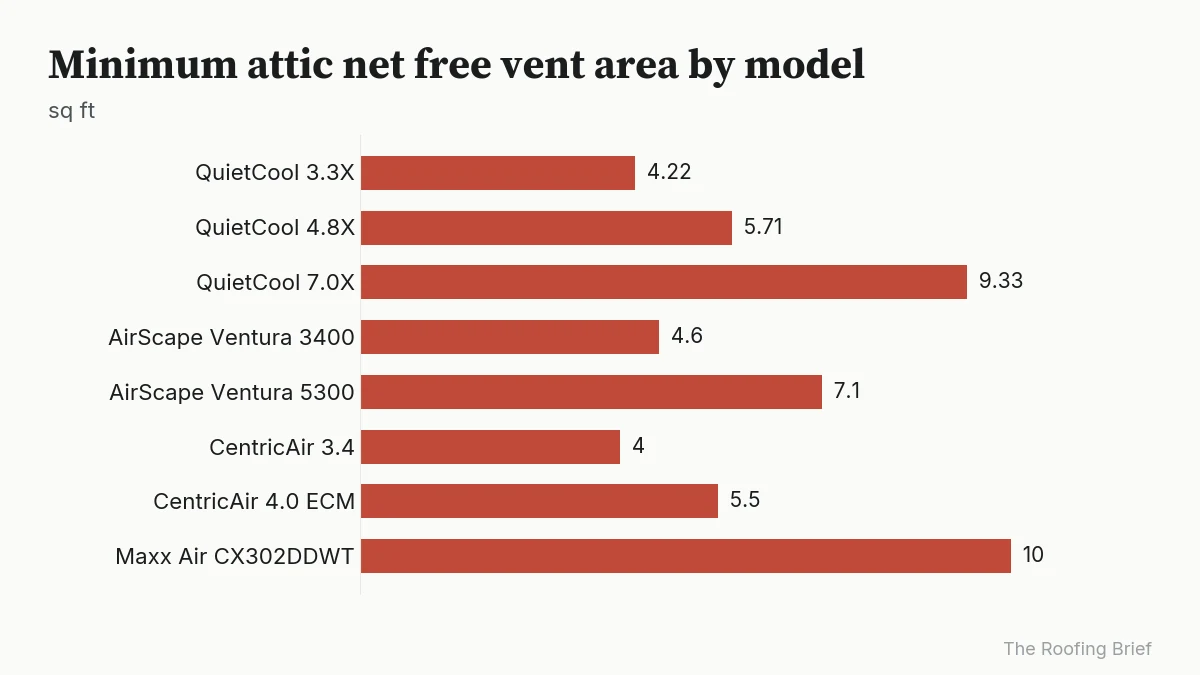
A whole house fan needs at least 1 square foot of attic net free vent area for every 750 CFM it moves, per PNNL and QuietCool’s owner’s guide, which marks the rule “VERY IMPORTANT.” Screens and louvers cut net free area by about half, so PNNL says to double the gross opening when vents are screened. Makers print the resulting minimum for each model on the spec sheet.
| Model | Maker airflow, high | Minimum attic NFA (sq ft) | Maker recommended NFA (sq ft) | Source |
|---|---|---|---|---|
| QuietCool Stealth Pro 3.3X RF | 3,159 CFM | 4.22 | Not stated | QuietCool spec sheet |
| QuietCool Stealth Pro 4.8X RF | 4,280 CFM | 5.71 | Not stated | QuietCool spec sheet |
| QuietCool Stealth Pro 7.0X RF | 6,996 CFM | 9.33 | Not stated | QuietCool spec sheet |
| AirScape Ventura 3400 | 4,518 Q-CFM | 4.6 | 7 | AirScape model comparison |
| AirScape Ventura 5300 | 7,007 Q-CFM | 7.1 | 10 | AirScape model comparison |
| CentricAir 3.4 | 3,242 CFM | 4.0 | Not stated | CentricAir 3.4 product page |
| CentricAir 4.0 ECM | 4,146 CFM | 5.5 | Not stated | CentricAir 4.0 ECM product page |
| Maxx Air CX302DDWT | Up to 4,425 CFM | 10 to 12 | Not stated | Maxx Air product page |
QuietCool’s minimums are its high-speed CFM divided by 750: 4,280 divided by 750 is 5.71. The traditional 30-inch Maxx Air shutter fan asks for 10 to 12 sq ft (1,440 to 1,728 sq in) at 4,425 CFM, about 1 sq ft per 369 to 443 CFM, so an attic that suits a ducted fan can fall short for an open shutter unit.
The fan’s requirement often exceeds the code minimum for attic ventilation. Under 2021 IRC Section R806.2, the default is 1/150 of the vented space, or 1/300 when 40 to 50% of the vent area sits within 3 feet of the ridge (plus a Class I or II ceiling vapor retarder in Climate Zones 6 to 8). The worked example below is a Roofing Brief calculation for one attic.
| Line | Value | How it is calculated |
|---|---|---|
| Attic floor area | 1,800 sq ft | Input |
| Existing vent area at the IRC 1/300 ratio | 6.0 sq ft (864 sq in) | 1,800 divided by 300 |
| Fan A: QuietCool Stealth Pro 4.8X minimum | 5.71 sq ft | Spec sheet; 6.0 covers it with 0.29 sq ft spare |
| Fan B: QuietCool Stealth Pro 7.0X minimum | 9.33 sq ft | Spec sheet |
| Shortfall with Fan B | 3.33 sq ft (480 sq in) | 9.33 minus 6.0, times 144 |
| Ridge vent to close the gap | 27 linear feet | 480 divided by 18 sq in per foot, rounded up |
| Alternative: gable vents | 3 vents | 3.33 divided by 1.20 sq ft per 12 by 19.5 in gable vent, rounded up |
The 18 sq in per foot ridge figure and the 1.20 sq ft gable figure are the average sizes in QuietCool’s owner’s guide vent table, which lists ridge vent at 0.125 sq ft per foot; check the rating printed on the product you buy. Our net free area calculation guide compares declared ratings by brand, and the ridge vent installation guide covers the slot cut.
Which whole house fan models compare on CFM, watts, noise and price?
Among the eight models below, the quietest on high is QuietCool’s Stealth Pro 3.3X and 4.8X at 47.4 dBA, and the lowest price is the Maxx Air CX302DDWT shutter fan at $514.99 on the maker’s store. Ducted fans from QuietCool, AirScape and CentricAir list at $1,449 to $1,959.25 in October 2026, 2.8 to 3.8 times the shutter fan.
| Model | Airflow high (maker) | HVI-916 or Title 24 airflow, high | Watts, high | dBA, high / low | Price, seller, date seen | Source |
|---|---|---|---|---|---|---|
| QuietCool Stealth Pro 3.3X RF | 3,159 CFM | 2,350 CFM | 264 | 47.4 / 36.1 | Not checked | QuietCool spec sheet Rev. 10/2/24 |
| QuietCool Stealth Pro 4.8X RF | 4,280 CFM | 3,130 CFM | 408 | 47.4 / 33.0 | $1,959.25, Platt Electric Supply, Oct 2026 | QuietCool spec sheet Rev. 10/2/24 |
| QuietCool Stealth Pro 7.0X RF | 6,996 CFM | 5,200 CFM | 725 | 51.7 / 41.4 | Not checked | QuietCool spec sheet Rev. 10/2/24 |
| AirScape Ventura 3400 | 4,518 Q-CFM | 3,342 CFM | 292 | 52 / 36 | $1,559, AirScape store, Oct 2026 | AirScape model comparison |
| AirScape Ventura 5300 | 7,007 Q-CFM | 5,497 CFM | 902 | 60 / 37 | $1,799, AirScape store, Oct 2026 | AirScape model comparison |
| CentricAir 3.4 | 3,242 CFM | 3,242 CFM (maker labels it Title 24 airflow) | 382 | 49 / 47 | $1,449, CentricAir store, Oct 2026 | CentricAir 3.4 product page |
| CentricAir 4.0 ECM | 4,146 CFM | 4,146 CFM (maker labels it Title 24 airflow) | 749 | 49 / 47 | $1,949, CentricAir store, Oct 2026 | CentricAir 4.0 ECM product page |
| Maxx Air CX302DDWT (30 in shutter) | Up to 4,425 CFM | Not listed | 150 (page also lists 3.2 A) | Not listed | $514.99 regular, Maxx Air store, Oct 2026 (backordered) | Maxx Air product page |
Two cautions apply. The Maxx Air page lists 150 W and 3.2 A at 120 V, and 3.2 A at 120 V is 384 W, so ask the seller which number is the running load. QuietCool’s sheets also set a minimum attic clearance of 34 inches for the 3.3X, 36 inches for the 4.8X and 44 inches for the 7.0X, while AirScape recommends 40 to 48 inches.
How much electricity does a whole house fan use compared with central AC?
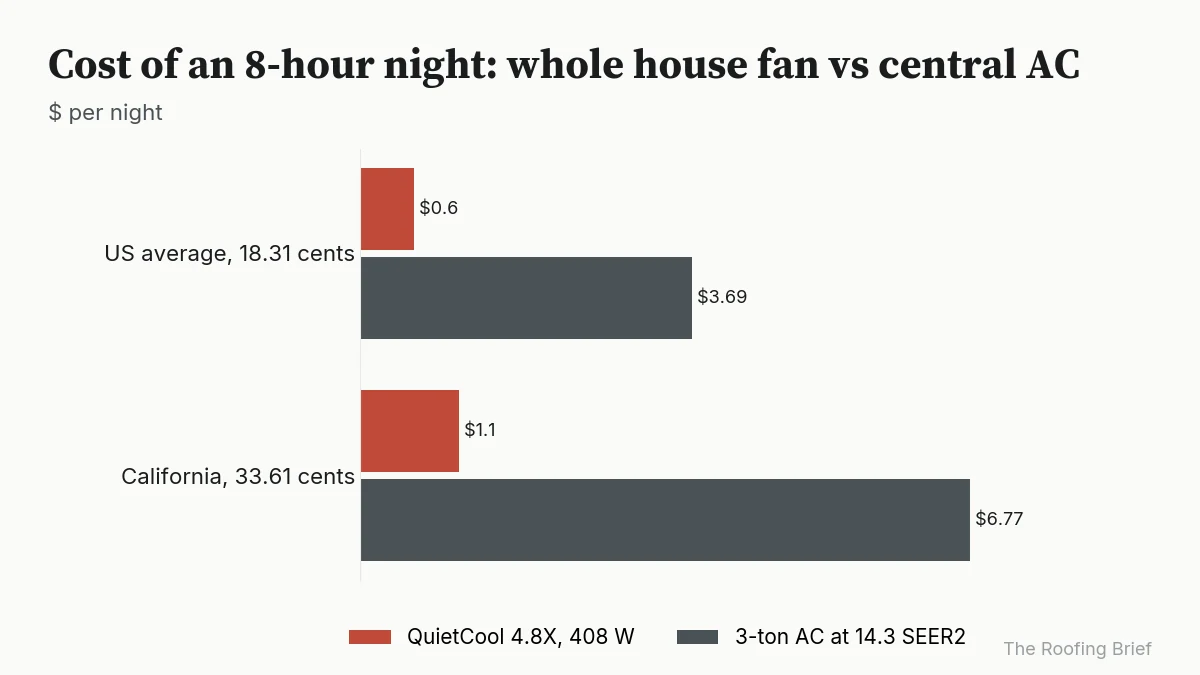
A QuietCool Stealth Pro 4.8X draws 408 W on high and 73.9 W on low, while a 3-ton central AC at the 14.3 SEER2 federal minimum for the Southeast and Southwest averages about 2,517 W. Over an 8-hour night that is 3.26 kWh for the fan against 20.14 kWh for the AC, about one sixth of the energy, before any duty-cycle correction.
| Line | Whole house fan | Central AC | How it is calculated |
|---|---|---|---|
| Equipment | QuietCool Stealth Pro 4.8X, high speed | 3-ton (36,000 Btu/h) split AC at 14.3 SEER2 | Spec sheet; 10 CFR 430.32(c)(6) |
| Power | 408 W | 2,517 W | 36,000 divided by 14.3 for the AC |
| Energy, 8-hour night | 3.26 kWh | 20.14 kWh | Power times 8 hours |
| Cost per night, US average 18.31 cents | $0.60 | $3.69 | EIA Table 5.6.A, July 2026 residential |
| Cost per night, California 33.61 cents | $1.10 | $6.77 | EIA Table 5.6.A, July 2026 residential |
| Savings over 90 nights, US average | $278 (90 times $3.09) | Roofing Brief estimate | |
| Savings over 90 nights, California | $510 (90 times $5.67) | Roofing Brief estimate | |
| Simple payback on $1,500 installed | 5.4 seasons (US average); 2.9 seasons (California) | HomeGuide national average divided by the savings | |
These savings are an upper bound because they assume the AC compressor would have run all 8 hours. If it would have cycled half the time, halve the savings and double the payback. QuietCool’s product page claims “up to 50-90%” lower AC use; that figure depends on climate and is a maker claim, not a measured result for any one house.
Which climates suit a whole house fan?
A whole house fan pays off where summer nights fall below about 67°F and the day to night swing is about 25°F or more, per PNNL citing Givoni (1991). PNNL rates IECC zones 3B, 4B and 5B as very well suited and 1A to 3A as least beneficial. In humid zones it should run only at night when outdoor air is at least 10°F cooler than the indoor daytime air.
| IECC climate zones | PNNL rating | Operating rule |
|---|---|---|
| 3B, 4B, 5B | Very well suited | Run evenings and nights; close the house in the morning |
| 2B, 3C, 4C, 6B | Good candidates | Run whenever outdoor air is cooler than indoor air |
| 4A to 6A, and up to 8 | Effective, but humidity is a concern | Night use when outdoors is at least 10°F cooler; never with AC on |
| 1A to 3A | Less benefit | Expect limited hours; AC still carries most of the load |
The moist “A” zones are the ones PNNL flags for humidity, because a whole house fan trading 12 to 23 air changes an hour brings in outdoor moisture and cannot remove it. PNNL’s rule for every zone is the same: never run the fan when outdoor air is warmer than indoor air, and avoid running the AC for several hours before or after it.
What codes and safety rules apply to a whole house fan?
The 2021 IRC chapters we checked (3, 8 and 11) have no whole-house-fan section, so outside California the permit covers wiring and ceiling work. California’s Section 150.1(c)12 adds an HVI-listed fan of at least 1.5 CFM per square foot of conditioned floor area, plus attic vent area of at least its rated airflow divided by 750, per the CEC’s CF2R-MCH-02 form.
| Rule | Requirement | Source |
|---|---|---|
| California airflow minimum | Conditioned floor area times 1.5 CFM, using the HVI-rated airflow | CEC CF2R-MCH-02, Section 150.1(c)12 |
| California attic vent area | Installed attic NFVA at least total fan airflow divided by 750 | CEC CF2R-MCH-02 |
| Combustion appliances | Room-air or standing-pilot appliances not recommended; furnaces need a switch so only one runs | PNNL whole-house fan guide |
| Fireplaces | Close doors and dampers before the fan runs | PNNL whole-house fan guide |
| Ceiling seal | Insulated, gasketed cover or damper; seal the drywall cut with foam or caulk | PNNL whole-house fan guide |
| Framing | Do not cut ceiling joists; install the fan before attic insulation is blown in | PNNL whole-house fan guide |
| Grille location | Not over a staircase | QuietCool Stealth Pro owner’s guide |
Backdraft is the hazard that matters most. QuietCool’s Stealth Pro owner’s guide warns that the fan can pull enough air from the house, “particularly if not enough windows are open,” to “easily backdraft gas appliances.” PNNL notes that some localities require one of three fixes: a sealed combustion appliance, a fan ducted outdoors, or an interlock switch. A fan moving 4,280 CFM needs about 17 sq ft of open window to keep that pull off the water heater flue.
California’s numbers above come from the 2019-cycle CF2R-MCH-02, the version of the form we could open, so ask the plans examiner which current form and airflow minimum apply on your permit date. Sealing the fan opening belongs in the same job as air sealing the attic, because PNNL notes the fan pressurizes the attic.
How much does a whole house fan cost installed?
A whole house fan costs $600 to $2,300 installed, with a $1,500 national average, per HomeGuide’s August 29, 2025 cost guide. The fan alone runs $300 to $1,500, and labor runs $300 to $800 on existing wiring or $600 to $1,600 with a new circuit and switch. Adding a roof vent adds $200 to $700 per vent.
| Cost line | Low | High | Source |
|---|---|---|---|
| Whole house fan unit | $300 | $1,500 | HomeGuide, Aug 2025 |
| Installation labor and wiring | $300 | $1,600 | HomeGuide, Aug 2025 |
| Added roof vent, each | $200 | $700 | HomeGuide, Aug 2025 |
| Permits and inspection | $50 | $350 | HomeGuide, Aug 2025 |
| Fan shutters, if not included | $40 | $200 | HomeGuide, Aug 2025 |
| Typical installed total | $600 | $2,300 | HomeGuide, Aug 2025 |
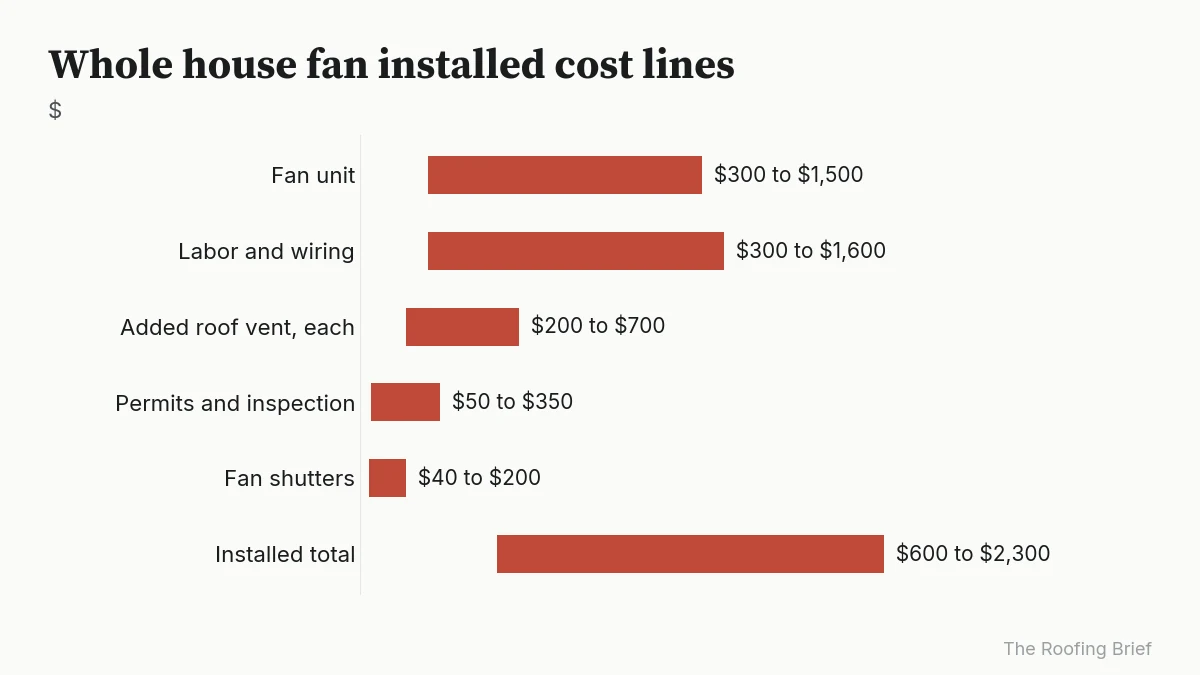
The fan price moves the total most. A $514.99 Maxx Air shutter fan and a $1,959.25 QuietCool 4.8X differ by $1,444 before labor, and HomeGuide puts a new dedicated circuit and wall switch at $250 to $900. Where the attic falls short on vents, the 27 feet of ridge vent in the worked example above is part of the fan job.
The install itself follows a fixed order, set out below with the maker figures for a QuietCool Stealth Pro 4.8X:
- Confirm attic clearance of at least 36 inches above the ceiling joists and a joist spacing of 16 or 24 inches on center (QuietCool 4.8X sheet).
- Confirm attic net free vent area of at least 5.71 sq ft, adding ridge, gable or soffit vent area first if short.
- Cut a 14 1/4 by 30 1/4 inch ceiling opening between joists in a central hallway, not over a staircase; no joist cutting is required.
- Set the damper box, hang the motor head on its strap and connect the 9-foot acoustic duct.
- Run power to the 120 VAC, 5.16 A (high speed) motor, on a new circuit if the electrician requires one.
- Seal the drywall cut with foam or caulk, then blow or replace attic insulation around the box (PNNL).
- Give the household the operating rule: open windows first, never run with the AC or a fireplace in use.
Where do common guides and the primary sources disagree?
Three popular claims do not match the primary documents. Cost guides quote vent ratios as tight as 1 sq ft per 450 CFM, certified airflow is only 73 to 78% of the box CFM on the five models in our table that publish both, and savings claims of “up to 90%” ignore climate. The table sets each claim beside what the maker sheet, federal guide or code form says.
| Claim | Where it appears | What the primary source says |
|---|---|---|
| 1 sq ft of attic vent per 450 CFM | HomeGuide cost guide | 1 per 750 CFM (PNNL, QuietCool, CEC form); Maxx Air asks for about 1 per 369 to 443 CFM on its shutter fan |
| Size on the box CFM | Retail listings | Use HVI-916: QuietCool 4.8X 3,130 vs 4,280; AirScape Ventura 3400 3,342 vs 4,518 |
| “Save up to 50-90%” on AC | QuietCool product page | PNNL rates zones 1A to 3A as less benefit; savings depend on night temperature and humidity |
Should you install a whole house fan?
Install one if summer nights in your area drop below about 67°F, the attic has the clearance and vent area the model needs, and no room-air combustion appliance or standing pilot is in the living space. If any of those fail, fix that item first or put the money toward the AC. The decision table gives the threshold for each situation.
| If your situation is | Do this | Threshold and source |
|---|---|---|
| Nights rarely drop below 67°F, or you are in zones 1A to 3A | Skip the fan or expect few hours of use | PNNL climate guidance |
| Gas appliance with a standing pilot or room-air draft indoors | Seal or replace the appliance, or interlock it, before installing | PNNL; QuietCool owner’s guide |
| Attic NFA below fan CFM divided by 750 | Add vent area first: shortfall in sq in divided by the ridge vent rating per foot | QuietCool owner’s guide; worked example above |
| Attic clearance below the model minimum (34 to 44 in for QuietCool Stealth Pro) | Choose a smaller model, a wall-mount adapter, or a roof-mount unit | QuietCool spec sheets |
| California new construction or addition | HVI-listed fan, 1.5 CFM per sq ft, NFVA of airflow divided by 750 | CEC CF2R-MCH-02 |
| Fan will run near bedrooms | Pick a ducted model under 50 dBA on high | QuietCool 47.4 dBA; CentricAir 49 dBA |
| Dry climate, enough vents, no combustion conflict | Size at 1.5 to 3 CFM per sq ft on HVI airflow and install | PNNL sizing guidance |
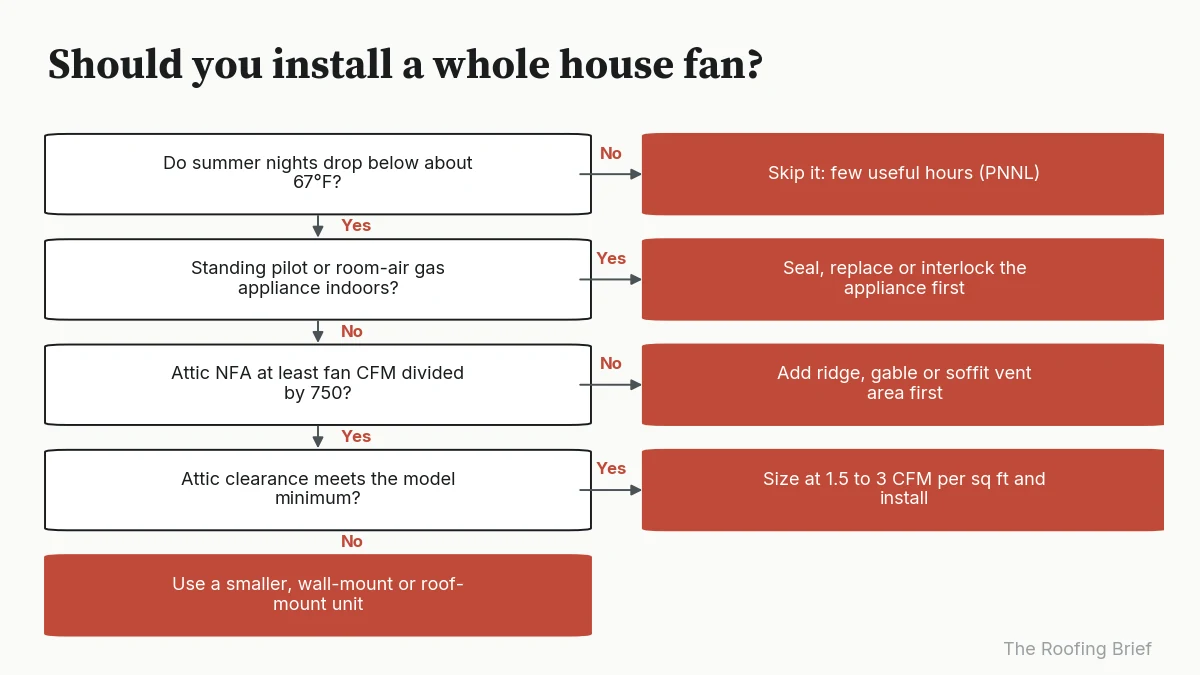
Once the fan is in, the ridge and soffit vents carry its exhaust every night, so check them against the code ratio in the 1/300 attic ventilation rule guide whenever the roof is replaced.
How we compiled this
We compiled this page in October 2026 from 16 primary documents and one dated cost guide, listed in full under Sources. Every figure on the page traces to one of them, and every calculation shows its inputs. We did not test, install or measure any fan.
- Federal guidance and data: PNNL Building America Solution Center, 10 CFR 430.32 and EIA Electric Power Monthly Table 5.6.A.
- Codes and forms: 2021 IRC Section R806 and California’s CF2R-MCH-02 whole house fan form.
- Maker documents: six QuietCool documents (four spec sheets, the owner’s guide and a product page) plus AirScape, CentricAir (two pages) and Maxx Air pages.
- Prices: Platt Electric Supply plus the AirScape, CentricAir and Maxx Air stores, seen in October 2026; installed costs from HomeGuide (August 29, 2025).
Frequently asked questions
Is it worth getting a whole house fan?
It is worth it where nights cool off. In our worked example, a 408 W QuietCool 4.8X replacing a 2,517 W central AC for 90 nights saves up to $278 at the July 2026 US average power price and $510 at California’s 33.61 cents, paying back a $1,500 install in 5.4 or 2.9 seasons. In humid zones 1A to 3A, PNNL expects less benefit.
Can you run a whole house fan and the air conditioner at the same time?
No. PNNL states that whole-house fans “should not be used at the same time as air conditioning,” and it advises avoiding AC for several hours before or after running the fan. The fan replaces cooled indoor air with outdoor air at 12 to 23 air changes per hour, so running both pays to cool air that is being exhausted to the attic.
How many windows do you need to open for a whole house fan?
Open at least 4 square feet of screened window area per 1,000 CFM, per PNNL. A 4,280 CFM fan needs about 17 square feet of actual opening. Sliding windows open only one third to one half of their area, so count the open gap, not the frame. QuietCool’s guide warns that running with too few windows open can backdraft gas appliances.
What is the difference between a whole house fan and an attic fan?
A whole house fan mounts in the top-floor ceiling and pulls air from the rooms through open windows into the attic, cooling the house. An attic fan mounts on the roof or gable and moves only attic air. A whole house fan is sized at 12 to 23 air changes per hour of house volume, per PNNL, and needs a damper to seal the ceiling.
What size whole house fan for a 2000 sq ft house?
For 2,000 sq ft with 8-foot ceilings, PNNL’s 1.5 to 3 CFM per sq ft gives 3,000 to 6,000 CFM of HVI-rated airflow, and California’s minimum is 3,000 CFM. QuietCool rates its Stealth Pro 5.5X for 1,681 to 2,522 sq ft at 5,044 CFM on high (3,750 CFM HVI-916), with a 6.73 sq ft attic vent minimum. At the high end, open about 24 sq ft of window.
How much does it cost to have a whole house fan installed?
HomeGuide’s August 29, 2025 guide puts a whole house fan at $600 to $2,300 installed, with a $1,500 national average. The fan is $300 to $1,500 of that, labor $300 to $800 on existing wiring or $600 to $1,600 with a new circuit, and each added roof vent $200 to $700. In October 2026 listings, fans ran from $514.99 (Maxx Air) to $1,959.25 (QuietCool 4.8X).
Sources
- Building America Solution Center (PNNL, US DOE): Whole-House Fans, accessed Oct 2026
- QuietCool QC STL PRO-3.3X RF Specifications, Rev. 10/2/24, accessed Oct 2026
- QuietCool QC STL PRO-4.8X RF Specifications, Rev. 10/2/24, accessed Oct 2026
- QuietCool QC STL PRO-5.5X RF Specifications, Rev. 10/2/24, accessed Oct 2026
- QuietCool QC STL PRO-7.0X RF Specifications, Rev. 10/2/24, accessed Oct 2026
- QuietCool Stealth Pro RF Owner’s Guide (2-12-26), accessed Oct 2026
- QuietCool Stealth Pro X product page, accessed Oct 2026
- AirScape: Compare AirScape Fans and AirScape Ventura store listing, accessed Oct 2026
- CentricAir 3.4 product page, accessed Oct 2026
- CentricAir 4.0 ECM product page, accessed Oct 2026
- Maxx Air 30 in. 2-Speed Direct Drive Whole House Fan with Shutter (CX302DDWT), accessed Oct 2026
- Platt Electric Supply: QuietCool QC-STL-PRO-4.8X-RF listing, accessed Oct 2026
- California Energy Commission CF2R-MCH-02, Whole House Fan (2019 Residential Compliance), accessed Oct 2026
- 10 CFR 430.32, Energy conservation standards (eCFR), accessed Oct 2026
- EIA Electric Power Monthly Table 5.6.A, July 2026 data, accessed Oct 2026
- 2021 International Residential Code, Chapter 8, Section R806 (as adopted in Colorado without amendments, UpCodes viewer), accessed Oct 2026
- HomeGuide: How Much Does a Whole-house Fan Cost to Install? (August 29, 2025), accessed Oct 2026