
By The Roofing Brief Team | Last reviewed: October 2026
Roofing pants are work pants cut for kneeling, ladder climbing and sloped footing: stretch fabric (usually 2% to 11% spandex), a gusseted crotch, reinforced knee pad pockets and, in one niche product, rubber grip panels on the seat and legs. The best-known non-slip option, the SteepGear Pants, listed at $119.99 a pair on SteepGear’s own store in October 2026, while knee pad pocket pants such as the Carhartt 102802 sat near $65.
Every spec on this page comes from maker product pages, dated retailer listings, OSHA rule text and the European knee-protector standard EN 14404. The Roofing Brief did not wear-test any pants. No grip clothing counts as fall protection: on a roof steeper than 4:12 with an edge 6 feet or more above a lower level, OSHA 29 CFR 1926.501(b)(11) still requires guardrails with toeboards, safety nets or a personal fall arrest system.
Roofing pants at a glance: key numbers
Five numbers settle most roofing pants decisions: the price of the only purpose-built grip pant, the stretch share of common fabrics, the fabric weight band, the knee protection test levels and the OSHA slope line where fall protection rules change. Each figure in the table below links to the maker, standard or regulation it came from, as checked in October 2026.
| Figure | Value | Source |
|---|---|---|
| SteepGear Pants (rubber grip), 1 pair | $119.99; $109.99 each for 3 or more | SteepGear store listing, Oct 2026 |
| SteepGear Shorts (over-pant grip overlay) | $94.99 | SteepGear store listing, Oct 2026 |
| Spandex share in named roofing pants | 2% (Carhartt 102802, SteepGear) to 11% (Duluth Flexpedition) | Maker fabric specs |
| Fabric weight band | 6 oz/yd² (Carhartt Force) to 11.5 oz/yd² (original Duluth Fire Hose) | Maker fabric specs |
| Knee pad penetration levels | Level 1: over 100 N; Level 2: over 250 N | EN 14404:2024 via SATRA |
| OSHA “steep roof” line | Slope greater than 4 in 12 | 29 CFR 1926.500(b) |
What pants do roofers wear?
Most roofers wear stretch work pants in one of four builds: 8 oz cotton canvas with 2% to 3% spandex, nylon-spandex softshell around 6 oz, cotton-nylon ripstop with rubber grip panels, or regular pants under a slip-on grip overlay. Shingle crews add knee pad pockets; inspectors and adjusters on 8:12 and steeper roofs are the main buyers of grip clothing.
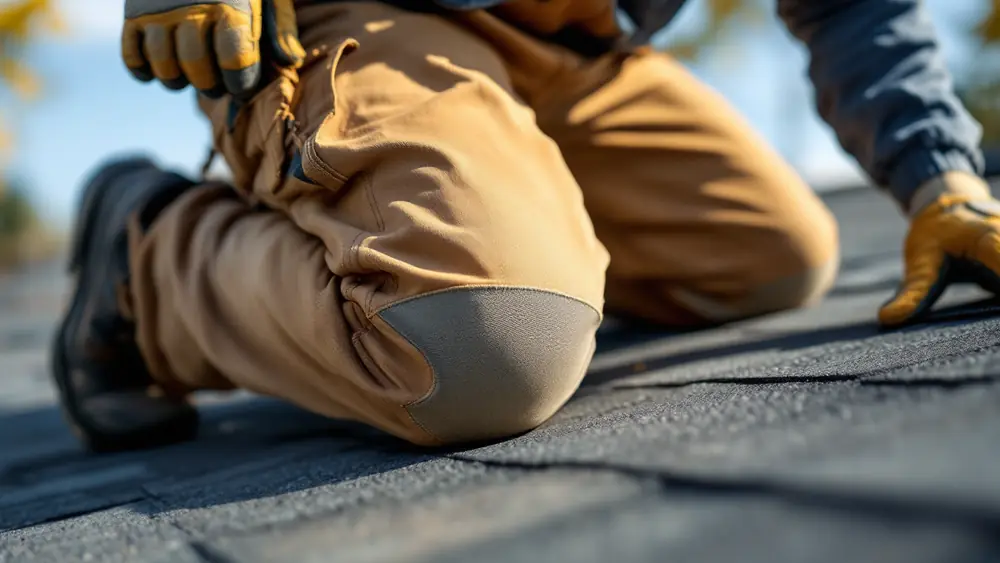
The table sorts the four builds, from 2% to 11% spandex, by what they do best. Fabric percentages come from each maker’s listing; “best for” is an editorial match of the fabric’s published traits to roof tasks, not a test result.
| Pant build | Example (maker spec) | Strength | Tradeoff | Best for |
|---|---|---|---|---|
| Stretch cotton canvas | Carhartt 102802: 8 oz, 98% cotton / 2% spandex | Abrasion from granules and decking; double-front knee pad sleeve | Heavier and slower to dry than nylon | Tear-off and shingle install, spring and fall |
| Nylon-spandex softshell | Duluth Flexpedition Roofers 84307: 89% nylon / 11% spandex | 4-way stretch for crawling and lunging | Nylon is a thermoplastic, a poor match for hot tar or torch work | Steep shingle work in heat; ladder-heavy days |
| Ripstop with rubber grip | SteepGear Pants: 53% cotton / 45% nylon / 2% spandex | Rubber on the seat and legs adds friction when you sit or slide | Only a 32 in inseam; $119.99 | Inspections and repairs on dry 8:12 and steeper roofs |
| Grip overlay over any pant | SteepGear Shorts: non-latex rubber grid, leg zippers | Goes on over boots; moves between pants | A second layer in summer heat | Adjusters, solar techs, holiday-light installers |
Roofing pants compared: 11 models from maker spec sheets
The 11 pants below cover every model named in the top-ranking roofing pants roundups plus the knee-certified European option those lists skip. Fabric, weight and knee features are quoted from each maker’s listing; prices are the listed price on the named store in October 2026 and change often. “Not published” means the maker’s page gives no figure.
| Model (item no.) | Fabric | Weight | Knee system | Other spec | Price as listed Oct 2026 | Source |
|---|---|---|---|---|---|---|
| SteepGear Pants | 53% cotton, 45% nylon, 2% spandex ripstop | Not published | No pad pocket listed | Rubber grip on back to above the knee and down the leg; 8 pockets; waist 27 to 43 in, 32 in inseam only | $119.99 (SteepGear) | SteepGear |
| SteepGear Shorts (overlay) | Shell with non-latex rubber grid | Not published | None | Leg zippers fit over boots; reach-through pockets; waist 25 to 48 in | $94.99 (SteepGear); $109.99 (Tool Experts) | SteepGear |
| Duluth Flexpedition Cargo Roofers Pants (84307) | 89% nylon, 11% spandex, 4-way stretch | Not on indexed listing | Knee pad pockets, nylon reinforcements | Sheds moisture and blocks wind, per Duluth | Not captured (site blocked automated access) | Duluth Trading |
| DuluthFlex Fire Hose Relaxed Fit Cargo (45507) | 97% cotton, 3% spandex canvas | 8 oz | Not stated on indexed listing | Duluth says 30% lighter than original 11.5 oz Fire Hose | Not captured | Duluth Trading |
| DuluthFlex Dry on the Fly Relaxed Fit Cargo (46201) | Quick-dry synthetic with spandex | Not on indexed listing | None listed | Built-in UPF 50; Crouch Gusset; 11 pockets | Not captured | Duluth Trading |
| Carhartt Rugged Flex Rigby Double-Front (102802) | 98% cotton, 2% spandex canvas | 8 oz | Double-front sleeve fits Carhartt knee pad inserts | Gusseted crotch; hidden zip back pocket | $64.99 (Carhartt Company Gear, WorkingPerson) | Carhartt |
| Carhartt Force Ripstop Cargo (107329) | 95% nylon, 5% spandex ripstop | 6 oz | Not stated | FastDry sweat wicking | Not captured | Carhartt |
| Dickies FLEX Performance Workwear (DKWD4901) | 98% cotton, 2% Lycra | Not published | Cordura knee pad pouches | Crotch gusset; Cordura kick plates; reflective hits | $89.99 list, $43.98 sale (Dickies) | Dickies |
| Truewerk T2 WerkPant | 50% nylon, 40% polyester, 10% spandex softshell | Not published | No pad pocket; Truewerk lists a T2 PRO at $129 with a kneepad pocket | C0 DWR (PFAS-free); 9 pockets; gusseted inseam; 30 to 36 in inseams | $99 (Truewerk) | Truewerk |
| Truewerk XP WerkPant | Lightweight moisture-wicking softshell, 4-way stretch | Not published | Built-in removable knee pads | Sold as a summer pant | $99 (Truewerk) | Truewerk |
| Blåkläder Craftsman Trousers 4-way stretch X1900 (1989) | 93% polyamide, 7% elastane dobby | 295 g/m² (8.7 oz/yd²) | Cordura stretch knee pockets; EN 14404-3 certified with Blåkläder pads 4027, 4032, 4057, 4058 | Hammer loops; knife holder; 3-needle inner leg seam | €193.98 incl. VAT (Blåkläder Italy) | Blåkläder |
Duluth Trading’s product pages refused automated requests in October 2026, so the Duluth rows quote the maker’s own listing text as Google indexes it. Check the live Duluth page for the current price and inseam options before ordering.
Do non-slip roofing pants work? What SteepGear’s grip can and cannot do
Non-slip roofing pants add friction where your body meets the roof: SteepGear puts a rubber pattern on the seat and legs so a seated or sliding worker drags rather than glides. SteepGear’s own About page says the clothing helps “slow your descent and give you time to regain your balance.” That is a slip-reduction claim, not fall arrest, and no OSHA standard accepts it as fall protection.
Three dated records put the “patented” label in context. SteepGear cites US Design Patent D774,279 S, titled “Roof safety shorts”, which Google Patents shows granted December 20, 2016 to inventor Damon Howard Hawkins, status Active, with anticipated expiration December 20, 2031. A design patent covers ornamental appearance, not a tested grip level. The utility application SteepGear lists as “Patent Pending”, US 2014/0283289 A1, shows as Abandoned on Google Patents.
Surface conditions decide whether rubber grips at all. The Tool Experts listing for SteepGear Shorts says the grid is “designed for dry conditions” and that wet or icy roofs need supplemental fall protection, and it markets the shorts for 8/12 to 12/12 pitches. SteepGear’s store copy names asphalt shingles, metal, tile, plywood and underlayment as target surfaces.
| Situation | Can grip pants or shorts help? | What the rule or maker text says |
|---|---|---|
| Dry architectural shingles, 8:12 to 12:12 | Yes, as added friction when seated or sliding | Retailer markets SteepGear Shorts for 8/12 to 12/12 (Tool Experts) |
| Dew, frost, rain or ice | No reliable benefit | “Designed for dry conditions” (Tool Experts FAQ) |
| Any roof over 4:12, edge 6 ft or higher, employer job site | Only as a supplement | Guardrails with toeboards, nets or PFAS required, 1926.501(b)(11) |
| Low-slope roof (4:12 or less) | Little to gain from seat grip | Warning lines, monitors or PFAS options, 1926.501(b)(10) |
| Residential job 6 ft or higher | Only as a supplement | Guardrail, net or PFAS unless a written fall protection plan applies, 1926.501(b)(13) |
Footwear does most of the anti-slip work, so pair any pant with a sole matched to the surface. Our guide to the best roofing boots ranks pad, wedge and magnetic soles by roof type; its top pick, the Cougar Paws Performer, lists at $219 with $31.95 replacement pads. Harness selection is covered in our roofing harness comparison.
Roofing pants with knee pads: pocket systems and the EN 14404 standard
Roofing pants with knee pads use one of three systems: an internal pocket that holds a flat insert (Carhartt double-front, Dickies Cordura pouches, Duluth knee pockets), pads sewn or built in (Truewerk XP) or a pocket certified with a matched pad under EN 14404 (Blåkläder, Snickers). Only the last group publishes a tested protection level. US listings we checked cite no knee-protection standard.
EN 14404 is the European standard for knee protectors. Per SATRA’s summary of EN 14404:2024, the 2024 series replaced EN 14404:2004+A1:2010, was harmonised in May 2025, and now requires any garment sold with a knee pocket to be tested to Part 3 (a matched pad and garment) or Part 4 (interoperable pads). Type 2 means a pad held in a trouser pocket.
| EN 14404:2024 level | Penetration resistance | In pounds-force (Roofing Brief conversion) | Test surface | Roofing fit |
|---|---|---|---|---|
| Level 0 | No penetration protection claimed | None | Flat, even | Clean decks only |
| Level 1 | More than 100 N | About 22.5 lbf | Flat, even | Shingle install on swept decks |
| Level 1U | More than 100 N | About 22.5 lbf | Uneven | Laps, cap nails, granule-covered decks |
| Level 2 | More than 250 N | About 56.2 lbf | Uneven | Tear-off with loose nails and debris |
Certification only holds for the tested pair. Snickers Workwear says its Type 2 pads and trousers are co-certified, and Blåkläder certifies its X1900 1989 trouser to EN 14404-3 only with its pads 4027, 4032, 4057 and 4058. A Blåkläder pad in a Carhartt pocket, or a Carhartt pad in a Blåkläder pocket, carries no rating.
| Knee pad insert | Fits | Published spec | Price as listed Oct 2026 | Source |
|---|---|---|---|---|
| Carhartt Light Duty Utility Knee Pad Insert | Carhartt double-front pants | No protection standard listed | $19.99 (carhartt.com) | Carhartt listing via Google Shopping |
| Carhartt Heavy Duty Utility Knee Pad Inserts | Carhartt double-front pants | No protection standard listed | $26.99 (carhartt.com) | Carhartt listing via Google Shopping |
| Carhartt 103193 Knee Pads | Small: waist 28 to 30 in; Medium: 32 to 36 in; Large: 38 in and up | Sized by waist, not by knee | Varies by retailer | Dungarees |
| Blåkläder Gel Kneepad (4032) | Any Blåkläder knee pad pocket | 25 mm gel core | See maker | Blåkläder |
| Snickers KneeGuard pads | Snickers trousers only | EN 14404 Type 2, certified inside Snickers trousers | See maker | Snickers |
Kneeling load on a pitched roof is a measured problem. A 2019 NIOSH and West Virginia University study in Applied Ergonomics put 9 subjects on a slope-adjustable platform mimicking shingle installation and found roof slope and posture changed knee flexion, abduction and rotation, the angles linked to knee disorders in roofers.
Fabric weight decoded: oz per square yard vs g/m²
US makers list fabric weight in ounces per square yard and European makers in grams per square meter; 1 oz/yd² equals 33.906 g/m². Most roofing pants fall between 6 and 8.7 oz/yd² (203 to 295 g/m²). The original 11.5 oz Duluth Fire Hose canvas, at 390 g/m², sits at the heavy end for cold-weather tear-off.
| Pant | Listed weight | Converted (Roofing Brief arithmetic) | Fiber |
|---|---|---|---|
| Carhartt Force Ripstop Cargo 107329 | 6 oz/yd² | 203 g/m² | 95% nylon / 5% spandex |
| Duluth Flexpedition Standard Fit Cargo 84319 | 6.1 oz/yd² | 207 g/m² | 89% nylon / 11% spandex |
| Carhartt Rigby Double-Front 102802 | 8 oz/yd² | 271 g/m² | 98% cotton / 2% spandex |
| DuluthFlex Fire Hose 45507 | 8 oz/yd² | 271 g/m² | 97% cotton / 3% spandex |
| Blåkläder X1900 1989 | 295 g/m² | 8.7 oz/yd² | 93% polyamide / 7% elastane |
| Duluth Fire Hose Relaxed Fit Cargo 92204 (original) | 11.5 oz/yd² | 390 g/m² | 100% cotton |
The arithmetic also checks a maker claim. Duluth says DuluthFlex Fire Hose canvas is “30% lighter than the originals”; 8 oz divided by 11.5 oz is 0.696, or 30.4% lighter, so the claim matches Duluth’s own published weights. The 6.1 oz figure comes from the Flexpedition Standard Fit listing; Duluth’s indexed Roofers listing gives the same 89/11 blend without a weight.
Hot-weather roofing pants: UPF ratings and heat
For summer roofing, pick a lightweight, light-colored pant with a published UPF rating. ASTM D6603 labeling groups UPF 15 to 24 as good, 25 to 39 as very good and 40 to 50+ as excellent. A UPF 50 fabric passes about 1/50, or 2%, of UV; Truewerk’s fabric guide says an average white cotton tee rates UPF 5, passing about 20%.
| UPF rating | ASTM D6603 category | Share of UV passing through (1 / UPF) | Named roofing-relevant example |
|---|---|---|---|
| 5 | Below labeling minimum | 20% | Average white cotton tee, per Truewerk fabric guide |
| 15 | Good | 6.7% | Lowest rating that can be labeled UV-protective |
| 30 | Very good | 3.3% | Truewerk Cloud fabric (UPF 30+) |
| 50 | Excellent | 2.0% | DuluthFlex Dry on the Fly cargo pants (UPF 50) |
Category labels follow the ASTM scheme as summarized in a 2023 review in PMC. Most canvas work pants carry no UPF label at all, including the Carhartt 102802 and Dickies DKWD4901 listings, so treat an unlabeled pant as unrated rather than assuming protection.
Color and fit move heat load as much as fiber. Cal/OSHA’s heat illness clothing guidance calls for lightweight, loose, breathable and light-colored clothing, and warns that PPE covering the lower body can trap heat and calls for closer monitoring, more breaks and more water. Federal OSHA’s heat illness poster (OSHA 3431) gives the same light-colored, loose-fitting advice.
Hot tar, torches and when cotton pants matter
On hot-mop built-up roofing, OSHA’s Protecting Roofing Workers guide (OSHA 3755) lists “long sleeve cotton shirts, long cotton pants without cuffs” among the clothing employers must provide around kettles, luggers and mop buckets. The no-cuff detail removes a fold that can hold spilled tar against the ankle. The same guide notes a roofing torch can reach 2,000°F at the torch end.
That guidance favors cotton canvas, such as the 8 oz Carhartt 102802 or DuluthFlex Fire Hose, over the 89% nylon Flexpedition or 50% nylon Truewerk T2 for kettle and torch days, because nylon and polyester are thermoplastics that soften with heat. For torch-applied modified bitumen, ask whoever holds the crew’s NRCA CERTA torch-safety certification what clothing the job’s torch plan specifies.
What OSHA requires (and does not) for roofing clothing
No OSHA construction standard names roofing pants, grip clothing or knee pads. 29 CFR 1926.95(a) requires protective clothing “wherever it is necessary by reason of hazards,” and 1926.95(d)(4)(i) says employers do not have to pay for “everyday clothing, such as long-sleeve shirts, long pants, street shoes, and normal work boots.”
Shorts are a judgment call under federal policy. An April 17, 1997 OSHA enforcement memo on short pants in hot tar and asphalt work says 1926.95(a) “does not specify any particular kind of protection, such as long pants,” and tells compliance officers to balance burn protection against “extremely warm weather.” Employer rules and state plans can be stricter.
| Item | Required by a named OSHA rule? | Who pays under 1926.95(d) | Rule text |
|---|---|---|---|
| Ordinary long work pants | Only where a hazard calls for skin cover | Worker (everyday clothing exception) | 1926.95(a), (d)(4)(i) |
| Cotton pants for hot-mop BUR | Listed as must-provide clothing in OSHA 3755 guidance | Conditional: confirm with the employer’s PPE assessment | OSHA 3755, built-up roofing section |
| Rubber grip pants or shorts | No | Not addressed by any OSHA standard | None |
| Knee pads | No construction standard names them | Not addressed by any OSHA standard | None |
| Fall protection on roofs over 4:12 | Yes, at 6 ft or more above a lower level | Employer | 1926.501(b)(11), 1926.95(d)(1) |
Fall risk is the reason the pants debate matters. A CPWR study in the Journal of Safety Research (Dong et al., 2013) found roof falls were one-third of fatal falls in US construction from 1992 to 2009, and 67% of roof-fall deaths happened at establishments with 1 to 10 employees. Our full list of required gear is in the roofing safety equipment guide.
What a 3-pair roofing pants setup costs
A three-pair rotation costs about $222 to $330 at October 2026 list prices, depending on whether you buy grip pants, built-in knee pad pants or canvas pants with one set of inserts. The table shows the arithmetic; it excludes tax, shipping and sales, and Truewerk and Dickies both ran promotions that month.
| Setup | Line items (listed price, Oct 2026) | Total (Roofing Brief arithmetic) |
|---|---|---|
| Canvas with knee inserts | 3 x Carhartt 102802 at $64.99 + 1 pair Carhartt Heavy Duty inserts at $26.99, moved between pants | $221.96 |
| Grip overlay over sale pants | 3 x Dickies DKWD4901 at $43.98 sale + 1 SteepGear Shorts at $94.99 | $226.93 |
| Built-in knee pads | 3 x Truewerk XP WerkPant at $99 | $297.00 |
| Grip pants, multi-pair price | 3 x SteepGear Pants at $109.99 (3+ price) | $329.97 |
| Grip pants, single-pair price | 3 x SteepGear Pants at $119.99 | $359.97 |
The overlay setup buys grip for $94.99 instead of $329.97 because one pair of SteepGear Shorts moves between any pants, and its leg zippers let it go on over boots. The tradeoff is a second fabric layer, which Cal/OSHA flags as added heat load in summer.
How to fit roofing pants and knee pads
Fit roofing pants by waist first, then inseam, then knee pocket height while kneeling on a slope. A pad that rides below the kneecap leaves the zone EN 14404 tests uncovered, and size charts differ: SteepGear Pants come only in a 32 in inseam, Truewerk T2 in 30 to 36 in, and Carhartt sizes its 103193 pads by waist.
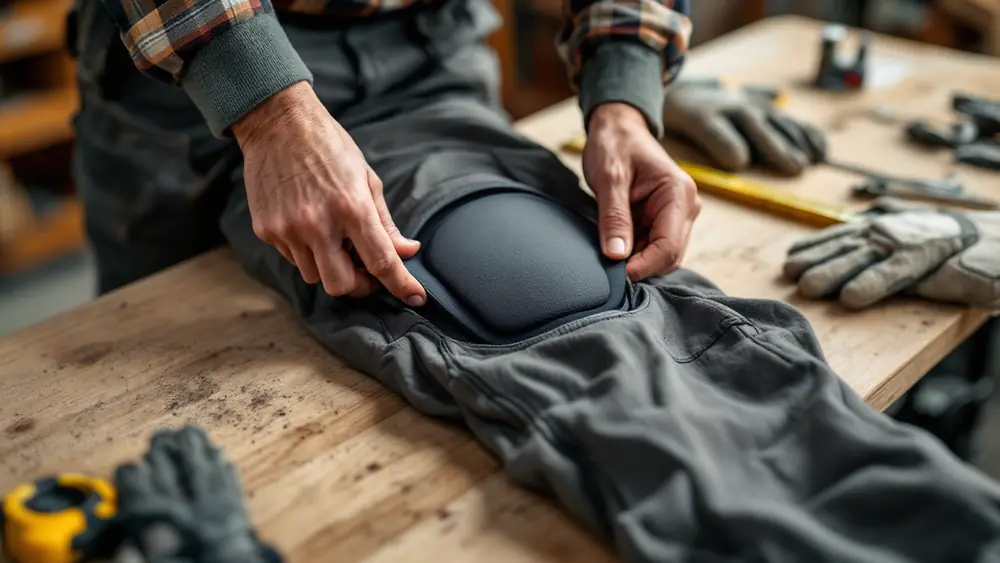
- Measure waist over your work layer. SteepGear Pants run Small 27 to 30 in through XLarge 39 to 43 in. For SteepGear Shorts, the Tool Experts sizing guide says order your standard waist and do not size up, because the overlay already allows room for clothes underneath.
- Pick the inseam for ladder work. A hem that drags catches boot heels on rungs. Truewerk lists 30, 32, 34 and 36 in inseams for the T2; SteepGear Pants come in 32 in only, so taller workers may run short.
- Match pads to the pocket maker. Buy Carhartt inserts for Carhartt double-fronts, Blåkläder pads 4027, 4032, 4057 or 4058 for the X1900, and Snickers pads for Snickers trousers. Mixing brands voids any EN 14404 rating.
- Size Carhartt pads by waist. Per the Dungarees listing, 103193 Small fits waist 28 to 30 in, Medium 32 to 36 in and Large 38 in and up.
- Kneel on a slope to check position. Kneel on a 6:12 or steeper surface for 30 seconds. The pad should cover the kneecap without sliding toward the shin; if it drops, try the next pad size or a pant with an adjustable pocket.
- Check the gusset on a ladder. Climb two rungs (OSHA 1926.1053 spaces portable ladder rungs 10 to 14 inches apart) and squat. A gusseted crotch (Carhartt 102802, Dickies DKWD4901, Truewerk T2) should not pull at the seam.
- Follow the grip-rubber care label. SteepGear’s care text for its 2% spandex blend says machine wash cold on gentle, tumble dry low or lay flat, and avoid bleach, fabric softener and high heat to protect the spandex.
Which roofing pants should you buy?
Choose roofing pants by roof slope, surface, season and how much you kneel. Grip clothing earns its price on dry 8:12 and steeper roofs; knee pad pocket pants matter most on full-day shingle installs; cotton matters for hot tar and torch work. The decision table maps each common job to a named pant and the rule behind the pick.
| If your work is mostly… | Choose | Why (sourced) |
|---|---|---|
| Inspections or adjusting on dry 8:12 to 12:12 shingle roofs | SteepGear Shorts ($94.99) over your normal pants | Retailer markets them for 8/12 to 12/12; leg zippers go over boots |
| Steep repairs where you sit on the roof for long stretches | SteepGear Pants ($119.99) | Rubber grip on seat and legs; 8 pockets; 32 in inseam only |
| Full-day shingle install with constant kneeling | Carhartt 102802 with Carhartt inserts, or Dickies DKWD4901 | Double-front sleeve or Cordura knee pouches; gusseted crotch |
| Kneeling on debris and loose nails (tear-off) | Blåkläder X1900 1989 with a certified Blåkläder pad | Only option here certified to EN 14404-3; Level 2 means over 250 N |
| Summer work in full sun | DuluthFlex Dry on the Fly (UPF 50) in a light color | UPF 50 passes about 2% of UV; Cal/OSHA advises light, loose clothing |
| Hot-mop BUR or kettle work | Long cotton pants without cuffs, such as 8 oz cotton canvas | OSHA 3755 lists cotton pants without cuffs near kettles |
| Cold, wet shoulder season | Truewerk T2 WerkPant ($99) | DWR-finished softshell, 50/40/10 nylon, polyester, spandex |
| Dew, frost or rain on the roof | No pant fixes this; use fall arrest or wait | Grip overlay “designed for dry conditions”; 1926.501(b)(11) |
| Low-slope commercial (4:12 or less) | Knee pad pocket pants; skip seat grip | Kneeling dominates; low-slope fall rules in 1926.501(b)(10) |
Grip on metal panels depends more on the shoe than the pant. Magnetic soles grip steel but not aluminum, and our metal roofing shoes guide compares 5 picks for both metals, and the roofing gloves guide matches cut levels to tasks. The full kit list with 2026 prices is in our roofing tools and equipment list.
What the top roofing pants lists leave out
The pages ranking for “roofing pants” in October 2026 are a maker storefront, two contractor-software roundups, retailers and social videos. None prints fabric weights side by side, a knee-protection standard, a UPF scale or the OSHA slope rule. The table compares specific claims on those pages with the primary record, framed neutrally.
| Claim as published | Where | Primary record |
|---|---|---|
| Falls from roofs “accounted for one-third of construction fatalities” 1992 to 2009 | SteepGear About page | The cited CPWR study says one-third of fatal falls in construction, not of all construction deaths (Dong et al., 2013) |
| “Patent Pending # US 20140283289 A1” | SteepGear About page | Google Patents lists that application as Abandoned; the granted D774,279 is a design patent |
| SteepGear Pants fabric “65% cotton, 35% polyester” | Lights at Wholesale listing, SKU SG014 | SteepGear’s own listing: 53% cotton, 45% nylon, 2% spandex |
| SteepGear Shorts at $109.99 | Tool Experts listing | SteepGear’s own store: $94.99, October 2026 |
| “Ranked #1 Roofing Pants in 2025” | SteepGear home page | The source is the iRoofing roundup, an editorial list built from comments by pros; it does not describe a test |
Retailer pages can lag a maker’s fabric change, so the maker’s listing wins when the two disagree. For grip pants, confirm the fabric blend, the inseam and the grip coverage on SteepGear’s product page before ordering from a third-party seller.
Frequently asked questions
What pants do roofers wear?
Most roofers wear stretch work pants with a gusseted crotch and knee pad pockets, such as the 8 oz, 98% cotton Carhartt 102802 or the 89% nylon, 11% spandex Duluth Flexpedition Cargo Roofers Pants. Crews on steep roofs sometimes add rubber grip clothing like SteepGear Pants. For hot-mop built-up roofing, OSHA 3755 lists long cotton pants without cuffs.
What are the best non-slip pants for roofers?
SteepGear Pants are the only full-length roofing pants we found with rubber grip on the seat and legs, listed at $119.99 in October 2026. SteepGear Shorts, a $94.99 overlay, add the same grid over any pants. Retailer copy says the rubber is designed for dry roofs, and neither replaces the fall protection OSHA requires above 4:12.
What do roofers wear to work?
A typical roofer kit is stretch work pants with knee pads, a long-sleeve light-colored shirt, soft-soled roofing boots, cut-resistant gloves, eye protection and a hard hat, plus a harness on roofs over 4:12. Cal/OSHA advises lightweight, loose, light-colored clothing in heat. OSHA does not require employers to pay for everyday long pants under 1926.95(d)(4)(i).
What clothes do roofers wear?
Roofers favor clothes that stretch, breathe and resist abrasion: canvas or nylon-spandex pants between about 6 and 8.7 oz per square yard, long-sleeve shirts with a UPF rating, and knee pad systems. Around kettles and hot tar, OSHA’s Protecting Roofing Workers guide calls for long-sleeve cotton shirts and long cotton pants without cuffs, because synthetics soften with heat.
What do roofers use to not slip?
Roofers prevent slips mainly with footwear matched to the surface, such as pad soles for shingles, plus roof brackets, toe boards and a personal fall arrest system. Rubber grip clothing such as SteepGear adds friction if you sit or slide on a dry roof. On roofs over 4:12 with an edge 6 feet up, OSHA 1926.501(b)(11) requires guardrails, nets or fall arrest.
Do roofing pants with knee pads meet a safety standard?
Most US roofing pants do not cite one. The European EN 14404:2024 series rates knee protectors at Level 0, 1, 1U or 2, where Level 2 resists more than 250 N of penetration. Blåkläder certifies its X1900 1989 trousers to EN 14404-3 only with its own pads 4027, 4032, 4057 and 4058, and Snickers pads are certified only inside Snickers trousers.
Can roofers wear shorts on the job?
Federal OSHA does not ban shorts outright. A 1997 OSHA enforcement memo says 29 CFR 1926.95(a) does not specify long pants and tells inspectors to weigh burn hazards from hot tar or asphalt against extreme heat. Employers must still decide who faces a skin hazard, and many company policies and state plans set stricter clothing rules.
Are SteepGear pants worth $119.99?
They can be for inspectors and repair crews who sit on dry 8:12 and steeper roofs, because the grip is on the seat and legs. For three pairs, SteepGear’s 3-plus price of $109.99 brings the total to $329.97, while one $94.99 pair of SteepGear Shorts plus three Dickies DKWD4901 pants at $43.98 sale totals $226.93.