
By The Roofing Brief Team | Last reviewed: October 2026
Roofing adhesive is the product that bonds one roofing layer to another, and the right one depends on the job: asphalt roof cement meeting ASTM D4586 for gluing down shingle tabs, ASTM D3019 lap cement for roll roofing, and the membrane maker’s own bonding adhesive for EPDM or TPO. Coverage ranges from about 12.5 sq ft per gallon for roof cement troweled 1/8 in thick to 150 sq ft per gallon for a single-sided EPDM adhesive, per the maker sheets cited below.
Retail “roofing adhesive” aisles mix these products with primers and sealants: in October 2026 the Home Depot Roofing Adhesives category named a 1 gal acrylic roof and wall primer sealer as its best-rated product. Every number on this page comes from a maker installation sheet, a data sheet, the South Coast AQMD rule text or a dated retailer listing, each linked where it is used. The Roofing Brief did not test any product.
Key numbers at a glance
These are the figures most roofing adhesive searches are after: how much cement goes under a shingle, when hand-sealing is required, how far a gallon of membrane adhesive stretches, and the VOC cap that decides what can be sold in Southern California.
| Question | Figure | Source |
|---|---|---|
| Hand-seal pattern for a laminated shingle | 4 quarter-sized dabs, 1 in up from the bottom edge, layer under 1/8 in thick | GAF Timberline HDZ installation instructions (2023) |
| Slope where every shingle must be hand-sealed | Over 21:12 (60 degrees): 6 nails plus 4 spots of cement | Owens Corning Duration instructions (2026) |
| Cement spec the shingle makers name | ASTM D4586, Type I or II | ASTM D4586/D4586M-25 |
| EPDM contact adhesive coverage | 45 to 60 sq ft per gallon, both surfaces coated | Elevate BA-2004(T) TIS 817 (Sept 11, 2025) |
| Single-sided EPDM adhesive coverage | 120 to 150 sq ft per gallon, substrate only | Elevate EPDM Solvent Free TIS 830 |
| VOC limit for EPDM/TPO membrane adhesive in the South Coast AQMD | 250 g/L | SCAQMD Rule 1168 (amended Nov 4, 2022) |
| Price checks, October 2026 | 10.1 fl oz roof cement tube $4.98; 5 gal EPDM bonding adhesive $165.00 | Arbor listing; Arbor listing |
What is roofing adhesive, and which type does each job need?
Roofing adhesive is a family of at least seven different products, each written to a different standard or maker sheet. Asphalt roof cement (ASTM D4586) glues shingle tabs; lap cement (ASTM D3019) bonds roll roofing; solvent or water-based contact adhesives bond EPDM, TPO and PVC; two-part polyurethane foam holds insulation boards and roof tile. Using the wrong family can void a membrane warranty or blister shingles.
| Job | Adhesive type | Standard or rule | Example products | Source |
|---|---|---|---|---|
| Hand-sealing or regluing asphalt shingle tabs | Asphalt roof cement (plastic cement), tube or trowel grade | ASTM D4586 Type I or II; Class II is for damp or wet surfaces | APOC 109 Rain-Proof (Type I); Liquid Nails RR-808 | APOC 109 TDS; Liquid Nails RR-808 TDS |
| Roll roofing laps and cold-process plies | Asphalt lap cement / roll roofing adhesive | ASTM D3019: Type I exposed nailing, Type III concealed nailing | Henry 203; Gardner Roll Roofing Adhesive | Henry 203 page |
| EPDM to insulation, wood, metal or masonry | Solvent-based contact adhesive, or single-sided solvent-free adhesive | Membrane maker’s data sheet | Elevate BA-2004(T); Carlisle Sure-Seal 90-8-30A | Elevate TIS 817; Carlisle Adhesives Quick Reference Guide (2022) |
| TPO and PVC membranes | Membrane-specific contact or water-based adhesive | Membrane maker’s data sheet | Carlisle Sure-Weld TPO Bonding Adhesive; GAF EverGuard TPO SBA 1121; Carlisle Low-VOC HydroBond (PVC only) | Carlisle guide |
| Insulation boards and fleece-back membrane | Two-component low-rise polyurethane foam, applied in beads | Bead spacing from the tested wind uplift assembly | Carlisle Flexible FAST; OlyBond500 | Carlisle guide |
| Clay and concrete roof tile | One- or two-component foam tile adhesive | Maker’s product approval | APOC Polyset roofing adhesives | APOC roof adhesives |
| RV rubber roofs | Water-based membrane adhesive | RV maker or membrane maker | RecPro 8010 (EPDM, TPO and PVC) | RecPro 8010 listing |
| EPDM or TPO seams | Not a bonding adhesive: splice tape, splice adhesive or heat welding | Elevate TIS 817: “Do not use for splicing” | Seam tape or hot-air weld | Elevate TIS 817 |
ASTM D4586 splits roof cement two ways: Type I asphalts are self-healing, adhesive and ductile, Type II has a higher softening point and lower ductility, and Class I is for essentially dry surfaces while Class II is for damp, wet or underwater surfaces. That Class II rating is the one to look for on a tube labeled “wet or dry”. For the RV case, RV roof sealant by membrane type covers the lap sealants that sit on top of these adhesives at RV roof sealant.
How to glue down shingles: the maker hand-sealing rules
To glue down asphalt shingles, put four 1 in dabs of ASTM D4586 asphalt roof cement under each laminated shingle (two under each tab of a three-tab shingle) and press the shingle into them. GAF, Owens Corning and CertainTeed all require this hand-sealing on slopes over 21:12, and GAF and Owens Corning also call for it in prolonged cold, when the factory sealant strip may not activate.
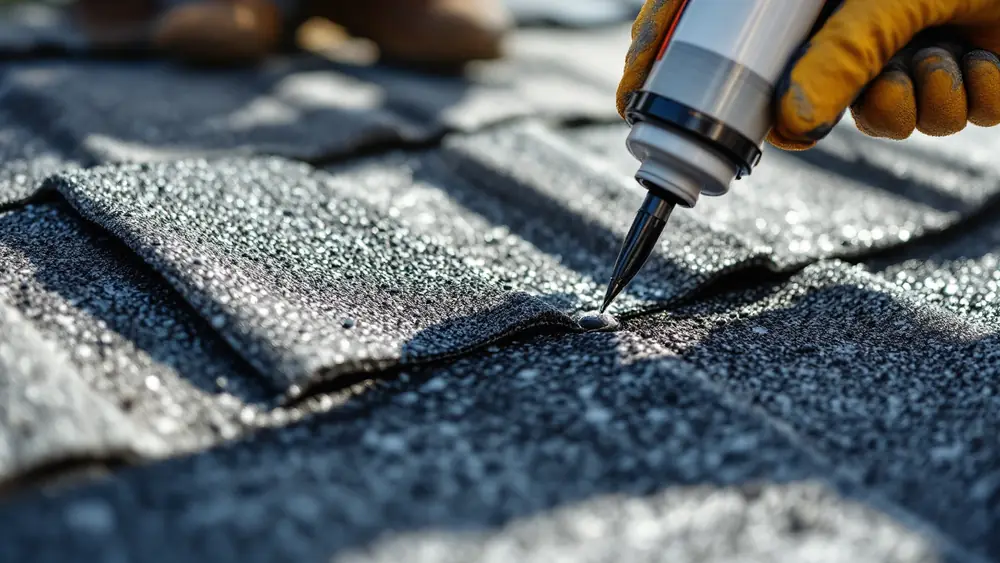
The model code leaves the pattern to the maker. Section R905.2.6 of the 2021 International Residential Code requires the maker’s fastener count but not less than four fasteners per strip shingle, and says that where the slope exceeds 21:12, shingles are installed as the manufacturer requires. Some older code editions put that steep-slope trigger at 20:12, so check the edition your county adopted.
Maker-by-maker hand-sealing patterns
| Maker and document | When hand-sealing is required | Pattern | Cement spec |
|---|---|---|---|
| GAF Timberline HDZ instructions (RESTL622, 2023) | Mansards 21:12 and steeper; prolonged cold; areas where airborne dust or sand can foul the sealant before it seals | 4 quarter-sized dabs, 1 in and 13 in in from each side and 1 in up from the bottom; mansard nails 6 in from the bottom; cement layer under 1/8 in | ASTM D4586 Type I or II |
| Owens Corning Duration instructions (2026) | Slopes over 60 degrees or 21 in per foot; below 40°F, perimeter shingles | 6 fasteners and 4 spots per shingle, each spot 1 in in diameter | ASTM D4586 Type I or II |
| Owens Corning bulletin TB-10022497-A (cold weather) | Air and surface at or below 40°F | All perimeter shingles: four 1 in dabs about 1 in from the leading edge on laminates; two 1 in dabs under each tab on three-tab shingles | ASTM D4586 |
| CertainTeed Shingle Applicator’s Manual, Landmark chapter | Steep slope over 21/12 | 6 nails and 4 spots per full shingle; 1 in spots under each corner and about 12 to 13 in from each edge | ASTM D4586 Type II |
All three makers warn about the same failure: GAF says excess cement “can cause blistering of the shingles” and can soften the asphalt in underlayments, Owens Corning says excessive cement may blister the shingle, and CertainTeed’s manual repeats the caution. The difference that matters on a steep slope is CertainTeed’s Type II call, the higher softening point grade that resists flowing on a near-vertical face.
Step by step: gluing down a loose shingle tab
- Check the shingle and the weather. Work when the shingle is above 40°F, the Owens Corning cold-weather threshold, so the tab bends without cracking. A creased or torn tab needs replacement, not glue; see replacing missing or damaged shingles.
- Pick a cement rated for the surface. On a dry roof any ASTM D4586 tube works; on a damp roof use a product rated for wet use, such as Liquid Nails RR-808, which its data sheet says works on wet roofs and applies above 32°F.
- Clean the bond line. Scrape off loose granules and old, hardened sealant from the course below so the cement lands on asphalt, not grit.
- Place four dabs about 1 in across. For a laminated shingle, follow the GAF layout: 1 in and 13 in in from each side, 1 in up from the bottom edge. For a three-tab shingle, use two dabs under each tab, about 1 in from the leading edge and the tab corner, per Owens Corning.
- Keep it thin. Hold the layer under 1/8 in (3 mm) thick, the GAF limit, and keep it back from the edge so no cement squeezes out onto the course below.
- Press the tab down firmly and check that no nail head is raised under it; GAF notes raised fasteners interfere with sealing.
- Leave it alone for 24 hours. The Liquid Nails RR-808 sheet says to let the repair dry 24 hours, and its 20% volume shrinkage is a reason not to over-apply.
How many tubes of roof cement do you need?
A 1 in dab at the 1/8 in GAF maximum holds about 0.098 cu in of cement, and a 10.1 fl oz tube holds about 18.2 cu in, so one tube covers roughly 185 dabs or 46 laminated shingles at full thickness. That math matches the APOC 109 data sheet coverage of about 12.5 sq ft per gallon at 1/8 in. The table uses 64 shingles per square, the count in GAF’s 3-bundle Timberline HDZ square.
| Scenario | Shingles | Dabs (4 each) | Cement at 1/8 in | 10.1 fl oz tubes | Tube cost at $4.98 |
|---|---|---|---|---|---|
| 10 lifted laminated tabs after a storm | 10 | 40 | 3.9 cu in | 1 (0.2 used) | $4.98 |
| 2-square mansard face, 64 shingles per square | 128 | 512 | 50.3 cu in | 3 (2.8 used) | $14.94 |
| Owens Corning cold-weather perimeter on a ranch roof: two 50 ft eaves, four 16 ft rakes | 172 | 688 | 67.5 cu in | 4 (3.7 used) | $19.92 |
| Whole 25-square roof hand-sealed in prolonged cold | 1,600 | 6,400 | 628 cu in (2.7 gal) | 35, or one 4.75 gal pail | $174.30 in tubes |
Roofing Brief arithmetic: dab volume is pi x 0.5 in x 0.5 in x 0.125 in; one fluid ounce is 1.805 cu in. The ranch count assumes 16 shingles per 50 ft eave (39 3/8 in shingles) and 35 courses per 16 ft rake at a 5 5/8 in exposure. For the whole-roof case, a 4.75 gal pail of Henry 204 Plastic Roof Cement, which Henry’s sheet says meets ASTM D4586 Type I, was listed at $62.56 at Arbor in October 2026, about a third of the tube cost.
Roll roofing adhesive and lap cement (ASTM D3019)
Roll roofing adhesive is asphalt lap cement brushed or squeegeed between the overlapping edges of mineral-surfaced roll roofing. ASTM D3019 defines Type I, a brushing grade for exposed-nail application, and Type III, a heavier stabilized grade for concealed-nail application. Henry lists its 203 Roll Roofing Adhesive at 2 gallons per square and says it bonds selvedge laps on 90 lb roll roofing.
Roll roofing itself has a slope floor: 2021 IRC R905.5.2 bars mineral-surfaced roll roofing below 1:12, so lap cement is not a way to make roll roofing work on a dead-flat deck. Temperature also matters. The Gardner Roll Roofing Adhesive page says to apply when surface temperatures are 50°F to 120°F, with no rain forecast for 24 to 36 hours, and lists it at $49.99 as of October 2026.
| Shed roof example | Figure | Basis |
|---|---|---|
| Roof area | 10 ft x 20 ft = 200 sq ft (2 squares) | Example input |
| Adhesive needed at 2 gal per square | 4 gal | Henry 203 coverage |
| Five 0.90 gal cans of Henry 203 | $94.00 (5 x $18.80) | Arbor listing, Oct 2026 |
| One 4.75 gal pail of Henry 203 | $73.31 | Arbor listing, Oct 2026 |
EPDM and TPO bonding adhesive: coverage, temperature and VOC by product
EPDM and TPO bonding adhesives are contact cements rolled onto both the membrane and the deck, left to flash off until tacky, then mated. Solvent versions cover 45 to 60 sq ft per gallon; water-based and single-sided versions cover 100 to 150. They are not interchangeable: Elevate’s BA-2004(T) sheet says “Do not use with TPO or TPO XR membranes”.
| Product | Membrane | Coverage per gallon | Minimum temperature | VOC | Source |
|---|---|---|---|---|---|
| Elevate EPDM Bonding Adhesive BA-2004(T) | EPDM; not TPO | 45 to 60 sq ft, two-sided (225 to 300 per 5 gal pail) | Above 20°F and rising | 633 g/L | TIS 817, Sept 11, 2025 |
| Elevate Single-Ply LVOC Bonding Adhesive-1168 | EPDM; not UltraPly TPO XR | 45 to 60 sq ft | Above 45°F | Under 250 g/L | TIS 824, Aug 23, 2024 |
| Elevate EPDM Solvent Free Bonding Adhesive | Non-reinforced EPDM on slopes up to 1:12 | 120 to 150 sq ft, substrate only; flashing 60 to 75, two-sided | Above 40°F | Low VOC; sheet says it meets SCAQMD Rule 1168 | TIS 830, Sept 11, 2025 |
| Carlisle Sure-Seal 90-8-30A | EPDM | 60 sq ft finished | None listed | Listed as not VOC compliant | Carlisle guide, 2022 |
| Carlisle Sure-Weld TPO Bonding Adhesive | TPO | 60 sq ft finished | None listed | 669 g/L | Carlisle Sure-Weld adhesives sheet, 2018 |
| Carlisle Aqua Base 120 | EPDM, TPO, FleeceBACK | 100 to 120 sq ft | 40°F; protect from freezing | Meets SCAQMD per Carlisle | Carlisle guide, 2022 |
| Carlisle CAV-GRIP III (aerosol cylinder) | EPDM and TPO | About 1,000 sq ft per 40 lb cylinder | 25°F as adhesive, 15°F as primer | Under 250 g/L | CAV-GRIP III data sheet |
| Carlisle Low-VOC HydroBond | PVC only, not KEE HP | 100 to 133 sq ft | 40°F | Meets SCAQMD per Carlisle | Carlisle guide, 2022 |
Two details in these sheets rarely make it onto retail pages. Elevate tells installers to warm BA-2004(T) pails to 60°F to 80°F before use and expects a one-year shelf life only when stored in that range. Elevate also warns that very porous substrates such as rough wood or concrete block may need two coats, so test-bond a small piece of membrane first. Fully adhered systems are compared with mechanically attached and ballasted ones in membrane attachment methods compared.
Adhesive cost per square foot, worked
Dividing each pail price by its rated coverage gives the adhesive cost per square foot of bonded membrane. On a small roof the pail size drives the bill more than the per-foot rate, because leftover adhesive has a shelf life of about 12 months on the Elevate sheets. The example is a 500 sq ft garage roof, field only.
| Product | Price as listed at Arbor, Oct 2026 | Coverage per pack | Adhesive cost per sq ft | Packs for 500 sq ft | Spend |
|---|---|---|---|---|---|
| Elevate BA-2004(T), 5 gal | $165.00 | 225 to 300 sq ft | $0.55 to $0.73 | 2 to 3 | $330.00 to $495.00 |
| Carlisle 90-8-30A, 5 gal | $201.50 | 300 sq ft | $0.67 | 2 | $403.00 |
| Carlisle Sure-Weld TPO, 5 gal | $260.89 | 300 sq ft | $0.87 | 2 | $521.78 |
| Carlisle Aqua Base 120, 5 gal | $470.00 | 500 to 600 sq ft | $0.78 to $0.94 | 1 | $470.00 |
| Carlisle CAV-GRIP III, 40 lb cylinder | $1,041.03 | About 1,000 sq ft | About $1.04 | 1 (half used) | $1,041.03 plus spray gun |
Roofing Brief arithmetic, adhesive only: it excludes primer, seam tape, flashing adhesive and labor, and prices change often. On this 500 sq ft roof, the water-based Aqua Base 120 needs one pail where the solvent adhesives need two, so the cheapest per-foot product is not the cheapest purchase. Full EPDM installation steps and costs are in EPDM roofing installation.
How to apply contact bonding adhesive
- Check temperature first. For Elevate BA-2004(T), substrate and air must exceed 20°F and be rising; pails stored cold go back to 60°F to 80°F before use.
- Prepare both faces. Surfaces must be clean, dry and smooth; broom excess dusting agent off the membrane underside.
- Stir, do not thin. Stir until there is no sediment or marbling; Elevate’s sheet says thinning is not allowed.
- Roll both surfaces at about the same time with a solvent-resistant roller so both flash off together, keeping adhesive off the seam areas. Sprayed adhesive must be back-rolled with a 9 in medium-nap roller.
- Run the finger test in Elevate TIS 817. Touch straight down and push forward at an angle; if the adhesive strings or feels wet, it is not ready to mate.
- Mate and broom. Per Elevate TIS 817, roll the coated membrane into the coated substrate slowly, then broom it with a stiff push broom under heavy pressure right away.
Insulation and fleece-back adhesives: bead spacing and coverage
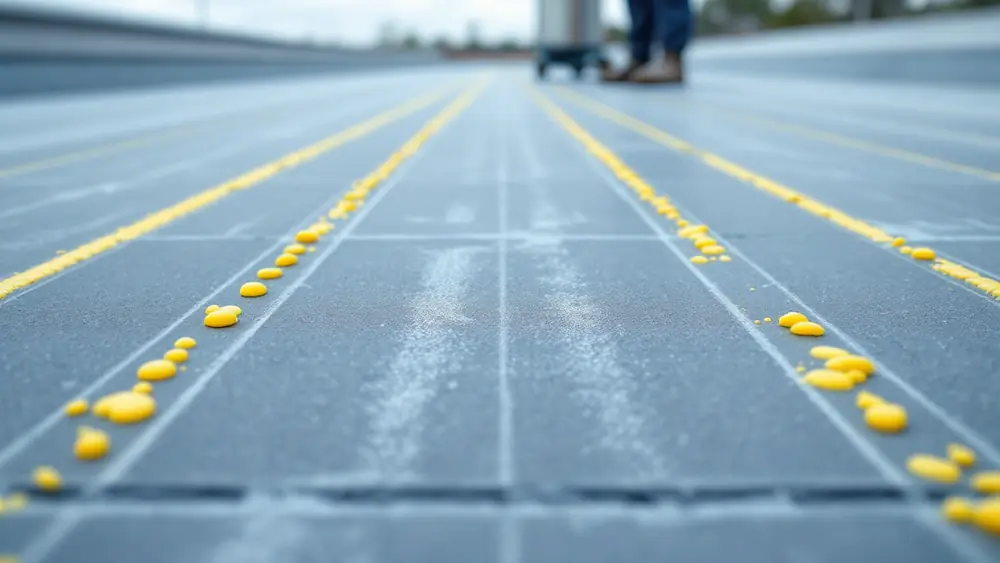
Low-slope insulation boards and fleece-back membranes are usually glued with two-component low-rise polyurethane foam laid in beads, and the bead spacing sets the coverage. Carlisle’s guide shows a 5 gal Flexible FAST jug covering 2,000 to 2,500 sq ft at 12 in on center but only 670 to 900 sq ft at 4 in on center, with application allowed down to 25°F.
| Carlisle Flexible FAST package | 12 in o.c. beads | 6 in o.c. beads | 4 in o.c. beads | Full spray |
|---|---|---|---|---|
| Dual cartridge | 400 to 600 sq ft | 200 to 300 sq ft | 100 to 200 sq ft | Not listed |
| 5 gal jugs | 2,000 to 2,500 sq ft | 1,000 to 1,250 sq ft | 670 to 900 sq ft | 600 to 1,000 sq ft |
| 15 gal drums | 6,000 to 7,500 sq ft | 3,000 to 3,750 sq ft | 2,110 to 2,700 sq ft | 1,800 to 3,000 sq ft |
| 50 gal drums | 20,000 to 25,000 sq ft | 10,000 to 12,500 sq ft | 6,700 to 9,000 sq ft | 5,000 to 10,000 sq ft |
Source: Carlisle Adhesives Quick Reference Guide CST-3018, dated April 18, 2022. The spacing on a real roof comes from the approved wind uplift assembly, and perimeter and corner zones often need tighter beads than the field. The ratings that set those patterns are explained in roof wind uplift ratings.
VOC limits: which roofing adhesives are legal in Southern California
In the South Coast Air Quality Management District, Rule 1168 caps EPDM/TPO membrane adhesive, other single-ply adhesive, roof adhesive primer and “all other roof adhesives” at 250 g/L of VOC. Several standard solvent adhesives exceed that cap on their own data sheets, so contractors there buy the low-VOC or water-based versions of the same product lines.
| Rule 1168 category (Table 1) | VOC limit | Product VOC on its data sheet |
|---|---|---|
| EPDM/TPO single ply roof membrane adhesive | 250 g/L | Elevate BA-2004(T) 633 g/L; Carlisle Sure-Weld TPO 669 g/L; Elevate LVOC-1168 under 250 g/L; CAV-GRIP III under 250 g/L |
| Single ply roof membrane adhesive (except EPDM/TPO) | 250 g/L | Carlisle Low-VOC PVC Bonding Adhesive listed as SCAQMD compliant |
| Hot applied modified bitumen / built-up roof adhesive | 30 g/L from Jan 1, 2023 | Factory or hot-kettle products |
| Shingle laminating adhesive | 30 g/L from Jan 1, 2023 | Used in shingle plants, not on the roof |
| All other roof adhesives | 250 g/L | APOC 109 Rain-Proof lists 250 g/L regulatory |
| Multi-purpose construction adhesives | 70 g/L | Relevant if a general construction adhesive is used on a roof |
| All other roof sealants | 300 g/L | Sealants, not adhesives |
A second deadline is easy to miss. Table 3 of Rule 1168 bans products containing more than 0.01 percent para-chlorobenzotrifluoride (pCBtF) in EPDM/TPO membrane adhesive from January 1, 2027, with sell-through and use-through ending January 1, 2028. Elevate’s TIS 824 for Single-Ply LVOC Bonding Adhesive-1168, dated August 23, 2024, lists 4-chlorobenzotrifluoride among its solvents, so a reformulation or a different product may apply in that district; check the current sheet. Rule 1168 applies only inside the South Coast AQMD, and other districts and states set their own limits.
Roofing adhesive prices at Home Depot, Lowe’s and supply houses
Retail roofing adhesive runs from about $5 for a 10.1 fl oz tube of roof cement to over $1,000 for a 40 lb aerosol cylinder of membrane adhesive. Big-box stores such as the Lowe’s roof adhesives aisle stock tubes, quarts and gallons for shingles and roll roofing; membrane bonding adhesives in 5 gal pails are mostly sold through roofing supply houses.
| Product | Use | Size | Price | Retailer, as listed October 2026 |
|---|---|---|---|---|
| APOC Rain-Proof fibered roof cement | Shingle tabs, flashing patches, wet or dry | 10.1 fl oz tube | $4.98 | Arbor |
| Liquid Nails Roof Repair RR-808 | Loose shingles, flashing; ASTM D4586 | 10.3 oz tube | From $5.73 | Walmart |
| Geocel RP-400 wet-dry roof cement | Shingle and flashing repair | 10 oz tube | $8.40 | Arbor |
| Henry 203 Roll Roofing Adhesive | Roll roofing laps | 0.90 gal / 4.75 gal | $18.80 / $73.31 | Arbor |
| Henry 204 Plastic Roof Cement | Trowel-grade shingle and flashing work | 4.75 gal | $62.56 | Arbor |
| Elevate BA-2004(T) | EPDM bonding | 5 gal | $165.00 | Arbor |
| GAF EverGuard TPO SBA 1121 | TPO bonding | 5 gal | $187.00 | Arbor |
| Carlisle Sure-Weld TPO Bonding Adhesive | TPO bonding | 5 gal | $260.89 | Arbor |
| Carlisle CAV-GRIP III | EPDM and TPO, spray applied | 40 lb cylinder | $1,041.03 | Arbor |
Prices are single listings checked in October 2026 and can change; local “roofing adhesive nearby” stock varies by store. A tube labeled “roof sealant” is often a sealant rather than a D4586 cement, so read the back label for the ASTM number before buying for shingle tabs.
Roofing adhesive vs roof sealant vs roof tape
Roofing adhesive bonds two layers together, a roof sealant fills a joint that moves, and roof tape is a pre-formed strip that carries its own adhesive across a seam. ASTM D4586 governs asphalt roof cement, while elastomeric joint sealants fall under ASTM C920 movement classes such as Class 25 or 35. A cracked flashing joint needs a sealant; a lifted shingle tab needs an adhesive.
Searches for “roofing adhesive tape” and “roofing adhesive roll” usually mean self-adhered products: a 35 mil butyl repair tape, a 6 in membrane cover tape, or peel-and-stick roll roofing. Those are compared in roof tape by roof type and peel and stick roofing. Silicone, polyurethane, acrylic and butyl sealant chemistries are covered in roof sealant types.
Which roofing adhesive should you use?
Match the adhesive to the material and the conditions printed on the sheet. The table maps common situations to the product type and the threshold that decides it; every row traces to a maker sheet, ASTM standard or Rule 1168 cited above.
| Situation | Use | Threshold or rule |
|---|---|---|
| A few laminated shingle tabs lifted, roof dry, above 40°F | ASTM D4586 roof cement tube, 4 dabs per shingle | Layer under 1/8 in (GAF) |
| Same repair on a damp roof or in light rain | D4586 cement rated for wet surfaces (Class II or labeled wet/dry), such as Liquid Nails RR-808 | RR-808 applies above 32°F |
| New shingles on a mansard or wall-like slope | 6 nails plus 4 cement spots per shingle | Over 21:12 (60 degrees); CertainTeed names Type II |
| Shingles installed at or below 40°F | Hand-seal perimeter shingles (Owens Corning); all shingles in prolonged cold (GAF) | Factory sealant may not activate until warm weather |
| Roll roofing on a shed or porch | ASTM D3019 lap cement, about 2 gal per square (Henry 203) | Slope at least 1:12 (IRC R905.5.2); surface 50°F to 120°F (Gardner) |
| EPDM on wood, insulation or metal | Membrane maker’s EPDM bonding adhesive on both faces | 45 to 60 sq ft per gallon; BA-2004(T) above 20°F and rising |
| Small EPDM roof, mild weather, low slope | Single-sided solvent-free or water-based adhesive | Slope up to 1:12 and above 40°F (Elevate Solvent Free) |
| TPO or PVC membrane | That membrane maker’s TPO or PVC adhesive | Never an EPDM-only adhesive such as BA-2004(T) |
| Job inside the South Coast AQMD | Low-VOC or water-based adhesive | 250 g/L cap; pCBtF ban for EPDM/TPO adhesive from Jan 1, 2027 |
| Membrane seams, cracked flashing or a leak at a joint | Not an adhesive: seam tape, splice adhesive, welding or a sealant | BA-2004(T) sheet: “Do not use for splicing” |
Cold-weather limits for shingles and membranes, including the 40°F Owens Corning shingle threshold, are collected in roof repair in winter. If shingles on a new roof still have not sealed after a warm spell, the causes are sorted in new roof shingles not laying flat.
Frequently asked questions
What is the best roofing adhesive?
There is no single best roofing adhesive, because the material decides it. For asphalt shingle tabs, GAF, Owens Corning and CertainTeed all call for asphalt roof cement meeting ASTM D4586. For EPDM, use the membrane maker’s bonding adhesive, such as Elevate BA-2004(T) at 45 to 60 sq ft per gallon. For TPO, use a TPO adhesive, since Elevate says BA-2004(T) must not be used on TPO.
What is the strongest waterproof glue for roofing?
No maker publishes a cross-brand strength ranking, so “strongest” has no checkable answer. On a low-slope roof, holding power comes from the tested assembly: membrane, adhesive, insulation and deck together carry an FM or UL wind uplift rating. On shingles, the bond the makers specify is ASTM D4586 roof cement in 1 in dabs, and GAF warns that a layer over 1/8 in can blister shingles.
What is the 25 rule in roofing?
The 25 percent rule comes from Florida Building Code, Existing Building, Section 706.1.1: if more than 25 percent of a roof or roof section is repaired, replaced or recovered within 12 months, the whole roof covering must meet current code. Since 2022, Florida Statute 553.844(5) removes that whole-roof trigger for roofs built to the 2007 Florida Building Code or later. Most other states have no statewide 25 percent roof rule.
What do you use to glue down shingles?
Use asphalt roof cement, also sold as plastic cement, that meets ASTM D4586, applied as quarter-sized dabs. GAF’s Timberline HDZ instructions call for 4 dabs placed 1 in and 13 in in from each side and 1 in up from the bottom edge, in a layer under 1/8 in thick. Owens Corning’s cold-weather bulletin uses two 1 in dabs under each tab of a three-tab shingle.
Can you use construction adhesive on roof shingles?
The GAF, Owens Corning and CertainTeed instructions name asphalt roof cement meeting ASTM D4586 for hand-sealing, not construction adhesive. Tubes sold for this job, such as Liquid Nails RR-808 Roof Repair, are asphalt based and list ASTM D4586 on the data sheet. In the South Coast AQMD, multi-purpose construction adhesives are also held to 70 g/L of VOC under Rule 1168, a separate category from roof adhesives.
How much bonding adhesive do I need for an EPDM roof?
Divide the area by the coverage on the data sheet. Elevate BA-2004(T) covers 45 to 60 sq ft per gallon with both surfaces coated, so a 500 sq ft roof needs about 8.3 to 11.1 gallons, or 2 to 3 five-gallon pails. Elevate’s single-sided Solvent Free adhesive covers 120 to 150 sq ft per gallon, so one pail can do the same field. Add flashing areas separately.
Does roofing adhesive work in cold weather?
Some products do, within limits printed on the sheet. Elevate BA-2004(T) needs substrate and air above 20°F and rising, and Carlisle CAV-GRIP III sprays down to 25°F, while water-based Carlisle Aqua Base 120 and HydroBond need 40°F. For shingles, Owens Corning recommends hand-sealing perimeter shingles at or below 40°F because the factory sealant strip may not activate.
What is the difference between roofing adhesive, roof sealant and roof tape?
Roofing adhesive bonds two surfaces together: a shingle tab to the course below, a membrane to the deck, or one roll roofing sheet to the next. A roof sealant fills a joint or gap and is rated for movement, for example under ASTM C920. Roof tape is a pre-formed strip with its own adhesive that bridges a seam. Many leaks need a sealant or tape, not an adhesive.