
By The Roofing Brief Team | Last reviewed: October 2026
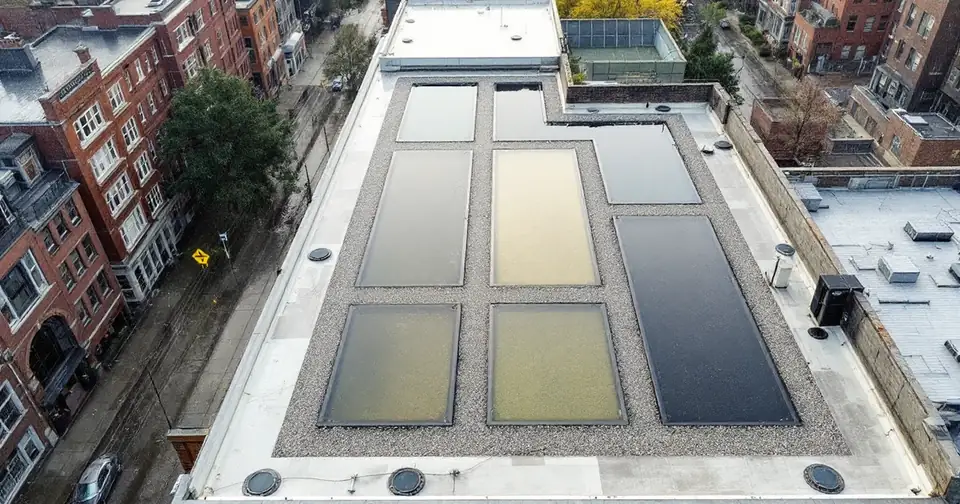
A blue roof is a flat or nearly flat roof built to hold rainwater for a few hours and release it slowly through restricted drains, so a storm reaches the sewer as a trickle instead of a surge. Philadelphia caps the pond at 4 to 6 inches and 72 hours, New York City caps blue roof drawdown at 24 hours, and every inch of water adds 5.2 pounds per square foot to the structure.
The term also gets used for two unrelated things: the free blue tarps that the U.S. Army Corps of Engineers installs after hurricanes under Operation Blue Roof, and roofs that are simply colored blue. Both are covered in the meanings table below, with links to our roof tarp guide and our blue roof shingles comparison.
Blue roof: key numbers at a glance
The eight numbers that decide whether a blue roof works come from two city stormwater manuals, the International Building Code and the International Plumbing Code. Every figure below is quoted from the named document, and the dates show which edition was read in October 2026.
| Figure | Value | Source |
|---|---|---|
| Water load on the roof | 5.2 psf per inch of depth | 2018 IBC Equation 16-35, R = 5.2(ds + dh) |
| Philadelphia maximum ponding depth | 4 to 6 in (6 in is roughly 32 psf) | PWD Stormwater Management Guidance Manual v3.4, Section 4.6.3 |
| Philadelphia maximum drain-down time | 72 hours after the 24-hour design storm | PWD Manual v3.4, Section 4.6.3 |
| New York City maximum drawdown, blue roof storage | 24 hours | NYC Stormwater Manual (final Feb. 1, 2024), Table 4.5 |
| New York City maximum release rate, combined sewer areas | 0.1 cfs per acre | NYC Stormwater Manual, Chapter 2 sewer operations requirement |
| Roof slope for drain-restrictor blue roofs | Under 2% (about 1/4 in per foot) | PWD Manual v3.4, Section 4.6.1 |
| Membrane height above the design pond | At least 6 in above peak ponding elevation | PWD Manual v3.4, Section 4.6.5 |
| Minimum roof drains on a controlled-flow roof | 2 drains up to 10,000 sq ft; 4 drains above 10,000 sq ft | IPC Section 1110.4 |
What does blue roof mean? Three different things share the name
In building codes and stormwater manuals, a blue roof means rooftop detention: the Philadelphia Water Department manual calls blue roofs “controlled flow roof drain systems” that hold rain behind check dams or drain restrictors. After a hurricane, the same two words usually mean a blue tarp, and on a house listing they can mean blue shingles.
| Meaning | What it is | Who it applies to | Source |
|---|---|---|---|
| Stormwater blue roof | A flat roof that ponds rain on purpose, up to 4 to 6 in in Philadelphia, and releases it through orifices or weirs | Commercial, institutional and multifamily buildings with low-slope roofs | PWD Manual v3.4, Section 4.6; NYC Stormwater Manual (2024) |
| Operation Blue Roof tarp | Free fiber-reinforced sheeting installed by the U.S. Army Corps of Engineers after a declared disaster | Primary residences or permanently occupied rentals with less than 50 percent structural damage | USACE Operation Blue Roof and USACE news releases |
| Blue-colored roof | Blue shingles, blue metal panels, or experimental cool coatings made with the pigment Egyptian blue | Any roof; a color choice with no water storage | Maker color charts; Berkeley Lab, Oct. 9, 2018 |
The Egyptian blue research is the only place where blue color and roof performance meet. Berkeley Lab reported on October 9, 2018 that the calcium copper silicate pigment re-emits absorbed sunlight as near-infrared light with up to 70 percent energy efficiency, which could keep a colored roof cooler Berkeley Lab presented it as a research result published in the Journal of Applied Physics, not as a roofing product.
Blue roof types: drain restrictors, check dams, trays and stone
Blue roofs come in five working layouts, and the roof slope picks the layout first. Philadelphia’s manual says controlled-flow drains generally need slopes under 2%, while check dams can hold water on roofs steeper than 2%; New York City’s 2012 pilot found modular trays the least sensitive to slope.
| Type | How it holds water | Best fit | Named example or spec | Source |
|---|---|---|---|---|
| Roof drain restrictor (controlled-flow drain, modified inlet) | A weir or orifice insert over the existing drain backs water up behind it; the overflow slot sets the maximum depth | New or existing roofs with a parapet and under 2% slope | Sized from the maker’s depth-to-flow curve for each drain | PWD Manual v3.4, Section 4.6.2 |
| Roof check dams | Low perforated dams across the roof create ponding cells; the perforations meter the release | Roofs over 2% slope or without a parapet | Perforated aluminum T-sections, used at NYC’s PS 118 pilot | PWD Manual v3.4; NYC DEP 2012 pilot report |
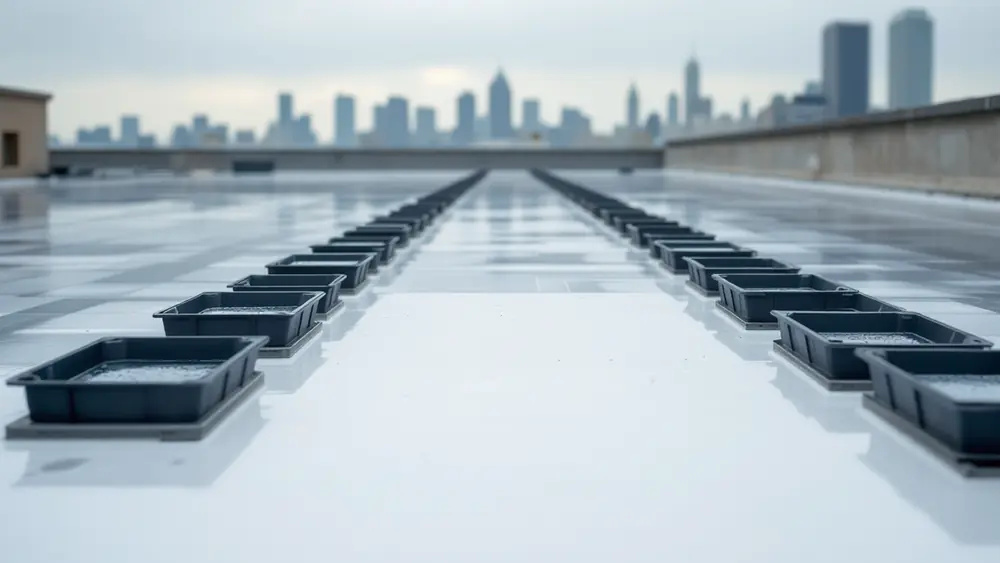
| Modular trays | Plastic or metal trays hold water above the membrane and release it onto the roof surface | Retrofits where only some bays can carry the load | Recycled plastic trays held by ballast alone at NYC pilot roofs | NYC DEP 2012 pilot report; Construction Specifier, May 11, 2017 |
| Stone-ballasted protected membrane roof (PMR) | Water fills the voids in ballast stone and rises above it; heavier stone keeps loose-laid insulation from floating | Utility roofs with no tenant traffic | Hydrotech PMR blue roof with Styrofoam insulation | Hydrotech (Sika) PMR blue roof page |
| Pavers on raised pedestals or a void layer under a green roof (blue-green) | Water is stored in the open space under pavers or under the growing media | Terraces and amenity decks; projects that also want plants | Hydrotech Permavoid units with 95% open space; LiveRoof RoofBlue DETAIN, about 2 gal (455 cu in) per sq ft | Hydrotech; LiveRoof RoofBlue page |
A sixth category, the active or “smart” blue roof, adds motorized valves that open ahead of forecast rain. Wikipedia’s blue roof entry dates forecast-integrated active blue roofs to a 2008 proposal, and Toronto’s Sustainable Technologies Evaluation Program describes valves tied to weather algorithms that empty the roof before a storm and feed a rainwater tank for toilet flushing or irrigation.
How much water a blue roof holds, and what it weighs
One inch of water over 1,000 square feet is 623 gallons and weighs 5.2 pounds per square foot, the constant in the IBC rain-load equation. A 6-inch pond therefore adds about 31 psf, which matches Philadelphia’s own figure of “roughly 32 pounds per square foot of dead load” for its 6-inch cap.
| Ponding depth | Load on the roof | Water per 1,000 sq ft | Compared with a 20 psf roof live load |
|---|---|---|---|
| 1 in | 5.2 psf | 623 gal | 26% of 20 psf |
| 2 in | 10.4 psf | 1,247 gal | 52% |
| 3 in | 15.6 psf | 1,870 gal | 78% |
| 4 in (Philadelphia low end) | 20.8 psf | 2,494 gal | 104%, already above 20 psf |
| 6 in (Philadelphia cap) | 31.2 psf | 3,740 gal | 156% |
Source: Roofing Brief arithmetic from the 5.2 psf per inch constant in 2018 IBC Equation 16-35 and 7.48 gallons per cubic foot. The 20 psf comparison is the ordinary flat-roof live load in IBC Table 1607.1; snow, ballast and drift loads are separate.
Stone ballast stores less than its depth. Philadelphia requires designers to use a porosity of 0.40 for ballast stone, so 4 inches of stone holds 1.6 inches of water inside it, and any additional storage has to be free water above the stone, adding 5.2 psf per inch on top of the stone’s own dead load.
Snow country roofs often have spare capacity. A 2017 Building Enclosure article by two Simpson Gumpertz & Heger engineers notes that where the flat-roof snow load exceeds 35 psf, members may not need much added strength for a shallow blue roof, but where snow is under 35 psf or the 20 psf roof live load governed, strengthening is more likely. Thirty-five psf equals about 6.7 inches of water.
The code check is not optional. Section 1611.3 of the 2018 International Building Code requires roofs with “hardware to control the rate of drainage” to have a secondary drainage system at a higher elevation and to be designed for water up to that secondary inlet plus the head above it, then checked for ponding instability; the 2024 IBC sends the same calculation to ASCE 7 Chapter 8.
Blue roof rules in Philadelphia, New York City and the model codes
Blue roof rules differ most on drawdown time: New York City allows 24 hours, Philadelphia allows 72, and the IBC’s definition of positive roof drainage uses 48 hours after precipitation. The table compares the rules from each primary document, so a designer working across both cities can see where one manual is stricter than the other.
| Rule | Philadelphia (PWD Manual v3.4) | New York City (NYC Stormwater Manual, 2024) | Model codes (IBC, IPC) |
|---|---|---|---|
| Maximum ponding depth | 4 to 6 in, set by structural capacity | No single blue roof depth cap in Table 4.5; set by the structural design | Roof designed for water to the secondary drain inlet plus head (IBC 1611.3) |
| Maximum drawdown | 72 hours after the 24-hour storm | 24 hours for blue roof temporary storage | No blue-roof-specific limit |
| Release rate | Set by the project’s applicable Stormwater Regulations | 0.1 cfs per acre in combined sewer areas; an upstream blue roof in series may run up to 2 cfs per acre | Engineered design based on the IPC 1106.1 rainfall rate (IPC 1110.1) |
| Orifice size | Per Section 4.12, Outlet Controls | Not smaller than 1 in; under 2 in needs pretreatment | Control devices protected by strainers (IPC 1110.3) |
| Overflow and outlet structure | Positive overflow up to the 100-year, 24-hour storm (10-year if exempt from Flood Control) | Separate outlet control structure not required, because the controlled-flow device is reachable from the roof surface | Secondary drains or scuppers where parapets would trap water (IPC 1108.1); scupper openings at least 4 in high (2018 IPC 1108.3) |
| Counts toward retention? | Acceptable for non-infiltrating Water Quality compliance in combined sewer areas | No: NYC DEP counts blue roofs as detention only | Not addressed |
| Minimum slope or drains | Under 2% for drain restrictors; check dams above 2% | Not specified for blue roofs | Single-ply membranes need a 1/4:12 (2%) design slope (IBC 1507.12.1, 1507.13.1); 2 to 4 drains (IPC 1110.4) |
Sources: NYC Stormwater Manual, an appendix to Chapter 19.1 of Title 15 RCNY published final February 1, 2024; PWD Manual v3.4, Section 4.6; 2018 IBC and IPC text as adopted in Philadelphia; 2021 IPC Chapter 11.
New York City’s rules apply to “covered development projects” that disturb 20,000 square feet or more of soil or create 5,000 square feet or more of new impervious area. NYC DEP’s green roof permitting slides say plainly that “blue roofs and detention layers within green roofs are not counted towards retention,” so a New York project that needs retention credit has to pair the blue roof with a green roof, infiltration or reuse.
The slope rule creates a real conflict. The IBC asks for a 2% design slope on single-ply roofs so water drains, and the Building Enclosure engineers point out that a 2% roof satisfies both the code and a blue roof design, while a dead-flat roof stores more but fights the code’s drainage intent on new work.
Worked example: a 10,000 sq ft blue roof in a NYC combined sewer area
A 10,000 square foot roof under New York City’s 0.1 cfs per acre limit may release only about 10.3 gallons per minute, and one inch of rain on it is 6,234 gallons, which takes about 10 hours to drain at that rate. The arithmetic below shows why two 1-inch orifices, the code minimum count with the city’s minimum orifice size, slightly overshoot the limit.
| Step | Input | Arithmetic | Result |
|---|---|---|---|
| Roof area in acres | 10,000 sq ft | 10,000 / 43,560 | 0.230 acre |
| Allowed release rate | 0.1 cfs per acre (NYC, combined sewer area) | 0.1 x 0.230 | 0.023 cfs, about 10.3 gpm |
| Volume of a 1-inch rain | 1 in over 10,000 sq ft | 833 cu ft x 7.48 gal | 6,234 gal |
| Weight of a 3-inch pond | 15.6 psf | 15.6 x 10,000 | 156,000 lb across the roof |
| Time to drain 1 inch at the limit | 833 cu ft at 0.023 cfs | 833 / 0.023, ignoring evaporation | About 10.1 hours, inside NYC’s 24-hour limit |
| Flow through one 1-inch orifice at 3 in of head | Q = CD A (2gH)0.5, CD 0.61 (NYC Eq. 4.15) | 0.61 x 0.00545 sq ft x 4.01 ft/s | 0.0133 cfs, about 6.0 gpm |
| Two drains (IPC 1110.4 minimum), 1-inch orifices, 3 in of head | 2 x 6.0 gpm | 12.0 / 10.3 | About 16% over the limit |
| Same two orifices at 6 in of head | 2 x 8.5 gpm | 16.9 / 10.3 | About 64% over the limit |
Roofing Brief estimate for illustration only; a licensed engineer sizes real outlets from the drain maker’s rating curves. NYC’s manual anticipates this case: where 0.1 cfs per acre would need an orifice under 1 inch, “a one-inch orifice with a smaller inner diameter may be accepted, at the discretion of DEP.”
What the New York City blue roof pilots measured
New York City’s Department of Environmental Protection monitored three blue roof designs side by side from April 2011 to December 2012 and found that modular trays “consistently provided the highest level of stormwater control,” check dams came second, and a flow-restricting drain inlet performed about like an untreated roof. No competing guide in the current top results reports these type-by-type outcomes.
| Pilot site | Blue roof type and area | Measured result | Source |
|---|---|---|---|
| Metropolitan Avenue, DEP storage facility | Modified inlet, 5,250 sq ft | Some retention for small storms; “generally similar in performance to the uncontrolled reference” | NYC DEP 2012 pilot monitoring report |
| Metropolitan Avenue | Check dams, 5,890 sq ft | Better than the modified inlet, but not as consistent as trays | Same |
| Metropolitan Avenue | Modular trays, 10,680 sq ft | Best detention and retention; more than 50% of rainfall volume typically evaporated before reaching the drain; over 300,000 gal managed a year | Same |
| PS 118, Queens | Check dams of perforated aluminum T-sections, about 3,500 sq ft | 20% to 80% volume retention in 2012; the adjacent 4-inch-soil green roof retained 30% to 100% of storms of 1 inch or less | Same |
| Osborne Association, 809 Westchester Ave., Bronx | Blue detention trays mixed with green trays (2013) | Designed to manage over 100,000 gal a year and cut roof runoff 32% in a typical storm | NYC DEP press release 13-93, Sept. 4, 2013 |
Sources: NYC Green Infrastructure Plan: 2012 Green Infrastructure Pilot Monitoring Report; NYC DEP press release 13-93.
The report credits trays’ “distributed nature and the limited impact of roof slope on tray function.” That matters for retrofits: a restrictor only stores water where the roof’s low points allow it, while trays store a set depth wherever they sit, which is why Toronto’s Sustainable Technologies Evaluation Program also cites the New York result in its blue roof design guide.
Waterproofing a blue roof: membranes, flashing and leak testing
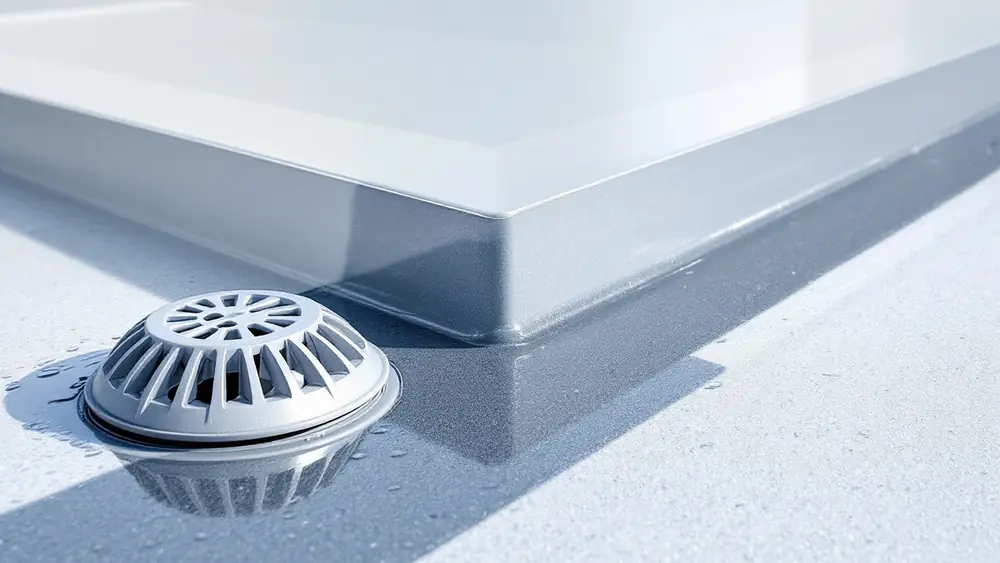
A blue roof keeps water on the membrane by design, so Philadelphia limits blue roof membranes to PVC meeting ASTM D4434, EPDM meeting ASTM D4637 and TPO meeting ASTM D6878, with every seam, corner and penetration sealed and the membrane carried at least 6 inches above the highest design pond.
| Membrane or assembly | Standard or rule | Why it suits, or does not suit, ponding | Source |
|---|---|---|---|
| PVC single-ply | ASTM D4434 | Hot-air welded seams; permitted by PWD | PWD Manual v3.4, Section 4.6.4 |
| EPDM single-ply | ASTM D4637 | Permitted by PWD; seams must be fully sealed | PWD Manual v3.4, Section 4.6.4 |
| TPO single-ply | ASTM D6878 | Hot-air welded seams; permitted by PWD | PWD Manual v3.4, Section 4.6.4 |
| Hot fluid-applied rubberized asphalt, fabric reinforced | Monolithic, no seams | PWD calls it “well-suited for blue roofs”; leaks stay localized over concrete decks | PWD Manual 4.6.2; Building Enclosure, 2017 |
| Cold liquid-applied membranes | Monolithic | PWD rates them “equally effective,” because propane-fired equipment for hot systems faces strict rules | PWD Manual v3.4, Section 4.6.2 |
| Multi-ply modified bitumen | Tiled multiple sheets to reduce seam exposure | Acceptable when high quality; PWD does not recommend lower-quality multi-layer asphaltic sheets | PWD Manual v3.4, Section 4.6.2 |
Inverted, or protected membrane, assemblies add two blue-roof risks that the Building Enclosure article spells out: water under the insulation can float loose-laid boards, and cold ponded water over a slab can pull the ceiling surface toward its dew point. Hydrotech’s answer is heavier-than-typical stone or heavier, thicker pavers sized to resist buoyancy.
Leak testing before the water goes on is the cheapest insurance. The Building Enclosure article recommends flood testing or Electric Field Vector Mapping (EFVM), third-party inspection during installation and membrane adhesion testing; our roof leak detection guide compares EFVM with other test methods.
Blue roof vs green roof: detention vs retention
A blue roof slows water down, while a green roof soaks some of it up. In New York City’s 2012 monitoring at PS 118, the green roof retained more water from storms of 1 inch or less, but the blue roof drained faster and freed its storage sooner in long storms; NYC DEP now credits blue roofs only for detention.
| Factor | Blue roof | Green roof | Source |
|---|---|---|---|
| Main job | Detention: delay and meter the release | Retention: absorb and evaporate | NYC DEP permitting guidance |
| Installed cost | About $1 per sq ft or less for the flow-control add-on | $10 to $35 per sq ft installed in 2026 | FRSA Florida Roofing; our green roof guide |
| Weight | 5.2 psf per inch of water, only while ponded | About 13 to 30 psf extensive and 35 to 100 psf intensive, saturated, all the time | 2018 IBC Eq. 16-35; ANSI/SPRI VF-1 (2017) |
| Measured retention, NYC PS 118 (2012) | 20% to 80% | 30% to 100% for storms of 1 in or less | NYC DEP 2012 pilot report |
| Drawdown limit | 24 hours (NYC); 72 hours (Philadelphia) | Not a ponding practice | NYC Stormwater Manual; PWD Manual |
| Habitat, air quality, roof cooling | None, per PWD’s list of limitations | Yes | PWD Manual v3.4, Section 4.6.1 |
| Satisfies NYC Local Laws 92 and 94 roof zone | Not listed as an option | Yes, or solar of at least 4 kW | Our green roof mandates report |
Blue-green roofs combine the two by storing water in a void layer below the growing media. LiveRoof’s RoofBlue DETAIN module, 24 by 12 by 3.75 inches, holds about 2 gallons per square foot, and Philadelphia’s manual gives blue-green roofs their own Section 4.14. For the cooling comparison, see our cool roof vs green roof guide.
How much does a blue roof cost?
A blue roof’s flow-control hardware typically adds about $1 per square foot or less, according to a Florida Roofing magazine article from FRSA and a PHP Systems/Design blog post, but the full project cost is set by three bigger items: structural strengthening, a ponding-grade membrane and taller flashings.
| Item or project | Cost | What it covers | Source |
|---|---|---|---|
| Blue roof flow-control add-on | Close to or under $1 per sq ft | Restrictors, dams or trays on a roof that already carries the load | FRSA, Florida Roofing; PHP Systems/Design blog |
| Blue roof, Canadian estimate | $1 to $2 per sq ft | Containment, valves and sensors | BDC (Business Development Bank of Canada) |
| Green roof, for comparison | $10 to $35 per sq ft installed | Extensive through intensive systems | Roofing Brief green roof guide, 2026 |
| Blue-green detention upgrade, The Moderne, Saratoga Springs, NY (2021) | $195,000 for about 11,000 sq ft, roughly $17.73 per sq ft | Detention layer added under a planned green roof; replaced a 6,000 cu ft tank first estimated at $75,000 and later at close to $900,000 | Living Architecture Monitor, Spring 2022 |
| Osborne Association blue and green tray roof, Bronx (2013) | $288,000 DEP grant plus $400,000 in-kind | Integrated blue and green trays; area not published | NYC DEP press release 13-93 |
The add-on figures assume the structure and membrane are already adequate. On a retrofit, raising flashings to 6 inches above a 4-inch design pond means flashings at least 10 inches above the roof field at every curb and wall, and the Building Enclosure engineers warn that raising flashing heights can greatly increase re-roofing cost. Our flat roof replacement cost guide prices the membrane itself.
The Living Architecture Monitor case was written by Brad Garner of Green Roof Diagnostics, whose Purple-Roof concept was used on that project, so treat its savings figures as a vendor-reported case study. The per-square-foot number still shows that a detention layer under plants costs far more than restrictors on a bare membrane.
How a blue roof is designed and built
A blue roof is built in the same order Philadelphia’s manual lists in Section 4.6.5, with the structural check and the leak test added from the Building Enclosure guidance. Each step below names the number or document that controls it.
- Confirm the stormwater target. Get the required release rate and drawdown from the local manual, for example 0.1 cfs per acre and 24 hours in New York City combined sewer areas, or the applicable Philadelphia Stormwater Regulations and 72 hours.
- Run the structural check. A licensed structural engineer checks rain load to the secondary drain inlet plus head under IBC 1611.3 or ASCE 7 Chapter 8, at 5.2 psf per inch, plus ponding instability; PWD requires this for new buildings and retrofits.
- Measure slope and storage. Under 2% slope, drain restrictors usually work; above 2%, plan check dams or trays. Subtract the volume taken by equipment, curbs and furniture, and use 0.40 porosity for any ballast stone.
- Install or upgrade the membrane. Use PVC (ASTM D4434), EPDM (ASTM D4637), TPO (ASTM D6878) or a monolithic fluid-applied system, and carry it up parapets and curbs at least 6 inches above the peak pond.
- Test before ballast or trays go on. Flood test or run an EFVM scan, and keep third-party inspection records.
- Install outlet controls and overflow. Fit restrictors, dams or trays per the plumbing code, protect control devices with strainers (IPC 1110.3), use at least 2 drains up to 10,000 sq ft and 4 above (IPC 1110.4), and provide overflow that, in Philadelphia, passes the 100-year, 24-hour storm.
- Place ballast or pavers. Use clean-washed stone with under 0.5% wash loss (AASHTO T-11), sized 3/8 inch to 2 inches and larger than the outlet screen openings, meeting ASTM D1863.
- Set up access and records. Provide safe access to every outlet and a vantage point to watch drain-down after rain; inspect monthly for the first year, per PWD Table 4.6-1 and NYC Table 5.14.
Our flat roof drainage system guide compares the interior drains, scuppers and siphonic systems a blue roof’s restrictors sit on, and our scupper drain guide covers overflow scupper sizing under IPC Section 1108.
Blue roof maintenance schedule
Clogged outlets are the main blue roof failure, and both city manuals start with monthly inspections in year one. New York City then requires debris removal at least twice a year, and Philadelphia sets ongoing frequency from what the first year shows.
| Task | New York City (Table 5.14) | Philadelphia (Table 4.6-1) |
|---|---|---|
| Inspect outlets and storage areas | Monthly in the first year, then at least twice a year | Monthly in the first year to set ongoing frequency |
| Remove debris and sediment from drains, screens, dams and overflows | Same schedule, or as needed | During inspections or as needed |
| Break up ice at outlets and overflows | As warranted in winter | As needed in winter months |
| Inspect and repair leaks | As warranted | During inspections; seams, corners and penetrations first |
| Records | Keep copies of inspection records and tests for five years | Maintain records of all inspections |
Philadelphia sorts failures into two kinds: a roof that drains too slowly, which shows as standing water beyond the design drain-down or overflow in small storms, and a roof that drains too fast, which usually means a leak or a missing restrictor. Toronto’s Sustainable Technologies Evaluation Program notes that building operators have removed clogged flow-control devices outright, which silently turns a blue roof back into an ordinary roof.
Is a blue roof right for your building?
A blue roof fits a roof under 2% slope, with structural room for at least 15.6 psf (a 3-inch pond), on a site where the roof is most of the impervious area and the local rule needs detention, not retention. PWD lists small roof-to-site ratios as a limitation.
| If your building… | Then consider | Why |
|---|---|---|
| Has a parapet and a roof under 2% slope | Drain restrictor blue roof | PWD says controlled-flow drains generally need slopes under 2% |
| Has a roof over 2% slope or no parapet | Check dams or modular trays | Check dams create ponding cells; trays performed best in NYC’s pilot regardless of slope |
| Is an existing roof framed for 20 psf with under 35 psf snow load | Engineer review before any ponding; trays over beams and columns only | A 4-inch pond is 20.8 psf; Building Enclosure flags these roofs as likely to need strengthening |
| Needs retention credit in New York City | Green roof, blue-green roof or reuse | NYC DEP does not count blue roofs toward retention |
| Has an occupied terrace | Pavers on raised pedestals over storage | Hydrotech’s paver assembly stores water under the walking surface |
| Is a typical pitched house roof, such as 4:12 | Not a blue roof candidate; look at downspout disconnection or rain barrels | A 4:12 roof is a 33% slope, far above PWD’s 2% guide |
| Is a low-slope roof due for replacement anyway | Specify the blue roof with the new membrane | Membrane, flashing height and slope work happen once; see our tapered insulation guide |
Ask the engineer three things before signing: the design ponding depth in inches and the resulting psf at 5.2 psf per inch, the drain-down time at the design storm compared with the local limit, and whether the membrane maker accepts that depth and duration in writing for its warranty. For the national context on roof runoff and stormwater fees, see our impervious roof area report.
Frequently asked questions
What does having a blue roof mean?
In building and stormwater terms, having a blue roof means the roof is designed to hold rainwater on purpose and release it slowly through restricted drains, check dams or trays. Philadelphia allows a pond of 4 to 6 inches that must drain within 72 hours, and New York City limits blue roof drawdown to 24 hours. After a hurricane, the phrase usually means a temporary blue tarp instead.
What does it mean if a house has a blue roof?
On a house, a blue roof usually means one of two things. After a declared disaster it is often a temporary tarp from Operation Blue Roof, which the U.S. Army Corps of Engineers installs free on primary residences with less than 50 percent structural damage. Otherwise it is a color choice, such as blue asphalt shingles. Stormwater blue roofs are rare on houses because pitched roofs cannot pond water.
What is the deal with blue roofs?
Blue roofs are a low-cost way for flat-roofed buildings to meet city stormwater rules. Holding even 1 inch of rain on a 10,000 square foot roof keeps 6,234 gallons out of the sewer during the peak. Florida Roofing magazine and PHP Systems/Design put the flow-control add-on at about 1 dollar per square foot or less, against 10 to 35 dollars for a green roof.
Why is China using blue roofs?
Two different things get called blue roofs in China. The bright blue roofs seen in aerial photos of factory districts are typically color-coated steel panels, a color choice that stores no water. China’s rooftop and urban stormwater effort is the Sponge City program: State Council guidance issued in October 2015 set a goal of 20 percent of urban area absorbing and reusing 70 percent of rainwater by 2020, and 80 percent by 2030.
What does a blue roof protect you from?
A stormwater blue roof mainly protects sewers and streets. By releasing rain at limits such as 0.1 cubic feet per second per acre in New York City combined sewer areas, it trims the peak flows that cause combined sewer overflows, which Construction Specifier says can begin in New York with about half an inch of rain. It does not add fire, wind or hail protection to the building.
What is a blue roof vs green roof?
A blue roof detains water and lets it drain, while a green roof retains water in soil and plants. In New York City monitoring at PS 118 in 2012, the blue roof retained 20 to 80 percent of storm volume and the green roof 30 to 100 percent for storms of 1 inch or less. New York City counts blue roofs only as detention, never as retention.
Can you put a blue roof on a house?
Only on a flat or nearly flat house roof that an engineer has checked. Philadelphia guidance says drain restrictor blue roofs generally need slopes under 2 percent, while a common 4:12 pitched roof is a 33 percent slope and cannot pond water. On a flat rowhouse roof, every inch of stored water adds 5.2 pounds per square foot, so a structural check comes first.
How much weight does a blue roof add?
Water adds 5.2 pounds per square foot for every inch of depth, the constant in the International Building Code rain load equation. A 3-inch pond adds 15.6 psf, a 4-inch pond 20.8 psf and a 6-inch pond 31.2 psf. Philadelphia rounds its 6-inch maximum to roughly 32 psf of dead load, which is more than the 20 psf live load many flat roofs were framed for.