
By The Roofing Brief Team | Last reviewed: October 2026
Roof leak detection means finding where water gets through the roof, which is rarely the spot where it drips. On a shingle roof, the dependable sequence is an attic check during rain, a moisture meter on the decking and ceiling, then a staged hose test. On flat roofs, professionals add infrared, impedance or nuclear moisture surveys and electronic leak detection, and every one of those tools has hard limits.
This page compares the detection methods, what each one can and cannot find, and what each costs. If you are not yet sure the water is coming through the roof at all, start with our triage guide on who to call for a roof leak. Once the entry point is confirmed, the repair steps are in our guide on how to fix a roof leak.
Key numbers at a glance
These are the figures that decide which detection method is worth paying for and how fast to act. Each comes from a named standard, manufacturer document or published cost guide, listed in the Source column. Prices are national ranges and vary by region, roof height and access.
| What it is | Figure | Source |
|---|---|---|
| Price for a roofer to identify a leak around flashing | $150 to $300; more if shingles must be removed to inspect the sheathing | Yelp cost guide, updated October 2026 |
| Residential infrared roof inspection | $400 to $600 | HomeGuide, roof inspection cost |
| Window to dry wet materials before mold usually grows | 24 to 48 hours | U.S. EPA, Mold Course Chapter 4 |
| Wood moisture content below which fungi and insects are less of a risk | Below 20% | Oregon State University Extension, EM 8600 |
| Reading depth of a roof impedance scanner | Up to 4 in (100 mm) | Tramex RWS Roof and Wall Scanner data |
| Weight of water added by a flood test | 5.19 lb per sq ft for every inch of depth | ASTM D5957, Note 1 |
How do I find out where my roof is leaking?
Find a roof leak by moving from cheap, non-invasive checks to expensive or destructive ones: confirm the water is rain-related, trace it in the attic, measure moisture, then prove the entry point with a controlled water test. Stop at the first step that gives a confirmed entry. Most residential leaks need nothing more than a flashlight, a moisture meter and a garden hose.
The order matters because each step narrows the search area for the next one. NRCA’s 2026 technical bulletin on investigating roof leaks warns that repairs often fail because “the actual leakage paths have not been verified.” The sequence below is built to verify the path before anyone pays for a repair.
- Confirm it is a roof leak. Note whether the drip starts with rain or snowmelt, with a fixture upstairs, or only while the air conditioner runs. Only the first points to the roof.
- Record the interior evidence. Measure the stain’s distance from two walls, photograph it and write down the date and weather. That coordinate is your starting point in the attic.
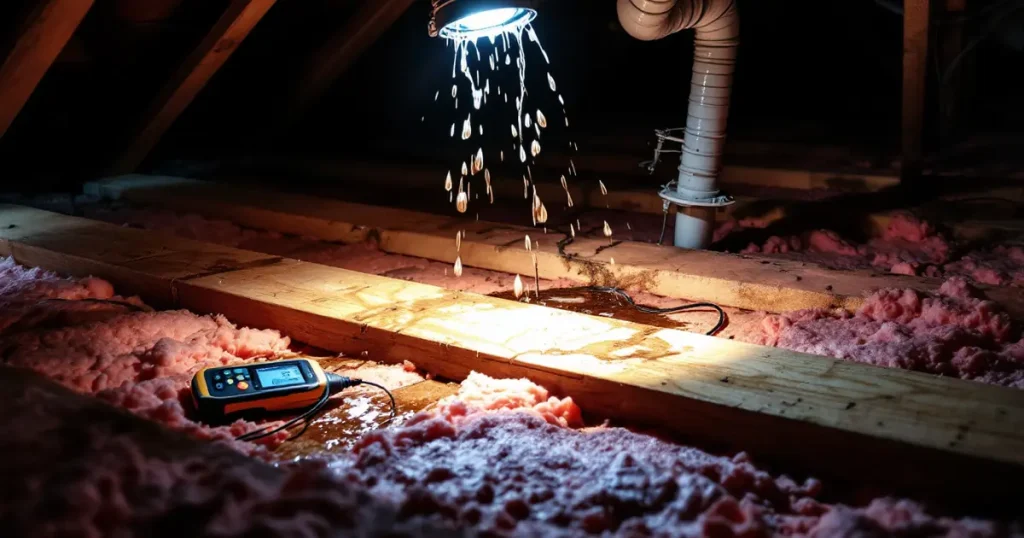
- Inspect the attic during or right after rain. Follow wet trails uphill along rafters and the underside of the deck. The highest wet point is still downstream of the entry, so keep looking above it for a penetration, valley or flashing.
- Measure moisture. Use a pin meter on decking and rafters around the trail and compare each reading with a known-dry area of the same material.
- Inspect the roof surface above the wet zone. Use binoculars or drone photos to check vent boots, step flashing, chimney flashing, valleys and skylight curbs uphill of the attic finding.
- Run a staged hose test. One person wets one zone at a time from low to high while a helper watches inside. A drip during one zone, and not the zone below it, proves the entry.
- Escalate if the test stays dry. A leak that will not reproduce may need wind-driven rain, may be an ice dam, or may be attic condensation. A roofer may need to lift shingles, which Yelp’s cost guide notes raises the diagnostic price.
- On low-slope roofs, commission a survey. If the source is still unknown or wet insulation is suspected, an infrared, impedance or nuclear survey and electronic leak detection are the next tools, covered below.
Roof leak detection methods compared
Roof leak detection methods fall into two groups: tests that find the hole, and surveys that find wet material. Hose tests and electronic leak detection locate the breach. Moisture meters, infrared and nuclear gauges locate water that has already spread, which can sit feet away from the entry. Knowing which group a tool belongs to prevents paying for the wrong answer.
| Method | What it actually detects | Best on | What it cannot do | Source |
|---|---|---|---|---|
| Attic inspection in rain | Active water trails, wet decking, drips at nail tips | Steep-slope roofs with an open attic | See into finished ceilings; the wet point is downstream of the entry | NRCA, How to Investigate a Roof Leak (7/2026) |
| Hose (water) test | A leak reproduced in one isolated zone | Shingle, tile and metal roofs; flashing details | Reproduce wind-driven rain or ice dams; a dry result does not clear the roof | Roofing Brief stain-tracing procedure |
| Pin moisture meter | Electrical resistance between the pins, shown as wood moisture or a relative scale | Decking, rafters, drywall spot checks | Read beyond the tiny region between the pins; no standard exists for roofing materials | Professional Roofing, Dec. 2025; ASTM D7438 |
| Pinless meter | Moisture in the top 1/4 or 3/4 in of a surface | Ceilings and walls with no attic access | See the roof deck above a ceiling | Wagner Meters, Orion 930 specification |
| Indoor thermal camera | Surface temperature differences, such as evaporative cooling on wet drywall | Fast ceiling scans after rain | See moisture itself; every anomaly needs a meter reading | Teledyne FLIR; Professional Roofing |
| Infrared roof survey | Wet insulation above the deck, imaged at night | Low-slope roofs with insulation above the deck | Find the point of entry; skip core verification | ASTM C1153-23, sections 1.1, 1.6 and 4.3 |
| Impedance scanner | Comparative moisture down to about 4 in | Insulated low-slope membranes | Work on metal, black EPDM or foil-faced surfaces | ASTM D7954/D7954M-22; Tramex |
| Nuclear moisture gauge | Hydrogen in the assembly, read on a 5 to 10 ft grid | Multi-layer low-slope assemblies | Give absolute moisture; readings are relative until cores are weighed | ANSI/SPRI/IIBEC NT-1 2017 (R2022), via Professional Roofing |
| Electronic leak detection (ELD) | Breaches, holes and seam voids in the membrane | Exposed membranes over a conductive deck or layer | Test without a conductive substrate; most methods fail on black EPDM | ASTM D7877-14; ASTM D8231-19; Carlisle SynTec |
| Core cut | The real layers and moisture by weight | Verifying any survey | Avoid damage; each cut is a breach that must be patched | Professional Roofing; NRCA |
| Flood test | Watertightness of horizontal waterproofing | Plaza decks and waterproofing, not roofs | Apply to roofs: ASTM says it “is not intended for use on building roofing systems” | ASTM D5957-98(2021); NRCA |
Which detection method fits your roof?
The right roof leak detection method depends on the roof type, whether there is an attic, and whether you need the hole or the extent of wet material. Use the table to pick a starting method, then escalate only if it fails. A steep-slope home rarely needs anything beyond step four of the sequence above.
| If your situation is | Start with | Escalate to | Usually skip |
|---|---|---|---|
| Shingle roof, open attic, drip during rain | Attic inspection in rain, pin meter | Staged hose test | Infrared roof survey |
| Cathedral ceiling or finished attic | Pinless meter grid and indoor thermal scan | Hose test with a helper watching the ceiling | Cutting the ceiling first |
| Leaks only in wind-driven storms | Note wind direction and the affected wall or slope | Roofer inspection of sidewall and step flashing | Repeated hose tests |
| Leaks only in winter, at the eaves | Check for ice dams and frost on nail tips | Insulation and air-sealing work | Membrane surveys |
| Exposed TPO, PVC or mod-bit over a steel deck or conductive layer | Visual check of seams, curbs and drains | Electronic leak detection | Flood test |
| Black EPDM roof | Visual check of seams and flashings | Scanning-platform ELD only if a conductive primer is under the membrane; otherwise infrared with cores where insulation sits above the deck | Impedance scanning, vector mapping, high-voltage ELD |
| Heavy gravel or ballast | Visual check of flashings and drains | Nuclear survey with cores | Infrared, which extra gravel can distort |
| Metal roof | Visual check of fasteners, laps and boots | Hose test by zone | Impedance scanning |
| Large wet area, deciding repair versus replacement | Infrared, impedance or nuclear survey | Core cuts with gravimetric analysis | Patching before the wet area is mapped |
| Drips only when the AC runs or in dry weather | Not a roof leak; check the condensate pan and plumbing | HVAC technician or plumber | Any roof test |
Sources: ASTM D7954 section 1.4; Carlisle SynTec, Electronic Leak Detection Systems (April 2023); Fluke, infrared roof inspection guidance.
Hose testing: what a water test can and cannot prove
A hose test proves a roof leak only when water appears inside while one isolated zone is wet, and not while the zone below it was wet. It is the cheapest proof available on a steep-slope roof. A dry result does not clear the roof, because a garden hose cannot recreate wind-driven rain, ice dams or hours of saturation.
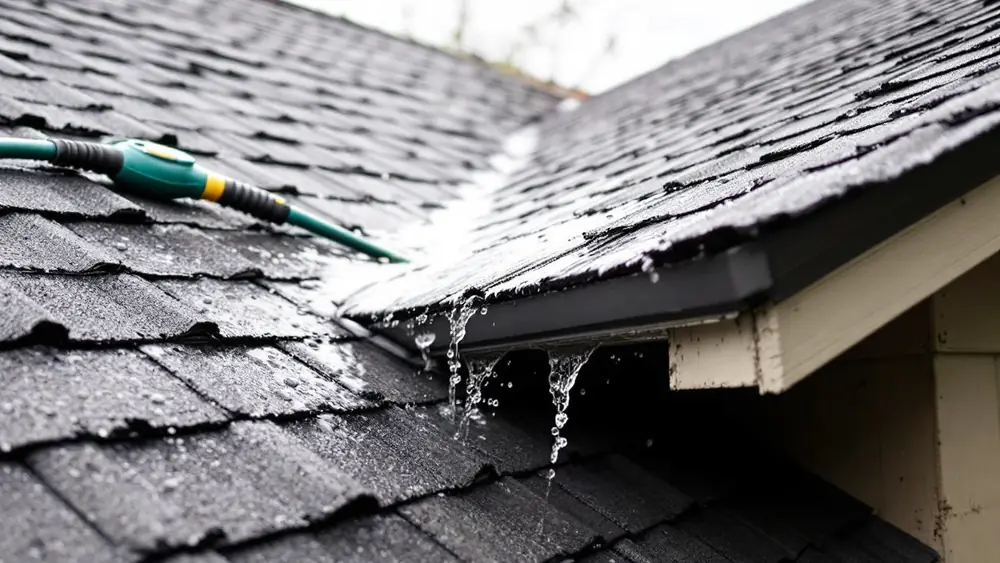
The discipline is the order: start at the lowest suspect zone and move uphill, so water from above never contaminates the result. Our guide to tracing a ceiling water stain back to the roof gives the full two-person procedure, with 5 to 10 minutes per zone. Use normal garden hose pressure, never a pressure washer, and keep the person on the roof off wet, steep slopes.
| Question | What a hose test tells you | Why |
|---|---|---|
| Is this flashing, boot or valley the entry? | Yes, if a drip appears inside during that zone only | The zone below was tested first and stayed dry |
| Is the roof watertight everywhere? | No | Only tested zones were checked, at low pressure |
| Why does it leak only in storms? | Usually no answer | Wind pushes water sideways and uphill under laps; a hose does not |
| Is it an ice dam? | No | Ice dams pond meltwater behind ice at the eave, which a hose cannot reproduce |
| Did my repair work? | Partly | A dry retest is a good sign; the next storm is the real test |
Moisture meters: pin, pinless and roof impedance scanners
Moisture meters measure wetness at a point, so they confirm and map a leak rather than find its entry. A pin meter reads the wood or drywall between its pins, a pinless meter reads a shallow layer under its pad, and a roof impedance scanner reads several inches into a low-slope assembly. All three give relative readings that need a dry reference to mean anything.
| Meter type | How it reads | Depth | Best use in leak detection | Main limit | Source |
|---|---|---|---|---|---|
| Pin (resistance) | Current between two pins | Pin length | Rafters, roof decking, drywall at the stain edge | Leaves holes; a thin condensation layer on a facer can read wet | Professional Roofing, Dec. 2025 |
| Pinless (example: Wagner Orion 930) | Electromagnetic field under the pad | 1/4 in or 3/4 in, selectable | Grid scan of a ceiling with no attic access | Reads the ceiling, not the roof deck above it | Wagner Meters specification |
| Roof impedance scanner (example: Tramex RWS) | Electrical impedance through the membrane | Up to 4 in (100 mm) | Mapping wet insulation on insulated low-slope roofs | Not for metal, black EPDM or foil facers; needs cores | Tramex data; ASTM D7954 section 1.4 |
Reading the numbers takes care. Oregon State University Extension advises that framing lumber be dried below 20 percent moisture content, because wood below that level is less susceptible to fungi and insects. A decking reading well above a dry reference spot from the same sheet points to active or recent water.
On low-slope roofs, the meters only point to where to cut. Michael T. Williams, writing in NRCA’s Professional Roofing in December 2025, notes there is no standard for using pin meters on roofing materials, and that ASTM D7954 treats impedance readings as qualitative until correlated with the moisture content of extracted cores.
Thermal cameras and infrared roof surveys
A thermal camera sees temperature, not water. Indoors, wet drywall often shows up cooler because evaporation pulls heat from it. On a low-slope roof at night, wet insulation shows up warmer because water holds the day’s heat longer. Both readings are clues that need confirmation with a meter or a core before anyone cuts or repairs.
Indoor thermal scans of ceilings and walls
An indoor thermal scan is the fastest way to map a wet ceiling, especially where there is no attic. Teledyne FLIR explains that thermal imagers detect water through temperature differences caused by evaporation, capacitance or conduction, and tells users to “always use a moisture meter to confirm what the thermal camera has detected.” Cold air from a duct, a missing patch of insulation or a recessed light can all mimic a wet spot.
Infrared roof moisture surveys under ASTM C1153
ASTM C1153-23 covers infrared imaging at night to locate wet insulation in roofs “that have insulation above the deck in contact with the waterproofing.” That scope matters: a typical shingle roof with insulation on the attic floor is outside it. The standard also states it “does not provide methods to determine the cause of moisture or its point of entry,” and it calls for verifying infrared data with invasive tests such as cores.
| Survey condition or interference | Effect on an infrared roof survey | Source |
|---|---|---|
| Clear, sunny day before the survey | Loads heat into the roof; wet insulation releases it slowly after sunset | Fluke |
| Clear night with little or no wind | Lets dry areas radiate and cool so wet areas stand out | Fluke |
| Dry roof surface, clear of snow, dirt and debris | Surface water and debris mask the pattern | Fluke |
| Season | Temperature differences run about 5°F in winter versus 20°F in summer | Fluke |
| Repaired areas with different insulation | Can look wet when they are not | Fluke |
| Extra gravel or bitumen left from construction | Holds heat and mimics wet insulation | Fluke |
| Exhaust onto the roof or heat from south and west walls | Creates warm patterns unrelated to moisture | Fluke |
| Anomalies found | Must be verified by cores, or cores plus moisture probes | ASTM C1153, as summarized in Professional Roofing |
Drone thermal flights follow the same physics and the same verification rule. Our guide to drone roof inspections covers what an aerial pass can and cannot show.
Flat roof leak detection: electronic leak detection (ELD)
Electronic leak detection finds the actual hole in a flat roof membrane by sending current across the surface and tracing where it passes through a breach to a grounded layer below. ASTM D7877 is the guide for the methods and ASTM D8231 covers the low-voltage scanning practice. Every method needs an exposed membrane and a conductive substrate directly beneath it.
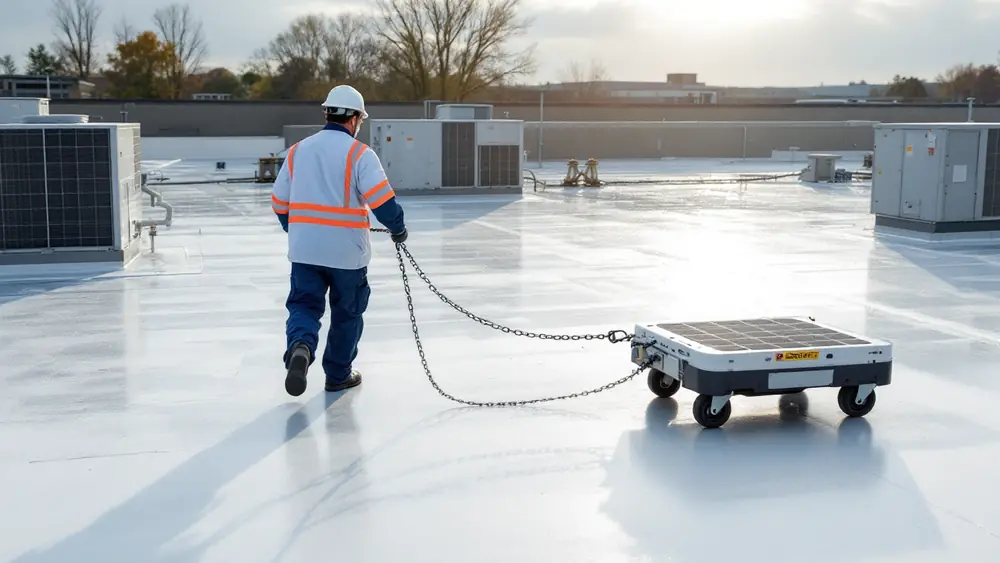
Carlisle SynTec’s April 2023 technical note lists the shared requirements: a conductive substrate under the membrane, a valid ground connection, an exposed membrane, and a continuous electrical path from the top of the membrane to the conductive layer. ASTM D7877 adds that insulation or protection board under the membrane interrupts that path unless a conductive material is placed directly under it. Ballast, pavers and vegetation have to come off, or the testing has to happen before they go on.
| ELD method | Voltage | Membrane condition | Black EPDM? | Notes |
|---|---|---|---|---|
| Low-voltage scanning platform (Detec IntegriScan) | Low voltage, under 50 V per ASTM D8231 | Wetted surface | Yes, when a conductive primer is under the membrane | Platform about 18 by 24 in, pushed across the field |
| Low-voltage vertical roller (Detec VSU) | Low voltage | Wetted surface | Per the platform system | 3/8 in nap, 9 in roller for flashings and walls |
| Electronic field vector mapping (International Leak Detection) | 40 V pulse for one second every three seconds | Wetted surface with a perimeter wire loop | No; also fails on aluminized coatings | Water contact must be continuous through the breach |
| High-voltage spark or holiday test | 1,000 to 30,000 V DC | Completely dry | No; also fails on aluminized coatings | More false positives reported and greater injury risk |
Source: Carlisle SynTec, SpecTopics: Electronic Leak Detection Systems (April 2023); ASTM D7877-14; ASTM D8231-19. For the repair side once the breach is marked, see our guide to finding and fixing a flat roof leak.
Nuclear moisture surveys and core cuts
A nuclear moisture survey reads a licensed gauge at points on a grid across a low-slope roof and maps where the assembly holds more hydrogen, which usually means water. It finds wet areas, not holes. Under ANSI/SPRI/IIBEC NT-1, the readings are only relative and must be quantified by core cuts weighed wet and dry, per Professional Roofing’s December 2025 summary.
The gauges carry a sealed radioactive source. One NRC license on file, for example, authorizes a 10 mCi americium-241 source in a roof moisture gauge, and the maker Seaman Nuclear notes that a state or NRC license or registration may be required. Hire an operator who holds the license rather than renting a gauge.
| Item | Inputs | Result | Basis |
|---|---|---|---|
| Grid readings, 10,000 sq ft roof at 10 ft spacing | 10,000 / (10 x 10) | About 100 readings | Roofing Brief arithmetic; NT-1 grid of 5 to 10 ft |
| Same roof at 5 ft spacing | 10,000 / (5 x 5) | About 400 readings | Roofing Brief arithmetic |
| Moisture content of a core (illustrative) | Wet 130 g, dry 100 g: (130 minus 100) / 100 x 100 | 30% by weight | Gravimetric formula quoted in Professional Roofing |
| Which cores to pull | Low, middle and high readings | Calibrates the whole map | Professional Roofing, describing NT-1 practice |
A core cut is the one method that shows the truth directly: the actual layers and how wet each is. It is also destructive. NRCA notes each test cut “creates a breach in a roof system that must be patched,” so cores should be few, planned from a survey, and patched the same day.
Why flood testing is the wrong roof leak test
Flood testing, plugging the drains and ponding water on a roof, is the wrong way to find a roof leak. ASTM D5957, the flood-test guide, says it “is not intended for use on building roofing systems.” NRCA does not recommend flood testing roofs, warning it is “not appropriate for identifying potential leak sources” because roofs are built to shed water, not hold it.
The load is the second problem. NRCA notes that 4 in of water is a dead load of more than 20 psf, and slope makes it deeper at the drains. The table runs the ASTM D5957 weight figure on two roof sizes.
| Water depth | Load per sq ft | Total on a 1,000 sq ft roof | Total on a 10,000 sq ft roof |
|---|---|---|---|
| 1 in | 5.19 lb | 5,190 lb | 51,900 lb |
| 2 in | 10.38 lb | 10,380 lb | 103,800 lb |
| 4 in | 20.76 lb | 20,760 lb | 207,600 lb |
Source: ASTM D5957-98(2021), Note 1 (5.19 lb per sq ft per inch of depth); Roofing Brief arithmetic. If a flood test does find a serious breach, NRCA points out there is no way to stop the water already entering the building.
How to find a roof leak with no attic access
Without an attic, find a roof leak from both sides of the ceiling: map the wet area indoors with a pinless meter or thermal camera, inspect the roof surface directly above and uphill of that area, then run a staged hose test while someone watches the ceiling. Cutting a small inspection opening is the last step, not the first.
- Map the wet ceiling area. Take pinless meter readings on a grid of roughly one foot, plus readings on a dry area for reference. A thermal scan after rain can speed this up.
- Find the uphill side. On a cathedral ceiling, water runs down the rafter bays toward the eave, so the entry usually sits above the upper edge of the wet area.
- Inspect the roof above that line. From a ladder at the eave, binoculars or drone photos, check boots, skylights, chimney and sidewall flashing, and valleys in that rafter bay.
- Hose test with a ceiling watcher. Work from low to high, one zone at a time, and have the helper recheck the meter readings, not only look for drips.
- Use an existing opening. Removing a recessed light trim or a ceiling fan canopy often lets you see or probe into the cavity without cutting.
- Cut a small opening only if needed. Cut at the upper edge of the wet area, where it can be patched, and photograph the cavity before drying starts.
- Start drying. The EPA notes mold usually will not grow if wet materials are dried within 24 to 48 hours, so drying should not wait for the final diagnosis.
Roof leak detection cost by method
Roof leak detection usually costs $150 to $300 when a roofer traces a leak around flashing, per Yelp’s October 2026 cost guide, and more if shingles must be lifted. Infrared roof inspections run $400 to $600 per HomeGuide. Electronic leak detection and nuclear surveys are quoted per project, and we found no national cost guide for them, so we do not print a number.
| Service | Typical price | Source |
|---|---|---|
| Roofer traces a leak around flashing | $150 to $300 | Yelp, updated October 2026 |
| Roofer minimum service call | $150 to $350 | Roofing Brief, leaking roof repair cost (2026) |
| Physical roof inspection | $75 to $200 | HomeGuide |
| Separate attic inspection | $200 to $500 | HomeGuide |
| Drone roof inspection | $150 to $600, most about $375 | HomeGuide, drone roof inspection cost |
| Infrared roof inspection, residential | $400 to $600 | HomeGuide |
| Thermal imaging during a home inspection | $300 to $500 | HomeGuide, home inspection cost |
| Commercial roof inspection | $200 to $600, or $0.05 to $0.10 per sq ft | HomeGuide |
| Electronic leak detection, nuclear survey, core cuts | Quoted per project | No national cost guide found |
| Buying a thermal camera | About $400 for a smartphone attachment; $600 to $1,500 for a mid-range handheld | Spectora 2026 buyer’s guide |
The arithmetic below shows how those figures combine in common decisions. All rows are Roofing Brief estimates built from the sourced ranges above, before local adjustments.
| Scenario | Calculation | Result |
|---|---|---|
| Buy an entry thermal camera instead of paying a roofer to trace one leak | $400 / $300 and $400 / $150 | The camera costs 1.3 to 2.7 times one diagnosis, and still needs a meter to confirm |
| Diagnosis billed separately, plus a single-source repair | ($150 to $300) + ($150 to $1,500) | $300 to $1,800 |
| Commercial inspection of a 20,000 sq ft roof | 20,000 x $0.05 and 20,000 x $0.10 | $1,000 to $2,000 before any moisture survey |
| Residential infrared inspection versus a physical inspection | ($400 to $600) minus ($75 to $200) | $200 to $525 more for the thermal layer |
Repair prices by leak source are in our leaking roof repair cost breakdown.
Is a roof leak covered by homeowners insurance?
A roof leak may be covered when a sudden, covered event such as wind, hail or a falling tree opened the roof. The standard ISO HO 00 03 homeowners form excludes “wear and tear, marring, deterioration,” so a leak from an aged vent boot or worn flashing usually is not. Detection evidence matters either way: photos and a written finding of the entry point support a claim.
Policy wording varies by insurer and state, so read your own declarations and form. The duties after a loss, such as prompt notice and reasonable repairs to protect the property, are laid out in the insurance section of our roof leak triage guide.
Frequently asked questions
How do I find out where my roof is leaking?
Work from cheap checks to costly ones. Confirm the drip follows rain, then trace wet trails uphill in the attic during or right after a storm. Check decking with a moisture meter against a dry reference spot, inspect flashing and boots above the wet area, and prove the entry with a staged hose test, low zones first, while a helper watches inside.
How do you find a roof leak with no attic access?
Map the wet ceiling with a pinless moisture meter or a thermal camera, then inspect the roof directly above and uphill of the wet area, since water runs down the rafter bays. Run a staged hose test while a helper rechecks the ceiling readings. Use a recessed light or fan opening to look inside before cutting a small inspection hole.
How much does roof leak detection cost?
A roofer typically charges $150 to $300 to trace a leak around flashing, per Yelp's October 2026 cost guide, with more if shingles must be lifted. HomeGuide lists physical roof inspections at $75 to $200 and infrared roof inspections at $400 to $600. Electronic leak detection and nuclear moisture surveys on commercial roofs are usually quoted per project.
Can a thermal camera find a roof leak?
A thermal camera finds temperature differences, not water. Indoors it can show a wet ceiling as a cooler patch, and on a low-slope roof at night it can show wet insulation as warmer. It does not show where water entered, and both Teledyne FLIR and ASTM C1153 call for confirming anomalies with a moisture meter or core samples.
What is electronic leak detection on a flat roof?
Electronic leak detection sends low or high voltage across an exposed flat roof membrane and traces where current passes through a breach to a grounded layer below. ASTM D7877 and D8231 cover the methods. It needs a conductive deck or layer under the membrane, and most methods cannot test black EPDM, which conducts electricity because of its carbon black.
Is a roof leak covered by homeowners insurance?
It may be, if a sudden covered event such as wind, hail or a falling tree opened the roof. The standard ISO HO 00 03 form excludes wear and tear and deterioration, so leaks from aged boots or worn flashing usually are not covered. Read your own policy, give prompt notice, and keep photos and the written finding of the entry point.
How much will it cost to fix a roof leak?
A single-source roof leak usually costs $150 to $1,500 to repair, with an average near $800 in 2026, per The Roofing Brief's leaking roof repair cost analysis. A cracked vent boot sits at the low end, while valley, skylight and chimney flashing work sits at the top. Most roofers also charge a $150 to $350 minimum service call.
Sources
Standards, manufacturer documents and cost guides used on this page
- ASTM C1153-23, Standard Practice for Location of Wet Insulation in Roofing Systems Using Infrared Imaging (scope 1.1, 1.6; significance 4.3).
- ASTM D7877-14, Standard Guide for Electronic Methods for Detecting and Locating Leaks in Waterproof Membranes (sections 1.3, 1.6, 4.4).
- ASTM D8231-19, Standard Practice for the Use of a Low Voltage Electronic Scanning System for Detecting and Locating Breaches in Roofing and Waterproofing Membranes (section 4.2).
- ASTM D7954/D7954M-22, Standard Practice for Moisture Surveying of Roofing and Waterproofing Systems Using Nondestructive Electrical Impedance Scanners (sections 1.4.1 to 1.4.3, 1.6).
- ASTM D5957-98(2021), Standard Guide for Flood Testing Horizontal Waterproofing Installations (section 1.2, Note 1).
- ANSI/SPRI/IIBEC NT-1 2017 (R2022), Detection and Location of Latent Moisture in Building Roofing Systems by Nuclear Radioisotopic Thermalization, as summarized by Michael T. Williams, “Surveying roof moisture,” Professional Roofing, December 2025.
- NRCA technical bulletins: How to Investigate a Roof Leak (July 2026) and roof flood testing (December 2022); Joan P. Crowe, “Water, water everywhere,” Professional Roofing, February 2006.
- Carlisle SynTec, SpecTopics: Electronic Leak Detection (ELD) Systems, April 2023.
- Fluke, infrared roof inspection guidance; Teledyne FLIR, how to detect a water leak with thermal imaging.
- Tramex, RWS Roof and Wall Scanner data; Wagner Meters, Orion 930 pinless meter specification.
- U.S. NRC license 13-24729-01 (roof moisture gauge, americium-241 sealed source); Seaman Nuclear licensing note.
- U.S. EPA, Mold Course Chapter 4; Oregon State University Extension, EM 8600 Wood Moisture Relationships.
- Yelp, leak detection cost guide (updated October 2026); HomeGuide roof inspection, drone roof inspection and home inspection cost guides (accessed October 2026); Spectora, thermal imaging camera buyer’s guide (2026).
- ISO HO 00 03 05 11 Homeowners 3 Special Form, Section I Perils Insured Against.
Method: The Roofing Brief compiles published standards, manufacturer documents, public data and dated price listings. We did not field-test the equipment named here. Prices are national ranges; get written quotes for your roof.