
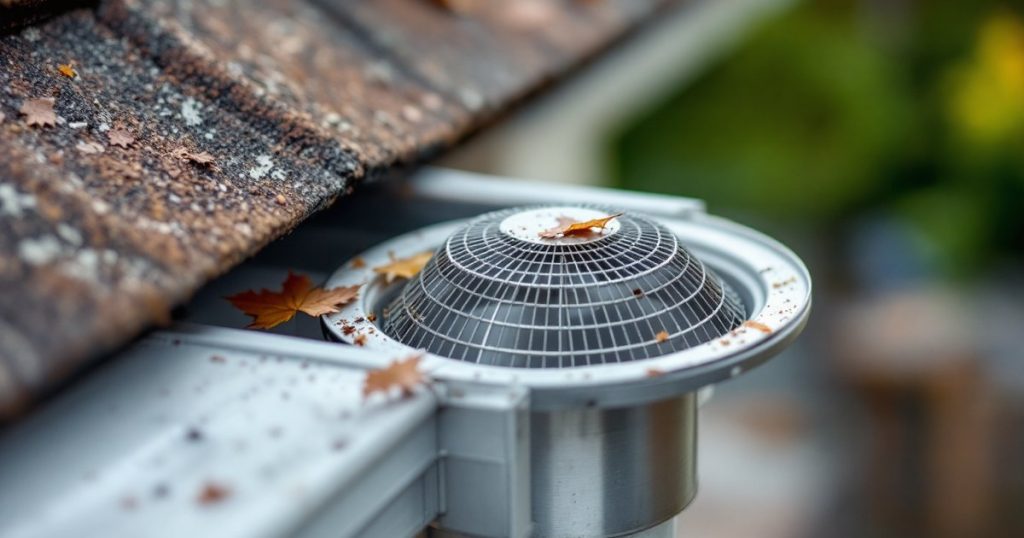
A downspout guard is any part that keeps a downspout working: a strainer or brush that stops leaves at the gutter outlet, a filter that catches debris before it reaches a buried drain, or a steel protector that keeps mowers and vehicles from crushing the pipe. Most of the products sold under the name cost $5 to $75 per downspout and install in minutes. The catch is that a guard does not remove debris. It moves the clog to a place you can reach, and it has to be cleaned there.
By The Roofing Brief Team · Last reviewed: October 2026
Downspout guards: key numbers at a glance
These are the figures that decide which downspout guard to buy. Prices are posted retail or maker prices seen in October 2026 and change often, so treat them as a snapshot. The open-area row is a Roofing Brief estimate built from a plumbing code ratio, with the arithmetic shown later on this page.
| Figure | Value | Source |
|---|---|---|
| Wire downspout strainer (Amerimax Universal Aluminum Leaf Strainer, 21348) | $4.99 to $6.59 each | Mechanicsburg Agway and Ace Hardware listings, seen Oct 2026 |
| Foam downspout insert (GutterFoam Downspout, 3 x 4 x 2.25 in.) | $19.99 per box of 6 | GutterFoam product page, seen Oct 2026 |
| Brush downspout guard (GutterBrush, four 18 in. brushes, 4.25 in. diameter for 5 in. gutters) | $29.95 sale price ($33.00 regular) | GutterBrush product page, seen Oct 2026 |
| In-line downspout filter at grade (Amerimax FlexGrate) to rain head (Leaf Eater Ultra RHUL100) | $9.66 to $74.95 each | Home Depot, Ace Hardware and Rain Harvesting Supplies listings, seen Oct 2026 |
| Steel downspout protector against impact (36 to 48 in. tall) | $128.95 to $275.95 each | Traffic Safety Warehouse (Vestil) and Global Industrial (Ideal Warehouse) listings, seen Oct 2026 |
| Open inlet area to keep clear on a 2 x 3 in. downspout | About 9 sq. in. (1.5 x the 6 sq. in. pipe) | Roofing Brief estimate using the Uniform Plumbing Code roof-drain strainer ratio |
What is a downspout guard?
“Downspout guard” covers four different product families, and retailers mix them on the same shelf. Three of them manage debris at different points along the water path: the gutter outlet, inside the pipe, and at the bottom where the downspout meets a buried drain. The fourth has nothing to do with leaves and protects the pipe from physical damage.
- Downspout strainers (leaf strainers): a wire or plastic basket pushed into the gutter outlet so leaves stay in the gutter instead of entering the pipe.
- Downspout filters and inserts: foam blocks or bristle brushes that sit in or over the outlet and let water soak or trickle through.
- In-line leaf catchers and downspout filters: a housing with a screen or grate spliced into the downspout, usually near the ground or above a rain barrel, that sheds or holds debris before a buried drain or tank.
- Physical downspout guards (bottom protectors): steel sleeves, cast iron boots, safety caps and rodent guards that protect the lower pipe from impact, sharp edges or animals.
Downspoutboots.com, a maker of commercial downspout boots, draws the same line in a blog post on the topic. It notes that “downspout guard” can mean a leaf strainer, but in the commercial trade it usually means a plate steel protector secured over an exterior downspout.
Downspout guard types compared
Each type of downspout guard solves a different problem, so the right comparison is where it sits and what it stops. Strainers and inserts keep leaves out of the pipe. In-line filters keep leaves out of what is downstream of the pipe. Protectors keep the pipe itself intact. The table lists named products with specs taken from the maker’s own page or instruction sheet.
| Type | Where it sits | Example product and maker specs | Price seen Oct 2026 | Main trade-off | Source |
|---|---|---|---|---|---|
| Wire downspout strainer | Pushed into the gutter outlet | Amerimax Universal Aluminum Leaf Strainer: aluminum, bends to fit 2 x 3 in., 3 x 4 in. and round outlets, for aluminum and vinyl gutters | $4.99 to $6.59 | Small surface area; leaves mat over it and back water up in the gutter | Amerimax (OmniMax International) instruction sheet; retailer listings |
| Foam downspout insert | Wedged into the top of the downspout | GutterFoam Downspout: polyether outdoor foam, 3 x 4 x 2.25 in., no tools | $19.99 for 6 | Fine debris lodges in the pores; foam holds water | GutterFoam product page |
| Brush downspout guard | Laid in the gutter over the outlet | GutterBrush Downspout Guards: 18 in. lengths, 4.25 in. brush for 5 in. gutters or 5.25 in. for 6 in. gutters | $29.95 per 4 (5 in.); $33.00 per 4 (6 in.) | Debris collects in the bristles and must be shaken out | GutterBrush product page |
| Deflector wedge | Set in the gutter beside the outlet | Smart Spring The Wedge (oversized): fits 2 x 3 in. downspouts, best in 6 in. gutters, no tools | $24.99 per 4 | Moves leaves aside rather than trapping them; no specs on flow | Smart Spring product page |
| In-line grate filter at grade | Between the downspout and a 4 in. buried pipe | Amerimax FlexGrate: fits 2 x 2, 2 x 3 and 3 x 4 in. downspouts; connects to 4 in. corrugated or PVC pipe | $9.66 to $9.99 | Protects the buried line only; the downspout above can still clog | Amerimax instruction sheet; Home Depot and Ace listings |
| Rain head (in-line leaf catcher) | Spliced into the downspout above a tank or drain | Rain Harvesting Leaf Eater Ultra RHUL100: angled stainless screen with 1/32 in. aperture, multi-fit cap for 3 in., 4 in., 2 x 3 in. and 3 x 4 in. | $74.95 | Highest price; screen still needs checks | Rain Harvesting Supplies product page |
| Cleanout with leaf filter | At the base, where the downspout enters a buried pipe | French Drain Man Torrential Rain cleanout: vented body with removable screen, 2 x 3 or 3 x 4 in. | $48.95 sale ($91.95 regular) | Ground-level cleaning, but debris still travels the full pipe | French Drain Man product page |
| Steel impact protector | Bolted to the wall over the lower downspout | Vestil steel protector: 48 x 9-3/16 x 6-1/8 in., 1/8 in. steel, 34 lb, hardware not included | $128.95 | Commercial look; needs masonry anchors | Traffic Safety Warehouse listing |
| Rodent guard | In the bottom outlet | Amerimax Rodent Guard: white vinyl, 2 x 3 in. | $7.49 to $9.97 | Catches any debris that got past the top | Menards and DK Hardware listings |
Do downspout guards work?
Downspout guards work at one job: keeping leaves and twigs out of the vertical pipe and any buried line below it. They do not stop debris from collecting, so the clog moves to the guard. Small outlet strainers can restrict flow once leaves mat over them, and wet debris held at the outlet can freeze. A guard is a trade of one cleaning location for another.
Clog shifting: the clog moves to the guard
A strainer at the outlet catches leaves at the top of the downspout, which means the leaves now sit in the gutter right where water needs to leave it. GutterBrush, which sells a competing brush product, notes that a strainer left uncleaned can back water up and overflow the gutter onto the fascia, siding and foundation. Grayson’s Gutter Guard, an Australian installer, reports that a share of buyer reviews for downpipe guards describe the guard blocking at the top in the first heavy rain.
That is the trade in plain terms. Without a guard, leaves can pack the top or bottom elbow, which is harder to clear, as covered in our guide on how to clean gutter downspouts. With a guard, the pile sits on top where a scoop can reach it, as long as someone checks it.
Flow restriction: the open-area math
A guard can only pass water through the openings that are not covered by leaves. Building codes do not regulate residential gutter strainers, but the Uniform Plumbing Code sets a useful benchmark for roof drains. Section 1105.2, as reproduced in the 2012 Nevada Plumbing Code, states: “Strainers shall have a minimum inlet area above the roof level not less than one and one-half times the area of the conductor or leader to which the drain is connected.” The same section exempts drains that discharge to hanging gutters, so this is a yardstick, not a requirement for your house.
Applied to common downspouts, the 1.5 ratio gives the open area a guard should keep clear after debris lands on it. A small wire basket loses open area quickly once wet leaves wrap its top, which is why longer brush guards and side-mounted grates advertise more surface area.
| Downspout size | Nominal cross-section | Open inlet area to keep clear (1.5x) | Source |
|---|---|---|---|
| 2 x 3 in. rectangular | 6.0 sq. in. | 9.0 sq. in. | Roofing Brief estimate (2 x 3 x 1.5) |
| 3 x 4 in. rectangular | 12.0 sq. in. | 18.0 sq. in. | Roofing Brief estimate (3 x 4 x 1.5) |
| 3 in. round | 7.1 sq. in. | 10.6 sq. in. | Roofing Brief estimate (3.1416 x 1.5 squared x 1.5) |
| 4 in. round | 12.6 sq. in. | 18.8 sq. in. | Roofing Brief estimate (3.1416 x 2 squared x 1.5) |
Method: nominal outside dimensions are used, so the true inside area of the pipe is slightly smaller and the target slightly generous. The ratio comes from a commercial roof-drain rule and is offered as a planning benchmark only.
Ice and freeze-thaw
Ice is the cold-climate risk with any guard that holds wet debris at the outlet. IKO, the shingle maker, explains that clogged or slow-draining gutters freeze over and then hold more water on the roof edge, although it attributes most ice dams to attic ventilation and insulation. A strainer packed with soaked leaves is a slow-draining outlet by definition, so in freeze-thaw regions it should be cleared before the first hard freeze. Foam has a related problem because it holds water, a point covered in our comparison of the types of gutter guards. GutterBrush claims its brush guards help reduce winter gutter ice; that is a maker claim we have not seen independently tested.
Downspout strainers: the wire basket at the outlet
A downspout strainer is a wire or plastic basket, usually domed, that pushes into the gutter outlet. Water passes through the mesh and leaves stay in the gutter. It is the cheapest downspout guard, at roughly $5 to $7 for the Amerimax aluminum model in October 2026 listings, and it suits open gutters under broadleaf trees where the pile can be scooped off by hand.
Pros: very low cost, no tools, keeps leaves out of elbows and buried pipe, and the Amerimax version bends to fit square and round outlets per its instruction sheet. Cons: small surface area, so it blinds over faster than larger guards (a point GutterBrush makes about wire baskets); it passes pine needles and shingle grit; and a neglected strainer can cause the gutter overflow it was bought to prevent.
Install a downspout strainer this way:
- Clean the gutter and flush each downspout with a hose until water runs freely from the bottom, as the Amerimax instruction sheet directs before installation.
- Check the outlet size: most residential outlets are 2 x 3 in., 3 x 4 in. or 3 in. round.
- Squeeze or bend the strainer so its base matches the outlet shape.
- Push it down into the outlet until it sits snug, with the dome standing up into the gutter.
- Run water down the gutter again and confirm it reaches the downspout without pooling around the strainer.
Maintenance: Amerimax does not publish a cleaning interval for its strainer. GutterBrush advises inspecting and cleaning strainers regularly, particularly in fall and after storms, and IKO recommends cleaning gutters twice a year, in spring and in late fall after leaf drop. Under heavy trees, a strainer often needs a check after every major storm in autumn.
Downspout filters and inserts: foam and brush
Downspout filters and inserts are bulkier than a wire basket. A foam insert wedges into the top of the downspout and water soaks through it. A brush guard lies in the gutter over the outlet so water trickles between bristles. Both trade the strainer’s small dome for more surface area, which can stretch the time between cleanings, but both still need to be pulled and cleared.
Foam inserts: GutterFoam Downspout is made of the same polyether outdoor foam as the company’s gutter inserts, measures 3 x 4 x 2.25 in., and is sold six per box for $19.99. Foam is the easiest guard to install and the hardest to clean in place, because fine debris lodges in the pores, as explained in our review of foam gutter guards.
Brush guards: GutterBrush sells four 18 in. brushes per pack, in 4.25 in. diameter for 5 in. gutters and 5.25 in. for 6 in. gutters, with a galvanized steel core and UV-protected polypropylene bristles per the maker. It argues that its larger surface area protects longer than wire baskets. The brush still collects leaves in its bristles.
Install a foam or brush downspout guard this way:
- Clean the gutter and flush the downspout so you are not sealing old debris in place.
- For foam, push the block into the top of the downspout until it sits just below the outlet lip, with no gaps at the sides.
- For a brush, lay an 18 in. length in the gutter centered over the outlet so the brush covers the opening and extends past it on both sides.
- Pour water into the gutter upstream and watch the outlet. Water should pass through within seconds, not pond above the guard.
Maintenance: neither maker page lists a fixed interval. Pull the foam or brush when you clean the gutters, shake or rinse it, and replace foam that has hardened or crumbled. Lift-out brushes are easier to clear than foam, which must be removed piece by piece.
In-line leaf catchers and downspout filters
An in-line leaf catcher is a housing spliced into the downspout that sheds or holds debris before it reaches a buried drain, a cistern or a rain barrel. It does not keep leaves out of the downspout itself; it keeps them out of what comes after it. That makes it the right downspout guard when the expensive failure is a clogged underground line, not a clogged gutter outlet.
- Amerimax FlexGrate: a vinyl grate filter that, per the Amerimax instruction sheet, fits 2 x 2, 2 x 3 and 3 x 4 in. downspouts and connects to 4 in. corrugated or PVC drain pipe. The maker diagram shows debris directed out of the filter and away from the foundation instead of into the buried pipe. Listed at $9.66 to $9.99 in October 2026.
- Rain Harvesting Leaf Eater Ultra (RHUL100): a rain head that uses an angled stainless steel mesh screen with a 1/32 in. aperture to deflect leaves off the screen, with an outlet that pivots for vertical or rear connection and a cap that fits 3 in., 4 in., 2 x 3 in. and 3 x 4 in. pipe. Listed at $74.95 by Rain Harvesting Supplies.
- Cleanout with leaf filter: French Drain Man’s Torrential Rain cleanout combines a vented downspout cleanout with a removable screen, listed at $48.95 on sale in October 2026.
Pros: protects the buried line that is hardest and costliest to clear, can be cleaned at ground level, and fine screens keep mosquitoes out of rainwater tanks. Cons: the downspout and its top elbow are still unguarded, a screen that holds debris has to be emptied, and splicing a housing in requires cutting the downspout.
Install an in-line downspout filter this way:
- Decide the height. Grade-level filters like FlexGrate go where the downspout meets the buried pipe; rain heads go at a reachable height above a tank inlet.
- Mark and cut the downspout square with a hacksaw or tin snips, and deburr the cut edge.
- Fit the filter’s inlet over or into the downspout. FlexGrate uses a flexible connector and a removable insert for 3 x 4 in. pipe per its instructions.
- Connect the outlet to the 4 in. drain pipe or downstream downspout section, and secure with screws rather than glue so it can be removed. Rain Harvesting’s Leaf Eater Original guide gives the same no-glue instruction.
- Strap the housing to the wall, then run a hose test from the gutter and confirm water exits the drain end.
Maintenance: Rain Harvesting describes the Leaf Eater Ultra as needing minimal maintenance, and its Leaf Eater Original guide says the primary screen is mostly self-cleaning but can jam with leaves and should be checked, with the secondary mosquito screen checked regularly. For any grade-level filter, check it after leaf drop and after the first big storm of the season. Our guide to an underground gutter drain that is clogged covers what happens when the buried section is left unprotected.
Downspout guards against physical damage
A physical downspout guard is a rigid sleeve, boot or cap that protects the lower few feet of a downspout from mowers, vehicles, carts, sharp edges or animals. It does nothing for leaves. On houses, the common versions are rodent guards and safety caps; on commercial and multifamily buildings, plate steel protectors and cast iron boots are the norm wherever traffic passes the wall.
- Steel protectors: Downspoutboots.com says these are typically fabricated from plate steel 12 gauge to 1/4 in. thick, with a full-length flange or anchor tabs. The Vestil unit listed by Traffic Safety Warehouse is 48 in. tall, 1/8 in. steel, 34 lb, bolt-on, for damage from fork trucks, vehicles and mowers. Ideal Warehouse sells a 36 in., 77 lb dock version listed at $275.95 by Global Industrial.
- Cast iron downspout boots: J.R. Smith describes its 1785 boot as impervious cast iron that protects the more fragile sheet metal downspout and transitions it to underground piping.
- Safety caps: GutterWorks sells a Downspout Safety Cap for 2 x 3 or 3 x 4 in. downspouts in white, brown or black, described on its product page as protection from a downspout’s sharp edges.
- Rodent guards: Amerimax makes a vinyl Rodent Guard for 2 x 3 in. downspouts that fits the bottom outlet, listed at $7.49 to $9.97.
Install a steel downspout protector this way:
- Measure the downspout width and depth plus its wall brackets, and pick a protector deep enough to clear both.
- Choose a height that covers the strike zone: mower decks and bumpers for houses, fork truck forks and trailer edges at docks.
- Hold the protector in place and mark the anchor holes on the wall, not on the downspout.
- Drill and set masonry anchors sized for the wall. The Vestil listing notes that installation hardware is not included.
- Bolt the guard on and confirm the downspout can still be detached at the elbow for cleaning.
A rodent guard or any screen at the bottom outlet will catch debris that got past the top. Check it after leaf season, and make sure water still exits freely. Where the water should go after it leaves the pipe is covered in our guide to downspout drainage.
Downspout guards with or without full gutter guards
A downspout guard protects one point; a full gutter guard protects the whole run. Downspout guards make sense on their own when leaves are large, gutters are reachable and the budget is small. With a good full-length guard, top-of-outlet strainers are usually redundant, but an in-line filter above a buried drain still earns its place.
The cost gap explains why people start with downspout guards. Using Amerimax’s figure of about 150 linear feet of gutter on an average home and an assumed four downspouts, the Roofing Brief arithmetic below compares the options.
| Option for a 150 ft, four-downspout house | Math | Approximate cost | Source |
|---|---|---|---|
| Wire strainers at each outlet | 4 x $4.99 to $6.59 | $20 to $26 | Retail listings, Oct 2026 |
| Foam downspout inserts | 1 box of 6 at $19.99 | $20 | GutterFoam, Oct 2026 |
| Brush downspout guards | 1 pack of 4 at $29.95 | $30 | GutterBrush, Oct 2026 |
| In-line grate filters at grade | 4 x $9.66 to $9.99 | $39 to $40 | Retail listings, Oct 2026 |
| Rain heads above tanks or drains | 4 x $74.95 | $300 | Rain Harvesting Supplies, Oct 2026 |
| Full-length gutter guards, installed | 150 ft x $2.30 to $20 per ft | $345 to $3,000 | Angi and HomeAdvisor ranges, via our types of gutter guards guide; gutter length per Amerimax |
The cheap options leave the gutter itself open, so it still needs cleaning. If pine needles, seed pods or shingle grit are the problem, a strainer will not stop them and a micro-mesh guard is the better tool. Our picks are in the best gutter guards review, and brand detail is in our Gutterglove gutter guards review. A full guard also needs upkeep, as our gutter guard maintenance guide explains.
Two related problems are often mistaken for downspout issues. Water sheeting over the gutter at a roof valley is a capacity problem solved by a gutter splash guard, not a strainer. Water eroding soil at the base calls for an extension, splash block or downspout diverter.
Which downspout guard should you pick?
Pick a downspout guard by the failure you are trying to prevent, not by the product name. Match your situation to a row below. Where two rows apply, such as open gutters feeding a buried drain, combine them: a guard at the top for the pipe and a filter at the bottom for the drain line.
| Your situation | Recommended guard | Why |
|---|---|---|
| Open gutters, broadleaf trees, downspout empties onto a splash block | Wire strainer or brush guard at the outlet | Keeps leaves out of elbows for about $5 to $8 per outlet; scoop the pile at each gutter cleaning |
| Downspout feeds a buried drain pipe | In-line grate filter or cleanout with leaf filter at grade | The buried line is the costly clog; ground-level access makes checks easy |
| Rain barrel or cistern | Rain head with fine stainless screen | A 1/32 in. screen keeps leaves and mosquitoes out of stored water |
| Full micro-mesh gutter guards already installed | Usually no outlet strainer; in-line filter only if a buried drain is present | A second screen at the outlet adds restriction where little debris arrives |
| Pine needles, seed pods or heavy shingle grit | Full-length micro-mesh gutter guard | Strainers pass fine debris; it needs to be stopped at the gutter surface |
| Hard freeze climate | Brush, or a strainer cleared before the first freeze | Wet leaves held at the outlet slow drainage, and slow-draining gutters freeze over |
| Mowers, vehicles or carts pass the wall | Steel protector or cast iron boot | Rigid steel or cast iron takes impacts that crush sheet metal |
| Rodents entering from the bottom | Rodent guard at the outlet | Blocks animals; check it after leaf drop because it also catches debris |
How often to clean a downspout guard
Clean a downspout guard at least as often as the gutters, which IKO puts at twice a year, in spring and in late fall after leaves drop. Most guard makers give no fixed interval, so the practical rule is to check each guard after the main leaf fall and after the first heavy storm of the season, and to clear outlet guards before the first hard freeze.
| Guard type | Maker guidance | Practical check | Source |
|---|---|---|---|
| Wire strainer | Clean and flush the system before installing; no interval stated | Spring, late fall, and after autumn storms | Amerimax instruction sheet; GutterBrush; IKO |
| Foam insert | No interval stated | Pull and rinse at each gutter cleaning; replace when hardened or crumbling | GutterFoam product page |
| Brush guard | Larger surface area claimed to go longer between cleanings | Lift out and shake at each gutter cleaning | GutterBrush product page |
| Rain head | Minimal maintenance; check the secondary screen regularly | After leaf drop and after major storms | Rain Harvesting product page and Leaf Eater Original guide |
| Grade-level filter or cleanout | No interval stated | After leaf drop; whenever water backs up at the base | Amerimax and French Drain Man product pages |
| Steel protector or rodent guard | No interval stated | After any impact; check rodent screens for debris each fall | Vestil listing; Amerimax listings |
Frequently asked questions
Do gutter downspout guards work?
Downspout guards work at keeping leaves and twigs out of the vertical pipe and any buried drain below it. They do not make debris disappear: the clog moves to the guard, where it is easier to reach. A small wire strainer can block the gutter outlet once wet leaves mat over it, so every guard needs a check at least twice a year and after heavy autumn storms.
What are the best gutter downspout guards?
The best downspout guard depends on what fails. For open gutters under broadleaf trees, a wire strainer or brush guard at the outlet is the low-cost choice. For a downspout feeding a buried drain, an in-line grate filter or cleanout with a leaf screen protects the line. For rain barrels, a rain head with a fine stainless screen fits. Where mowers or vehicles pass, use a steel protector.
Do downspout splash guards work?
Products sold as downspout splash guards are usually splash blocks or diverters at the base, and they work when they carry water far enough from the foundation and the soil slopes away. A gutter splash guard is a different part: a raised strip on the gutter edge at a roof valley that stops water from overshooting the gutter. Neither one keeps leaves out of the downspout.
Are downspout strainers worth it?
Downspout strainers are worth it when the gutters are open, the trees drop large leaves, and someone will clear the strainer each season. At roughly $5 to $7 each in October 2026 listings, they cost little and keep leaves out of elbows and buried pipe. They are not worth it if nobody checks them, because a blinded strainer can overflow the gutter.
What is the difference between a downspout strainer and a downspout filter?
A downspout strainer is a basket that sits in the gutter outlet and holds leaves in the gutter. A downspout filter usually means a foam or brush insert at the top of the pipe, or a housing with a screen spliced into the downspout lower down. Strainers protect the whole pipe; in-line filters protect only what sits below them, such as a buried drain or a rain barrel.
How do I keep rodents out of my downspout?
Fit a rodent guard into the bottom outlet of the downspout. Amerimax sells a vinyl Rodent Guard for 2 x 3 in. downspouts, listed at about $7.49 to $9.97 in October 2026, and stainless steel inserts are also sold. Any screen at the bottom will catch debris that got past the top, so check it after leaf drop and confirm water still flows out freely.
Should I remove downspout strainers in winter?
In freeze-thaw climates, clear downspout strainers before the first hard freeze, and consider pulling them for winter if trees keep dropping debris. A strainer packed with wet leaves slows drainage, and IKO notes that slow-draining gutters can freeze over and hold more water at the roof edge. In mild climates, leaving a clean strainer in place year-round is usually fine.