
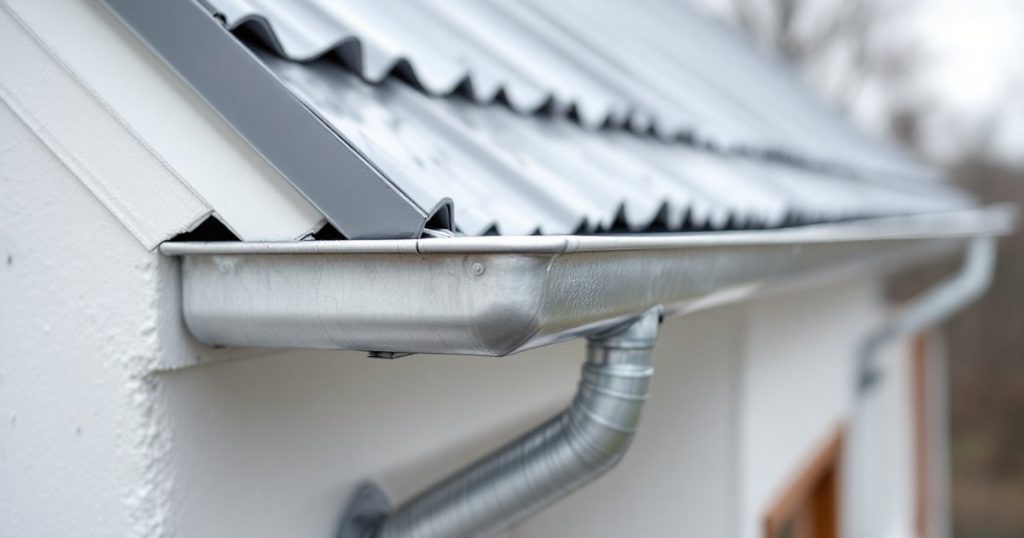
Galvanized gutters are steel gutters coated with zinc, usually to the G90 designation in ASTM A653, which puts roughly 0.76 mil of zinc on each face. They are stiffer and heavier than aluminum, cost about $5 to $20 per linear foot installed according to Fixr, and are rated for about 20 years in the NAHB life-expectancy study. How fast they rust depends less on the brand than on coating weight, local air, and what sits wet inside the trough.
This page is the owner’s spec guide to the galvanized (and Galvalume) steel gutter itself: coating grades, gauges, rust timing, cost, painting, installation and repair. If you are still choosing between metals, start with our steel vs aluminum gutters comparison or the five-way gutter materials comparison.
By The Roofing Brief Team. Last reviewed: October 2026.
Key numbers at a glance
These six figures answer most galvanized gutter questions before a quote is signed. Each comes from a named standard, specification, cost guide or study. Prices and service life vary by region, profile, installer and exposure, so treat every range as a starting point and confirm current figures with local installers and the product’s own data sheet.
| Figure | Value | Source |
|---|---|---|
| Standard zinc coating for gutter sheet | G90: 0.90 oz/sq ft total, both sides | ASTM A653, per U.S. Steel Technical Bulletin TSB 4.1 |
| Zinc thickness per face, G90 | About 0.76 mil (roughly 18 to 19 microns) | American Galvanizers Association (AGA); U.S. Steel TSB 4.1 |
| Installed cost per linear foot | $5 to $20 (sectional $5 to $13, seamless $12 to $20) | Fixr galvanized gutter cost guide |
| Typical service life | About 20 years | NAHB / Bank of America Home Equity, Study of Life Expectancy of Home Components (2007) |
| Commercial spec thickness, galvanized hanging gutter | 0.034 inch (about 22 gauge) | New York State OGS master specification, Section 076223 |
| Maximum bracket spacing in that spec | 36 inches | New York State OGS master specification, Section 076223 |
What are galvanized gutters, and how are Galvalume gutters different?
Galvanized gutters are formed from carbon steel sheet that has passed through a molten zinc bath, leaving a zinc layer that corrodes first and shields the steel. Galvalume gutters use steel coated with an alloy of about 55% aluminum, 1.6% silicon and the balance zinc under ASTM A792. Both are sold as “steel gutters,” so the coating line on a quote matters more than the word steel.
Coating grades are named by weight, not thickness. Under ASTM A653, a G90 sheet must carry at least 0.90 ounces of zinc per square foot, measured across both faces, and G60 carries 0.60. U.S. Steel’s construction bulletin notes that, all else equal, a G90 coating lasts about 50% longer than G60, because zinc protection is roughly proportional to thickness.
| Coating | Standard | Minimum coating weight (both sides) | Approx. total thickness | Where you see it on gutters | Source |
|---|---|---|---|---|---|
| G60 galvanized | ASTM A653 | 0.60 oz/sq ft | 1.02 mils | Lighter coating; G90 lasts about 50% longer in the same conditions | U.S. Steel TSB 4.1 |
| G90 galvanized | ASTM A653 | 0.90 oz/sq ft | 1.53 mils | The grade named in gutter specifications such as NY OGS 076223 | U.S. Steel TSB 4.1; NY OGS Section 076223 |
| AZ50 Galvalume | ASTM A792 | 0.50 oz/sq ft | 1.60 mils | Galvalume steel coil, bare or painted | U.S. Steel TSB 4.1 |
| AZ55 Galvalume | ASTM A792 | 0.55 oz/sq ft | 1.76 mils | Galvalume steel coil, bare or painted | U.S. Steel TSB 4.1 |
Galvalume coating weighs less per square foot than G90 yet is thicker, because aluminum is far less dense than zinc. The trade-off is chemistry. The Metal Construction Association warns that aluminum-bearing coatings such as Galvalume are vulnerable to wet alkaline materials like concrete, mortar and stucco, and to runoff from copper. For how the two coatings behave as roof panels, see galvanized vs Galvalume roofing.
What gauge are galvanized gutters?
Galvanized gutters range from very thin 30 to 32 gauge sections sold in 10-foot lengths at hardware stores, to 26 gauge coil run seamless on a machine, to about 22 gauge (0.034 inch) in commercial specifications. A lower gauge number means thicker steel. On galvanized sheet, each gauge step changes thickness by a few thousandths of an inch and weight by roughly 0.06 to 0.13 pounds per square foot.
The weight-per-foot column below is a Roofing Brief calculation: published galvanized sheet weight multiplied by the coil width used for each profile (11-7/8 inch coil for 5-inch K-style and 15 inch coil for 6-inch K-style, as listed by gutter supplier GutterAll). It covers the trough only, not hangers, end caps or water.
| Material and gauge | Thickness | Sheet weight | Trough weight, 5-inch K-style | Trough weight, 6-inch K-style | Where it shows up | Source |
|---|---|---|---|---|---|---|
| Galvanized 30 ga | 0.0157 in | 0.656 lb/sq ft | About 0.65 lb/ft | About 0.82 lb/ft | Retail 10-foot sections (some list 30 or 32 ga) | Galvanized sheet gauge chart, MEP Academy; retailer listings |
| Galvanized 28 ga | 0.0187 in | 0.781 lb/sq ft | About 0.77 lb/ft | About 0.98 lb/ft | Heavier sectional systems | Galvanized sheet gauge chart, MEP Academy |
| Steel 26 ga | 0.0217 in | 0.906 lb/sq ft | About 0.90 lb/ft | About 1.13 lb/ft | Seamless steel and Galvalume coil | Galvanized sheet gauge chart; GutterAll 26 ga coil listings |
| Galvanized 24 ga | 0.0276 in | 1.156 lb/sq ft | About 1.14 lb/ft | About 1.45 lb/ft | Commercial downspouts (0.028 inch spec) | Galvanized sheet gauge chart; NY OGS Section 076223 |
| Aluminum 0.027 in (comparison) | 0.027 in | About 0.38 lb/sq ft | About 0.38 lb/ft | About 0.47 lb/ft | Standard residential seamless aluminum | Roofing Brief calculation from aluminum density, 0.0975 lb/cu in |
Two practical readings follow. A 6-inch, 26 gauge steel gutter weighs about 2.4 times as much per foot as 0.027 inch aluminum before it holds any water or ice, which is why steel systems lean on closer hanger spacing and sound fascia. And the thin 30 to 32 gauge steel sold in big-box sections (one New York hardware listing for an Amerimax 4-inch galvanized K-style section, UPC 049821140076, states 32 gauge) is far lighter than what commercial specifications call for.
When do galvanized gutters start to rust?
A G90 gutter face holds about 19 microns of zinc, and ISO 9223 publishes how fast zinc corrodes in each atmospheric category. Dividing one by the other gives a rough “zinc consumed” timeline: roughly 9 to 27 years in a typical urban or suburban (C3) setting, 4 to 9 years in a high-corrosivity (C4) coastal or industrial site, and longer than 27 years in clean rural air.
The table is a Roofing Brief estimate, not a warranty or a published service life. It divides per-face zinc thickness (from U.S. Steel’s ASTM conversion) by the ISO 9223 zinc corrosion rates published by the American Galvanizers Association. Those rates come from first-year exposures, and zinc usually slows as its patina forms, so open exterior faces may last longer than shown.
| ISO 9223 category | Typical setting (per AGA) | Zinc loss rate | G90 face, years to consume zinc | G60 face, years to consume zinc |
|---|---|---|---|---|
| C2 Low | Rural areas, small towns, low pollution | 0.1 to 0.7 microns/yr | 27 or more | 19 or more |
| C3 Medium | Urban areas, or 1 to 30 km from the ocean | 0.7 to 2.1 microns/yr | About 9 to 27 | About 6 to 19 |
| C4 High | Industrial areas, under 1 km from the ocean | 2.1 to 4.2 microns/yr | About 4.5 to 9 | About 3 to 6 |
| C5 Very high | Heavy industry or wet, salt-laden coastal sites | 4.2 to 8.4 microns/yr | About 2 to 4.5 | About 1.5 to 3 |
Source note: zinc thickness from U.S. Steel TSB 4.1 (G90 at 1.53 mils and G60 at 1.02 mils across both faces); corrosion rates from the AGA summary of ISO 9223. Galvalume is not modeled because its aluminum-zinc coating corrodes differently.
Where rust shows up first on a galvanized gutter
Rust rarely starts on the open face of a galvanized gutter. It tends to start where the zinc is thinnest, missing or kept wet: inside the trough under packed leaves, at cut ends and miters, at screw and rivet holes, along scratches from ladders or cleaning tools, and anywhere copper runoff or dissimilar metal touches the steel.
- Trough bottom under debris. Wet leaves hold water against the zinc for days, which is the time-of-wetness condition that drives the higher ISO 9223 rates.
- Cut edges, miters and outlets. Field cuts expose bare steel at the edge; the surrounding zinc protects it sacrificially, but only for a limited distance and time.
- Fasteners. The NY OGS specification calls for 300-series stainless or hot-dip galvanized fasteners (ASTM A153 or F2329), not plain or electroplated steel.
- Copper and treated wood. The Metal Construction Association warns that copper runoff, including from copper flashing, plumbing and HVAC lines, and wet pressure-treated lumber can corrode zinc and Al-Zn coatings quickly.
How long do galvanized gutters last?
Galvanized steel gutters are commonly rated for about 20 years. The NAHB study sponsored by Bank of America Home Equity (2007) lists galvanized steel gutters at 20 years, the same as aluminum, against 50-plus for copper. Fixr describes “20 plus years” with maintenance. Real life can run shorter on the coast or under chronic debris, and longer in dry inland air.
Three choices move the number. G90 over G60 adds roughly half again the zinc life, per U.S. Steel. A factory paint system over the zinc adds a barrier, and the AGA reports that a paint-over-galvanizing “duplex system” lasts 1.5 to 2.5 times longer than either coating alone. Keeping the trough clean shortens the time the zinc spends wet. Our 2026 roofing material lifespan report covers how published lifespans compare with field results.
How much do galvanized gutters cost?
Galvanized gutters cost about $5 to $20 per linear foot installed according to Fixr, with sectional runs at $5 to $13 and seamless at $12 to $20. Angi puts typical installed pricing at $5 to $12 per foot and an average project near $1,500. On a 150-foot house, Fixr’s range works out to roughly $750 to $3,000 before downspouts, which Fixr prices at $300 to $600 for four.
| Material | Installed cost per linear foot | Source |
|---|---|---|
| Vinyl | $2 to $5 | Inch Calculator |
| Aluminum | $6 to $20 (Fixr); $8 to $18 (Inch Calculator) | Fixr; Inch Calculator |
| Galvanized steel | $5 to $20 (Fixr); $5 to $12 (Angi) | Fixr; Angi |
| Steel, general | $18 to $27 | Inch Calculator |
| Stainless steel | $9 to $25 | Fixr |
| Copper | $30 to $50 | Inch Calculator |
The published ranges disagree because each guide samples different regions, profiles and job sizes, so a local quote is the only number that counts. Raw material is a small share of the price. When checked in October 2026, Oregon supplier GutterAll listed 15-inch coil for 6-inch K-style at $2.99 per foot in 0.027 inch aluminum, $3.99 in 26 gauge painted steel and $4.99 in 26 gauge Galvalume Plus. For labor, hangers and the full install picture, see our gutter cost per linear foot breakdown.
Galvanized vs aluminum, copper and vinyl gutters
Galvanized steel sits between aluminum and copper: stiffer and more dent resistant than aluminum, cheaper than copper, and rated for about the same 20 years as aluminum in the NAHB study. Its weak points are weight and rust once the zinc is gone. Vinyl is cheapest, copper lasts longest, and aluminum is the default because it is light and does not red-rust.
| Factor | Galvanized steel | Aluminum | Copper | Vinyl | Source |
|---|---|---|---|---|---|
| Installed cost per foot | $5 to $20 | $6 to $20 | $30 to $50 | $2 to $5 | Fixr; Inch Calculator |
| Rated life | About 20 years | About 20 years | 50+ years | Not rated in study | NAHB 2007 study |
| Thermal movement, 40 ft run, 100°F swing | About 0.32 in | About 0.63 in | Not calculated | Not calculated | Roofing Brief calculation, Engineering ToolBox coefficients |
| Trough weight, 6-inch K-style | About 1.13 lb/ft (26 ga) | About 0.47 lb/ft (0.027 in) | Varies by ounce weight | Varies by product | Roofing Brief calculation |
| Main failure mode | Rust after zinc loss | Dents, seam stress | Solder joint failure | UV and cold brittleness | Trade consensus; see sibling guides |
The thermal row uses Engineering ToolBox expansion coefficients of about 6.7 millionths per °F for steel and 13.1 millionths per °F for aluminum. For the head-to-head buying decision, our steel vs aluminum gutters guide covers cost per year of service and climate fit.
Are galvanized gutters better in snow and ice?
Galvanized steel gutters can resist the denting and bending that ice dams, sliding snow and ladders cause on thin aluminum, because steel is stiffer and moves about half as much with temperature. That advantage only holds if the extra weight is supported: closer hanger spacing, brackets matched to the gutter, and fascia sound enough to carry more than twice the trough weight of aluminum.
The NY OGS commercial specification caps bracket spacing at 36 inches and requires brackets at least twice the gutter’s thickness. Supplier GutterAll describes 24 inch spacing as common and 18 inch spacing where snow, ice or long runs add load. Neither number replaces the hanger maker’s instructions or a check of local snow loads, so confirm both before ordering. See gutter bracket and hanger types for options.
How are galvanized gutters installed?
Most galvanized gutters go up as sectional runs joined with lapped, riveted and sealed seams, though seamless steel is possible where an installer runs 26 gauge coil on a machine. The steps below follow the NY OGS specification and manufacturer guidance, adapted for a residential job. Installers will adjust details to the profile, hanger system and local code.
- Confirm the coating and gauge in writing. Ask for G90 galvanized or AZ50/AZ55 Galvalume and the gauge, because “steel gutter” alone does not say which.
- Size the gutter to the roof. Match 5-inch or 6-inch K-style or half-round to roof area and rainfall; our gutter size chart lists capacities.
- Check the fascia. Replace soft or rotted boards before hanging a steel system, since a 26 gauge steel trough weighs more than twice as much per foot as 0.027 inch aluminum.
- Set brackets. Space hangers no farther apart than the hanger maker allows, and tighter in snow country; the NY OGS spec caps spacing at 36 inches.
- Join sections. The NY OGS spec calls for 1-inch lapped seams, riveted and sealed with butyl tape plus sealant; residential installers often use a gutter sealant rated for steel.
- Plan for movement. The same spec allows expansion joints no more than 48 feet apart on long runs.
- Use compatible fasteners. Choose 300-series stainless or hot-dip galvanized fasteners, and keep copper and treated lumber from contacting the steel.
- Protect every cut. Touch up field cuts and scratches with a zinc-rich coating before the system goes into service.
Can you paint galvanized gutters?
Yes, but not with oil-based paint. Sherwin-Williams explains that alkyd or oil paints stick to galvanized metal at first and then peel, because zinc reacts with the alkyd binder and forms a soapy film (saponification). New galvanized steel also carries oil or a passivation layer that must come off. Acrylic primers and direct-to-metal acrylics are the usual fix.
- Remove loose paint and white rust. Use a stiff brush or abrasive pad without cutting through to bare steel, as Gutter Helmet and Sherwin-Williams both advise.
- Degrease with a water-based cleaner. Sherwin-Williams recommends a water-based cleaner/degreaser over hydrocarbon solvents, which can leave residue. Some gutter guides suggest solvent wipes; follow the paint maker’s data sheet when they conflict.
- Rinse and dry completely. Paint only on a dry surface within the temperature range on the label.
- Prime with a galvanized-rated acrylic. Sherwin-Williams lists products such as Pro Industrial Pro-Cryl Universal Primer and DTM Primer/Finish for galvanized metal.
- Topcoat with exterior acrylic latex. Apply one or two coats and respect the recoat window on the can.
Factory pre-painted steel coil avoids most of this; the paint is applied at the mill over the metallic coating. For color options that match trim, see our gutter color guide.
How do you maintain and repair galvanized gutters?
Galvanized gutters last longest when the trough stays clean and every breach in the zinc gets touched up early. Clean in spring and fall, as HomeAdvisor recommends, rinse salt or industrial grime where it builds up, and inspect the trough floor, seams and outlets for red rust. Small damaged areas can be repaired with zinc-rich paint; perforated sections should be replaced.
- White rust vs red rust. White or gray powder is zinc corrosion product and usually means the coating is still working. Red-brown rust means bare steel is exposed.
- Touch-up standard. ASTM A780 recognizes three repair methods for damaged galvanizing: zinc-based solder, zinc-rich paint and zinc metallizing. Zinc-rich paints qualify when the dry film holds 65% to 69% zinc dust, or more than 92%, according to the AGA.
- Replace when perforated. Once rust has eaten through the trough, patches tend to buy only limited time, and replacing the section is often the better repair.
- Keep copper away. Do not add copper flashing or copper gutter guards upstream of a galvanized gutter.
Which one should you pick?
Galvanized or Galvalume steel gutters make the most sense where strength matters more than weight: snow and ice country, hail-prone areas, long exposed runs, and homes with a steel roof. Aluminum is usually the better fit near salt water or on fascia that cannot take extra load, and copper suits long ownership on period homes. Use the table to match the situation.
| Your situation | Usual recommendation | Why |
|---|---|---|
| Heavy snow, ice dams or sliding snow | G90 galvanized or Galvalume, 26 ga or heavier, close hanger spacing | Stiffer trough resists bending; low thermal movement |
| Within about 1 km (0.6 mile) of salt water | Aluminum or copper over bare galvanized | At ISO 9223 C4 and C5 rates, G90 zinc can be consumed in roughly 2 to 9 years |
| Steel standing-seam or exposed-fastener roof | Matching painted Galvalume or galvanized steel gutter | Consistent metals and finish; see our steel roof gauge guide |
| Copper flashing, valleys or roof above | Copper gutter, not galvanized | MCA: copper runoff corrodes zinc and Al-Zn coatings |
| Gutter touching masonry, stucco or concrete | Galvanized G90 rather than Galvalume | MCA: wet alkaline materials attack aluminum-bearing coatings |
| Tight budget, soft fascia, short ownership | Seamless aluminum | Lighter load, similar 20-year rated life, wide color choice |
| Historic or high-end home, long ownership | Copper half-round | NAHB rates copper gutters at 50+ years |
Frequently asked questions
Do galvanized gutters rust?
Yes, eventually. The zinc coating corrodes first and protects the steel, but once it is used up or breached, red rust starts. It usually appears first inside the trough under wet debris, at cut ends, miters and fastener holes, and wherever copper runoff reaches the steel. Coastal and industrial air consumes zinc several times faster than clean rural air, according to ISO 9223 rates.
How long do galvanized gutters last?
About 20 years is the common rating. The NAHB life-expectancy study (2007) lists galvanized steel gutters at 20 years, the same as aluminum. Actual life depends on coating weight, climate and upkeep: a G90 coating lasts about 50% longer than G60 per U.S. Steel, while salt air, chronic debris and copper runoff can shorten it considerably.
Are galvanized gutters better than aluminum?
They are stronger, not universally better. Galvanized steel resists dents and moves about half as much with temperature, which helps in snow, ice and hail. Aluminum is lighter, does not red-rust and is easier to run seamless. Both carry about a 20-year rating in the NAHB study, so climate, fascia condition and budget usually decide.
Can you paint galvanized gutters?
Yes, with the right products. Skip alkyd or oil paints, which Sherwin-Williams says react with zinc and peel. Remove loose paint and white rust, clean with a water-based degreaser, rinse and dry, then use an acrylic primer rated for galvanized metal and an exterior acrylic topcoat. Factory pre-painted steel coil avoids field painting entirely.
What gauge are galvanized gutters?
It varies by product. Retail 10-foot galvanized sections are often 30 or 32 gauge, seamless steel coil is commonly 26 gauge, and commercial specifications such as New York State OGS Section 076223 call for 0.034 inch, about 22 gauge. Lower gauge numbers mean thicker, heavier steel that resists bending better.
Are Galvalume gutters better than galvanized?
Often, but not everywhere. Galvalume’s aluminum-zinc coating (AZ50 or AZ55 under ASTM A792) is generally preferred for long life in open air. Galvanized G90 can be the safer pick where the gutter touches wet masonry, stucco or concrete, which the Metal Construction Association says attack aluminum-bearing coatings. Neither tolerates copper runoff well.
How much do galvanized gutters cost?
Fixr puts galvanized gutters at $5 to $20 per linear foot installed, with sectional at $5 to $13 and seamless at $12 to $20. Angi cites $5 to $12 per foot and an average project near $1,500. Downspouts, removal of old gutters, gutter guards and multi-story access add to the total, so get itemized local quotes.