
By The Roofing Brief Team. Last reviewed: October 2026.
How long do gutters last? Aluminum gutters last about 20 years on average according to the National Association of Home Builders (NAHB) 2007 Study of Life Expectancy of Home Components, and 20 to 40+ years on InterNACHI’s Standard Estimated Life Expectancy Chart for Homes. Galvanized steel gutters average 20 years in both. Copper gutters last 50+ years and copper downspouts about 100. Salt air, clogs and storm damage shorten every one of those numbers.
This page covers lifespan: how long each material lasts according to named sources, what shortens it, how to read the signs, and when repair still makes sense. To choose a material for a new system, use our gutter materials comparison. For full replacement pricing, see the gutter replacement cost guide.
Key numbers at a glance
The figures below are the lifespan benchmarks a homeowner, inspector or buyer is most likely to be quoted. Each comes from a named chart or maker document, and each assumes normal maintenance and normal weather. Treat them as averages to compare against, not a countdown for your house.
| Item | Figure | Source |
|---|---|---|
| Aluminum gutters | 20 years (average) | NAHB/Bank of America study, 2007 |
| Aluminum gutters and downspouts | 20 to 40+ years | InterNACHI standard chart |
| Galvanized steel gutters | 20 years | NAHB 2007; InterNACHI |
| Copper gutters / copper downspouts | 50+ years / 100 years | NAHB 2007; InterNACHI |
| Vinyl gutters and downspouts | 25+ years (not rated by NAHB) | InterNACHI standard chart |
| Coastal aluminum (Florida chart) | 15 to 35+ years | InterNACHI Florida chart |
How long do gutters last by material?
Gutter lifespan depends mostly on material. NAHB and InterNACHI agree on galvanized steel (20 years) and copper (50+ years), but they differ on aluminum, and only InterNACHI rates vinyl. Neither chart rates zinc. The table puts every published figure side by side so you can see where the sources agree and where they split.
| Material | NAHB 2007 study | InterNACHI standard chart | InterNACHI Florida chart | Other named source |
|---|---|---|---|---|
| Aluminum gutters | 20 years | 20 to 40+ years | 15 to 35+ years | HomeGuide 2026: 20 to 30 years |
| Aluminum downspouts | 30 years | 20 to 40+ years (rated with gutters) | 15 to 35+ years | None found |
| Galvanized steel gutters | 20 years | 20 years | 15 years | HomeGuide 2026 lists all steel at 20 to 50 years |
| Vinyl gutters | Not rated | 25+ years | 20+ years | HomeGuide 2026: 10 to 20 years |
| Copper gutters | 50+ years | 50+ years | 40+ years | HomeGuide 2026: 50 to 100 years |
| Copper downspouts | 100 years | 100 years | 80 years | None found |
| Zinc gutters | Not rated | Not rated | Not rated | VMZINC: zinc roofs 100+ years; HomeGuide 2026: 30 to 80+ years |
Sources: NAHB/Bank of America Home Equity Study of Life Expectancy of Home Components (February 2007), Table 22; InterNACHI Standard Estimated Life Expectancy Chart; InterNACHI Estimated Life Expectancy Chart for Florida Homes; HomeGuide gutter installation cost guide (2026); VMZINC FAQ.
Why do the lifespan sources disagree?
The sources measure different things. NAHB’s figures come from a summer 2006 telephone survey of manufacturers, trade associations and researchers, published in February 2007, and the source list for its siding and gutter table names suppliers including Berger Building Products and Guttersupply.com. InterNACHI says its chart assumes regular recommended maintenance and normal wear, not extreme weather, neglect or abuse, and should be used as a guideline, not a guarantee.
Cost guides such as HomeGuide publish their own ranges without a stated method, which is why vinyl shows up at 10 to 20 years there and 25+ years on InterNACHI’s chart. When two credible sources disagree, plan around the lower figure and use the higher one as the best case. NAHB’s study is also nearly 20 years old, so it reflects products and survey answers from 2006.
How long do aluminum gutters last?
Aluminum gutters last about 20 years on average per NAHB, with aluminum downspouts at about 30 years. InterNACHI rates aluminum gutters, downspouts, soffit and fascia together at 20 to 40+ years, and 15 to 35+ years on its Florida chart for salt, sun and wind exposure. Aluminum does not rust, so end of life usually comes from finish wear, failed seams, loose hangers and dents.
Coil thickness (0.027 inch versus 0.032 inch) changes dent resistance, but neither NAHB nor InterNACHI publishes a separate lifespan by thickness, so treat any “extra years for heavier coil” claim as an estimate. Our copper vs aluminum gutters comparison covers the trade-off if you are weighing an upgrade.
How long do aluminum gutters last in Florida and other coastal areas?
InterNACHI’s Florida chart lists aluminum gutters at 15 to 35+ years, five years less at each end than its standard chart. InterNACHI says items regularly exposed to saltwater, wind, sun and heat are particularly vulnerable to premature failure, and that the Florida chart may apply to nearby coastal states with similar weather. Kaycan’s 25-year aluminum gutter warranty also excludes damage from salt spray.
How much life do my gutters have left?
Subtract the system’s age from the published benchmark for its material to get a rough remaining life, then let the gutters’ condition overrule the number. The table below does that arithmetic for systems installed in 2016, 2006 and 1996, using the low and high figures from NAHB and InterNACHI. It is a Roofing Brief calculation, not an inspection.
| Material (benchmark range) | Installed 2016 (10 yrs old) | Installed 2006 (20 yrs old) | Installed 1996 (30 yrs old) |
|---|---|---|---|
| Aluminum (20 NAHB to 40+ InterNACHI) | 10 to 30+ years left | 0 to 20+ years left | Past NAHB average; up to 10+ years on InterNACHI’s upper figure |
| Galvanized steel (20, both) | About 10 years left | At the benchmark | 10 years past the benchmark |
| Vinyl (10 to 20 HomeGuide; 25+ InterNACHI) | 0 to 15+ years left | Past HomeGuide range; 5+ years on InterNACHI | Past both ranges |
| Copper (50+, both) | 40+ years left | 30+ years left | 20+ years left |
Method: remaining life = benchmark years minus age in 2026. A plus sign carries through where the source gives an open-ended figure. A system past its benchmark is not automatically failed, and a younger one can fail early from clogs, impact or salt exposure.
What shortens gutter lifespan?
Salt air, standing water from clogs, dissimilar-metal runoff, storm impact and skipped maintenance shorten gutter life the most. NAHB’s study notes that component life depends on installation quality, maintenance, weather and climate, and that the people it surveyed stressed maintenance above all. Warranty exclusions point to the same culprits, because makers exclude what they cannot control.
| Factor | What it does | Source |
|---|---|---|
| Salt air (coastal) | InterNACHI’s Florida chart cuts aluminum to 15 to 35+ years, galvanized steel to 15 and copper to 40+ | InterNACHI Florida chart |
| Salt spray, standing water, no maintenance | Listed as warranty exclusions on Kaycan aluminum gutters | Kaycan 25-year limited warranty (2025) |
| Copper runoff onto aluminum | Copper salts in the wash may accelerate corrosion of aluminum; CDA says it should be prevented from draining onto exposed aluminum | Copper Development Association, Copper in Architecture Design Handbook |
| Asphalt shingle runoff into copper | Concentrated acidic water can erode copper before its patina forms; shingles resting on copper can cause “line corrosion” | CDA Design Handbook |
| Marine or industrial air on zinc | VMZINC says zinc roofing corrosion can rise from about 2 microns a year to 5 or 6, cutting expected life to as little as 60 years | VMZINC FAQ |
| Wind, hail, falling objects | Excluded from the Kaycan warranty; a storm claim goes to insurance, not the gutter maker | Kaycan warranty |
| Paint over the factory finish | Voids the Kaycan warranty unless Kaycan authorizes it | Kaycan warranty |
Overflow from clogged gutters also rots the fascia board the gutters hang on, which can end a gutter system before the metal wears out. Our guide to fascia rot from gutters covers how to spot it early.
Signs your gutters need to be replaced
Rust or holes through the metal, cracks, sagging runs, gutters pulling off the fascia, separated seams and water stains below the roofline are the signs HomeGuide lists. One sign on one run is usually a repair. Several signs across the house, especially on a system near its benchmark age, usually mean replacement. The table maps each sign to the usual next step.
| Sign | What it usually means | Usual next step |
|---|---|---|
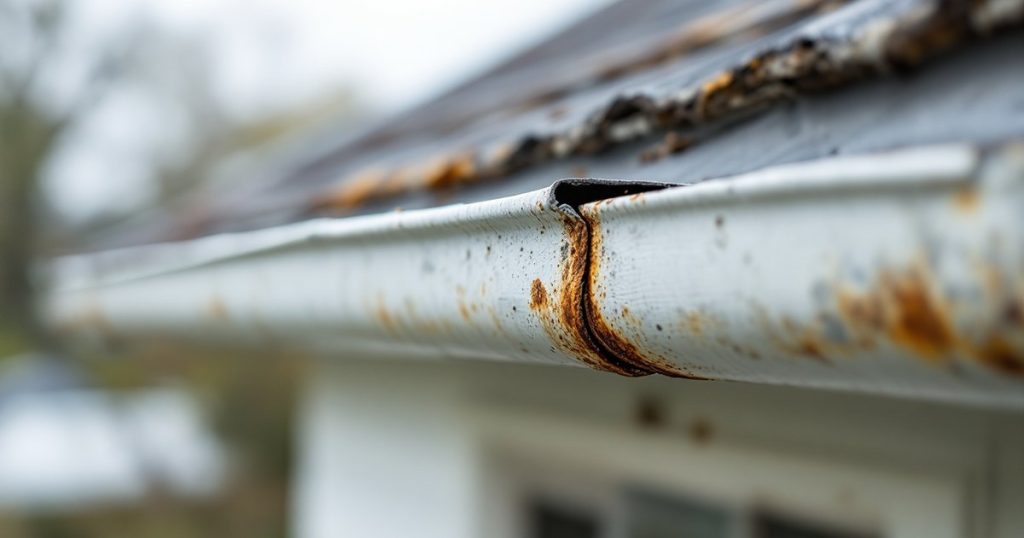
| Rust spots or holes through the metal | Coating worn through (steel) or corrosion (aluminum near salt or copper) | Replace the affected runs; replace the system if rust is widespread |
| Cracks or splits | Impact or cold-weather cracking, common on vinyl | Repair one section; replace if cracks recur |
| Sagging even when empty | Loose or failed hangers, or soft fascia | Re-hang and add hangers; check the fascia first |
| Gutter pulling away from fascia | Fasteners pulled out of rotted or split wood | Repair fascia, then re-hang or replace |
| Separated seams in several places | Sealant failure, often on sectional systems | Reseal once; replace if it keeps recurring |
| Water stains, peeling paint, foundation pooling | Overflow or leaks reaching the wall and ground | Find the cause: clog, slope, leak or undersized gutter |
Sign list: HomeGuide, When to replace your gutters (2026). Next steps are general guidance; a contractor’s on-site inspection governs.
How to check your gutters in one pass
A twice-yearly walk-around catches most problems while they are still repairs. Do it from the ground and from a properly footed ladder, and hire out anything above a single story if you are not equipped to work at height.
- Find the install date on old invoices, closing documents or warranty paperwork, and note the material.
- Walk the perimeter from the ground and sight along each run for dips, bows and gaps between the gutter and the fascia.
- Look under each run for drip lines, stains, peeling paint and soil washout below corners and seams.
- From a ladder, check hangers or spikes for looseness and the fascia for soft or dark wood.
- Inspect the trough for rust, pinholes, cracks and standing water that does not drain toward the outlets.
- Run a hose at the high end of each run and watch the seams, corners and downspout outlets for leaks.
- Record what you found and compare it with the remaining-life table above before calling for quotes.
Should I replace 20 year old gutters?
Not on age alone. Twenty years is NAHB’s average for aluminum and galvanized steel and the low end of InterNACHI’s aluminum range, so a 20 year old system is due for a close inspection, not automatic replacement. HomeGuide notes that when gutters are over 20 years old and showing multiple issues, replacement is often more cost effective than patchwork repairs.
A 20 year old copper system is less than halfway to its 50+ year benchmark and is normally repaired, not replaced. A 20 year old vinyl system is already past HomeGuide’s 10 to 20 year range, so recurring cracks are a reasonable trigger to replace it.
Repair or replace: which one should you pick?
Repair isolated problems on a system with meaningful life left, and replace when problems are widespread, recurring or paired with a system past its benchmark. Angi’s 2026 data puts the average professional gutter repair at $390, against $1,800 to $3,800 for a full replacement on a 1,500 square foot home per HomeGuide. The arithmetic below shows how fast repeat repairs close that gap.
| Repair visits (at Angi’s $390 average) | Total spent | Share of a $1,800 to $3,800 replacement |
|---|---|---|
| 1 | $390 | 10% to 22% |
| 2 | $780 | 21% to 43% |
| 3 | $1,170 | 31% to 65% |
| 5 | $1,950 | 51% to 108% |
Sources: Angi, How Much Does Gutter Repair Cost (2026 data); HomeGuide gutter installation cost (2026). Percentages are Roofing Brief arithmetic (total spent divided by each end of the HomeGuide range).
| If this is your situation | Then | Typical cost (Angi 2026 by damage type) |
|---|---|---|
| One leaking seam or corner, system under its benchmark age | Repair: clean and reseal | $80 to $140 |
| Water pools because the pitch is off | Repair: re-slope the run | $80 to $250 |
| One sagging run, sound fascia | Repair: re-hang and add support | $80 to $600 |
| Storm or impact damage to one section | Repair or replace that section; check insurance | $240 to $550 |
| Rust-through or cracks on several runs, at or past benchmark age | Replace the system | See the replacement cost guide |
| Third repair in a short span on an aging system | Price a replacement before paying for the next repair | Compare quotes |
For detailed repair pricing by problem, see our gutter repair cost breakdown.
How much does it cost to replace gutters on a 1,500 sq ft house?
HomeGuide’s 2026 guide estimates about 150 linear feet of gutter and $1,800 to $3,800 installed for a 1,500 square foot single-story home with a simple roofline. Two-story homes add about $1 to $3 or more per linear foot, which is roughly $150 to $450 or more on 150 feet. Material choice moves the total most.
HomeGuide prices aluminum at $10 to $20 per linear foot and copper at $25 to $40, so on 150 feet copper adds roughly $750 to $4,500 over aluminum (Roofing Brief arithmetic: $3,750 to $6,000 versus $1,500 to $3,000). Fascia repair and gutter guards add to any of these. Our gutter replacement cost guide breaks totals down by material and home size.
Does a gutter warranty tell you how long gutters last?
No. A gutter warranty covers manufacturing defects and finish failure for a set period, usually material only, and it is not a lifespan estimate. Kaycan’s aluminum gutter warranty runs 25 years, but full coverage lasts 10 years, then prorates, and it excludes labor, salt spray, storms, standing water and missed maintenance. It also covers the original homeowner only and is not transferable.
| Year after installation | Kaycan share of material cost | Notes |
|---|---|---|
| 1 to 10 | 100% (non-prorated) | Repair, refinish, replace or refund at Kaycan’s option |
| 11 | 90% | Prorated period begins |
| 12 | 80% | |
| 13 | 70% | |
| 14 | 60% | |
| 15 | 50% | |
| 16 to 25 | 10% | Holds at 10% for the rest of the term |
Source: Kaycan Aluminum Siding, Gutter, and Accessories 25 Year Limited Warranty, for product installed on or after February 1, 2025. Labor, forming, installation and removal are excluded in every year.
Vinyl warranties can be thinner than the label suggests. Retail listings describe Genova’s Raingo vinyl gutters as carrying a limited lifetime warranty, while Genova’s written product warranty (Form 257207) promises the parts will be made to its quality standards and function within standard residential use, with no stated term and no labor or property damage coverage. Angi reports that repair workmanship warranties typically run one to three years.
How to make gutters last longer
Keep gutters draining, keep metals separated and keep the factory finish intact. Every source in this guide ties lifespan to maintenance, and the Kaycan warranty requires periodic maintenance to stay valid. These steps target the failure causes in the table above.
- Clean gutters at least twice a year, in spring and fall, and every three months under deciduous or pine trees, per This Old House.
- Clear downspout outlets and elbows at each cleaning so water cannot stand in the trough.
- Re-secure loose hangers before a run starts to sag, and fix any soft fascia before re-hanging.
- Keep copper flashing and copper roof runoff from draining onto aluminum gutters, as the Copper Development Association advises.
- Read your coil warranty before painting over a factory finish. Kaycan’s warranty does not apply to material painted over the original finish unless Kaycan authorizes it. The Englert Rainpro, Michigan Aluminum and Rainstamp warranties do not specifically address painting, but they cover only defects in their own factory finish and Englert voids coverage for repairs made without its written authorization, so painting may complicate a claim. Our guide to painting gutters covers prep and primers by material.
- Wash the factory finish periodically, especially surfaces rain does not reach; Kaycan’s care instructions name the underside of eave gutters among the surfaces that need routine cleaning.
- Keep the install invoice and warranty paperwork, because makers such as Kaycan ask for proof of the installation date with any claim.
Our gutter cleaning cost and schedule guide covers what professional cleaning runs and how often tree cover calls for it.
Frequently asked questions
Should I replace 20 year old gutters?
Not on age alone. Twenty years is the average life NAHB’s 2007 Study of Life Expectancy of Home Components gives aluminum and galvanized steel gutters, and the low end of InterNACHI’s 20 to 40+ year range for aluminum. Replace when a 20 year old system also shows rust-through, multiple sagging runs, separated seams or fascia damage. Sound, well-pitched gutters can keep working.
How do I know if my gutters need to be replaced?
Replacement signs include rust or holes through the metal, cracks, sagging sections even when the gutter is empty, gutters pulling away from the fascia, seams that separate in several places, and water stains or peeling paint below the roofline. HomeGuide lists these as warning signs. One isolated problem is usually a repair; several at once usually point to replacement.
How much does it cost to replace gutters on a 1500 sq ft house?
HomeGuide’s 2026 cost guide puts a 1,500 square foot home at about 150 linear feet of gutter and $1,800 to $3,800 installed, for a single-story house with a simple roofline. Two-story homes add about $1 to $3 or more per linear foot. Copper, zinc, fascia repair and gutter guards raise the total.
What is the best time of year to get your gutters cleaned?
Spring and fall. This Old House recommends clearing gutters at least twice a year, ideally once in spring and once in fall, and every three months if deciduous or pine trees shed onto the roof. A late-fall cleaning after leaf drop matters most in cold climates, because clogged gutters hold water and ice through winter.
What is the longest lasting gutter material?
Copper, among materials the two main life-expectancy charts rate. NAHB and InterNACHI both list copper gutters at 50+ years and copper downspouts at 100 years. Zinc is not rated in either chart, but VMZINC states a correctly designed zinc roof can last more than 100 years. Aluminum and galvanized steel average about 20 years in NAHB’s study.
Can gutters last 50 years?
Copper gutters can. NAHB’s study and InterNACHI’s chart both rate copper gutters at 50+ years, and InterNACHI’s Florida chart still gives coastal copper 40+ years. Aluminum gutters reaching 40 years or more fall within InterNACHI’s 20 to 40+ year range, but NAHB’s average for aluminum is 20 years, so 50 years is uncommon for aluminum, steel or vinyl.
How long do vinyl gutters last?
The sources disagree. InterNACHI’s Standard Estimated Life Expectancy Chart lists vinyl gutters and downspouts at 25+ years, and 20+ years on its Florida chart. HomeGuide’s 2026 cost guide lists vinyl at 10 to 20 years. NAHB’s 2007 study does not rate vinyl gutters. Cold-climate cracking and sun fading are the usual reasons vinyl is retired early.
Sources
- National Association of Home Builders / Bank of America Home Equity, Study of Life Expectancy of Home Components, February 2007
- InterNACHI, Standard Estimated Life Expectancy Chart for Homes
- InterNACHI, Estimated Life Expectancy Chart for Florida Homes
- Kaycan, Aluminum Siding, Gutter, and Accessories 25 Year Limited Warranty (2025)
- Genova Products, Limited Product Warranties, Form 257207
- VMZINC, Zinc FAQ
- Copper Development Association, Copper in Architecture Design Handbook (A4050)
- HomeGuide, Gutter Installation Cost (2026)
- Angi, How Much Does Gutter Repair Cost? (2026 data)
- This Old House, How To Clean Your Gutters