
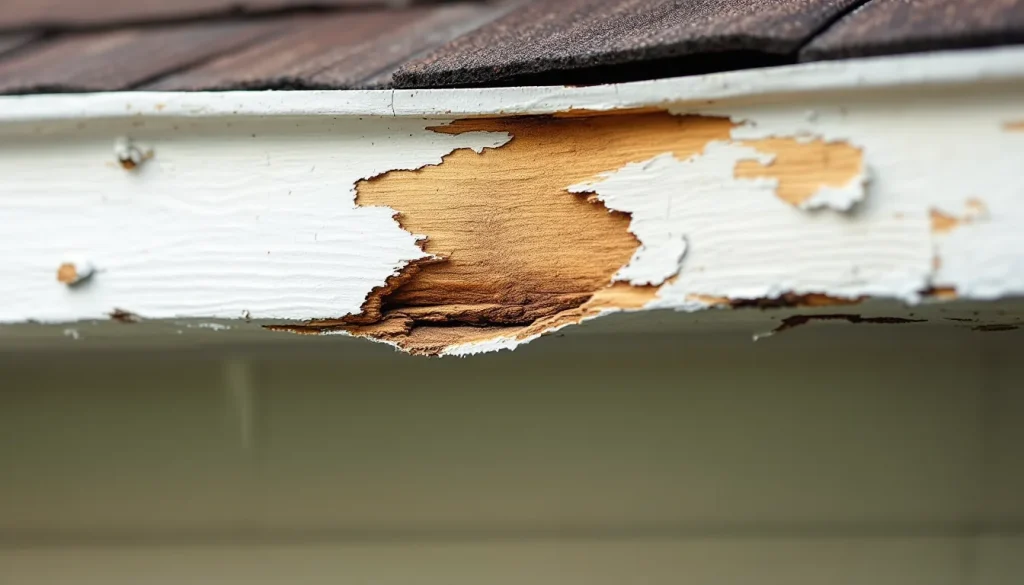
Fascia (see our soffit and fascia replacement cost) rot from gutters is caused by six specific failure modes: chronically clogged gutters overflowing behind the gutter, missing or curled drip edge that lets capillary water wick onto the fascia, undersized gutter capacity that overflows during heavy rain, broken sealant at corner miters or end caps, ice dam back-flow in winter, and improperly fastened gutters that pull away from the fascia and leave a gap for water entry. Repair costs run $300 to $1,800 per affected section depending on whether the rot has spread to soffit and rafter tails. This guide covers how to diagnose each cause from the ground, the fix priority, and the cost ladder before it becomes a structural problem.
The short version
- Six causes: clogged gutter overflow, missing drip edge, undersized capacity, corner miter seal failure, ice dam back-flow, gutter pull-away from fascia.
- Early signs from the ground: paint blistering on the fascia, vertical brown streak below a corner, soft spongy spot when you press a screwdriver into the wood, wasps building nests in the wood (they like soft wet wood).
- Repair cost ladder: $300 to $600 for a single 8 ft section of replacement fascia board, $600 to $1,200 if soffit is involved, $1,200 to $1,800+ if rafter tails are rotted.
- The cause is almost never the gutter itself. It is what the gutter is failing to do: divert water away from the wood.
- Diagnose by watching the gutter during a heavy rain. Overflow at corners means a clog or seal problem. Overflow at the front edge means capacity or drip-edge missing.
- Fascia rot can spread to sheathing and rafter tails in 18 to 36 months if ignored. Fix the cause first, then replace the wood.
What fascia rot actually looks like
Fascia is the horizontal board that runs along the eave behind the gutter, capping the ends of the rafter tails and giving you something to nail the gutter to. On most homes it is 1×6 or 1×8 pine or cedar, painted to match the trim. When it rots, it does so in a predictable progression:
- Stage 1 (months 0 to 6): Paint blisters or peels in vertical streaks below a gutter joint, corner, or outlet. The wood looks discolored but is still firm to the touch.
- Stage 2 (months 6 to 18): Paint sloughs off in 2 to 4 inch patches. Bare wood is gray and slightly soft when you press a screwdriver into it (it should resist; if the tip sinks 1/8 inch, the rot has started).
- Stage 3 (months 18 to 36): Wood is sponge-like, often with visible mold or fungal staining (dark gray or black streaks). Gutter hangers may be pulling out because the fascia no longer holds a screw.
- Stage 4 (3+ years): Rot has bridged to the rafter tails behind the fascia and possibly to the roof deck sheathing. You can see the rot from the attic side. Structural repair territory.
Most homeowners catch it at stage 2 or 3, usually when they finally repaint the trim and discover the wood is soft, or when a wasp nest in the fascia clues them in. The earliest catch is in the gutter cleaning itself: a competent crew will note any fascia staining as part of the inspection (see /gutter-cleaning-cost-and-schedule/).
Cause 1: chronic gutter overflow from clogs
The most common cause by a wide margin. When a gutter clogs at the outlet or partway down its run, water backs up and overflows. On a flat gutter without a drip edge the water sheets directly down the front of the gutter and onto the fascia below. On a gutter that has pulled away from the fascia even 1/8 inch, the water flows behind the gutter and runs straight down the back face of the fascia, which never sees sunlight and never dries out.
Diagnostic: walk around the house during the next heavy rain. If you see water sheeting over the front of the gutter, clogs are the cause. If you see no visible overflow but the fascia is staining, the water is going behind the gutter (worse problem, faster rot).
Fix priority: clean the gutter, snake the downspouts, and walk under the gutter line during the next storm to verify flow. If overflow continues with a clean gutter, the cause is capacity (cause 3) or seal failure (cause 4), not clogs. The annual cleaning schedule that prevents this is in /gutter-cleaning-cost-and-schedule/ and the guard math that reduces clog frequency is at /best-gutter-guards/.
Cause 2: missing or curled drip edge
Drip edge is a piece of L-shaped or T-shaped metal flashing that runs along the eave under the first row of shingles. The vertical leg of the L hangs down 1/2 to 1 inch in front of the fascia, and the bottom of the drip edge directs water into the gutter rather than letting it wick back along the underside of the shingle and onto the fascia.
Older homes (pre-1980s in most regions, pre-2012 nationwide as IRC made it mandatory) often have no drip edge at all. Newer homes sometimes have drip edge that has curled or pulled away because it was nailed only at the top corner without proper fasteners. Without functional drip edge, capillary action pulls a thin film of water back from the shingle edge and runs it directly onto the top of the fascia, where it soaks in and rots the wood from the top down.
Diagnostic: look up at the gutter from below at the eave line. You should see a 1/2 to 1 inch metal strip behind the gutter, painted to match the trim. If you see bare wood, raw fascia, or just the underside of the shingle, you have no drip edge or it has fallen behind the gutter. The fix is to install or replace the drip edge, which usually requires lifting the first row of shingles and may involve removing the gutter. Cost: $4 to $7 per linear foot installed, often bundled into a re-roof. For the full drip-edge install detail see /drip-edge-installation-detail/ and the materials overview at /drip-edge/.
Cause 3: undersized gutter capacity
A gutter that meets minimum code in Atlanta will overflow regularly in Seattle. A gutter sized for the original roof area will overflow if you have added a porch or addition that drains into the same run. The symptoms look identical to a clog (overflow over the front edge during heavy rain) but the gutter is clean and the downspouts are clear.
Diagnostic: measure the roof drainage area feeding each downspout and compare to the chart in /gutter-sizes-and-capacity/. If the gutter or downspout is undersized, no amount of cleaning will fix the overflow. The repair is to upsize: usually adding an additional downspout or upgrading from 2×3 inch to 3×4 inch downspouts on a 5 inch or 6 inch K-style gutter. The full sizing rule (1 sq inch downspout per 100 sq ft of roof area, 35 ft max gutter run per outlet) is covered in /downspout-placement-and-sizing/.
Cause 4: corner miter or seal failure
Sectional gutter joints, corner miters, and end caps all rely on a butyl or polyurethane sealant to be watertight. That sealant has a service life of 5 to 12 years. After it fails, the joint weeps a slow drip during every rain. The drip is too small to see from the ground but it is enough to keep the fascia behind the joint wet for hours after the rain stops, which is exactly the condition that wood rot fungi need to colonize.
Diagnostic: look for a vertical brown stain or paint blister directly below a gutter joint, corner miter, or end cap. The stain pattern is the giveaway: cause 1 (overflow) produces wide horizontal staining; cause 4 (seam leak) produces narrow vertical staining tied to a specific joint above.
Fix: clean and dry the joint, scrape out the old sealant, and reapply with a butyl-based gutter sealant (Geocel 2300 or NP1 are the industry favorites). Cost: $15 in sealant and 30 minutes per joint as a DIY fix, $150 to $300 if a contractor does a whole-house re-seal pass. For continuous-vs-sectional joint-count math, see /continuous-vs-sectional-gutters/.
Cause 5: ice dam back-flow
In snow climates, ice dams form when warm attic air melts snow on the upper roof, the meltwater runs down to the cold eave, and refreezes into a ridge of ice along the gutter. Water continues to flow behind the ice dam, finds the easiest exit, and often runs behind the gutter and down the fascia, or backs up under the shingles and into the soffit. Either way, the wood behind the gutter gets wet repeatedly throughout the winter and rots over a few seasons.
Diagnostic: in winter, look for icicles hanging from the gutter front edge and a ridge of ice visible from the ground at the roof eave. In spring, look for paint peeling at the soffit (the underside of the eave overhang) and fascia rot concentrated on the north and east sides of the house (the slowest to thaw).
Fix: address the root cause (attic ventilation and insulation, see /ice-dam-prevention/ and /soffit-vents/) and add heat cable as a tactical fix for the gutter and downspouts. The heat cable approach is detailed in /heated-gutter-cable/ and the parallel roof-edge install in /heat-cable-for-ice-dams/. For active mid-winter removal see /ice-dam-removal/.
Cause 6: gutter pull-away from the fascia
Spike-and-ferrule gutter fasteners (the old standard, used until roughly 2005 on most production homes) tend to pull out of the fascia over 10 to 20 years as the wood swells and shrinks through seasons. The gutter does not fall off; it sags forward 1/8 to 1/2 inch and creates a gap between the back of the gutter and the fascia. Water running into a clean, sized gutter then sheets out of that gap, runs behind the gutter, and drains down the back of the fascia.
Diagnostic: stand under the eave and look up. The back lip of the gutter should be tight to the fascia. If you can see daylight, fingers, or a continuous gap, you have pull-away. Often paired with visible gutter slope inconsistency or a section that looks “tipped” forward.
Fix: replace spike-and-ferrule fasteners with hidden hangers (a 24 to 30 inch spacing, screwed to the fascia, not nailed). Materials cost: $1.50 to $3 per hanger plus $30 to $60 for a quality fastener pack. Labor: a half day for a 200 foot home. Combined with a re-pitch and re-seal pass, you usually get another 15 to 20 years out of the existing gutter. For the install detail, see /rain-gutter-install-guide/.
The repair cost ladder
What fascia repair actually costs depends on how far the rot has spread when you finally get to it. The ladder runs from a $300 single-board swap to a $5,000+ structural repair:
| Scope | Material cost | Labor cost | Total (per section) |
|---|---|---|---|
| 8 ft pine fascia board swap, paint match | $25 to $50 | $275 to $550 | $300 to $600 |
| 16 ft fascia + soffit replacement, vinyl soffit | $80 to $150 | $520 to $1,050 | $600 to $1,200 |
| Fascia + soffit + 2 to 3 rafter tail sister | $150 to $300 | $1,050 to $1,500 | $1,200 to $1,800 |
| Fascia + soffit + rafter tails + sheathing repair | $400 to $800 | $1,800 to $3,200 | $2,200 to $4,000+ |
| Whole-eave structural rebuild (rare) | $1,500+ | $3,500+ | $5,000+ |
The cause matters less than the timing. Catching the rot at stage 1 or 2 (paint blistering, no soft wood) means a $300 to $600 board swap. Letting it spread to stage 4 means a structural repair that approaches a partial re-roof in scope. Add gutter and downspout work to fix the upstream cause and the typical total project runs $1,500 to $3,500 once the fascia is involved. See /gutter-installation-cost/ for the gutter-side baseline and /fascia-board/ for the materials and trim options.
The 20-minute walk-around that catches it early
You do not need a contractor to inspect your own fascia. The DIY walk-around runs about 20 minutes and is the single most useful preventive task you can do on a typical home each year:
- Walk the full perimeter on a sunny day. Look up at the gutter and the fascia behind it. Use binoculars on two-story homes.
- Note any paint blistering, peeling, or color change directly below a gutter joint, corner, end cap, or outlet.
- Press a screwdriver tip into any suspect spot from a ladder. Firm resistance means surface staining only. Any tip penetration deeper than 1/16 inch means active rot.
- Look up the fascia from the ground after the next rain. Any dripping after the rain has stopped means a slow leak somewhere upstream.
- Check the soffit underside for stains, peeling paint, or sagging panels. Soffit damage usually means the rot has already bridged from fascia to soffit, a stage 3 problem.
Items 2 and 4 together catch about 80 percent of fascia rot before stage 3. The annual walk-around is also the right time to spot drip-edge problems, miter seal failure, and hanger pull-away. Combined with the annual gutter cleaning, you can keep a typical eave system maintained for under $300 a year.
When to skip DIY and call a roofer
Three signs that the project has outgrown a homeowner DIY repair:
- Soft wood extends more than 24 inches in any direction (the rot has spread to adjacent boards and possibly to soffit framing).
- You can see daylight or attic insulation from outside the eave (sheathing damage, not just fascia damage).
- Gutter hangers pull out of the fascia by hand (the wood no longer holds fasteners, and re-hanging the gutter requires sistering or replacing structural members).
For any of these you want a licensed roofer or trim carpenter, not a handyman. The work usually involves removing a portion of the gutter, possibly lifting the first course of shingles, replacing the affected fascia and any rot-damaged soffit or rafter tail, and re-hanging the gutter. Estimate range $1,200 to $4,000 depending on scope. If the rot ties into a previous roof leak from above, you may also need flashing or roof repair (see /roof-leak-repair/ and /roof-flashing/).
Prevention checklist
Six items prevent roughly 90 percent of fascia rot cases over a 20-year ownership window:
- Clean the gutters once or twice a year on the schedule from /gutter-cleaning-cost-and-schedule/.
- Verify drip edge is in place and functional. If missing, retrofit it during the next reroof.
- Confirm gutter capacity and downspout count match the roof area per /downspout-placement-and-sizing/.
- Re-seal corner miters and end caps every 5 to 8 years (or upgrade to continuous gutter where joint count goes from 30 to 6).
- In snow country, install heat cable on the eave and downspouts before the first hard freeze.
- Walk the perimeter once a year and press a screwdriver into any suspect spot.
Do these six things and fascia rot becomes a 30-year problem instead of a 10-year problem. Skip any of them and you can expect to be replacing fascia somewhere on the house within a decade.