
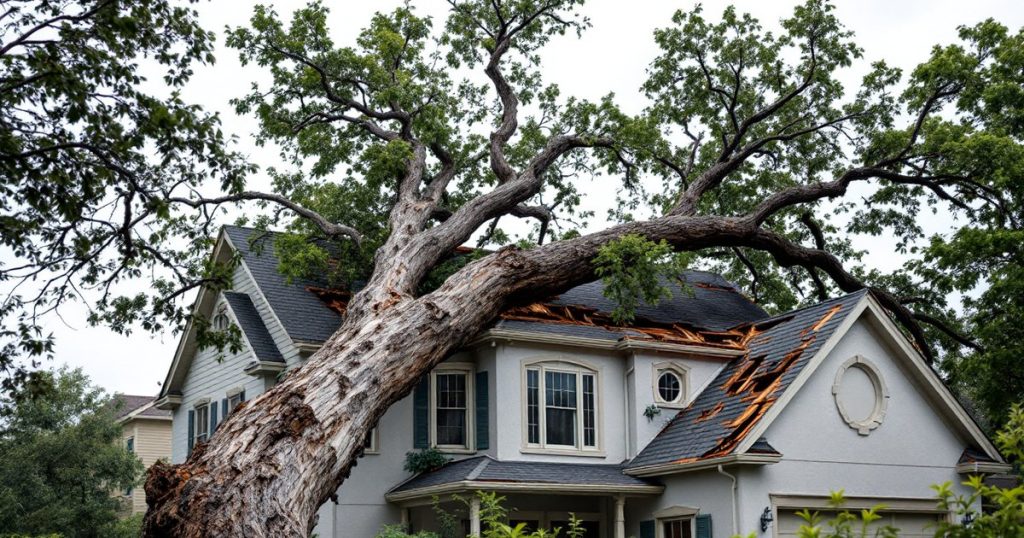
When a tree falls on your roof, get people out of the impact zone, stay at least 35 feet from any downed power line, and call 911 and the utility before anyone touches the tree. Tree damage to a roof is usually covered by a standard homeowners policy when a sudden event drops the tree on the house, but tree removal carries its own small limit: the ISO HO-3 form pays up to $500 per tree and $1,000 per loss. Policy language controls, so read your own form.
By The Roofing Brief Team. Last reviewed: October 2026.
Key numbers at a glance
These six figures answer most first-day questions after a tree hits a house. Each is tied to a named source. Insurance limits come from the ISO Homeowners 3 form (HO 00 03 05 11), which many insurers use or adapt, so your policy may differ.
| Figure | What it means | Source |
|---|---|---|
| 35 feet | Minimum distance to keep from fallen power lines and anything they are touching | American Red Cross, power outage safety |
| 10 feet | Minimum distance from overhead power lines for tree work; closer work is for qualified line-clearance crews | OSHA Hurricane eMatrix, tree trimming |
| $500 per tree, $1,000 per loss | Most the ISO HO-3 form pays to remove fallen trees under its Debris Removal additional coverage | ISO HO 00 03 05 11, Section I, E.1.b |
| 5% of dwelling limit, $500 per tree | Cap for replacing your own damaged trees, and only for named perils that do not include wind | ISO HO 00 03 05 11, Section I, E.3 |
| $400 to $1,200 | Average tree removal cost (national average $850); same-day removal often 2 to 3 times the standard rate | HomeGuide tree removal cost guide |
| $175 to $700 | Typical roof tarp job; emergency after-hours tarping runs $1.00 to $2.80 per square foot | HomeGuide roof tarp cost guide |
What to do first when a tree falls on your roof
Life safety comes before the claim. Move everyone away from the damaged rooms, check for downed lines and gas leaks from a safe spot, and call 911 and your utilities if either is involved. Only after the scene is safe should you photograph the damage, call your insurer, and arrange an emergency tarp. Cutting or pulling the tree yourself is the step most likely to make things worse.
- Clear the impact zone. Progressive’s claims guidance says to move everyone, including pets, away from the damaged area because the structure may be compromised and covered in glass and debris.
- Look for downed lines without approaching them. The American Red Cross says to “Stay at least 35 feet away from fallen power lines and anything they are touching” and to call 911. A tree resting on a line can carry current, so treat the whole tree as energized.
- Call the utility. Report the downed line to your electric utility. If the tree hit the gas service or you smell gas, leave the house and call the gas company or 911 from outside.
- Cut power only if you can do it dry. Progressive suggests shutting off power at the panel when a line may be down. Ready.gov warns not to touch electrical equipment if it is wet or you are standing in water, so skip this step if the panel area is wet.
- Decide whether anyone can stay. Use the warning signs in the next section. If in doubt, stay elsewhere until a contractor or engineer checks the framing.
- Photograph before anything moves. Shoot the tree, the roof, the attic and every damaged ceiling from safe positions, plus the stump or root ball.
- Notify your insurer and get a tarp on. The ISO HO-3 form requires you to “Give prompt notice to us or our agent” and to protect the property from further damage. Keep every receipt.
Signs the structure is unsafe to stay in
Leave the house if the tree is still shifting, the roof line visibly sags, or ceilings bow, crack or drip near the impact point. Progressive lists four triggers for staying elsewhere: the tree has not completely fallen, the roof is severely damaged, major structural supports are damaged, or utility lines are damaged. A sagging ridge or a ceiling bulging under a pooled load can fail without warning.
- Visible dip in the ridge or roof plane under the trunk
- New ceiling cracks, bulges or drywall pulling off fasteners below the impact
- Creaking or popping as wind moves the tree
- Water pouring into a room with electrical outlets or fixtures
If the house is not fit to live in, the ISO HO-3 form’s Coverage D (Loss Of Use) covers “any necessary increase in living expenses” while repairs are made, subject to your limit. Keep hotel and meal receipts.
Why you should not cut a fallen tree off the roof yourself
A tree lying on a roof is loaded in ways that are hard to read: bent limbs can spring back, and one wrong cut can drop the trunk through the decking. OSHA’s storm cleanup guidance for tree work lists falls from heights, chain saws, contact with electrical lines and “impact from tree debris and felled trees” among the main hazards. Leave removal to a professional tree crew.
OSHA’s tree trimming activity sheet gives three specific warnings that apply directly to a tree on a house:
- Tension: “If tree is broken and under pressure, make sure you know which way the pressure is going.”
- Spring poles: young trees that other trees have fallen against “act like spring poles and can propel back.”
- Drop zones: keep non-essential people “at least 20 feet beyond expected drop zones.”
The same sheet says to stay at least 10 feet from overhead power lines, and only qualified line-clearance tree trimmers work closer. If you run a generator during the outage, Ready.gov says to keep it outdoors and at least 20 feet from windows, doors and attached garages.
Does homeowners insurance cover tree damage to a roof?
In many cases, yes. Under the ISO HO-3 form, damage to the house itself falls under open-peril dwelling coverage, so a tree crushing the roof is generally covered unless an exclusion applies. Removing the tree is a separate, capped coverage: up to $500 per tree and $1,000 per loss in the ISO form. Replacing your own damaged trees is capped again and excludes wind. Policy language controls, so check your declarations page and form.
The quotes below come from the ISO Homeowners 3 Special Form, edition HO 00 03 05 11, as filed and published by the Maine Bureau of Insurance. Many U.S. insurers use this form or a version adapted from it, but your carrier’s wording, endorsements and state amendments decide your claim.
Damage to the house: open-peril dwelling coverage
The ISO HO-3 form states, for the dwelling and other structures: “We insure against direct physical loss to property described in Coverages A and B.” That is open-peril wording, so a tree damaging the roof is covered unless an exclusion removes it. Insurers commonly dispute claims where the tree was visibly dead or rotting, and the Iowa Insurance Division says such a claim “may be denied” when the risk was known beforehand.
Other structures such as a detached garage or fence fall under Coverage B. A tree on your car is not a homeowners claim: the Iowa Insurance Division points to the comprehensive coverage on your auto policy instead.
Tree removal: the $1,000 and $500 limits in the form
The ISO form’s Debris Removal additional coverage, E.1.b, pays “your reasonable expense, up to $1,000,” to remove fallen trees that damage a covered structure or block a driveway or wheelchair ramp. It then adds: “The $1,000 limit is the most we will pay in any one loss, regardless of the number of fallen trees. No more than $500 of this limit will be paid for the removal of any one tree.”
The form treats your trees and a neighbor’s trees differently. It covers:
- “Your trees felled by the peril of Windstorm or Hail or Weight of Ice, Snow or Sleet”
- “A neighbor’s trees felled by a Peril Insured Against under Coverage C”
The form also states, “This coverage is additional insurance,” meaning it sits on top of the dwelling limit rather than inside it. The Insurance Information Institute describes typical removal coverage as “generally up to about $500 to $1,000, depending on the insurer and the type of policy purchased.”
Your own damaged trees: Trees, Shrubs And Other Plants
Replacing a tree you lost is a different coverage from removing it, and it is narrow. The ISO form covers trees, shrubs, plants and lawns only for fire or lightning, explosion, riot or civil commotion, aircraft, vehicles not owned by a resident, vandalism or malicious mischief, and theft. Wind is not on that list, so a wind-toppled shade tree usually is not replaced under this coverage.
Where it applies, the form pays “up to 5% of the limit of liability that applies to the dwelling for all trees, shrubs, plants or lawns. No more than $500 of this limit will be paid for any one tree, shrub or plant.”
Other HO-3 provisions that matter after a tree strike
Five more provisions in the ISO HO-3 form shape a tree claim: temporary repairs such as tarping, damaged contents, collapse, debris from the house itself, and your duties after the loss. Each carries conditions and limits, so read the matching section of your own policy before relying on it, and ask your adjuster which provision a given bill falls under.
| Provision (ISO HO 00 03 05 11) | What the form says | Why it matters for a tree on the roof |
|---|---|---|
| E.2 Reasonable Repairs | Pays “the reasonable cost incurred by you for the necessary measures taken solely to protect covered property” from further damage; does not increase the limit | Emergency tarping and board-up are usually claimed here; keep the invoice |
| Coverage C peril 10, Falling Objects | Contents are not covered “unless the roof or an outside wall of the building is first damaged by a falling object” | Furniture and electronics damaged after the roof is breached may be covered |
| E.8 Collapse | Covers “abrupt collapse” caused by Coverage C perils; does not apply to a part that is “standing, even if it shows evidence of cracking, bulging, sagging” | A sagging but standing roof is usually handled as direct physical damage, not collapse |
| E.1.a Debris Removal | Debris removal of covered property is inside the dwelling limit; an extra 5% of that limit is available if damage plus debris exceeds it | Hauling broken shingles, decking and drywall is part of the dwelling claim |
| Section I Conditions, Duties After Loss | Requires prompt notice, protecting the property, keeping “an accurate record of repair expenses,” and a sworn proof of loss within 60 days after the insurer’s request | Missing these duties can reduce what the insurer pays |
The tree removal gap: a worked example
The $500 per-tree cap rarely covers removing a large tree from a house in an emergency. One large oak on the roof can cost $1,700 to $6,000 to remove on a same-day call (Roofing Brief estimate, arithmetic below). That leaves $1,200 to $5,500 uncovered if the whole bill is treated as tree removal under E.1.b. How the bill is split between dwelling coverage and the tree removal limit can matter more than the cap itself.
The arithmetic, using HomeGuide’s ranges: a large tree of 60 to 80 feet costs $850 to $2,000 to remove, and same-day service often runs 2 to 3 times the standard rate. That gives $850 x 2 = $1,700 at the low end and $2,000 x 3 = $6,000 at the high end. Subtracting the $500 per-tree limit leaves $1,200 to $5,500.
Some insurers treat lifting the tree off the structure as part of the dwelling repair. Maryland’s People’s Law Library, run by the state’s Thurgood Marshall State Law Library, says the cost to remove a tree from a damaged dwelling “would be paid under the dwelling portion of your policy,” after which the tree is placed on the ground for removal. The same guide describes tree removal coverage of about $500 per loss in policies there, not the ISO form’s $1,000. That difference is a reminder that your policy, not the model form, sets the number. Ask the adjuster how the bill will be split before the crane is booked, and have the tree service itemize “off the structure” and “ground cleanup” separately.
A neighbor’s tree fell on my roof: who pays?
In most cases you file with your own homeowners insurer, even when the tree belonged to a neighbor. The Insurance Information Institute says “You are insured no matter who owns the tree.” If the neighbor was negligent, for example by ignoring a tree they knew was dead, your insurer may pursue the neighbor’s insurer through subrogation, and you may get your deductible back. Negligence rules vary by state.
The common legal test is whether the tree owner knew or should have known about a dangerous condition. Maryland’s People’s Law Library states that a homeowner “can be held liable if a tree on the homeowner’s property presents a danger to abutting properties and the homeowner knew or should have known about the deteriorating condition of the tree,” citing Hensley v. Montgomery County, 25 Md. App. 361 (1975). The Oklahoma Insurance Department says a neighbor “could be considered negligent” if notified that a tree is a safety concern and nothing is done. Other states apply their own case law, so a local attorney is the right source on liability.
Whose insurance pays: scenario table
This table summarizes how tree claims typically route between your insurer, a neighbor’s insurer and your auto policy. Outcomes depend on your policy wording, your state’s negligence law and the facts of the loss, so treat it as a starting point for a conversation with your insurer, not a coverage decision.
| Scenario | Usually files first | What may follow | Source |
|---|---|---|---|
| Your healthy tree falls on your house in a windstorm | Your homeowners policy | Dwelling repair minus deductible; removal up to the form’s tree limits | ISO HO 00 03 05 11; Triple-I |
| Neighbor’s healthy tree falls on your house in a storm | Your homeowners policy | Usually treated as no-fault; your deductible applies | Triple-I; Iowa Insurance Division |
| Neighbor’s dead or rotting tree they knew about falls on your house | Your homeowners policy | Your insurer may subrogate against the neighbor’s insurer; deductible may be returned | Iowa Insurance Division; Oklahoma Insurance Department |
| Your tree falls on a neighbor’s house | The neighbor’s homeowners policy | You may be liable if your neglect contributed | Iowa Insurance Division |
| Any tree falls in the yard and hits nothing | Usually no coverage | Removal may be covered only if it blocks a driveway or ramp | Triple-I; ISO E.1.b |
| Tree falls on your car | Auto comprehensive coverage | Homeowners policy does not cover the vehicle | Iowa Insurance Division |
How much does tree damage to a roof cost to repair?
Tree damage repair costs run from a few hundred dollars for a branch scrape to well over $8,000 when rafters or trusses break, before tree removal and interior repairs. HomeGuide puts truss or rafter repairs at $500 to $5,000 and roof decking at $200 to $500 per 100 square feet. The tiers below combine those ranges into Roofing Brief estimates, with the arithmetic shown.
| Damage tier | Typical scope | Estimated cost | How it is built |
|---|---|---|---|
| Branch scrape or small puncture | Shingles and underlayment only; decking intact | $150 to $1,000 | HomeGuide minor roof repair range |
| Hole through the decking, framing intact | Tarp, about 200 sq ft of decking, underlayment and shingles | $1,575 to $3,300 | Tarp $175 to $700 + decking 2 x ($200 to $500) + shingles 200 sq ft x $5 to $8 |
| Broken rafters or trusses | Engineer visit, framing repair, decking and shingles | $2,225 to $8,900 | Engineer $150 to $600 + framing $500 to $5,000 + decking $400 to $1,000 + shingles $1,000 to $1,600 + tarp $175 to $700 |
| Roof replacement after widespread damage | Full tear-off of a 2,000 sq ft architectural shingle roof | $10,000 to $16,000 | Roofing Brief 2026 cost report, $5 to $8 per sq ft installed |
Sources: HomeGuide roof repair, roof tarp and structural engineer cost guides; The Roofing Brief 2026 roofing cost report for the $5 to $8 per square foot architectural asphalt baseline. Small patches often price higher per square foot than a full roof because of minimum charges, so treat the shingle line as a floor. Tree removal, interior drywall and insulation, and any water damage are extra; HomeGuide puts roof repairs involving water damage at $1,000 to $6,000 or more.
The tarp is often the first bill. HomeGuide’s national figures match the ranges in our roof tarping cost guide, and under the ISO form the tarp is usually claimed as a reasonable repair.
What a roofer and engineer should check after a tree strike
A tree that breaks through shingles usually loads the framing below, so a proper inspection goes past the visible hole. Expect a roofer to check the covering, underlayment, decking, rafters or trusses, ridge, fascia and gutters, plus the attic and ceilings. When framing is cracked, split or displaced, many insurers and building departments expect a structural engineer’s letter before repair.
Engineered trusses have a specific code rule. The 2021 International Residential Code, Section R802.10.4, carried forward in the 2024 IRC, says: “Truss members shall not be cut, notched, drilled, spliced or otherwise altered in any way without the approval of a registered design professional.” A broken truss is typically repaired to an engineered repair detail approved by a registered design professional, not improvised on site.
- Rafters: cracked or split rafters are often sistered or replaced; the fix should match the original size and span.
- Trusses: repairs follow a stamped detail per IRC R802.10.4.
- Decking: broken or delaminated sheathing is replaced to match the existing thickness so the new roof lies flat.
- Engineer letter: HomeGuide puts a structural engineer roof inspection at $150 to $600. The report typically states whether the structure is sound and how to correct problems.
- Permit: structural repairs commonly require a building permit; check with your local building department.
If the roof plane still dips after the tree is removed, our guide to sagging roof repair covers how framing fixes are scoped.
Documentation checklist for a tree damage claim
Good documentation answers the questions an adjuster will ask: what fell, why it fell, what it hit, and what you spent. Capture the tree’s condition before it is cut up, because the stump and break point are the main evidence of whether the tree was healthy. Weather records support the cause of loss, and itemized invoices decide how costs are split between dwelling coverage and the tree removal limit.
- Wide and close photos of the tree on the roof, taken from the ground or a window, before removal
- Photos of the stump, root ball and break point, showing whether the wood was sound or rotted
- Attic photos of rafters, trusses and decking, and every damaged ceiling and wall inside
- A video walk-through with the date visible on your phone
- Storm records for your date and county from the NOAA Storm Events Database
- Your policy declarations page, claim number, adjuster name and a log of every call
- Itemized invoices: tarp, board-up, tree removal split into “off the structure” and “ground cleanup,” hotel and meals
- Any prior arborist report, or a dated message you sent a neighbor about their tree
Our step-by-step guide to filing an insurance claim for roof damage covers adjuster visits, estimates and appeals.
Repair or replace after tree damage: which path fits?
Most tree claims end in a repair, not a new roof. Insurers generally pay to restore the damaged area, and a full replacement usually comes into play only when the damage is widespread, the framing is compromised across the roof, or matching materials are not available. The table maps common situations to a starting recommendation.
| Your situation | Starting recommendation | Who to call first |
|---|---|---|
| Limb on the roof, no hole, no leak | Have a tree crew remove it, then a roofer inspect the covering | Tree service, then roofer |
| Hole through the roof, framing looks intact | Emergency tarp, photos, claim, then a patch repair | Insurer and roofer |
| Sagging ridge, cracked rafters or trusses | Leave the area, get a structural engineer’s letter before repair | Insurer, tree crew, engineer |
| Tree touching a power line | Stay 35 feet away; utility crew must clear it first | 911 and electric utility |
| Old roof near the end of its life with new tree damage | Ask how the roof is valued; an actual cash value payout may cover only part of a replacement | Insurer, then roofer for a full quote |
| Neighbor’s tree, known to be dead | File with your insurer and tell them who owns the tree | Your insurer; an attorney if damages are large |
For how valuation, deductibles and wear exclusions affect any roof claim, see our explainer on whether homeowners insurance covers roof damage.
Frequently asked questions
Does homeowners insurance cover tree damage to a roof?
Usually, when a sudden event drops the tree on the house. The ISO HO-3 form insures the dwelling against “direct physical loss” unless an exclusion applies, so a tree crushing the roof is generally covered after your deductible. Claims can be disputed if the tree was visibly dead and the risk was known. Removal of the tree has its own limit. Policy language controls.
Does homeowners insurance pay for tree removal after a storm?
Often, but only up to a small limit and usually only if the tree hit a covered structure or blocks a driveway or ramp. The ISO HO-3 form pays up to $1,000 per loss and no more than $500 per tree. Your own trees qualify when felled by windstorm, hail, or weight of ice, snow or sleet. A tree that falls in the yard and hits nothing is generally not covered.
Who pays if a neighbor’s tree falls on my house?
In most cases your own homeowners insurer pays, minus your deductible, because the Insurance Information Institute says you are insured no matter who owns the tree. If the neighbor knew or should have known the tree was dangerous, your insurer may recover costs from the neighbor’s insurer through subrogation and refund your deductible. Negligence rules vary by state.
What happens if tree limbs touch my roof?
Tree branches can damage a roof without falling: limbs touching it scrape off shingle granules, can lift or crack shingles in wind, clog gutters and keep the roof damp. IKO says branch tips “should be at least six feet from the roof.” Insurers often treat this slow damage as wear and tear, which the ISO HO-3 form excludes, so trimming is a maintenance cost.
Is granular loss on a roof covered by insurance?
Usually not when it builds up over time. The ISO HO-3 form excludes “Wear and tear, marring, deterioration,” and gradual granule loss from branch abrasion or age generally falls there. Granule loss tied to a specific covered event, such as a falling limb or a hailstorm, may be covered if it caused direct physical damage. Your insurer’s inspection and policy wording decide it.
Should I remove the tree from my roof before the adjuster comes?
Do not remove it yourself. Photograph everything first, then let a professional tree crew take it off if it is causing more damage or is unsafe; insurers generally expect you to protect the property from further damage. Tell your insurer before work starts when you can, keep itemized invoices, and save photos of the stump and break point for the adjuster.
How much does it cost to remove a tree from a roof?
HomeGuide puts average tree removal at $400 to $1,200, with large trees of 60 to 80 feet at $850 to $2,000, and same-day service often 2 to 3 times the standard rate. A large tree on a roof in an emergency can reach $1,700 to $6,000 (Roofing Brief estimate). The ISO HO-3 form pays up to $500 per tree for removal.
Sources: ISO Homeowners 3 Special Form HO 00 03 05 11 (copy published by the Maine Bureau of Insurance); American Red Cross power outage safety; OSHA Hurricane eMatrix, tree trimming; Ready.gov power outages; Insurance Information Institute; Iowa Insurance Division; Oklahoma Insurance Department; Maryland People’s Law Library; Progressive; HomeGuide tree removal, roof repair, roof tarp and structural engineer cost guides; IKO; 2021 and 2024 International Residential Code, Section R802.10.4. This page is general information, not legal or insurance advice; your policy, your state’s law and the facts of your loss decide coverage and liability.