
By The Roofing Brief Team | Last reviewed: October 2026
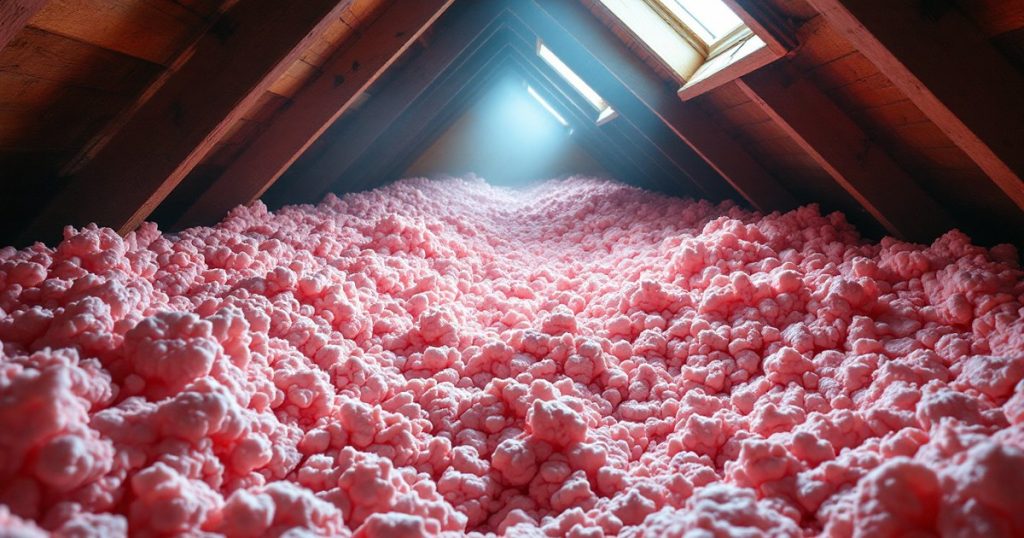
AttiCat insulation is Owens Corning’s PINK unbonded loose-fill fiberglass, sold in 27.5 lb bags and designed to be blown only through the AttiCat machine that Home Depot and Lowe’s lend free for 24 hours when you buy 10 or more bags. Per Owens Corning’s May 2026 product data sheet, R-30 takes 14.6 bags per 1,000 sq ft at 10.75 inches, and R-49 takes 25 bags at 17 inches. It is formaldehyde-free (UL Environment validated) and GREENGUARD Gold certified.
This review works from Owens Corning’s own documents: the AttiCat product data sheet (Pub. No. 10011273-L, May 2026), the AttiCat Machine Rental Guide (Pub. No. 10028802), the machine sell sheet (Pub. No. 10009541-D, August 2026) and the AttiCat troubleshooting guide. Competitor figures come from the Johns Manville, CertainTeed and Greenfiber coverage charts. The step-by-step blowing technique lives in our guide on how to blow insulation in an attic, and store-by-store rental terms in our insulation blower rental guide. This page is the product review: what the AttiCat bag and machine actually deliver, and how the numbers compare.
AttiCat key numbers at a glance
The figures most AttiCat buyers come for are the bag count per R-value, the depth, the rental terms and the bag price. Every row below is taken from an Owens Corning document or a retailer listing, and the price row is store-specific because Home Depot prices vary by location.
| Item | AttiCat figure | Source |
|---|---|---|
| Bag weight | 27.5 lb nominal | Owens Corning AttiCat data sheet, May 2026 |
| R-30 coverage | 14.6 bags per 1,000 sq ft, 10.75 in minimum thickness | Owens Corning AttiCat data sheet, May 2026 |
| R-49 coverage | 25 bags per 1,000 sq ft, 17 in minimum thickness | Owens Corning AttiCat data sheet, May 2026 |
| Machine rental | 24 hours free with 10 bags; a daily fee may apply after that | Owens Corning AttiCat Machine Rental Guide |
| Blowing rate | About 7 lb per minute, or 4 to 5 minutes per bag | Owens Corning AttiCat troubleshooting guide |
| Bag price | $61.90 per bag; $58.81 each when buying 30 or more (one store’s listing) | Home Depot listing for model AC01, seen Oct 2026 via Google’s index of the page |
What is Owens Corning AttiCat insulation?
Owens Corning describes AttiCat PINK Blown-In Insulation as “an unbonded loosefill Fiberglas thermal insulation” that is “designed for use exclusively with the AttiCat machine.” It is meant for open attic floors in new and existing homes. The product is rated from R-19 to R-60 on the Owens Corning product page, with the data sheet chart also listing R-13 through R-44.
The “expanding” in the product name refers to how the material behaves in the machine. Owens Corning says the fiberglass “releases and finishes conditioning and expansion while traveling through the hose inside the machine before application,” and that once installed it has “virtually no settling.” The data sheet backs that up in a concrete way: for every R-value, the minimum installed thickness and the minimum settled thickness are the same number.
AttiCat standards, safety and certifications
The AttiCat data sheet lists the code and lab standards the product is tested against. These are the claims a building inspector or energy auditor may ask about, so they are worth knowing by name rather than by marketing phrase.
- Material standard: conforms to ASTM C764 Type I (pneumatic application). R-values are measured under ASTM C687.
- Fire: passes ASTM E136 and is considered non-combustible by the model building codes. Flame spread 0 and smoke developed 5 under ASTM E84 and ULC S102.2.
- Moisture and mold: does not absorb moisture per ASTM C1104 and does not support mold growth per ASTM C1338. Owens Corning adds that insulation contaminated with water and organic matter can still grow mold and should be removed.
- Indoor air: UL Environment GREENGUARD Gold certified and UL Environment validated formaldehyde-free.
- Other: an SCS-certified Environmental Product Declaration, participation in the Declare label, California quality standards and the Minnesota Insulation Standards Program.
Fiberglass can cause temporary skin and mucous membrane itching, which the data sheet calls “completely reversible.” Owens Corning’s rental guide lists glasses, masks and gloves as required personal protective equipment.
AttiCat insulation chart: bags, depth and weight by R-value
To reach a stated R-value with AttiCat, you must install at least the listed bags per 1,000 sq ft and at least the listed thickness. Owens Corning’s data sheet says missing either one “will result in lower insulation R-value.” The chart below reproduces Owens Corning’s numbers for the five common attic targets, plus a cost column computed from one Home Depot listing.
| R-value | Bags per 1,000 sq ft | Max net coverage per bag | Min weight per sq ft | Min settled thickness | Material cost per sq ft at $61.90/bag | Source |
|---|---|---|---|---|---|---|
| R-19 | 9 | 110.7 sq ft | 0.248 lb | 7 in | $0.56 | OC data sheet; cost is Roofing Brief arithmetic |
| R-30 | 14.6 | 68.5 sq ft | 0.402 lb | 10.75 in | $0.90 | OC data sheet; cost is Roofing Brief arithmetic |
| R-38 | 19 | 52.6 sq ft | 0.523 lb | 13.5 in | $1.18 | OC data sheet; cost is Roofing Brief arithmetic |
| R-49 | 25 | 39.9 sq ft | 0.688 lb | 17 in | $1.55 | OC data sheet; cost is Roofing Brief arithmetic |
| R-60 | 31.5 | 31.8 sq ft | 0.866 lb | 20.5 in | $1.95 | OC data sheet; cost is Roofing Brief arithmetic |
The cost column divides the $61.90 bag price by the maximum net coverage per bag. At the R-19 row that gives $0.56 per sq ft, which matches the “56 cents per sq ft” figure Home Depot prints on the listing. At the 30-bag bulk price of $58.81, R-49 drops from $1.55 to about $1.47 per sq ft. Your local store’s price may differ, so rerun the division with the number on your shelf tag.
Why Minnesota gets extra AttiCat bags
Owens Corning’s chart carries two extra columns that apply only in Minnesota, where state rules require insulation to deliver its stated R-value at winter design temperatures. At R-49 the data sheet adds 2.0 inches and 3.7 bags per 1,000 sq ft; at R-60 it adds 2.5 inches and 4.9 bags. At R-19 it adds nothing.
The reason is convection. Owens Corning notes that air movement inside loose-fill fiberglass in open attics “can reduce its thermal performance at extreme winter temperatures,” and that the label R-value reflects average performance over the heating season. Johns Manville and CertainTeed publish similar Minnesota tables for their blowing wools. If you live somewhere with Minnesota-like winter design temperatures, the extra bags are a reasonable margin even where the law does not require them.
How to calculate AttiCat bags for your attic
To calculate AttiCat bags, divide your attic floor area by the “maximum net coverage” per bag at your target R-value and round up to the next whole bag. That column is more precise than the rounded bags-per-1,000 figure. Then confirm the depth on site with rulers stapled to the joists, because the bag count alone does not guarantee the R-value.
- Measure the attic floor. Multiply length by width in feet for each rectangle and add them up. Leave out areas you will not insulate, such as the floored section around the hatch.
- Pick the target R-value. Use the ENERGY STAR table further down this page for your climate zone and existing insulation depth.
- Divide by coverage per bag. Area divided by the chart’s maximum net coverage at that R-value gives the minimum bag count.
- Round up. Any fraction becomes a full bag. A short bag spreads the shortfall across the whole attic.
- Check the weight math. Area multiplied by the minimum weight per sq ft, divided by 27.5 lb, should land on the same bag count.
- Check the rental threshold. If the total is under 10 bags, the free 24-hour rental may not apply, so compare the store’s daily rate against buying extra bags.
Worked example: a 1,200 sq ft attic in climate zone 5
Take a 1,200 sq ft attic in climate zone 5 that already has 3 to 4 inches of old insulation. ENERGY STAR’s retrofit table recommends adding R-49 in that case. The AttiCat arithmetic below shows why the coverage column, not the rounded chart line, sets the final count.
- Rounded chart line: 1,200 sq ft x 25 bags per 1,000 sq ft = 30.0 bags.
- Coverage column: 1,200 sq ft / 39.9 sq ft per bag = 30.08 bags, which rounds up to 31 bags.
- Weight check: 1,200 sq ft x 0.688 lb per sq ft = 825.6 lb. Divided by 27.5 lb per bag = 30.02 bags, again rounding up to 31.
- Depth target: at least 17 inches of new AttiCat on top of the existing layer.
- Material cost: 31 bags x $58.81 bulk price = $1,823.11, using the one Home Depot listing seen in October 2026. At the single-bag price of $61.90 the same 31 bags would be $1,918.90.
- Blowing time: 31 bags at 4 to 5 minutes each is about 2 to 2.6 hours of machine time, before setup, attic prep and cleanup.
The 31 bags also clear the 10-bag threshold for the free 24-hour rental three times over. For other materials and wall cavities, our blow-in insulation calculator covers the general method.
What R-value should you blow in with AttiCat?
ENERGY STAR recommends adding attic insulation to R-30 in climate zone 1, R-49 in zones 2 and 3, and R-60 in zones 4 through 8 when the attic is uninsulated. If you already have 3 to 4 inches, the recommended addition drops to R-25, R-38 or R-49. The AttiCat bag counts below are matched to those targets.
| Climate zone | Uninsulated attic: add | AttiCat bags per 1,000 sq ft | Already 3 to 4 in: add | AttiCat bags per 1,000 sq ft |
|---|---|---|---|---|
| 1 | R-30 | 14.6 | R-25 | 12.6 (R-26 row, the nearest at or above R-25) |
| 2 | R-49 | 25 | R-38 | 19 |
| 3 | R-49 | 25 | R-38 | 19 |
| 4A and 4B | R-60 | 31.5 | R-49 | 25 |
| 4C, 5 and 6 | R-60 | 31.5 | R-49 | 25 |
| 7 and 8 | R-60 | 31.5 | R-49 | 25 |
Source: ENERGY STAR, “Recommended Home Insulation R-Values” (energystar.gov), which bases its retrofit guidance on the 2021 IECC Residential Provisions, Table R402.1.3. AttiCat bag counts are from the Owens Corning data sheet. Local code for new construction or a permitted remodel may set a different minimum, so check with your building department. If the space is an attic over a garage, see our guide to blowing insulation over a garage ceiling.
The AttiCat machine: specs and the free rental program
The AttiCat machine is a two-piece, 141 lb blower with a 100 ft, 2-inch hose and a radio remote, and it runs on one 15-amp, 115-volt household circuit. Owens Corning’s rental guide says Home Depot and Lowe’s rent it, and that buying 10 bags of AttiCat gets you 24 hours of free machine time, with a daily fee possible beyond that.
| Spec | AttiCat machine | Source |
|---|---|---|
| Height x width | 57.25 in x 36 in | OC sell sheet, Aug 2026 |
| Weight | 141 lb | OC sell sheet, Aug 2026 |
| Hose | 100 ft of 2-inch hose with stainless connector and clamp | OC sell sheet, Aug 2026 |
| Drive motor | 3/4 hp, 8.4 amps | OC sell sheet, Aug 2026 |
| Power | One 15-amp, 115V circuit | OC sell sheet, Aug 2026 |
| Controls | FM radio-frequency remote on the hose (2 AAA batteries) | OC sell sheet; OC troubleshooting guide |
| Feeding | No-touch feeder with integrated auto cutter that uses a standard utility knife blade | OC sell sheet; OC troubleshooting guide |
| Normal output | About 7 lb per minute, 4 to 5 minutes per bag | OC troubleshooting guide |
| Warranty | 12-month limited | OC sell sheet, Aug 2026 |
Retailer terms line up with Owens Corning’s guide but carry their own conditions. Lowe’s AttiCat listings state “Free 24 hour machine rental with purchase of 10 or more AttiCat bags.” Home Depot’s insulation rental page says the first day is free with 10 or more bags of fiberglass insulation and that the fiberglass blower “may only be rented with the purchase of fiberglass insulation.” Home Depot’s rental listing notes that model and availability vary by location, and the listing shows 4-hour, daily and weekly rates tied to a local store. Confirm the terms and any card deposit at your store before you load the truck.
Can you buy an AttiCat machine?
Owens Corning publishes a sell sheet for the machine with a 12-month limited warranty and a repair service network, but its AttiCat product page does not list a retail price and points homeowners to store rental. If you want to buy one, Owens Corning’s support line is 1-800-GET-PINK. For most single-attic jobs, the free 24-hour rental makes ownership hard to justify.
How to install AttiCat insulation, step by step
Installing AttiCat is a two-person job: one person feeds half-bags into the machine at ground level while the other blows from the far end of the attic back toward the hatch. Owens Corning says a 1,000 sq ft attic at R-30 takes as little as 2 hours of blowing time. The steps below follow Owens Corning’s data sheet, rental guide and troubleshooting guide.
- Prep the attic first. Air seal top plates and penetrations, install baffles at the eaves so the fiberglass does not block soffit vents, and build a dam around the access hatch. Our guide to attic insulation baffles covers that step.
- Respect the clearances. Owens Corning says not to insulate on top of or within 3 inches of recessed lights unless they are IC-rated, and not to fill the air space around metal flues, chimneys or fireplaces. Provide the clearances in NFPA 31, NFPA 54 or NFPA 211, or your local code.
- Mark the depth. Staple depth rulers to joists across the attic at your target minimum thickness, such as 17 inches for R-49. Our guide to attic insulation depth rulers covers code spacing and marking.
- Set up the machine. Latch the feeder onto the base with the feeder opening above the control panel, attach the hose, run it to the attic and plug into a standard 115V outlet on a 15-amp circuit. If the machine runs slowly, Owens Corning suggests a different circuit.
- Cut each bag in half. Cut along the dotted line on the package. Insert one half-bag at a time, cut end first, and push it fully past the auto cutter. Overfilling the feeder is the most common jam cause in the troubleshooting guide.
- Blow from the far end back. Start at the point farthest from the hatch and work back so you never crawl over fresh insulation. Keep the hose low and level, and fill to the rulers.
- Count bags as you go. Compare bags used against your calculated total for the area covered. Running out early usually means the layer is too thick in one area and thin in another.
- Return the machine on time. The free period is 24 hours, and a daily fee may apply if you keep the machine longer.
For full blowing technique, cleanup and common mistakes, see our step-by-step guide on how to blow insulation in an attic.
AttiCat vs cellulose vs other loose-fill fiberglass
At R-49, AttiCat needs 25 bags per 1,000 sq ft and about 688 lb of material. Johns Manville Climate Pro B-7700 and CertainTeed InsulSafe SP need 22.4 and 23.5 heavier bags. Greenfiber SANCTUARY cellulose needs 68.5 bags and about 1,713 lb. The difference is in the bags you can buy and the machine you can rent, not the R-value.
| Product | Type | Bag size | R-30 bags per 1,000 sq ft | R-49 bags per 1,000 sq ft | R-49 minimum depth | R-49 material weight per 1,000 sq ft | Who installs it | Source |
|---|---|---|---|---|---|---|---|---|
| Owens Corning AttiCat | Unbonded loose-fill fiberglass | 27.5 lb | 14.6 | 25 | 17 in | 688 lb | DIY with the AttiCat machine | OC data sheet, May 2026 |
| Johns Manville Climate Pro B-7700 | Loose-fill fiberglass, formaldehyde-free | Not printed on chart; about 31.7 lb implied | 13.0 | 22.4 | 17 in | 710 lb | Professional high-volume machines, per JM | JM B-7700 expanded attic chart; jm.com product page |
| CertainTeed InsulSafe SP | Unbonded white loose-fill fiberglass, no formaldehyde | 31 lb nominal | 13.8 | 23.5 | 18.25 in | 727 lb | Pneumatic equipment with a shredding section, per CertainTeed | CertainTeed InsulSafe SP spec sheet and builders statement |
| Greenfiber SANCTUARY | Cellulose | 25 lb | 36.5 | 68.5 | 14.3 in installed, 13.3 in settled | About 1,713 lb | Cellulose blowing machine | greenfiber.com SANCTUARY attic chart |
Notes: weights are the chart’s minimum pounds per sq ft multiplied by 1,000 for the fiberglass products. The SANCTUARY figure is Roofing Brief arithmetic (68.5 bags x 25 lb), and Greenfiber’s coverage is adjusted for 2×6 framing at 16 inches on center. The Johns Manville bag weight is implied by multiplying its R-30 coverage (77.1 sq ft) by its minimum weight (0.41 lb per sq ft); Johns Manville does not print it on the chart.
AttiCat vs cellulose: the key differences
AttiCat fiberglass and cellulose reach the same R-value in different ways. Cellulose packs more R per inch, so SANCTUARY reaches R-49 at 14.3 inches installed against AttiCat’s 17 inches. It does that at roughly 2.5 times the weight on the ceiling and needs extra depth at install time to allow for settling. AttiCat’s chart allows no settling, so its installed and settled depths are the same.
Fire and chemistry differ too. AttiCat is non-combustible per ASTM E136, while cellulose relies on added fire retardants; Greenfiber lists SANCTUARY as Class 1/A with flame spread 5 and smoke developed 5. Our full cellulose vs fiberglass attic insulation comparison covers air movement, moisture recovery and cost.
Can you put Johns Manville or CertainTeed blowing wool in an AttiCat machine?
Owens Corning designs AttiCat insulation for exclusive use with the AttiCat machine, and the AttiCat machine is built around the AttiCat half-bag feeder and auto cutter. Johns Manville describes Climate Pro as engineered for professional high-volume blowing machines. Owens Corning also does not recommend blending other materials into AttiCat, and CertainTeed says mixing InsulSafe SP with other blown insulations voids its thermal claims. Stick to one product per job.
Which attic insulation should you pick?
AttiCat makes the most sense for a homeowner who wants to do the attic in a day, can buy 10 or more bags, and wants the lightest ceiling load per R-value among the products compared here. If a contractor is doing the work, the choice of material matters less than the installed bag count and depth on the job card.
| Your situation | Better fit | Why |
|---|---|---|
| DIY, open attic, 10+ bags needed | AttiCat | Free 24-hour machine with 10 bags; 688 lb per 1,000 sq ft at R-49 |
| Limited headroom at the eaves | Cellulose, or a pro to detail the eaves | SANCTUARY reaches R-49 about 3 inches shallower than AttiCat |
| Older ceiling drywall or plaster you worry about | AttiCat or other loose-fill fiberglass | About 0.69 to 0.73 lb per sq ft at R-49 against about 1.7 lb for SANCTUARY |
| Hiring an insulation contractor | Whatever they bid, at the charted bag count | Ask for the product name, bag count and depth in writing to match the chart |
| Very cold winter design temperatures | AttiCat plus the Minnesota extra bags | OC adds 3.7 bags per 1,000 sq ft at R-49 to hold R-value in extreme cold |
| Fewer than 10 bags needed | Compare the paid daily rate with extra bags | The free rental needs 10 bags; a small top-up may cost more in rental than in material |
For a broader cost picture that includes professional installation, see our blown-in insulation cost guide. If you are still choosing between loose fill and rolls, see our comparison of AttiCat vs fiberglass batts.
Is there a tax credit for AttiCat insulation in 2026?
No federal tax credit is available for AttiCat or any other attic insulation installed in 2026. The Section 25C Energy Efficient Home Improvement Credit, which covered insulation at 30% of material cost up to $1,200 a year, was terminated by Public Law 119-21 (signed July 4, 2025). The IRS states the credit applies to improvements made through December 31, 2025.
State programs and utility rebates may still pay for attic insulation, and they vary by location and program year. Check your utility and state energy office before you buy, and ask a tax professional about any 2025 work. Our attic insulation tax credit guide covers the 2025 claim rules.
Frequently asked questions
What is Owens Corning AttiCat blowing insulation?
AttiCat is Owens Corning’s PINK unbonded loose-fill fiberglass insulation for attic floors, sold in 27.5 lb bags and designed to be blown only with the AttiCat machine. It is rated from R-19 to R-60 on Owens Corning’s product page, conforms to ASTM C764 Type I, is non-combustible per ASTM E136, and is GREENGUARD Gold certified and UL validated formaldehyde-free.
What is AttiCat loose-fill insulation made of?
AttiCat loose-fill insulation is unbonded fiberglass, meaning loose glass fibers with no binder holding them together. The fibers come compressed in the bag and finish expanding inside the AttiCat machine’s hose before they land in the attic. Owens Corning says installed AttiCat has virtually no settling, and its chart lists the same installed and settled thickness for every R-value.
What are the key differences between AttiCat and cellulose insulation?
AttiCat fiberglass is lighter and does not settle. Cellulose is denser and has more R-value per inch. At R-49, AttiCat needs 25 bags and 17 inches per 1,000 sq ft, about 688 lb. Greenfiber SANCTUARY cellulose needs 68.5 bags and 14.3 inches, about 1,713 lb. AttiCat is non-combustible per ASTM E136, while cellulose relies on added fire retardants. The two use different rental machines.
How many bags of AttiCat do I need for 1,000 square feet?
For 1,000 sq ft, Owens Corning’s chart calls for 9 bags at R-19, 14.6 at R-30, 19 at R-38, 25 at R-49 and 31.5 at R-60, so round up to 15 or 32 bags where the chart shows a fraction. For any other area, divide the area by the chart’s coverage per bag and round up. Then check the depth with rulers, because both the bag count and the minimum thickness must be met.
Where can I find an AttiCat insulation blower for rent or for sale?
Owens Corning’s rental guide lists Home Depot and Lowe’s as AttiCat machine rental locations, with 24 hours free when you buy 10 bags of AttiCat and a daily fee possible after that. Owens Corning publishes a sell sheet with a 12-month limited warranty but no retail price on its product page. Call 1-800-GET-PINK to ask about buying one.
How long does it take to blow AttiCat insulation?
Owens Corning says a 1,000 sq ft attic at R-30 can be covered in as little as 2 hours of blowing time. Its troubleshooting guide gives a normal rate of about 7 lb per minute, or 4 to 5 minutes per bag. At that pace, a 31-bag R-49 job on 1,200 sq ft is about 2 to 2.6 hours of machine time, plus setup, prep and cleanup.
Can I still get a tax credit for AttiCat insulation?
Not for 2026 installs. The federal 25C Energy Efficient Home Improvement Credit ended for property placed in service after December 31, 2025, under Public Law 119-21. Insulation finished and in use by the end of 2025 may still be claimed on a 2025 return. State and utility rebates may be available, so check with your utility and a tax professional.
Sources: Owens Corning, AttiCat PINK Blown-In Insulation product data sheet, Pub. No. 10011273-L (May 2026); Owens Corning AttiCat product page (accessed October 2026); Owens Corning AttiCat Machine Rental Guide, Pub. No. 10028802; Owens Corning AttiCat Machine sell sheet, Pub. No. 10009541-D (August 2026); Owens Corning AttiCat Troubleshooting Guide, Pub. No. 10028787; Johns Manville Climate Pro B-7700 expanded attic coverage chart and jm.com Climate Pro product page (accessed October 2026); CertainTeed InsulSafe SP specification sheet and InsulSafe SP builders statement for Minnesota; Greenfiber SANCTUARY product page and attic chart (accessed October 2026); ENERGY STAR, Recommended Home Insulation R-Values (accessed October 2026); IRS, Energy Efficient Home Improvement Credit (accessed October 2026); Public Law 119-21, sec. 70505; Lowe’s and Home Depot AttiCat and insulation rental listings (seen October 2026).