
By The Roofing Brief Team | Last reviewed: October 2026
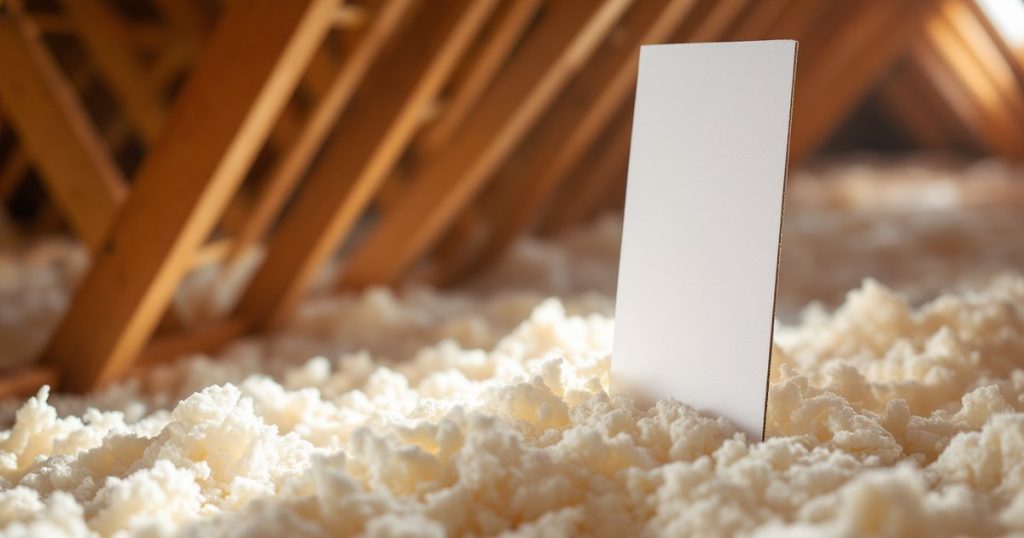
An attic insulation ruler is a card-stock depth gauge stapled upright to a ceiling joist or truss so anyone standing at the attic hatch can read how deep the blown-in insulation is. For blown fiberglass and cellulose, the 2021 and 2024 International Residential Code (Section N1101.10.1.1) require at least one marker per 300 square feet, printed with the minimum initial installed thickness in numbers at least 1 inch tall, each facing the attic access.
The ruler only tells the truth if three things line up: the right number is marked on it (taken from the bag chart of the exact product being blown), its zero sits on the ceiling drywall, and enough bags actually went in. This guide covers all three, with the code text quoted, depth charts from three manufacturers, and the arithmetic for checking an existing attic.
Key numbers at a glance
| Item | Figure | Source |
|---|---|---|
| Marker spacing for blown attic insulation | At least 1 per 300 sq ft of attic | 2021 IRC N1101.10.1.1 / 2021 IECC R303.1.1.1 |
| Height of the numbers on the marker | Not less than 1 inch (25 mm) | 2021 IRC N1101.10.1.1 |
| R-49 depth, AttiCat fiberglass | 17 in installed, 17 in settled; 25 bags per 1,000 sq ft | Owens Corning AttiCat data sheet, Pub. 10011273-L, May 2026 |
| R-49 depth, Greenfiber INS541LD cellulose | 15.20 in initial, 13.68 in settled; 83.5 bags per 1,000 sq ft | Greenfiber INS541LD attic card, PM-6.3-194 Rev F |
| R-60 depth, AttiCat fiberglass | 20.5 in (plus 2.5 in in Minnesota) | Owens Corning AttiCat data sheet, May 2026 |
| Cost of rulers | Free in-aisle with AttiCat at Lowe’s, or about $0.33 to $0.67 each in contractor packs | Lowe’s/Owens Corning AttiCat brochure (2019); retailer listings checked October 12, 2026 |
What does the code say about attic insulation depth markers?
The 2021 IRC, Section N1101.10.1.1 (identical to 2021 IECC Section R303.1.1.1), requires blown or sprayed fiberglass and cellulose ceiling insulation to carry depth markers: at least one for every 300 square feet, fixed to trusses or joists, marked with the minimum initial installed thickness in numbers at least 1 inch tall, and facing the attic access opening. The 2024 IRC keeps the requirement at Section N1101.10.1.1 with the same marker language, per ICC’s published section.
Here is the 2021 text, as reproduced on Yakima County, Washington’s 2021 IRC insulation certificate form:
“N1101.10.1.1 (R303.1.1.1) Blown or sprayed roof/ceiling insulation. The thickness of blown-in or sprayed fiberglass and cellulose roof and ceiling insulation shall be written in inches (mm) on markers that are installed at not less than one for every 300 square feet (28 m2) throughout the attic space. The markers shall be affixed to the trusses or joists and marked with the minimum initial installed thickness with numbers not less than 1 inch (25 mm) in height. Each marker shall face the attic access opening. The thickness and total R-value of sprayed polyurethane foam insulation shall be indicated on the certification provided by the insulation installer.”
One detail trips up a lot of people. The code asks the marker to show the initial installed thickness. The settled thickness belongs on the insulation certificate. Many commercial rulers print both scales anyway, which is helpful, but the inspector reads the ruler against the installed number.
| Requirement | What the code text says | Section (2021 IRC / 2021 IECC) |
|---|---|---|
| Which insulation needs markers | Blown-in or sprayed fiberglass and cellulose in roofs and ceilings | N1101.10.1.1 / R303.1.1.1 |
| How many markers | Not less than one per 300 sq ft (28 m2) throughout the attic | N1101.10.1.1 / R303.1.1.1 |
| Where they go | Affixed to the trusses or joists | N1101.10.1.1 / R303.1.1.1 |
| What number goes on them | Minimum initial installed thickness, in inches (mm) | N1101.10.1.1 / R303.1.1.1 |
| Size of numbers | Not less than 1 inch (25 mm) tall | N1101.10.1.1 / R303.1.1.1 |
| Orientation | Each marker faces the attic access opening | N1101.10.1.1 / R303.1.1.1 |
| Spray foam | No markers; thickness and total R-value go on the certificate | N1101.10.1.1 / R303.1.1.1 |
Source: 2021 IRC Chapter 11 text as reproduced by Yakima County Public Services (form revised April 22, 2025); 2024 IRC section listing on ICC Digital Codes. Local jurisdictions can amend these sections, so confirm with your building department.
Because the markers are affixed to trusses or joists, they also show where the framing sits once blown insulation has buried it. Step only on framing you can locate, never on the insulation between joists, which rests on drywall that will not hold your weight. For footing, boards and lighting, see our guide on how to walk in an attic with blown insulation.
What has to be on the insulation certificate?
For blown fiberglass and cellulose, Section N1101.10.1 (R303.1.1) requires the installer’s certificate to list six items: initial installed thickness, settled thickness, settled R-value, installed density, coverage area and number of bags installed. The installer must sign, date and post the certificate “in a conspicuous location on the job site.” The certificate, not the ruler, is where settled depth and bag count are documented.
In practice, the certificate and the rulers check each other. If the certificate claims R-49 over 1,000 square feet of AttiCat but lists 18 bags, the bag count falls short of the 25 bags per 1,000 square feet that Owens Corning’s chart calls for, no matter what the rulers read.
What the FTC R-value Rule puts on the bag chart
The depth you mark on an insulation ruler should come from the coverage chart printed on the bag, and federal law dictates what that chart contains. Under the FTC’s R-value Rule, 16 CFR 460.12(b)(2), every loose-fill label must show minimum settled thickness, initial installed thickness, maximum net coverage area, bags per 1,000 square feet and minimum weight per square foot at R-13, R-19, R-22, R-30, R-38 and R-49.
Three other parts of the rule matter for anyone holding a ruler:
- How installed thickness is measured. 16 CFR 460.5(a)(5) requires the initial installed thickness to be determined under ASTM C1374, the test method for installed thickness of pneumatically applied loose-fill insulation. The label must also say which blowing machine and settings were used.
- Settling is built into the test. 16 CFR 460.5(a)(2) requires loose-fill cellulose R-values to be tested at the settled density from ASTM C739. That is why a cellulose chart shows two depths and the settled depth carries the R-value.
- What the installer must hand over. 16 CFR 460.17 says the receipt for loose-fill must show coverage area, initial installed thickness, minimum settled thickness, R-value and the number of bags used, and it bars installers from multiplying an R-per-inch figure by inches installed.
The practical takeaway: depth alone does not prove R-value. Owens Corning’s AttiCat data sheet states that failure to provide “both the required number of bags and at least the minimum thickness will result in lower insulation R-value.” Greenfiber’s attic card says the same about bags and thickness.
Installed vs settled depth: how many inches for each R-value?
For blown insulation, the inches needed for a given R-value depend on the product. Owens Corning AttiCat fiberglass needs 17 inches for R-49 and reports no settling. Greenfiber INS541LD cellulose goes in at 15.20 inches and settles to 13.68 inches for R-49. Thermafiber INSUL-FILL mineral wool prints 16.6 inches for R-49 on its ruler.
| R-value | AttiCat fiberglass: installed / settled (in) | Greenfiber INS541LD cellulose: initial / settled (in) | Thermafiber INSUL-FILL rock wool: ruler depth (in) |
|---|---|---|---|
| R-13 | 5 / 5 | 4.29 / 3.86 | 4.4 |
| R-19 | 7 / 7 | 6.19 / 5.57 | 6.4 |
| R-22 | 8 / 8 | 7.12 / 6.41 | 7.4 |
| R-30 | 10.75 / 10.75 | 9.57 / 8.62 | 10.1 |
| R-38 | 13.5 / 13.5 | 11.97 / 10.77 | 12.8 |
| R-44 | 15.5 / 15.5 | Not listed | 14.9 |
| R-49 | 17 / 17 | 15.20 / 13.68 | 16.6 |
| R-60 | 20.5 / 20.5 | 18.37 / 16.53 | Not listed (ruler tops out at R-52, 17.6 in) |
Sources: Owens Corning AttiCat PINK Blown-In data sheet, Pub. 10011273-L (May 2026), 27.5 lb bag, AttiCat machine with 2.5 in hose; Greenfiber INS541LD attic card PM-6.3-194 Rev F (03/20), 19.05 lb bag, Greenfiber Monarch machine; Thermafiber INSUL-FILL ruler, Pub. 10021304-B (April 2020). Always use the chart on the bag you are actually blowing.
Batts and other materials need different depths for the same rating. Our R-49 insulation thickness guide breaks that target down by material.
How much does blown cellulose settle?
On Greenfiber’s INS541LD attic card, the initial installed depth is about 11 percent deeper than the settled depth at every R-value listed. At R-49 that gap is 1.52 inches (15.20 minus 13.68); at R-60 it is 1.84 inches (18.37 minus 16.53). A ruler marked at the settled number on a fresh cellulose job means the attic was under-blown by roughly that margin.
Fiberglass behaves differently on paper. Owens Corning’s AttiCat chart lists identical installed and settled depths with the footnote “Settling is negligible, with no impact on R-value.” Minnesota is the exception: its rules require stated R-values at winter design temperatures, so the AttiCat chart adds 2.0 inches (3.7 bags per 1,000 sq ft) at R-49 and 2.5 inches at R-60 for Minnesota jobs.
Why the chart on your bag beats any printed ruler
Coverage charts change between product versions. An older AttiCat chart for a 28.5 lb bag (Owens Corning Pub. 10009393-C, August 2010, still hosted on Lowe’s product pages) listed R-49 at 16.50 inches and 25.8 bags per 1,000 sq ft. The current 27.5 lb bag lists R-49 at 17 inches and 25 bags. A ruler printed for the old product would read half an inch short on today’s material. Check the label, not the ruler’s preprinted R-value scale, before you mark the target line.
How to use an insulation ruler when blowing insulation
Use an attic insulation ruler by stapling it vertically to a joist or truss with its zero resting on the ceiling drywall, marking the target installed depth from the bag chart, then blowing until the insulation surface meets that line. Install at least one ruler per 300 square feet, spread across the attic, each facing the hatch, and keep count of bags as you go.
- Measure the attic floor. Multiply length by width for the area to be insulated, then divide by 300 and round up for the number of rulers.
- Pick the target R-value. ENERGY STAR’s retrofit table, based on the 2021 IECC, recommends R-60 for uninsulated attics in zones 4 to 8, R-49 in zones 2 and 3 and R-30 in zone 1. Where 3 to 4 inches already exist, it recommends adding R-49 in zones 4 to 8 and R-38 in zones 2 and 3.
- Read the bag chart. Note the minimum initial installed thickness and minimum bags per 1,000 sq ft for that R-value on the exact product you bought.
- Staple each ruler upright. Fasten it to the side of a joist or truss with the bottom touching the drywall, not resting on top of old insulation. Thermafiber’s ruler instructions say to attach rulers “vertically on joists, roof trusses, or vertical framing.”
- Mark the target line. Write the target depth on every ruler with a marker. When topping up, add the existing depth to the new installed depth.
- Turn rulers toward the hatch. The code requires each marker to face the attic access opening so an inspector can read it without walking the attic.
- Blow from the far end back to the hatch. Greenfiber’s guide says to start at the corner farthest from the access and hold the hose about 3 feet above the surface to spread material evenly.
- Count bags against the chart. Compare bags used to the chart’s minimum for your square footage before you call the job done.
- Post the paperwork. Fill in the certificate (Greenfiber’s attic card has a signature block) and post it near the access. Thermafiber suggests stapling one ruler copy near the hatch for future reference.
For the full blowing process, from renting a machine to baffling the eaves, see our step-by-step guide to how to blow insulation in an attic.
How many attic rulers do you need?
Divide the attic floor area by 300 and round up. A 1,000 square foot attic needs at least 4 rulers, and a 2,000 square foot attic needs at least 7. Spread them across the space, including far corners and low areas near the eaves, rather than clustering them by the hatch where depth is easiest to hit.
| Attic floor area (sq ft) | Minimum rulers (area / 300, rounded up) |
|---|---|
| 500 | 2 |
| 800 | 3 |
| 1,000 | 4 |
| 1,200 | 4 |
| 1,500 | 5 |
| 2,000 | 7 |
| 2,500 | 9 |
Source: Roofing Brief arithmetic from the 300 sq ft spacing in 2021 IRC N1101.10.1.1.
Worked example: topping up a 1,200 sq ft attic
Take a 1,200 square foot attic in climate zone 5 with about 4 inches of old settled cellulose. ENERGY STAR’s retrofit table says to add R-49 when 3 to 4 inches already exist in zone 5. Here is the Roofing Brief arithmetic for two products:
| Step | AttiCat fiberglass | Greenfiber INS541LD cellulose |
|---|---|---|
| Rulers (1,200 / 300) | 4 | 4 |
| R-49 depth to add | 17 in | 15.20 in initial (13.68 settled) |
| Line to mark on the ruler (4 in existing + new) | 21 in | 19.2 in, expect it to settle near 17.7 in |
| Minimum bags (rate x 1.2) | 25 x 1.2 = 30 bags | 83.5 x 1.2 = 100.2, so 101 bags |
| Ruler length needed | 24 or 25 in | 20 in works, 24 in gives margin |
Sources: ENERGY STAR recommended home insulation R-values; Owens Corning AttiCat data sheet (May 2026); Greenfiber INS541LD attic card. The cellulose bag count is far higher because each Greenfiber bag weighs 19.05 lb and cellulose is blown much denser. The Owens Corning AttiCat review covers that system’s machine and bag logistics in more detail.
Where to buy an attic insulation ruler (or print one)
You can get attic insulation rulers free with blown-in insulation at many big-box stores, print a manufacturer ruler at home, or buy contractor packs online for roughly $0.33 to $0.67 per ruler. A 2019 Lowe’s and Owens Corning AttiCat brochure tells shoppers to “use the FREE RULER found in-aisle,” and Thermafiber publishes a printable ruler PDF.
| Source | What you get | Price as listed (checked Oct 12, 2026) | Note |
|---|---|---|---|
| Lowe’s AttiCat aisle | Free card ruler; the brochure itself prints a ruler scale to 23 in | Free | Lowe’s/Owens Corning brochure, 2019; stock varies by store |
| Thermafiber INSUL-FILL ruler PDF | Printable 20 in ruler with R-11 to R-52 depths for INSUL-FILL | Free | Pub. 10021304-B; depths apply to that product only |
| PrintableRulers.net | Three-section printable ruler to 24 in | Free | Print at 100 percent scale and check against a tape |
| Insulation Machines | 24 in heavy-duty R-value rulers, 225 per box | $74.02 (about $0.33 each) | Printed one side |
| Applied Energy Products | Attic rulers, 500 per box (SKU IN607-1), marked both sides to 20 in | $180.00 (about $0.36 each) | Weatherization supplier |
| Insulation4US | Accu1 25 in attic rulers, pack of 100 | $66.61 (about $0.67 each) | Shipping extra |
| Amazon | J&R Products 25 in card-stock attic measuring rulers, case of 1,000 | Varies | Also listed in smaller packs by other sellers |
Prices change often and exclude shipping and tax. For a homeowner job, a free ruler or a printout is usually enough. For code inspections, pick a ruler at least 24 inches long, since R-60 in AttiCat alone is 20.5 inches before any existing insulation.
How to measure existing attic insulation and estimate its R-value
To measure existing attic insulation, push a ruler or tape measure straight down through the insulation until it touches the ceiling drywall, read the depth at the surface, and repeat in at least three spots, including near the eaves. Identify the material, then multiply the average depth by an R-per-inch figure taken from that material’s coverage chart.
- Stay on the framing. Step only on joists or a board laid across them, and wear a dust mask and eye protection.
- Identify the material before touching it. If it is pebble-like, gray-brown or silver-gold, it may be vermiculite. EPA advises treating vermiculite insulation as if it contains asbestos and not disturbing it.
- Measure to the drywall. Part the insulation and confirm the tape touches the ceiling, not a wire, duct or compressed layer.
- Take several readings. Check near the hatch, mid-attic and at the eaves, where wind washing and low roof pitch often leave thin spots.
- Estimate R-value. Use the table below, then subtract that from your target to size the top-up.
| Measured depth (in) | Loose fiberglass (about R-2.9/in) | Cellulose, settled (about R-3.6/in) | Loose rock wool (about R-3.0/in) |
|---|---|---|---|
| 3 | R-9 | R-11 | R-9 |
| 4 | R-12 | R-14 | R-12 |
| 6 | R-17 | R-21 | R-18 |
| 8 | R-23 | R-29 | R-24 |
| 10 | R-29 | R-36 | R-30 |
| 12 | R-35 | R-43 | R-35 |
| 14 | R-40 | R-50 | R-41 |
| 16 | R-46 | R-57 | R-47 |
| 18 | R-52 | R-64 | R-53 |
Source: Roofing Brief estimate. Per-inch values are derived from each chart’s R-49 row: AttiCat 49 / 17 in = 2.88; Greenfiber INS541LD 49 / 13.68 in settled = 3.58; Thermafiber INSUL-FILL 49 / 16.6 in = 2.95. Older or different products can deliver less per inch, and compressed, wet or wind-washed insulation underperforms, so treat these as estimates, not ratings. The FTC bars installers from using this per-inch shortcut on customer receipts (16 CFR 460.17); it is only a screening estimate for a homeowner.
Batts follow different math, since each batt is labeled with its own R-value and thickness. Our comparison of blown-in vs batt insulation explains when each one makes sense in an attic.
Common insulation ruler mistakes
The most common insulation ruler mistakes are rulers that do not reach the drywall, rulers folded or cut short, the settled number marked instead of the installed number, and too few rulers placed only near the hatch. Each one makes the ruler read deeper than the real insulation, so inspectors spot-check with a tape measure.
- Folded or cut-short rulers. Energy rating firm EnergyLogic photographed a paper ruler folded beneath the insulation that read 18 inches where a tape measure read 15 inches. Building scientist Chris Conway told the Insulation Institute that under-blowing can happen “if the insulation depth ruler is cut short or the bottom is folded over.”
- Zero sitting on old insulation. On retrofits, a ruler pushed into existing insulation without reaching the drywall overstates depth. Conway noted that in a 130 to 140 degree attic, installers may guess where the ceiling is.
- Marking the settled depth on cellulose. The code marker number is the initial installed thickness. Marking 13.68 inches for Greenfiber R-49 instead of 15.20 inches leaves the attic about 1.5 inches short once it settles.
- Trusting depth without the bag count. Both the AttiCat and Greenfiber charts require the minimum bags and the minimum thickness. Fluffy, under-dense material can hit the line with too few bags.
- Using another product’s scale. A ruler preprinted for one brand does not match another brand’s chart. Write your own target line from your bag.
- Too few rulers, all by the hatch. One per 300 square feet is the code minimum, and they belong throughout the attic.
- Burying hazards to reach a number. Owens Corning says not to insulate on top of or within 3 inches of recessed lights unless they are IC-rated, and to keep insulation out of air spaces around metal flues and chimneys. Keep eave baffles in place so soffit vents stay open.
Going far past the target depth rarely pays back. Our guide to whether you can over-insulate a house covers where extra inches stop helping.
Which number should go on the ruler?
| Situation | Number to mark | Why |
|---|---|---|
| New construction, code inspection | Minimum initial installed thickness from the bag chart | Required by 2021 IRC N1101.10.1.1 |
| Blown cellulose | Initial installed depth (e.g., 15.20 in for INS541LD R-49) | Settles about 11 percent to the rated depth |
| AttiCat fiberglass | Chart depth (e.g., 17 in for R-49) | Installed and settled are the same on the chart |
| Topping up existing insulation | Existing depth plus new installed depth | Ruler zero must sit on the drywall |
| Minnesota job | Chart depth plus the Minnesota column | State rule adds inches for winter performance |
| Home inspector or buyer checking | Compare ruler to a tape reading at 3 or more spots | Catches folded or short rulers |
Frequently asked questions
Where can I get insulation rulers?
Many big-box stores keep free card rulers next to the blown-in insulation; a 2019 Lowe’s and Owens Corning AttiCat brochure tells shoppers to use the free ruler found in-aisle. You can also print the Thermafiber INSUL-FILL ruler PDF, or buy contractor packs online, which listed at about $0.33 to $0.67 per ruler in October 2026.
How do I measure for insulation?
Measure the attic floor (length times width) to size bags and rulers, then push a ruler straight down through existing insulation until it touches the drywall and read the depth. Check at least three spots, including the eaves. Multiply the average depth by the R-per-inch from the material’s coverage chart to estimate the current R-value.
How many inches is R-49 blown insulation?
It depends on the product. Owens Corning AttiCat fiberglass needs 17 inches and 25 bags per 1,000 square feet for R-49. Greenfiber INS541LD cellulose goes in at 15.20 inches and settles to 13.68 inches. Thermafiber INSUL-FILL mineral wool lists 16.6 inches. Always use the coverage chart printed on the bag you are installing.
How many inches of blown insulation is R-30?
For R-30, Owens Corning AttiCat fiberglass requires 10.75 inches and 14.6 bags per 1,000 square feet. Greenfiber INS541LD cellulose requires 9.57 inches initial, settling to 8.62 inches, with 46.1 bags per 1,000 square feet. The Thermafiber INSUL-FILL ruler shows 10.1 inches for R-30. Both the depth and the bag count must be met.
Is R-19 or R-30 better in the attic?
R-30 resists heat flow better than R-19, because a higher R-value means more insulating power. For most of the country neither is enough on its own: ENERGY STAR’s retrofit table, based on the 2021 IECC, recommends R-49 to R-60 for uninsulated attics outside climate zone 1, where R-30 is the recommendation.
Are attic insulation depth markers required by code?
Yes, where the 2021 or 2024 IRC (Section N1101.10.1.1) or the matching IECC section is adopted. Blown or sprayed fiberglass and cellulose attic insulation needs at least one marker per 300 square feet, fixed to joists or trusses, showing the minimum initial installed thickness in numbers at least 1 inch tall and facing the attic access. Local amendments can vary.
What is the R-value of 8 inches of insulation?
Using per-inch figures derived from current coverage charts, 8 inches of loose fiberglass is roughly R-23, settled cellulose roughly R-29 and loose rock wool roughly R-24. These are estimates: older products, compressed insulation and batts can differ, and only the product label states a rated R-value for a given thickness.
Sources
- 2021 International Residential Code, Sections N1101.10.1 and N1101.10.1.1 (2021 IECC R303.1.1 and R303.1.1.1), as reproduced by Yakima County Public Services, 2021 IRC Chapter 11 insulation certificate (revised April 22, 2025).
- ICC Digital Codes, 2024 IRC Section N1101.10.1.1 listing.
- Federal Trade Commission, Labeling and Advertising of Home Insulation (R-value Rule), 16 CFR Part 460, Sections 460.5, 460.12, 460.17 (eCFR).
- Owens Corning, AttiCat PINK Blown-In Insulation product data sheet, Pub. 10011273-L, May 2026; AttiCat application instructions Pub. 10009393-E (November 2022) and 10009393-C (August 2010).
- Greenfiber, INS541LD attic card PM-6.3-194 Rev F and Greenfiber product guide DM-6.3-343, hosted on Home Depot product pages.
- Thermafiber, INSUL-FILL Blown-In Attic Insulation Ruler, Pub. 10021304-B, April 2020.
- Lowe’s and Owens Corning, AttiCat blown-in insulation brochure, 2019.
- ENERGY STAR, Recommended Home Insulation R-Values.
- Insulation Institute (NAIMA), “Blown-in Insulation’s Measures and Checks,” August 12, 2021.
- EnergyLogic, “Beware of Sneaky Insulation Rulers!”
- U.S. EPA, Protect Your Family from Asbestos-Contaminated Vermiculite Insulation.