
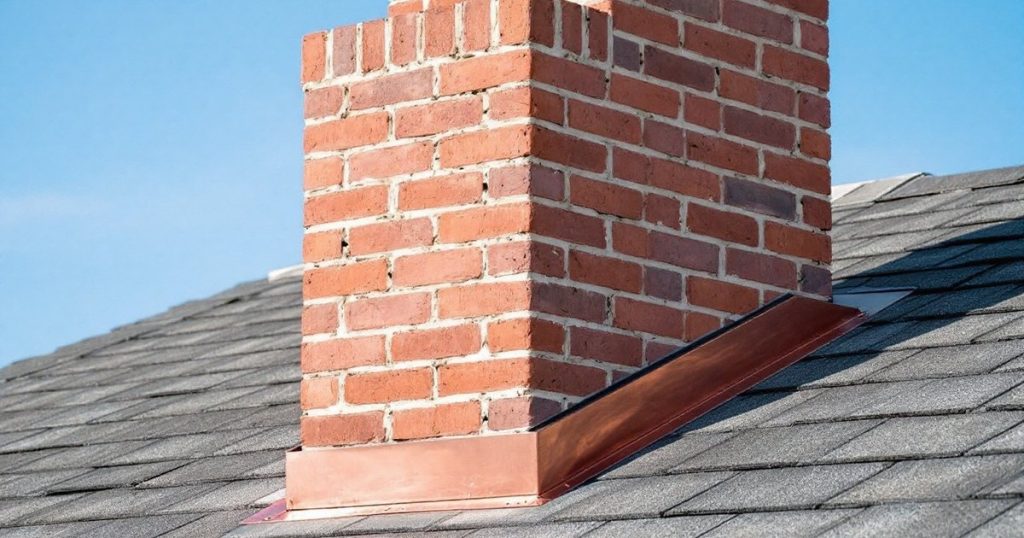
By The Roofing Brief Team | Last reviewed: October 2026
The cost to replace chimney flashing usually runs $300 to $1,800, according to HomeGuide’s February 2026 cost guide, and Angi puts the 2026 national average at about $1,000. A reseal of sound metal can start near $200. A full step and counter flashing replacement on a brick chimney typically lands in the $400 to $1,600 band. Add a new cricket on a chimney wider than 30 inches, or switch to copper, and the job can pass $3,000. Labor, not metal, is most of the bill: HomeGuide estimates labor at 60% to 70% of the total.
This page is the cost breakdown. If you are still working out whether your flashing has actually failed, start with our guide to bad chimney flashing. If water is already coming in, our chimney flashing leak repair guide covers diagnosis by leak type.
Key numbers at a glance
These are the figures most people searching for chimney flashing cost need, each tied to a named source and dated. Ranges are national averages. Your local price can sit above or below them depending on labor rates, roof access, chimney width and chimney construction.
| Item | Typical figure | Source |
|---|---|---|
| Chimney flashing repair or replacement, typical range | $300 to $1,800 | HomeGuide, Feb. 10, 2026 |
| National average, flashing repair or replacement | About $1,000 (most pay $400 to $1,600) | Angi, 2026 cost guide |
| Reseal of a minor leak | From about $200 | Angi, 2026; HomeGuide lists $200 to $500 for minor damage |
| Chimney flashing replacement (full) | $300 to $800 | Fixr, Jan. 31, 2025; repeated by This Old House, Mar. 12, 2026 |
| Chimney cricket | $700 to $1,300 | This Old House, Mar. 12, 2026 |
| Code trigger for a cricket | Chimney wider than 30 in. parallel to the ridge | 2021 IRC Section R1003.20 |
How much does it cost to replace chimney flashing by job type?
Chimney flashing cost depends first on scope. A reseal of intact metal costs a few hundred dollars. Replacing step and counter flashing on a standard brick chimney typically costs $400 to $1,600. A full rebuild that adds a code-sized cricket behind a wide chimney can cost $1,800 or more. The table below lines up the published ranges by job, so you can match a quote to the work it actually describes.
| Job type | What it usually includes | Typical cost | Source |
|---|---|---|---|
| Reseal | Strip failed caulk at the reglet and edges, apply new sealant, re-seat a lifted edge | $200 to $500 | HomeGuide (Feb. 2026); Angi says from about $200 |
| Spot repair | Patch or re-secure a damaged section, no full tear-out | $150 to $500 (HomeAdvisor); $200 to $300 (Fixr) | HomeAdvisor; Fixr (Jan. 2025) |
| Step flashing replacement | New L-shaped step pieces woven into the shingle courses on the chimney sides | $400 to $600 | Angi, 2026 |
| Continuous flashing | Single formed strip bent to the chimney and roof | $800 to $1,000 | Angi, 2026 |
| Full replacement, step plus counter flashing | Tear-out, new apron, step, counter flashing cut into a reglet, back pan | $300 to $800 (Fixr); $400 to $1,600 (Angi) | Fixr (Jan. 2025); Angi (2026) |
| Full replacement, large or stone chimney | Same scope, more linear feet and harder masonry cutting | $500 to $1,800 (HomeGuide, large chimney); can exceed $2,000 (Angi) | HomeGuide (Feb. 2026); Angi (2026) |
| Full rebuild with new cricket | New flashing system plus a framed and flashed cricket on the uphill side | About $1,800 to $4,100 (copper example below) | Roofing Brief estimate built from This Old House cricket pricing and retail copper prices |
The published ranges overlap because each guide defines “repair” and “replacement” a little differently. When two quotes differ by $1,000, the first question is whether both include counter flashing cut into a new reglet, or whether one only reseals the old metal.
Chimney flashing cost by chimney size
Chimney size changes cost through linear feet of metal and hours on the roof. HomeGuide’s February 2026 guide prices a small chimney at $300 to $1,200, a mid-sized chimney at $400 to $1,500 and a large chimney at $500 to $1,800. Width also decides whether code requires a cricket, which is the single largest jump in price.
| Chimney size | Average cost | Source |
|---|---|---|
| Small | $300 to $1,200 | HomeGuide, Feb. 2026 |
| Mid-sized | $400 to $1,500 | HomeGuide, Feb. 2026 |
| Large | $500 to $1,800 | HomeGuide, Feb. 2026 |
Chimney flashing cost by material: aluminum, galvanized, copper and lead
Aluminum and galvanized steel are the budget metals, copper costs several times more, and lead is rarely priced by U.S. cost guides at all. Published per-foot figures vary widely because some quote raw stock and others appear to fold in fabrication and labor. The table separates those so you can see what the metal itself adds to a chimney flashing quote.
| Metal | HomeGuide, per linear ft (Feb. 2026) | Angi, per linear ft (2026) | Retail stock, per ft (Oct. 2026) | Lifespan (HomeGuide) |
|---|---|---|---|---|
| Aluminum | $5 to $10 | $0.75 | Not checked | 15 to 20 years |
| Galvanized steel | $6 to $10 | $0.50 (steel) | Not checked | Not stated |
| Copper | $15 to $30 | $2 to $3 | $20.00 (16 oz, 12 in. wide); $25.00 (20 oz, 12 in.) | 50 to 100 years |
| Lead (2.5 lb sheet) | Not listed | Not listed | $7.96 to $9.45 (12 in. wide) | Not stated |
Retail stock prices are Roofing Brief arithmetic from current listings: Permacover lists 16 oz copper flashing, 12 in. by 10 ft, at $199.95 and 20 oz at $249.95. RotoMetals lists 2.5 lb (1/24 in.) sheet lead, 12 in. by 20 ft, at $189 and 12 in. by 25 ft at $199. Retail prices change, so treat them as a snapshot.
Why per-foot flashing prices disagree
Angi’s copper figure of $2 to $3 per foot sits far below a current 16 oz copper roll at about $20 per foot, so it likely reflects narrow or light stock. HomeGuide’s $5 to $30 per-foot range does not say whether labor is included, and it sits well above raw stock prices, which suggests it covers more than metal. Ask any contractor quoting per foot which of the two they mean.
How much metal does a chimney actually use?
A typical single-flue chimney uses roughly 20 to 30 feet of 12-inch flashing stock across the apron, step pieces, counter flashing and back pan. That is a Roofing Brief estimate for a chimney about 32 by 24 inches, with a perimeter of 112 inches, or about 9.3 feet, and no cricket. At that quantity, the metal choice moves the bill by these amounts:
- Aluminum or galvanized: under $25 at Angi’s per-foot rates. Our chimney flashing kit guide puts complete parts kits at about $40 to $210.
- Lead, 2.5 lb: about $160 to $285 (20 to 30 ft at $7.96 to $9.45).
- Copper, 16 oz: about $400 to $600 (20 to 30 ft at $20.00).
Lead sheet is a traditional chimney flashing metal in the UK but is far less common on U.S. homes, and neither HomeGuide nor Angi prices it. Copper and lead also need compatible fasteners and should not touch aluminum or galvanized steel, because dissimilar metals can corrode at the contact point.
What goes into a chimney flashing quote: line items
A chimney flashing quote is mostly labor and access, with metal as a smaller share unless you choose copper or lead. Fixr’s January 2026 roof repair guide says labor is at least 60% of roof repair cost and can approach 90% on flashing jobs that use little material. The line items below are the pieces a complete quote should name or clearly include.
| Line item | Typical cost | Source |
|---|---|---|
| Chimney inspection | $100 to $250 | HomeGuide, Feb. 2026 |
| Roof inspection (to find the leak source) | $100 to $400 (HomeGuide); $75 to $800 (Angi) | HomeGuide; Angi |
| Service call fee, some chimney companies | $50 to $100 | This Old House, Mar. 2026 |
| Labor, masons or chimney sweeps | $50 to $125 per hour | HomeGuide, Feb. 2026 |
| Labor, roofers (repair work) | $45 to $75 per hour (HomeAdvisor); $50 to $120 per hour (Fixr) | HomeAdvisor; Fixr, Jan. 2026 |
| Flashing metal, aluminum or galvanized | About $40 to $210 for a parts kit | Roofing Brief kit guide |
| Flashing metal, copper (20 to 30 ft of 12 in. 16 oz) | About $400 to $600 | Roofing Brief arithmetic, Permacover listing |
| Sealant | About $10 per tube | Angi, 2026 |
| Chimney cricket, if added | $700 to $1,300 | This Old House, Mar. 2026 |
| Masonry crack repair found during the job | $300 to $1,000 | Angi, 2026 |
| Chimney sealing or waterproofing | $150 to $400; up to $850 with waterproofing | HomeGuide, Feb. 2026 |
For context on wages: the U.S. Bureau of Labor Statistics reports a median roofer wage of $26.65 per hour (May 2025 OEWS). Contractor billing rates run higher than wages because they carry insurance, equipment, travel and overhead.
Worked examples: three chimney flashing jobs priced out
These three examples show how the published ranges combine into a real quote. They are Roofing Brief estimates, not bids. Labor hours are our assumption for a two-person crew and are shown so you can swap in your own local rate. Each total is cross-checked against the published ranges above.
Example 1: reseal on a 24-inch chimney
A 24-inch brick chimney on a 5/12 roof has sound metal, but the caulk at the counter flashing has cracked and one corner has lifted. The roofer strips the old sealant, re-seats the corner and reseals. Expect about $200 to $500, the range HomeGuide gives for minor damage and consistent with Angi’s “from about $200.” No cricket is required because the chimney is under 30 inches wide.
Example 2: step and counter flashing replacement on a 28-inch brick chimney
A 28-inch brick chimney on a 6/12 asphalt roof has rusted step flashing and face-nailed counter flashing. The scope is full replacement in aluminum, with the counter flashing cut into a new reglet. Expect roughly $340 to $1,460, built up from metal and labor as follows.
- Metal: a parts kit at about $40 to $210.
- Labor: 6 to 10 labor-hours at HomeGuide’s $50 to $125 per hour, or $300 to $1,250.
- Total: about $340 to $1,460.
That total sits close to Angi’s $400 to $1,600 band and overlaps HomeGuide’s small-chimney range of $300 to $1,200. No cricket is needed at 28 inches.
Example 3: full rebuild with cricket on a 40-inch chimney, in copper
A 40-inch brick chimney sits below the ridge on an 8/12 roof with no cricket and a history of leaks at the back. Because it is wider than 30 inches and does not meet the ridge, 2021 IRC Section R1003.20 calls for a cricket. Table R1003.20 sets cricket height at one-third of its width on an 8:12 slope, so this cricket rises about 13.3 inches (40 divided by 3).
- Copper: 30 to 40 feet of 12-inch 16 oz stock, covering the cricket, at $20.00 per foot, or $600 to $800.
- Flashing labor: 10 to 16 labor-hours at $50 to $125 per hour, or $500 to $2,000.
- Cricket framing and installation: $700 to $1,300 per This Old House.
- Total: about $1,800 to $4,100.
The cricket line may already include some metal, so a contractor who prices the whole job together may come in lower. Expect the 8/12 pitch and any staging to push the job toward the high end.
What drives chimney flashing cost up or down
Five factors explain most of the gap between a $300 and a $3,000 chimney flashing quote: chimney width and whether code requires a cricket, roof pitch and height, how hard the masonry is to cut for a reglet, chimney construction, and local labor rates. Material only becomes a major cost driver when you choose copper or lead.
- Chimney width and the cricket. A chimney wider than 30 inches parallel to the ridge triggers the IRC cricket requirement unless it meets the ridge. That can add $700 to $1,300 (This Old House).
- Roof pitch and height. Steep roofs and multi-story homes need more safety equipment and time, which HomeGuide and Angi both list as a cost driver. This Old House notes that staging and safety barriers can add significant time and cost.
- Reglet cutting in masonry. Counter flashing is set into a slot cut into a mortar joint. HomeGuide notes that natural stone is harder and slower to cut than manufactured veneer, with brick in between.
- Chimney type. Metal or prefabricated chimneys typically cost less to reflash than masonry chimneys, per HomeGuide.
- Location. Urban labor costs more than rural, and some jurisdictions require a permit and inspection (HomeGuide).
Does a chimney over 30 inches need a cricket?
Yes, under the 2021 International Residential Code, a chimney wider than 30 inches parallel to the ridge needs a cricket unless the chimney meets the ridgeline. The cricket must be flashed and counterflashed like the rest of the chimney. Whether a reflash of an older chimney triggers adding one depends on your local code adoption and building official.
The code text, 2021 IRC Section R1003.20 Chimney crickets, reads: “Chimneys shall be provided with crickets where the dimension parallel to the ridgeline is greater than 30 inches (762 mm) and does not intersect the ridgeline. The intersection of the cricket and the chimney shall be flashed and counterflashed in the same manner as normal roof-chimney intersections. Crickets shall be constructed in compliance with Figure R1003.20 and Table R1003.20.”
The roofing chapter repeats the rule. 2021 IRC Section R903.2.2 Crickets and saddles reads: “A cricket or saddle shall be installed on the ridge side of any chimney or penetration more than 30 inches (762 mm) wide as measured perpendicular to the slope. Cricket or saddle coverings shall be sheet metal or of the same material as the roof covering.”
| Roof slope | Cricket height H (Table R1003.20) | H on a 36 in. chimney | H on a 48 in. chimney |
|---|---|---|---|
| 12:12 | 1/2 of W | 18 in. | 24 in. |
| 8:12 | 1/3 of W | 12 in. | 16 in. |
| 6:12 | 1/4 of W | 9 in. | 12 in. |
| 4:12 | 1/6 of W | 6 in. | 8 in. |
| 3:12 | 1/8 of W | 4.5 in. | 6 in. |
Source: 2021 IRC Table R1003.20; the height columns are Roofing Brief arithmetic. Some cost guides describe the 30-inch rule as a 2012 IBC requirement. For one- and two-family homes the governing text is in the IRC, and ICC’s online library shows the same 30-inch cricket language in the 2015 IRC. Our chimney cricket install guide covers framing and build steps.
On a reroof, 2021 IRC Section R908.6 adds: “Flashings shall be reconstructed in accordance with approved manufacturer’s installation instructions.” In practice that means reusing old chimney flashing is not automatic when the shingles come off.
Who replaces chimney flashing: a roofer or a chimney mason?
Roofers replace chimney flashing in most cases, because the flashing is woven into the shingles and underlayment. A chimney mason or chimney repair specialist should go first when the masonry itself has failed. HomeAdvisor advises fixing structural masonry damage before flashing is reinstalled, and HomeGuide notes that both roofers and certified chimney sweeps do this work.
| Your situation | Call first | Why |
|---|---|---|
| Flashing rusted, loose or caulk-only; brick and mortar sound | Roofer | Flashing ties into shingles and underlayment (HomeAdvisor) |
| Spalling brick, crumbling mortar at the reglet line, cracked crown | Chimney mason, then roofer | New counter flashing needs sound joints to grip |
| Natural stone chimney | Mason and roofer together | Stone is slower to cut for a reglet (HomeGuide, Angi) |
| Reroof planned within a year or two | Roofer, bundled with the reroof | Bundling can cut labor (Angi) |
| Metal roof | Roofer experienced with metal panels | Different details apply; see our chimney flashing for metal roofs guide |
How long does chimney flashing replacement take?
A reseal is usually a short visit of a few hours. A full step and counter flashing replacement on a standard chimney is typically a one-day job; Angi’s DIY math assumes about four hours of work. Jobs that add a cricket, copper soldering or masonry repointing can take longer, and new mortar may need time before the counter flashing is sealed.
Can you replace chimney flashing yourself?
You can reseal and inspect chimney flashing yourself if you are safe on a roof, but full replacement is a hard DIY job. It means lifting shingle courses without breaking seals, weaving step flashing correctly and cutting a reglet into masonry with a grinder. Angi estimates DIY saves about $300 in labor, based on $75 per hour for four hours.
A full replacement follows this sequence, adapted from HomeAdvisor’s description of the pro process:
- Inspect the existing flashing for rust, cracks, failed sealant and gaps.
- Remove the old flashing and old caulk or roofing cement to expose clean surfaces.
- Cut and shape new aluminum, copper or galvanized flashing to fit.
- Install base and step flashing woven into the shingles, then counter flashing set into the mortar joints.
- Seal the reglet and seams with a compatible sealant.
- Check that water sheds away from the chimney on all four sides.
Two hazards set the DIY limit. Grinding mortar creates respirable crystalline silica dust, which OSHA regulates for construction work under 29 CFR 1926.1153, including handheld grinders used for tuckpointing. Falls are the other: OSHA requires fall protection for residential construction workers at 6 feet or more (29 CFR 1926.501(b)(13)). Those rules bind employers, not homeowners, but they show where the risk is. Angi lists recaulking, touch-up painting, clearing debris and visual checks as reasonable DIY tasks.
Signs your chimney flashing needs replacing
The clearest signs are water stains on ceilings or walls near the chimney, damp attic framing at the chimney base, and visible rust, gaps or loose sections in the metal. Cracked or peeling caulk is often the first sign, and a musty smell near the fireplace can point to a slow leak. HomeGuide and Angi both list these signs.
Our bad chimney flashing guide covers the six failure modes and how to choose between reseal, reflash and replace.
Does homeowners insurance cover chimney flashing replacement?
Homeowners insurance may cover chimney flashing damage when a sudden covered event causes it, such as wind, hail, a fallen tree or lightning. It usually does not pay to replace flashing that rusted, dried out or failed with age, which insurers treat as wear and tear. Fixr, This Old House and GEICO describe coverage this way, and your policy wording controls.
| Cause of the flashing failure | How it is often treated | Source |
|---|---|---|
| Wind or hail tears or lifts the flashing | May be covered as a covered peril, subject to your deductible | Allstate; Fixr |
| Lightning strikes the chimney | May be covered | Fixr; This Old House |
| A falling tree damages the chimney or roof | May be covered as a sudden, accidental event | GEICO |
| Rusted metal, dried caulk, age | Usually excluded as wear and tear | Fixr; This Old House |
| Missing cricket or poor original install | Usually treated as maintenance or workmanship, not a covered loss | Roofing Brief reading of the wear-and-tear standard; check your policy |
Some policies treat the interior water damage from a leak differently from the failed flashing itself, so read the exclusions before you file. Our guide to whether homeowners insurance covers roof damage explains how claims are evaluated.
How chimney flashing affects your roof warranty
Standard shingle warranties generally do not pay for flashing, so a contractor’s workmanship warranty is what usually covers a reflash. GAF’s Roofing System Limited Warranty excludes “non-GAF accessories, metalwork, or flashing” from labor coverage and states that “costs related to underlayment, metal work, and flashings are not included.” Its Golden Pledge warranty is the exception for chimneys.
The GAF Golden Pledge sample warranty (form RESWT161L-0426) states: “Misapplication of your GAF Products and flashings at valleys, dormers, chimneys, sidewalls, and plumbing vents (the ‘Covered Flashings’) is also covered.” The same document warns that “the replacement of existing flashings may be difficult, costly, or impractical” on some buildings, and asks owners to review flashing with their contractor.
Three practical points follow. If your roof is still under a workmanship warranty, call the original installer first, because work by another contractor may affect that coverage; check your contract. Ask a new contractor to put the flashing workmanship term in writing. And on a reroof, ask whether the chimney is being reflashed or the old metal reused, since that changes both price and warranty.
Which chimney flashing job do you need?
Match the condition you see on and around the chimney to the scope and budget below. When in doubt, pay for an inspection first: a $100 to $400 roof inspection (HomeGuide) is cheaper than replacing chimney flashing that turns out not to be the leak source.
| What you see | Likely scope | Budget to expect |
|---|---|---|
| Metal sound, caulk cracked | Reseal | $200 to $500 |
| One corner or section lifted or torn | Spot repair | $150 to $500 |
| Rusted step flashing, counter flashing face-nailed or caulk-only | Full step and counter replacement | $400 to $1,600 |
| Chimney over 30 in. wide, water pooling behind it, no cricket | Replacement plus cricket | $1,100 to $3,000 or more in galvanized or aluminum; higher in copper |
| Reroof planned soon | Reflash during the reroof | Ask for it as a line item in the roof quote |
The $1,100 to $3,000 row is a Roofing Brief estimate: Angi’s $400 to $1,600 flashing range plus This Old House’s $700 to $1,300 cricket range. For the price of a whole roof, see our 2026 roofing cost report.
How to compare chimney flashing quotes
Compare chimney flashing quotes line by line, not by total. A low quote often reseals old metal or skips the reglet, while a higher quote may include new counter flashing, a cricket or masonry repair. Get at least three written estimates, as HomeGuide recommends, and check each against this list.
- Does the quote replace the step flashing, or reuse it?
- Is the counter flashing cut into a reglet, or surface-mounted and caulked?
- Which metal and thickness, and are fasteners compatible with it?
- Is a cricket included, and is it sized to Table R1003.20?
- Are shingle replacement, masonry repair and permit fees included?
- What workmanship warranty applies to the flashing, in writing?
Frequently asked questions
How much should it cost to replace flashing around a chimney?
Replacing flashing around a chimney typically costs $300 to $1,800, per HomeGuide’s February 2026 guide, and Angi reports a 2026 national average of about $1,000. A reseal can start near $200. A full step and counter flashing replacement usually runs $400 to $1,600, and adding a cricket or choosing copper can push the job past $3,000.
Do roofers replace chimney flashing?
Yes. Roofers replace chimney flashing in most cases because the step flashing is woven into the shingles and underlayment. HomeAdvisor recommends starting with a roofer. If the brick, mortar or crown has failed, a chimney mason should repair the masonry first, and the roofer then installs new flashing into sound mortar joints.
Are chimney leaks covered by homeowners insurance?
Chimney leaks may be covered when a sudden covered event, such as wind, hail, lightning or a fallen tree, caused the damage. Leaks from rusted or aged flashing are usually excluded as wear and tear, according to Fixr and This Old House. Coverage depends on your policy wording and deductible, so read the exclusions before filing a claim.
How long does it take to repair chimney flashing?
A reseal usually takes a few hours. A full step and counter flashing replacement on a standard chimney is typically a one-day job, and Angi’s DIY estimate assumes about four hours of work. Adding a cricket, soldered copper or masonry repointing can extend the job, especially when new mortar needs time to cure.
Is copper chimney flashing worth the extra cost?
Copper can be worth it on a slate roof, a historic home or a house you plan to keep for decades. HomeGuide puts copper flashing life at 50 to 100 years versus 15 to 20 for aluminum. On a typical chimney, 16 oz copper adds roughly $400 to $600 in metal at current retail prices, plus labor for soldered seams.
Does replacing chimney flashing require adding a cricket?
It can. 2021 IRC Section R1003.20 requires a cricket where a chimney is wider than 30 inches parallel to the ridge and does not meet the ridgeline. Whether a flashing replacement on an existing chimney triggers that rule depends on your local code adoption and building official, so ask before work starts.
Sources
- HomeGuide, “How Much Does Chimney Flashing Repair Cost? (2026),” Kristen Cramer, February 10, 2026.
- Angi, “How Much Does Chimney Flashing Repair Cost?” 2026 cost guide, reviewed October 2026.
- Fixr, “Chimney Repair Cost,” Adam Graham, updated January 31, 2025.
- Fixr, “Roof Repair Cost,” updated January 21, 2026.
- This Old House, “Chimney Repair Cost,” updated March 12, 2026 (cost data based on Fixr and HomeAdvisor).
- HomeAdvisor, “Who Should I Hire to Fix Chimney Flashing?” reviewed October 2026.
- International Code Council, 2021 International Residential Code, Sections R903.2.2, R905.2.8.4, R908.6, R1003.20 and Table R1003.20.
- GAF, Golden Pledge Limited Warranty sample, form RESWT161L-0426; GAF Roofing System Limited Warranty sample, form RESWT163L.
- Permacover, 16 and 20 Ounce Copper Flashing Rolls listing, October 2026.
- RotoMetals, Sheet Lead 1/24 in. (2.5 lb) listing, October 2026.
- U.S. Bureau of Labor Statistics, Occupational Employment and Wage Statistics, Roofers, May 2025.
- OSHA, 29 CFR 1926.1153 (respirable crystalline silica, construction) and 29 CFR 1926.501(b)(13) (residential construction fall protection).
- Allstate, home insurance resource on roof leaks and covered perils (allstate.com), reviewed October 2026.
- GEICO, “Does Homeowners Insurance Cover Roof Leaks?” (geico.com), reviewed October 2026.