
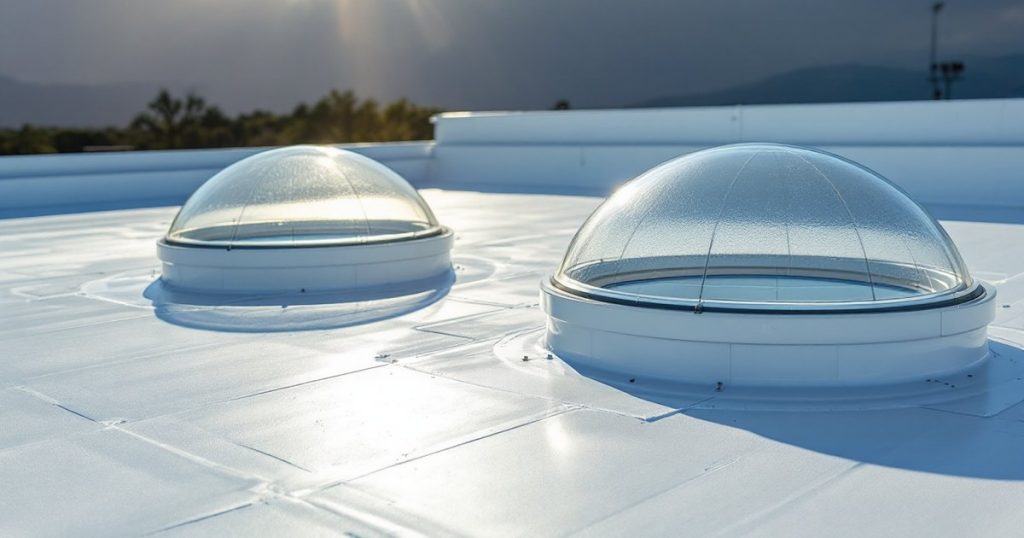
Plastic skylights are skylights glazed with an acrylic or polycarbonate dome instead of glass, and they trade clarity, energy performance and service life for lower price, lighter weight and far higher impact resistance. Sun-Tek’s 2026 catalog rates polycarbonate at 250 times the impact resistance of glass and acrylic at 17 times, yet a clear acrylic double dome has an estimated solar heat gain coefficient of about 0.84, against 0.26 for a VELUX low-E glass unit. The 2021 IRC lists “approved rigid plastics” as legal skylight glazing, with no retention screen required. Below are the material numbers, the code rules, what they cost, and where plastic is the right call.
By The Roofing Brief Team · Last reviewed: October 2026
Key numbers at a glance: plastic skylights
These are the figures most plastic skylight decisions turn on, taken from the manufacturer literature and model codes named in the last column. Treat each row as a reference point rather than a quote for every product.
| Question | Answer | Source |
|---|---|---|
| Impact resistance vs glass | Polycarbonate about 250x; acrylic about 17x (standard acrylic sheet is quoted at 10x to 20x) | Sun-Tek 2026 Product Catalog; Röhm ACRYLITE Premium FF page |
| Light transmission of clear sheet | Acrylic about 92%; clear plastic double dome about 92% center-of-glazing; VELUX FS laminated low-E glass unit VT 0.60 | Plaskolite OPTIX data; Insulite Skylights performance chart; VELUX FS tested performance sheet |
| Solar heat gain (SHGC), clear dome vs low-E glass | Clear acrylic double dome about 0.84 (center-of-glazing estimate); VELUX FS 04 glass 0.26 (NFRC whole unit) | Insulite Skylights; VELUX |
| Energy code skylight U-factor limit | 0.55 in climate zones 3 to 8; 0.65 in zone 2; 0.75 in zones 0 and 1 | 2021 IECC Table R402.1.2 |
| Low-slope curb rule | Below 3:12, unit skylights sit on a curb at least 4 in above the roof unless the maker’s instructions say otherwise | 2021 IRC R308.6.8 |
| Typical maker warranty | Sun-Tek polycarbonate units 10 years (SF and SFPH models 5 years) vs 20 years on its glass units | Sun-Tek 2026 Product Catalog |
What are plastic skylights?
A plastic skylight is a skylight whose glazing is a thermoformed acrylic (PMMA) or polycarbonate sheet, almost always shaped into a dome or pyramid so rain and debris run off. Most are fixed, curb-mounted or self-flashing units, sold as single, double or triple domes, with each added dome layer trapping air to cut heat loss.
Plastic glazing shows up in four places today: budget residential units such as the Sun-Tek PolyDome line, the small domes on tubular skylights such as the VELUX Sun Tunnel and Solatube, mobile home skylights, and commercial flat-roof daylighting from VELUX Commercial (which owns Wasco) and Kingspan Light + Air (formerly Bristolite). Most premium residential deck-mounted skylights, including the VELUX FS line, use insulated glass instead.
The word “plastic” covers two very different materials. Acrylic is the clearer, cheaper, more UV-stable of the two but cracks under a hard hit. Polycarbonate is the tough one, used where hail, foot traffic or vandalism matter, but it needs a factory UV layer to stay clear outdoors. If you are still choosing between fixed, vented and tubular formats, start with our guide to the main types of skylights.
Acrylic vs polycarbonate vs glass skylights: how the materials compare
Acrylic wins on clarity and UV stability, polycarbonate wins on impact strength, and tempered or laminated low-E glass wins on scratch resistance, solar heat control and warranty length. The table sets the three side by side using each maker’s own published figures, so read the numbers as maker claims for sheet material, not as test results for a finished skylight.
| Property | Acrylic (PMMA) dome | Polycarbonate dome | Tempered or laminated glass | Source |
|---|---|---|---|---|
| Impact resistance | About 17x glass (Sun-Tek); 10x to 20x (ACRYLITE Premium FF); impact-modified DURAPLEX 5x to 6x standard acrylic | About 250x glass | Tempered glass about 4x annealed glass | Sun-Tek 2026 catalog; Röhm; Plaskolite; Guardian Glass |
| Visible light transmission (clear) | About 92% | Up to about 90% (Palram SUNSKY corrugated sheet) | Single clear pane 90% center-of-glass; VELUX FS laminated low-E unit 0.60 whole unit | Plaskolite; Palram; Sun-Tek; VELUX |
| UV and yellowing | Naturally UV stable; ACRYLITE warrants no more than 3% light-transmission loss over 30 years | Needs a co-extruded UV cap; Plaskolite TUFFAK UV carries a 10-year warranty against breakage, yellowing and light loss | Does not yellow; VELUX 04 laminated glass blocks 99.9% of UV (300 to 380 nm) | Röhm; Plaskolite; VELUX |
| Heat tolerance | Up to about 190°F | Up to about 240°F | Not a limiting factor on a roof | Sun-Tek 2026 catalog |
| Weight | About half of glass | About half of glass | Heaviest | Sun-Tek 2026 catalog |
| Fire class for commercial plastic glazing | CC2 (OPTIX and DURAPLEX) | CC1 (TUFFAK) | Noncombustible | Plaskolite skylight sheet guide; IBC 2606.4 |
| Thermal movement | Moves more than metal or glass | Plaskolite advises allowing 1/16 in per foot of length and width | Low | Plaskolite TUFFAK FAQ |
One difference does not show up in the table: plastic scratches far more easily than glass, so abrasive cleaning and roof grit dull a dome over time.
Which is better for a skylight, acrylic or polycarbonate?
Acrylic is the better pick where clarity and long-term UV stability matter and impact risk is low, such as a sheltered residential roof. Polycarbonate is the better pick where hail, falling branches, foot traffic or vandalism are real risks, as on commercial roofs, hail-belt homes and outbuildings. Double-dome units can mix the two, with a weatherable outer dome over a tougher inner dome.
Plaskolite’s skylight sheet guide shows that pairing directly: its non-UV-enhanced TUFFAK SK polycarbonate is meant only as the inner sheet of a two-dome skylight, while UV-capped TUFFAK SK1 or weatherable OPTIX acrylic goes on the outside. Plaskolite also lists TUFFAK as passing FM 4431 Class 4 (severe) hail testing. Sun-Tek builds its residential PolyDome line entirely in UV-stabilized polycarbonate.
Do plastic skylights turn yellow?
Polycarbonate without a UV-protective cap is not built for sun exposure: Plaskolite says its non-UV TUFFAK SK sheet “is not designed to be a weatherable product” and belongs inside a two-dome unit. Acrylic resists yellowing by chemistry: Röhm says ACRYLITE is made of “naturally UV-stable molecules” and warrants clear sheet against yellowing for 30 years.
Finished-skylight warranties are shorter than sheet warranties. VELUX covers yellowing on its polycarbonate dome skylights for 5 years, and guarantees its acrylic Sun Tunnel domes stay below a yellowness index of 4 for 5 years and below 10 for 10 years.
Are plastic skylights energy efficient?
Clear plastic domes are weak on energy compared with modern low-E glass, mostly because they let in so much solar heat. Insulite Skylights’ center-of-glazing estimates put a clear acrylic double dome at an SHGC of 0.84, while VELUX’s NFRC-certified FS fixed skylight with laminated low-E glass is rated 0.26. Tinted or white domes cut heat gain but also cut daylight sharply.
| Glazing | U-factor | SHGC | Visible light | Basis | Source |
|---|---|---|---|---|---|
| Clear acrylic, single dome | 0.80 | 0.87 | 95% | Center-of-glazing estimate | Insulite Skylights performance chart |
| Clear acrylic, double dome | 0.50 | 0.84 | 92% | Center-of-glazing estimate | Insulite Skylights |
| White acrylic, double dome | 0.50 | 0.50 | 49% | Center-of-glazing estimate | Insulite Skylights |
| Bronze acrylic, double dome | 0.50 | 0.46 | 25% | Center-of-glazing estimate | Insulite Skylights |
| Clear acrylic, triple dome | 0.30 | 0.80 | 85% | Center-of-glazing estimate | Insulite Skylights |
| VELUX FS (deck mount), 04 laminated low-E glass | 0.44 | 0.26 | 0.60 | NFRC whole unit at 20° slope | VELUX FS tested performance sheet |
| VELUX FCM (curb mount), 04 glass | 0.48 | 0.27 | 0.64 | NFRC whole unit at 20° slope | VELUX FCM tested performance sheet |
Read the two kinds of numbers differently. Insulite labels its plastic values as center-of-glazing estimates from LBNL WINDOW software, “not actual results from testing,” so they leave out the frame and curb; the VELUX figures are certified whole-unit ratings that include the frame.
Field data point the same way. In a winter field test published by Lawrence Berkeley National Laboratory (Klems, 1999), a clear double-bubble acrylic skylight on a non-thermally-broken aluminum frame measured 4.79 W/m²K, about 0.84 Btu/hr·ft²·°F, against about 0.66 for an argon-filled low-E flat skylight; a clear double-glazed flat unit measured about the same as the bubble.
What U-factor does the energy code require for skylights?
The 2021 IECC caps skylight U-factor at 0.75 in climate zones 0 and 1, 0.65 in zone 2 and 0.55 in zones 3 through 8, and caps glazed fenestration SHGC at 0.25 in zones 0 to 3. Skylights in zones 0 to 3 may be excluded from that SHGC cap if their own SHGC is 0.30 or less. Your state or city may adopt a different edition or amendments.
| 2021 IECC climate zone | Max skylight U-factor | Max glazed fenestration SHGC | Clear acrylic double dome (U 0.50, SHGC 0.84) vs limit |
|---|---|---|---|
| 0 and 1 | 0.75 | 0.25 (skylights may use 0.30) | U passes; SHGC about 2.8x the 0.30 skylight allowance |
| 2 | 0.65 | 0.25 (skylights may use 0.30) | U passes; SHGC about 2.8x the allowance |
| 3 | 0.55 | 0.25 (skylights may use 0.30) | U passes narrowly at center of glazing (whole unit likely higher); SHGC about 2.8x |
| 4 except Marine | 0.55 | 0.40 | U passes narrowly at center of glazing (whole unit likely higher); SHGC about 2.1x |
| 5 and Marine 4 | 0.55 | Not required | U passes narrowly at center of glazing (whole unit likely higher) |
| 6, 7 and 8 | 0.55 | Not required | U passes narrowly at center of glazing (whole unit likely higher) |
Source: 2021 IECC Table R402.1.2 and its footnotes; comparison column is Roofing Brief arithmetic using the Insulite estimates above (0.84 divided by 0.30 is 2.8; 0.84 divided by 0.40 is 2.1).
Three code details matter more for plastic than for glass. First, IECC R303.1.3 requires NFRC-rated U-factors, and an unlabeled skylight is assigned a default: 1.05 for a double-glazed skylight on a nonmetal frame and 1.30 on a metal frame without a thermal break, roughly twice the 0.55 limit. Second, R402.3.3 exempts up to 15 square feet of glazed fenestration per dwelling unit from the U-factor and SHGC limits, which can cover one small dome. Third, the code applies to skylights over conditioned space, so a dome over an unconditioned shed or detached garage is generally outside these limits. Confirm with your building department, and see our guide to energy efficient skylights for the glass side of the comparison.
No federal tax credit offsets either choice in 2026. Public Law 119-21 ended the Section 25C energy efficient home improvement credit for property placed in service after December 31, 2025, so check state and utility programs instead and confirm with a tax professional.
What does the building code say about plastic skylights?
The 2021 International Residential Code allows plastic skylights outright: Section R308.6.2 lists “approved rigid plastics” alongside laminated, fully tempered, heat-strengthened and wired glass as permitted skylight glazing. Plastic also skips the broken-glass retention screen that some tempered glass skylights need, because the screen rules in R308.6.3 and R308.6.4 apply only to glass.
| Rule (2021 IRC unless noted) | What it says | What it means for plastic |
|---|---|---|
| R308.6.2 Materials | Glazing limited to laminated glass (0.015 in PVB interlayer up to 16 sq ft and 12 ft high, 0.030 in above that), fully tempered, heat-strengthened or wired glass, and approved rigid plastics | Acrylic and polycarbonate domes are permitted glazing |
| R308.6.3 and R308.6.4 Screens | Fully tempered or heat-strengthened glass, or a fully tempered, heat-strengthened or wired inboard pane, needs a broken glass retention screen below it, with exceptions in R308.6.5 | No retention screen rule applies to a plastic dome |
| R308.6.5 Screens not required | No screen for laminated glass meeting Item 1 of R308.6.2, or for fully tempered glass up to 16 sq ft, no more than 12 ft above a walking surface and no thicker than 3/16 in (a second condition covers larger, steeply sloped glass) | Glass only; laminated glass avoids the screen |
| R308.6.8 Curbs | Unit skylights on a roof pitched less than 3:12 go on a curb at least 4 in above the roof plane, unless the maker’s instructions say otherwise | Applies to plastic and glass units alike |
| R308.6.9 Testing and labeling | Unit skylights and tubular daylighting devices must be tested by an approved independent lab and labeled to AAMA/WDMA/CSA 101/I.S.2/A440 | Buy a labeled unit; a site-built plastic dome has no rating |
| R308.6.9.1 Comparative analysis | Lets glass-glazed unit skylights of untested sizes use engineering analysis for wind design pressure | Written for glass-glazed units only, so a plastic unit’s rating should come from its own tested size |
The rules above are from the 2021 IRC as reproduced in the New Jersey adoption on UpCodes; local amendments vary, so confirm the edition with your building department. For how the same rules apply to venting units and egress, see our comparison of fixed vs vented skylights.
Commercial plastic skylights: IBC Section 2610
On commercial and multifamily buildings, plastic skylights fall under IBC Section 2610, which is stricter than the IRC because plastics burn. The plastic must sit on a curb at least 4 inches above the roof, domes must rise at least 10 percent of their width (never less than 3 inches), and each skylight is capped at 100 square feet inside the curb unless the building is sprinklered or has smoke and heat vents.
| 2021 IBC section | Requirement |
|---|---|
| 2610.2 Mounting | Curb not less than 4 in above the roof; plastic edges protected by metal or other noncombustible material unless the dome passes a Class B brand test. Curbs not required on slopes of 3:12 or more in Group R-3 and on buildings with a nonclassified roof covering |
| 2610.3 Slope | Flat or corrugated plastic skylights slope at least 4:12; dome-shaped skylights rise at least 10% of maximum width, minimum 3 in (Class B burning brand exception) |
| 2610.4 Maximum area | 100 sq ft per skylight within the curb (no limit with full sprinklers per 903.3.1.1 or smoke and heat vents per 910) |
| 2610.5 Aggregate area | Up to 33 1/3% of the floor area below for CC1 plastics, 25% for CC2; doubled with full sprinklers or smoke and heat vents |
| 2610.6 Separation | At least 4 ft between skylights, with sprinkler and Group R-3 exceptions |
| 2610.7 Location | Not within 6 ft of an exterior wall whose openings must be protected under Section 705 |
The CC1 versus CC2 class is a material choice with a code consequence. Plaskolite lists its TUFFAK polycarbonate as CC1 and its OPTIX and DURAPLEX acrylics as CC2 under IBC 2606.4, so on an unsprinklered building an all-polycarbonate layout can cover more of the roof.
Do commercial plastic skylights need fall protection?
Yes, in most cases. OSHA treats a skylight as a hole: under 29 CFR 1910.28(b)(3)(i), employers must protect workers from falling through any hole “(including skylights)” 4 feet or more above a lower level with covers, guardrails, travel restraint or personal fall arrest. During construction, 29 CFR 1926.501(b)(4) sets the trigger at 6 feet.
A plastic dome does not count as a cover unless it is strong enough. Covers must support at least twice the maximum intended load under 1910.29(e), and at least twice the weight of employees, equipment and materials under 1926.502(i)(2). In a December 20, 2007 interpretation letter, OSHA said that a skylight meeting the 1926.502(i)(2) cover criteria will be treated as a cover, and noted it was unclear whether a maker’s “rated to hold 775 pounds” claim included a safety factor. The usual routes are a screen or guardrail at each skylight, or a skylight its maker rates for fall protection, with the rating documented for the safety file.
Who makes plastic skylights?
The main plastic skylight makers sold in the US are Sun-Tek (polycarbonate residential units), VELUX (polycarbonate dome skylights sold only in select Sun Belt states, plus acrylic Sun Tunnel domes), VELUX Commercial, which absorbed Wasco, Kingspan Light + Air, which absorbed Bristolite, and Solatube for tubular domes. Each brand fact below comes from the maker’s own site or a dated announcement.
| Brand | Plastic products | Material and warranty notes | Source |
|---|---|---|---|
| Sun-Tek | PolyDome self-flashing (SF, SFPH, SFA, SFAW), curb-mount (CM, CMA), tile (TP) and hurricane (HSF) units; commercial double and triple domes | Polycarbonate (Palram PALSUN), not acrylic; 10-year limited warranty, 5 years on SF and SFPH and on commercial units; “fall protection available” on commercial models | sun-tek.com; Sun-Tek 2026 Product Catalog |
| VELUX (residential) | Polycarbonate dome skylights CMD, CMDA, SFRD, SFHD and SFDA | Sold only in select Sun Belt states (VELUX describes Gulf Coast and southern border states; published state lists differ, so confirm availability with a dealer); 10-year product, 5-year hail and 5-year yellowing coverage in the VELUX limited warranty | pro.veluxusa.com; VELUX limited warranty flyer |
| VELUX Sun Tunnel | Tubular skylights with a roof dome | Acrylic dome standard; polycarbonate on TGR, TMR and TMF for High Velocity Hurricane Zones; acrylic dome yellowness index guaranteed below 4 for 5 years and below 10 for 10 years. The TLR uses flat glass where local rules bar acrylic domes | VELUX professional blog (May 14, 2026); pro.veluxusa.com |
| Wasco / VELUX Commercial | Commercial acrylic, polycarbonate and glass unit and structural skylights | Wasco says it brought the first acrylic dome skylight to market in 1949 and introduced the Wascolite Skydome in 1951; acquired by VELUX America in 2018. Its residential E-Class line is glass | wascoskylights.com |
| Kingspan Light + Air (formerly Bristolite) | Commercial unit skylights, including the Series 1400 monolithic acrylic unit | Lists polycarbonate, acrylic and glass glazing; Bristolite agreed to join Kingspan Group in November 2016 | lightandair.kingspan.com; 2016 announcement |
| Solatube | Tubular daylighting devices | Impact-modified acrylic dome standard; high-impact polycarbonate on the SkyVault series; 10-year warranty on components | solatube.com residential FAQ |
Mobile home skylights are a separate niche. Mobile Home Outfitters stocks Fox Lite polycarbonate units, which it lists with a limited lifetime warranty. For a ranking of mainstream glass and plastic skylight brands, see our best skylight brands guide.
How much do plastic skylights cost?
Plastic skylights are the cheapest skylights to buy. On October 12, 2026, Lustercraft listed a Sun-Tek curb-mount polycarbonate skylight for a 22 x 46 curb (2246 size) at $289, while the same retailer listed a VELUX FCM 2246 curb-mount glass skylight with laminated low-E glass at $629. That is $340 more, or about 2.2 times the price, for glass on the same curb size.
| Item | Listed price (October 12, 2026) | Retailer |
|---|---|---|
| Sun-Tek self-flashing polycarbonate, 22.5 x 22.5 in / 22.5 x 46.5 in | $129 / $267 (full range $88 to $573) | Lustercraft |
| Sun-Tek curb-mount polycarbonate, 2222 / 2246 (bronze over clear double dome) | $134 / $289 (full range $107 to $629) | Lustercraft |
| Replacement dome, 25.25 x 25.25 in, acrylic single / double | $50 / $90 | Skylight Depot |
| Replacement dome, 25.25 x 25.25 in, polycarbonate single / double | $105 / $145 | Skylight Depot |
| Fox Lite mobile home polycarbonate skylight | $109.99 (16 x 16 in) to $1,419.99 (48 x 72 in) | Mobile Home Outfitters |
| VELUX FCM curb-mount glass, laminated low-E, 2222 / 2246 | $545 / $629 | Lustercraft |
| VELUX ECL flashing kit for FCM | $164 to $175 | Lustercraft |
The polycarbonate premium is visible in replacement domes too: at Skylight Depot the 25.25 inch polycarbonate double dome costs $55 more than the acrylic one, about 1.6 times the price. Unit price is only part of the bill, though. Labor, flashing, the interior light shaft and any framing repair can easily cost more than a plastic dome itself, which is why a dome-only swap on a sound curb is the lowest-cost fix. Listed prices change often and exclude shipping and tax.
How long do acrylic and polycarbonate skylights last?
Expect a plastic skylight to need attention well before a glass one. Marco Skylights, which builds acrylic and polycarbonate domes, says skylights “can last eight to fifteen years, depending on certain factors.” VELUX, which sells glass, says “many VELUX skylights can last 20 years or more.” Maker warranties follow the same split: Sun-Tek covers its polycarbonate units for 10 years and its glass units for 20.
| Claim | Figure | Who says it |
|---|---|---|
| Dome skylight service life | “eight to fifteen years, depending on certain factors” | Marco Skylights (dome maker) |
| Glass skylight service life | “20 years or more” for many units; upgrade after about 30 years | VELUX (glass maker) |
| Plastic bubble vs roof life | “Why leave a 5 year skylight on a 20 year roof?” | VELUX pro replacement page (marketing glass FCM replacements) |
| Polycarbonate skylight warranty | 10 years (5 years on SF and SFPH) | Sun-Tek 2026 catalog |
| Glass skylight warranty | 20 years | Sun-Tek 2026 catalog |
| Acrylic sheet light-loss warranty | No more than 3% loss over 30 years | Röhm ACRYLITE (sheet, not a finished skylight) |
Each source has a commercial interest, so the honest reading is a range. A UV-capped polycarbonate or good acrylic dome can stay serviceable for 10 to 15 years or more on a sound curb; seals, fasteners and flashing often fail before the plastic does. Replace the dome when it cracks, crazes, turns cloudy enough to cut light noticeably, or when condensation shows up between the two domes.
When do plastic skylights make sense?
Plastic makes sense where impact resistance, low weight and low price matter more than view, energy performance and service life. That usually means outbuildings, unconditioned spaces, commercial low-slope roofs and hail-prone sites. Over living space in a hot climate, or where you want a clear view of the sky, insulated low-E glass is usually the stronger choice.
| Your situation | Better pick | Why |
|---|---|---|
| Shed, barn, workshop or detached garage (unconditioned) | Polycarbonate or acrylic dome | Lowest cost, light, and energy code limits generally do not apply outside the conditioned envelope |
| Commercial or warehouse low-slope roof | Polycarbonate or double dome with a polycarbonate layer | Impact strength, CC1 class under IBC 2610.5, curb-mounted by code; plan fall protection |
| Hail belt, falling branches, ball courts | Polycarbonate | About 250x glass impact rating per Sun-Tek; TUFFAK lists FM 4431 Class 4 hail |
| Living room, bedroom or kitchen in climate zones 0 to 3 | Low-E glass | Clear domes run far above the 0.25 to 0.30 SHGC limits; glass units rate about 0.26 |
| Cold climate living space (zones 5 to 8) | Low-E argon glass | Lower whole-unit U-factor than a clear plastic dome |
| You want to see sky and clouds clearly | Flat glass | Plastic scratches and hazes; prismatic and white domes diffuse the view |
| Small dark closet, hall or bath | Tubular skylight (plastic dome on top) | The dome is small, and a tube is cheaper than a framed shaft |
| Replacing an old dome on a sound curb, tight budget | Matching replacement dome | Reuses the curb and flashing; check curb size and height first |
How to replace a plastic bubble skylight
Replacing a plastic bubble skylight starts with one decision: swap only the dome on the existing curb, or replace the whole unit. A dome-only swap is the cheaper route when the curb is dry, square and at least 4 inches tall; a leaking curb, rotted framing or a move to glass means a full replacement.
- Diagnose the failure. Check the ceiling and curb for stains. A crack or haze in the dome alone points to a dome swap; water at the curb or deck points to flashing, which a new dome will not fix.
- Measure the curb. Record the inside and outside curb dimensions and the curb height, because each maker states whether its sizes refer to the inside or outside of the curb. IRC R308.6.8 calls for a curb at least 4 inches tall on roofs below 3:12.
- Choose the glazing. Acrylic for clarity and UV stability, polycarbonate for impact, or a glass curb-mount unit such as the VELUX FCM if you want a longer warranty and lower solar gain.
- Check the label. For living space, pick a unit with an NFRC label and an AAMA/WDMA/CSA 101/I.S.2/A440 rating so it can be shown to meet IRC R308.6.9 and the energy code.
- Remove the old dome and clean the curb. Strip old sealant and fasteners, and repair any soft wood before setting the new unit.
- Set, seal and fasten per the maker’s instructions. Plastic moves with temperature far more than glass, so leave the expansion clearance the maker specifies rather than fastening tight.
- Water-test and inspect. Hose the curb from the low side up, then check inside for drips before closing up.
A deck-mounted unit or any job that disturbs the shingle flashing is roofer work. For costs and the repair-or-replace call, see our roof skylight replacement guide. If the roof is being replaced anyway, our guide on when to replace skylights when reroofing explains why a plastic bubble is usually swapped at the tear-off.
Frequently asked questions
Are plastic skylights good?
Plastic skylights are good for sheds, garages, commercial low-slope roofs and hail-prone sites, where impact strength and low cost matter most. Sun-Tek rates polycarbonate at about 250 times the impact resistance of glass. Over living space they trail low-E glass: clear domes admit much more solar heat, scratch more easily and carry shorter warranties, such as 10 years versus 20 for Sun-Tek glass units.
How long do acrylic skylights last?
Acrylic dome skylights often need replacing within about 8 to 15 years. Marco Skylights, a dome maker, says skylights “can last eight to fifteen years,” and VELUX guarantees its acrylic Sun Tunnel domes only against heavy yellowing for 10 years. Acrylic sheet itself is UV stable, so crazing, cracks, failed seals and flashing usually end a dome’s life before the plastic yellows.
Which is better for skylights, acrylic or polycarbonate?
Acrylic is better for clarity and long-term UV stability, transmitting about 92 percent of visible light. Polycarbonate is better for impact, rated by Sun-Tek at about 250 times glass versus about 17 times for acrylic, and it tolerates more heat. Polycarbonate must have a UV-protective layer to resist yellowing. Double-dome units can pair a weatherable outer dome with a tougher inner one, a layout shown in Plaskolite’s skylight sheet guide.
Do plastic skylights need a screen under them?
No retention screen is required for plastic skylights under the 2021 IRC. The screen rules in Sections R308.6.3 and R308.6.4 apply to fully tempered, heat-strengthened and wired glass, while R308.6.2 lists approved rigid plastics as permitted glazing without a screen. On commercial roofs, OSHA fall protection rules for holes, including skylights, still apply and are a separate requirement.
Can you replace just the plastic dome on a skylight?
Yes, on many curb-mounted units you can replace only the plastic dome if the curb and flashing are sound and dry. Measure the curb inside and outside dimensions and its height, and confirm the replacement dome is made for that size. If water is getting in at the curb or deck, a new dome will not stop it, and the flashing or the whole unit needs replacing.
Are artificial skylights any good?
Artificial skylights are LED ceiling panels that imitate daylight and a sky view without a roof opening, so they cannot leak and need no curb, flashing or energy code skylight rating. They can brighten windowless rooms, but they use electricity and do not deliver real daylight. A tubular skylight with a small plastic dome is the usual low-cost option for bringing actual sunlight into a dark room.
Why aren’t skylights popular anymore?
Skylights are still widely sold. Much of their bad reputation comes from older plastic bubble units that yellowed, crazed or leaked, and glass makers lean on that: VELUX markets its glass FCM curb-mount skylight to contractors as a replacement for plastic bubbles. Today most residential lineups use sealed low-E glass with factory flashing kits, while plastic domes remain common on commercial roofs, tubular skylights and outbuildings.