
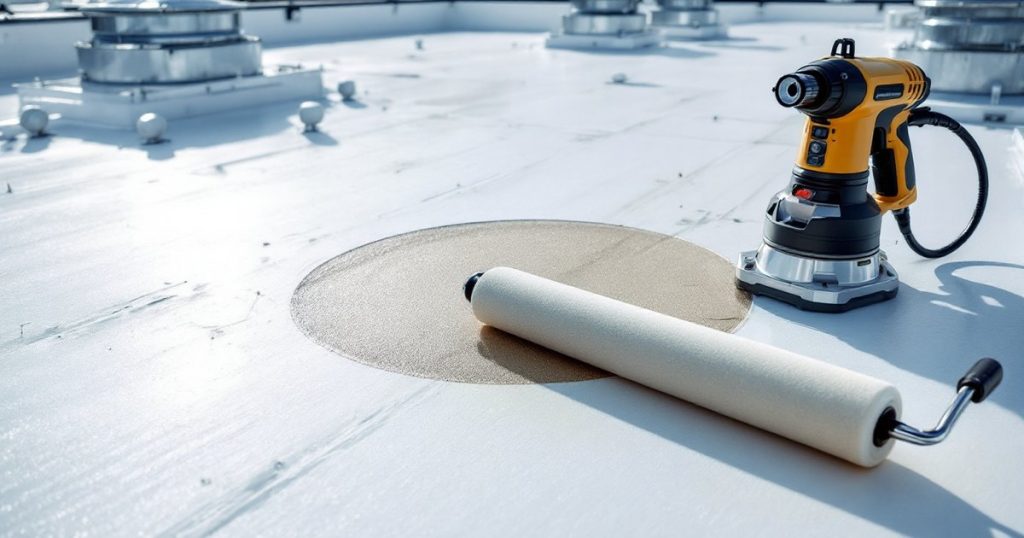
PVC roof repair is a heat weld, not a glue job: the damaged area is cleaned back to weldable vinyl, then a patch of the same kind of PVC membrane is hot-air welded over it with rounded corners, a continuous weld of at least 1.5 inches, and a probe check once it cools. Carlisle requires the patch to run at least 2 inches past the damage and Johns Manville at least 3 inches. Where the big PVC makers part ways is cleaning, and getting that step wrong is the usual reason a patch on an older PVC roof lets go.
This page compiles the published repair procedures of Sika Sarnafil, Carlisle Sure-Flex, GAF EverGuard and Duro-Last, plus Johns Manville and FiberTite where they add something, and shows where those procedures disagree. For TPO, see our TPO roof repair guide. For PVC as a whole roof system (cost, lifespan, slope), see our PVC flat roof guide.
By The Roofing Brief Team. Last reviewed: October 2026.
Key numbers at a glance
These are the figures that decide whether a PVC patch holds, each taken from a maker’s own installation or repair document. The makers set different numbers for the same step, so on a roof still under warranty, the warranty holder’s current written instructions take priority over anything in this table.
| Figure | Value | Source |
|---|---|---|
| Patch overlap past the damage | 2 in. minimum (Carlisle); 3 in. minimum (Johns Manville) | Carlisle Thermoplastics Field Guide, Sept. 2023; JM PVC Membrane Application Guide |
| Minimum hot-air weld width | 1.5 in. (Carlisle, Duro-Last, JM); GAF specifies a film-tearing bond of 1 to 1.5 in. | Carlisle field guide; Duro-Tuff specification; JM guide; GAF EverGuard manual, rev. 8/25 |
| Wait before probing a new weld | 20 minutes minimum (Carlisle); 30 minutes or until ambient temperature (GAF) | Carlisle field guide; GAF EverGuard manual seam probing checklist |
| Solvent flash-off before welding | Up to 15 minutes (Carlisle); about 20 minutes for MEK (Sika Canada); about 5 minutes (JM) | Carlisle field guide; Sika Canada Technical Bulletin 006, March 2020; JM guide |
| Age at which old PVC gets hard to weld | 5 to 7 years or older “may be difficult to achieve proper fusion” | Carlisle Thermoplastics Field Guide |
| Cut-edge sealant on a reinforced PVC patch | Not required (Carlisle Sure-Flex, GAF EverGuard PVC) | Carlisle field guide section 3.07; GAF EverGuard manual |
| Typical professional flat roof repair | $300 to $1,100, national average about $700 | Fixr, Flat Roof Repair Cost, updated Jan. 27, 2026 |
Is it PVC, KEE or TPO? Confirm before you buy anything
Confirm the membrane before any repair, because PVC patches go on PVC, TPO patches go on TPO, and the cleaners are not interchangeable. The fastest proof is the warranty or the original roofing contract, which names the maker and product. On the roof, a correctly welded PVC seam usually shows a little dark “bleed-out” at the seam edge, which GAF says is normal for PVC and should not appear on TPO.
Three families look alike from the ground. Standard PVC, such as Sika Sarnafil, is made to ASTM D4434. KEE-modified PVC, such as Carlisle Sure-Flex KEE HP, is PVC with a KEE resin modifier. KEE membranes such as FiberTite are made to ASTM D6754, which requires KEE to be at least half of the polymer content. Our PVC roofing membrane guide covers that chemistry in detail.
GAF’s EverGuard manual states the rule that ties all of this together: remedial work must be performed with like materials. A patch cut from leftover TPO will not fix a PVC roof, and a TPO cleaner is the wrong product for vinyl.
How the four big PVC makers say to repair their membrane
Sika Sarnafil, Carlisle, GAF and Duro-Last all repair PVC the same basic way: clean, weld a like-material patch with rounded corners, then probe. They disagree on how to clean, whether an abrasive pad is allowed, which solvent to use, and how long to wait. The table compares the published procedures side by side so a contractor or owner can see which rules apply to which roof.
| Step | Sika Sarnafil | Carlisle Sure-Flex | GAF EverGuard PVC | Duro-Last |
|---|---|---|---|---|
| First wash | Household liquid soap and water with soft cotton rags or mops | Broom or dry rag; detergent and water for heavy dirt, then rinse and dry | Low-residue cleaner (Formula 409) with a mildly abrasive pad, then rinse | Owner cleaning: non-sudsing, non-abrasive powdered cleanser; no solvent-based cleaners |
| Abrasive pad on aged sheet? | No: “Do not use abrasive cleaners” | Yes: Scotch-Brite pad with PVC and KEE HP Membrane Cleaner | Yes: mildly abrasive scrubbing pad on weathered or oxidized membrane | Not stated in the owner and spec documents reviewed |
| Solvent or cleaner before welding | Sika’s membrane cleaner on a soft cotton rag (US handbook); MEK on a terry cloth inside the marked patch area (Sika Canada) | PVC and KEE HP Membrane Cleaner; Weathered Membrane Cleaner “should not be used” on Sure-Flex PVC | EverGuard PVC Membrane Cleaner, MEK or acetone on a white terry cloth | Not stated; spec calls for non-solvent cleaners to remove asphalt |
| Welding note | “Weld slowly and with reduced heat” | Sheets 5 to 7 years or older may not fuse; the underside may be needed | Voids found more than 24 hours after welding are patched over, not re-welded | Seam must be continuous and at least 1.5 in. wide |
| Probe tool | Rounded screwdriver after cooling | Probe duller and flatter than a TPO probe, after at least 20 minutes | Blunt cotter key puller, after at least 30 minutes | Tack claw or cotter key extractor after the seam cools |
| Patch size rule | 4 in. round or rounded-square patch at T-joints on 72 mil and thicker sheet | Reinforced overlay at least 2 in. past the damage, rounded corners | Reinforced membrane for field damage; open seams stripped with reinforced membrane at least 4 in. wide | Rounded-corner patch, at least 4 x 4 in. or 4 in. round, at T-laps |
| Who repairs a warranted roof | Contact a Sika Sarnafil authorized applicator | Not stated in the field guide; Carlisle warranties cover systems installed by Carlisle Authorized Roofing Applicators | Owners may make reasonable temporary repairs in an emergency | Duro-Last authorizes the repair; its QA rep or an authorized contractor makes it |
Sources: Sika Roofing Applicator Handbook (US) and Sika Canada Technical Bulletin 006 (March 31, 2020); Carlisle Thermoplastics Field Guide (CST-9994, Sept. 2023) and PVC and KEE HP Membrane Cleaner data sheet; GAF EverGuard TPO/PVC Mechanically Attached Roofing Systems Manual (rev. 8/25) and EverGuard PVC Membrane Cleaner product page; Duro-Last Protecting Your Investment booklet, Duro-Tuff Mechanically Fastened System specification and Duro-Tuff 50-mil data sheet (rev. Oct. 13, 2025).
Sika Sarnafil: gentle cleaning, slow welding
Sika’s US applicator handbook treats aged Sarnafil gently. Its “Welding to Aged Membrane” procedure calls for household liquid soap and water on soft cotton rags or mops, says “Do not use abrasive cleaners,” then uses Sika’s membrane cleaner on a clean cotton rag to lift embedded dirt. The cleaner must never be poured on the sheet and must fully evaporate before welding, which the handbook says to do “slowly and with reduced heat.”
Sika’s Canadian Technical Bulletin 006 adds two rules a patcher should know. Solvents strip the factory lacquer from Sarnafil, so clean only a pencil-marked patch outline about 1/8 in. larger than the patch, wiping in one direction with MEK on a terry cloth, and allow about 20 minutes to flash off. The same bulletin says weathered membrane cleaner, gasoline and other non-approved chemicals are not acceptable on Sarnafil.
Carlisle Sure-Flex: scrub with the PVC cleaner, then watch the age
Carlisle’s procedure is the most abrasive of the four. Its field guide says the repair area must be cleaned before any repair and, when standard cleaning is not enough, scrubbed with a Scotch-Brite pad and PVC and KEE HP Membrane Cleaner, wiped with a Splice Wipe or cotton rag, then welded. Carlisle’s rooftop checklist requires that pad-and-cleaner step on membrane exposed to sun for more than 7 days.
Carlisle also warns that solvent from its PVC cleaner can take up to 15 minutes to flash off, and that rushing it causes cold welds. Damage gets a separate piece of Sure-Flex reinforced membrane with rounded corners, extending at least 2 in. past the area, and every edge is probed once cooled. Carlisle says cut-edge sealant is not required on Sure-Flex.
GAF EverGuard PVC: grade the contamination first
GAF sorts dirt into three levels. Light contamination (a few days of dust or dew) gets a white terry cloth with membrane cleaner. Dirt-encrusted or weathered and oxidized membrane gets a low-residue cleaner and a mildly abrasive pad, a full rinse, then EverGuard PVC Membrane Cleaner, MEK or acetone on a white terry cloth, with the solvent allowed to flash off before welding.
For damage, GAF calls for reinforced membrane in the field of the roof and, for an entire open seam, a reinforced strip at least 4 in. wide with T-joint cover patches heat-welded at each corner. GAF hand welds use a two-pass method with a silicone roller, and its manual notes that reinforced PVC, unlike TPO, does not need cut-edge sealant.
Duro-Last: report first, and keep solvents off the roof
Duro-Last’s owner literature puts the warranty process ahead of the repair method. An owner must report a leak to Duro-Last within 7 to 14 days of discovery, depending on the warranty, and Duro-Last decides whether its own quality assurance representative or an authorized contractor makes the repair. Damage from unauthorized components used in repair is excluded on the warranty forms Duro-Last publishes.
On cleaning, Duro-Last tells owners to use a non-sudsing, non-abrasive powdered cleanser and says solvent-based cleaners cannot be used. Its Duro-Tuff specification calls asphalt-based products incompatible with the membrane, requires a continuous weld at least 1.5 in. wide, and has seams checked with a tack claw or cotter key extractor once cool.
FiberTite and other KEE membranes follow their own procedures
FiberTite is a KEE membrane made by Seaman Corporation to ASTM D6754, not a standard PVC sheet, so its repairs follow FiberTite’s own instructions rather than a PVC maker’s. FiberTite’s BBA certificate says damage is repaired by cleaning the area and welding a patch, with lap areas cleaned at least 50 mm (about 2 in.) wide and welds at least 38 mm (about 1.5 in.).
FiberTite publishes a training video on repairing old membrane and runs a technical services line, so contact the maker before choosing a cleaner or patch stock for a FiberTite roof. Our FiberTite roofing review covers its KEE chemistry, warranty and cost.
Where the PVC repair procedures disagree
The makers agree on rounded corners, like-material patches and probing, but they split on four points that change how a crew works. An abrasive pad that Carlisle and GAF require is ruled out by Sika, and a solvent GAF accepts is off limits under Duro-Last’s owner guidance. A crew moving between brands has to follow the roof’s own maker, not habit from the last job.
| Question | Makers that say yes | Makers that say no or limit it | Source |
|---|---|---|---|
| Scrub aged PVC with an abrasive pad? | Carlisle (Scotch-Brite), GAF (mildly abrasive pad) | Sika: “Do not use abrasive cleaners” | Carlisle field guide; GAF manual; Sika handbook |
| Use MEK or acetone? | GAF (MEK or acetone); Sika Canada (MEK, inside patch outline only) | Duro-Last owner guidance: no solvent-based cleaners; Sika: solvent removes the lacquer finish | GAF manual; Sika TB 006; Duro-Last booklet |
| Use a TPO/EPDM “weathered membrane cleaner”? | None for PVC | Carlisle: should not be used on Sure-Flex PVC; Sika Canada: not acceptable on Sarnafil | Carlisle field guide; Sika TB 006 |
| Seal the cut edges of a reinforced patch? | Not required on PVC | Required on TPO by Elevate (Amrize) and JM; see the TPO roof repair guide | Carlisle field guide; GAF manual |
| Minimum patch overlap past damage | 2 in. (Carlisle); 3 in. (JM) | Sika and GAF documents reviewed set no single field number | Carlisle field guide; JM PVC guide |
How to repair a PVC roof with a hot-air welded patch
A durable PVC patch takes ten steps: confirm the membrane and warranty, find the breach, cut out scorched or contaminated material, size and round the patch, clean to the maker’s procedure, let the solvent flash off, test weld, weld in two passes, probe after cooling, and record the job. Each step below is drawn from the maker documents cited above, and the roof’s own maker governs where they differ.
- Confirm the membrane and warranty. Read the warranty to get the maker, product and notification window. On a Duro-Last roof, that window is 7 to 14 days from discovery of a leak.
- Find the breach and check below it. Probe nearby seams and press for soft, wet insulation. Wet board gets cut out and replaced before any patch.
- Cut out scorched membrane. JM’s PVC guide says burned or discolored membrane cannot take a good weld and must be patched; for burned areas it cuts away material at least 1 in. beyond the burn.
- Cut the patch from like material. Use reinforced PVC of the same type for field damage (GAF, Carlisle, JM), sized at least 2 in. (Carlisle) or 3 in. (JM) past the damage on every side. Round every corner.
- Clean to the maker’s procedure. Wash first, then apply the maker’s PVC cleaner or approved solvent only over the patch footprint, using the tools that maker allows.
- Let it flash off completely. Allow up to 15 minutes (Carlisle) or about 20 minutes for MEK (Sika Canada). Water left on the sheet can blister the weld, and Sika’s bulletin says the surface must be dry before welding.
- Run a test weld. Carlisle and Sika call for test welds every morning and afternoon, and GAF at the start of every work period. On an old sheet, a peel test on the actual roof shows whether the surface will fuse.
- Weld in two passes. Make a thin, continuous pre-weld at the back edge, then the final weld with the nozzle at about 45 degrees and a silicone roller behind it (Sika, GAF). Sika recommends a 1.5 in. nozzle for straight seams and a 3/4 in. nozzle for corners.
- Probe every edge after cooling. Wait at least 20 minutes (Carlisle) or 30 minutes (GAF), then drag a blunt probe along the weld. Any spot where the tip enters is a void to re-weld or patch.
- Record the repair. Photograph it, note the date, products and location, and send the record to the warranty holder.
Cut-edge sealant is the step TPO crews often add out of habit. Carlisle and GAF both say reinforced PVC does not need it. A 2 in. silicone roller is the standard partner to a hand welder, and our seam roller comparison covers the options.
Worked example: patch sizes under each maker’s overlap rule
The overlap rule sets the patch size, and the difference between makers grows with the damage. The table applies Carlisle’s 2 in. and JM’s 3 in. minimums to three common defects, measuring the damage as width by length and adding the overlap on every side. These are Roofing Brief calculations from the published minimums, not maker figures; a crew may cut larger.
| Defect (width x length) | Carlisle minimum patch (2 in. each side) | JM minimum patch (3 in. each side) | Patch area, Carlisle vs JM |
|---|---|---|---|
| Nail puncture, 1/2 x 1/2 in. | 4.5 x 4.5 in. | 6.5 x 6.5 in. | 20.25 vs 42.25 sq in. |
| Hail fracture, 2 x 2 in. | 6 x 6 in. | 8 x 8 in. | 36 vs 64 sq in. |
| Dropped-tool slit, 1/4 x 10 in. | 4.25 x 14 in. | 6.25 x 16 in. | 59.5 vs 100 sq in. |
Arithmetic: patch dimension equals the damage dimension plus twice the overlap. For the nail puncture under Carlisle, 0.5 + 2 + 2 = 4.5 in. per side. Sika Canada’s bulletin adds about 1/8 in. to the cleaned outline beyond the patch so the weld lands on clean membrane.
Minimum waiting time built into one patch
Most of a small PVC patch is waiting, not welding, and rushing the waits is what produces cold welds. Adding the published flash-off and cooling minimums gives the floor for one patch before it can be signed off.
| Wait | Carlisle | GAF | Source |
|---|---|---|---|
| Solvent flash-off before welding | Up to 15 min. | Until dry (“flash off”); longer in cold weather | Carlisle field guide; GAF manual |
| Cooling before probing | 20 min. minimum | 30 min. or ambient temperature | Carlisle field guide; GAF probing checklist |
| Total built-in wait (Roofing Brief arithmetic) | Up to 35 min. | 30 min. plus flash-off time | Sum of the rows above |
Can you weld new PVC to old PVC?
Often yes, but older vinyl is harder to fuse than older TPO. Carlisle’s field guide says PVC membranes 5 to 7 years or older “may be difficult to achieve proper fusion” and that the crew may have to weld to the underside of the old sheet, which has not seen weathering. Sika’s answer for aged Sarnafil is to clean thoroughly and weld slowly with reduced heat.
The reason is chemistry. Flexible PVC relies on plasticizers, and Carlisle notes that asphalt roof cement or asphaltic flashing left against PVC and KEE HP membranes will “promote premature plasticizer migration,” which leaves the sheet stiffer. That is why the test weld and peel matter more on PVC than on TPO, where a GAF field study found 12 to 18 year old sheets still welded well.
- Clean a test spot next to the repair with the full maker procedure and let it dry.
- Weld a scrap strip of like membrane to it using the two-pass method.
- Peel it after cooling. Sika’s handbook describes a correct weld as one where the membrane shears before the weld separates; GAF calls the same result a film-tearing bond.
- If it fails, clean again and retest once. Then try the underside of the old sheet, as Carlisle describes.
- If both fail, stop patching. A sheet that will not fuse top or bottom is a section-replacement or full-replacement decision, which our flat roof repair options guide walks through.
Emergency and temporary PVC roof fixes
When water is coming in and no welder is available, the goal is a controlled temporary seal that does not make the permanent repair harder. Duro-Last says emergency repairs can be made by “applying duct tape or caulking over the leak source,” must not enlarge the permanent repair, and should be reported to Duro-Last no later than the next working day if possible. GAF’s manual says owners may make reasonable and customary temporary repairs at their own expense in an emergency.
What not to use matters as much. Carlisle and Duro-Last both treat asphalt-based products as incompatible with PVC, and Carlisle ties asphalt contact to plasticizer loss. Any tape, caulk or residue left on the sheet has to be removed and the area cleaned before a weld will hold, so keep the temporary fix small. For tracing the water back to its source, see our guide to finding and fixing a flat roof leak.
| Temporary material | Use on a PVC roof? | What the maker literature says |
|---|---|---|
| Duct tape or caulk over the leak | Yes, as an emergency stopgap | Duro-Last owner booklet; report the repair promptly |
| Asphalt roof cement or plastic cement | No | Duro-Last: asphalt-based products incompatible; Carlisle: promotes plasticizer migration |
| Solvent cleaner by the owner | Not on a Duro-Last roof | Duro-Last: solvent-based cleaners cannot be used |
| Welded like-material patch | Yes, the permanent repair | Sika, Carlisle, GAF, Duro-Last, JM |
PVC repair and your warranty
On a PVC roof still under a manufacturer warranty, the first call goes to the warranty holder, not a handyman. Sika tells owners to contact a Sika Sarnafil authorized applicator for repairs, Duro-Last decides who repairs a reported leak, and Duro-Last’s warranty forms exclude damage caused by unauthorized components used in repair. Coverage terms vary by warranty, so read the issued document.
Duro-Last’s booklet also notes that it does not provide cost-free leak investigations for causes outside the warranty, and that damage by other trades, such as HVAC or satellite dish work, is not covered. Photographs of the damage and of any work done on the roof before the leak appeared can help a claim. Our flat roof insurance guide covers how storm damage claims differ from warranty claims.
RV PVC roofs follow different rules
A PVC roof on an RV is usually adhered and sealed, not hot-air welded, so its repair products differ from commercial PVC. Dicor’s Tufflex PVC RV roofing, for example, installs with a water-based adhesive, butyl tape under vents and accessories, and Dicor lap sealant at edges, and its installation guide warns: “Do not use silicone, it will not adhere to Tufflex.”
Cleaning rules flip as well. Dicor tells Tufflex owners not to use acetone or citrus cleaners and not to use cleaners containing petroleum solvents, while GAF accepts acetone on its commercial EverGuard PVC. Dicor sells 401-PR and 402-PR roof repair kits for punctures. Always use the RV roof maker’s own sealant and kit, and check the coach maker’s manual, because RV roofs vary by brand and model year.
| Item | Commercial PVC roof | RV PVC roof (Dicor Tufflex example) | Source |
|---|---|---|---|
| Permanent patch | Hot-air welded like-material patch | Maker’s roof repair kit (Dicor 401-PR or 402-PR) | Maker repair documents; Dicor Roof Care and Maintenance |
| Edge and accessory sealant | Maker-approved sealant where details call for it | Dicor lap sealant (501LSW, 502LSW, 551LSW); no silicone | Dicor Tufflex installation guide |
| Acetone | Accepted by GAF for EverGuard PVC | “Do not use Acetone or Citrus Cleaners” | GAF manual; Dicor Tufflex installation guide |
| Routine cleaning | Twice-yearly inspections; mild cleaners | Dicor Rubber Roof Cleaner at least four times a year | Sika and Duro-Last owner guidance; Dicor care sheet |
What does PVC roof repair cost?
National cost guides rarely price PVC separately. Fixr’s flat roof repair guide (updated January 27, 2026) puts typical professional flat roof repairs at $300 to $1,100 with an average near $700, patching at $150 to $1,500 or more, seam repair at $200 to $1,000, and membrane repairs at $250 to $1,750. A PVC job can land outside those ranges depending on access, membrane age and what is found under the damage.
| Repair type | Typical range | Source |
|---|---|---|
| Flat roof repair, overall | $300 to $1,100 (average about $700) | Fixr, Jan. 2026 |
| Patching | $150 to $1,500 or more | Fixr, Jan. 2026 |
| Professional seam repair | $200 to $1,000 | Fixr, Jan. 2026 |
| Membrane repair | $250 to $1,750 | Fixr, Jan. 2026 |
| Per square foot of repaired area | $2 to $10 | Fixr, Jan. 2026 |
Three PVC-specific factors tend to push a bill up: an aged sheet that needs an underside weld or a section replacement, earlier asphalt or caulk repairs that must be cut out, and wet insulation under the damage. A covered leak on a roof under warranty may cost the owner nothing, depending on the terms. For whole-roof pricing, see our PVC roof cost guide.
Which PVC repair should you pick?
Match the repair to the roof’s warranty status, the type of damage and how the old sheet responds to a test weld. A clean, weldable sheet with one defect takes a welded patch; contamination needs a cut-out; a sheet that will not fuse needs a replacement decision. The table maps common situations to the repair the maker literature supports.
| Situation | Recommended repair | Who should do it |
|---|---|---|
| Roof under a manufacturer warranty, any damage | Report to the warranty holder within its window before repairing | Maker-authorized contractor |
| Active leak, no welder on site | Small duct tape or caulk stopgap, then a welded repair | Owner or roofer, per the maker’s emergency guidance |
| Puncture or cut, sheet passes a test weld | Like-material welded patch, 2 to 3 in. past the damage, rounded corners | Roofer with a hand welder |
| Open seam with a clean lap | Re-weld and probe, or strip in (GAF: reinforced strip at least 4 in. wide) | Roofer with a hand welder |
| Asphalt cement or caulk on the sheet | Clean per the maker; if it will not clean, cut out and replace the section | Roofer |
| Sheet 5 to 7+ years old fails a top-surface weld | Try an underside weld (Carlisle), else section replacement | Contractor experienced in PVC repair |
| KEE membrane such as FiberTite | FiberTite’s own repair procedure and materials | FiberTite-authorized applicator |
| RV PVC roof | RV roof maker’s repair kit and lap sealant, no silicone on Tufflex | Owner or RV service center |
Frequently asked questions
What is the life expectancy of a PVC roof?
Maker warranty terms give the best published guide. Duro-Last lists 15- to 25-year NDL warranties for its flagship PVC and up to 30-year NDL warranties on thicker lines, Carlisle offers 25- and 30-year PVC warranties on qualifying systems, and FiberTite cites a 40-year reference service life for its KEE membranes. A warranty term is not a lifespan, and maintenance and prompt repairs drive the result.
What are the downsides of PVC roofing?
PVC depends on plasticizers, so older sheets can become harder to weld; Carlisle says PVC 5 to 7 years or older may not fuse properly. PVC is also incompatible with asphalt products, which Carlisle says promote plasticizer migration, and makers disagree on cleaning methods, so a crew must follow the roof’s own maker. PVC usually costs more upfront than TPO.
How do you weld PVC roofing?
Clean the area with the maker’s PVC cleaner, let the solvent flash off, then hot-air weld a like-material patch in two passes: a thin pre-weld at the back edge, then the final weld with a silicone roller. Carlisle, Duro-Last and JM require a weld at least 1.5 in. wide. Probe every edge after at least 20 minutes (Carlisle) or 30 minutes (GAF).
What sealant should you use on a PVC RV roof?
Use the RV roof maker’s own sealant. For Dicor Tufflex PVC roofing, Dicor specifies its lap sealants (501LSW, 502LSW or 551LSW) and warns that silicone will not adhere to Tufflex. Dicor also says not to use acetone, citrus cleaners or petroleum-solvent cleaners on the membrane. Other RV roof brands may differ, so check the coach and roof maker’s manual first.
Can you use roof cement or caulk on a PVC roof?
Not asphalt roof cement. Duro-Last calls asphalt-based products incompatible with its membrane, and Carlisle says bitumen-based roof cement left against PVC promotes premature plasticizer migration. Duro-Last does allow duct tape or caulking over a leak as an emergency stopgap, reported to Duro-Last promptly. The permanent repair is a welded patch of like material after full cleaning.
Can you weld new PVC to old PVC?
Often, after thorough cleaning, but results vary with age. Carlisle says PVC 5 to 7 years or older may be difficult to fuse and that the underside of the old sheet may be needed, while Sika advises welding aged Sarnafil slowly with reduced heat. Run a test weld and peel it on the actual roof; a good weld tears the membrane before the weld separates.
How much does PVC roof repair cost?
Fixr (January 2026) puts typical flat roof repairs at $300 to $1,100 with an average near $700, patching at $150 to $1,500 or more, seam repair at $200 to $1,000, and membrane repair at $250 to $1,750. Aged PVC that needs an underside weld, wet insulation, or old asphalt repairs to cut out can raise the bill. Covered warranty repairs may cost the owner nothing.
Does repairing a PVC roof yourself void the warranty?
It can. Duro-Last’s warranty forms exclude damage from unauthorized components used in repair, and Duro-Last decides who makes a covered repair; Sika tells owners to use a Sika Sarnafil authorized applicator. GAF allows reasonable temporary emergency repairs at the owner’s expense. Report the damage to the warranty holder first and read the issued warranty, since terms vary.
Sources
- Sika Corporation, Roofing Applicator Handbook (US): Welding to Aged Membrane, hand welding, quality control of welded seams, membrane cleaning, Décor cleaners.
- Sika Canada, Canadian Technical Bulletin 006, Localized Membrane Cleaning, March 31, 2020.
- Sika Sarnafil, Commercial Roof Maintenance (usa.sika.com resource center).
- Carlisle SynTec, Thermoplastics Field Guide, CST-9994, Sept. 6, 2023: section 3.07 Welding Problems/Repairs, PVC welding and probing notes.
- Carlisle SynTec, PVC and KEE HP Membrane Cleaner Product Data Sheet; PVC (Thermoplastic) Rooftop Guide/Inspection Checklist, 2021.
- GAF, EverGuard TPO/PVC Mechanically Attached Roofing Systems Manual, rev. 8/25: hand welding, seam repair, membrane/seam cleaning table, seam probing checklist, guarantee notes.
- GAF, EverGuard PVC Membrane Cleaner product page.
- Duro-Last, Protecting Your Investment owner booklet; Care and Maintenance Guide and Owner Checklist; Membrane Reference Guide.
- Duro-Last, Duro-Tuff Mechanically Fastened System specification (rev. April 3, 2014); Duro-Tuff 50-Mil Membrane data sheet (rev. Oct. 13, 2025).
- Johns Manville, JM PVC Membrane Application Guide, RS-7857.
- British Board of Agrément, Certificate 08/4586 for FiberTite Roofing Membranes (published on fibertite.com).
- Dicor Products, Tufflex PVC Roofing OEM installation guide and Roof Care and Maintenance sheet.
- Fixr, Flat Roof Repair Cost, updated Jan. 27, 2026.
Reviewed by The Roofing Brief Team. Last reviewed: October 2026. Maker procedures cited here come from published documents and may change; on any roof under warranty, the warranty holder’s current written instructions take priority.