
By The Roofing Brief Team. Last reviewed: October 2026.
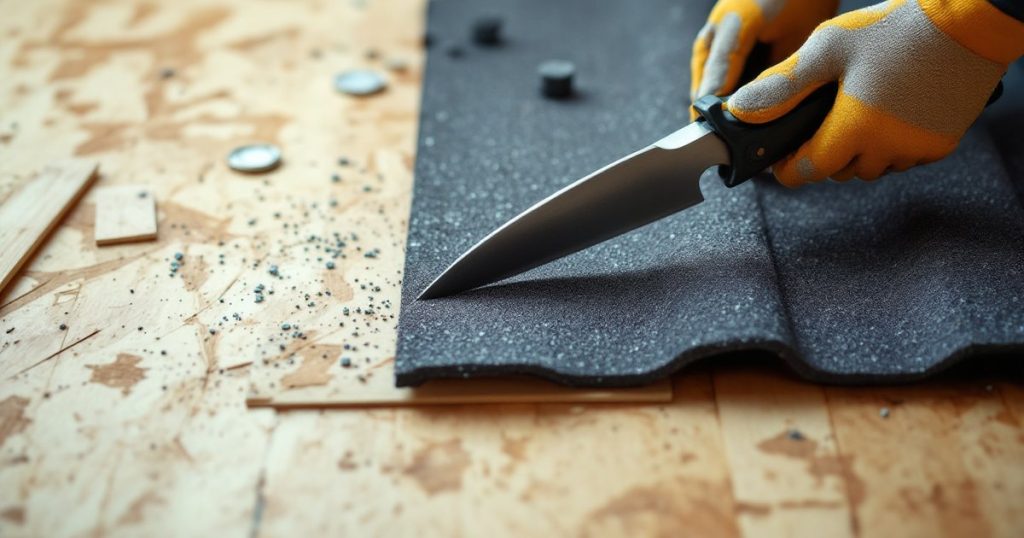
To cut shingles cleanly, mark the line, load a utility knife with a sharp hook blade, and draw it through the shingle in one quick pass, usually working from the smooth back side. Where the cut goes matters as much as how you make it. GAF, Owens Corning, CertainTeed and IKO each publish specific cut-back, corner-clip and overhang dimensions for valleys, rakes, starter strips and vents, and they do not all agree. This guide compiles those dimensions from each maker’s current installation instructions.
Key numbers at a glance
These are the figures most people need before making a cut. Each comes from a named manufacturer document; where makers differ, the range is shown and broken out in the comparison tables further down.
| What you are cutting | Number | Source |
|---|---|---|
| Closed-cut valley: top-layer shingles cut back from the valley centerline | 2 inches | GAF Timberline instructions; Owens Corning Duration instructions (July 2026); CertainTeed Landmark instructions; IKO |
| Valley corner clip | 45 degrees (GAF, no size stated); 2 inches (CertainTeed, IKO); 1 inch (Owens Corning Roofer’s Guide) | Maker instructions listed in Sources |
| No-nail zone either side of a closed valley centerline | 6 inches | GAF, Owens Corning, CertainTeed |
| Underlying shingles carried across the valley | At least 12 inches past centerline | GAF, Owens Corning, CertainTeed, IKO |
| Starter and shingle overhang at rakes and eaves | 1/4 to 3/4 inch (GAF, Owens Corning, IKO); 1/2 inch with drip edge, 3/4 inch without, never over 1 inch (CertainTeed) | Maker instructions |
| Hook blades, 5-pack (Stanley 11-983) | About $6 to $8 | Walmart and Gas and Supply listings, checked Oct 13, 2026 |
What is the best tool to cut shingles?
The best tool to cut asphalt shingles for most jobs is a utility knife with a hook blade, because the curved edge pulls through the mat without wandering. GAF’s Timberline instructions state that curved blade utility knives cut its laminated shingles more effectively than straight blades, and that a circular saw with a carbide-tipped blade is also effective. Powered shears suit crews making hundreds of valley cuts.
Prices below are retail listings checked on October 13, 2026 through Google Shopping. They change by retailer and promotion, so treat them as a dated snapshot rather than a quote. For product picks among knives, see our ranked guide to the best roofing knife.
| Tool | Best use | Trade-off | Listed price (Oct 13, 2026) | Source |
|---|---|---|---|---|
| Utility knife (e.g. Stanley FatMax 10-778) | All-round cutting, repairs, rakes, valleys | Blade dulls fast on granules | $14.99 to $16.27 | Ace Hardware, Walmart listings |
| Hook blades, 5-pack (Stanley 11-983; Milwaukee hook blades) | Pull cuts through shingles and roll roofing | Needs a knife that takes standard blades | $5.99 to $8.21 (Stanley); $6.97 to $7.99 (Milwaukee) | Walmart, Gas and Supply, Milwaukee Store, Farm and Home Supply listings |
| Fixed hook-bill knife (Hyde 20550) | All-day shingle and felt cutting | Blade always exposed | $12.22 to $13.76 | Groves Industrial, Surry General Store listings |
| Drill-mounted shingle shear (Malco TurboShear TSS1) | Valley trim and cuts around outlets | Needs a drill; rated to 1/2 inch of shingle | $249.99 to $292.15 | Malco spec page; RSI Hardware, SupplyHouse listings |
| Circular saw blade, carbide (Diablo 7-1/4 in, 24-tooth) | Stacks of thick laminated shingles on the ground | Dust, noise, cut hazard; not for cutting on the roof surface | $9.97 | Acme Tools, Northern Tool, SupplyHouse listings |
| Bench lever cutters (Roof Zone Shingle Shaper; Qual-Craft Shingle Shark) | Repetitive identical cuts at the staging area | Cost, weight | $289.75 to $319.95 (Roof Zone); $513.89 (Shingle Shark) | Panther East, Big Rock Supply, Acme Tools listings |
A homeowner replacing a few shingles needs only the knife and a pack of hook blades, roughly $21 to $24 at the listed prices. The full tool list for larger jobs, with 2026 price ranges, is in our roofing tools and equipment guide.
How to cut asphalt shingles with a hook blade, step by step
Cutting asphalt shingles with a hook blade takes six steps: mark, position, hook, pull, check and replace the blade when it drags. Owens Corning’s Roofer’s Guide advises keeping every cutting device sharp and cutting “with a quick motion as you pull the roofing knife through the shingle.” GAF’s field guide adds the safety rules: cut away from your body and replace dull blades often.
- Mark the line. Snap a chalk line on the roof for valley and rake cuts, or use a straightedge or square for a single shingle on the ground.
- Support the shingle. For loose shingles, cut on a scrap of plywood or on the bundle. For cuts made in place, such as a closed-cut valley, keep the blade shallow; Owens Corning’s Duration instructions warn to take care not to cut the underlying shingles.
- Flip it if you are cutting a loose shingle. Cutting from the smooth back side keeps the blade out of the granules. This is common trade practice described in the top-ranking how-to results; the four makers’ instructions reviewed here do not require a particular face.
- Hook and pull. Set the hook at the edge and draw it along the line in one steady pass, with your body and free hand out of the blade’s path, as GAF’s utility knife safety rules direct.
- Check the edge. A clean cut leaves a crisp line. Torn granules or a ragged mat mean the blade is dull.
- Change the blade. GAF’s field guide notes that dull blades have to be forced, which increases the chance of slipping. Retract or cover the blade when you set the knife down.
The straight-blade score-and-snap method
A straight utility blade can cut shingles by scoring rather than slicing. Score the back side once or twice along a straightedge, bend the shingle along the score, and run the blade through the remaining mat. It works on single-layer 3-tab shingles but struggles on laminated shingles, which GAF describes as particularly tough and better cut with a curved blade.
Can you cut shingles with a circular saw or oscillating tool?
You can cut shingles with a circular saw, and GAF names a carbide-tipped circular saw blade as effective for its Timberline laminated shingles. None of the GAF, Owens Corning, CertainTeed or IKO instructions reviewed for this guide mention oscillating multi-tools. They appear in popular videos for trimming shingles, but no maker endorses or prohibits them in these documents.
Power cutting belongs on the ground or on a stable work surface, not on installed roofing where a blade can slice underlayment or the deck. On the roof, OSHA requires fall protection for residential construction work 6 feet or more above a lower level (29 CFR 1926.501). A corded or cordless saw adds a cord or a heavy tool to that hazard, which is why most on-roof trimming is still done with a knife.
Where the cuts go: GAF, Owens Corning, CertainTeed and IKO compared
The four largest North American shingle makers agree on the 2 inch closed-cut valley cut-back and a 6 inch no-nail zone, but they differ on corner clips, cement width, woven valleys and how far the starter overhangs the rake. Follow the instructions for the shingle you are installing, because warranty coverage depends on them.
| Cutting detail | GAF (Timberline) | Owens Corning (Duration) | CertainTeed (Landmark) | IKO (Cambridge) |
|---|---|---|---|---|
| Preferred valley | Open or closed-cut; woven not for laminated shingles | Closed-cut, woven or metal all acceptable | Closed-cut preferred; open and woven acceptable | Open metal recommended; closed acceptable but not recommended (see warranty) |
| Closed-cut cut-back | 2 inches from centerline | Chalk line 2 inches from centerline | 2 inches back from centerline | 2 inches back of centerline (IKO installation article) |
| Corner clip | 45 degrees, size not stated | “Clip upper corner,” size not stated in July 2026 sheet | Cut 2 inches diagonally off upper corner | 2 inch triangle (open valley) |
| Cement at the cut edge | Seal valley shingles to each other with plastic cement | 3 to 4 inch wide continuous bead | Embed each shingle in a 2 inch wide strip | 3 inch band (open valley) |
| Nail limit near valley | None within 6 inches of centerline; extra nail at shingle end | Fasten at least 6 inches from centerline | No nails within 6 inches of centerline | No nail closer than 2 inches from the open-valley chalk line |
| Starter overhang at rake and eave | 1/4 to 3/4 inch | 1/4 to 3/4 inch past drip edge | 1/2 inch with drip edge, 3/4 inch without, max 1 inch | 1/4 to 3/4 inch |
| Source document | Timberline LayerLock instructions RESTL622; Pro Field Guide RESGN103 (2025) | Pub. No. 10014283-L (July 2026) | Master Craftsman Shingle Applicator’s Manual, Landmark chapter | Cambridge instructions (01/21) |
How to cut shingles for a closed-cut valley
In a closed-cut valley, shingles from one roof plane run at least 12 inches across the valley, and shingles from the other plane are cut 2 inches short of the centerline, clipped at the top corner and sealed. GAF puts the larger roof plane on top so the bigger water flow runs over the cut line. CertainTeed likewise lays the smaller roof area across the valley first.
- Line the valley first. GAF calls for a full 36 inch roll of its leak barrier centered in the valley; Owens Corning and CertainTeed call for a 36 inch wide valley liner or waterproofing underlayment.
- Run the underlying plane through. Carry each course at least 12 inches past the centerline, press it into the valley, and keep nails 6 inches away from the centerline. GAF adds an extra fastener at the shingle end to make up for the nail-free strip.
- Snap the cut line. Snap a chalk line 2 inches from the centerline on the side you have not yet shingled.
- Shingle the top plane past the line. GAF’s field guide lets you leave the top shingles extended past the centerline and cut them later.
- Cut along the chalk line. Use a shallow pull cut so the hook blade does not score the shingles underneath.
- Clip the upper corner. Cut the top corner of each trimmed shingle at about 45 degrees so water is steered back to the valley center: 2 inches off for CertainTeed, a 45 degree clip for GAF.
- Seal the cut edge. Bed the cut ends in asphalt roofing cement at the width your maker specifies (2 inches CertainTeed, 3 to 4 inches Owens Corning). GAF and Owens Corning both warn that excess cement can blister shingles.
Owens Corning’s older Roofer’s Guide adds a rule worth keeping for any valley: never finish a course with a shingle trimmed shorter than 12 inches, and trim a section off the adjacent shingle instead so a longer piece reaches the valley. The underlayment stack, metal options and failure modes behind these cuts are covered in our valley flashing detail guide.
How to cut shingles for an open metal valley
For an open metal valley, snap two chalk lines 6 inches apart at the top of the valley that spread 1/8 inch per foot toward the eave, trim every shingle end to its line, clip the top corner and bed the end in cement. GAF, Owens Corning and IKO all use the 6 inch start and the 1/8 inch per foot taper, which handles the growing water volume lower in the valley.
The table shows the exposed width at the eave for common valley lengths. It is Roofing Brief arithmetic from the makers’ rule: 6 inches plus 1/8 inch for every foot of valley length. Owens Corning’s Roofer’s Guide gives the same 7 and 8 inch results for 8 and 16 foot valleys, and IKO caps the spread at 8 inches.
| Valley length | Width at top | Added taper (1/8 in per ft) | Width at eave | Note |
|---|---|---|---|---|
| 8 ft | 6 in | 1 in | 7 in | Matches Owens Corning example |
| 12 ft | 6 in | 1-1/2 in | 7-1/2 in | Roofing Brief arithmetic |
| 16 ft | 6 in | 2 in | 8 in | Matches Owens Corning example; IKO maximum |
| 20 ft | 6 in | 2-1/2 in | 8-1/2 in (IKO: 8 in max) | Roofing Brief arithmetic |
| 24 ft | 6 in | 3 in | 9 in (IKO: 8 in max) | Roofing Brief arithmetic |
Metal and cut details differ slightly by maker. GAF specifies valley metal at least 20 inches wide and 24 gauge, with shingles lapping the metal at least 4 inches. IKO’s Cambridge sheet specifies at least 24 inch wide, 28 gauge metal, a 2 inch triangle clipped off each shingle corner and a 3 inch band of asphalt plastic cement.
How far should shingles overhang the rake, and how do you cut rake shingles?
Most makers want the starter and the first shingle in each course to overhang the rake drip edge by 1/4 to 3/4 inch. CertainTeed’s Landmark instructions set 1/2 inch with drip edge, 3/4 inch without, and never more than 1 inch. Owens Corning lets shingles sit flush with D, F or T style drip edge. Rake cuts follow a set offset schedule.
The offset schedule is the length cut off the first shingle of each course so end joints do not line up. Cut these on the ground with a square, then set each piece at the rake with the specified overhang. Owens Corning’s cold-weather rule applies here too: below 40 degrees F, all perimeter shingles must be hand-sealed with four 1 inch dabs of ASTM D4586 asphalt cement.
| Course | GAF Timberline | Owens Corning Duration | CertainTeed Landmark | IKO Cambridge |
|---|---|---|---|---|
| 1st | Full shingle | Full shingle | Full shingle | Full shingle |
| 2nd | Trim 6 in | Remove 6-1/2 in | Cut 6 in (save piece) | Trim 10 in |
| 3rd | Trim 11 in | Remove 13 in | Cut 11 in (save piece) | Trim 20 in |
| 4th | Trim 17 in | Remove 19-1/2 in | Use saved 11 in piece | Trim 30 in |
| 5th | Full shingle, repeat | Remove 26 in | Use saved 6 in piece | Repeat sequence |
| 6th | Repeat | Remove 32-1/2 in | Full shingle, repeat | Repeat |
| Source | RESTL622 | Pub. No. 10014283-L, July 2026 | Landmark chapter, five-course method | Cambridge instructions |
IKO’s Cambridge instructions also recommend cementing shingles at rake edges for maximum wind protection, and GAF says that for maximum wind resistance at rakes you should use a GAF starter strip that contains sealant, or cement the shingles to the underlayment and to each other in a 4 inch width of asphalt plastic cement.
How to cut a starter strip from 3-tab shingles
To cut a starter strip from a 3-tab shingle, trim off the tabs along a straight line across the tops of the cutouts, then trim 4 to 6 inches off the first piece so its joints offset the first course. The self-seal strip must end up at the eave. IKO notes that a 3-tab simply laid upside down puts the sealant too high to seal the first course.
- Check that your maker allows it. All four makers recommend their own starter products. GAF’s field guide gives a hand-cut method for 3-tab roofs; CertainTeed accepts self-sealing 3-tabs with the tabs removed; Owens Corning’s only approved field starter for Duration is a Duration shingle with the exposure section cut off.
- Cut the tabs off straight. Cut across the tops of the cutouts in one straight line so the sealant strip sits along the lower edge.
- Check the height. CertainTeed requires starter pieces at least 7-5/8 inches tall.
- Trim the first piece. GAF trims 6 inches, CertainTeed 6 inches, Owens Corning 6-1/2 inches, and ARMA’s manual 4 to 6 inches.
- Set the overhang. Overhang the drip edge by your maker’s figure, 1/4 to 3/4 inch for most.
- Nail low. ARMA and GAF place starter fasteners 1-1/2 to 3 inches above the eave edge; IKO’s article says about 3 to 4 inches from the outer edge.
The strip height you get depends on the shingle size. The table is Roofing Brief arithmetic from published dimensions: ARMA’s manual lists the metric-size strip shingle at 13-1/4 by 39-3/8 inches with a 5-5/8 inch exposure, and the older English size is 12 by 36 inches with a 5 inch exposure.
| 3-tab size | Height minus tab depth | Starter height | Meets CertainTeed 7-5/8 in minimum? | Shingles per 100 ft of eave |
|---|---|---|---|---|
| Metric, 13-1/4 x 39-3/8 in | 13-1/4 minus 5-5/8 | About 7-5/8 in | Yes, just | 31 (1,200 in divided by 39-3/8 in = 30.5, rounded up) |
| English, 12 x 36 in | 12 minus 5 | About 7 in | No | 34 (1,200 in divided by 36 in = 33.3, rounded up) |
The count assumes no waste and one starter piece per shingle. Add the rakes if you run a starter there too, as GAF recommends for best performance.
How to cut shingles around a plumbing vent
To cut shingles around a plumbing vent, shingle up to the pipe, cut a hole in the next shingle so it fits tightly over the pipe, set it in asphalt roof cement, then slide the flashing boot over the pipe and continue shingling over its upper flange. This sequence comes from GAF’s Pro Field Guide and the ARMA Residential Asphalt Roofing Manual.
- Shingle up to the pipe. Bring the courses up until the next shingle would land on the pipe.
- Cut the hole. Hold the shingle in position, mark the pipe location, and cut an opening that fits tightly around the pipe.
- Seal it. GAF calls for a bead of plastic cement around the pipe; ARMA sets the shingle in ASTM D4586 roof cement.
- Set the flange. Slide the preformed flange over the pipe into a bed of cement, and seal the flange to the pipe at the top.
- Shingle over the upper flange. Cut the upslope shingles to fit around the boot collar. GAF says the lower part of the flange should sit flush without face nailing.
Both GAF and ARMA warn that excess cement can blister shingles. The Owens Corning, CertainTeed and IKO shingle sheets reviewed here do not give a vent-pipe cut sequence. For boot types and when a boot needs replacing, see our roof vent pipe boot guide.
Cutting shingles in cold weather
Cold shingles are stiff and break easily, so warm them before bending and handle them gently. GAF says asphalt shingles are stiff in cold weather and can easily break. Owens Corning calls for extra care below 40 degrees F. CertainTeed says shingles must be warm enough to form hips, ridges and valleys without cracking.
- Warm before forming. ARMA’s manual says to warm a shingle until it is pliable before forming it, and not to install shingles that cracked while being formed.
- Store accessories warm. IKO advises storing hip and ridge shingles in a heated area before cold-weather use.
- Gap and seal. Below 40 degrees F, Owens Corning requires a gap of no more than 1/16 inch at shingle end joints and hand-sealing of perimeter shingles.
- Hot days cut differently. GAF warns that shingle edges are easily damaged in hot weather, so cut on a firm surface and avoid dragging cut pieces across the roof.
Hand-sealing after cold-weather repairs is covered step by step in our shingle replacement guide.
Which cutting method should you use?
Pick the cutting method by the number of cuts, the shingle type and where the cut happens. A hook-blade knife covers nearly every situation. Power tools only pay off for high-volume valley work or stacks of thick laminated shingles cut on the ground.
| Your situation | Use this | Why | Source |
|---|---|---|---|
| Repairing 1 to 3 shingles | Utility knife with hook blade | Low cost, cuts both 3-tab and laminated shingles | GAF RESTL622 precautionary notes |
| Thick laminated or premium shingles | Curved hook blade, or carbide circular saw on the ground | GAF calls these shingles tough to trim | GAF RESTL622 |
| Closed-cut valley trimmed in place | Hook blade with a shallow pull, or a drill shear | Protects the underlying shingles; Malco markets the TSS1 for valley trim | Owens Corning 10014283-L; Malco |
| Many identical rake or starter pieces | Knife and square at a staging bench, or a lever cutter | Repeatable straight cuts | Owens Corning 10014283-L (straight horizontal cut) |
| Below 40 degrees F | Warm shingles first, then cut and hand-seal perimeter pieces | Cold shingles crack and do not self-seal | Owens Corning; GAF; ARMA |
| Starter for a Duration roof | Owens Corning starter, or a Duration shingle with the exposure cut off | Only approved field-starter method for that line | Owens Corning 10014283-L |
Frequently asked questions
What is the best tool to cut shingles with?
A utility knife with a hook blade is the best tool for most shingle cutting. GAF’s Timberline instructions say curved blade knives cut laminated shingles more effectively than straight blades and that a carbide-tipped circular saw blade also works. Drill-mounted shears such as the Malco TurboShear TSS1 suit crews making many valley cuts.
What is the easiest way to cut shingles?
The easiest way to cut shingles is to mark a straight line, turn a loose shingle face down, and pull a sharp hook blade through it in one quick pass. Owens Corning advises keeping cutting devices sharp and using a quick motion. Replace the blade when it starts tearing granules instead of slicing.
Can I cut shingles with an oscillating tool?
You can, and oscillating multi-tools appear in popular shingle-cutting videos, but none of the GAF, Owens Corning, CertainTeed or IKO installation instructions reviewed for this guide mention them. GAF names curved blade knives and carbide-tipped circular saws. If you use any power tool, keep it away from installed underlayment and work with fall protection.
Should you cut shingles from the back side?
Cutting a loose shingle from the smooth back side is common trade practice because the blade avoids the abrasive granules and dulls more slowly. The maker instructions reviewed here do not require a particular face. For cuts made in place, such as a closed-cut valley, you cut from the top and must avoid scoring the shingles underneath.
Can you cut shingles with a circular saw?
Yes. GAF states that a circular saw with a carbide-tipped blade is effective for cutting its Timberline shingles. Make saw cuts on the ground or a stable bench, not on the roof surface, where the blade can cut underlayment or decking. A 24-tooth carbide framing blade listed for $9.97 at several retailers on October 13, 2026.
How far back do you cut shingles in a valley?
In a closed-cut valley, cut the top-layer shingles 2 inches back from the valley centerline, clip the upper corner and seal the edge in roofing cement. GAF, Owens Corning, CertainTeed and IKO all use the 2 inch figure. Clip and cement widths differ: CertainTeed clips 2 inches and uses a 2 inch cement strip.
Sources
- GAF, Timberline LayerLock Installation Instructions (RESTL622).
- GAF, Steep-Slope Pro Field Guide (RESGN103, 2025).
- Owens Corning, Duration Series Shingles Installation Instructions, Pub. No. 10014283-L (July 2026).
- Owens Corning, Roofer’s Guide, Pub. No. 10020940 (2016).
- CertainTeed, Landmark Series installation instructions, Master Craftsman Shingle Applicator’s Manual.
- IKO, Cambridge Application Instructions (01/21); IKO articles on starter shingles (Sept 2023) and shingle installation (Oct 2023).
- Asphalt Roofing Manufacturers Association, Residential Asphalt Roofing Manual (2014).
- Malco Tools, TurboShear asphalt shingle cutter (TSS1) product page.