
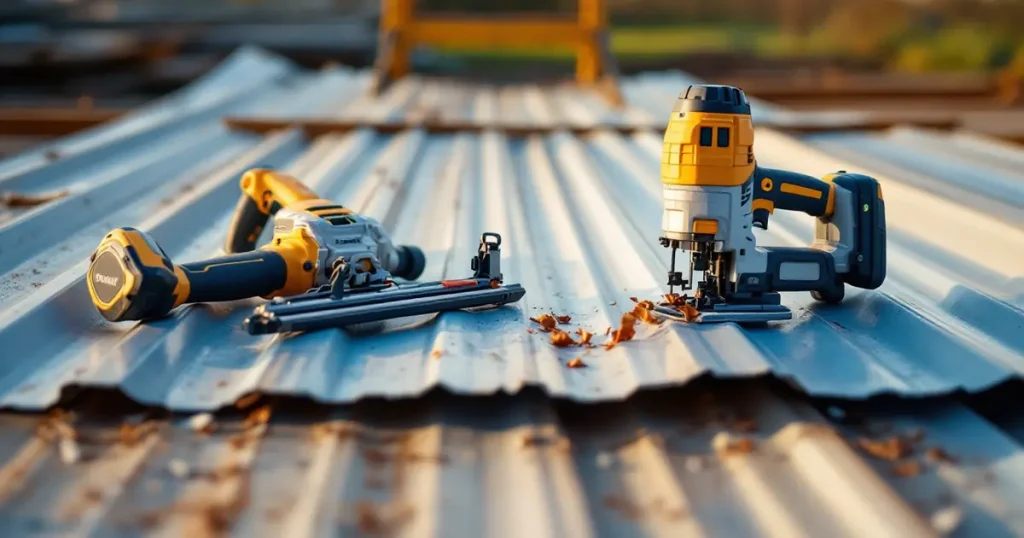
Nibbler vs shears for metal roofing comes down to panel profile and cut shape: a nibbler punches out small crescents, so it climbs the ribs of corrugated and PBR panels and turns curves down to a 1-3/4 in inner-edge radius (Makita JN1601), while a power shear slices a straight line in flat stock, removing either nothing (single cut) or a 7/32 in strip (DeWalt DCS491B double cut). Both outrun the gauges on a house roof. The 16 gauge rating on a Milwaukee 2476-20 nibbler is 0.0598 in, 3.3 times the 0.0179 in of a 26 gauge panel.
All 15 current power tools compared here, from Milwaukee, Makita, DeWalt, Bosch and TRUMPF, are rated for 29 to 24 gauge roofing, so the choice turns on the other maker-published numbers: minimum radius, rib depth, start hole, waste and October 2026 retail price. Four panel makers’ cutting rules are set out as well. The Roofing Brief has not bench tested these tools. Every figure comes from the maker’s product page, manual or a named retailer listing.
Key numbers at a glance
These are the figures behind most nibbler or shear decisions on a metal roof. Gauge thicknesses use the Manufacturers’ Standard Gauge for uncoated steel sheet, which matches Malco’s published 24 gauge = 0.61 mm conversion.
| Figure | Value | Source |
|---|---|---|
| Compact nibbler capacity | 16 ga mild steel (0.0598 in), 18 ga stainless | Milwaukee 2476-20, Makita XNJ01Z and JN1601 product pages |
| Heavy nibbler capacity | 10 ga mild steel (0.1345 in) | Milwaukee 3476-20, Makita JN3201 product pages |
| Common residential panel thickness | 29 ga 0.0135 in, 26 ga 0.0179 in, 24 ga 0.0239 in | Manufacturers’ Standard Gauge; MBCI PBR is 26 ga standard |
| Double cut shear waste strip | 7/32 in, curls out of the cut | DeWalt DCS491B and DCS494B product pages |
| Nibbler cutting track | 5 mm (0.197 in) | Bosch GNA 18V-16 E technical data (UK) |
| Tightest published radius | Nibbler 1-3/4 in (Makita JN1601 inner edge); shear 1.0 in (DeWalt DCS496B offset shear) | Makita and DeWalt product pages |
| Price, bare tool, October 2026 | Nibblers $254 to $799; shears $259 to $469 | Home Depot, Lowe’s, Acme Tools, Tool Nut listings |
How a nibbler and a shear cut metal roofing differently
A nibbler drives a punch down through the sheet into a die about 1,300 to 2,200 times a minute (Makita JN3201: 1,300 spm; Makita JN1601: 2,200 spm), removing a 5 mm wide track of crescent chips. A shear closes blades like scissors at 2,300 to 4,000 strokes a minute (DeWalt DCS491B up to 2,300; Makita JS1602 4,000). The cut mechanism decides which panels each tool can follow, which is the real shear vs nibbler question on a roof.
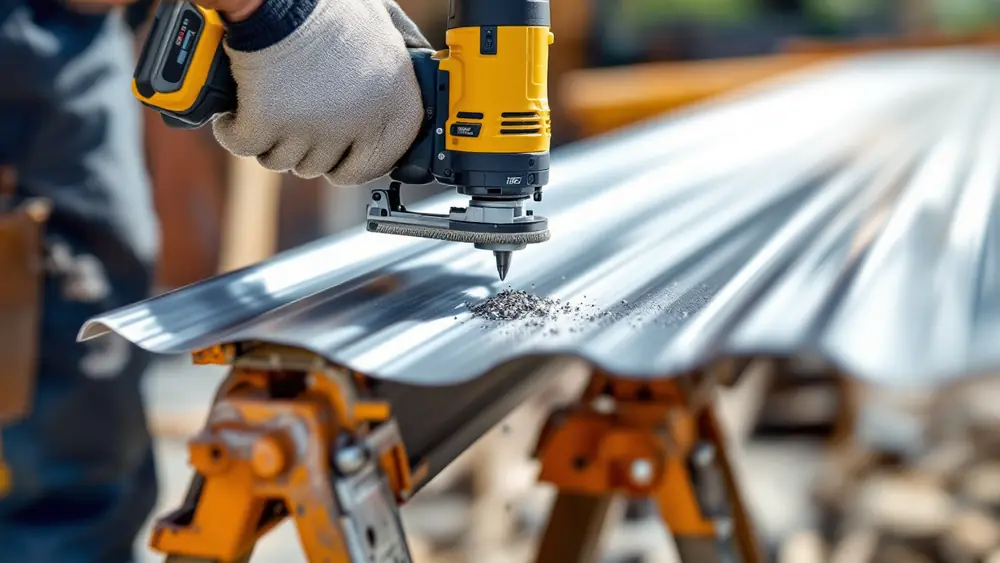
A single cut shear removes no metal; Makita says its JS1602 is “engineered to cut without the material loss in kerf typically associated with nibblers.” The tradeoff is that one side of a single cut curls. A double cut shear runs a center blade between two outer blades and peels off a 7/32 in strip, leaving both edges flat. A nibbler leaves both edges flat too, but sprays its waste as loose chips.
| Factor | Nibbler | Single cut shear | Double cut shear | Source |
|---|---|---|---|---|
| Waste | 5 mm track of chips | None | 7/32 in continuous strip | Bosch GB data; Makita JS1602; DeWalt DCS491B |
| Edge shape | Both sides flat | One side curls | Both sides flat | Tooled-Up single vs double cut explainer; Makita XSJ03Z page (“minimizes material distortion”) |
| Tightest radius (example) | 1-3/4 in, Makita JN1601 | 1.5 in, Milwaukee 2637-20 (3 in minimum cut diameter) | 5.5 in, DeWalt DCS491B | Maker pages; Rexel listing for 2637-20 |
| Interior cutout from a drilled hole | Yes: 21 to 22 mm start hole | No | No | Makita JN1601 manual; Bosch; TRUMPF |
| Ribbed or corrugated crosscut | Yes, with die turned to the cut direction | Not marketed for it | Milwaukee: “optimized for straight cuts” | Makita JN1601 manual; Milwaukee 2635-20 page |
| Panel maker approval | Listed by MBCI, ABC, Gibraltar, Lysaght | Listed by MBCI, ABC, Lysaght | Listed by MBCI, ABC, Lysaght | See the panel maker table below |
Gauge capacity: how much headroom each tool has on roofing steel
Every power nibbler and shear in this comparison cuts residential roofing gauges with room to spare; the limit that bites on a roof is profile, not thickness (16 ga nibblers are rated for 0.0598 in steel against 0.0135 to 0.0239 in panels). The table divides each tool class’s rated thickness by the panel thickness. A ratio of 2.0 means the tool is rated for steel twice as thick as the panel.
| Panel gauge (example product) | Thickness | 16 ga nibbler (0.0598 in) | 18 ga shear (0.0478 in) | Malco MAX2000 snips (0.048 in mild steel) | Malco TSCM (0.024 in max) |
|---|---|---|---|---|---|
| 29 ga (Union Corrugating MasterRib, per Lowe’s listings) | 0.0135 in (0.34 mm) | 4.4 times | 3.5 times | 3.6 times | 1.8 times |
| 26 ga (MBCI PBR standard) | 0.0179 in (0.45 mm) | 3.3 times | 2.7 times | 2.7 times | 1.3 times |
| 24 ga (common standing seam) | 0.0239 in (0.61 mm) | 2.5 times | 2.0 times | 2.0 times | 1.0 times, at its limit |
| 22 ga (heavier commercial) | 0.0299 in (0.76 mm) | 2.0 times | 1.6 times | 1.6 times | Over capacity |
Ratings assume mild steel. Each maker drops stainless one or two gauges: the Makita JN3201 goes from 10 ga mild steel to 13 ga stainless, and the DeWalt DCS494B from 14 ga to 16 ga. Aluminum ratings run thicker, such as 12 ga on the Makita XNJ01Z, because aluminum roofing sheet is softer. Makita’s JN1601 manual says the groove on the die holder doubles as a thickness gauge, with marks at 1.6 mm for mild steel and 1.2 mm for stainless; if the panel does not fit the groove, do not cut it.
Nibblers for metal roofing compared by model
Seven nibblers cover the roofing market, from the 3.5 lb TRUMPF N 160 to the 7.6 lb Milwaukee 3476-20. For 29 to 24 gauge panels, any 16 gauge model has the capacity. The differences that matter on a roof are battery platform, radius, start hole and whether the maker publishes a rib depth or sells an extension for deep corrugation.
| Model | Power | Mild steel / stainless | Min radius | Speed | Weight | Roofing note | Price (Oct 2026) |
|---|---|---|---|---|---|---|---|
| Milwaukee M12 FUEL 2476-20 | 12V cordless | 16 ga / 18 ga | Not on Milwaukee page | Up to 7 ft/min in 16 ga | Not consistent across listings | Chip bag included; 49-72-0152 die holder extension listed for deeper corrugation | $254 after $25 promo, Home Depot |
| Milwaukee M18 FUEL 3476-20 | 18V cordless | 10 ga / 12 ga | 2 in | About 5 ft/min in 10 ga (Milwaukee image caption) | 7.6 lb | Capacity far beyond roofing panels; chip bag included | $799, Home Depot |
| Makita XNJ01Z | 18V LXT cordless | 16 ga / 18 ga | 1-3/4 in inner, 2 in outer | 0 to 1,900 spm | 4.8 lb with battery | Makita: “ideal for cutting roofing sheet metal”; chips exit below the sheet | Retailer listings inconsistent; check current price |
| Makita JN1601 | 5 A corded | 16 ga / 18 ga | 1-3/4 in inner, 2 in outer | 2,200 spm | 3.6 lb | Manual covers corrugated and trapezoidal sheet; 21 mm start hole | $444, Burns Power Tools |
| Makita JN3201 | 6.2 A corded | 10 ga / 13 ga | 4-3/4 in inner | 1,300 spm | 7.5 lb | Wide radius; built for plate, not panels | $799, Acme Tools |
| Bosch GNA18V-16EN | 18V cordless | 16 ga (US page) | 40 mm (1.57 in), GNA 18V-16 E UK data | 1,400 spm | 3.7 lb | 5 mm cutting track; 22 mm start hole | Not checked |
| TRUMPF TruTool N 160 | 12V cordless | 1.6 mm steel at 400 N/mm2 | 24 mm (0.94 in) | 2.2 m/min (7.2 ft/min) | 1.6 kg (3.5 lb) with battery | Cuts trapezoidal sheet up to 40 mm deep; 22 mm start hole | Dealer quote |
The DeWalt 20V MAX metal cutters we found on dewalt.com in October 2026 (DCS491B, DCS494B and DCS496B) are all shears, and we found no DeWalt-branded nibbler. The DCS496B is listed as a “Swivel Head Offset Shears 18 Gauge,” even though some retail category pages group it with nibblers. If you are on DeWalt batteries, the choice is between its three shears or a nibbler from another platform.
Power shears for metal roofing compared by model
Eight shears cover flat-stock roofing work. The 18 gauge class handles every residential panel at 2.0 times or more headroom on 24 gauge; 14 gauge models add capacity a house roof rarely uses. The DeWalt DCS496B offset shear is the one shear in this group that turns a 1.0 in radius, close to nibbler territory for round cutouts.
| Model | Cut type | Mild steel / stainless | Min radius | Speed | Price (Oct 2026) | Source |
|---|---|---|---|---|---|---|
| DeWalt DCS491B | Double cut, swivel head | 18 ga / 20 ga | 5.5 in | 0 to 2,300 spm | $259, Lowe’s | dewalt.com |
| DeWalt DCS494B | Double cut, swivel head | 14 ga / 16 ga | 5 in | 2,450 spm | $279, Ohio Power Tool | dewalt.com |
| DeWalt DCS496B | Offset shear, swivel head | 18 ga | 1.0 in | 0 to 2,300 spm | $299, Lowe’s | dewalt.com |
| Milwaukee M18 2635-20 | Double cut | 18 ga / 20 ga | 3 in (6 in min cut diameter, listings) | Not on Milwaukee page | $299, Acme Tools | milwaukeetool.com |
| Milwaukee M18 2637-20 | Single cut | 18 ga / 20 ga | 1.5 in (3 in min cut diameter, Rexel) | 2,300 spm (Stanion listing) | $349, R.S. Hughes | Rexel, Stanion listings |
| Makita XSJ03Z | Double cut, D-handle | 14 ga / 16 ga | Not listed | 0 to 3,000 spm | $419, The Power Tool Store | makitatools.com |
| Makita XSJ04Z | Offset shear | 18 ga / 20 ga | “Radius cuts up to 3 in” | 0 to 3,000 spm | $469, Tool Nut | makitatools.com |
| Makita JS1602 | Corded straight shear, 3.3 A | 16 ga / 18 ga | 1-3/16 in | 4,000 spm | Not checked | makitatools.com |
Milwaukee listings quote minimum cut diameter, not radius: 3 in on the 2637-20 is a 1.5 in radius, and 6 in on the 2635-20 is a 3 in radius. Two non-shear cutters also matter on a roof. Malco’s TSCM TurboShear chucks into a drill (minimum 14.4V, 1/4 in chuck) and is rated for 30 to 24 gauge corrugated and box-rib panels, with blades set at a 75 degree offset so the drill clears the profile; SupplyHouse.com listed it at $146.37. Malco’s MAX2000 aviation snips (M2001 left, M2002 right, M2003 combination) are rated 0.048 in mild steel and 0.054 in galvanized, listed at $35.99 for the M2001.
Cutting corrugated and ribbed panels: where shears stop
A crosscut on an exposed fastener panel has to climb every rib, and that is the nibbler’s job. TRUMPF is the only maker in this group that publishes a profile limit: its TruTool N 160 cuts trapezoidal sheet up to 40 mm (1.57 in) deep. That clears the 1-1/4 in (31.75 mm) ribs on MBCI’s PBR panel and the 3/4 in ribs on Union Corrugating MasterRib.
Milwaukee and Makita do not print a maximum rib depth. Milwaukee sells the 49-72-0152 die holder extension for the 2476-20, which retailer listings describe as for cutting deeper corrugated metal; The Power Tool Store listed it at $149. Makita’s JN1601 manual instead gives the technique: turn the die to face the cutting direction and hold the tool body parallel to the grooves. Shear makers frame their tools for straight work; Milwaukee calls the 2635-20 “optimized for straight cuts with minimal distortion.”
Use this sequence for a nibbler crosscut on a corrugated or trapezoidal panel. Steps 2 to 5 and 8 follow Makita’s JN1601 manual; step 1 follows MBCI and step 9 follows ABC Metal Roofing.
- Set the panel on sawhorses on the ground. MBCI says never cut panels on the roof or over other panels, because swarf can cause permanent staining.
- Check the gauge in the die holder groove. On the Makita JN1601 the groove marks 1.6 mm mild steel and 1.2 mm stainless.
- Coat the cut line with machine oil. Makita says this extends punch and die life and matters most on aluminum.
- Rotate the die so it faces the cutting direction. The JN1601 die turns 360 degrees with positive stops at 0, 90 left, 90 right and 180 degrees.
- Hold the tool body parallel to the ribs with the head at 90 degrees to the surface, and align the die holder notch, which equals the cutting width, with the line.
- Feed gently up and over each rib; do not force the tool flat across the profile.
- Catch chips with the bag Milwaukee ships with the 2476-20 and 3476-20, or sweep below the sawhorses as you go.
- Wait before touching the punch, die or cut edge. Makita warns they “may be extremely hot.”
- Blow filings off the finished face rather than wiping them by hand, as ABC Metal Roofing advises, then check the cut edge for burrs.
Curves, vent holes and cutouts: radius decides the tool
A round hole for a plumbing vent is a radius problem. Schedule 40 PVC pipe has an outside diameter of 2.375 in at 2 in nominal, 3.500 in at 3 in and 4.500 in at 4 in (ASTM D1785), so the hole radius is half of that. For a hole, the panel keeps the outer edge of the kerf, so use Makita’s outer-edge figure: 2 in on the JN1601, against 1-3/4 in on the inner edge. Any interior hole also needs a start hole: 21 mm (13/16 in) for the Makita JN1601 and 22 mm for Bosch and TRUMPF, which a 7/8 in (22.2 mm) step drill clears.
| Hole for | Hole radius | Makita JN1601 (2 in outer edge) | Milwaukee 3476-20 (2 in) | TRUMPF N 160 (24 mm, 0.94 in) | DeWalt DCS496B (1.0 in) | DeWalt DCS491B (5.5 in) |
|---|---|---|---|---|---|---|
| 2 in Sch 40 pipe, 2.375 in OD | 1.19 in | Too tight | Too tight | Yes | Yes, cutting in from an edge | No |
| 3 in Sch 40 pipe, 3.500 in OD | 1.75 in | Too tight | Too tight | Yes | Yes, cutting in from an edge | No |
| 4 in Sch 40 pipe, 4.500 in OD | 2.25 in | Yes | Yes | Yes | Yes, cutting in from an edge | No |
| Square skylight or chimney opening | Corners only | Yes, from a start hole | Yes, from a start hole | Yes, from a start hole | Needs an edge to start | Needs an edge to start |
Radius figures come from the Makita, Milwaukee, TRUMPF and DeWalt product pages. A shear has to enter the sheet from an edge, so an interior vent hole in the middle of a panel is nibbler work unless you cut in from the panel edge and seal the slot. For a 2 or 3 in vent with a 16 gauge nibbler whose radius is too wide, nibble straight segments inside the circle from the start hole and finish the curve with offset snips such as the Malco MAX2000 offset models.
Chips, swarf and paint: what panel makers say
Panel makers agree on the hazard and disagree on saws. All four documents below warn that steel particles left on a coated panel rust or stain. MBCI rules out saws entirely, Gibraltar accepts a 7-1/4 in metal cutting wheel on a circular saw, and Lysaght prefers a metal-cutting saw blade over an abrasive disc. Check the document for the panel you are installing before choosing a tool.

| Panel maker document | Tools named as acceptable | Tools ruled out or ranked lower | Swarf and setup rule |
|---|---|---|---|
| MBCI, “Proper Cutting and Cleaning of Metal Building Panels” (Aug 10, 2017) | Nibblers, snips or shears | Saws, abrasive blades, grinders, torches | Swarf “can cause permanent staining”; cut on the ground, never over other panels |
| Gibraltar Building Products help article, 29 ga SM-Rib panel | Nibblers, tin snips or a 7-1/4 in metal cutting wheel on a circular saw | None named | Saw filings are hot and adhere; cut from the underside and remove all filings |
| ABC Metal Roofing, “How To Cut Metal Panels” (Oct 21, 2020) | Shears and nibblers for panels, snips for trim | Skill saw only “if this is the only resource available,” with a metal panel blade | Painted side down for a saw; blow filings off, do not touch them |
| Lysaght (Colorbond steel, Australia), “Tips for cutting sheet metal onsite” | Power saw with metal-cutting blade (preferred); electric shears and nibblers | Carborundum (abrasive) disc leaves more burr | Cut over the ground with the color face down; swarf “will cause rust stains” |
MBCI calls cutting with the wrong tools a “warranty-buster at worst,” so read your panel and paint warranty before using any saw. Makita builds the XNJ01Z so chips drop below the sheet “to minimize damage to cutting surface,” which suits cutting with the finished face up when the panel is supported on sawhorses. A circular saw is the case where the color face goes down.
Waste per 100 ft of cut: chips vs strip, worked out
A nibbler and a double cut shear remove about the same weight of steel; the difference is form. Over 100 ft of cut in 26 gauge steel, a 5 mm nibbler track removes about 1.20 lb as loose crescents, and a 7/32 in double cut strip removes about 1.33 lb as one curl. A single cut shear removes none. The table shows the arithmetic, using a steel density of 0.2836 lb per cubic inch.
| Step | Nibbler (5 mm track, Bosch) | Double cut shear (7/32 in strip, DeWalt) | Single cut shear |
|---|---|---|---|
| Cut length | 100 ft = 1,200 in | 1,200 in | 1,200 in |
| Width removed | 0.197 in | 0.219 in | 0 in |
| Area removed | 236.2 sq in | 262.5 sq in | 0 |
| Volume at 26 ga (0.0179 in) | 4.23 cu in | 4.70 cu in | 0 |
| Steel removed, 26 ga | 1.20 lb, as chips | 1.33 lb, as a strip | 0 lb |
| Steel removed, 29 ga (0.0135 in) | 0.90 lb | 1.01 lb | 0 lb |
| Steel removed, 24 ga (0.0239 in) | 1.60 lb | 1.78 lb | 0 lb |
Chip count is the cleanup problem. Milwaukee rates the 2476-20 at up to 7 ft per minute, and retail listings give it up to 2,200 strokes per minute. At those two maximums, each stroke advances about 0.038 in, or roughly 314 chips per foot and 31,400 chips per 100 ft (Roofing Brief estimate from the published figures; actual feed varies with the operator and gauge).
Cutting speed and time per panel
Only two makers in this comparison publish a feed rate for a metal nibbler: Milwaukee rates the 2476-20 at up to 7 ft per minute in 16 gauge, and TRUMPF rates the N 160 at 2.2 m (7.2 ft) per minute. Shear makers publish strokes per minute instead, which does not convert to feet per minute without a stroke length. The table works the Milwaukee figure through a typical exposed fastener reroof.
| Job | Cut length | Trigger time at 7 ft/min | Basis |
|---|---|---|---|
| One crosscut on a 36 in coverage panel (MBCI PBR or MasterRib) | 3 ft of coverage width | About 26 seconds | 3 ft divided by 7 ft/min = 0.43 min |
| 30 panels, one crosscut each | 90 ft | About 12.9 minutes | 90 ft divided by 7 ft/min |
| One 3 in vent hole | 11.0 in circumference | About 8 seconds | 3.500 in OD times 3.1416 = 11.0 in = 0.92 ft |
These are Roofing Brief estimates from the maker’s maximum rate. A ribbed crosscut is longer than the 36 in coverage width because the path climbs each rib, so real trigger time on PBR runs higher than the first row.
Nibbler vs shears price: what each setup costs
The cheapest powered setup in October 2026 listings is a DeWalt DCS491B shear at $259 or a Milwaukee 2476-20 nibbler at $254 after a Home Depot promotion, both bare tools. Carrying both a nibbler and a shear costs about $553 to $913 in the combinations below, before batteries. Prices below are from named retailer listings checked October 19, 2026, and change with promotions.
| Setup | Tools | Listed price (bare tools) | Covers |
|---|---|---|---|
| Hand tools only | Malco M2001 snips ($35.99, SupplyHouse.com) plus Malco TSCM ($146.37, SupplyHouse.com) on your own drill | About $182 | 29 to 24 ga corrugated and box rib, trim, short cuts |
| Milwaukee nibbler plus shear | 2476-20 ($254, Home Depot) plus 2635-20 ($299, Acme Tools) | About $553 | Ribbed crosscuts, cutouts, flat pan rips |
| Milwaukee nibbler with deep-rib extension | 2476-20 ($254) plus 49-72-0152 ($149, The Power Tool Store) | About $403 | Deeper corrugation per Milwaukee’s accessory listing |
| DeWalt shears only | DCS491B ($259, Lowe’s) plus DCS496B ($299, Lowe’s) | About $558 | Straight rips plus 1.0 in radius curves; no rib crosscuts |
| Makita corded nibbler plus cordless shear | JN1601 ($444, Burns Power Tools) plus XSJ04Z ($469, Tool Nut) | About $913 | Ribbed crosscuts, 1-3/4 in holes, flat pan rips |
A corded nibbler on a roof job needs a heavy enough extension cord. Makita’s JN1601 manual table for a tool drawing up to 6 A at 120 V calls for 18 AWG at 25 ft, 16 AWG at 50 and 100 ft, and 14 AWG at 150 ft.
Which one should you buy for your roof?
Choose by the profile on the roof and the cut you make most often: ribbed and corrugated crosscuts go to a nibbler, 24 ga flat-pan rips to an 18 ga double cut shear, and 2 to 3 in vent holes to a tool with a radius near 1 in. The table maps each common roofing job to the tool that matches its profile, radius and gauge from the specs above. For the full kit beyond cutting, see our guide to tools for metal roofing.
| If your job is | Use | Why (spec) |
|---|---|---|
| Crosscutting 29 or 26 ga corrugated or R-panel | 16 ga nibbler, or Malco TSCM on a drill | Climbs ribs; TSCM rated 30 to 24 ga corrugated and box profiles |
| PBR or other 1-1/4 in rib panels | Nibbler with deep-rib support (Milwaukee 49-72-0152 or TRUMPF N 160) | TRUMPF publishes 40 mm (1.57 in) trapezoid depth |
| Ripping 24 ga standing seam pans or flat trim | 18 ga double cut shear | Both edges flat; 2.0 times headroom on 24 ga |
| Hidden cuts under a lap where waste matters | Single cut shear (Milwaukee 2637-20) | No kerf loss, no chips |
| Vent holes for 4 in pipe, skylight corners | Nibbler from a 7/8 in start hole | 21 to 22 mm start hole; 2 in outer-edge radius on JN1601 and 3476-20 |
| 2 and 3 in vent holes or tight trim curves | TRUMPF N 160 or DeWalt DCS496B | 0.94 in and 1.0 in minimum radius |
| A shed or one-off DIY roof in 29 ga | Malco MAX2000 snips plus TSCM | About $182 total; 3.6 times snip headroom on 29 ga |
| Installer whose panel maker is MBCI | Nibbler, snips or shears only | MBCI rules out saws, abrasive blades, grinders and torches |
For a shear-by-shear buying guide, including single vs double cut, see our metal roofing shears guide. Step-by-step cutting for every panel type is in how to cut metal roofing, and corrugated crosscuts and edge rust are covered in how to cut corrugated metal roofing. Profile dimensions for PBR (1-1/4 in ribs), R-panel and 5V are in our guide to types of metal roof panels.
Frequently asked questions
Which is better, nibbler or shear?
For metal roofing, a nibbler is better on ribbed and corrugated panels and interior cutouts, because a punch and die can climb ribs and start from a 21 mm (13/16 in) drilled hole (Makita JN1601). Shears are better for long straight rips on flat standing seam pans and trim: a single cut shear such as the Milwaukee 2637-20 removes no metal at all, and a double cut shear leaves both edges flat.
What are two types of nibblers?
By power source, the two types are powered nibblers (corded, cordless or pneumatic, such as the Makita JN1601 or Milwaukee 2476-20) and manual nibblers you squeeze by hand. Roofers use powered punch-and-die nibblers for panel cuts. Spring-loaded notching nibblers fill a narrow niche: the Masc Nibbler sold by John Stortz and Son cuts a 1 in eave notch in steel up to 26 gauge for standing seam hemming.
What thickness can a nibbler cut?
Compact cordless and corded nibblers are rated for 16 gauge mild steel, 0.0598 in thick: the Milwaukee 2476-20, Makita XNJ01Z and Makita JN1601 all list 16 gauge mild steel and 18 gauge stainless. Heavy nibblers reach 10 gauge, 0.1345 in: the Milwaukee 3476-20 and Makita JN3201. Residential roofing at 29 to 24 gauge is 0.0135 to 0.0239 in, well inside every rating.
What is the best tool for cutting corrugated iron?
For crosscuts on corrugated iron, a nibbler or a corrugated drill attachment such as the Malco TSCM, rated for 30 to 24 gauge corrugated and box profiles. MBCI tells installers to use nibblers, snips or shears and never saws, grinders or torches. Lysaght, the Australian Colorbond roll former, prefers a power saw with a metal-cutting blade over an abrasive disc and says reciprocating nibblers produce an excellent cut.
What is the purpose of a nibbler?
A nibbler cuts sheet metal by punching out a small crescent with each stroke, so it can follow curves, start from a drilled hole and climb over ribs without bending the sheet. On a roof that means crosscuts on corrugated and ribbed panels, vent and skylight cutouts, and curved trim. Makita’s JN1601 manual says an interior cutout starts from a round hole over 21 mm (13/16 in).
What is the best nibbler for cutting metal roofing?
Pick by battery platform and rib depth. Makita markets the 18V XNJ01Z for roofing sheet metal up to 16 gauge. Milwaukee’s M12 FUEL 2476-20 is rated 16 gauge at up to 7 ft per minute and takes the 49-72-0152 die holder extension for deeper corrugation. For trapezoidal ribs up to 40 mm (1.57 in) deep, TRUMPF publishes that figure for its TruTool N 160.
Do nibblers cut straight lines?
Yes, if you guide them. A nibbler follows whatever line you steer, so clamp a straightedge for long rips. Lysaght notes that with electric shears and nibblers extra care with the straightness of the cut may be required. Makita’s die holder has a notch whose width equals the cutting width, which you align to the marked line.
Are nibblers better than shears for cutting metal roofing?
On exposed fastener panels with ribs, usually yes, because Milwaukee describes its 2635-20 double cut shear as optimized for straight cuts, and ribbed profiles need a tool that climbs. On flat standing seam pans and trim stock, shears are faster to clean up: a single cut shear makes no chips, while a nibbler leaves roughly 1.2 lb of crescents per 100 ft of cut in 26 gauge steel (Roofing Brief estimate).