

By The Roofing Brief Team | Last reviewed: October 2026
A solar attic fan is a roof or gable exhaust fan run by its own 10 to 70 W panel: October 2026 models move 433 to 2,280 CFM, cost $349.99 to $913.46, and earn no federal tax credit.
Key takeaways
- Across 22 models from nine makers, including the QuietCool, Solatube and Attic Breeze fans that lead Google’s results, panels run from 10 W to 70 W and published airflow from 433 to 2,280 CFM; five makers publish no CFM for the models we checked.
- Makers rate coverage inconsistently: Maxx Air rates its 1,280 CFM roof fan for 1,200 sq ft (1.07 CFM per sq ft) but its 433 CFM gable fan for 1,850 sq ft (0.23) (Maxx Air).
- In a Central Florida test home, two 10 W solar fans cut daily peak attic air temperature by an average of 22°F and air conditioning energy by 6.0%, about 460 kWh a year (FSEC-GP-171-00).
- At the July 2026 U.S. residential average of 18.31 cents per kWh, those savings are worth $84.23 a year, a payback of 8.8 to 12.3 years on 2026 prices for two fans.
- The IRS says the Residential Clean Energy Credit is not available for property placed in service after December 31, 2025 (IRS, page updated July 4, 2026).
Solar attic fan key numbers
These 8 figures frame most solar attic fan purchases: the sizing rule, the intake rule, the airflow and price spread of 2026 models, the measured savings, the electric fan it replaces, and the tax position. Each row names its source, so you can check the number against the maker sheet, study or government page it came from.
| Figure | Value | Source |
|---|---|---|
| Minimum fan airflow | Attic sq ft x 0.7 = CFM | Air Vent AV-005 sell sheet, Sept 2026 |
| Intake needed | CFM / 300 x 144 = sq in of net free area | Air Vent AV-005 sell sheet, Sept 2026 |
| Published airflow, 2026 models | 433 to 2,280 CFM | Maxx Air and Solar Royal product data, Oct 2026 |
| Panel size, 2026 models | 10 to 70 W | Air Vent 2026 catalog; Solar Royal SR1800 sheet |
| Unit price at maker stores | $349.99 to $913.46 | Maxx Air and Lomanco stores, Oct 2026 |
| Measured cooling savings, one test home | 6.0%, about 460 kWh a year | FSEC-GP-171-00, 2000 |
| Electric attic fan draw it replaces | 250 to 300 W | FSEC-CR-1496-05, 2005 |
| Federal Residential Clean Energy Credit | Not available for property placed in service after Dec 31, 2025 | IRS, updated July 4, 2026 |
Which solar attic fans are on the market, and how do they compare?
Twenty-two current solar attic fans from nine makers span 10 to 70 W panels and 433 to 2,280 CFM where airflow is published. Remington, Lomanco, Broan, QuietCool and Solatube publish watts or coverage but no CFM on the October 2026 pages we opened, so those fans cannot be sized with the 0.7 rule from maker data. Warranties run from Maxx Air’s 1 year to lifetime at Remington and Attic Breeze.
The table lists every identifier, spec and price we could confirm at a maker document or store page. Air Vent figures come from its 2026 Ventilation Catalog and September 2026 sell sheet, Solar Royal figures from its 2026 SR1800 spec sheet, and Lomanco figures from its solar vents page.
| Maker and model | Mount | Panel | Panel type | CFM | Rated attic area | Intake required | Warranty | Price, seller, Oct 2026 |
|---|---|---|---|---|---|---|---|---|
| Air Vent SC8BL | Roof, attached panel | 10 W | Not stated | 800 | 1,200 sq ft | 384 sq in | 5 yr limited | No listing found |
| Air Vent NPSP8WW | Roof, attached or detached panel | 10 W | Not stated | 800 | 1,200 sq ft | 384 sq in | 5 yr limited | No listing found |
| Air Vent 9025TR | Roof, attached panel | 25 W | Not stated | 1,050 | 1,500 sq ft (catalog: 2,600) | Not stated | 5 yr motor, 20 yr panel and housing | No listing found |
| Air Vent NPSG8 | Gable | 10 W | Not stated | 800 | 1,200 sq ft | 384 sq in | 5 yr limited | No listing found |
| Maxx Air 1,030 CFM roof | Roof, integrated panel | 25 W | Monocrystalline | 1,030 | 1,000 sq ft | 495 sq in | 1 yr | $369.99, Maxx Air store |
| Maxx Air 1,280 CFM roof | Roof, adjustable panel | 50 W | Monocrystalline | 1,280 | 1,200 sq ft | 615 sq in | 1 yr | $459.99, Maxx Air store |
| Maxx Air 433 CFM gable | Gable, panel on 25 ft cord | 15 W | Multi-crystal | 433 | 1,850 sq ft (page also says 1,500) | 400 sq in | 5 yr vent, 10 yr panel | $349.99, Maxx Air store |
| Remington 20 W | Roof | 20 W | Not stated | Not published | 1,400 sq ft | 4 sq ft per fan | Lifetime parts | $359, Remington store |
| Remington 30 W | Roof | 30 W | Not stated | Not published | 2,000 sq ft | 4 sq ft per fan | Lifetime parts | $398, Remington store |
| Remington 40 W galvanized | Roof, tilting panel | 40 W | Polycrystalline | Not published | 2,400 sq ft | 4 sq ft per fan | Lifetime parts | $438, Remington store |
| Remington 60 W | Roof, tilting panel | 60 W | Polycrystalline | Not published | 4,000 sq ft (page also says 3,000 plus) | 4 sq ft per fan | Lifetime parts | $599, Remington store |
| Lomanco OSV40 Omni Solar Vent | Roof, remote panel | 40 W | Not stated | Not published | Not stated | Not stated | 10 yr vent, 5 yr panel and motor | $913.46, Lomanco store |
| Lomanco SGABLE40 | Gable, remote panel | 40 W | Not stated | Not published | Not stated | 768 sq in | 10 yr vent, 5 yr panel and motor | $648.04, Lomanco store |
| Solar Royal SR1810 | Roof | 35 W | Monocrystalline | Up to 1,825 | Up to 2,955 sq ft | Not stated | 15 yr; lifetime upgrade if registered | No open listing |
| Solar Royal SR1870 | Roof, plus 35 W remote panel | 70 W | Monocrystalline | Up to 2,280 | Up to 3,555 sq ft | Not stated | 15 yr; lifetime upgrade if registered | No open listing |
| QuietCool 40 W Solar Gable (SLR-40W) | Gable, panel on 30 ft cord | 40 W | Not stated | Not published | Not stated | Not stated | Not stated | $359, QuietCool store |
| Solatube RM1500 | Roof | 16 W | Not stated | Not published | Not stated | Not stated | Not stated | $681.95 to $741.29 across listed variants, Solatube shop |
| Solatube RM2400 | Roof | 33 W | Not stated | Not published | Not stated | Not stated | Not stated | $681.95 to $741.29 across listed variants, Solatube shop |
| Attic Breeze AB-2523A | Roof | 25 W | Monocrystalline | 1,550 | Not stated | 750 sq in | Lifetime | $729.95, Energy Efficient Solutions |
| Attic Breeze AB-3523A | Roof | 35 W | Monocrystalline | 1,775 | Not stated | Not stated | Lifetime | $763.95, Energy Efficient Solutions |
| Attic Breeze AB-4523A | Roof | 45 W | Monocrystalline | 1,925 | Not stated | Not stated | Lifetime | $799.95, Energy Efficient Solutions |
| Broan 345SOBK | Roof | Not in manual | Not stated | Not in manual | Not stated | 2 sq ft open inlet | 2 yr motor, 6 yr product | No listing found |
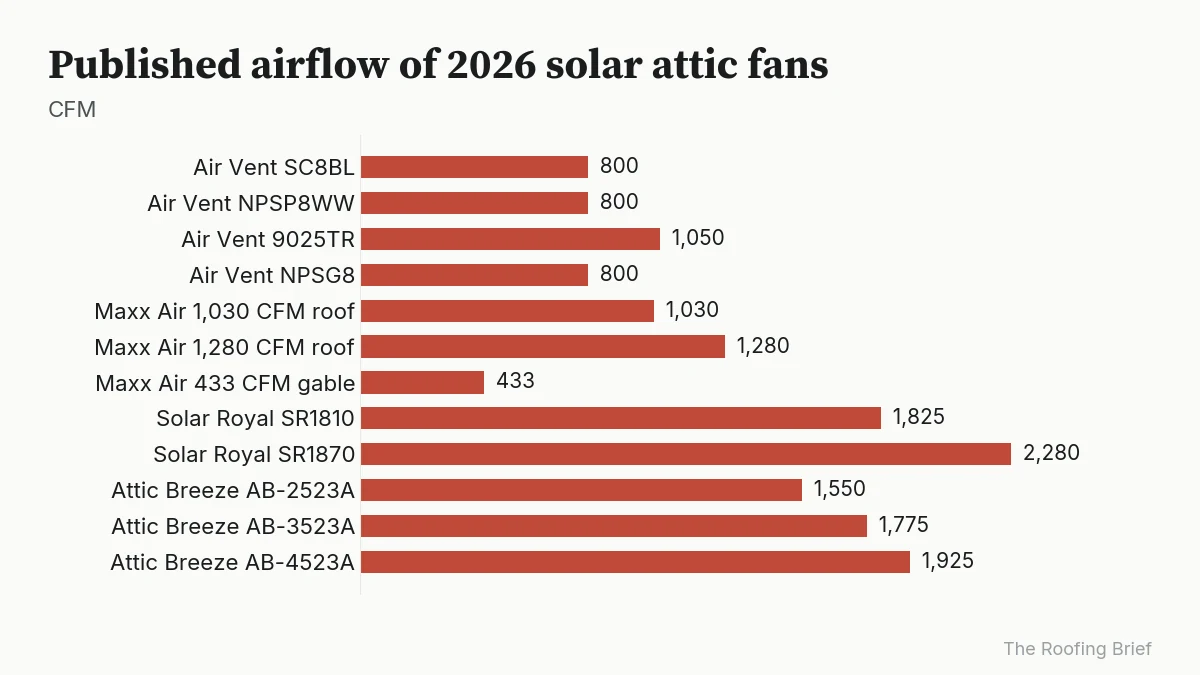
Remington’s intake figure is from its solar attic fan store page, and its prices and warranty from each product page; Maxx Air data is from its roof-mount store page and product pages; the Broan row is from its 345SO instructions. QuietCool data is from its store page, Solatube data from its solar attic fan shop, and Attic Breeze data from the Energy Efficient Solutions listing. Air Vent’s 384 sq in intake figure is from its 2017 brochure.
For humidity control, Remington’s 60 W fan ships with a humidistat and thermostat pre-installed, and its 40 W galvanized model is sold as a humidistat and thermostat version. QuietCool’s 40 W gable fan uses a preset thermostat that turns on at 88°F and an included AC/DC inverter that switches it to grid power at night.
How do you size a solar attic fan?
Size a solar attic fan like any powered vent: multiply attic floor area by 0.7 for minimum CFM, then provide 144 sq in of intake per 300 CFM. Air Vent states both rules on its September 2026 sell sheet, and Remington’s buying guide repeats the 0.7 multiplier. A 1,500 sq ft attic needs at least 1,050 CFM and 504 sq in of intake.
The catch is that makers do not apply their own rules evenly. Dividing each model’s published CFM by its rated attic area shows a spread from 0.23 to 1.07 CFM per square foot, and two Air Vent documents from 2026 rate the same 9025TR at 1,500 sq ft and 2,600 sq ft. By the 0.7 rule, Maxx Air’s 433 CFM gable fan covers about 619 sq ft, not 1,850.
| Model | CFM | Rated attic area | CFM per sq ft rated | CFM per panel watt |
|---|---|---|---|---|
| Air Vent SC8BL | 800 | 1,200 sq ft | 0.67 | 80 |
| Air Vent 9025TR (sell sheet) | 1,050 | 1,500 sq ft | 0.70 | 42 |
| Air Vent 9025TR (catalog) | 1,050 | 2,600 sq ft | 0.40 | 42 |
| Maxx Air 25 W roof | 1,030 | 1,000 sq ft | 1.03 | 41.2 |
| Maxx Air 50 W roof | 1,280 | 1,200 sq ft | 1.07 | 25.6 |
| Maxx Air 15 W gable | 433 | 1,850 sq ft | 0.23 | 28.9 |
| Solar Royal SR1810 | 1,825 | 2,955 sq ft | 0.62 | 52.1 |
| Solar Royal SR1870 | 2,280 | 3,555 sq ft | 0.64 | 32.6 |
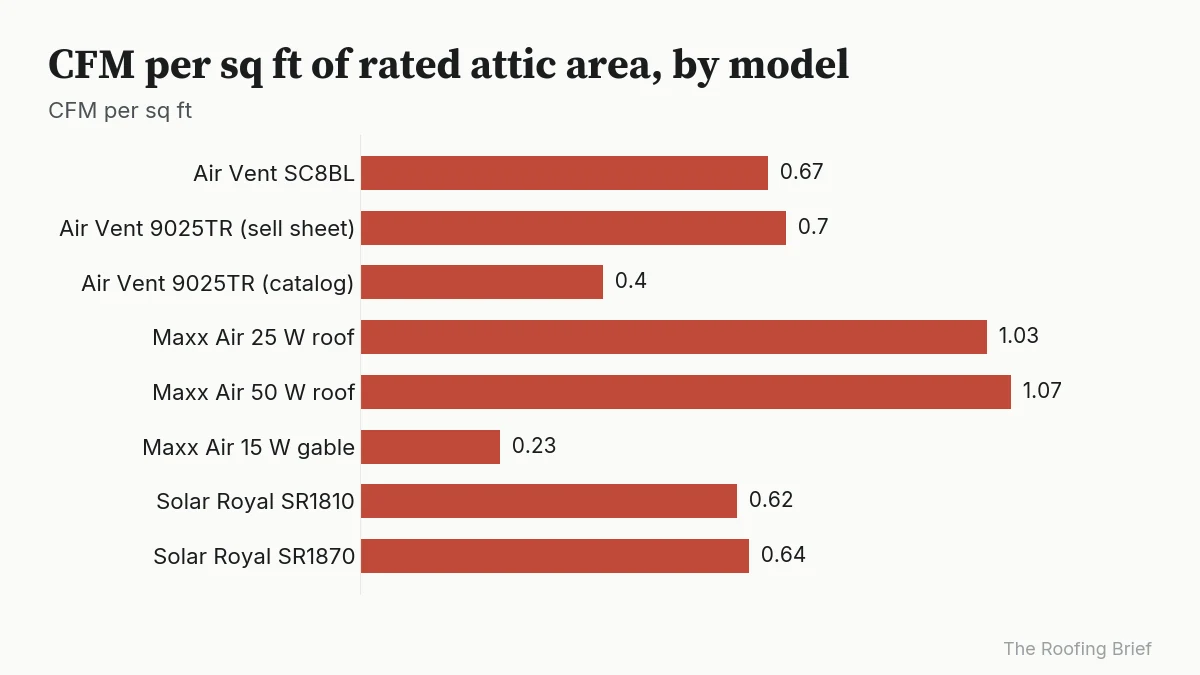
Intake is where the published rules line up best. Maxx Air’s 495 sq in for its 1,030 CFM roof fan and 615 sq in for its 1,280 CFM fan both match CFM / 300 x 144 within 1 sq in. Attic Breeze’s 750 sq in per 25 W, 1,550 CFM fan is within 6 sq in of the formula. Lomanco’s SGABLE40 calls for 768 sq in, which by the same formula matches a 1,600 CFM fan, though Lomanco publishes no CFM. Our net free area calculation guide converts that to vents.
The worked example below sizes a 2,000 sq ft attic, which needs 1,400 CFM and 672 sq in of intake by the Air Vent rules, using models with published CFM and, where available, October 2026 store prices.
| Option for a 2,000 sq ft attic | Total CFM | Meets 1,400 CFM? | Intake for that CFM | Unit cost, Oct 2026 |
|---|---|---|---|---|
| 1 x Solar Royal SR1810 | 1,825 | Yes | 876 sq in | No open listing |
| 2 x Air Vent SC8BL | 1,600 | Yes | 768 sq in | No listing found |
| 2 x Maxx Air 25 W roof | 2,060 | Yes | 990 sq in (Maxx Air: 495 each) | $739.98 |
| 1 x Maxx Air 50 W roof | 1,280 | No | 615 sq in | $459.99 |
More fans mean more intake: every extra 300 CFM needs another 144 sq in at the soffits, and our guide to soffit vents lists net free area by vent type.
Solar vs electric attic fan: what changes?
A solar attic fan trades grid power and wiring for daylight-only operation. FSEC’s 2005 literature review puts typical electric attic ventilators at 250 to 300 W, while solar units draw nothing from the grid and need no circuit. In exchange, airflow follows the sun, stops at night, and the unit costs two to six times more than a $149 electric roof fan.
| Item | Solar attic fan | Electric attic fan | Source |
|---|---|---|---|
| Grid power while running | 0 W | 250 to 300 W typical | FSEC-CR-1496-05, 2005 |
| When it runs | When the panel is lit | When the thermostat or humidistat calls | DOE BASC; GAF Master Flow manuals |
| Night operation | Only with an add-on, such as Remington’s $149 110V hybrid adapter for its 60 W fan | Yes | Remington store, Oct 2026 |
| Wiring | None; Lomanco says no electrician is needed | 120 V grounded circuit, 14-gauge minimum | Lomanco; GAF V971381 |
| Published airflow | 433 to 2,280 CFM | 1,050 to 1,620 CFM (Air Vent electric line) | Maker data; Air Vent 2026 catalog |
| Unit price | $349.99 to $913.46 | $149 (Master Flow ERV5) | Maker stores; HVAC Quick, Oct 2026 |
| Installed range, roof mount | $300 to $1,400 | $200 to $1,200 | HomeGuide, Apr 2024 |
| Georgia State Energy Code | Allowed | Not allowed unless solar powered | DOE BASC |
The DOE Building America Solution Center lists a solar unit among its mitigations for anyone set on an attic fan, because it does not pull in humid night air, stops in rain, and tends to have a lower CFM rating that creates less negative pressure. For the electric install, wiring and permit steps, see our attic fan installation guide.
Where do solar attic fans underperform?
Solar attic fans underperform in shade, at night, in cloudy or rainy weather, and in late afternoon, because airflow depends on panel output. The FSEC test fans were rated 600 to 800 CFM only at peak sun of 1,000 W per square meter, and the study reported that afternoon savings were not in evidence. Shaded roof faces and starved intake cut output further.
The FSEC-GP-171-00 study, by Danny Parker and John Sherwin of the Florida Solar Energy Center, retrofitted two 10 W thin-film units on August 6, 1997, to a Central Florida home that already had a radiant barrier. Comparing matched weather periods before and after, the results were these.
| Measured result (FSEC test home, 1997) | Value |
|---|---|
| Average drop in daily peak attic air temperature | 22°F |
| Air conditioning energy cut | 6.0% (2.8 kWh per day) |
| Estimated annual cooling savings | 460 kWh |
| Payback at 1997 Florida prices | More than 20 years |
| Cost of the two fans | About $600, about $850 installed |
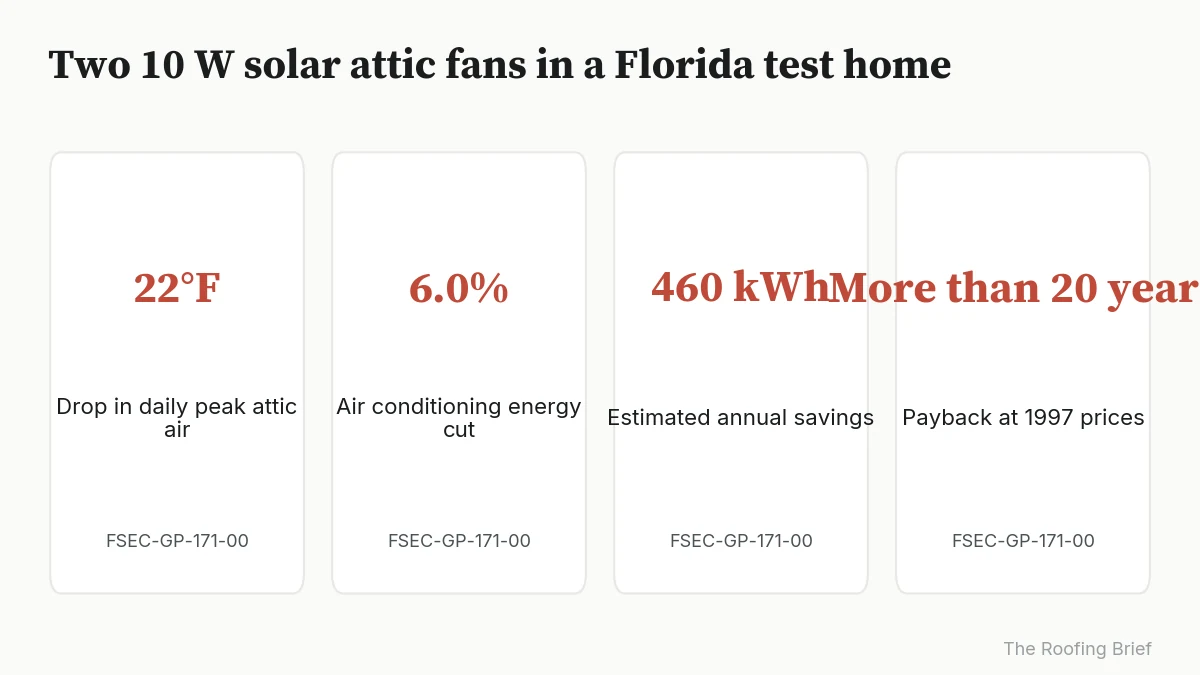
Each weak spot has a maker figure behind it:
- Shade. Broan’s 345SO instructions say to pick the roof spot with the best sun at 4:00 p.m. in the hottest month, on the south, southwest or west face, 24 to 36 in below the peak.
- Night and rain. FSEC’s 2005 review notes PV ventilation will not run during humid nighttime periods or rainy periods; hybrid adapters, such as Air Vent’s Solar Controller, which ran a fan in 15-minute cycles for up to 10 hours, exist to cover that gap.
- Winter. Broan offers a CWT45 thermostat that stops the motor below 50°F, for climates where cold-weather condensation is not a concern.
- Roof pitch. Air Vent lists its solar roof models for 3/12 to 8/12 pitches; outside that range, use a gable unit or a curb adapter.
- Intake. Broan’s solar manual warns that missing intake “could cause natural-draft gas appliances to backdraft,” the same risk an electric fan carries.
Low CFM limits the depressurization risk but does not remove it: Broan still asks for 2 sq ft of open intake on its solar 345SO. Before adding any powered exhaust, air seal the ceiling so the fan pulls from the soffits rather than the house; our attic air sealing guide lists the leak points, and the attic ventilation guide covers passive options.
Does a solar attic fan pay for itself?
A solar attic fan pays back slowly, if at all. Using FSEC’s measured 460 kWh a year and the July 2026 U.S. residential average of 18.31 cents per kWh from the EIA Electric Power Monthly, savings are worth $84.23 a year. Two fans at October 2026 prices then pay back in 8.8 to 12.3 years.
| Cost case for two fans | Cost | Annual savings | Simple payback |
|---|---|---|---|
| FSEC 1997 installed cost | $850 | $84.23 | 10.1 years |
| 2026 parts only, 2 x Maxx Air 25 W roof | $739.98 | $84.23 | 8.8 years |
| 2026 parts plus roofer, low ($45 per hour, 4 hours) | $919.98 | $84.23 | 10.9 years |
| 2026 parts plus roofer, high ($75 per hour, 4 hours) | $1,039.98 | $84.23 | 12.3 years |
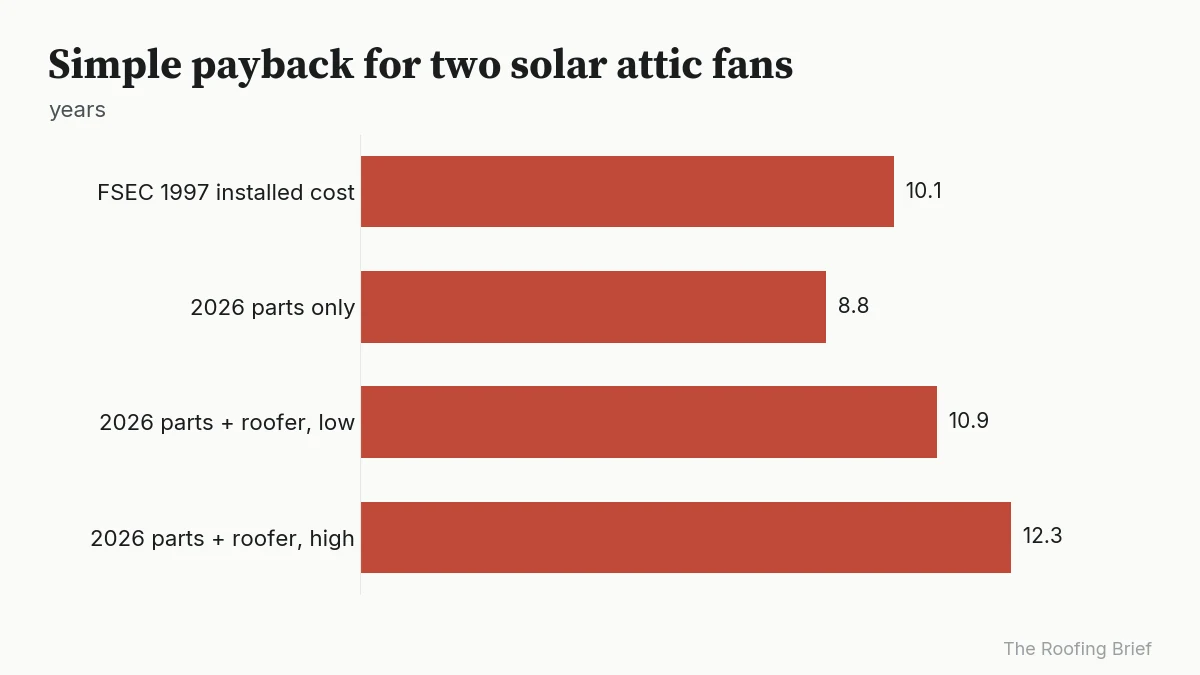
Inputs: 460 kWh x $0.1831 = $84.23 a year; labor assumes 2 hours per fan at the $45 to $75 roofer rate in Bob Vila’s December 2023 cost guide. The Maxx Air units carry a 1 year warranty, shorter than every payback here. FSEC says savings may be larger in homes without a radiant barrier, with less ceiling insulation, or with the air handler in the attic.
Is a solar attic fan eligible for a federal tax credit?
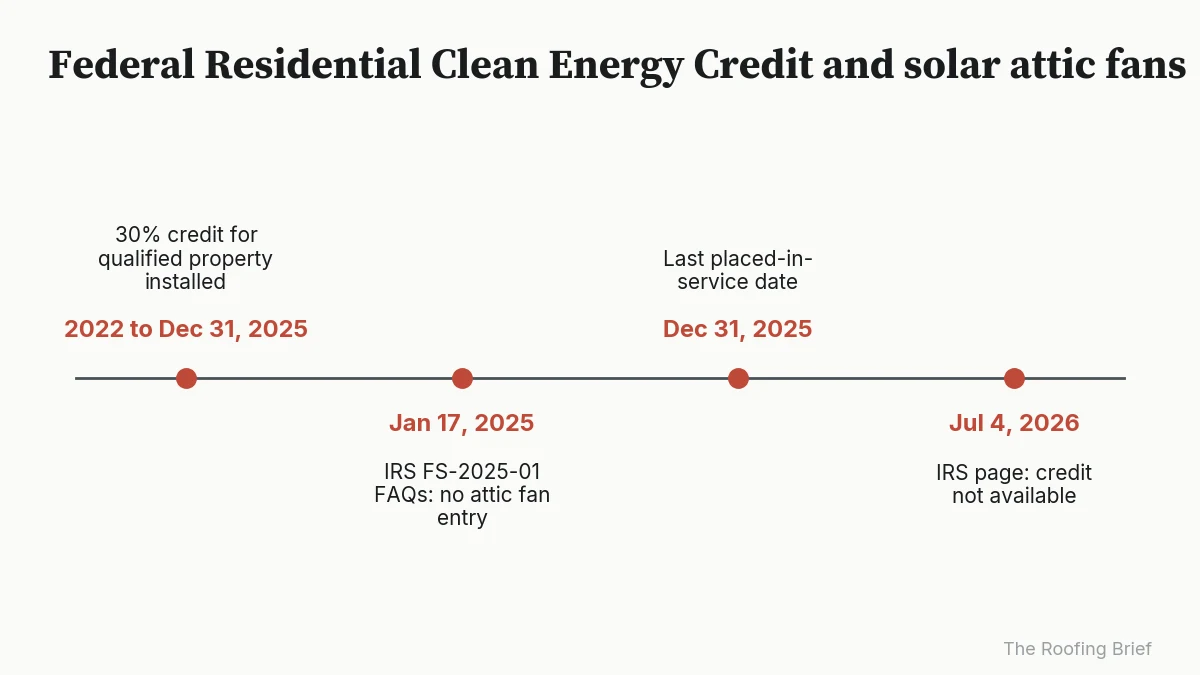
No, not for a fan placed in service in 2026. The IRS Residential Clean Energy Credit page, last updated July 4, 2026, says the 30% credit covered qualified property installed from 2022 through December 31, 2025, and “is not available for any property placed in service after December 31, 2025.” Its qualified list names solar electric panels, not attic fans.
| Date | Status | Source |
|---|---|---|
| 2022 to Dec 31, 2025 | 30% Residential Clean Energy Credit for qualified property installed | IRS 25D page |
| Jan 17, 2025 | IRS FAQ fact sheet FS-2025-01 published; no attic fan entry | IRS FS-2025-01 |
| Dec 31, 2025 | Last placed-in-service date for the credit | IRS 25D page |
| Jul 4, 2026 | IRS page update: credit not available after Dec 31, 2025 | IRS 25D page |
We found no IRS document that names solar attic fans as qualifying property; earlier eligibility claims came from maker certification statements, such as Lomanco’s, rather than an IRS ruling. Lomanco’s web page now says the federal credit for homeowner-owned systems expired December 31, 2025, while its Omni Solar Vent instruction sheet (revision 20850_0926) still says the vent “may be eligible for a federal tax credit.” For credits that cover attic insulation and air sealing, see our attic insulation tax credit guide.
How do you install a solar attic fan?
A roof-mount solar attic fan installs like a powered vent minus the wiring: site it in full sun 24 to 36 in below the peak, cut a 14 in deck hole, slide the base under the upper shingles and screw it down every 6 in. Those figures are from Broan’s 345SO instructions; GAF’s Master Flow manual uses similar steps for electric units.
- Choose the spot with the best sun at 4:00 p.m. in the hottest month, on the south, southwest or west face, 24 to 36 in below the peak.
- Test the fan in sunlight on the ground, then tape cardboard over the panel so it cannot spin during install.
- From the attic, drill a guide hole halfway between rafters at the chosen point.
- Scribe a 16 1/2 in circle on the shingles and a 14 in circle on the deck, and cut both.
- Draw a 27 in square around the hole and pull the nails from its top two-thirds.
- Bed the base groove in roofing cement, slide it under the upper shingles, and fasten with #10 x 1 in pancake head screws at the corners and every 6 in, leaving the bottom edge unsealed.
- Fit the dome, remove the cardboard, and confirm the fan runs.
Broan notes that installation by anyone other than the original roofer may affect an existing roof warranty, so ask the roofer first. Our attic fan installation guide covers flashing details and gable mounting.
Should you buy a solar attic fan? Decision table
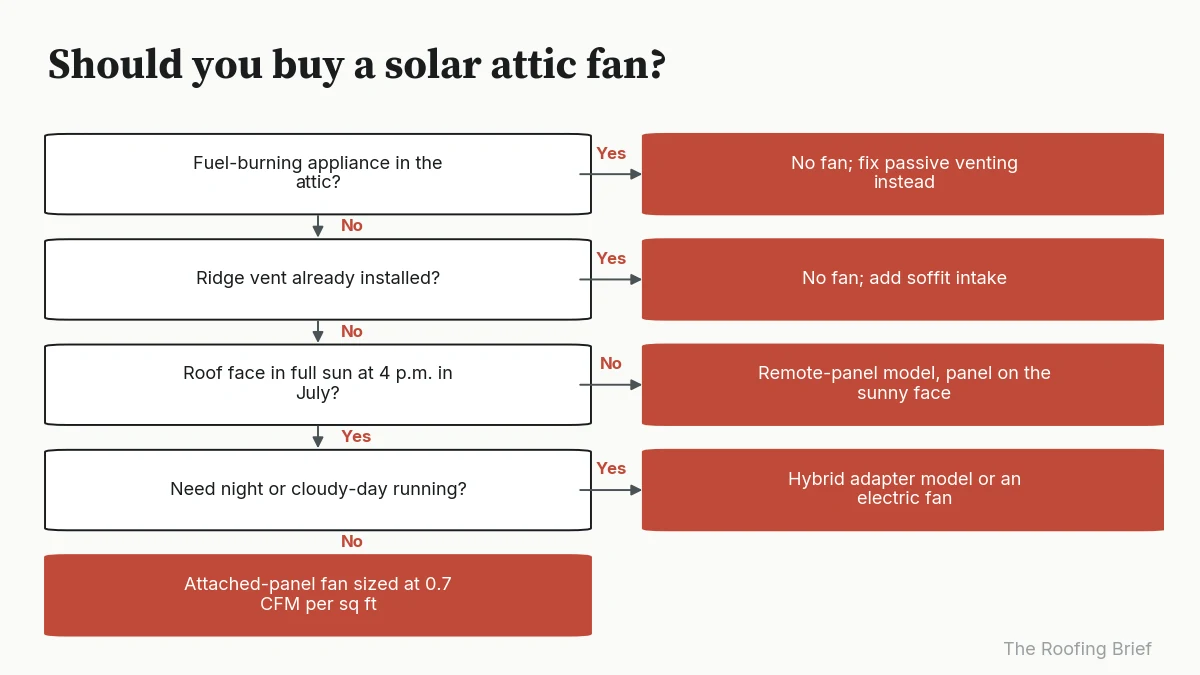
Buy a solar attic fan only when the attic has no fuel-burning appliance, no ridge vent, intake that meets the CFM / 300 x 144 rule, and a roof face in full afternoon sun. If you need nighttime running, pick a hybrid model or an electric fan. The table pairs common situations with an action and the maker or study figure behind it.
| If your situation is | Do this | Basis |
|---|---|---|
| Fuel-burning appliance in the attic | No fan; fix passive venting instead | DOE BASC; Broan 345SO |
| Ridge vent already installed | No fan; add soffit intake | DOE BASC; GAF RESMF334 |
| Roof face shaded at 4 p.m. in July | Remote-panel model, panel on the sunny face | Broan 345SO; Lomanco OSV40; Maxx Air gable (25 ft cord) |
| Need night or cloudy-day running | Hybrid adapter model or an electric fan | Remington 110V adapter; FSEC 2005 |
| Roof pitch outside 3/12 to 8/12 | Gable unit or curb adapter | Air Vent solar product page |
| Attic over 2,000 sq ft | Two fans or one 1,825 CFM class unit, plus 144 sq in intake per 300 CFM | Air Vent AV-005; Solar Royal SR1800 sheet |
| Main goal is payback | Air seal and insulate first; fan payback ran 8.8 to 12.3 years in our 2026 example | DOE BASC; FSEC-GP-171-00; EIA |
For other exhaust choices, our guides to roof vent types and ridge vents vs power attic fans compare passive and powered options. A whole-house fan cools living space instead.
How we compiled this
We compiled this from 31 primary documents opened in October 2026: catalogs, spec sheets, manuals and store pages from Air Vent, Maxx Air, Remington, Lomanco, Solar Royal, Broan, QuietCool, Solatube, Attic Breeze and GAF; two FSEC studies; a 1994 ACEEE field study; DOE Building America guidance; two IRS documents; EIA prices; and one retailer listing. We did not buy, install or test any fan.
Frequently asked questions
Do solar-powered attic fans really work?
They cool the attic, with modest whole-house savings. In FSEC’s Central Florida test, two 10 W solar fans cut the daily peak attic air temperature by an average of 22°F and air conditioning energy by 6.0%, about 460 kWh a year. At 18.31 cents per kWh (EIA, July 2026), that is worth $84.23 a year.
What are the disadvantages of solar attic fans?
Output follows the sun: FSEC reported afternoon savings were not in evidence, and panel-only fans stop at night and in rain. Units cost $349.99 to $913.46 at maker stores in October 2026, two to six times a $149 electric fan. Maxx Air’s warranty is 1 year, and five makers publish no CFM for the solar models we checked.
Why don’t we use attic fans anymore?
Many building scientists consider the risks greater than the benefits, says DOE’s Building America Solution Center, which recommends passive ventilation and notes ENERGY STAR does not recommend attic fans. The worry is negative pressure: in 1993 field tests, powered fans pulled an average of 231 CFM of house air. Georgia’s energy code still allows solar units while barring grid-powered ones.
How much does it cost to have a solar attic fan installed?
HomeGuide’s April 2024 survey puts a solar roof fan at $300 to $1,400 installed. At October 2026 maker store prices, units alone run $349.99 to $913.46. Adding a roofer for about 2 hours at $45 to $75 per hour, the rate in Bob Vila’s December 2023 guide, puts one Maxx Air 1,030 CFM fan at $459.99 to $519.99.
Do solar attic fans work at night?
Not on panel power alone. FSEC’s 2005 review notes that solar ventilation does not run during humid nighttime or rainy periods. Some models add grid backup: QuietCool’s $359 40 W solar gable fan ships with an AC/DC inverter that switches to AC power at night, and Remington sells a $149 110V hybrid adapter for its 60 W fan.
How many solar attic fans do I need?
Divide the CFM your attic needs by one fan’s published CFM. Air Vent’s rule is attic square feet x 0.7, so a 2,000 sq ft attic needs 1,400 CFM: two 800 CFM Air Vent SC8BL units or one 1,825 CFM Solar Royal SR1810. Each 300 CFM needs another 144 sq in of soffit intake.
How long do solar attic fans last?
Warranties are the best published guide, and they run from 1 year to lifetime. Maxx Air covers its solar roof fans for 1 year, Air Vent covers the 9025TR motor for 5 years and its panel and housing for 20, Lomanco covers the OSV40 vent for 10 years, and Remington and Attic Breeze offer lifetime coverage.
Do solar attic fans qualify for the tax credit in 2026?
No. The IRS Residential Clean Energy Credit page, updated July 4, 2026, says the credit is not available for any property placed in service after December 31, 2025. Its list of qualified expenses names solar electric panels, solar water heaters, wind turbines, geothermal heat pumps, fuel cells and battery storage, and does not mention attic fans.
Sources
- Air Vent, 2026 Ventilation Catalog VC021726A, accessed Oct 2026
- Air Vent, Power Vents Electric and Solar sell sheet AV-005 (September 2026), accessed Oct 2026
- Air Vent, Power Vents brochure AVI063 (June 2017), accessed Oct 2026
- Air Vent, Power Vents product page (solar roof pitch range), accessed Oct 2026
- Maxx Air, roof mount power attic ventilators store page, accessed Oct 2026
- Maxx Air, 1,030 CFM solar roof mount ventilator with integrated 25 W panel, accessed Oct 2026
- Maxx Air, 1,280 CFM solar roof mount ventilator with 50 W panel, accessed Oct 2026
- Maxx Air, 433 CFM solar gable mount ventilator with panel, accessed Oct 2026
- Remington Solar, solar attic fans store page, accessed Oct 2026
- Remington Solar, 20 Watt Solar Attic Fan, accessed Oct 2026
- Remington Solar, 30-Watt Solar Attic Fan, accessed Oct 2026
- Remington Solar, 40-Watt Galvanized Black Steel Roof Mount Solar Attic Fan, accessed Oct 2026
- Remington Solar, 60-Watt Steel Roof Mount Solar Powered Attic Fan, accessed Oct 2026
- Remington Solar, Choosing the Right Fan (0.7 sizing rule), accessed Oct 2026
- Lomanco, Solar Vents page (OSV40 and SGABLE40), accessed Oct 2026
- Lomanco, Solar Power Vents and Parts store, accessed Oct 2026
- Lomanco, Omni Solar Vent instructions and warranty (20850_0926), accessed Oct 2026
- QuietCool, 40 Watt Solar Gable Attic Fan store page, accessed Oct 2026
- Solatube, Solar Attic Fans shop (RM1500, RM2400), accessed Oct 2026
- Energy Efficient Solutions, Attic Breeze solar attic fans listing, accessed Oct 2026
- Solar Royal, SR1800 Series Specification Sheet (2026.2), accessed Oct 2026
- Broan-NuTone, Models 345SOBK and 345SOWW Roof-Mount Solar Powered Attic Ventilator instructions, accessed Oct 2026
- Parker, D.S. and Sherwin, J.R., Performance Assessment of Photovoltaic Attic Ventilator Fans, FSEC-GP-171-00 (2000), accessed Oct 2026
- Parker, D.S., Literature Review of the Impact and Need for Attic Ventilation in Florida Homes, FSEC-CR-1496-05 (May 2005), accessed Oct 2026
- Tooley, J.J. and Davis, B.E., Powered Attic Ventilators, ACEEE Summer Study 1994, accessed Oct 2026
- U.S. DOE Building America Solution Center (PNNL), Attic Ventilation Fans, accessed Oct 2026
- IRS, Residential Clean Energy Credit (page last reviewed or updated July 4, 2026), accessed Oct 2026
- IRS, Fact Sheet FS-2025-01, energy credit FAQs (January 17, 2025), accessed Oct 2026
- U.S. EIA, Electric Power Monthly Table 5.6.A, July 2026 data (released September 24, 2026), accessed Oct 2026
- HVAC Quick, attic fans listing (Master Flow ERV5 price, October 2026), accessed Oct 2026
- GAF, Master Flow Power Attic Vent Roof Mount Installation Instructions V971381 (updated 3/15), accessed Oct 2026
- HomeGuide, Attic Fan Installation Cost (April 19, 2024), cost aggregator, accessed Oct 2026
- Bob Vila, What You Need to Know About Attic Fan Installation Cost (updated December 19, 2023), cost aggregator, accessed Oct 2026