
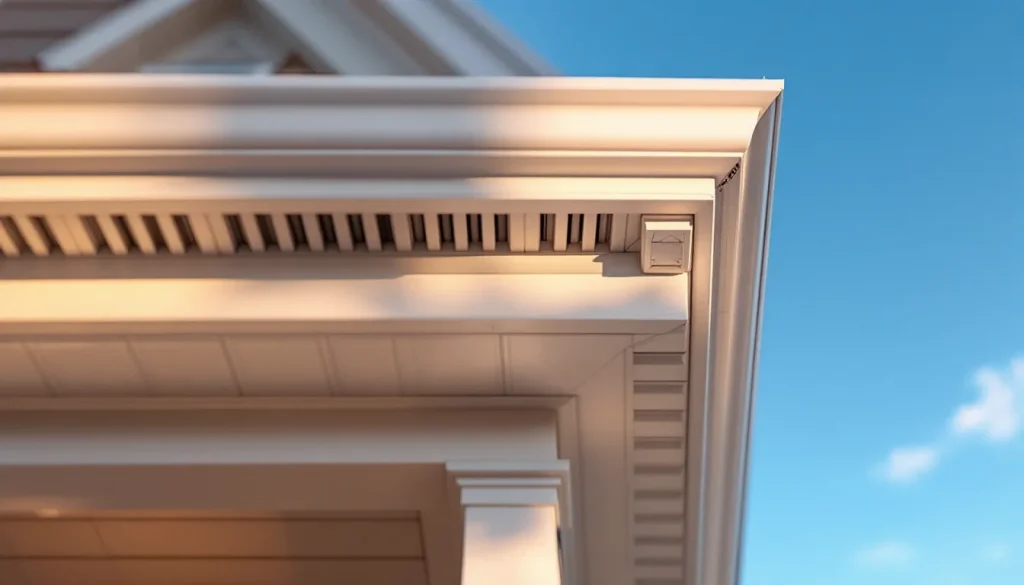
Soffit (see our soffit and fascia replacement cost) vents are the passive intake ventilation openings installed in the underside of the roof eave (the soffit), and they pair with ridge vents at the peak of the roof to create a continuous airflow path that exhausts hot, moist attic air. In 2026, properly functioning soffit ventilation extends asphalt shingle lifespan by 20 to 30 percent and is required by IRC R806 ventilation code for almost all residential homes built or reroofed in U.S. jurisdictions. Add to that the fact that blocked or undersized soffit vents are the most common diagnosed cause of premature shingle failure under GAF and Owens Corning warranty claims, and the question stops being whether to install them and becomes how to install them right. Here is how soffit vents work, what the code requires, and why blocked intakes quietly cause roof failures years before any homeowner notices.
The short version
- Soffit vents are the intake side of attic ventilation; they pair with ridge vents at the peak to move hot, moist attic air out through natural convection.
- IRC R806 requires 1 square foot of net free vent area per 300 square feet of attic floor when ventilation is split 50/50 intake-to-exhaust.
- Continuous strip soffit vents are the modern standard. Round vents and rectangular vents are retrofit options for older homes with solid soffits.
- Soffit vent costs run $5 to $15 per linear foot installed during a reroof or fascia project.
- The most common mistake is insulation blocking the soffit vents from above. The fix is baffles (also called rafter vents or chutes) installed between each rafter pair.
- Blocked soffit vents drop shingle lifespan from 25 to 30 years down to 12 to 18 years, and most major manufacturer warranties exclude claims when intake ventilation is undersized.
The Short Answer: What Soffit Vents Do + Code Requirement
Attic ventilation works by convection. Hot air rises out the top of the attic through ridge vents or gable vents, drawing cooler outside air in through soffit vents at the eave. This continuous airflow does three things: keeps the underside of the roof sheathing cool in summer (which protects the shingles), prevents moisture from condensing on rafters in winter (which prevents rot and mold), and reduces ice dam formation in cold climates (because the cooler roof surface stays below freezing as the snow on it).
The IRC R806 code requires net free vent area equal to 1/150 of the attic floor area, or 1/300 when the ventilation is split 50/50 between intake (soffit) and exhaust (ridge or gable). On a 1,500 square foot attic, that means 5 to 10 square feet of net free vent area total. The intake side (soffit vents) carries half of that requirement, or 2.5 to 5 square feet of net free area. This is the calculation that determines how much soffit vent is enough.
For the broader attic ventilation framework including ridge vents, gable vents, and powered ventilation, see attic ventilation.
The Soffit Vent + Ridge Vent System
The soffit-plus-ridge system is the modern residential standard and has been the dominant approach since the 1990s. Cool outside air enters at the soffit, passes through the rafter bays (between the underside of the roof sheathing and the top of the attic insulation), and exits at the ridge. The temperature differential between the cool intake and warm exhaust drives the airflow without any mechanical assistance.
| Ventilation system | Intake | Exhaust | Effectiveness | Best for |
|---|---|---|---|---|
| Soffit + ridge (balanced) | Continuous soffit vent | Continuous ridge vent | Excellent | Most new construction |
| Soffit + gable | Continuous soffit vent | Triangular gable vents | Good | Older homes without ridge |
| Gable only | Gable vent | Gable vent | Poor (short circuit) | Rare; usually retrofit failure |
| Soffit + powered fan | Continuous soffit vent | Electric or solar attic fan | Variable (can reverse) | Specific hot climate cases |
| Vented eave + cathedral baffle | Soffit vent at eave | Ridge vent at peak | Excellent | Cathedral and vaulted ceilings |
A common error is mixing exhaust types. Installing a ridge vent and leaving the old gable vents open creates a short circuit: air takes the path of least resistance, which is from gable to ridge rather than from soffit to ridge. The soffit vents stop drawing air and the attic loses its intake. Best practice when adding a ridge vent is to block off the gable vents from inside the attic.
IRC R806 Code Requirements (the 1:300 Rule)
IRC R806.2 specifies net free ventilating area equal to 1/150 of the attic area, reducible to 1/300 when at least 40 percent and not more than 50 percent of the required vent area is located in the upper portion of the attic (within 3 feet of the ridge) and the balance is in the lower portion (soffit or eave).
In practice, almost all residential ventilation today uses the 1/300 ratio with a roughly even split between soffit intake and ridge exhaust. Worked example: a 2,000 square foot attic needs 2,000 / 300 = 6.67 square feet of total net free area, split as 3.33 square feet of soffit intake and 3.33 square feet of ridge exhaust.
| Attic floor area | Total NFA required (1/300) | Soffit NFA (50%) | Ridge NFA (50%) |
|---|---|---|---|
| 1,000 sq ft | 3.33 sq ft (480 sq in) | 1.67 sq ft (240 sq in) | 1.67 sq ft (240 sq in) |
| 1,500 sq ft | 5.0 sq ft (720 sq in) | 2.5 sq ft (360 sq in) | 2.5 sq ft (360 sq in) |
| 2,000 sq ft | 6.67 sq ft (960 sq in) | 3.33 sq ft (480 sq in) | 3.33 sq ft (480 sq in) |
| 2,500 sq ft | 8.33 sq ft (1,200 sq in) | 4.17 sq ft (600 sq in) | 4.17 sq ft (600 sq in) |
| 3,000 sq ft | 10.0 sq ft (1,440 sq in) | 5.0 sq ft (720 sq in) | 5.0 sq ft (720 sq in) |
NFA is shorthand for Net Free Area, the actual open area available for airflow after accounting for the vent’s screen, louvers, or perforation pattern. It is always smaller than the vent’s gross dimensions, and the manufacturer’s published NFA number is what the code calculation uses.
Types: Continuous, Round, and Rectangular
| Vent type | Typical NFA | Install method | Best for |
|---|---|---|---|
| Continuous strip soffit | 9 sq in per linear foot | Built into vented soffit panels | New construction, full soffit replacement |
| Round vent (2″, 3″, 4″) | 3-13 sq in per vent | Hole saw cut into solid soffit | Retrofit on solid wood soffits |
| Rectangular vent (4×16, 8×16) | 26-52 sq in per vent | Cutout in solid soffit | Retrofit when round vents would not meet NFA |
| Drip-edge intake vent | 9-12 sq in per LF | Replaces drip edge at eave | Homes with no eave overhang (no soffit possible) |
The choice almost always reduces to continuous strip soffit for new construction or full soffit replacement, and round or rectangular cutouts for retrofits where the existing solid wood soffit will stay in place. Drip-edge intake vents are a niche solution for homes with zero eave overhang where there is literally no soffit to vent through.
Continuous Soffit Vents (the Modern Standard)
Continuous strip soffit panels integrate the vent slots directly into the vinyl or aluminum soffit panel. Each manufacturer publishes a panel NFA: typically 5 to 10 square inches per linear foot of soffit length. A panel rated 9 square inches per linear foot covers a 150 square foot attic at 26.7 linear feet of vented soffit, which most homes meet easily on a normal soffit run.
The advantages are airflow distribution (every rafter bay gets intake, not just the bays near a single vent), aesthetics (no visible cutouts, just the soffit pattern), and code compliance (the manufacturer’s published NFA simplifies the calculation). The disadvantage is the panel cost: vented soffit panels run about 30 to 50 percent more than solid soffit panels, and the install requires careful coordination with the fascia and gutter work.
During a full reroof or full eave replacement, continuous vented soffit is the default choice almost everywhere. Pair it with a continuous ridge vent and the attic ventilation problem is solved.
Round Soffit Vents (Older Homes, Easy Retrofit)
Round soffit vents are the retrofit standard for homes with existing solid wood or vinyl soffits that the homeowner does not want to replace. Sizes are typically 2-inch, 3-inch, or 4-inch diameter, with NFA running 3 square inches for the 2-inch size up to roughly 12 to 13 square inches for the 4-inch size.
Installation is straightforward: drill the hole with a hole saw matched to the vent size, insert the vent, and seal the perimeter. A homeowner can install round vents in an afternoon with a drill, hole saws, and a caulk gun. The challenge is meeting NFA at scale: a 1,500 square foot attic needs 360 square inches of intake, which equals 30 of the 4-inch round vents at 12 square inches each. Spread across the eave length of a typical home, that is one vent every 4 to 6 feet.
Round vents work best when paired with baffles in the attic to prevent insulation from sliding down and blocking them from above. Without baffles, blown-in insulation can defeat the vents within a year or two as the insulation settles into the eave cavity.
Sizing: Net Free Area Calculation
The calculation has three steps: measure the attic floor area, apply the 1/300 ratio, and split the result 50/50 between intake and exhaust. Then check the manufacturer NFA spec for the vent type you plan to install and divide to determine how many linear feet of continuous vent or how many round/rectangular vents are needed.
Worked example for a 1,800 square foot attic:
- Total NFA required = 1,800 / 300 = 6.0 sq ft = 864 sq in.
- Soffit intake = 432 sq in.
- Ridge exhaust = 432 sq in.
- Continuous vented soffit at 9 sq in/LF = 432 / 9 = 48 LF of vented soffit required (achievable on a 200 LF perimeter).
- OR: 4-inch round vents at 12 sq in each = 432 / 12 = 36 vents required.
Build in a 10 to 20 percent safety margin. Real-world NFA degrades over time as screens collect dust and pollen, and the manufacturer NFA is a clean-screen value. Aim for 20 percent more vent area than the bare code minimum.
Installation: Vented Soffit Panels
Installing vented soffit panels is a pro job in almost every case because it pairs with fascia and gutter work. The sequence: remove the existing soffit (often plywood or beadboard), inspect the rafter tails and lookouts for rot, install the J-channels at the wall and fascia edges, slide the vented soffit panels into the channels, and trim to fit.
The critical detail is the rafter bay alignment. The vented soffit only works if each rafter bay has clear airflow from the soffit cavity up into the attic above. This requires baffles between every rafter pair, installed before insulation work resumes. Skipping baffles and assuming blown-in insulation will stay put is the single most common installation error.
Material cost for vented soffit runs $1 to $3 per square foot of soffit area (vinyl) or $2 to $5 per square foot (aluminum). Total installed cost runs $5 to $15 per linear foot of eave, which includes the panel, J-channel, fasteners, baffles, and labor.
Installation: Round Vent Retrofit
Round vent retrofit is a credible DIY project for a homeowner with ladder skills. The tools needed are a stud finder, drill, hole saw matched to the vent size, caulk gun, and the vents. The work order:
- Mark vent locations on the soffit, centered between rafter tails. Avoid hitting framing.
- Drill a pilot hole at each mark, confirm no framing interference, then cut the full hole with the hole saw.
- Insert each vent, secure with the supplied screws.
- Seal the perimeter with paintable caulk.
- From inside the attic, install baffles between each rafter pair where vents were added.
A typical DIY round vent retrofit on a 1,500 square foot home with 150 linear feet of soffit takes one full day and costs $150 to $400 in materials. The baffles add another $50 to $150 in materials and 2 to 4 hours of attic work. Total project budget for DIY is $200 to $550 versus $900 to $2,000 for a pro install.
Cost: $5 to $15 per Linear Foot Installed
| Approach | Cost/LF installed | 150 LF home | Includes |
|---|---|---|---|
| Continuous vented soffit (vinyl) | $5-$10 | $750-$1,500 | Panel, J-channel, install |
| Continuous vented soffit (aluminum) | $8-$15 | $1,200-$2,250 | Panel, J-channel, install |
| Round vent retrofit (DIY) | $1-$3 | $150-$450 | Vents only, no labor |
| Round vent retrofit (pro) | $4-$8 | $600-$1,200 | Vents, install, sealant |
| Add baffles in attic | $2-$5 | $300-$750 | Baffles + install labor |
Bundling soffit vent work with a reroof saves 20 to 30 percent on the total because the crew is already on-site, the staging is in place, and the inspection finds problems that would otherwise require a separate visit. If you are within a few years of a reroof anyway, defer the soffit work until the reroof. If your shingles have 8 or more years of useful life left, do the soffit work now to protect what is left.
Signs Your Soffit Vents Are Blocked
| Sign | What it indicates |
|---|---|
| Hot attic in summer (above 130 F) | Inadequate airflow; intake or exhaust restricted |
| Frost on roof nail tips inside attic in winter | Moisture not being exhausted; condensation cycle |
| Ice dams forming at eaves | Attic too warm; soffit intake not cooling the roof deck |
| Premature shingle failure (curling, granule loss before year 15) | Sheathing temperatures too high; ventilation undersized |
| Mold or mildew smell in attic | Moisture trapped, no convective exhaust |
| Insulation visibly piled at eave from inside attic | Insulation has slid into soffit cavity, blocking intake |
The simplest field test is a hand check on a sunny summer day: stand under the soffit and feel for cool air movement at the vent openings. If you cannot feel air movement, the vents are either blocked from above (insulation) or undersized for the attic exhaust capacity. The next step is a quick attic inspection to check baffles and look at the underside of the sheathing for moisture staining.
Insulation Mistake: Blocking the Vents
Blocked soffit vents are the most common diagnosed cause of premature shingle failure and one of the leading causes of denied manufacturer warranty claims. The mechanism: when insulation is added to an attic (especially blown-in fiberglass or cellulose), it tends to migrate down into the eave cavity over the soffit vents. The vents become invisible from above and from below, and the attic loses its intake airflow.
This is why baffles exist. Baffles (also called rafter vents, attic chutes, or insulation baffles) are stiff plastic or cardboard channels installed between rafter pairs in the eave cavity. They create a clear airflow path from the soffit vent up into the attic, even when insulation is piled on top of them. Baffles are required by code in most jurisdictions any time soffit ventilation is paired with insulation in the rafter bay area, and they are universally recommended even where not strictly required.
Baffles: The Critical Component
Baffles are a $5 to $10 part per rafter bay that can extend roof life by 5 to 10 years. They install between rafter pairs at the eave end, stapled to the underside of the roof sheathing and extending from the top plate of the wall up past the insulation level. The baffle creates a 1 to 2 inch air channel that the insulation cannot fill.
The most common types are polystyrene foam (Accuvent, ProVent), heavy cardboard (Owens Corning Raft-R-Mate), and rigid plastic. Foam baffles are the most durable and the easiest to install. Cardboard baffles are the cheapest and work fine in dry climates.
Installation: pull back the insulation at each rafter bay, staple the baffle to the underside of the sheathing, push the insulation back into place against the baffle. On a typical home with 30 rafter pairs at the eave, the baffle install takes 3 to 5 hours and costs $150 to $300 in materials. It is the single highest-value roof life intervention a homeowner can make.
Soffit Repair
Damaged soffit panels often show up alongside fascia rot, since they share the same eave moisture problems. Common damage modes are panel sagging (lost fastener engagement), pest holes (wasps and squirrels chewing through vinyl or wood), water staining, and broken or missing panels.
Repair scope ranges from spot replacement of one or two panels ($50 to $200) to full perimeter soffit replacement ($1,500 to $5,000) depending on size and material. Like fascia, soffit damage is usually a downstream symptom of an upstream cause: failed flashing, overflowing gutters, missing drip edge, or pest entry through a degraded fascia joint. Always trace the cause before replacing the panels. See fascia board for the paired diagnostic framework and roof leak repair for the broader water-tracking method.
Manufacturer Warranty Connection
GAF, Owens Corning, and CertainTeed all condition their shingle warranties on adequate attic ventilation. The standard language requires “balanced ventilation meeting current code requirements,” which in plain language means the 1/300 NFA rule with at least 40 percent of the area in soffit intake.
Warranty claims for premature shingle failure include an attic inspection. If the inspector finds undersized soffit intake, blocked soffit vents, or insulation defeating baffles, the warranty claim is typically denied or reduced. The cost saving from a $30,000 manufacturer warranty payout versus a $300 baffle and vent fix is enormous, and most homeowners do not learn about the warranty exclusion until the claim is denied.
For specific brand warranty language and how it compares to other failures, see our signs you need a new roof and how long does a roof last guides. For the related underlayment decision that also affects shingle warranties, see felt vs synthetic underlayment.
Frequently asked questions
What are soffit vents?
Soffit vents are the intake ventilation openings installed in the underside of a roof eave (the soffit). They pair with ridge vents at the peak to create natural convective airflow through the attic.
How much soffit vent area do I need?
IRC R806 requires 1 square foot of total net free vent area per 300 square feet of attic floor when split 50/50 intake-to-exhaust. A 1,500 square foot attic needs about 2.5 square feet of soffit intake.
Do all homes need soffit vents?
Almost all homes with conventional vented attics need soffit vents to meet IRC R806. The exceptions are sealed (conditioned) attics and homes with engineered alternative ventilation systems, which require an architect or code official sign-off.
How much do soffit vents cost to install?
Continuous vented soffit panels run $5 to $15 per linear foot installed during a reroof or eave replacement. Round vent retrofits run $1 to $3 per linear foot DIY or $4 to $8 per linear foot when professionally installed.
Can I install soffit vents myself?
Round vent retrofits on existing solid soffits are realistic DIY. Continuous vented soffit panel work is usually a pro job because it bundles with fascia and gutter work. Either approach requires baffles installed in the attic to keep insulation from blocking the vents.
What are baffles and do I need them?
Baffles (also called rafter vents or attic chutes) are stiff plastic or cardboard channels installed between rafter pairs at the eave to keep insulation from sliding into the soffit cavity. They are required by code in most jurisdictions and are the single highest-value roof-life intervention.
Will blocked soffit vents void my shingle warranty?
Likely yes. GAF, Owens Corning, and CertainTeed all condition their warranties on balanced attic ventilation meeting code. Claims for premature shingle failure are often reduced or denied when an inspector finds undersized or blocked soffit intake.