
By The Roofing Brief Team | Last reviewed: November 2026
Raccoon damage to a roof is covered by insurance only when it is sudden structural damage that your policy’s animal exclusions do not reach: raccoons are not rodents, but the 2011 ISO homeowners form (HO 00 03 05 11) also excludes “nesting or infestation, or discharge or release of waste products or secretions, by any animals.” In practice, a torn roof or vent on a home insured under that wording is arguable, the attic cleanup and the removal bill are almost always yours, and personal belongings soaked through a raccoon hole are not covered under the standard named perils for contents.
Squirrels are rodents, so exclusion (g) applies to them directly; our guide to squirrel roof damage covers their chew holes and metal repairs.
The deciding facts are your form edition, whether the raccoon was denning, and whether the repair bill clears your deductible. The matrix below applies the clause text of the ISO Homeowners 3 form to each kind of raccoon damage; the sections after it quote the clauses, show how four carriers describe their own position, and run the deductible math on a typical eave break-in.
Raccoon roof damage coverage matrix
This table reads the 2011 ISO HO 3 (HO 00 03 05 11, as filed with the Maine Bureau of Insurance) against each damage type. Carrier-written forms can be broader or narrower, so treat each row as the starting position, not a ruling.
| Damage type | Likely outcome under HO 00 03 05 11 | Clause that decides it | What tips it |
|---|---|---|---|
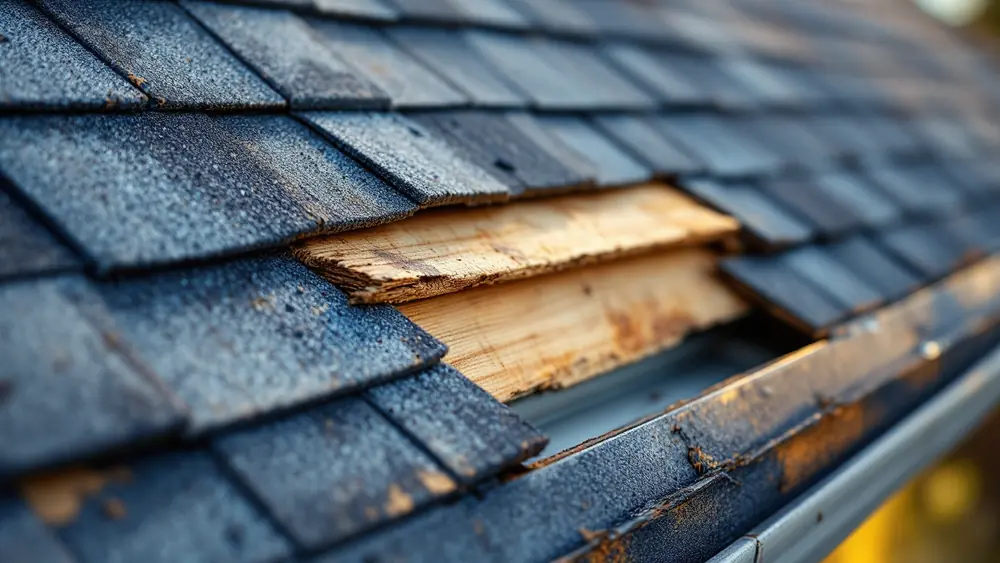
| Shingles torn back and a hole ripped in the deck at the eave or roof-to-wall joint | Arguable under Coverage A (open perils) | Section I Perils Insured Against A.2.c.(6)(g) and (h) | One forced entry with no den favors coverage; a den, kits or latrine lets the insurer cite (h) “nesting or infestation” |
| Ridge vent, box vent or turbine vent crushed or pulled off | Arguable, same as above | A.2.c.(6)(h); A.2.c.(6)(a) wear and tear | Brittle or rusted vents invite a “wear and tear, marring, deterioration” denial |
| Soffit panels pushed in, fascia chewed | Arguable for a single event; excluded if it is the den entrance | A.2.c.(6)(h) | Rotted wood behind the soffit shifts the cause to deterioration |
| Insulation soaked with urine and feces (latrine) | Excluded | A.2.c.(6)(h) “discharge or release of waste products or secretions, by any animals” | Very little: this is the clause the 2011 revision added |
| Rain damage to ceilings and walls after a raccoon hole | Possibly covered as ensuing loss to the dwelling | “Under 2.b. and c. above, any ensuing loss to property described in Coverages A and B not precluded by any other provision in this policy is covered.” | Prompt tarping (Section I Condition C.4) and no weeks-long leak; delay invites the Neglect exclusion |
| Furniture, clothes or electronics soaked through the hole | Not covered | Coverage C windstorm peril covers rain entry only when “the direct force of wind or hail damages the building causing an opening in a roof or wall” | A raccoon opening is not wind; no named Coverage C peril fits |
| Ceiling drywall collapses under a raccoon family | Possibly covered | Additional Coverage E.8 Collapse, d.(4): “Weight of contents, equipment, animals or people” | The collapse must be abrupt, meaning the part “cannot be occupied for its intended purpose” |
| Trapping, removal and exclusion work | Not covered | Not a “direct physical loss” to property | Removal is a service bill, not damage to the dwelling |
What the policy actually says about animals
ISO rewrote the animal exclusion in 2011, and that edition change is the single biggest reason two raccoon claims on the same street get different answers. The older 2000 form (HO 00 03 10 00, also on the Maine Bureau of Insurance site) excluded “vermin” without defining it. The 2011 form dropped “vermin” and added a nesting and waste exclusion that applies to “any animals”.
| Form edition | Exact exclusion text (Coverage A and B) | Effect on a raccoon claim | Source |
|---|---|---|---|
| HO 00 03 10 00 (2000) | “(g) Birds, vermin, rodents, or insects; or (h) Animals owned or kept by an ‘insured’.” | Fight is over whether a raccoon is “vermin”; one appeals court said it is not | ISO form, Maine Bureau of Insurance copy |
| HO 00 03 05 11 (2011) | “(g) Birds, rodents or insects; (h) Nesting or infestation, or discharge or release of waste products or secretions, by any animals; or (i) Animals owned or kept by an ‘insured’.” | Raccoon is not a rodent, but nesting and droppings by any animal are excluded | ISO form, Maine Bureau of Insurance copy, page 10 of 24 |
| Both editions | “(a) Wear and tear, marring, deterioration” | Old, brittle shingles or rotted fascia at the entry point give a second denial ground | Same forms, A.2.c.(6)(a) |
| 2011 edition | “Under 2.b. and c. above, any ensuing loss to property described in Coverages A and B not precluded by any other provision in this policy is covered.” | Water damage that follows an excluded raccoon hole can still be paid | HO 00 03 05 11, page 10 of 24 |
Raccoons (Procyon lotor) belong to the family Procyonidae in the order Carnivora, not the order Rodentia, per the University of Michigan Animal Diversity Web. Amica says the same thing in plain terms on its animal damage page: “raccoons and skunks aren’t defined as rodents but rather as mammals,” while the HO 3 “specifically excludes damage caused by rodents like mice, rats or squirrels.” That is why squirrel damage to the same roof is a much harder claim than raccoon damage. For the squirrel side of the line, our guide to squirrels in the attic covers entry holes, baby season and trapping rules.
Check which edition you have before you call. The form number prints on the declarations page and in the footer of every policy page, in the format HO 00 03 05 11 or HO 00 03 03 22, or a carrier number such as State Farm’s own form. The ISO edition tracker at insurancexdate.com lists the 2011 edition as still in use in Alabama, California, Connecticut, Florida, Georgia, Hawaii, Louisiana, North Carolina, Texas and the Virgin Islands as of November 2026, with the 2022 edition in about 40 other jurisdictions; carriers can file their own wording in any state.
How four insurers describe raccoon damage
Carrier pages updated between December 2024 and August 2026 disagree, which tells you the answer lives in each company’s form, not in a universal rule. All four statements below are quoted from the insurer or its spokesperson.
| Insurer | What it says | Date | Source |
|---|---|---|---|
| Allstate | “Homeowners insurance may help cover structural damage caused by raccoons, such as damage to the roof or attic, but usually does not cover damage to personal belongings.” | Last updated August 2026 | Allstate |
| Progressive | “Raccoon damage to your home or belongings typically isn’t covered by a homeowners insurance policy,” though “wildlife damage may be covered under your homeowners policy’s dwelling coverage and other structures coverage.” | Updated December 5, 2024 | Progressive |
| Amica | Raccoon damage to the structure “may be covered depending on policy language and cause of loss”; the policy “may cover sudden animal damage” but “usually excludes gradual damage from rodents, insects or infestation.” | Accessed November 2026 | Amica |
| State Farm (Wisconsin policy) | A spokesperson said “damage caused by animals, birds or insects is excluded” and “coverage is provided as an exception for damage caused by wild bears and deer,” after a 2018 policy update | October 11, 2020 | FOX6 Milwaukee |
The State Farm story involved a 94-year-old policyholder whose attic restoration after a raccoon entered through a vent was quoted at $16,000; FOX6 reported the claim, her first in 42 years, was denied. A Milwaukee wildlife company in the same report put its average raccoon attic restoration at $5,000 to $15,000. A broad “animals” exclusion with a bear and deer carve-back, like the one State Farm described, leaves no raccoon argument at all, so read your exclusion list before you spend money on a contractor’s estimate.
What courts have said about raccoons and vermin
Case law on raccoons is thin and mostly old, but three points recur in coverage disputes:
- A raccoon is not “vermin” when the policy leaves the word undefined. In Marks v. Trinity Universal Insurance Co., 531 So. 2d 516 (La. Ct. App. 1988), the court found “vermin” ambiguous and construed it against the insurer, as summarized by the Property Insurance Coverage Law blog. That argument only helps under a pre-2011 style “vermin” exclusion.
- Insurers closed that gap by defining the word. The same source reports that the American Association of Insurance Services (AAIS) 2007 forms define vermin as “an animal of a type that is prone to enter or burrow into or under a structure to seek food or shelter,” which reads squarely on a raccoon.
- A raccoon cannot commit vandalism. In Capital Flip, LLC v. American Modern Select Insurance Co., No. 2:19-cv-180 (W.D. Pa. Sept. 2019), the federal court held that “vandalism” and “malicious mischief” require a human actor, so a dwelling policy’s vandalism peril did not cover raccoon damage, as reported by Carlton Fields. That matters most for landlords on named-peril DP 1 or DP 2 forms.
What raccoon roof damage looks like
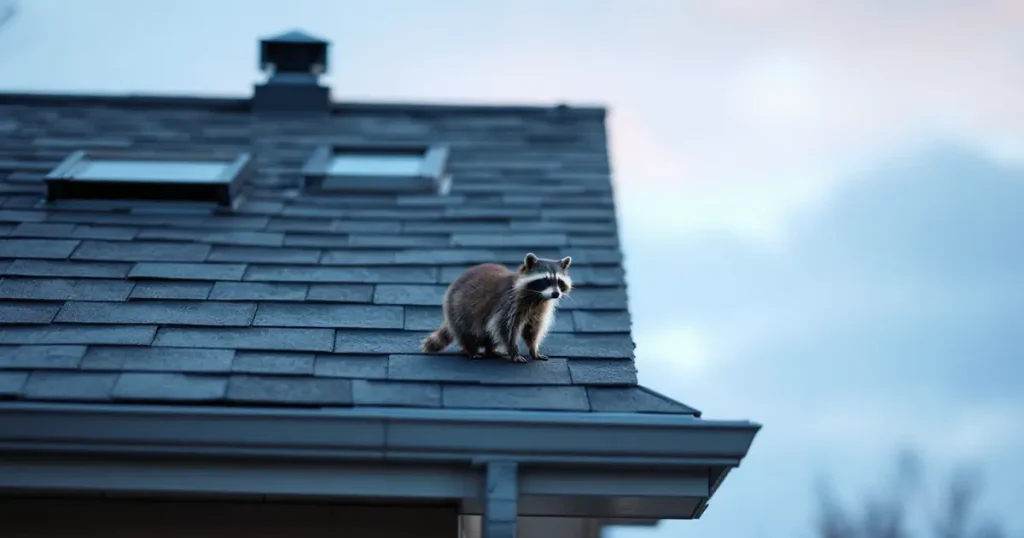
Raccoons get onto a roof by climbing, then pull open the weakest seam. The Washington Department of Fish and Wildlife guide Evicting Animals from Buildings lists the common entry points as “attic louvers, and roof vents, as well as holes in roofs, siding, soffits, and foundations,” and notes that raccoons “often leave scratches, tracks, and body oil stains where they shimmy up downspouts, trees, or the corners of buildings to access roofs.” Allstate, citing Wildlifehelp.org, describes raccoons “pulling apart vents, soffits, and roofing to get inside.”
- Eave and roof-to-wall corners: shingle tabs folded back or torn off near the drip edge, often beside the downspout or building corner the Washington Department of Fish and Wildlife describes as the climbing route. Our roof eaves repair guide prices the edge components.
- Vents: box vents pried off their flange, ridge vent sections crushed flat, or turbine vents bent. The 2021 IRC R806.1 caps attic vent openings at a 1/4 in least dimension, with hardware cloth or similar screening for larger openings, per the ICC code text.
- Soffits: vinyl or aluminum soffit panels pushed up into the attic. Our soffit repair guide lists section repair at $9 to $34 per linear foot.
- Chimneys: WDFW names an uncapped chimney as an entry. A steel cap with mesh is covered in our chimney cap guide.
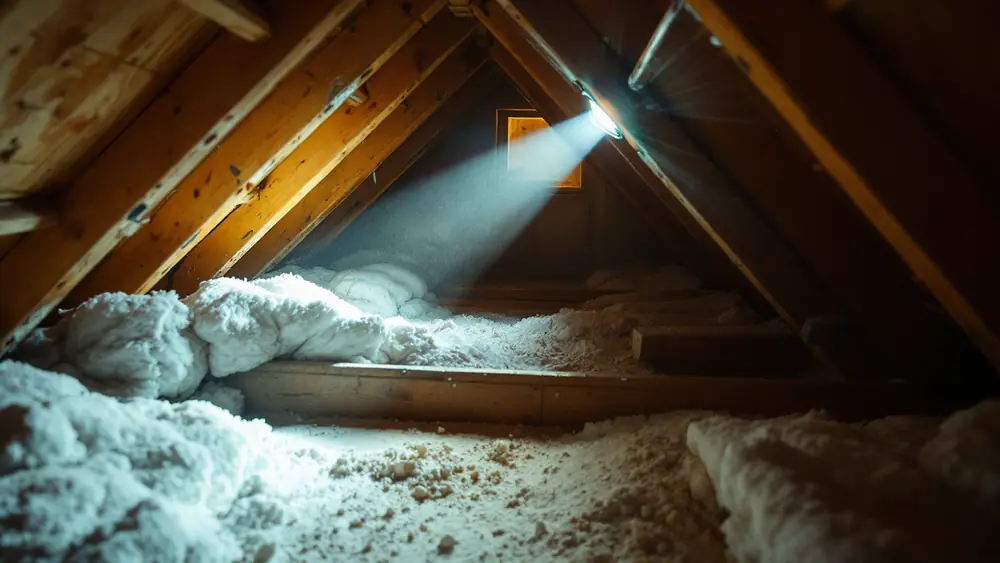
- Inside the attic: flattened or tunneled insulation and a concentrated latrine, usually within 20 feet of the entry hole per WDFW’s nest-search guidance.
Photograph each of these before any repair. An adjuster weighing clause (h) of HO 00 03 05 11 against a single sudden entry will look for one thing: evidence of a den. A torn eave with no nest material inside reads differently from a torn eave with a latrine and a litter beside it.
Worked example: the deductible math on an eave break-in
Inputs: a raccoon tears through architectural shingles and one deck panel at the eave, pushes in 10 linear feet of soffit, and uses a 1,200 sq ft attic as a latrine. Prices are national published ranges; the arithmetic is a Roofing Brief estimate.
| Line item | Quantity and unit price | Estimated cost | Coverage view (2011 ISO HO 3) | Price source |
|---|---|---|---|---|
| Architectural shingle repair | 1 square (100 sq ft) at $5 to $8 per sq ft | $500 to $800 | Arguable, Coverage A | 2026 Roofing Cost Report |
| Roof deck replacement | One 4 x 8 ft sheet (32 sq ft) at $2 to $5 per sq ft | $64 to $160 | Arguable, Coverage A | HomeGuide decking range |
| Soffit section repair | 10 linear ft at $9 to $34 per linear ft | $90 to $340 | Arguable, Coverage A | HomeGuide |
| Structural subtotal | $654 to $1,300 | The only part a claim can reach | Sum of rows above | |
| Raccoon removal from attic | One job | $550 to $975 | Not covered (no physical loss) | Angi, 2026 |
| Attic decontamination | 1,200 sq ft at $1.50 to $3 per sq ft | $1,800 to $3,600 | Excluded, A.2.c.(6)(h) waste products | Angi 2026, compiled in our attic cleaning cost guide |
| Total job | $3,004 to $5,875 | Roofing Brief arithmetic |
| Deductible | Claimable structural loss | Insurer pays (if covered) | You pay of the $3,004 to $5,875 job |
|---|---|---|---|
| $500 | $654 to $1,300 | $154 to $800 | $2,850 to $5,075 |
| $1,000 | $654 to $1,300 | $0 to $300 | $3,004 to $5,575 |
| $2,500 | $654 to $1,300 | $0 | $3,004 to $5,875 |
On those numbers, a raccoon claim pays meaningful money only with a deductible near $500 or when rain has followed the raccoon in and created a larger ensuing-loss line for ceilings, drywall and paint. On an actual cash value roof settlement the shingle line is also depreciated before the deductible comes off; our actual cash value roof guide shows how that math works. A filed claim, paid or not, can also appear on your LexisNexis C.L.U.E. property report, which insurers read at renewal.
File, fix or both: the decision table
| If | Then | Why |
|---|---|---|
| Your form says “vermin” with no definition (2000-style) and the raccoon made one entry | File and cite the form text; ask the adjuster to name the clause if denied | Marks (La. Ct. App. 1988) held a raccoon is not “vermin” under an undefined vermin exclusion |
| Your form is HO 00 03 05 11 or later and there is a den, kits or a latrine | Do not expect the structural repair to be paid; pay for removal and exclusion first | Clause (h) “nesting or infestation” fits the facts |
| Your carrier’s exclusion says “animals” with only a bear or deer exception | Skip the claim unless rain damage followed; check for an ensuing-loss sentence | No raccoon argument is left in that wording |
| Rain came through the raccoon hole and stained ceilings or walls | Tarp before the next rain, keep receipts, then file for the interior dwelling damage | Ensuing loss to Coverage A can be paid; Condition C.4 requires “reasonable and necessary repairs to protect the property” |
| Structural repair estimate is under your deductible | Pay out of pocket and do not open a claim | The worked example shows $0 paid on a $1,000 or $2,500 deductible |
| Roof is near the end of its life and the shingles around the hole are brittle | Expect a wear and tear denial; put the money toward the roof | A.2.c.(6)(a) “wear and tear, marring, deterioration” |
| A ceiling dropped under the animals’ weight | File under Additional Coverage Collapse | E.8.d.(4) lists “weight of contents, equipment, animals or people” |
Removal and cleanup rules that protect the claim and you
Removal comes before roof repair, and WDFW’s 8 to 10 week nest period for young raccoons is the reason the order matters. Sealing a hole with kits inside sends the mother back through the roof somewhere else, which is new damage of the same excluded kind.
- Photograph and date everything first: the hole from the ground and from the ladder, the attic side, any nest, and interior water stains. Condition C of HO 00 03 05 11 lists the duties after loss, including showing the damaged property and keeping “an accurate record of repair expenses.”
- Tarp the opening if rain is coming: the 2011 HO 3 Additional Coverage E.2 Reasonable Repairs pays “the reasonable cost incurred by you for the necessary measures taken solely to protect covered property” when the damage itself is covered. Keep the receipt either way.
- Check for young before any one-way door: WDFW says young mammals “generally leave the nest area eight to ten weeks after being born” and that a one-way door “must be used only when you can be sure that no young” are present. Leave the door on for 7 days, longer in cold or rainy weather.
- Seal every other gap first, then the active hole: WDFW lists “wood, 1/4-inch mesh galvanized hardware cloth, sheet metal, aluminum flashing” and warns that steel wool “quickly corrodes after becoming wet.” A homemade one-way door flap should extend at least 6 in from the opening, per the same guide.
- Treat the latrine as a biohazard: the CDC’s raccoon roundworm prevention page (November 2024) advises disposable gloves, “a N95-rated respirator if working in a confined space,” and rubber boots or disposable booties. Feces “should be removed and burned, buried, or sent to a landfill,” and “most chemicals do not kill roundworm eggs; however, heat kills the eggs instantly.” WDFW recommends a wildlife damage control company for “removing a large accumulation of droppings.”
- Repair the roof last: replacement shingles go on with at least 4 fasteners per strip shingle under 2021 IRC R905.2.6, or the maker’s higher count, and replaced vents get screened to the 1/4 in R806.1 limit.
For the full open-perils rule in HO 00 03 Coverage A and the roof losses it pays, see our guide to whether homeowners insurance covers roof damage. Animal damage sits alongside hail, wind and aging in our overview of the types of roof damage.
Frequently asked questions
Does homeowners insurance cover raccoon damage to the roof?
Sometimes. Under the 2011 ISO HO 3, sudden structural damage such as a torn eave can be argued because raccoons are not rodents, but clause (h) excludes nesting, infestation and animal waste, so a denning raccoon usually defeats the claim. Allstate says coverage “may help” for roof and attic damage; Progressive says it “typically isn’t covered.”
Does State Farm homeowners insurance cover raccoon damage?
Not in the policy State Farm described to FOX6 Milwaukee in October 2020: a spokesperson said damage by “animals, birds or insects is excluded,” with coverage “provided as an exception for damage caused by wild bears and deer” after a 2018 policy update. State Farm forms differ by state, so read the exclusion list in your own policy.
How much does raccoon removal cost, and does insurance pay for it?
Angi’s 2026 guide lists a national average of about $400 for raccoon removal and $550 to $975 for an attic job. Homeowners policies treat removal as pest control rather than a direct physical loss, so it is paid out of pocket even when the roof repair is covered.
Is raccoon urine or feces dangerous to clean up?
Yes. The Washington Department of Fish and Wildlife warns that raccoon urine and droppings “may create odors and become a potential health hazard,” and the CDC links raccoon feces to raccoon roundworm (Baylisascaris), whose eggs most chemicals do not kill. The CDC recommends gloves, an N95 respirator in confined spaces, and burning, burying or landfilling the waste.