

By The Roofing Brief Team | Last reviewed: October 2026
Hail damage to a house rarely stops at the roof. The same storm that bruises shingles can crack vinyl siding at the laps, dent aluminum gutters and siding, shred window screens, break glass and flatten the fins on an air-conditioner condenser. Lab tests by Haag Engineering found new vinyl siding fracturing from ice balls between 0.75 and 1.25 inches, depending on profile, and aluminum siding denting at 0.75 inch. Whether any of it gets paid depends on three things: functional versus cosmetic damage, how your policy settles each part of the property, and whether the total beats your deductible.
Key numbers at a glance
These are the figures that decide most whole-house hail questions: the hail size that starts doing damage, what dented AC fins actually cost in performance, how big a typical wind and hail claim is, and the policy clocks that run after a storm. Each figure comes from a named, checkable source and can vary with material age, product, policy form and state.
| Figure | Value | Source |
|---|---|---|
| Hail size that makes a thunderstorm “severe” | 1.00 in. (quarter size) or larger; raised from 0.75 in. on January 5, 2010 | National Weather Service; American Meteorological Society news, January 2010 |
| Smallest ice ball that fractured new vinyl siding in lab tests | 0.75 to 1.25 in., depending on profile and thickness | Herzog, Morrison, Patnode and Green, Haag Engineering, “Ice Ball Impact Testing of Siding,” RCI convention, March 2012 |
| Smallest ice ball that dented aluminum siding / 29-gauge steel siding | 0.75 in. / 1.00 in. | Same Haag Engineering siding study, Table 3 |
| AC condenser fin area flattened before performance dropped appreciably | 60% (capacity down 4%, SEER down 9% on one unit) | Sitzmann, Lu and Smith, “Hail Effects on Air-Conditioner Performance,” ASME IMECE2007-41518 |
| Average US homeowners wind and hail claim, 2019 to 2023 | $14,747 per claim; 2.80 claims per 100 house-years | ISO (Verisk), via Insurance Information Institute |
| Hail events logged in 2025 | 5,432 (5,373 in 2024) | NWS Storm Prediction Center, via Insurance Information Institute |
| Window to tell the insurer you will repair, to collect replacement cost beyond the first check | 180 days after the date of loss (unendorsed form) | ISO Homeowners 3 Special Form HO 00 03 03 22, Section I Condition D.2.e |
What does hail damage to a house look like, part by part?
Hail damage to a house shows up differently on every material. Vinyl cracks or punctures, usually along the bottom lap. Aluminum and steel dent. Screens tear or stretch, glass cracks or breaks, wood trim splits or loses paint in fresh chips, and AC condenser fins fold flat. The table below lists what to look for on each part, whether it is usually functional or cosmetic, and the evidence an adjuster will want.
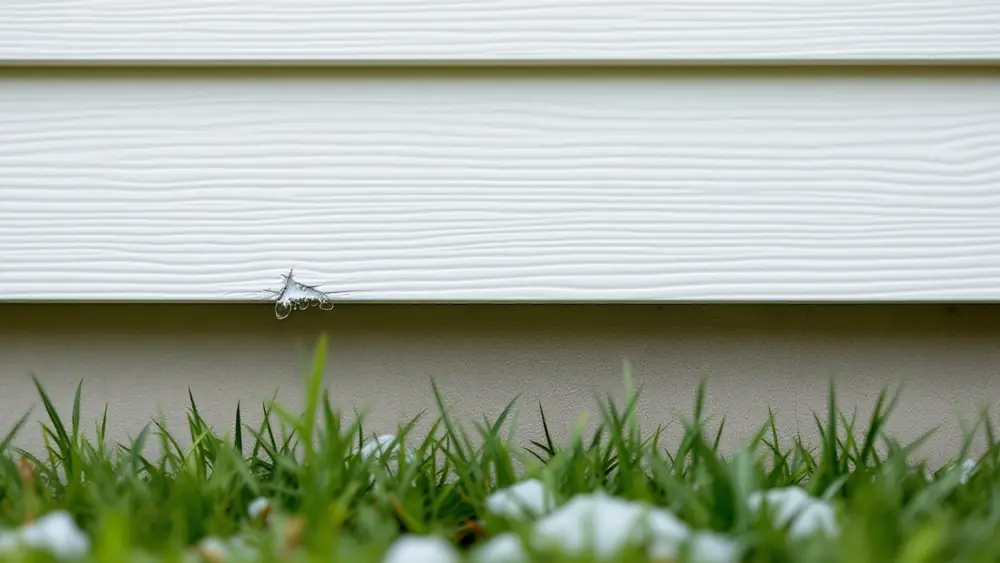
Dents at the threshold size can be close to invisible. In the 2012 Haag siding tests, small dents in aluminum and steel siding “were virtually nondiscernible” and were found only by running a finger along the panel, rubbing chalk across it, shining a bright light at a low angle, or removing the panel to check its back side. Use the same tricks before you decide a wall was spared.
| Part of the house | What hail damage looks like | Usually functional or cosmetic? | Evidence to capture |
|---|---|---|---|
| Vinyl siding | Cracks, holes or broken corners, most often at the lap; hits concentrate on the walls facing the storm | Functional: a crack or hole opens the wall to water | Close-up of each break with a coin or ruler for scale, then a wide shot of the whole elevation |
| Aluminum or steel siding | Round or oval dents, larger buckles from big stones | Often argued as cosmetic unless the coating fractures or panels deform at the laps | Chalk the panel, then photograph under low-angle light |
| Fiber cement and wood siding | Chipped edges, cracked boards, fresh bare spots in paint | Cracks are functional; paint spatter alone is usually cosmetic | Fresh breaks look clean and unweathered; photograph before painting |
| Window glass and skylights | Star cracks, chips or broken panes | Functional | Photograph inside and out, then board or film the opening |
| Window screens | Tears, holes, stretched or dented mesh, bent frames | Functional for torn mesh; dented frames are debated | Count damaged screens per elevation |
| Gutters and downspouts | Dents along the front face and the top edge, crushed downspout elbows | Often cosmetic unless seams split, pitch changes or flow is blocked | Note the dent size; it also proves hail size for the roof claim |
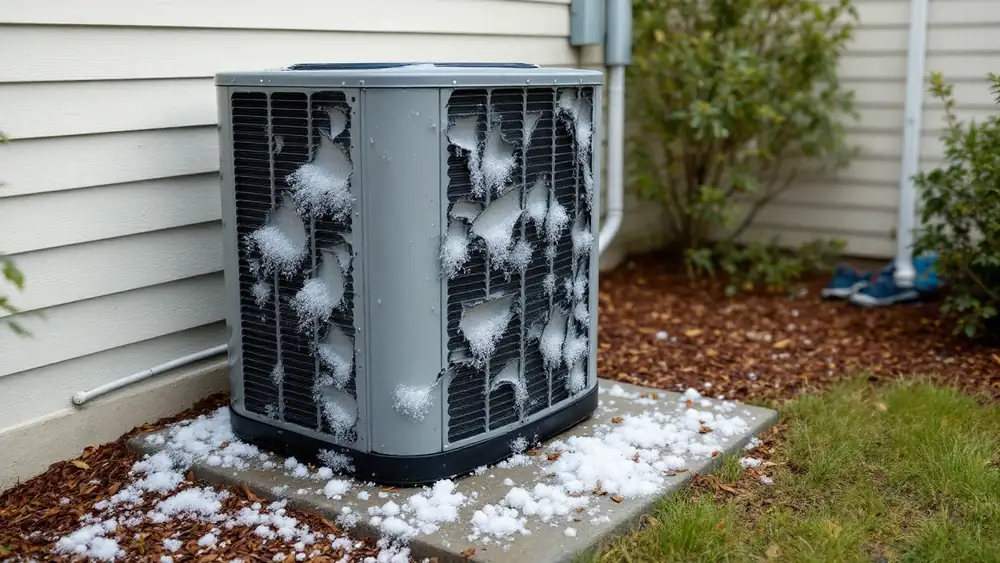
| AC condenser | Flattened fins, dented cabinet, rarely a punctured coil tube | Cosmetic until enough fin area is flattened to cut airflow; a refrigerant leak is functional | Photograph each coil face; ask an HVAC tech for capacity readings |
| Fences, decks, painted trim | Scuffs on wood, split pickets, chipped paint | Mixed; fresh splits are functional | Scuff marks show hail size and direction |
Soft metals around the house double as a hail gauge. Haag Engineering’s 2004 paper on asphalt shingles describes using spatter marks on faded metal, scuffs on wooden fences and dents in aluminum AC fins to estimate hail size and direction, which should match any damage claimed on the roof. For the roof itself, our guide to what hail damage looks like on a roof covers each roofing material.
What size hail damages siding, windows and other parts of a house?
Hail about 0.75 inch (penny size) can start damaging the thinnest exterior materials, and 1 inch (quarter size) is enough for most vinyl and steel siding. In Haag Engineering’s lab tests on new siding, foam-backed vinyl lap and both aluminum sidings failed at 0.75 inch, most vinyl profiles and 29-gauge steel at 1 inch, and the thicker 0.046-inch Dutch lap vinyl at 1.25 inches.
| Material | Threshold hail or ice ball size | What failed | Source |
|---|---|---|---|
| Foam-backed vinyl lap siding, 0.044 in. | 0.75 in. | Fracture | Herzog et al., Haag Engineering, 2012, Table 3 (lab, new siding) |
| Vinyl clapboard and Dutch lap, 0.042 in. | 1.00 in. | Fracture at the lap | Herzog et al., 2012, Table 3 |
| Vinyl clapboard, 0.046 in. | 1.00 in. | Fracture at the lap | Herzog et al., 2012, Table 3 |
| Vinyl Dutch lap, 0.046 in. | 1.25 in. | Fracture | Herzog et al., 2012, Table 3 |
| Aluminum clapboard siding (two thicknesses tested) | 0.75 in. | Dent | Herzog et al., 2012, Table 3 |
| 29-gauge steel clapboard siding | 1.00 in. | Dent | Herzog et al., 2012, Table 3 |
| 3-tab asphalt shingles | 1.00 in. | Damage onset (field surveys) | Marshall, Herzog, Morrison and Smith, Haag Engineering, AMS paper P3.2, Table 3 |
| 30-year laminated shingles | 1.25 in. | Damage onset (field surveys) | Same AMS paper, Table 3 |
| Medium cedar shakes | 1.50 in. | Damage onset (field surveys) | Same AMS paper, Table 3 |
| Concrete tiles | 1.75 in. | Damage onset (field surveys) | Same AMS paper, Table 3 |
Treat these as starting points, not guarantees. The siding was new and unweathered and was struck at a 60-degree angle; the authors tie the spread in results to thickness, profile, support conditions and material quality, and they note that the size of a fracture or puncture was not a reasonable indicator of the ice ball size. Wind-driven hail also changes which walls take hits, which is why one elevation can be shattered while the opposite side is clean. For roof-specific thresholds and the NOAA object chart, see what size hail can damage a roof.
To check the hail that actually fell at your address, search the NOAA NCEI Storm Events Database and the Storm Prediction Center’s daily storm reports for your county and storm date. Those reports also anchor the date of loss for your claim.
Hail damage to an AC condenser: cosmetic or functional?
Dented AC condenser fins are usually cosmetic until a large share of the coil is flattened. In a 2007 study by Haag Engineering and the University of Texas at Arlington, two 30,000 Btu/h residential condensers lost little or no capacity with dents spread across the whole coil (41% of fin area flattened). Capacity first dropped appreciably at 60% flattened, and combing the fins restored most of the loss.
The researchers dented the fins with a round-headed dowel to simulate hail, then folded whole columns of fins to reach 60%, 80% and 100% flattened. The last column of the table below is Roofing Brief arithmetic: if SEER falls by a given share, the unit uses 1 divided by (1 minus that share) as much electricity for the same cooling.
| Fin area flattened | Capacity change | SEER (efficiency) change | Extra electricity for the same cooling (Roofing Brief arithmetic) |
|---|---|---|---|
| 41%: discrete dents over the entire coil | Little to none | Down 2% and 5% (two units) | About 2% to 5% (1 / 0.98 and 1 / 0.95) |
| 60%: columns of fins folded flat | Down 4% | Down 9% (one unit) | About 10% (1 / 0.91) |
| 100%: nearly all airflow blocked | Down 23% and 27% | Down 34% (both units) | About 52% (1 / 0.66) |
| 100% flattened, then combed | Within 1% and 4% of undented | Within 4% and 6% of undented | About 4% to 6% |
Source: Sitzmann, Lu and Smith, “Hail Effects on Air-Conditioner Performance,” Proceedings of IMECE2007, ASME paper IMECE2007-41518. The units were R-22 split systems with conventional finned coils; newer equipment and microchannel coils were not part of the test, so results may differ.
In practice, a condenser with scattered dents and normal readings is usually treated as cosmetic. A coil with most of its face crushed, a punctured refrigerant tube, or measured capacity loss is functional damage. HomeGuide’s August 2025 cost guide puts condenser coil replacement at $900 to $2,300 and a whole condenser at $1,200 to $4,200 out of warranty, so ask an HVAC technician to record temperature split and pressures before anyone recommends replacement.
Cosmetic vs functional damage: the line that decides house claims
Functional damage reduces a part’s ability to keep out water or do its job: a cracked siding panel, broken glass, a torn screen, a split gutter seam. Cosmetic damage changes appearance only: shallow dents in aluminum siding, gutters or AC fins. Many policies pay for both, but a cosmetic damage exclusion endorsement removes coverage for the appearance-only kind.
Check how far your exclusion reaches. The Texas Department of Insurance’s Commissioner’s Bulletin B-0030-98 described endorsement HO-145, “Exclusion of Cosmetic Damage to Roof Coverings Caused by Hail,” which by its title applies to roof coverings, not siding or gutters. Other carriers file their own wording, and some reach metal siding, gutters or other metal surfaces. The Oklahoma Insurance Department warns that a policy may include “exceptions for cosmetic damage, meaning it only affects the aesthetics rather than function of the house,” along with a separate, higher hail deductible. To compare the wording carriers actually use, see the filed cosmetic exclusion forms side by side.
Courts read the exact words. In a July 2026 Eighth Circuit opinion on hail-dented school roofs, the court held that weakening a roof so it can no longer carry the same load may fall outside a cosmetic exclusion even without a leak. Our page on metal roof hail damage covers that case. For siding and gutters, the safest move is to read the endorsement on your declarations page before the adjuster arrives.
How does homeowners insurance treat each part of the house?
Under the standard ISO Homeowners 3 form, hail damage to the house, garage and other buildings is covered, and the policy applies one deductible to all covered damage from the same loss. Settlement rules differ by item, though. Fences, awnings and outdoor equipment settle at actual cash value even on a replacement cost policy, plants are not covered for hail, and cars belong to your auto policy.
| Item | Where it sits in HO 00 03 | Is hail covered? | How the loss is settled (unendorsed form) |
|---|---|---|---|
| Roof, siding, windows, attached gutters, attached deck | Coverage A, Dwelling | Yes; open perils, subject to exclusions such as wear and tear | Replacement cost if insured to at least 80% of replacement cost; actual cash value until repair is complete, unless the loss is under both 5% of the building limit and $5,000 |
| Detached garage or shed | Coverage B, Other Structures | Yes | Replacement cost, same rules as buildings |
| Fence | Coverage B; a structure that is not a building | Yes | Actual cash value |
| Awnings, outdoor antennas, outdoor equipment, household appliances | Listed in Loss Settlement D.1.b | Yes | Actual cash value, whether or not attached to the building |
| Patio furniture, grills, belongings | Coverage C, Personal Property | Yes; windstorm or hail is a named peril for Coverage C | Actual cash value (many carriers sell a replacement cost endorsement) |
| Trees, shrubs, plants, lawns | Additional Coverage E.3 | No; the listed perils are fire or lightning, explosion, riot, aircraft, vehicles, vandalism and theft | Not applicable; tree removal up to $3,000 is covered when windstorm or hail fells a tree that hits a covered structure or blocks a driveway |
| Cars | Excluded from Coverage C as “motor vehicles” | Under auto comprehensive coverage, not the home policy | Per the auto policy, with its own deductible |
Source: ISO HO 00 03 03 22, Section I Property Coverages, Perils Insured Against, Deductible and Condition D (Loss Settlement). Your carrier’s form may differ, and endorsements change these terms. Where an AC condenser falls (dwelling equipment or “outdoor equipment”) can differ by carrier and adjuster, so ask how it will be valued. The Oklahoma Insurance Department notes that comprehensive auto coverage “may help pay to repair auto body, windshield and interior damage caused by hail,” while liability-only policies typically will not.
For the roof portion, our guides to whether homeowners insurance covers roof damage and actual cash value vs replacement cost on a roof walk through depreciation and roof-age schedules.
Siding matching: when insurers must replace undamaged walls
When hail cracks a few vinyl panels and the color or profile is discontinued, the dispute shifts to matching: whether the insurer must replace undamaged siding so the wall looks uniform. No single national rule decides it. A 1997 NAIC model regulation, Florida statute and an Ohio rule set standards where they apply, and elsewhere the policy wording and court decisions control.
| Rule | What it says | Limits | Source |
|---|---|---|---|
| NAIC Unfair Property/Casualty Claims Settlement Practices Model Regulation | When replaced items “do not match in quality, color or size, the insurer shall replace all items in the area so as to conform to a reasonably uniform appearance. This applies to interior and exterior losses.” | A model only; binding where a state adopted it. Applies to replacement cost settlements | NAIC Model 902, Section 9.A(2), July 1997 |
| Florida | The insurer “shall make reasonable repairs or replacement of items in adjoining areas” when replaced items do not match | Homeowner’s policies settling on repair or replacement cost; insurer may weigh cost, achievable uniformity and remaining useful life | Fla. Stat. 626.9744(2) |
| Ohio | Insurer replaces as much of the item as needed for a “reasonably comparable appearance” when a replacement does not match | Minimum claim-settlement standard for insurers doing business in Ohio; a comparable, not identical, appearance | Ohio Adm. Code 3901-1-54 |
| States without a matching rule | Policy language (“like kind and quality”) and case law decide | Results vary widely | Your state insurance department |
Practical steps help in any state. Pull one damaged panel and photograph its back for the maker’s stamp, ask the adjuster in writing whether a matching product exists, and get a siding supplier’s written statement if the profile or color is discontinued. HomeGuide notes a contractor trick for small repairs: move a panel from a hidden wall to the visible one and put new siding on the hidden side.
What does hail damage to a house cost to repair?
Most non-roof hail repairs are small line items. HomeGuide’s 2025 and 2026 cost guides put vinyl siding repair at $2 to $4 per square foot, window glass at $300 to $650 per window, screens at $100 to $350 per window, and gutter section replacement at $6 to $17 per linear foot. Costs rise quickly when whole elevations must be replaced to match.
| Repair | Typical cost range | Source (date) |
|---|---|---|
| Vinyl siding repair | $2 to $4 per sq ft; $8 to $60 per replaced panel | HomeGuide siding repair cost (Feb 2026) |
| Vinyl siding replacement, extensive damage | $4 to $12 per sq ft | HomeGuide siding repair cost (Feb 2026) |
| Aluminum siding repair / section replacement | $3 to $6 per sq ft / $4 to $12 per sq ft | HomeGuide siding repair cost (Feb 2026) |
| Fiber cement siding repair / new fiber cement | $4 to $12 per sq ft / $6 to $15 per sq ft | HomeGuide siding repair cost (Feb 2026) |
| Wood siding repair | $4 to $13 per sq ft | HomeGuide siding repair cost (Feb 2026) |
| Window glass replacement | $300 to $650 per window (range $150 to $1,500 or more) | HomeGuide window glass replacement cost (Feb 2026) |
| Window screen replacement / repair | $100 to $350 per window / $10 to $120 | HomeGuide window screen replacement cost (May 2023) |
| Gutter repair / section replacement / full replacement | $100 to $450 / $6 to $17 per lin ft / $12 to $25 per lin ft | HomeGuide gutter repair cost (Nov 2025) |
| Downspout replacement | $30 to $75 each | HomeGuide gutter repair cost (Nov 2025) |
| AC condenser coil / whole condenser (out of warranty) | $900 to $2,300 / $1,200 to $4,200 | HomeGuide AC condenser replacement cost (Aug 2025) |
| Architectural asphalt roof, installed | $5 to $8 per sq ft | The Roofing Brief 2026 roofing cost report |
Prices vary by region, access, material and season, and storm demand can push local prices up after a large hail event. Get at least two written, itemized estimates. For full gutter pricing by material, see our gutter replacement cost guide.
Is it worth claiming hail damage? A worked example
A hail claim is worth filing when the covered damage from the storm clearly exceeds your deductible. Because the policy applies one deductible to all covered damage from one loss, siding, screens and gutters often push a roof claim well past it. Without the roof, the same items can fall below a percentage deductible, as the Roofing Brief estimate below shows.
The example assumes a home insured for $350,000 with a 2,500 sq ft architectural shingle roof. Each line uses the midpoint of the cost ranges in the previous section; it is an illustration, not a quote.
| Line item | Quantity x midpoint price | Estimate |
|---|---|---|
| Roof replacement | 2,500 sq ft x $6.50 | $16,250 |
| Vinyl siding, one elevation replaced | 400 sq ft x $8.00 | $3,200 |
| Gutters replaced | 150 lin ft x $18.50 | $2,775 |
| Window screens | 8 x $225 | $1,800 |
| AC condenser coil (only if functional) | 1 x $1,600 | $1,600 |
| Total, all items | $25,625 |
| Scenario | Covered damage | Deductible | Estimated payable before any depreciation holdback |
|---|---|---|---|
| Everything above is covered | $25,625 | 2% of $350,000 = $7,000 | $18,625 |
| Roof undamaged; siding, gutters and screens only | $7,775 | 2% = $7,000 | $775 |
| Same, with a flat $1,000 deductible | $7,775 | $1,000 | $6,775 |
| Screens and gutters only | $4,575 | 2% = $7,000 | $0 |
| Screens and gutters only, $1,000 deductible | $4,575 | $1,000 | $3,575 |
Two policy details change the cash flow. Under the unendorsed HO 00 03 03 22, the insurer pays no more than actual cash value until repairs are complete, unless the loss is under both 5% of the building limit ($17,500 here) and $5,000; the $4,575 screens-and-gutters loss clears that test, the $7,775 loss does not. And the average ISO wind and hail claim of $14,747 for 2019 to 2023 shows that many paid claims are mid-sized, not total losses. For claim math on the roof itself, see our hail damage roof insurance claim guide.
What to do after hail hits your house: step by step
After hail, document every exterior surface before anything is repaired, protect openings from water, verify the storm date, and report the loss promptly. The Texas Department of Insurance advises filing “as soon as you can” if hail damaged your home or car, and the standard HO-3 form requires prompt notice and reasonable steps to prevent further damage.
- Stay off the roof. Inspect from the ground and from windows. Leave roof access to a contractor or the adjuster.
- Photograph every elevation. Take a wide shot of each wall, then close-ups of breaks and dents with a coin or tape measure for scale. Include gutters, downspouts, screens, window frames, the AC unit, fences, the deck and the mailbox.
- Measure the hail if you can. A stone in the freezer or a photo next to a ruler supports the storm size. Add the date and time.
- Look for interior leaks. Check ceilings, window sills and the attic. Water inside turns a cosmetic argument into a functional one.
- Make temporary repairs and keep receipts. Board or film broken glass and tarp openings. HO 00 03 pays the reasonable cost of measures taken solely to protect covered property from further damage.
- Pull the storm record. Save the NOAA Storm Events or SPC storm report for your county and date.
- Read your declarations page. Find the wind and hail deductible, any cosmetic damage exclusion and whether siding and roof settle at actual cash value or replacement cost.
- Get itemized estimates. Ask for separate lines for siding, gutters, screens, glass and HVAC so each item can be matched to the adjuster’s scope. Our guide to the insurance adjuster roof inspection explains what happens on site.
- Report one loss, not several. File the house, other structures and belongings under one claim with one date of loss; file the car separately with your auto insurer.
- Track the deadlines below. Calendar the 60-day proof of loss request window and the 180-day repair notice.
| Policy duty or deadline | What the ISO form says | Why it matters |
|---|---|---|
| Notice | “Give prompt notice to us or our agent” | Late notice can be used to deny a claim where the delay prejudiced the insurer |
| Protect the property | “Make reasonable and necessary repairs to protect the property” | Water damage from an untarped opening may be disputed |
| Proof of loss | Send a signed, sworn proof of loss “within 60 days after our request” | The clock starts on the insurer’s request, not the storm |
| Replacement cost holdback | Notify the insurer “within 180 days after the date of loss” of intent to repair or replace, if you first take actual cash value | Missing it can forfeit the withheld depreciation |
| Lawsuit | Action must be “started within two years after the date of loss” | Many states change this by statute; check yours |
Source: ISO HO 00 03 03 22, Section I Conditions C, D and H. Carrier forms and state law can shorten or lengthen these periods.
Can you fix hail damage to a house yourself?
You can fix small, cosmetic hail damage yourself after it is documented: straighten bent AC fins with a fin comb, patch screens with repair tape, and swap a cracked vinyl panel with a siding removal tool. Leave roofing, broken glass, coil leaks and anything inside a claim to licensed pros, and photograph everything before you touch it.
HomeGuide lists DIY vinyl siding repair kits at $10 to $20 and screen repairs from $10. The Haag and UT Arlington test showed fin combing recovered most of the lost capacity on fully flattened coils, which makes combing a sensible first step for cosmetic dents. Do not repair anything you plan to claim until the adjuster has seen it or has accepted your photos, because an early repair can erase the proof.
Which move fits your situation?
Use the table to match what you found after the storm to a next step. It assumes a standard homeowners policy; your deductible, endorsements and state rules can change the answer.
| If you find this | Then do this |
|---|---|
| NOAA reports show hail under 0.75 in. near you and soft metals show no dents | Inspect and photograph, but a claim is unlikely to be needed |
| Dents only on gutters, downspouts, aluminum siding or AC fins, no leaks | Document, check for a cosmetic exclusion, comb fins, and price repairs against your deductible |
| Cracked vinyl, broken glass, torn screens or split gutter seams | Protect openings, photograph, get itemized estimates and report the loss |
| Roof also shows bruised shingles or punctures | Claim the whole house as one loss so one deductible covers everything; see how much hail damage it takes to replace a roof |
| Damaged siding is discontinued and cannot be matched | Ask the adjuster in writing about matching and cite your state rule if one exists |
| Total damage is below your deductible | Pay for repairs, keep dated photos and receipts in case a later storm raises a prior-damage question |
| A contractor offers to “cover” your deductible | Decline; some states, including Georgia under O.C.G.A. 33-23-43, make promising to pay or rebate a deductible a crime. See our list of roofing contractor red flags |
| The claim is denied as cosmetic or wear and tear | Ask for the policy language relied on, get an independent inspection and review the appeal options in our denied roof claim guide |
Frequently asked questions
Is it worth claiming hail damage?
It is worth claiming when covered damage from the storm clearly exceeds your deductible. One deductible applies to all damage from one loss, so siding, screens and gutters added to a roof often clear it. In a Roofing Brief example, siding, gutters and screens alone totaled $7,775, which left only $775 after a 2% deductible on a $350,000 home but $6,775 after a $1,000 deductible.
Can you fix hail damage at home?
Yes, for small cosmetic damage, after you photograph it. You can comb bent AC condenser fins, patch screens and replace a cracked vinyl siding panel with a removal tool. A Haag Engineering and UT Arlington study found combing restored fully flattened condenser coils to within 1% to 4% of original capacity. Leave roofs, broken glass and refrigerant leaks to licensed professionals.
Does homeowners insurance go up after hail damage?
It can. Rating rules vary by insurer and state. The Washington insurance commissioner warns that filing a claim may increase your premium and that an insurer may not renew because of claims. The Colorado Division of Insurance says no Colorado law addresses non-renewal after a hail storm, and an insurer may consider non-renewing after multiple losses, including hail. Ask your agent how weather claims are rated before filing.
How long will a roof last after hail damage?
It depends on whether the hail caused functional damage. A Haag Engineering 10-year weathering study found shingles that lost granules but were not bruised or punctured kept shedding water, even with 70% of granules removed. The same paper notes that many shingle makers have issued technical bulletins saying hail granule loss shortens shingle life. Bruised or punctured shingles are functional damage and usually need repair or replacement.
What size hail can damage a house?
Hail about 0.75 inch can dent aluminum siding and crack thin foam-backed vinyl, according to Haag Engineering lab tests on new siding. Most vinyl profiles and 29-gauge steel siding failed at 1 inch, the National Weather Service threshold for severe hail. Asphalt shingles typically show damage from 1 to 1.25 inches, while concrete tile held until about 1.75 inches in field surveys.
Is hail damage to siding covered by insurance?
Usually, yes. Siding is part of the dwelling under a standard HO-3 policy, which covers direct physical loss unless excluded. Cracked or punctured siding is functional damage. Dents in metal siding may be denied if your policy has a cosmetic damage exclusion that reaches siding; some exclusions, like the Texas HO-145 endorsement, apply only to roof coverings. Check your declarations page.
Does homeowners insurance cover hail damage to my car?
No. The ISO HO-3 form excludes motor vehicles from personal property coverage. Hail damage to a car falls under the comprehensive coverage on your auto policy, which the Oklahoma Insurance Department says may pay for body, windshield and interior damage from hail. Liability-only auto policies typically do not. The car claim carries its own auto deductible.
Are trees and landscaping covered for hail damage?
Not under the standard ISO HO-3 form. Its trees, shrubs and plants coverage lists fire or lightning, explosion, riot, aircraft, vehicles, vandalism and theft, and not windstorm or hail. The form does pay up to $3,000 to remove trees felled by windstorm or hail when they damage a covered structure or block a driveway. Carrier forms can differ.
Sources
Primary sources used on this page
- Herzog, R.F., Morrison, S.J., Patnode, S.A., and Green, J.R., Haag Engineering Co., “Ice Ball Impact Testing of Siding,” 27th RCI International Convention, March 2012 (iibec.org).
- Marshall, T.P., Herzog, R.F., Morrison, S.J., and Smith, S.R., Haag Engineering Co., “Hail Damage Threshold Sizes for Common Roofing Materials,” American Meteorological Society conference paper P3.2 (ams.confex.com).
- Marshall, T.P., Herzog, R.F., and Morrison, S.J., Haag Engineering Co., “Hail Damage to Asphalt Roof Shingles,” AMS Annual Meeting, 2004, paper P9.4 (haagglobal.com).
- Sitzmann, M.J., Lu, F.K., and Smith, S.R., “Hail Effects on Air-Conditioner Performance,” Proceedings of IMECE2007, ASME paper IMECE2007-41518 (University of Texas at Arlington and Haag Engineering).
- Insurance Services Office, Homeowners 3 Special Form, HO 00 03 03 22.
- National Association of Insurance Commissioners, Unfair Property/Casualty Claims Settlement Practices Model Regulation (Model 902), Section 9.A(2), July 1997.
- Florida Statutes, Section 626.9744 (leg.state.fl.us).
- Ohio Administrative Code, Rule 3901-1-54 (codes.ohio.gov).
- Texas Department of Insurance, Commissioner’s Bulletin B-0030-98 (endorsement HO-145) and “Hail damage to your home or car? What to do next” (tdi.texas.gov).
- Oklahoma Insurance Department, Wind and Hail consumer page (oid.ok.gov).
- Colorado Division of Insurance, After a Hail Storm Insurance FAQs (doi.colorado.gov); Washington Office of the Insurance Commissioner, Winter weather and insurance coverage (insurance.wa.gov).
- Insurance Information Institute, Facts and Statistics: Hail, and Facts and Statistics: Homeowners and Renters Insurance (ISO/Verisk 2019 to 2023 data), reviewed October 2026.
- National Weather Service, Severe Thunderstorm safety and definitions (weather.gov); American Meteorological Society news, “NWS Increases Severe Hail Threshold,” January 2010.
- HomeGuide cost guides: siding repair (Feb 2026), window glass replacement (Feb 2026), window screen replacement (May 2023), gutter repair (Nov 2025), AC condenser replacement (Aug 2025).
- Official Code of Georgia Annotated, Section 33-23-43(c)(4).