
By The Roofing Brief Team | Last reviewed: October 2026
Squirrels in the attic are usually a nesting mother: evict her with a one-way door outside baby season, which runs February through August (ICWDM), then seal the hole with metal and check your state’s trapping rules first.
Key takeaways
- Gray and fox squirrels breed in mid-December or early January and a small share again in June; young may be in the attic from February through August (ICWDM tree squirrel control methods).
- Young leave the nest 8 to 10 weeks after birth, and squirrel nests are often within 20 feet of the entry hole (Washington Department of Fish and Wildlife, Evicting animals from buildings).
- ICWDM says to secure vents and chimneys before installing a one-way door and to fit spring-loaded doors with an apron of at least 1 foot square to stop chew-ins.
- Release rules differ by state: Washington bans releasing a squirrel anywhere but the property where it was trapped without a permit (RCW 77.15.250), and California bans releasing any tree squirrel elsewhere without a state permit (UC IPM Pest Notes 74122).
- Close entries with sheet metal or 1/4-inch hardware cloth (UC IPM), and keep attic vent screen openings between 1/16 and 1/4 inch under model code section R806.1.
- No toxicants are registered for tree squirrels, and no frightening device has been proven effective, per ICWDM.
The seven figures below decide when and how a squirrel eviction can happen. Each comes from a state wildlife agency, a university extension service or the ICWDM.
| Figure | Value | Source |
|---|---|---|
| Months young may be present | February through August | ICWDM |
| Gestation, gray and fox squirrels | 42 to 45 days | ICWDM biology page |
| Age young leave the nest | 8 to 10 weeks | WDFW; CT DEEP |
| Quiet days before sealing (newspaper test) | 3 days of fair weather | WDFW |
| One-way door apron | 1 ft square minimum | ICWDM |
| Limb clearance from the roof | 6 to 8 ft (ICWDM) or 10 ft (WDFW) | ICWDM; WDFW |
| Attic vent screen openings | 1/16 to 1/4 in | Model code R806.1 |
How do you know you have squirrels in the attic?
Gnawing, scratching and pattering in the early morning or during daylight usually signal squirrels, per the Connecticut Department of Energy and Environmental Protection (CT DEEP). Look for balls of torn insulation, cardboard, leaves and twigs, and for chewed holes at the roofline. Daytime noise points to gray or fox squirrels; night noise points to flying squirrels or rats.
Hole size helps name the animal. A South Carolina Department of Natural Resources species sheet says gray and fox squirrels gnaw holes the size of a baseball, red squirrels the size of a golf ball, and flying squirrels the size of a quarter. CT DEEP adds that flying squirrels enter through small holes around dormers, ridge vents, eaves and attic vents.
| Animal | When you hear it | Entry hole | Size | Source |
|---|---|---|---|---|
| Eastern gray squirrel | Early morning, daylight | Baseball-sized | 16 to 20 in long, 1 1/4 to 1 3/4 lb | CT DEEP; SC DNR; ICWDM |
| Fox squirrel | Daylight | Baseball-sized | 18 to 27 in long, 1 3/4 to 2 1/4 lb | SC DNR; ICWDM |
| Red squirrel | Daylight | Golf ball-sized | 10 to 15 in long, 1/3 to 2/3 lb | SC DNR; ICWDM |
| Southern flying squirrel | Night | Quarter-sized | 8 to 10 in long | SC DNR; ICWDM |
| Roof rat | Night, starting at twilight | Gap just over 1/2 in | 7 to 8 in head and body | Univ. of Arizona AZ1775; UNL NebGuide G1530 |
If droppings are small, dark and the noise is nocturnal, compare them against our roof rats guide, which tabulates rat dropping sizes. Mice leave smaller droppings and tunnel under insulation, a different job covered in our guide to getting rid of mice under attic insulation. Bats follow their own exclusion timing and rules, which our bats in the attic guide covers.
When is squirrel baby season, and why does it matter?
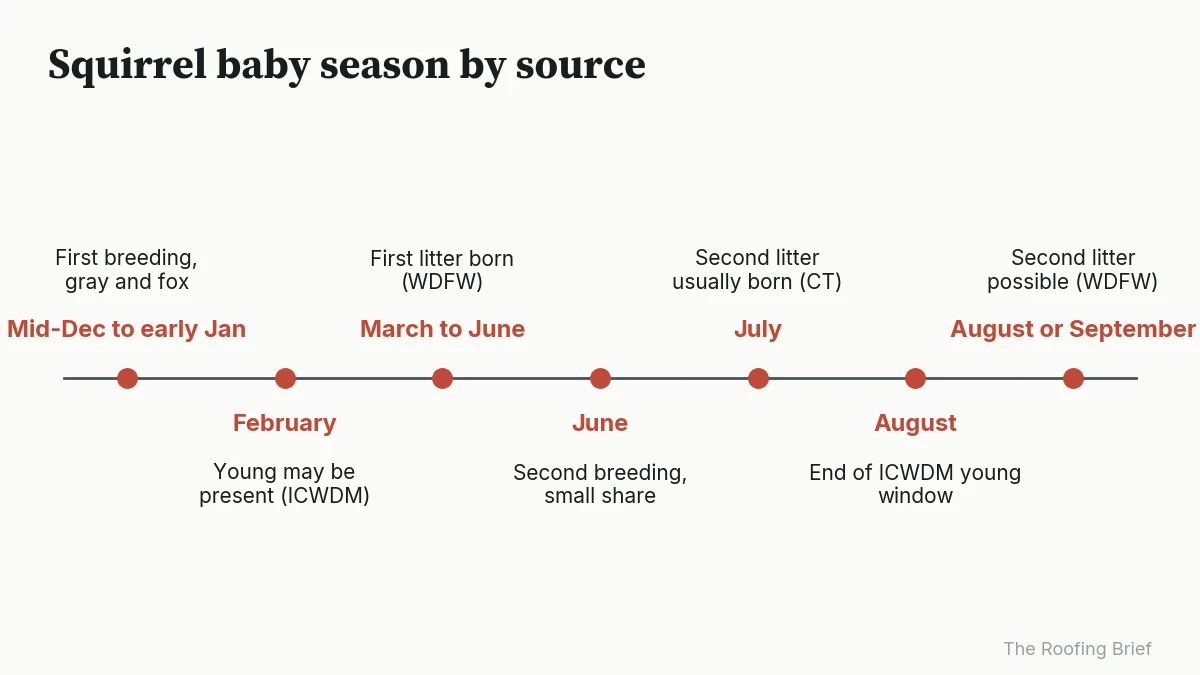
Squirrel baby season runs roughly February through August, the window ICWDM gives for young being present. Gray and fox squirrels breed in mid-December or early January, a small share breeds again in June, and gestation is 42 to 45 days. Evicting or trapping the mother during that window strands young that, per WDFW, will not survive in the wild without her.
Sources disagree on the exact months, so read the table as a range. WDFW says one litter of two to four is born March to June, with a possible second litter in August or September. CT DEEP says the second litter is usually born in July. Humane World for Animals, an advocacy group, gives February to May and August to October without citing a source. A September litter, which WDFW allows for, keeps young in the nest into autumn.
| Event | Timing | Source |
|---|---|---|
| First breeding, gray and fox squirrels | Mid-December to early January | ICWDM biology page |
| Young may be present | February through August | ICWDM control methods page |
| First litter born (2 to 4 young) | March to June | WDFW tree squirrels page |
| Second breeding (small share) | June | ICWDM biology page |
| Second litter usually born | July | CT DEEP gray squirrel fact sheet |
| Second litter possible | August or September | WDFW tree squirrels page |
| Short trips out of the nest | About 30 days old | WDFW |
| Young leave the nest | 8 to 10 weeks old | WDFW evicting page; CT DEEP |
| Weaned | 10 to 12 weeks old | ICWDM biology page |
| On their own | About 3 months old | WDFW |
Turn those ages into a date before you seal anything. The worked example below assumes you first hear young on March 15, 2026, and treat that as the birth date, which is the earliest they could have been born if you heard nothing before. Use the later dates if you heard the mother earlier and young only now.
| Rule applied | Weeks after March 15, 2026 | Earliest date to start eviction | Source of the age |
|---|---|---|---|
| Young leave nest, low end | 8 | May 10, 2026 | WDFW; CT DEEP |
| Young leave nest, high end | 10 | May 24, 2026 | WDFW; CT DEEP |
| Weaned, high end | 12 | June 7, 2026 | ICWDM |
The dates are Roofing Brief arithmetic (March 15 plus 56, 70 and 84 days), not agency deadlines. WDFW’s position is simpler: if young are present, “leave the family alone until they move on their own.”
How do you get squirrels out of your attic?
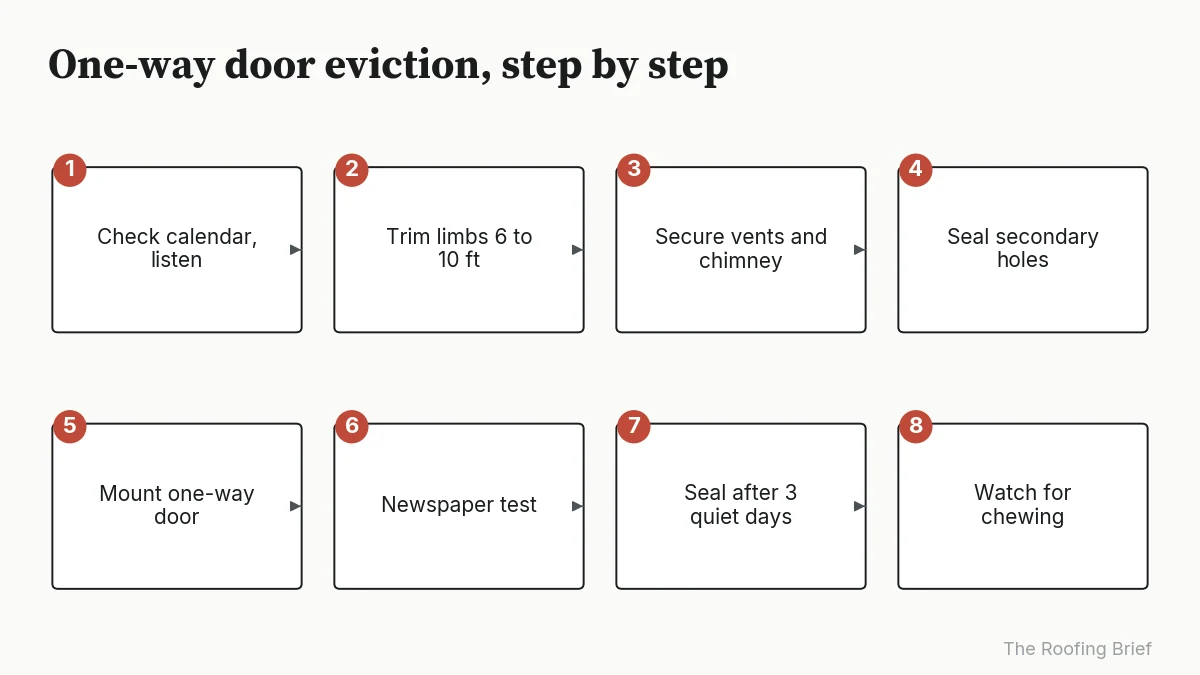
Get squirrels out of the attic by confirming no young are inside, sealing every opening except the main one, mounting a one-way door or excluder over that hole, and sealing it with metal once the squirrels stop using it. ICWDM says to secure vents and chimneys first, and WDFW says the animals are gone when a newspaper wad in the hole stays put for 3 days of fair weather.
- Check the calendar and listen. Between February and August, assume young may be present (ICWDM). Pound on a joist and listen for young; nests are often within 20 feet of the entry (WDFW).
- Trim the approach. Cut limbs back 6 to 8 feet from the roof (ICWDM) or 10 feet (WDFW). Slit 2-foot sections of 2- to 3-inch plastic pipe can stop squirrels on other wires, but ICWDM says never to install wire guards on or near electrical lines.
- Secure vents and the chimney. Screen vents with 1/4-inch hardware cloth (WDFW) and cap the chimney before the door goes on, so the door is the only way out (ICWDM).
- Seal secondary holes. Close every opening except the main entry with sheet metal or 1/4-inch hardware cloth (UC IPM 74122).
- Mount the one-way door. Use a spring-loaded door with an apron of at least 1 foot square, or an 18-inch length of 4-inch plastic pipe pointed down at 45 degrees (ICWDM).
- Test. With the door removed, pack wadded newspaper into the entry and repack it each time it moves. Do not use flour, which can attract a hungry animal (WDFW).
- Seal for good. After 3 undisturbed days of fair weather, close the hole with wood, 1/4-inch galvanized hardware cloth, sheet metal or aluminum flashing; plug small holes with copper or stainless mesh, since steel wool corrodes when wet (WDFW).
- Watch for chewing. An adult chewing hard to get back in usually means young are still inside; reopen and wait. CT DEEP suggests heavy 1/2-inch wire mesh as a temporary patch where chewing persists.
The table below sets the door specs from ICWDM next to one retail excluder so you can check fit. Measure the hole before you buy: the Tomahawk E40 excluder covers openings of 4 x 4 inches or smaller, which suits a gray squirrel’s baseball-sized hole but not a torn-out soffit panel.
| Device | Spec | Fits | Source |
|---|---|---|---|
| Spring-loaded one-way door | Apron at least 1 ft square around the hole | Holes on flat siding, fascia or soffit | ICWDM |
| Pipe excluder | 18 in of 4 in plastic pipe, pointing down at 45 degrees | Round holes on walls or eaves | ICWDM; Penn State Extension |
| Tomahawk E40 excluder | 4 x 4 x 12 in, 14 gauge, 1/2 x 1 in wire mesh; $31.90 | Openings 4 x 4 in or smaller | Tomahawk Live Trap listing, Oct 2026 |
| Cage trap (if legal in your state) | 5 x 5 x 18 in or larger; at least 3 traps for gray and fox squirrels | Rooftop or attic travel routes | ICWDM |
Freezing rain can freeze a one-way door shut or open, the ICWDM control chapter warns, so check it daily in winter. If a squirrel gets into a living room, CT DEEP advises opening a door or window to the outside and leaving the room; for one stuck in a chimney, lower a heavy rope down the flue so it can climb out.
Do lights, noise or repellents get squirrels out?
Not reliably. ICWDM says no frightening devices have been proven effective, though strobe lights in attics “show some promise,” and UC IPM Pest Notes 74122 says visual and sound devices lose their effect within a couple of days. Naphthalene mothballs may discourage squirrels briefly but are not recommended in occupied buildings, and the SC DNR sheet calls that use off-label and illegal in many states.
ICWDM also says no toxicants are registered for tree squirrels, and UC IPM states that poison baits for any tree squirrel are illegal in California. Taste repellents such as Ro-pel have had “a very limited success rate,” per Penn State Extension’s tree squirrel publication, so treat any spray as a supplement to exclusion, not a substitute.
| Popular method | What the primary source says | Source |
|---|---|---|
| Bright lights or a radio in the attic | Frightening devices lose effect within a couple of days | UC IPM 74122 |
| Strobe lights | Not proven, but “show some promise” | ICWDM; SC DNR |
| Mothballs (naphthalene) | Not recommended in occupied buildings; off-label and illegal in many states | ICWDM; SC DNR |
| Taste repellents such as Ro-pel | Very limited success rate | Penn State Extension |
| Poison bait | No toxicants registered for tree squirrels; illegal for any tree squirrel in California | ICWDM; UC IPM 74122 |
Are squirrel droppings in the attic dangerous?
Squirrels can carry tularemia and ringworm and are often infested with fleas and mites, per UC IPM Pest Notes 74122, so treat nests and droppings as contaminated. Use the CDC’s wet method from its rodent cleanup page (April 2024): air the space 30 minutes, soak with 1 part bleach to 9 parts water for 5 minutes, wipe, and bag.
UC IPM adds that dead squirrels should be handled with rubber, latex, nitrile or plastic gloves and sealed in a plastic bag to confine parasites. For a full attic cleanup, including when soiled insulation has to come out, see our attic cleaning guide, which separates basic clean-outs from rodent decontamination.
Is it legal to trap and relocate squirrels in your state?
Legality turns on your state’s rules, and several states restrict where a live squirrel can go. Fox and gray squirrels are game animals in most states, so trapping permits may be required, per ICWDM. Washington makes releasing a squirrel off the property where it was trapped a gross misdemeanor without a permit (RCW 77.15.250), and California bars releasing any tree squirrel elsewhere without a CDFW permit, per UC IPM.
| State | Who may act, and permit | Where a live squirrel may go | Other limits | Source |
|---|---|---|---|---|
| California | Owner or tenant may control eastern fox squirrels injuring property at any time; gray squirrels need a revocable CDFW permit | Releasing any tree squirrel elsewhere is illegal without a CDFW permit | No poison baits for any tree squirrel; drowning is illegal | UC IPM 74122 (Fish and Game Code summary) |
| Washington | Eastern gray and fox squirrels may be trapped or killed year-round when protecting private property; live traps need no special permit | Only on the property where legally trapped, unless permitted (RCW 77.15.250) | Western gray squirrel is threatened (WAC 232-12-007); red, Douglas and northern flying squirrels are protected (RCW 77.36.030) | WDFW; RCW 77.15.250 |
| Ohio | Any person may trap live nuisance wild animals; permission needed on another’s land; no fee unless licensed | Squirrels may be released or euthanized; release on public or private property requires the landowner’s permission | Unlicensed persons may hold an animal no more than 24 hours; traps checked every calendar day | Ohio Adm. Code 1501:31-15-03 |
| Indiana | Property owner or lessee may get a free temporary nuisance wild animal control permit | On site, or in the county of capture with landowner consent, or euthanized | Hold no more than 48 hours; check traps every 24 hours | 312 IAC 9-10-11 |
| Massachusetts | Unless otherwise authorized by law, a problem animal control permit is required to control problem animals, including gray, red and flying squirrels | Humane destruction, immediate liberation at the site of capture, or transfer of a sick or injured animal to a rehabilitator | Permittees must prefer exclusion over lethal means where practical | 321 CMR 2.14 |
| Connecticut | Homeowners may trap or shoot outside regulated seasons only if the animal is actively causing property damage or threatens health and safety | The statutory relocation ban covers raccoon, skunk and fox (CGS 26-47(b), 26-57), not squirrels | State trapping laws and local firearm rules still apply | CT DEEP |
| Pennsylvania | A property owner controlling damage does not need a hunting license | Released in the yard after entrances are closed | 1997 extension guidance; confirm current rules with the Pennsylvania Game Commission | Penn State Extension |
Even where moving a squirrel is legal, wildlife biologists advise against it. The SC DNR species sheet says to avoid translocating tree squirrels because of stress on moved and resident squirrels and disease concerns, and that many states do not allow it. Massachusetts requires permittees to tell clients how to prevent a repeat problem and to prefer exclusion where practical, under 321 CMR 2.14(20)(d).
Where do squirrels get into a roof, and how do you repair it?
Squirrels enter where the roof has a gap or soft edge: small gaps under the eaves, overlapping roof sections, knotholes and broken vent screens, per UC IPM, plus dormers, ridge vents and attic vents for flying squirrels, per CT DEEP. Repair with sheet metal, aluminum flashing or 1/4-inch hardware cloth, and replace rotted wood before you screen over it.
| Entry point | What to look for | Repair | Source |
|---|---|---|---|
| Soffit and eave gaps | Baseball-sized chewed holes, sagging or torn panels | Replace rotted board, then sheet metal or 1/4 in hardware cloth | UC IPM 74122; SC DNR |
| Roof-to-wall junction and overlapping roof sections | Gap where a lower roof meets a wall or upper roof edge | Close with aluminum flashing or sheet metal tied into the roofing | UC IPM 74122; ICWDM |
| Gable, soffit and ridge vents | Broken or chewed screens | 1/4 in galvanized hardware cloth; screen openings 1/16 to 1/4 in | WDFW; R806.1; CT DEEP |
| Chimney | Open flue, nesting debris | Cap the flue before mounting a one-way door | ICWDM; SC DNR |
| Dormers | Small holes at dormer corners | Seal with metal; flying squirrels need only quarter-sized holes | CT DEEP; SC DNR |
| Knotholes and wood siding at the gable | Enlarged knotholes | Patch wood, cover with sheet metal | UC IPM 74122 |
Each repair has its own roofing detail. Soft or chewed eave boards come first, using our soffit repair guide. Where a lower roof meets a sidewall, the seal is step flashing, covered in our step flashing guide. Screening a gable opening cuts its net free area, which our gable vent guide explains, and an open flue needs the cap in our chimney cap guide.
Mesh advice conflicts across sources. ICWDM and CT DEEP call for heavy 1/2-inch wire mesh, while WDFW and UC IPM call for 1/4-inch. On attic vents the 1/4-inch figure wins, because model code R806.1 requires vent screens with openings of 1/16 inch minimum and 1/4 inch maximum (2025 California Residential Code R806.1 text; 2021 IRC R806.1).
| Rule | Low (ft) | High (ft) | Source |
|---|---|---|---|
| Limb clearance from buildings | 6 | 8 | ICWDM |
| Limb clearance from buildings | 6 | 8 | Penn State Extension |
| Branches from sides and tops of buildings | 10 | 10 | WDFW |
| Limb clearance from buildings | 10 | 10 | SC DNR |
| Height of 2 ft metal collar on isolated trees | 6 | 6 | ICWDM |
| Minimum height of 24 in sheet metal tree guard | 5 | 5 | WDFW |
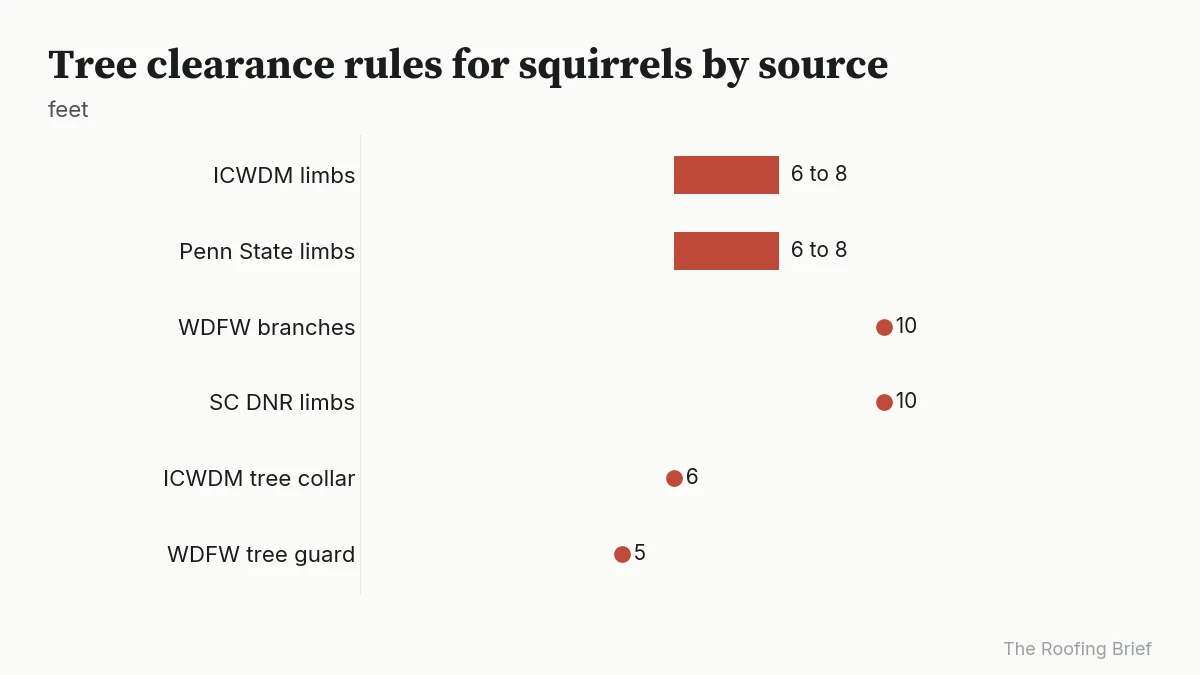
Trimming to 10 feet satisfies all four limb rules in the table. Metal tree collars only help on isolated trees; ICWDM says to attach them with encircling wires held by springs so the tree can grow, and the SC DNR sheet says to consult the power company before putting anything on a utility pole.
What does squirrel removal and repair cost?
The do-it-yourself materials for one entry hole cost about $92 at October 2026 listings: one Tomahawk E40 excluder at $31.90 plus two 36-inch by 10-foot hardware cloth rolls at $29.99 each from Hills Flat Lumber. A second entry hole adds another excluder, for about $124. Carpentry, flashing and insulation work are separate lines.
| Line | Quantity | Unit price | Line total | Basis |
|---|---|---|---|---|
| Tomahawk E40 excluder with one-way door | 1 | $31.90 | $31.90 | Tomahawk Live Trap listing, Oct 2026 |
| Hardware cloth 1/4 in, 23 gauge, 36 in x 10 ft (vents) | 1 | $29.99 | $29.99 | Hills Flat Lumber listing, Oct 2026 |
| Hardware cloth 1/2 in, 19 gauge, 36 in x 10 ft (chew patches) | 1 | $29.99 | $29.99 | Hills Flat Lumber listing, Oct 2026 |
| Hardware cloth subtotal | 2 rolls | $59.98 | Sum of the two rolls | |
| Kit total, one entry hole | $91.88 | $31.90 + $59.98 | ||
| Second excluder for a second hole | 1 | $31.90 | $31.90 | Tomahawk Live Trap listing, Oct 2026 |
| Kit total, two entry holes | $123.78 | $63.80 + $59.98 |
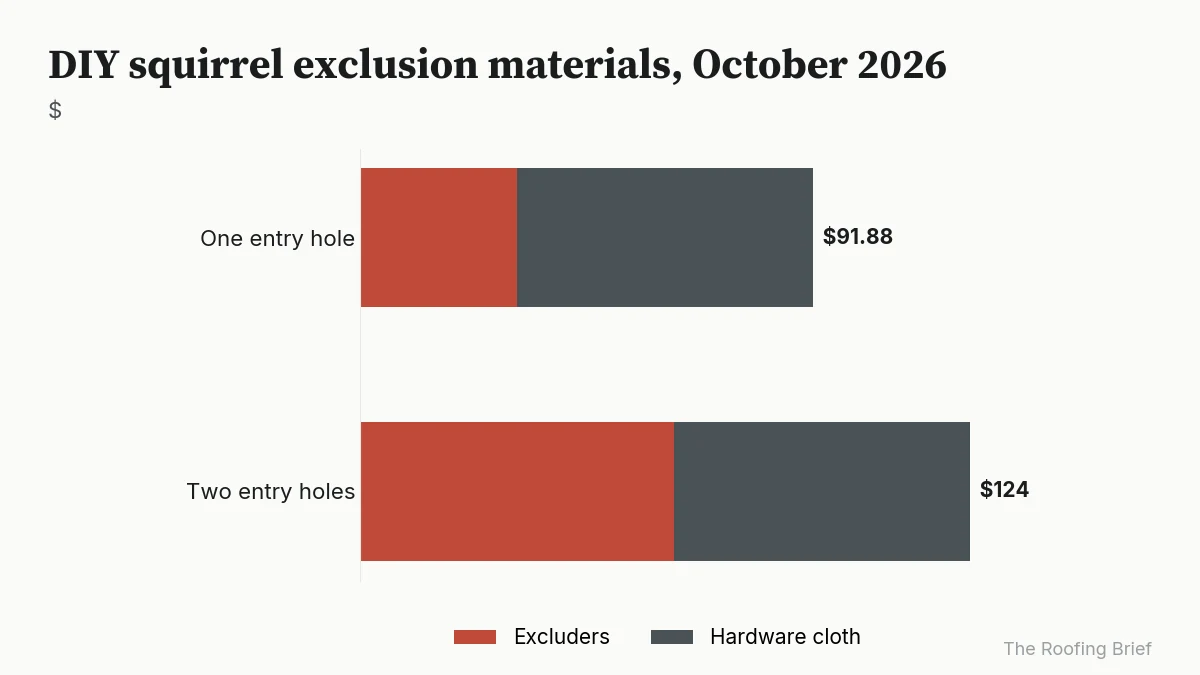
These are Roofing Brief totals from dated listings at two vendors, not quotes, and the 23-gauge roll is lighter wire than the 19-gauge roll, so use it on vents where the code’s 1/4-inch cap applies. Three items move a contractor’s bill most: how many entry holes there are, whether soffit or fascia boards need replacing, and how much insulation is soiled.
Price the carpentry with our soffit and fascia replacement cost guide. Ask each wildlife company whether its quote includes exclusion of every gap or only the active hole, how it checks for young between February and August, what it does with captured animals under your state’s rules, and whether it warranties the sealed holes. If a squirrel was near exposed wires, WDFW advises checking smoke detectors and having the wiring inspected.
Squirrels in the attic decision table
Find your situation in the left column, then follow the action and check the named source. The thresholds come from ICWDM, WDFW, CT DEEP, UC IPM Pest Notes 74122 and the state codes in the legal table, and the first two rows decide whether you can act yet at all.
| If your situation is | Do this | Source |
|---|---|---|
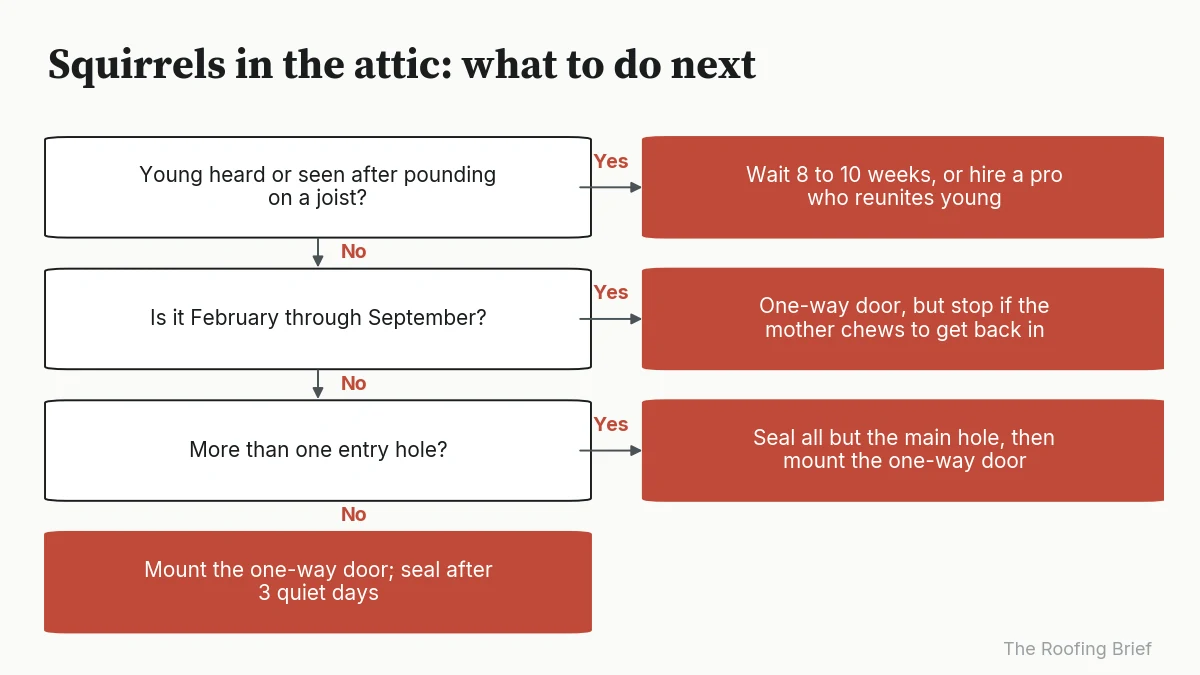
| You hear or see young, in any month | Wait until young leave, 8 to 10 weeks after birth, or hire a pro who reunites mother and young | WDFW |
| February through September, no young heard after pounding on joists | Proceed with the one-way door, and watch for frantic chewing | ICWDM; WDFW; CT DEEP |
| More than one entry hole | Seal all but the main hole first, then mount the one-way door | ICWDM; UC IPM 74122 |
| October through January, nothing heard | Seal secondary holes, mount the one-way door on the main hole | ICWDM; WDFW |
| Newspaper in the hole undisturbed for 3 fair-weather days | Remove the door and seal with metal | WDFW |
| Adult chewing hard to get back in | Assume young inside; reopen, wait, patch with heavy 1/2 in mesh | CT DEEP |
| You plan to trap and move the squirrel | Check your state row first; Washington and California restrict release off the property | RCW 77.15.250; UC IPM 74122 |
| Limbs within 10 ft of the roof | Trim to 6 to 8 ft at minimum, 10 ft to meet every source | ICWDM; WDFW |
| Squirrel near exposed wires | Test smoke detectors; have wiring inspected | WDFW |
| Nest and droppings across the insulation | CDC wet cleanup; bag soiled insulation | CDC; UC IPM 74122 |
Squirrels share entry points with roof rats, so once the squirrels are out, the same sealed roofline also keeps rats out if every gap larger than 1/4 inch is closed, the sealing threshold in UC IPM Pest Notes 74106 on rats.
How we compiled this
We compiled this guide from 21 primary documents: ICWDM tree squirrel chapters, UC IPM Pest Notes 74122, Penn State Extension, the Washington, Connecticut and South Carolina wildlife agencies, Ohio, Indiana, Massachusetts and Washington code text, the R806.1 code text, the CDC cleanup page and three rodent extension guides, plus dated Tomahawk Live Trap and Hills Flat Lumber listings, all accessed in October 2026. We did not trap squirrels, inspect attics or survey contractors.
Frequently asked questions
Should I worry about squirrels in my attic?
Yes, mainly for wiring and fire risk. The SC DNR species sheet says squirrels chew electrical wires, which can cause building fires, can create a fire hazard by nesting in chimneys, and can weaken rafters by gnawing. CT DEEP says squirrels in eaves and attics damage insulation and wiring and should be removed, and WDFW advises testing smoke detectors and having exposed wiring inspected.
What to do if you hear squirrels in your attic?
Note the time and the month first. Scratching in early morning or daylight points to gray or fox squirrels (CT DEEP), and February through August means young may be present (ICWDM). Find the entry hole from outside, pound on a joist to check for young, and do not seal anything yet. If no young respond, seal secondary holes and mount a one-way door on the main one.
What is the 5 7 9 rule for squirrels?
None of the wildlife agency or extension sources we checked uses a “5 7 9 rule”, so use their published distances instead. ICWDM and Penn State Extension say to trim limbs 6 to 8 feet from buildings, WDFW and SC DNR say 10 feet, and CT DEEP says to mount bird feeders on a metal pole at least 6 feet high with a metal, cone-shaped baffle.
Will squirrels leave the attic on their own?
A mother with young usually leaves once the young are grown. WDFW says young leave the nest 8 to 10 weeks after birth and advises that if young are present, the most humane option is to leave the family alone until they move on their own. They may come back to the same hole, so seal it with metal after the newspaper test shows 3 quiet days.
How long does a one-way door take to work?
Plan on several days. WDFW’s test for an empty attic is a wad of newspaper in the entry that stays undisturbed for 3 days of fair weather. ICWDM recommends a spring-loaded door with an apron of at least 1 foot square and warns that freezing rain can freeze it shut or open, so check the door daily and restart the 3-day count after storms.
Can I relocate a squirrel I trapped?
Often not legally. Washington allows release only on the property where the squirrel was trapped unless you hold a permit (RCW 77.15.250), California bars release elsewhere without a CDFW permit (UC IPM 74122), and Massachusetts permittees may release a live squirrel only at the site of capture (321 CMR 2.14). The SC DNR species sheet advises against translocation because of stress and disease concerns.
Do mothballs keep squirrels out of the attic?
No, and they can make people sick. ICWDM says naphthalene may temporarily discourage squirrels but is not recommended in occupied buildings because it can cause severe distress to people. The SC DNR species sheet calls mothball use against squirrels an off-label use that is illegal in many states. ICWDM adds that no toxicants are registered for tree squirrel control at all.
Is it a squirrel or a rat in my attic?
Listen to the clock. CT DEEP says gnawing, scratching and pattering in early morning or daylight hours usually signals squirrels, while roof rats are nocturnal and start moving at twilight, per University of Arizona publication AZ1775. Hole size helps too: gray and fox squirrels gnaw baseball-sized holes (SC DNR), while a rat needs a gap only slightly larger than 1/2 inch (NebGuide G1530).
Sources
- Internet Center for Wildlife Damage Management, Tree Squirrels, accessed Oct 2026
- Internet Center for Wildlife Damage Management, Tree Squirrel Biology, accessed Oct 2026
- Internet Center for Wildlife Damage Management, Tree Squirrel Damage Prevention and Control Methods, accessed Oct 2026
- UC IPM, Pest Notes: Tree Squirrels, UC ANR Publication 74122 (R.A. Baldwin), updated August 2016, accessed Oct 2026
- Washington Department of Fish and Wildlife, Living with wildlife: Tree squirrels, accessed Oct 2026
- Washington Department of Fish and Wildlife, Evicting animals from buildings, accessed Oct 2026
- Revised Code of Washington 77.15.250, Unlawful release or possession of fish, shellfish, or wildlife, accessed Oct 2026
- Connecticut DEEP, Squirrel Nuisance Problems, accessed Oct 2026
- Connecticut DEEP, Gray Squirrel fact sheet, accessed Oct 2026
- Connecticut DEEP, Common Wildlife Problems (homeowner trapping and relocation rules), accessed Oct 2026
- South Carolina Department of Natural Resources, Tree Squirrels species information (prepared by the National Wildlife Control Training Program, 2014), accessed Oct 2026
- Penn State Extension, Tree Squirrels (Thurston and Brittingham), updated January 1, 1997, accessed Oct 2026
- Ohio Administrative Code 1501:31-15-03, Nuisance wild animal control, accessed Oct 2026
- 312 Indiana Administrative Code 9-10-11, Nuisance wild animal control permit, accessed Oct 2026
- 321 Code of Massachusetts Regulations 2.14, Problem Animal Control, accessed Oct 2026
- International Code Council, 2021 International Residential Code, Section R806.1 Ventilation required (section wording checked against the 2025 California Residential Code reproduction below), accessed Oct 2026
- 2025 California Residential Code, Section R806.1 text, accessed Oct 2026
- CDC, How to Clean Up After Rodents, April 8, 2024, accessed Oct 2026
- University of Arizona Cooperative Extension, AZ1775: Roof Rats: Identification, Ecology, and Signs, July 2018, accessed Oct 2026
- University of Nebraska-Lincoln Extension, NebGuide G1530: Rodent-Proof Construction, Structural, revised January 2009, accessed Oct 2026
- UC IPM, Pest Notes: Rats, UC ANR Publication 74106, updated June 2025, accessed Oct 2026
- Tomahawk Live Trap, E40 Excluder for Squirrels, $31.90, listing seen Oct 2026
- Hills Flat Lumber, 1/4 in x 36 in x 10 ft 23-gauge hardware cloth, $29.99, listing seen Oct 2026
- Hills Flat Lumber, Agway 1/2 in x 36 in x 10 ft 19-gauge hardware cloth, $29.99, listing seen Oct 2026
- Humane World for Animals, What to do about squirrels (quoted for comparison only), accessed Oct 2026