
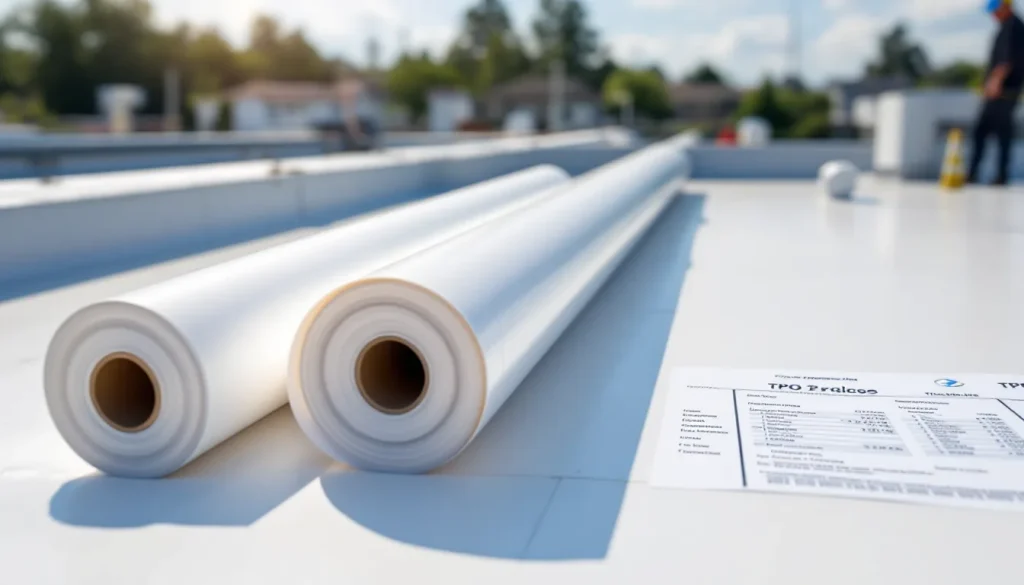
Sorting out tpo membrane pricing in 2026 means understanding that “TPO” is not a single product. It is a category of thermoplastic polyolefin single-ply membrane that comes in three primary thicknesses (45-mil, 60-mil, and 80-mil), two attachment methods (mechanically attached and fully adhered), and a wide range of manufacturer-specific warranty terms that drive long-term cost-per-year far more than the per-square install price does. This guide walks through current 2026 pricing per square (the commercial unit, where 1 square = 100 square feet) for each thickness, the cost differential between attachment methods, the ISO insulation R-value cost premium, and the warranty math that determines whether 60-mil or 80-mil is actually the better buy for a given building.
Last reviewed: August 2026.
What “per square” means in commercial roofing
The commercial roofing industry prices in squares, where 1 square equals 100 square feet of roof area. A 50,000 sq ft warehouse is a 500-square roof. A $500 per-square price equals $5 per square foot. This guide uses per-square pricing throughout because that is how commercial estimates are written, but per-square-foot conversions are included on every line so the math translates cleanly. For how per-square-foot pricing compares across other roofing materials, see our roof cost per square foot guide. The system overview that puts TPO in context with EPDM, PVC, and mod-bit is in our commercial roofs overview.
45-mil TPO: $300-450 per square installed
45-mil TPO is the entry-level commercial single-ply membrane. At $300 to $450 per square installed ($3.00 to $4.50 per square foot), it is the cheapest path to a new white reflective roof on a low-budget commercial replacement. The 2026 pricing range reflects mechanically attached installation over standard 4-inch polyiso insulation board with R-20 thermal value.
Leading 45-mil TPO products in 2026. Carlisle Sure-Weld TPO 45-mil, GAF EverGuard TPO 45-mil, Versico VersiWeld 45-mil, and Holcim/Firestone UltraPly TPO 45-mil. All four are available with standard 10 or 15-year manufacturer warranties on properly installed roofs, with extended warranty terms (20-year) requiring upgrade to 60-mil or 80-mil.
Where 45-mil fits. Short-hold buildings (5-10 year horizon), tenant-improvement reroofs where the lease structure does not justify capital for a longer-lifespan system, smaller commercial buildings where the per-square material cost difference matters more than the long-term lifespan difference. 45-mil is also the choice on temporary structures or buildings slated for redevelopment. When budget is the single deciding factor across the whole project, our cheapest roofing material comparison shows what each low-cost option sacrifices.
Where 45-mil does not fit. Roofs with rooftop traffic, roofs with hail exposure, roofs in regions with severe UV degradation, roofs that need a manufacturer 20 or 25-year NDL warranty. 45-mil simply does not have the thickness budget to survive the abrasion, puncture risk, and surface degradation that 60-mil and 80-mil handle.
60-mil TPO: $400-650 per square installed
60-mil TPO is the dominant commercial single-ply membrane in 2026, holding roughly 60-70% of all new TPO installations. At $400 to $650 per square installed ($4.00 to $6.50 per square foot) for mechanically attached over 4-6 inch ISO insulation, 60-mil hits the sweet spot of cost, lifespan (18-25 years), and manufacturer warranty availability (most manufacturers offer 20-year NDL warranties on 60-mil installations).
Leading 60-mil TPO products in 2026. Carlisle Sure-Weld TPO 60-mil, GAF EverGuard TPO 60-mil (and EverGuard Extreme 60-mil for high-UV regions), Versico VersiWeld 60-mil, and Holcim/Firestone UltraPly TPO 60-mil. All four are field-proven across millions of installed square feet and supported by extensive certified contractor networks.
What drives the $250 per-square spread. The bottom of the range ($400/sq) reflects mechanically attached installation, standard ISO insulation, simple roof geometry, and large project size (over 500 squares). The top of the range ($650/sq) reflects fully adhered installation, upgraded ISO insulation, complex detail work, smaller project size (under 200 squares), and high-cost labor markets (West Coast, Northeast urban).
Where 60-mil fits. Distribution warehouses, retail, office, schools, light manufacturing, anywhere the owner wants a 20-year warranty and a 20-25 year expected service life at competitive installed cost. 60-mil is the default spec on most commercial reroof and new construction projects in 2026. For the full TPO install cost analysis including ISO insulation R-value impact, see our TPO roof installation cost guide.
80-mil TPO: $550-850 per square installed
80-mil TPO is the premium TPO thickness, priced at $550 to $850 per square installed ($5.50 to $8.50 per square foot). The cost premium over 60-mil is typically $100 to $200 per square. What that premium buys: longer manufacturer warranty (25 or 30-year NDL warranties typically require 80-mil), better hail and puncture resistance, longer field-proven service life (25-30 years vs 18-25 for 60-mil), and a better long-term cost-per-year on long-hold buildings.
Leading 80-mil TPO products in 2026. Carlisle Sure-Weld TPO 80-mil, GAF EverGuard Extreme 80-mil, Versico VersiWeld 80-mil, and Holcim/Firestone UltraPly TPO 80-mil. The Carlisle Sure-Weld and GAF EverGuard Extreme 80-mil products in particular are specified on high-hail regions (Texas, Oklahoma, Kansas, Colorado, Nebraska) where the puncture resistance pays back in reduced claim risk.
Where 80-mil fits. Long-hold buildings (15-30 year horizon), institutional buildings (schools, government, healthcare campuses), buildings in high-hail or high-UV regions, buildings with rooftop traffic that subjects the membrane to abrasion, anywhere a 25 or 30-year manufacturer warranty is required. The cost premium over 60-mil pays back inside 5-7 years on most long-hold scenarios.
The table below summarizes the three TPO thicknesses side by side, using the installed per-square ranges and best-use guidance from the sections above.
| Mil thickness | Typical installed cost per square | Best use |
|---|---|---|
| 45-mil | $300 to $450 | Short-hold buildings, tenant-improvement reroofs, temporary structures |
| 60-mil | $400 to $650 | Distribution warehouses, retail, office, schools, the 2026 default commercial spec |
| 80-mil | $550 to $850 | Long-hold and institutional buildings, high-hail and high-UV regions, rooftop-traffic roofs |
Mechanically attached vs fully adhered: $50-150 per square spread
Beyond mil thickness, the second pricing variable is attachment method. Mechanically attached TPO is fastened to the deck through the insulation with screws and stress plates at specified spacing. Fully adhered TPO is bonded to the insulation board with adhesive (water-based, solvent-based, or low-VOC bonding adhesive depending on manufacturer).
Mechanically attached. $50 to $100 per square cheaper than fully adhered, faster to install, and the standard choice on warehouses, distribution, and any building where roof aesthetics and wind-uplift performance are not premium concerns. Mechanically attached TPO performs well on wind-uplift testing when designed and fastened correctly, but the fastener pattern can telegraph through the membrane and create visible ridges.
Fully adhered. $100 to $150 per square more than mechanically attached, delivers superior wind-uplift performance (often required by code in hurricane and high-wind regions), better aesthetics (no fastener telegraphing), and tighter detail performance at penetrations and edges. Fully adhered is the spec on hospitals, schools, institutional buildings, and high-wind coastal regions.
ISO insulation R-value: the line item that varies most
TPO is installed over polyisocyanurate (ISO) insulation board, and the insulation R-value drives a meaningful chunk of the total installed cost. Current 2026 energy code in most US jurisdictions requires R-25 to R-30 insulation on commercial roofs, with some jurisdictions (California Title 24, Washington, parts of New York) requiring higher.
R-20 ISO (4 inches single-layer). $90 to $140 per square. The minimum spec on most commercial replacements and the baseline most TPO quotes use.
R-25 ISO (5 inches, typically two-layer staggered). $115 to $175 per square. The current code minimum in most jurisdictions and the practical default for 2026 commercial installs.
R-30 ISO (6 inches, two-layer staggered). $145 to $210 per square. The right spec for cold climates, buildings with high heating load, and buildings targeting LEED or other green-building certifications.
R-38 ISO (7-8 inches, two or three-layer staggered). $185 to $275 per square. Required in some jurisdictions and for some building uses (warehousing with sensitive temperature control, cold-adjacent applications).
The ISO insulation line item alone can swing the total per-square installed cost by $100 or more depending on R-value spec. Building owners should always confirm in writing what R-value the quote includes.
Tapered ISO for drainage: $50-150 per square premium
Flat roofs are not actually flat. They need a slight slope (typically 1/4 inch per foot) to direct water to drains and scuppers. Tapered ISO insulation board, cut at the factory to create the slope pattern, is the standard solution. The cost premium for tapered ISO over flat ISO is $50 to $150 per square depending on slope, drain configuration, and project complexity.
Some quotes do not include tapered ISO and assume the existing roof slope is adequate. On replacements over existing roofs with ponding water issues, this is a hidden cost that needs to be in the quote upfront. Our flat roof drainage design guide covers the drainage assessment and tapered ISO design workflow.
Cover board: $35-80 per square, not always included
Cover board (typically gypsum-fiber board like DensDeck Prime, or high-density ISO cover board) is installed between the ISO insulation and the TPO membrane to provide a more uniform substrate, improve puncture resistance, and improve fire performance. Cover board adds $35 to $80 per square to the installed cost.
Most manufacturer warranty terms strongly recommend or require cover board on certain applications (hospitals, schools, high-traffic roofs, hail regions). Some quotes omit cover board to hit a lower headline price. Building owners should confirm: is cover board included, and if not, why not?
Warranty terms and warranty pricing premium
TPO manufacturer warranties in 2026 typically come in three tiers: 10-year, 15-year, and 20-25 year NDL (no dollar limit). The warranty tier gates on: (1) membrane thickness (45-mil typically limited to 10 or 15-year warranty, 60-mil to 20-year, 80-mil to 25 or 30-year), (2) certified contractor status, (3) third-party warranty inspection before warranty is issued, and (4) annual or semi-annual inspection by the certified contractor for the warranty term.
10-year warranty. Typically free or low-cost premium ($5-15 per square). The default on 45-mil installations.
20-year NDL warranty. $25 to $75 per square premium over 10-year. The default for 60-mil installations on long-hold buildings.
25 or 30-year NDL warranty. $75 to $175 per square premium. The right spec on 80-mil installations for long-hold institutional buildings.
The warranty math: a $50/sq warranty premium on a 20-year NDL vs 10-year warranty equals $0.50/sq ft. Spread over 10 additional years of warranty coverage, the warranty premium runs $0.05/sq ft/year. On a $7-9/sq ft TPO install, that warranty premium delivers meaningful risk transfer at marginal incremental cost. Our commercial roof warranty guide covers the warranty terms across major manufacturers.
The total installed cost example: 100,000 sq ft warehouse
Walking through a realistic 2026 quote on a 100,000 sq ft (1,000-square) distribution warehouse, with 60-mil mechanically attached TPO, R-25 ISO insulation, cover board, tapered ISO at drains, standard detail work, and 20-year NDL warranty:
60-mil TPO mechanically attached: $450/sq = $450,000. R-25 ISO insulation: $145/sq = $145,000. Cover board: $60/sq = $60,000. Tapered ISO at drains: $40/sq blended across full roof = $40,000. Tear-off and disposal of existing roof: $85/sq = $85,000. Detail work (perimeter edge, penetrations, drains): $55/sq = $55,000. 20-year NDL warranty: $50/sq = $50,000. Total: $885,000, or $8.85/sq ft installed.
The same warehouse with 80-mil TPO, R-30 ISO, and 25-year NDL warranty would run roughly $1,025,000 to $1,075,000, or $10.25 to $10.75/sq ft installed. The $1.50 to $2.00 per square foot premium delivers 5-7 additional years of expected service life and a 5-year longer warranty. The cost-per-year math typically favors the 80-mil spec on any building with a hold horizon over 15 years.
Regional pricing variation across US markets
TPO installed pricing varies meaningfully by region in 2026. The same 60-mil mechanically attached TPO over R-25 ISO that runs $7.50/sq ft in the Southeast can run $10.50/sq ft in the San Francisco Bay Area or $9.75/sq ft in metro New York. The drivers are labor cost, prevailing wage requirements on certain project types, local energy code stringency, and the availability of certified contractor capacity in the market.
Southeast and Texas. Lowest installed pricing nationally. 60-mil mechanically attached TPO with R-25 ISO typically lands at $7.00 to $8.50/sq ft.
Midwest and Mountain West. Mid-range installed pricing. 60-mil typically lands at $7.50 to $9.00/sq ft.
Northeast urban and West Coast. Highest installed pricing. 60-mil typically lands at $8.75 to $11.00/sq ft, with prevailing-wage projects (schools, government, hospitals) running higher.
Building owners with multi-site portfolios should not assume a single per-square price applies across regions. Regional contractor selection and competitive bidding within each market deliver meaningfully better pricing than national contracts with single per-square pricing.
Why 45-mil TPO is losing market share in 2026
The market share of 45-mil TPO has been declining steadily through the 2020s and that trend continues in 2026. The primary driver is the warranty math: at $50-100/sq more for 60-mil, the building owner buys 5-10 additional years of expected service life and access to the 20-year NDL warranty. The cost-per-year economics almost always favor 60-mil over 45-mil on any building with a hold horizon over 8 years.
The secondary driver is hail performance. Commercial insurers in hail-prone regions are increasingly excluding or surcharging 45-mil TPO due to documented higher claim frequency, which makes the all-in cost of 45-mil higher than 60-mil once insurance premium is factored in.
For 2026, the building owner scenarios where 45-mil still makes sense are narrowing: short-hold buildings (under 8 years), tenant-improvement reroofs with limited lease term, and temporary structures. For everything else, 60-mil is the default spec.
What honest TPO quotes look like in 2026
An honest TPO replacement quote in 2026 has separate line items for: (1) the membrane (with mil thickness, manufacturer, and product line called out by name), (2) the insulation (with R-value and product specified), (3) cover board if included, (4) tapered ISO if included, (5) tear-off and disposal, (6) detail work, (7) attachment method (mechanically attached vs fully adhered), (8) warranty tier with the warranty premium called out separately, and (9) any access cost (crane, lift) and tenant continuity provisions. Quotes that lump everything into a single per-square or lump-sum line are either lowballing to win the bid (and change-ordering on the back end) or hiding margin. Building owners who insist on line-item transparency pay less across a 25-year horizon than ones who chase the lowest headline number. For a broader view of flat-roof system pricing, our flat roof replacement cost guide compares TPO, EPDM, PVC, and mod-bit per square foot. For owners weighing TPO against EPDM or PVC, the TPO vs EPDM and TPO vs PVC comparisons cover the cross-system decision logic.
TPO roofing cost: frequently asked questions
How much does TPO roofing cost per square in 2026?
Installed TPO pricing in 2026 runs $300 to $450 per square for 45-mil, $400 to $650 per square for 60-mil, and $550 to $850 per square for 80-mil, where one square equals 100 square feet. Those figures cover the membrane and standard installation, so insulation R-value, cover board, tapered ISO, tear-off, and warranty tier move the total further.
Is 60-mil or 80-mil TPO the better buy?
60-mil is the 2026 default, offering 18 to 25 years of service life and a 20-year NDL warranty at a competitive installed cost. 80-mil adds roughly $100 to $200 per square and buys 25 to 30 years of service life, better hail and puncture resistance, and 25 or 30-year warranties. On buildings held over 15 years, 80-mil usually wins the cost-per-year math.
What is the difference between mechanically attached and fully adhered TPO?
Mechanically attached TPO is fastened to the deck with screws and stress plates, costs less, and installs faster, making it the standard on warehouses. Fully adhered TPO is bonded to the insulation with adhesive, runs $100 to $150 per square more than mechanically attached, and delivers superior wind-uplift performance plus better aesthetics, so it is specified on hospitals, schools, and high-wind coastal regions.
Why is 45-mil TPO losing market share?
For $50 to $100 more per square, 60-mil buys 5 to 10 additional years of service life and access to the 20-year NDL warranty, so the cost-per-year economics favor it on any building held over eight years. Commercial insurers in hail-prone regions also increasingly exclude or surcharge 45-mil, pushing its all-in cost above 60-mil once insurance is factored in.
Does a TPO quote include insulation and cover board?
Not always. ISO insulation is a separate line item that ranges from $90 per square for R-20 up to $275 per square for R-38, and it can swing the total by $100 or more depending on R-value. Cover board adds $35 to $80 per square and is sometimes omitted to hit a lower headline price. Confirm both in writing before comparing quotes.