
Reviewed by The Roofing Brief Team. Last reviewed: October 2026.
A roof coating can resist ponding water, but it does not remove the low spot: the permanent fixes are tapered insulation, additional roof drains, or relocated drains. Ponding on a flat roof is water that remains more than 48 hours after rain under drying conditions (NRCA glossary), and the right fix depends on whether the cause is design slope, structural deflection or drainage. Many membrane warranties exclude damage caused by ponding water, so read the exclusions in yours, and standing water concentrates wear on TPO, EPDM and other membranes. If an insurer or warranty inspector documents ponding and it is not addressed, it can complicate a later claim.
Sources: the NRCA definition, the International Building Code and International Plumbing Code, manufacturer documentation and contractor-quoted price ranges. The Roofing Brief did not run tests or survey roofs.
The short version
- The 48 hour line is the NRCA definition. Standing water more than 48 hours after rain, in drying conditions, counts as ponding.
- Many single-ply warranties exclude damage caused by ponding water. Check the exact language in your warranty before you assume coverage.
- The three root causes are insufficient slope at design (less than 1/4 inch per foot), structural deflection that develops over time, and clogged or undersized drains.
- Tapered polyiso insulation is the permanent fix. Adding drains or crickets is the targeted fix.
- Fix costs range widely, from a few hundred dollars for a cricket to tens of thousands for a full tapered retrofit; get local quotes.
- A roof coating for ponding water usually means silicone, because acrylic makers set explicit ponding limits; read the coating warranty’s ponding terms and thickness.
Short answer: the NRCA 48 hour standard
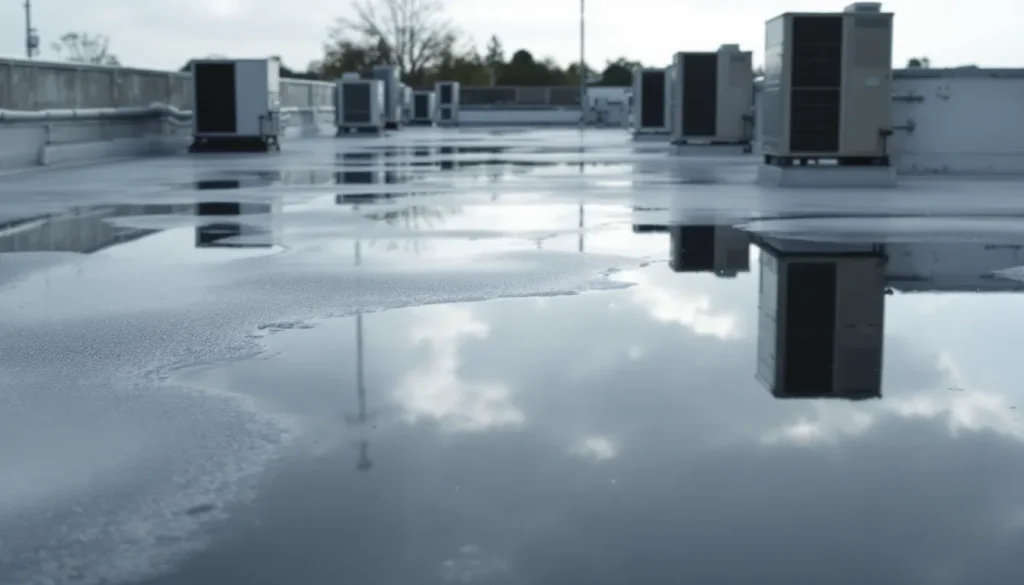
The National Roofing Contractors Association defines ponding as the excessive accumulation of water at low-lying areas on a roof that remains more than 48 hours after precipitation under conditions conducive to drying. It is not a building code definition, but it is the threshold the industry uses. Ponding sits near the top of most lists of flat roof drawbacks; for the full picture, see our guide to the disadvantages of a flat roof.
Why it matters: NRCA technical staff writing in Professional Roofing note that ponding water in excess of 48 hours can be detrimental to the roof assembly. Standing water adds weight, collects dirt that cuts a white membrane’s reflectivity, keeps seams under constant water, and can support algae and other biological growth.
Find the low spots, decide whether the cause is design, deflection or drainage, then choose: tapered insulation (permanent, $2.50 to $5.50 per sq ft), additional drains or crickets (targeted, $400 to $4,000 per spot), or a ponding-resistant silicone coating (interim, $2.50 to $5.00 per sq ft).
Why ponding and warranties collide
Many flat roof membrane warranties exclude damage caused by ponding water or require that the roof drain properly, and the exact wording varies by manufacturer, product and warranty tier. Some manufacturers offer options or system warranties that address ponding under stated conditions. Because terms differ and change, the only reliable answer is the warranty document for your roof: read the exclusions, the drainage requirements and any maintenance conditions.
If you file a claim for membrane failure and the manufacturer’s inspector finds ponding, the exclusion may be used to limit or deny it. On a new roof bid, ask each manufacturer in writing how its warranty treats ponding and whether a ponding option exists for your roof.
Three root causes
Ponding has three root causes that often combine. Insufficient slope at original design is common on older roofs. Current IBC Section 1507 requires a design slope of at least 1/4 inch per foot (2 percent) for built-up, modified bitumen, single-ply, spray foam and liquid-applied roofs, with coal-tar built-up allowed at 1/8 inch per foot. A roof built flatter often ponds even when everything else works correctly.
Structural deflection is the second cause and shows up as ponding mid-bay, away from the drains. Steel joists, wood trusses and concrete slabs all deflect under sustained load, and wet insulation or added HVAC and solar equipment can deepen it, so a roof that once drained can start to pond. Deflection means a coating alone will not hold: only added slope or structural work removes it.
Clogged or undersized drains are the third cause: a drain sized for one rainfall intensity can be overwhelmed by a heavier storm, and a clogged scupper compounds it. The twice-yearly inspection should include a drain flow check and debris removal, and it is the cheapest of the three causes to fix.
Tapered insulation as the permanent fix
Tapered polyiso insulation is the permanent solution to ponding caused by insufficient slope. Tapered panels are factory cut to a fixed slope (typically 1/4 inch per foot or 1/2 inch per foot) and laid out across the roof in a planned pattern that directs water to drains. A tapered system can be installed under a new membrane (full tear off plus tapered) or over an existing membrane (recover with tapered, less common).
Contractor-quoted planning ranges for tapered polyiso run about $2.50 to $5.50 per square foot installed, depending on average thickness, complexity, and region, on top of the membrane. This is the expensive option, but it is also the fix that removes the slope problem rather than working around it. Get local quotes for your roof.
Tapered insulation also adds R-value to the assembly, which is a useful side benefit; how much depends on the average thickness of the taper.
Drain additions and crickets
Adding a drain or relocating an existing drain is the targeted fix. A new internal drain through the deck and ceiling needs a plumbing tie-in and is the costlier of the targeted options; an additional scupper through the parapet and a cricket (a sloped insulation buildup behind a curb or wall to divert water around it) usually cost less. Planning ranges are in the table below.
Drains and crickets fit when ponding sits at one or two identifiable spots, such as a drain too far from the low point or a curb that blocks flow. They do not fit when ponding covers most of the roof, when slope is below 1/4 inch per foot, or when the membrane is near the end of its life and needs replacement anyway.
How to identify low spots manually
You do not need fancy equipment to find ponding areas. After a rain event, walk the roof at 48 hours and mark every standing water area with chalk or a marker on the membrane. Use a straight edge (a 6 foot level works) to measure depth at each spot. Note the distance to the nearest drain and whether the drain has flow blockage.
On a dry roof, look for residue rings: each pond often leaves a grayish deposit ring at its perimeter on white TPO, and the rings persist between storms so you can map ponds on a dry day. Note any biological growth (black algae, green moss), which suggests long-term standing water.
Insurance implications
Commercial property insurers may inspect flat roofs during underwriting and renewal, and FM Global publishes property loss prevention guidance that covers roof drainage. If an inspector documents ponding and it is not addressed, the insurer may respond at renewal with conditions, higher premiums or coverage limits, depending on the carrier and state.
Residential carriers can also flag ponding during inspections, especially after a claim. Policy terms and underwriting rules vary by insurer.
Photograph each pond with a sketch tied to a drain and parapet reference, get a contractor bid, and complete the fix before the next policy renewal, then send the carrier proof of repair. The photos also serve in a warranty dispute. See filing an insurance claim for roof damage for the claim path if you are dealing with active damage. For how policies treat flat roofs more broadly, see our guide to flat roof insurance coverage and exclusions.
Cost by fix type
| Fix | Planning cost range | Best for | Permanent? |
|---|---|---|---|
| Single drain addition | $1,500 to $4,000 | Localized ponding near a missing drain | If root cause is drainage only |
| Scupper addition through parapet | $800 to $2,500 | Perimeter ponding | If root cause is drainage only |
| Cricket behind curb or wall | $400 to $1,500 | Ponding behind a single obstruction | Yes for that location |
| Tapered polyiso, full retrofit | $2.50 to $5.50 per sq ft, plus membrane | Whole roof inadequate slope | Yes |
| Silicone coating over existing | $2.50 to $5.00 per sq ft | Ponding-resistant interim fix | Depends on coating warranty and thickness |
| Full tear off and new membrane | $7 to $14 per sq ft for TPO, PVC or modified bitumen, plus tapered insulation | Membrane at end of life and ponding present | Yes |
Membrane pricing is from the Roofing Brief 2026 Roofing Cost Report. Other rows are contractor-quoted planning ranges, not a survey; your roof’s access, size and region will move them, so get local quotes.
TPO ponding vs EPDM ponding
Both membranes are built to shed water, not hold it. TPO (ASTM D6878) and PVC (ASTM D4434) collect dirt in ponds that cuts reflectivity and keep heat-welded seams under water; EPDM (ASTM D4637) has standing water sitting on seam tape and adhesive. Neither makes ponding acceptable, and warranty treatment of ponding differs by manufacturer.
If your slope is borderline on a new roof, add tapered insulation to the job and get each manufacturer’s ponding warranty language in writing. See TPO vs EPDM roofing for the full comparison.
Roof coating for ponding water: silicone as a ponding-resistant alternative
A silicone roof coating is the coating type marketed for ponding water. Henry describes its 887 Tropi-Cool silicone as providing “permanent ponding water resistance” (Henry’s 887 Tropi-Cool page), and Gaco’s GacoFlex S20 data sheet lists 1.5 gal per 100 sq ft for about 22 dry mil at 95% solids by volume, with UL 790 Class A, FM approval and CRRC 0608-0076, for use over membranes in sound condition. Silicone does not soften or wash off under standing water the way some acrylic coatings can, and acrylic manufacturers such as Conklin set explicit ponding limits for their systems. Warranty terms depend on the product, the dry film thickness and whether a qualified applicator installs it, so read the coating warranty’s ponding language.
Contractor-quoted ranges run about $2.50 to $5.00 per square foot installed depending on existing roof condition and number of coats, well below the cost of a tear-off and new membrane. The catch is that most materials do not bond well over cured silicone, so future recoats are usually silicone over silicone, and a future replacement requires careful planning. See silicone roof coating for the full system breakdown.
Code requirements for flat roof drainage
The International Building Code (IBC) and International Plumbing Code (IPC) both set requirements for flat roof drainage. IBC Section 1507 sets a minimum design slope of 1/4 inch per foot (2 percent) for built-up, modified bitumen, single-ply, spray foam and liquid-applied roofs, with coal-tar built-up at 1/8 inch per foot; IBC Section 1511 lets a reroof or recover skip that minimum where the roof provides positive drainage. IBC Section 1611 requires the roof structure to be designed for the rain load that could build up if the primary drains are blocked. IPC Section 1108 requires secondary (emergency overflow) drains or scuppers where parapets or other perimeter construction would trap water if the primary drains back up, sized without counting the primary system. Older roofs built before these provisions were adopted may lack that redundancy, and a blocked primary drain on such a roof can let water build up beyond what the structure was designed to carry.
NRCA guidance
NRCA’s quality control guidelines and The NRCA Roofing Manual treat positive drainage as a fundamental requirement for modified bitumen, single-ply and built-up roofing. Its guidance points to slope to drains, overflow provisions and tapered insulation where slope is inadequate. These documents are the industry’s standard of care, separate from code, and they are often cited when a flat roof fails and the cause is disputed.
Commercial property warranty implications
For commercial owners, a manufacturer warranty defers a large replacement cost, and an unaddressed ponding condition can cost that coverage. Inspect at least twice a year, as the NRCA recommends, in spring and fall and after severe weather. Document all ponds, get contractor bids, then either fix them or get written confirmation from the membrane manufacturer on how the condition affects coverage. Letting a warranty lapse can be rational on a roof near end of life, rarely on one early in its service.
Symptom checklist: ponding vs normal drainage
| Observation | Ponding (action required) | Normal (no action) |
|---|---|---|
| Water 48 hours after rain | Yes | No |
| Residue rings on membrane | Yes | No |
| Black algae or biological growth | Yes | No |
| Standing water depth over 1/4 inch | Yes | Trace film only |
| Pattern repeats at every rain event | Yes | Random/event specific |
| Membrane discoloration under water area | Often yes | No |
| Visible deflection in deck | Often yes | No |
If X, then Y: choosing the ponding fix
| If | Then |
|---|---|
| Ponding sits behind one curb or wall | Cricket, $400 to $1,500 |
| Ponding sits at a drain that is too far from the low point | Add a drain, $1,500 to $4,000, or a scupper, $800 to $2,500 |
| Slope is under 1/4 inch per foot across the roof | Tapered polyiso, $2.50 to $5.50 per sq ft plus membrane |
| Membrane is sound, the budget is limited, and the warranty permits it | Silicone coating over the sound membrane, $2.50 to $5.00 per sq ft; confirm ponding terms first |
| Membrane is at end of life and ponding is present | Tear off and re-roof with tapered insulation |
| Deck deflects visibly | Structural repair before any coating, because a coating does not remove the low spot |
When to walk away from ponding fix and just replace
| Roof age | Ponding severity | Recommended action |
|---|---|---|
| 0 to 5 years | Any | Fix promptly (tapered or drains) and check warranty terms |
| 5 to 12 years | Localized birdbaths | Add drains or crickets |
| 5 to 12 years | Widespread ponding | Silicone coating or partial tapered |
| 12 to 18 years | Any | Plan replacement; consider a coating as an interim step |
| 18 plus years | Any | Full tear off with tapered insulation |
For a full replacement, see low slope roof systems and modified bitumen roof as alternative material choices. If you are unsure whether your roof is at end of life, see signs you need a new roof. For the broader replacement cost, see how much does a new roof cost and roofing cost per square.
FAQs
How long can a flat roof tolerate ponding water?
The NRCA threshold is 48 hours. Water that remains more than 48 hours after rain, in drying conditions, counts as ponding, and NRCA technical staff note that ponding beyond 48 hours can be detrimental to the roof assembly.
Will a silicone roof coating fix ponding?
It resists ponding rather than fixing it. A silicone roof coating is marketed for ponding water resistance, and the water still sits there, but the coating is designed to withstand it. Check the coating warranty’s ponding terms and required thickness, such as Gaco’s 22 dry mil at 1.5 gal per 100 sq ft.
How much does tapered insulation cost?
Contractor-quoted planning ranges run about $2.50 to $5.50 per square foot installed for tapered polyiso, depending on average thickness, complexity, and region, plus the membrane on top. Get local quotes for your roof.
Does the IBC require minimum slope on flat roofs?
Yes. IBC Section 1507 requires a design slope of at least 1/4 inch per foot (2 percent) for most low slope coverings, with coal-tar built-up allowed at 1/8 inch per foot. IBC Section 1511 lets a reroof skip that minimum where the roof provides positive drainage, so an older roof may be legal and still need a fix to perform.
Why do warranties exclude ponding?
Standing water concentrates wear on the membrane and its seams, and manufacturers treat drainage as design and maintenance they do not control. Many warranties exclude ponding damage, and the terms differ by manufacturer and tier, so read the exclusions in yours.
Can I just add another drain instead of replacing the roof?
Sometimes. If the ponding is localized to one area near a missing or undersized drain, adding a drain can solve the problem, at a contractor-quoted planning range of about $1,500 to $4,000. If the entire roof slopes wrong, no amount of drains will fix it.
Is ponding water covered by my property insurance?
The ponding itself usually is not. Building damage from a roof that fails because of ponding may or may not be covered, depending on whether the carrier classifies it as wear, maintenance or a covered peril. Ask your agent to confirm in writing.
Related reading: all roofing guides | TPO vs EPDM roofing | modified bitumen roof | silicone roof coating | elastomeric roof coating | low slope roof | signs you need a new roof | filing an insurance claim for roof damage | how much does a new roof cost