
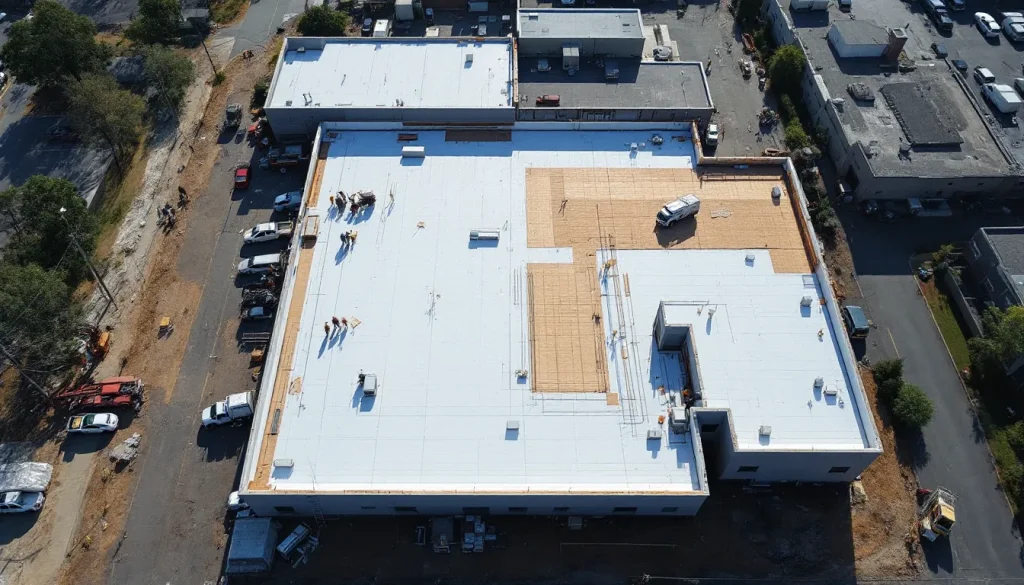
The list of best commercial roofing companies in 2026 is short, defensible, and ranks against four objective criteria: safety performance (EMR), manufacturer certification (for the full data set, see our the 2026 Roofing Contractor Industry Report) depth, project portfolio scale, and financial strength. Marketing claims are noisy; the criteria above produce a consistent ranking. Tecta America sits at the top by revenue, scope, and cert depth. Centimark, Nations Roof, KPost, and the dominant regional specialists round out the rest of the credible field. This guide walks the ranking, what each company does well, where each falls short, and how to read the rankings for your own project decision.
Last reviewed: August 2026.
The short version
- Tecta America is the largest US commercial roofer at roughly $1.5 billion revenue and 80-plus locations.
- Centimark, Nations Roof, KPost are the next national-scale tier; each has a distinct geographic and operational specialty.
- Top regional specialists by reputation: Baker Roofing (Carolinas), Latite Roofing (Florida), A.W. Farrell (NY metro), MR Roof (Indianapolis), Maxwell Roofing (Tennessee).
- Ranking criteria that matter: EMR safety score, manufacturer cert at top tier, project portfolio scale, financial strength, project references.
- No single company is the best fit for every project; the right pick depends on project size, location, complexity, and budget.
- Marketing-driven “Top 100” rankings are unreliable because they often weight self-reported revenue without verifying safety, cert, or completion track record.
The ranking criteria
Five defensible criteria rank commercial roofers in 2026: EMR safety score, manufacturer certification depth, project portfolio scale, financial strength, and verified project references. Each is objective and checkable, unlike self-reported revenue. Together they screen out contractors that market well but lack the safety record, cert tier, or completion track record to deliver large commercial work reliably.
EMR safety score. The Experience Modification Rating is a workers’ compensation multiplier that reflects actual injury history against industry average. Below 0.75 is excellent; below 1.0 is acceptable; above 1.25 is a red flag. The top commercial roofers run EMRs in the 0.55 to 0.80 range. EMR data is verifiable through state (for the full data set, see our the 2026 State Roofing Code and Licensing Report) WC registries. A low EMR reflects a safety culture visible on site, from fall protection down to whether crews consistently wear proper safety glasses for roofing.
Manufacturer certification depth. Cert tier across multiple major manufacturers (Carlisle, GAF, Sika Sarnafil, Versico, Firestone, Johns Manville) signals both technical competence and the ability to offer the full warranty menu to clients. The top tier (Carlisle Centurion Award, GAF Master Select, Sika Sarnafil RSB) is the screening threshold for serious commercial work.
Project portfolio scale. Public reference projects of 100,000 square feet and above demonstrate the bench depth and project management capability to handle large commercial work. A company (see our commercial roofing contractors) whose largest reference project is 30,000 square feet should not be ranked alongside one with multiple 500,000 square foot projects in the portfolio.
Financial strength. Bonding capacity, years in business, ownership structure stability, and revenue trend all signal that the company will be around to honor warranties and complete projects. ESOP, family-owned with succession plan, and private-equity-backed roll-ups all have different risk profiles. Background on the residential equivalent of this ranking is in best roofing contractor near you.
Project references. Three references at project size, contacted by phone, asking about schedule performance, budget adherence, punch list management, and would-hire-again sentiment. This is the cheapest and most powerful screening tool, and it is the one most owners skip.
Tier 1: The national leader
Tier 1 has a single national leader: Tecta America. At roughly $1.5 billion in revenue across 80-plus locations, with top-tier certifications on every major manufacturer system, Tecta operates at a scale no other US commercial roofer matches. It is the default bidder on large multi-market portfolios and complex specs, though its overhead rarely makes it the cheapest option in any one market.
Tecta America
Tecta America is the largest commercial roofing contractor in the United States, generating approximately $1.5 billion in revenue across 80-plus operating locations. Tecta was assembled starting in 2000 through a roll-up of regional commercial roofing companies and now operates as a unified brand with regional operating units. ASRC Construction is the majority owner.
Cert depth: Carlisle Authorized Applicator and Centurion Award winner at multiple operating units, GAF Master Select Contractor across the network, Sika Sarnafil RSB Registered Roofer at locations specializing in Sika work, Firestone Red Shield, Johns Manville Peak Advantage. The cert depth is industry-leading and is what enables Tecta to deliver NDL warranties across any major system on any size project.
Project portfolio: data centers, distribution centers, hospitals, universities, stadiums, big-box retail, manufacturing. Reference projects regularly include 500,000-square-foot warehouses and 1,000,000-square-foot distribution centers. Tecta is the default bidder on national-account work where a single contractor is delivering across dozens of building locations for clients including Amazon, Walmart, and Target.
Where Tecta falls short: pricing rarely leads in any single market, because the overhead structure is more expensive than a regional specialist. Project management consistency varies by operating unit; the best units (Atlanta, Chicago, Dallas, Phoenix) are excellent, while smaller units can be uneven. Bid responsiveness is sometimes slower than a hungry regional player. The screening questions that flush out these issues are in questions to ask roofing contractor.
Tier 2: National scale, distinct specialties
The Tier 2 nationals are Centimark, Nations Roof, and KPost. Each operates at national or near-national scale but wins on a distinct specialty: Centimark on long-term service-and-maintenance relationships, Nations Roof on industrial and multi-site portfolio work through its franchise network, and KPost on Texas and Sun Belt commercial projects. All three hold top-tier manufacturer certifications.
Centimark
Centimark is the Canada-headquartered national operating across the US and Canada with around 100 service centers. Centimark’s distinct value proposition is the long-term service-and-maintenance relationship: install the roof, then own the inspection and repair work for the warranty term. Centimark publishes detailed annual roof condition reports for clients, which is unusual in the industry and creates client stickiness. Contractors that run this kind of recurring-service book lean on dedicated software to schedule inspections and track accounts; the leading options are ranked in best roofing CRM.
Cert depth: Carlisle Authorized Applicator, GAF Master Select, Sika Sarnafil RSB. Centimark’s strength is the recurring-revenue service model; the install work funnels into the long-term maintenance relationship.
Where Centimark falls short: the service-first business model can sometimes price install bids higher because the company (see our flat roofing companies list) is underwriting service margin in the install price. Owners interested only in the install (not a long-term maintenance relationship) sometimes find Centimark less competitive on standalone bids.
Nations Roof
Nations Roof operates as a franchise-style network with around 30 locations and a focus on industrial, big-box retail, and multi-site portfolio work. The franchise structure means the brand’s strengths and weaknesses vary by location. The top Nations franchises (Atlanta, Chicago, Dallas, Houston, Phoenix) are competitive on any national bid.
Cert depth: Carlisle Authorized Applicator, GAF Master Select, Versico VersiTrac at most locations. The Nations Roof Service division specifically targets the recurring service market that Centimark also competes in.
Where Nations Roof falls short: the franchise structure creates inconsistency between locations. Vetting a Nations Roof franchise requires evaluating that specific franchise the same way you would evaluate any regional specialist.
KPost Company
KPost is a Texas-based commercial roofer that has grown to approximately $200 million in revenue with operations in Dallas, Houston, Austin, San Antonio, Phoenix, and Denver. KPost is the dominant bidder on Texas commercial work and is increasingly competitive on data center, hospital, and stadium projects across the Sun Belt.
Cert depth: Carlisle Centurion Award (top 5 percent of Carlisle applicators nationally), GAF Master Select, Sika Sarnafil RSB. KPost is one of a handful of contractors nationally that has held Centurion Award status for 10-plus consecutive years.
Where KPost falls short: outside the Sun Belt operating footprint, KPost is not a credible bidder. Buyers in the Northeast, Midwest, and Pacific Northwest need a different national or a strong regional.
Tier 3: Regional specialists with national-quality reputation
The Tier 3 regional specialists carry national-quality reputations inside their footprints: Baker Roofing in the Carolinas and Southeast, Latite in Florida, A.W. Farrell in the New York metro, MR Roof across the Midwest industrial corridor, and Maxwell in Tennessee. Each holds top-tier certifications and often beats the nationals on price and responsiveness within its home market.
Baker Roofing Company
Baker Roofing is headquartered in Raleigh and operates across the Carolinas, Georgia, Virginia, Tennessee, and Florida with around 1,100 employees. Baker was founded in 1915 and has been continuously employee-owned since 1996. The shop is a GAF Master Select Contractor and a Carlisle Centurion Award winner.
Project portfolio: Baker handles commercial replacement, new construction, service and maintenance, and residential work through divisions. The commercial portfolio includes hospitals, universities, government buildings, and industrial. Baker’s reputation in the Carolinas is at the top of the local market.
Where Baker falls short: outside the Mid-Atlantic and Southeast footprint, Baker is not a player. Sun Belt and Northeast buyers need different shops.
Latite Roofing & Sheet Metal
Latite is the dominant Florida commercial roofer with operations in Pompano Beach, West Palm Beach, Tampa, Orlando, and Fort Myers. Founded in 1947 and currently operating with around 800 employees, Latite specializes in commercial replacement and new construction across South Florida, Central Florida, and the Gulf Coast.
Cert depth: GAF Master Select Contractor, Carlisle Authorized Applicator, Sika Sarnafil RSB. The shop’s value proposition is hurricane code knowledge: every Florida commercial roof has to meet Florida Building Code wind uplift requirements that exceed standard ASCE 7 in many counties, and Latite’s crew knows the spec inside out.
Where Latite falls short: outside Florida, Latite does not bid.
A.W. Farrell & Son
A.W. Farrell is a New York-based commercial roofer operating across the Northeast and the New York metro area. Founded in 1937, A.W. Farrell handles commercial replacement, new construction, and service in a market where regulatory complexity and the union labor environment require local expertise.
Cert depth: Sika Sarnafil RSB Registered Roofer, Carlisle Authorized Applicator, GAF Master Select Contractor. A.W. Farrell is a fixture on New York City commercial bids and on Long Island commercial work.
Where A.W. Farrell falls short: outside the New York metro area and immediate Northeast, A.W. Farrell does not operate.
MR Roof (Midwest Roofing)
MR Roof operates from Indianapolis across Indiana, Ohio, Kentucky, and Illinois. The shop handles commercial replacement and new construction across the industrial Midwest, with reference projects in automotive manufacturing, logistics, and warehouse.
Cert depth: Versico VersiTrac, GAF Master Select Contractor, Carlisle Authorized Applicator. MR Roof is the regional default for industrial commercial work in the Midwest.
Where MR Roof falls short: outside the Midwest industrial corridor, MR Roof is not a player.
Maxwell Roofing & Sheet Metal
Maxwell Roofing is a long-running Tennessee commercial roofer headquartered in Nashville. Founded in 1897 and currently operating with around 200 employees, Maxwell handles commercial replacement, new construction, and service across Tennessee and surrounding states.
Cert depth: Sika Sarnafil RSB Registered Roofer, Carlisle Authorized Applicator. Maxwell has built a regional reputation on healthcare and education commercial work.
Where Maxwell falls short: outside Tennessee and immediate surrounding states, Maxwell is not actively bidding.
Comparison at a glance
The table below compares the nine companies on coverage, revenue scale, top-tier certifications, and best-fit project profile. Tecta America leads on scale at $1.5 billion-plus; the regionals range from roughly $50 million to $200 million-plus. Read it as a screening shortlist, not a ranking to buy from directly, because fit depends on your project’s location, size, and complexity.
| Company | Coverage | Revenue scale | Top-tier certs | Best fit |
|---|---|---|---|---|
| Tecta America | National, 80+ locations | $1.5B+ | Carlisle Centurion, GAF Master Select, Sika RSB | Large multi-market portfolios, complex specs |
| Centimark | National (US + Canada) | $700M-$900M est | Carlisle, GAF Master Select, Sika RSB | Long-term service-and-maintenance relationships |
| Nations Roof | National, franchise network | $500M+ est | Carlisle, GAF Master Select, Versico VersiTrac | Industrial, big-box retail, multi-site |
| KPost | Sun Belt (TX, AZ, CO and adjacent) | $200M+ | Carlisle Centurion, GAF Master Select, Sika RSB | Texas and Sun Belt commercial work |
| Baker Roofing | Mid-Atlantic + Southeast | $200M+ | GAF Master Select, Carlisle Centurion | Carolinas commercial and multi-trade |
| Latite Roofing | Florida | $200M+ est | GAF Master Select, Carlisle, Sika RSB | Florida commercial, hurricane code |
| A.W. Farrell | NY metro + Northeast | $150M+ est | Sika RSB, Carlisle, GAF Master Select | NYC and Long Island commercial |
| MR Roof | Midwest industrial corridor | $100M+ est | Versico VersiTrac, GAF Master Select | Midwest industrial commercial |
| Maxwell Roofing | Tennessee + adjacent | $50M+ est | Sika RSB, Carlisle | Tennessee healthcare and education |
How to use this list for your decision
This ranking is a screening tool, not a buying guide. The right pick for any commercial project depends on five variables: project location, project size, project complexity, schedule pressure, and budget priority. A national leader suits large, complex, multi-market work, while a regional specialist often wins smaller or budget-driven projects inside its footprint. Match the contractor to the project profile below.
Project location. If the project is in Houston, KPost and a regional Houston specialist are the credible bidders. Tecta has a Houston operating unit and may bid competitively. Baker, Latite, and A.W. Farrell are not in that market.
Project size. A 15,000 square foot building is probably the wrong project for Tecta to focus on; a Tecta operating unit may bid but is unlikely to bring the A-team crew. A regional specialist or local independent will compete more aggressively at that size.
Project complexity. A hospital re-roof with active occupancy, complex penetrations, and infection-control protocols is a complexity project. Nationals and top regionals are appropriate; local independents are typically not equipped for it.
Schedule pressure. If the project must complete in a 6-week window between tenant occupancy events, the contractor’s ability to mobilize a large crew quickly matters. Nationals and large regionals win on this dimension.
Budget priority. If the lowest qualified bid is the deciding factor, a regional or local will usually beat a national on a small-to-mid project. The trade-off is the warranty depth, the bonding capacity, and the brand reputation. The cost framework is in commercial roof replacement cost.
Why marketing rankings get this wrong
“Top 100 Commercial Roofing Companies” lists are published by trade magazines (Roofing Contractor, RoofersCoffeeShop, others) and are typically ranked by self-reported revenue. Revenue rank correlates loosely with quality but is not a reliable proxy. A company can report high revenue from a large residential operation while running a small and uneven commercial division. A company can drop in revenue rank during a slow year while continuing to deliver the same project quality. A company can buy revenue through aggressive low-bid strategy that creates change-order disputes downstream.
The criteria that matter for a commercial buyer are operational: cert tier, EMR, project portfolio at relevant size, completion track record, references. These criteria do not appear on most marketing rankings. Use the marketing rankings to identify candidate companies; use the operational criteria to qualify them.
The bidding workflow with this list
The bidding workflow for a commercial owner using this ranking runs in six steps: define the project profile, build a candidate list of four to six companies, issue a pre-qualification questionnaire, drop any company that fails verification, issue bid documents to the survivors, and award on overall value rather than lowest price. The full sequence follows.
1. Identify your project’s location, size, complexity, and timing requirements.
2. From this ranking, build a candidate list of 4 to 6 companies that fit your project profile. Mix one or two nationals with two or three regionals and one or two local specialists where relevant.
3. Issue a pre-qualification questionnaire covering EMR, cert verification, insurance, bonding, and three project references at your size. Verify all returned documentation independently.
4. Drop any company that fails verification or declines to provide complete documentation.
5. Issue bid documents to the surviving 3 to 5 candidates. Compare bids line by line against the spec.
6. Award based on overall value, not lowest price. The full pre-qualification framework is in commercial roofing contractor guide.
FAQ
Is Tecta America always the best choice?
Tecta is the largest and most cert-deep, but “best” depends on the project. On a 200,000 square foot Texas warehouse, KPost may bid more aggressively and deliver equivalent quality. On a 50,000 square foot Carolinas hospital, Baker Roofing is likely a stronger fit for the relationship. Tecta is the default consideration for large multi-market work.
How do private-equity-backed roll-ups affect contractor quality?
The commercial roofing industry has seen significant private-equity activity in the 2020s, with several large nationals and regionals having ownership changes. The quality impact varies by deal: some roll-ups maintain operating-unit autonomy and the cert depth holds steady; others impose cost-cutting that erodes crew quality. Ask whether the local operating unit has retained its key project management and crew through the ownership change.
Should I always require a Centurion Award or Master Select contractor?
For projects above $500,000 with full NDL warranty requirement, yes. For smaller projects with shorter warranty terms acceptable, base-tier cert may suffice. The cert requirement should match the warranty requirement.
Are union-only contractors better quality?
Union contractors typically have stronger safety culture and lower EMR. They are also more expensive. On Davis-Bacon public work and on union-environment private work, union contractors are required or strongly preferred. On private commercial work in right-to-work states, non-union and union contractors compete on equal footing.
How important is the manufacturer’s authorized contractor locator?
Critical. If the contractor claims a cert but is not listed in the manufacturer’s locator at the claimed tier, the cert is lapsed or never existed. Verify every cert claim with the manufacturer directly.
Bottom line
The best commercial roofing companies in 2026 are identifiable through objective criteria: safety performance, cert depth, portfolio scale, financial strength, and references. Tecta America leads at the national level by every defensible measure. Centimark, Nations Roof, and KPost round out the credible nationals with distinct specialties. Baker Roofing, Latite Roofing, A.W. Farrell, MR Roof, and Maxwell Roofing lead the regional tier in their respective footprints. The right pick for any specific project depends on location, size, complexity, and budget. Use this ranking to build a candidate list; use the pre-qualification framework to qualify the candidates. Skip the marketing rankings.