
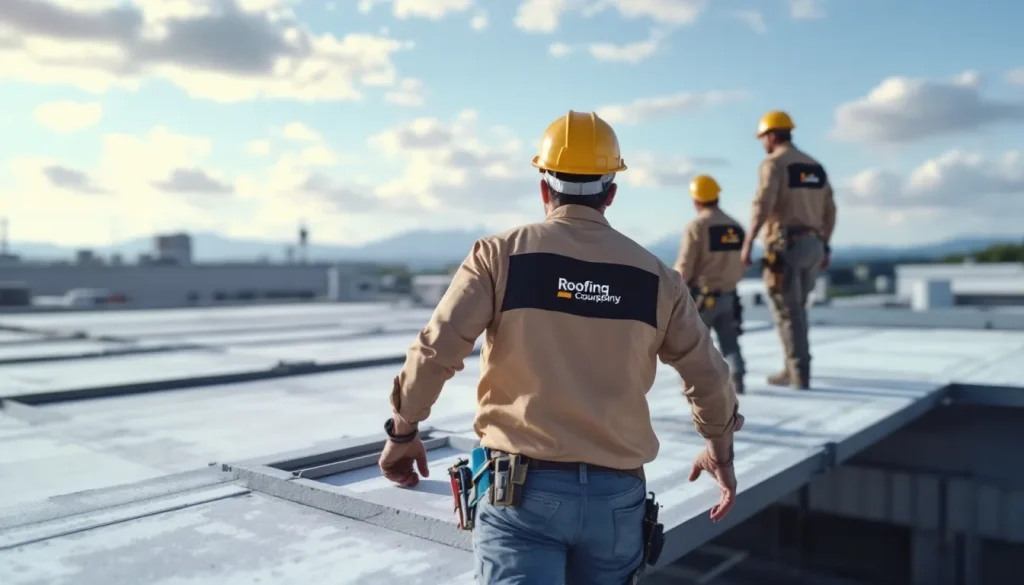
The commercial roofers in your market split into three tiers and each tier deserves a different vetting (for the full data set, see our the 2026 Roofing Contractor Industry Report) approach. National players (Tecta America, Centimark, Nations Roof, KPost) bring scale, consistent crew training, and the manufacturer cert depth to deliver an NDL warranty on a 200,000 square foot project anywhere in the country. Regional specialists (Baker Roofing in the Carolinas, Latite Roofing in Florida, A.W. Farrell in New York, MR Roof in Indianapolis, Maxwell Roofing in Tennessee) own the local code knowledge, the supplier relationships, and the crew bench. Local independents handle the 5,000 to 30,000 square foot work that the bigger shops will not bid. Picking the right tier for your project is half the job. Vetting the contractor properly is the other half.
Last reviewed: August 2026.
The short version
- Three tiers of commercial roofers: nationals, regional specialists, and local independents. Each fits a project-size range and a complexity range.
- Vetting screens that matter: EMR safety score under 1.0, manufacturer cert at the right tier, current GL and WC insurance with proper limits, bonding capacity above the project value.
- The biggest national: Tecta America, roughly $1.5 billion in revenue across 80-plus locations.
- The vetting kill switches: lapsed manufacturer cert, EMR above 1.25, unable to produce three references at project size, missing GL or WC certificate.
- Regional specialists beat the nationals on relationship-driven work, knowledge of local code, and crew familiarity with regional weather and building stock.
- Local independents are appropriate for projects under 30,000 square feet on lower-complexity buildings; for anything larger, the bench depth and bonding capacity become limiting.
National commercial roofers: who they actually are
National commercial roofers are a short list of firms that appear on membrane manufacturer top-applicator lists year after year: Tecta America, Centimark, Nations Roof, and KPost. They bring scale, consistent crew training, and manufacturer cert depth across every major brand, which makes them the default bidders on projects above roughly 100,000 square feet and on portfolios that span multiple markets.
Tecta America is the largest commercial roofer in the United States, generating roughly $1.5 billion in revenue across 80-plus operating locations. Tecta was assembled through a roll-up strategy starting in 2000 and now operates as a unified brand with regional (see our commercial roofing contractors near you) subsidiaries. The cert depth covers every major manufacturer (Carlisle, GAF, Sika Sarnafil, Versico, Firestone, Johns Manville, Versatile). Tecta is the default bidder on national-account work where a single contractor is delivering across dozens of building locations.
Centimark is the Canada-headquartered competitor with deep US presence, organized around a service-and-maintenance model layered on top of replacement work. Centimark’s value proposition is the long-term service relationship: install the roof, then own the inspection and repair work for the warranty term. Centimark publishes detailed annual roof condition reports for clients, which is unusual in the industry.
Nations Roof operates as a franchise model with around 30 locations and a focus on industrial and big-box retail. The franchise structure means crew quality and project management can vary by location, but the top Nations franchises (Atlanta, Chicago, Dallas, Phoenix) are competitive on any national bid.
KPost is a Texas-based commercial roofer that has grown to about $200 million in revenue with operations in Dallas, Houston, Austin, San Antonio, and Phoenix. KPost is the dominant bidder on Texas commercial work and on data center, hospital, and stadium projects.
The national tier is appropriate for projects above roughly 100,000 square feet, for portfolios spanning multiple markets, for complex specifications requiring deep manufacturer relationships, and for projects with aggressive schedule requirements. The trade-off: national pricing is rarely the lowest bid in any single market, because the overhead structure is more expensive than a regional (see our local commercial roofer finder) specialist.
Regional specialists: where they win
Regional specialists win on in-region commercial work. These shops are large enough to handle a 50,000 to 200,000 square foot project, deep enough on manufacturer cert to deliver the warranty, and small enough to keep relationship continuity with the owner across multiple projects. They typically beat the nationals on pricing, schedule responsiveness, and knowledge of local code, weather, and supplier relationships.
Baker Roofing Company is headquartered in Raleigh and operates across the Carolinas, Georgia, Virginia, Tennessee, and Florida with around 1,100 employees. Baker was founded in 1915 and has been continuously employee-owned since 1996. The shop is a GAF Master Select Contractor and a Carlisle Centurion Award winner. Baker is the regional benchmark for residential-and-commercial multi-trade work in the Carolinas market.
Latite Roofing is the dominant Florida commercial roofer with operations in Pompano Beach, West Palm Beach, Tampa, Orlando, and Fort Myers. Latite holds the GAF Master Select and Carlisle Authorized Applicator certs and has been bidding South Florida commercial work since 1947. The shop’s value proposition is hurricane code (for the full data set, see our the 2026 State Roofing Code and Licensing Report) knowledge: every Florida commercial roof has to meet the Florida Building Code wind uplift requirements, and Latite’s crew knows the spec inside out.
A.W. Farrell is a New York-based commercial roofer operating across the Northeast and the New York metro area. A.W. Farrell holds Sika Sarnafil RSB Registered Roofer status and is a Carlisle Authorized Applicator. The shop is a fixture on New York City commercial bids, where the regulatory complexity and the union labor environment require local expertise.
MR Roof (also known as Midwest Roofing) operates from Indianapolis across Indiana, Ohio, Kentucky, and Illinois. The shop is a Versico and GAF Master Select Contractor. MR Roof is the regional default for industrial commercial work in the Midwest.
Maxwell Roofing & Sheet Metal in Nashville is a long-running Tennessee commercial roofer, founded in 1897, currently operating with around 200 employees. Maxwell holds the Sika Sarnafil RSB cert and the Carlisle Authorized Applicator cert, and the shop has built a regional reputation on healthcare and education commercial work.
Regional specialists typically beat the nationals on pricing for in-region work, on schedule responsiveness, and on knowledge of local code, weather, and supplier relationships. Where they lose: multi-market national accounts that require a single contractor across the portfolio, and projects above 250,000 square feet where the crew bench depth gets stretched.
Local independents: appropriate scope
The local independent tier handles the 5,000 to 30,000 square foot commercial work that the bigger shops will not aggressively pursue. These are the shops that bid the corner strip mall, the local industrial building, the church, the school district maintenance work, the medical-office building.
Local independents are appropriate when the project is straightforward (single-ply membrane on a simple geometry, no unusual code requirements, no multi-site portfolio), when the building owner values relationship continuity over scale, and when the budget cannot stretch to a national or regional premium. Local independents are inappropriate when the project requires manufacturer NDL warranty terms above 20 years (the cert tier may be insufficient), when the project is above 30,000 square feet (bench depth gets thin), when the project involves complex structural or design conditions, or when the building owner needs bonding capacity above $500,000.
Vetting a local independent is more important than vetting a national, because the screening signals are noisier and the failure modes are more varied. The vetting framework in how to choose a roofing contractor applies regardless of tier, with extra emphasis on EMR, bonding, and reference checks at the local level.
The vetting screens that actually matter
The vetting framework for any commercial roofer is the same, and the screens are binary to evaluate: an EMR safety score under 1.0, current manufacturer certification at the right tier, current general liability and workers’ compensation insurance with adequate limits, bonding capacity above the project value, and three references at your project size. Drop a screen and you raise the project risk.
EMR safety score
The Experience Modification Rating (EMR) is a workers’ compensation insurance multiplier that reflects the contractor’s actual injury and claim history versus the industry average. EMR above 1.0 means the contractor has more claims than industry average. EMR below 1.0 means fewer claims. The bidding standard for commercial work in 2026:
- EMR below 0.75: excellent, signals a top-quartile safety culture
- EMR 0.75 to 1.0: good, signals an above-average safety culture
- EMR 1.0 to 1.25: acceptable for bid on small-to-mid projects but a red flag on larger work
- EMR above 1.25: most commercial owners will not allow on site; many GCs will not include in bid lists
EMR is public information through state workers’ comp registries and through the contractor’s WC insurance carrier. Ask for the current EMR in writing; reputable contractors send the document without flinching.
Manufacturer certification, current
The manufacturer cert is the single most important determinant of warranty availability. A contractor claiming GAF Master Select but not currently registered with GAF cannot deliver a GAF NDL warranty. Verify the cert directly with the manufacturer. GAF, Carlisle, Sika Sarnafil, Versico, Firestone, and Johns Manville all publish certified contractor locators on their websites. Search by company name. If the contractor is not in the locator at the claimed tier, the cert is lapsed.
The cert tiers to verify by manufacturer:
- GAF: Master Select Contractor (top), Master Commercial Contractor (mid), Certified Contractor (base)
- Carlisle: Centurion Award (top 5 percent), Sure-Weld Authorized Applicator (base), Perfection Award (annual recognition)
- Sika Sarnafil: Roofing Standards Bureau (RSB) Registered Roofer
- Versico: VersiTrac, Versitec, certified applicator
- Firestone: Red Shield Authorized Contractor
- Johns Manville: Peak Advantage Contractor
Insurance certificates, current and adequate
The commercial work standard for insurance in 2026:
- General Liability (GL): $2 million per occurrence, $4 million aggregate minimum for projects under $1 million; higher limits for larger projects
- Workers’ Compensation (WC): statutory limits for the state, with employer’s liability at $1 million minimum
- Auto liability: $1 million combined single limit
- Umbrella or excess liability: $5 million minimum on commercial projects
Insurance certificates have to be current (not expired), naming the building owner as additional insured, and showing the project address. The contractor’s certificate broker can issue an updated certificate within 24 hours. Anyone who balks at producing a current certificate has a problem with their carrier; do not hire them.
Bonding capacity
Performance and payment bonds are required on most commercial work above $250,000 and on all public-procurement work. The contractor’s bonding capacity should comfortably exceed the project value. A contractor with $1 million in bonding capacity should not be bidding a $2 million project, because a default would exceed their surety’s appetite.
Bonding capacity is verifiable through the contractor’s surety. A reputable contractor produces a current bonding capacity letter from their surety on request. Sureties evaluate contractor financial strength, work history, and the surety underwriter’s relationship; bonding capacity is a proxy for overall contractor health.
Reference checks at project size
Three references at projects of similar size and similar complexity, with contact information for the building owner or facility manager (not the contractor’s own sales rep). Call the references. Ask: did the project complete on schedule, did the budget hold within 5 percent, were the punch list items closed promptly, would you hire the contractor again, and what would you change about the experience? Reference calls take 15 minutes each and routinely surface project disasters that the contractor would prefer to bury.
Comparison: national, regional, local at a glance
The right tier depends on project size and complexity. Nationals fit complex specs, tight schedules, and multi-market portfolio work. Regional specialists fit in-region projects that need local code expertise and relationship continuity. Local independents fit simple specs on a single building with established local relationships. The table lines up typical project size, bonding capacity, and cert depth side by side.
| Tier | Typical project size | Bonding capacity | Cert depth | Best fit |
|---|---|---|---|---|
| National (Tecta, Centimark, Nations, KPost) | 50,000+ sq ft, multi-market portfolios | $20M+ per project | All major mfrs at top tier | Complex specs, schedule pressure, portfolio work |
| Regional specialist (Baker, Latite, A.W. Farrell, MR Roof, Maxwell) | 20,000 to 200,000 sq ft | $2M to $15M per project | 2 to 4 major mfrs at top tier | In-region work, local code expertise, relationship continuity |
| Local independent | 5,000 to 30,000 sq ft | $250K to $1M per project | 1 to 2 mfrs at mid tier | Simple specs, single building, established local relationships |
How they bid: what the differences look like
On the same 60,000 square foot warehouse TPO replacement, the three tiers bid differently. The national comes in at $9.50 per square foot ($570,000) with a 110-page submittal and an EMR of 0.62. The regional bids $8.20 ($492,000). The local independent bids $7.40 ($444,000) but carries exclusions, a shorter warranty, and thinner bonding capacity.
The national comes in at $9.50 per square foot total, $570,000. The bid is on Versico VersiWeld 60 mil mechanically attached, R-25 polyiso in two layers, 1/2 inch Securock cover board, GAF or Carlisle as alternates. The submittal package is 110 pages. The bonding capacity certificate shows $30 million available. The EMR is 0.62. The bid is detailed, with separately priced add-alternates for tapered insulation, edge metal upgrade, and rooftop equipment curb modifications.
The regional comes in at $8.20 per square foot, $492,000. The bid is on the same spec, with the regional’s preferred manufacturer relationship driving the suggested system. The submittal is 75 pages. Bonding capacity is $8 million. EMR is 0.78. The bid pre-prices the add-alternates at lower rates because the regional has supplier relationships locked in.
The local independent comes in at $7.40 per square foot, $444,000. The bid is also on the same spec but with notable exclusions: edge metal is “as required,” parapet cap is “by others,” and the warranty is the manufacturer 20-year material-only rather than the 25-year NDL. The submittal is 35 pages. Bonding capacity is $1 million, just barely covering the project. EMR is 1.04.
The right pick depends on the owner’s risk appetite, the project’s importance to operations, and the value of the longer warranty. The local bid is $126,000 cheaper than the national but trades off warranty terms, exclusions, and risk profile. The math on weighing those trade-offs is in commercial roof warranty guide.
Red flags that should kill a bid
Certain bid items should remove a contractor from consideration regardless of price: a failed manufacturer cert verification, an EMR the contractor will not produce, sparse or undersized references, an insurance certificate that is expired or names the wrong project, aggressive scope carve-outs, and a bid that lands 25 percent below the next lowest. Each one signals risk the owner ends up paying for.
The cert verification fails. The contractor claims GAF Master Select, but GAF’s locator does not list them at that tier. Either the cert lapsed or the contractor never had it. Either way, no NDL warranty is available.
The EMR refuses to materialize. The contractor stalls, says the question is unusual, or produces a document with the EMR number redacted. The number is bad and they know it.
The references are sparse. The contractor produces two references at projects much smaller than yours, with the third reference being the manufacturer’s local sales rep. They do not have a portfolio at your project size.
The insurance certificate names the wrong project, or the certificate is expired, or the limits are below specification, or the carrier is non-admitted in the state. None of these are normal. Reputable contractors produce current certificates with the right details.
The bid contains aggressive carve-outs. Edge metal “by others,” parapet detail “as field conditions allow,” warranty “TBD at completion.” These are escape hatches built into the bid so that the contractor can charge change orders or under-deliver on scope.
The bid is 25 percent below the next lowest bid. The contractor either misread the spec, is bidding work they intend to make up on change orders, or is desperate. None of these end well for the owner. The classic roofing-bid traps are detailed in roofing scams.
Vetting workflow, step by step
The honest pre-qualification workflow takes about 4 to 8 hours of owner time and screens out bad fits before bids go out. Build a candidate list of 6 to 10 contractors across all three tiers, send each a pre-qualification questionnaire, verify every returned document, eliminate the ones that fail, then issue bid documents to the surviving 3 to 5 candidates.
1. Build a candidate list of 6 to 10 contractors covering all three tiers. Pull names from manufacturer websites, peer referrals, and project signage on nearby buildings of similar scale.
2. Send a pre-qualification questionnaire to each candidate. Required items: company name, address, years in business, ownership structure, EMR for the last 3 years, cert documentation, current insurance certificates, three project references at similar size, and bonding capacity letter from surety.
3. Verify all returned documentation. Call the manufacturer to confirm cert tier. Pull EMR data from state WC registry. Verify insurance with the broker. Call all three references.
4. Eliminate contractors who fail any verification or who decline to provide complete documentation.
5. Issue the project bid documents to the surviving candidates (usually 3 to 5 after pre-qualification).
6. Open bids in a structured process. Compare against the spec line by line.
This workflow eliminates roughly 30 to 50 percent of candidates before bids are issued and saves the owner from awarding to a contractor who would not have survived the vetting. The full vetting framework for commercial work appears in commercial roofing contractor guide.
FAQ
How many bids should a commercial owner get?
Three to five qualified bids is the right range. Fewer than three creates a thin comparison; more than five wastes contractor time and dilutes the seriousness of the invitation. Quality of pre-qualification matters more than quantity of bids.
Can a residential roofer also do commercial work?
Some can, most should not. Commercial work requires different crews, different equipment, different manufacturer cert, different insurance, and different code knowledge. Ask whether the contractor has a dedicated commercial division with its own crew and project management, separate from the residential operation.
What if my project is in a market where the nationals do not have local presence?
The nationals can sub-contract to regional crews, but you lose the consistency advantage that justified the national bid. In markets without strong national presence, the regional specialist is usually the better choice.
How do I find regional specialists in my market?
Pull the manufacturer top-applicator list for your state (GAF, Carlisle, Sika Sarnafil all publish these). Cross-reference with commercial signage on big commercial roofs in your area. Ask peers in your facility management network. The top regional shop in any major market is identifiable in 60 minutes of research.
Should I prefer a contractor who is also doing my building’s HVAC or general construction?
Generally no, unless the building is a new construction where a single GC is managing all trades. Roofing is specialized enough that combining it with other trades sacrifices cert depth and crew expertise. The exception is a long-running facility services relationship with proven competence across multiple trades.
Bottom line
The commercial roofer market in 2026 splits into nationals, regional specialists, and local independents, and each tier is right for a different project. Pick the tier that matches your project size, complexity, and timeline. Vet the contractor through manufacturer cert verification, EMR check, insurance and bonding review, and reference calls. Drop any contractor who cannot produce current documentation or who comes in 25 percent below the next bid. The right commercial roofer is the one whose paperwork is clean, whose cert is current, whose EMR is below 1.0, and whose references all say they would hire them again.