
By The Roofing Brief Team | Last reviewed: November 2026
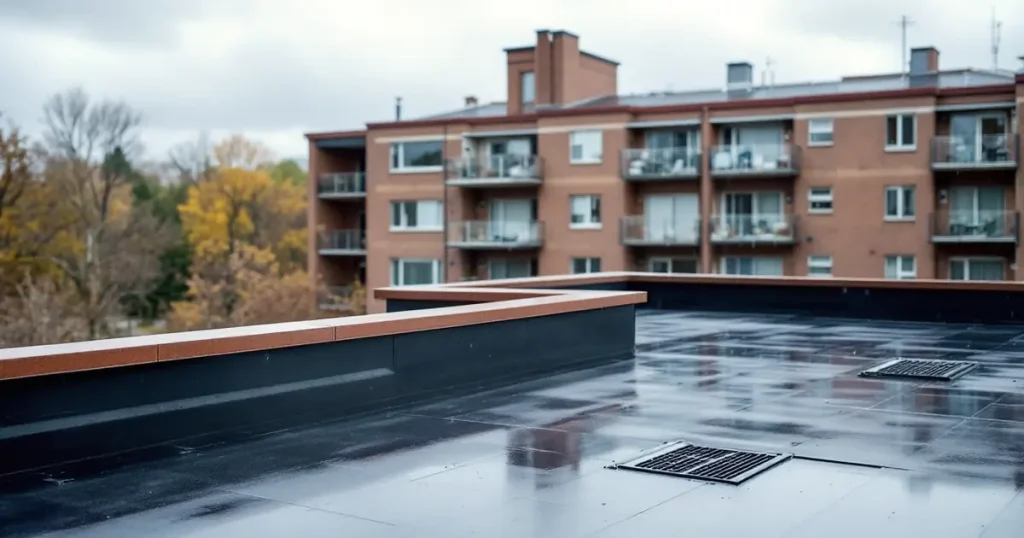
Condo water damage from a roof leak is normally split: the association repairs the roof because it is a common element, and the ceiling, finishes and belongings below it go to whichever policy your declaration names. In Florida the split is written into statute: the association’s policy must insure the building “as originally installed” but must exclude “floor, wall, and ceiling coverings,” cabinets and fixtures inside the unit, which are the owner’s to insure under Fla. Stat. 718.111(11)(f).
The second question is whether the leak was an insurable event. Wind that tears off shingles is one; rain seeping through a 25-year-old roof that the board never repaired usually is not, and that changes who pays far more than the policy names do. The tables below are compiled from statute text, the ISO HO 00 06 unit-owners form and Washington Insurance Commissioner guidance. They are not legal advice for your building.
Who pays for which part of the damage
Responsibility follows the physical layer that got wet. A roof leak into a top-floor unit can touch 6 layers, from the roof deck to the sofa, and Florida Statutes 718.111 gives each one a default payer.
| Damaged item | Usual payer | Rule behind it | Source |
|---|---|---|---|
| Roof covering, flashing, deck, rafters or trusses | Association (common expense or master policy) | Association maintains, repairs and replaces common elements unless the declaration says otherwise | Cal. Civ. Code 4775(a)(1); RCW 64.90.440(1) |
| Attic insulation and ceiling drywall as originally built | Association in Florida and in “bare walls” policies; owner only if the declaration says so | Florida master policy covers “all portions of the condominium property as originally installed” | Fla. Stat. 718.111(11)(f)1 |
| Paint, texture, wallpaper, flooring, cabinets, countertops, light fixtures | Unit owner (HO-6 Coverage A) unless the master policy is “all-in” | Florida master policy must exclude these items inside the unit | Fla. Stat. 718.111(11)(f)3; Washington OIC |
| Upgrades you or a prior owner added (granite, tile over carpet, an added skylight) | Unit owner, even under an “all-in excluding betterments” policy | Master policy restores original finishes only | Washington OIC |
| Furniture, rugs, electronics, clothing | Unit owner (HO-6 Coverage C) | Florida master policy must exclude “all personal property within the unit” | Fla. Stat. 718.111(11)(f)3 |
| Hotel or rent while the unit is unlivable | Unit owner (HO-6 loss of use), even during association repairs in California | Relocation costs during association repairs “shall be borne by the owner” | Cal. Civ. Code 4775(c) |
A board that repairs the roof but refuses the paint and flooring is often following Florida Statutes 718.111(11)(f) or California Civil Code 4775, not dodging them. The fight starts when the leak was not sudden, which is covered further down.
Your master policy type sets the line inside the unit
The Washington Office of the Insurance Commissioner (OIC) describes 3 master policy categories. Your annual Certificate of Insurance from the association shows the deductible; the declaration’s insurance article shows the category.
| Master policy type | Covers inside your unit | You insure on your HO-6 | Who pays the master deductible (per the OIC) |
|---|---|---|---|
| All-in | Exterior plus all interior finishes: doors, windows, shower or tub, vanity and cabinets, paint, trim, light fixtures, floor coverings | Belongings, liability, loss of use, and the deductible gap | Unit owners |
| All-in, excluding improvements or betterments | The unit back to its original interior and exterior finishes | Any upgrade over the original spec, such as granite replacing original laminate | Unit owners |
| Bare walls (walls out) | Everything up to the uncovered sheetrock and subfloor, including the roof | All interior finishes: tub, cabinets, paint, trim, fixtures, flooring | Unit owners |
The statute can set a different default. Washington’s RCW 64.90.470(2) says the association’s property insurance for stacked units “must include the units and, unless provided otherwise in the declaration, all improvements and betterments to the units”, and RCW 64.90.470(9) makes repair costs “not paid from insurance proceeds” a common expense. A Washington declaration can still charge a cost that benefits fewer than all units to those units under RCW 64.90.480(4)(b), which is how a master deductible lands on one owner. That chapter covers condominiums created on or after July 1, 2018; older Washington condos stay under chapter 64.34.
What the statutes actually say
Three states show the range. Florida writes the insurance split into law, California sets only the repair default, and Washington’s Uniform Common Interest Ownership Act sets both but lets the declaration move the cost.
| Section | Text (quoted or closely summarized) | What it means for a roof leak |
|---|---|---|
| Fla. Stat. 718.111(11)(j) | Insured property damaged “by an insurable event” is repaired “by the association as a common expense.” “In the absence of an insurable event,” responsibility follows “the maintenance provisions of the declaration or bylaws.” | A storm leak is an association repair; a wear-out leak depends on the declaration’s maintenance article |
| Fla. Stat. 718.111(11)(j) | “All property insurance deductibles” are “a common expense of the condominium,” except where the owner’s own negligence caused the damage | The master deductible is shared by all owners, unless owners voted to opt out under paragraph (k) |
| Fla. Stat. 718.111(11)(j)4 | The association need not pay for losses an owner knew about but did not report until after the association’s claim was settled or denied as untimely | Report ceiling stains in writing right away |
| Fla. Stat. 627.714(1) | HO-6 policies must include “at least $2,000 in property loss assessment coverage,” with a deductible of no more than $250, and no deductible if one already applied to the same loss | A Florida special assessment for a covered storm leak is partly insured |
| Fla. Stat. 627.714(4) | The unit owner’s policy is “excess coverage over the amount recoverable under any other policy covering the same property” | The master policy pays first where both apply |
| Cal. Civ. Code 4775(a)(1) and (a)(3) | The association repairs, replaces and maintains the common area; the owner does the same for the separate interest, unless the declaration provides otherwise | Roof to association, unit interior to owner, as a default only |
| RCW 64.90.470(4)(d) | If the owner has other insurance on the same risk, “the association’s policy provides primary insurance” | Washington master policy pays before your HO-6 |
Florida associations can vote out of the paragraph (j) cost rules by “a majority of the total voting interests” under Florida Statutes 718.111(11)(k), and the opt-out takes effect only when a notice is recorded under paragraph (m). Ask the manager whether one was recorded before you assume the deductible is shared.
Worked example: one leak, three outcomes
The inputs below are illustrative round numbers, not price quotes, chosen to show how the rules move the money. Assume a top-floor unit in a 40-unit building with equal 1/40 shares, a $10,000 per-occurrence master deductible and a $1,000 HO-6 deductible. Damage: $2,500 roof repair, $1,400 ceiling drywall, $900 paint and texture, $3,000 flooring and $1,500 of furniture.
| Line | A: Wind tears off shingles, Florida default rules | B: Same storm, all-in master policy, declaration charges the deductible to the unit | C: No storm, worn roof the board left unrepaired |
|---|---|---|---|
| Roof repair $2,500 | Under the deductible; common expense, your 1/40 share $62.50 | Common expense, your share $62.50 | Association maintenance cost, your share $62.50 |
| Ceiling drywall $1,400 | Association property, under the deductible; your share $35 | Master-covered but inside the deductible charged to you, claimable under HO-6 Coverage A item c | Not an insurable event; the declaration’s maintenance article decides |
| Paint, texture, flooring $3,900 | Your HO-6 Coverage A | Master-covered but inside the deductible charged to you | Base HO-6 likely denies (no storm opening); HO 17 32 or a negligence claim needed |
| Furniture $1,500 | Your HO-6 Coverage C | Your HO-6 Coverage C | Same HO-6 peril problem as above |
| HO-6 pays | $5,400 minus $1,000 deductible = $4,400 | $5,300 + $1,500 minus $1,000 = $5,800, if Coverage A is at least $5,300 | $0 on the base form |
| Your out-of-pocket | $1,000 + $97.50 share = $1,097.50 (the $97.50 may be reimbursed if levied as an assessment) | $1,000 + $62.50 = $1,062.50 | Up to $6,800 + $62.50 = $6,862.50 until the association is shown negligent |
In case A, Fla. Stat. 627.714(1) says no loss assessment deductible applies when your HO-6 deductible already applied to the same loss, so a $97.50 special assessment can go to the HO-6’s loss assessment coverage. In case B, $5,300 is the drywall, paint and flooring total that the master deductible pushed onto your unit, so a Coverage A limit of $5,000 would leave a $300 gap. Coverage A of the HO 00 06 form reaches it because it insures “property which is your insurance responsibility under a corporation or association of property owners agreement.” Case C is where owners and boards end up arguing, so the next section covers it.
When the leak was not sudden: wear and tear and negligence
The ISO HO 00 06 05 11 unit-owners form insures Coverage A against named perils only. Its Windstorm Or Hail peril “does not include loss to the inside of a building or the property contained in a building caused by rain, snow, sleet, sand or dust unless the direct force of wind or hail damages the building causing an opening in a roof or wall.” A slow drip through cracked flashing or a worn membrane does not meet that test, so a base-form claim for case C is often denied.
Two routes remain. The HO 17 32 Unit-Owners Coverage A Special Coverage endorsement switches Coverage A to open perils, which can pick up the resulting water damage inside the unit, although ISO open-perils wording still excludes wear and tear and deterioration of the thing that failed. Ask your agent which edition is listed on your declarations page. The second route is the association itself: under Fla. Stat. 718.111(11)(j), an uninsured repair follows the declaration’s maintenance article, and a board that ignored written leak reports may be liable for negligent maintenance of the common elements. Keep the dates of every report, because the claim against the association turns on when the board knew.
Owner negligence cuts the other way. Florida’s (j)1 makes an owner pay uninsured repair costs caused by the owner’s “intentional conduct, negligence, or failure to comply” with the declaration, and RCW 64.90.480(6) lets a Washington association assess an owner for damage caused by “willful misconduct or gross negligence.” An owner who drills through the roof membrane to mount a satellite dish, for example, can be charged for the ceilings below.
When the real fix is a new roof, the money question moves to reserves and special assessments; California Civil Code 5550, for example, requires a reserve study with a visual inspection at least every 3 years. That side is covered in who pays for an HOA roof replacement.
Top-floor and townhome-style units
- A skylight added by a previous owner is that owner’s betterment, so the Washington OIC lists its repair under the unit owner even in an “all-in excluding betterments” building.
- Built-up membrane roofs on condo buildings can be as flat as 1/4 inch per foot, the minimum design slope in 2021 IRC R905.9.1, so water can run along the deck before it shows on one unit’s ceiling. Typical membrane fixes are listed in flat roof leak repair by system.
- Ask the association’s roofer to trace the entry point in writing before anyone assigns blame. Infrared, flood and electronic tests (the electronic methods are described in ASTM D7877) are compared in roof leak detection methods.
- Some townhome declarations make the roof over each unit that owner’s responsibility. If yours does, the roof falls under HO 00 06 Coverage A item c, “property which is your insurance responsibility” under the association agreement, not under the master policy. Per-unit cost splits for that setup are in townhouse roof replacement cost.
- Wet attic insulation above a top-floor ceiling holds moisture against the drywall. The EPA says to dry water-damaged areas within 24 to 48 hours to prevent mold growth. Signs and removal costs are in attic mold causes and removal.
What to do in the first 72 hours
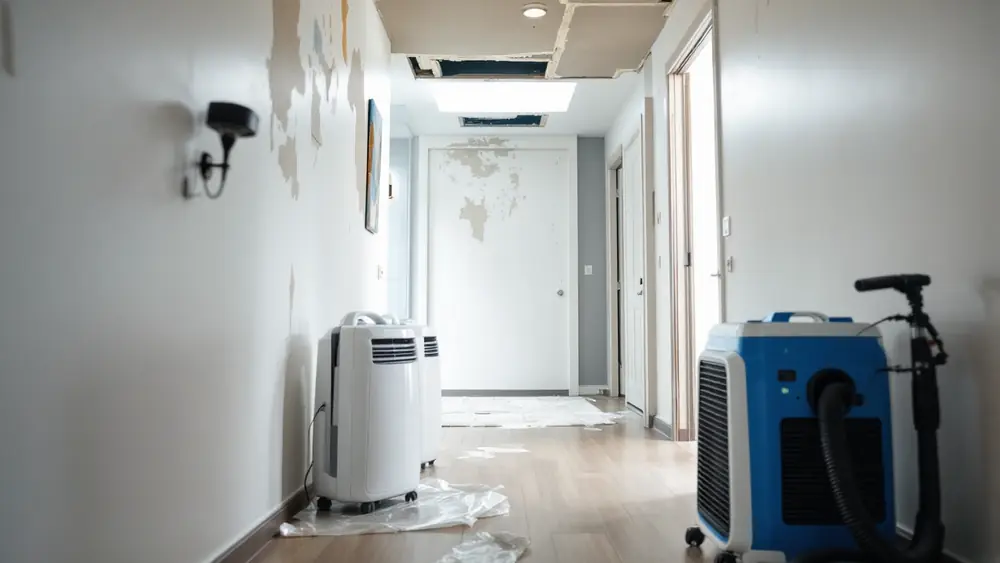
- Contain the water: buckets under drips, furniture moved, and a small hole in a bulging ceiling to drain it into a bucket.
- Photograph the ceiling, walls, floor and any visible roof damage with timestamps. The Washington OIC lists photos of “the source of the damage if it’s safe to do so” as step 1 of a condo unit claim.
- Notify the board or manager in writing the same day, by email and a dated letter. Florida’s 718.111(11)(j)4 penalizes late reporting.
- Request three documents: the declaration’s maintenance and insurance articles, the master policy Certificate of Insurance with its deductible, and any recorded deductible opt-out notice.
- Open a claim with your HO-6 insurer. Section I Conditions C.1 of the HO 00 06 form requires “prompt notice,” and the WA OIC says your insurer will need the CC&Rs to finish the claim.
- Start drying within 24 to 48 hours and keep every receipt for fans, dehumidifiers and mitigation crews.
- Do not rebuild yet. In Florida, reconstruction after a property loss is the association’s job, and an owner needs “the prior written consent of the board” to do the work under Florida Statutes 718.111(11)(g)1.
- Track the two adjusters. When both policies apply, the master adjuster prices the association’s share and your HO-6 adjuster prices the rest.
Not sure it is the roof? Plumbing and HVAC leaks are sorted in who to call for a roof leak.
Decision table: who to push, and for what
| If this is your situation | Then | Rule to cite |
|---|---|---|
| Storm damage with a visible opening in the roof | Association files on the master policy; you file HO-6 for finishes, contents and loss of use | HO 00 06 Windstorm Or Hail peril; Fla. Stat. 718.111(11)(j) |
| Interior damage is less than the master deductible | Ask whether the deductible is a common expense or charged to your unit; claim the charged part on HO-6 | Fla. Stat. 718.111(11)(j); RCW 64.90.480(4)(b) |
| You get a special assessment after a covered storm | Submit it under HO-6 loss assessment | HO 00 06 Additional Coverage 7 ($1,000); Fla. Stat. 627.714 ($2,000 minimum) |
| Leak from a worn roof the board was told about in writing | Demand repair of your interior as a maintenance failure; send copies of earlier reports | Declaration maintenance article; Cal. Civ. Code 4775(a)(1) |
| Leak through something you or a prior owner added | Expect to pay it yourself or through HO-6 | Fla. Stat. 718.111(11)(j)1; WA OIC betterments rule |
| Master policy claim denied and the board will not act | Contact your HO-6 insurer first, then a condo attorney if the dispute stays open | WA OIC claim guidance |
Loss assessment limits are small by default. The ISO form pays “up to $1,000,” and the HO 04 35 endorsement raises it, but its 04 91 edition still caps the part of an assessment that comes from the association’s deductible at $1,000 per unit. Wear-and-tear and sudden-peril rules for roofs in general are in what homeowners insurance covers on a roof. Low-slope buildings have their own claim issues, covered in flat roof insurance.
Frequently asked questions
Who is responsible for roof repairs in a condo?
The association, in most buildings, because the roof is a common element. California Civil Code 4775(a)(1) makes the association responsible for “repairing, replacing, and maintaining the common area” unless the declaration says otherwise, and Washington’s RCW 64.90.440(1) sets the same default. Check the declaration for exceptions: some townhome-style declarations assign the roof over each unit to that owner.
Who is responsible for water damage in a condo?
The building parts and the interior finishes are usually split. The association’s master policy covers the roof and, under most declarations, the structure up to the unfinished drywall; your HO-6 covers finishes the master policy leaves out, your belongings and your extra living costs. In Florida the master policy must exclude floor, wall and ceiling coverings, cabinets, countertops and fixtures inside the unit under Florida Statutes 718.111(11)(f)3.
Does my HO-6 cover a slow roof leak into my ceiling?
Often not on the base form. Coverage A on the ISO HO 00 06 05 11 form is named perils, and its Windstorm Or Hail peril excludes rain damage inside a building unless wind or hail first creates an opening in the roof or wall. Rain through a worn roof with no storm opening usually needs either the HO 17 32 open-perils endorsement or a negligence claim against the association.
How much does it cost to replace a roof on a condo building?
The Roofing Brief’s 2026 cost report puts architectural asphalt shingles at $5 to $8 per square foot installed, so a 12,000 sq ft (120 square) shingle roof works out to about $60,000 to $96,000 at that baseline. Low-slope condo roofs use TPO, PVC or modified bitumen instead, priced separately. The association pays from reserves or a special assessment.
My condo ceiling is leaking from the roof. What should I do first?
Contain the water, photograph the ceiling and the source, and notify the board or manager in writing the same day. Then open a claim with your HO-6 insurer, because the ISO HO 00 06 form requires prompt notice. Keep receipts for buckets, fans and emergency drying, and do not start reconstruction until the board consents in writing if you are in Florida (Fla. Stat. 718.111(11)(g)1).
Sources
- Florida Statutes 718.111(11), 2026 edition, condominium insurance and reconstruction
- Florida Statutes 627.714, unit owner loss assessment coverage
- California Civil Code 4775, repair and maintenance responsibility
- RCW 64.90.440, RCW 64.90.470 and RCW 64.90.480, Washington Uniform Common Interest Ownership Act
- Washington Office of the Insurance Commissioner: how condo insurance works and filing a condo unit claim
- ISO HO 00 06 05 11 Homeowners 6 Unit-Owners Form, filed copy hosted by the Maine Bureau of Insurance
- ISO HO 04 35 04 91 Loss Assessment Coverage endorsement
- EPA, A Brief Guide to Mold, Moisture and Your Home