
By The Roofing Brief Team | Last reviewed: October 2026
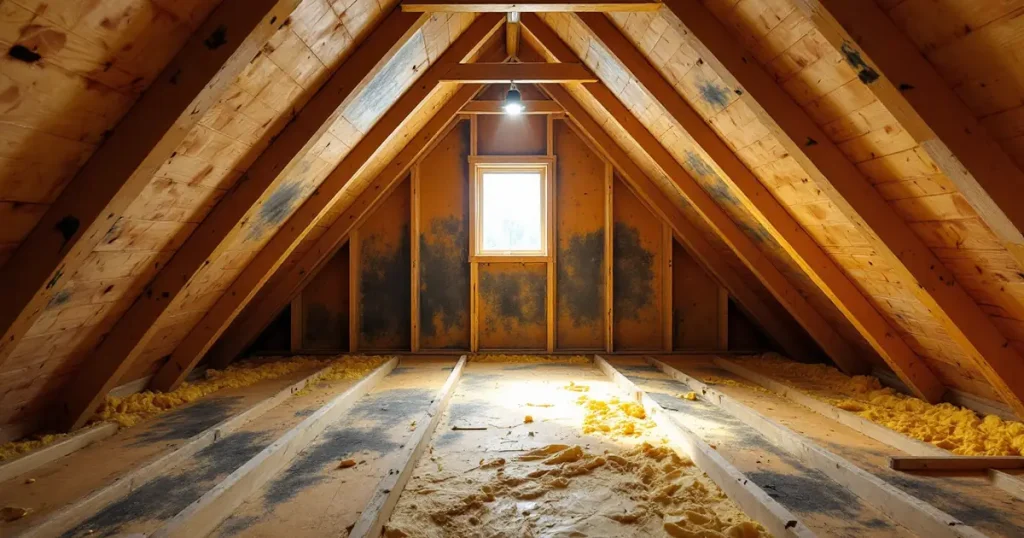
Attic mold is fungal growth on roof sheathing, rafters or insulation that starts when wood surfaces stay damp, and in most homes the water comes from one of three places: winter condensation from warm house air, a roof or flashing leak, or a bath fan venting into the attic, which the 2021 IRC bans in Sections M1501.1 and M1505.2. The cleanup that lasts removes that moisture source first; the EPA says that if you clean mold “but don’t fix the water problem, then, most likely, the mold problem will come back.”
Size sets who does the work. Per the EPA’s Brief Guide to Mold, Moisture and Your Home, a moldy area under about 10 square feet (roughly 3 ft by 3 ft) is in most cases a homeowner job; larger areas follow the EPA’s commercial remediation guide. HomeGuide (February 5, 2026) puts attic mold removal at $1,500 to $6,000 on average and $6,000 to $15,000 when damage is extensive, access is tight or the insulation has to be replaced.
Key numbers at a glance
| Figure | Value | Source |
|---|---|---|
| DIY size limit for mold cleanup | Under about 10 sq ft (roughly 3 ft by 3 ft), “in most cases” | EPA Brief Guide |
| Drying window that usually prevents growth | Wet materials dried within 24 to 48 hours | EPA Brief Guide |
| Indoor humidity target | Below 60% RH, ideally 30% to 50% | EPA Brief Guide |
| Surface mold-risk line used by designers | 30-day average surface RH under 80% when surface temperature is 41°F to 104°F | ASHRAE Standard 160, Addendum e |
| Wood moisture content | 20% or less gives “a reasonable margin of safety against fungus damage”; serious decay needs about 30% | USDA Forest Products Laboratory Wood Handbook, Ch. 13 |
| Attic vent area required | 1/150 of the vented space, or 1/300 when R806.2 exception conditions are met | 2021 IRC R806.2 |
| Attic mold removal, average job | $1,500 to $6,000; $6,000 to $15,000 if extensive | HomeGuide, Feb. 5, 2026 |
| Mold inspection | $300 to $650; up to $1,000 for a large home | HomeGuide mold inspection cost, 2026 |
Is mold in the attic dangerous?
Attic mold is mainly an allergy and irritation risk for whoever goes up there, and a resale and wood-durability problem for the house. The EPA says mold “can cause health problems,” that allergic reactions such as sneezing, runny nose, red eyes and skin rash are common, and that mold can trigger asthma attacks in people with asthma who are allergic to mold. The same EPA page adds that “symptoms other than the allergic and irritant types are not commonly reported as a result of inhaling mold.”
How much attic mold reaches the living space depends on air flow. In a Working RE Inspector article, home inspector Dylan Chalk argues attic mold is “not likely an indoor air quality issue” because the stack effect pushes house air up and out through the attic, with an exception: a leaky return duct in the attic can pull attic air into the house. The EPA’s rule for that case is direct: do not run an HVAC system you know or suspect is contaminated with mold.
| Situation | Exposure route | What the source says to do |
|---|---|---|
| Mold on sheathing, no ducts or air handler in the attic | Mostly during attic trips | Wear an N-95 respirator, gloves and unvented goggles (EPA); the EPA Brief Guide lists N-95s at about $12 to $25 |
| Return duct or air handler in the attic | Duct leaks can pull attic air into rooms | EPA: do not run HVAC you suspect is contaminated; see EPA’s air duct guidance first |
| Someone in the home has asthma, allergies or is immune-compromised | Higher sensitivity | EPA: consult a health professional before cleanup; professional judgment may justify a biocide for immune-compromised occupants |
| Heavy growth over more than 100 sq ft | Large spore release when disturbed | EPA remediation guide: full containment, double 6-mil polyethylene, decontamination chamber |
Mold also damages the house slowly. The Forest Products Laboratory Wood Handbook says stain and mold fungi “affect the strength of the wood only slightly,” but they make wood more absorbent, which “can lead to colonization by typical wood-decay fungi.” Decay is the structural threat: by the time decay causes a 10% weight loss, the handbook says most strength losses “may be expected to exceed 50%.”
Why am I getting mold in my attic?
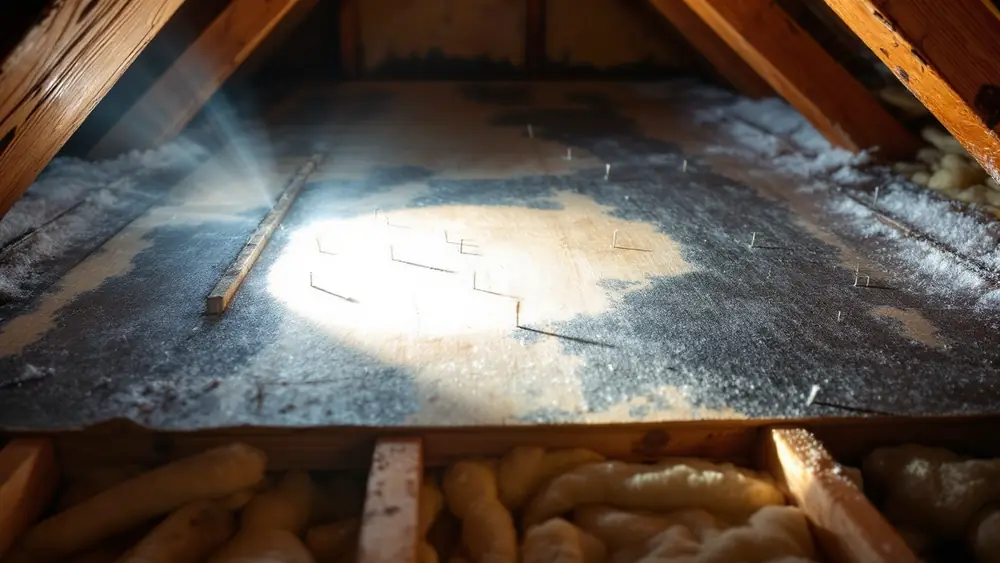
Attic mold grows wherever sheathing or framing stays wet long enough, and the pattern on the wood usually names the source. Warm, moist house air that leaks through ceiling openings condenses on the coldest surface it meets, which in winter is the roof deck and the nail tips poking through it. Building Science Corporation’s BSD-102 calls air leakage from the house, not vapor diffusion, the main moisture path into attics and says an air barrier at the ceiling should come first.
| Moisture source | Where the mold shows up | Code or threshold | Fix |
|---|---|---|---|
| House air leaking through can lights, chases, top plates and the hatch | Broad staining on the north slope and upper deck; frost or rust on nail tips | Condensation starts when the deck drops below the indoor dew point (44.6°F for 70°F air at 40% RH) | Air seal the ceiling plane first (BSD-102), then check ventilation |
| Bath, kitchen or dryer exhaust dumped into the attic | Concentrated growth around the fan housing or loose duct end | 2021 IRC M1501.1 and M1505.2: exhaust “shall not discharge into an attic” | Duct to a roof or wall cap; 4 in smooth duct allows 114 ft at 50 CFM (Table M1504.2) |
| Roof or flashing leak | A ring or streak below a chimney, pipe boot, valley or skylight; wet insulation underneath | EPA: dry wet materials within 24 to 48 hours | Repair the leak, then dry and clean the wood |
| Ice dams | Eave edge of the deck, above the exterior wall | Heat loss melts snow; water backs up at the cold eave | Air seal and insulate, then ventilate |
| Blocked or undersized ventilation | Even darkening across the deck; insulation packed into the soffits | IRC R806.3: at least a 1 in gap between insulation and sheathing at the vent | Install vent baffles; size vents to R806.2 |
| High indoor humidity in winter | Same pattern as air leakage, often worse in small, tight homes | EPA: keep indoor RH below 60%, ideally 30% to 50% | Run bath and kitchen fans, lower humidifier settings |
| Ducts or air handler in a hot-humid attic | Mold and drips around ductwork | BSD-102: duct condensation “is common” in hot-humid vented attics | Seal and insulate ducts; consider moving them inside |
The bath fan case is the easiest to confirm and fix. The 2021 IRC requires a bathroom fan to move 50 CFM intermittent or 20 CFM continuous (Table M1505.4.4) and to terminate outdoors, at least 3 ft from openings into the building (M1504.3). A fan whose flex duct ends on top of the insulation breaks both rules. Our guide to a bathroom vent through the roof covers the cap, duct and flashing.
The condensation math: when your roof deck gets wet
Winter attic mold is a dew point problem: any surface colder than the dew point of the air touching it collects water. The table uses the standard Magnus approximation for 70°F indoor air; it is Roofing Brief arithmetic, not a field measurement. On a cold night the roof deck runs close to outdoor temperature, so in Climate Zones 5 to 8 it sits far below every dew point in the table.
| Indoor air (70°F) RH | Dew point | Deck at 30°F | Deck at 45°F |
|---|---|---|---|
| 30% | 37.1°F | Frost forms if house air reaches it | Stays dry |
| 40% | 44.6°F | Frost forms | At the edge |
| 50% | 50.5°F | Frost forms | Wets |
| 60% | 55.5°F | Frost forms | Wets |
BSD-102 uses a 45°F roof-deck temperature as its design line for unvented roofs, matching interior air near 70°F at about 40% to 45% RH. Two things follow for a vented attic in a cold climate. First, cutting indoor RH from 50% to 30% lowers the dew point by about 13°F. Second, no humidity setting stops frost on a 30°F deck if house air reaches it, which is why air sealing comes before everything else.
Attic mold symptoms: what to look for
The best time to look is a cold winter morning: Working RE Inspector recommends checking the attic “first thing in the morning, when you see frost on the grass outside,” because condensation in attics is seasonal and often dry by afternoon. Bring a flashlight, an N-95 and a pin-type wood moisture meter, and step only on joists.
| Sign | What it usually means | How to confirm |
|---|---|---|
| Frost, drips or rust on nail tips through the deck | Winter condensation at or below dew point | Check on a frosty morning; nails are colder than the plywood |
| Gray to black staining over a whole slope, often north-facing | Long-term condensation mold | Moisture meter above 20% in winter; staining stops at framing lines |
| White, fuzzy or powdery growth on wood | Mold; the Wood Handbook lists colors “ranging from light shades to black” | Lift a sample on tape; wood under it is often sound |
| White crust on a masonry chimney inside the attic | Efflorescence: mineral salts left by water moving through brick or mortar | Salts appear on masonry, not plywood; they crumble to powder |
| Musty odor at the hatch | Active growth somewhere, possibly hidden under insulation | Pull back insulation at the eaves and around fan housings |
| Ceiling water stain below the attic | Leak, condensation drip or bath fan condensate | Trace upward from the stain on a dry day and a cold morning |
| Soft deck that an awl sinks into | Decay, not just mold; wood went above about 30% moisture | Probe from inside; replace soft sections. See our guide to rotted roof decking. |
Black, white or “harmless” black mold in the attic
Color does not tell you whether attic mold is dangerous, and the CDC says you do not need to know the type: if mold is growing in your home, the CDC says you need to clean it up and fix the moisture problem. The black staining that inspectors find across north-slope sheathing is usually called “harmless” because, per the Wood Handbook, mold fungi on softwoods often form a surface growth that “can easily be brushed or surfaced off” and affect strength “only slightly.”
“Harmless to the wood” is not the same as harmless to people. The EPA notes that “dead mold may still cause allergic reactions,” so killing it without removing it does not end the allergy risk. Stained sheathing also counts against a house at sale: Chalk writes that buyers who see mold on roof decking “can’t un-see it,” and he calls resale value “the best reason to have attic mold problems treated professionally.”
| Moisture meter reading in sheathing | What the Wood Handbook says | What to do |
|---|---|---|
| 20% or less | Air-dry wood; “a reasonable margin of safety against fungus damage” | Old staining may be inactive; clean or encapsulate, then recheck next winter |
| Above 20%, below about 30% | Humid air “will permit development of some mold fungi” but not significant decay | Active mold risk; find the air leak, fan or humidity source |
| About 30% (fiber saturation) or more | “Serious decay occurs only” above this point; it takes liquid water from rain, condensation or contact | Look for a leak or heavy condensation; probe for soft wood |
What to do if your attic has mold
Fix the water, then clean, then verify through one heating season. The EPA’s remediation guide says a plan “should include steps to fix the water or moisture problem, or the problem may reoccur,” and Working RE Inspector describes an attic where a white encapsulant was sprayed over mold without fixing the moisture and the mold grew back over the coating. The order below follows the EPA guide and BSD-102.
- Look on a morning below 32°F and photograph the pattern (whole slope, ring, eave strip or fan plume); the pattern points to the source in the cause table above.
- Take moisture meter readings on stained and clean sheathing; over 20% in winter means the problem is active (FPL Wood Handbook).
- Fix leaks and reroute every bath, kitchen and dryer duct to the outdoors per 2021 IRC M1501.1; dryer ducts top out at 35 ft (M1502.4.6.1).
- Air seal the ceiling plane first, as Building Science Corporation recommends in BSD-102: can lights, plumbing and wiring chases, top plates and the hatch. Our guide to air sealing an attic lists what to seal before adding insulation.
- Check vent area against 2021 IRC R806.2 and clear soffits to keep the 1 in gap R806.3 requires at vents.
- Measure the moldy area: under 10 sq ft is usually DIY per the EPA; 10 to 100 sq ft calls for limited containment; over 100 sq ft calls for full containment.
- Clean or encapsulate the wood, and bag moldy insulation in 6-mil polyethylene (EPA Method 4).
- Recheck readings and nail tips through the next January and February; readings at or under 20% mean the fix held.
EPA size thresholds for attic mold
| Moldy area | Protective equipment | Containment | Who usually does it |
|---|---|---|---|
| Under 10 sq ft | N-95 respirator, long gloves, goggles without vent holes | None required | Homeowner, “in most cases” (EPA Brief Guide) |
| 10 to 100 sq ft | Limited: half or full face respirator with HEPA cartridges | Limited: single layer of 6-mil fire-retardant polyethylene, negative pressure | Trained crew; a whole north slope often lands here or above |
| Over 100 sq ft | Full: full face powered air purifying respirator (PAPR) where exposures are high | Full: double polyethylene, airlock and decontamination chamber | Remediation contractor |
The EPA says these thresholds are based on the size of the area “to make it easier for remediators to select appropriate techniques, not on the basis of health effects,” and that heavy growth in a small area can release more spores than light growth over a large one. A 30 ft by 12 ft roof slope is 360 sq ft, so a stained slope is well past the DIY line.
Can you remove attic mold yourself?
You can remove attic mold yourself when the growth is under about 10 sq ft, the moisture source is fixed and nobody in the home has mold allergies or asthma. The EPA’s methods for wood and other surfaces are wet or damp wiping with water and detergent, HEPA vacuuming after the material is dry, and discarding what cannot be cleaned.
- Put on an N-95 respirator (it filters 95% of airborne particles, per the EPA), gloves of natural rubber, nitrile, neoprene, polyurethane or PVC if you use a cleaner, and goggles without vent holes (EPA).
- Scrub the growth with water and detergent, then dry the wood completely; the EPA’s Method 2 (damp wipe) uses water or water and detergent.
- Sand or wire-brush stained softwood where the growth stays; the Wood Handbook says surface growth on softwoods “can easily be brushed or surfaced off.”
- HEPA-vacuum the dried area and the insulation surface nearby; bag the filter and debris in sealed plastic (EPA Method 3).
- Double-bag moldy insulation in 6-mil polyethylene before carrying it through the house (EPA Method 4).
- Recheck with a moisture meter after 48 hours; wood should read 20% or less.
Bleach is not the default. The EPA says a biocide such as chlorine bleach “is not recommended as a routine practice during mold cleanup,” and never to mix bleach with ammonia cleaners because toxic fumes can result. Any spray sold as killing mold is a pesticide that must carry an EPA registration number under federal pesticide law (FIFRA); follow the label’s dwell time, PPE and ventilation rules. For general clean-outs, our attic cleaning guide covers rodent waste and vermiculite, which follow different rules.
What top-ranking attic mold advice gets wrong
Several pages that rank for attic mold give advice that differs from the primary sources. The table lines up each claim with what the EPA, CDC, IRC or building science source actually says; the claims are quoted or paraphrased from the pages linked, as read in October 2026.
| Claim | Where it appears | What the primary source says |
|---|---|---|
| Spray 10% to 20% bleach in water on the mold and recheck in 2 days | r/HomeImprovement thread ranking first for attic mold | EPA: bleach “is not recommended as a routine practice”; dead mold is still allergenic and has to be removed |
| Most attic mold situations are “squarely in professional territory” | SERVPRO attic mold page | EPA: under about 10 sq ft is DIY in most cases; size, health and containment decide, not the attic location |
| Testing tells the crew which mold they face | Several remediation cost pages | EPA: “In most cases, if visible mold growth is present, sampling is unnecessary”; CDC: you do not need to know the type |
| More ventilation cures attic mold | Many contractor pages | Working RE Inspector: extra venting can depressurize the attic and pull more house air up if the ceiling is not sealed; BSD-102: air barrier first |
| Mold removal costs $10 to $25 per sq ft | This Old House, citing Angi data | HomeGuide (2026) lists $15 to $30 per sq ft for remediation; Homewyse lists $2.30 to $2.80 per sq ft for basic mold cleaning (January 2026). Ask which area a quote measures |
Attic mold removal cost in 2026
Attic mold removal costs $1,500 to $6,000 for an average job and $6,000 to $15,000 when the damage is extensive, access is limited or insulation must be replaced, per HomeGuide (February 5, 2026). SERVPRO cites HomeAdvisor (2026) at $1,000 to $4,000, and This Old House cites Angi at the same $1,000 to $4,000 for attics. None of these ranges include fixing the moisture source, which is a separate line.
| Item | Published range | Source |
|---|---|---|
| Attic mold removal, average job | $1,500 to $6,000 | HomeGuide, Feb. 5, 2026 |
| Attic mold removal, extensive or poor access | $6,000 to $15,000 | HomeGuide, Feb. 5, 2026 |
| Attic mold removal, national average | $1,000 to $4,000 | SERVPRO citing HomeAdvisor, 2026; This Old House citing Angi |
| Mold remediation per sq ft | $10 to $25 (This Old House); $15 to $30 (HomeGuide) | This Old House; HomeGuide, 2026 |
| Basic mold cleaning per sq ft | $2.30 to $2.80 | Homewyse, January 2026 |
| Mold inspection | $300 to $650; testing alone $50 to $350 per test | HomeGuide, 2026 |
| Insulation removal | $1 to $2 per sq ft for clean, accessible material | HomeGuide, Nov. 2025 (see our insulation removal cost guide) |
| Insulation replacement | $1.00 to $4.50 per sq ft | HomeGuide mold removal cost guide, 2026 |
| New bath fan vented through the roof | $350 to $950 plus permit fees | HomeGuide |
| Roof decking replacement | $2 to $5 per sq ft installed | HomeGuide |
Worked example: a 1,200 sq ft attic with a moldy north slope
This is Roofing Brief arithmetic from the published ranges above, not a quote. The house has a 1,200 sq ft attic floor under a 6:12 gable roof, a bath fan dumping into the attic, and mold across the north slope. A 6:12 pitch multiplies plan area by 1.118, so the deck is about 1,342 sq ft and the north slope about 671 sq ft.
| Line | Arithmetic | Low | High |
|---|---|---|---|
| Mold inspection | HomeGuide range | $300 | $650 |
| Clean north slope (job pricing) | HomeGuide attic average | $1,500 | $6,000 |
| Same slope at a per-sq-ft rate | 671 sq ft x $10 to $25 (This Old House) | $6,710 | $16,775 |
| Same slope at basic cleaning rate | 671 sq ft x $2.30 to $2.80 (Homewyse) | $1,543 | $1,879 |
| Bath fan ducted through the roof | HomeGuide range | $350 | $950 |
| Scenario A: inspection, job-priced cleaning, fan fix | $300 + $1,500 + $350; $650 + $6,000 + $950 | $2,150 | $7,600 |
| Remove wet insulation | 1,200 sq ft x $1 to $2 | $1,200 | $2,400 |
| Replace insulation | 1,200 sq ft x $1.00 to $4.50 | $1,200 | $5,400 |
| Scenario B: Scenario A plus insulation out and in | $2,150 + $2,400; $7,600 + $7,800 | $4,550 | $15,400 |
The per-sq-ft line shows why quotes for the same attic can differ by thousands: a general remediation rate applied to 671 sq ft of deck lands at $6,710 to $16,775, well above HomeGuide’s attic job average. Ask every bidder for the square footage they measured, the containment level they plan, and whether insulation and the fan fix are included.
What moves the attic mold removal price
| Driver | Effect on cost | Source |
|---|---|---|
| Insulation contaminated or wet | Adds $1 to $2 per sq ft to remove plus $1.00 to $4.50 to replace | HomeGuide |
| Area over 100 sq ft | EPA recommends full containment with a decontamination chamber | EPA remediation guide |
| Tight access or low roof pitch | Pushes jobs toward $6,000 to $15,000 | HomeGuide |
| Decayed sheathing | Deck replacement at $2 to $5 per sq ft installed | HomeGuide |
| Inspection or clearance testing | $300 to $650 for an inspection; $50 to $350 per test | HomeGuide |
| Moisture source left unfixed | Repeat remediation; Working RE Inspector documents encapsulant overgrown by new mold | Working RE Inspector |
Does homeowners insurance cover mold in the attic?
Usually not, when the mold comes from condensation, poor ventilation or a slow leak. The ISO Homeowners 3 form (HO 00 03 10 00 sample posted by the Insurance Information Institute) excludes “mold, fungus or wet rot” from dwelling coverage, then gives back hidden mold “above the ceilings” only when it results from an accidental discharge from a plumbing, heating, air conditioning or sprinkler system or a household appliance. The same form excludes “wear and tear, marring, deterioration.”
| Scenario | Likely treatment under the HO 00 03 10 00 wording | Ask your insurer |
|---|---|---|
| Condensation mold from air leaks or a bath fan venting into the attic | Mold exclusion applies; often treated as maintenance | Whether a fungi endorsement adds any limit |
| Sudden wind or hail damage lets rain into the attic | Wind damage may be covered under the open-perils dwelling grant; resulting mold may be excluded or capped | The fungi or rot sublimit on your declarations |
| Air conditioner condensate line or attic air handler overflows | The hidden-mold exception names air conditioning systems and appliances | Whether your edition keeps this exception |
| Long-running roof leak nobody fixed | Wear-and-tear and mold exclusions are likely to be cited | Photos and dates showing when the leak started |
Policy wording changes by edition and insurer. ISO also publishes limited fungi, wet or dry rot, or bacteria endorsements (HO 04 26 and HO 04 27) that many carriers attach with a stated dollar limit, so the limit on your declarations page governs. Report sudden roof damage promptly and dry the wood within the EPA’s 24 to 48 hour window to limit mold that may not be covered.
How to prevent attic mold
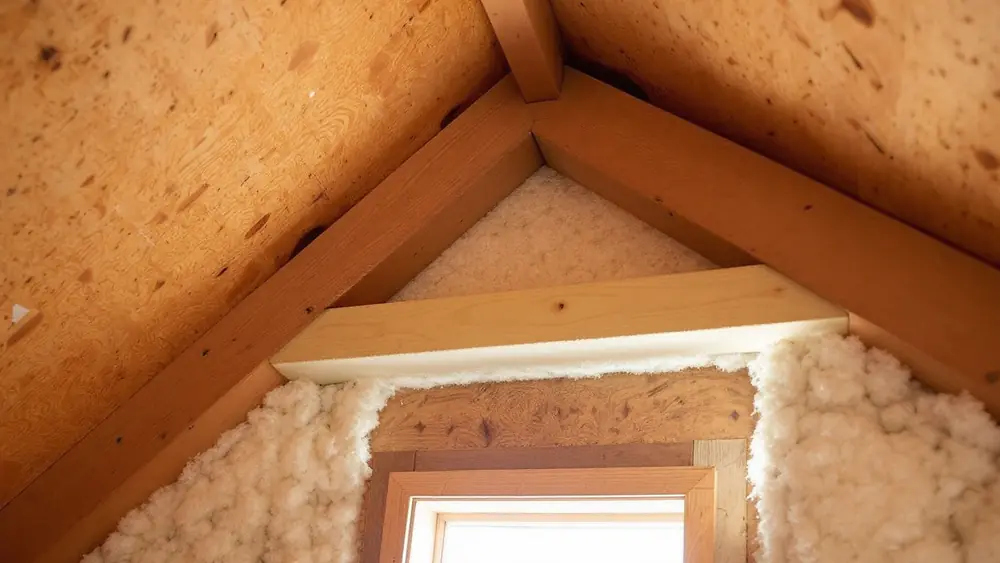
Preventing attic mold means keeping the roof deck above the dew point of any air that touches it, or keeping house air away from the deck. In code terms: no exhaust into the attic (2021 IRC M1501.1), vent area of 1/150 or 1/300 (R806.2), a 1 in airway at the eaves (R806.3), and a Class I or II vapor retarder in Climate Zones 6 to 8 if you use the 1/300 exception. Our attic ventilation guide covers vent types in detail.
| If you find | Then do this | Threshold or rule |
|---|---|---|
| A bath or kitchen fan ending in the attic | Duct it to a roof or wall cap with a damper | IRC M1501.1, M1505.2; 50 CFM intermittent bath fan |
| Frost on nail tips on cold mornings | Air seal the ceiling before adding vents | Deck below dew point (44.6°F at 70°F, 40% RH) |
| Indoor RH above 50% in January | Run fans longer, turn down humidifiers, add a dehumidifier in damp basements | EPA: below 60%, ideally 30% to 50% |
| Insulation stuffed against the soffit vents | Install rafter baffles | IRC R806.3: at least 1 in clear at the vent |
| Vent area under 1/300 of attic floor area | Add balanced intake and exhaust | IRC R806.2: upper vents carry 40% to 50% under the 1/300 exception |
| Mold strip along the eaves plus ice dams | Air seal and insulate the top plates, then vent; see our ice dam prevention guide | Heat loss melts snow at the warm deck |
| Ducts or an air handler in a hot-humid attic | Seal and insulate ducts, or move them inside the envelope | BSD-102: duct condensation common in hot-humid vented attics |
| Stain under a chimney, pipe boot or skylight | Repair the flashing and dry the wood | EPA: dry within 24 to 48 hours |
Worked example: vent area for a 1,200 sq ft attic
The 2021 IRC R806.2 sets net free vent area as a fraction of the vented space. For a 1,200 sq ft attic, the 1/150 rule needs 8 sq ft and the 1/300 exception needs 4 sq ft, with 40% to 50% of it within 3 ft of the ridge. GAF’s Cobra Rigid Vent 3 is rated at 18 sq in of net free area per linear foot, which sets the ridge vent length below.
| Step | 1/150 rule | 1/300 exception |
|---|---|---|
| Total net free area | 1,200 / 150 = 8 sq ft = 1,152 sq in | 1,200 / 300 = 4 sq ft = 576 sq in |
| Upper (exhaust) share | Not fixed by code; 576 sq in at a 50/50 split | 40% to 50% = 230 to 288 sq in |
| Ridge vent at 18 sq in per ft | 576 / 18 = 32 ft | 230 to 288 / 18 = 13 to 16 ft |
| Lower (intake) balance | 576 sq in | 288 to 346 sq in, in the bottom third of the attic |
The 1/300 path is only available if both R806.2 exception conditions are met: in Climate Zones 6, 7 and 8 a Class I or II vapor retarder on the warm-in-winter side of the ceiling, and the 40% to 50% upper-vent split. BSD-102 recommends 1/300 when an air barrier is present. Our ridge vent installation guide covers slot width and the soffit pairing rule.
Frequently asked questions
Is mold in the attic harmful?
Attic mold mainly causes allergic and irritant reactions in people who disturb it. The EPA says mold allergies are common and mold can trigger asthma attacks in allergic people, while other symptoms are not commonly reported. Exposure rises if a leaky return duct or air handler sits in the attic. Wear an N-95 (it filters 95% of particles), gloves and goggles in the attic, and fix the moisture before cleaning.
What to do if an attic has mold?
Find and stop the moisture first: roof leaks, bath or kitchen fans venting into the attic (banned by 2021 IRC M1501.1), and warm house air leaking through the ceiling. Then measure the moldy area. Under about 10 square feet the EPA says homeowners can usually clean it; larger areas call for containment. Recheck wood moisture the next winter; 20% or less means the fix held.
Why am I getting mold in my attic?
Most attic mold comes from warm, moist house air condensing on a cold roof deck in winter, a roof or flashing leak, or exhaust fans dumping humid air into the attic. For 70°F indoor air at 40% relative humidity the dew point is about 44.6°F, so a colder deck gets wet wherever house air reaches it. Blocked soffit vents and high indoor humidity make it worse.
How common is mold in attics?
No federal survey reports attic mold rates on their own, so any percentage you see is an estimate. Attic mold is most often linked to cold-winter regions, where roof sheathing drops below 45°F and the indoor dew point, and to homes with bath fans venting into the attic or leaky ceilings. In hot-humid regions it tends to form around ducts and air handlers placed in vented attics.
Can you live in a house with mold in the attic?
In most homes, yes, while the moisture problem is being fixed, because attic air usually flows up and out rather than into rooms. The exceptions are a return duct or air handler in the attic, and occupants with asthma, mold allergies or weak immune systems. The EPA says not to run an HVAC system you suspect is contaminated, and its DIY limit is about 10 square feet of mold.
Does homeowners insurance cover mold in the attic?
Usually not for condensation, ventilation or slow-leak mold. The ISO HO 00 03 10 00 form excludes mold, fungus or wet rot, with an exception for hidden mold caused by an accidental discharge from plumbing, heating, air conditioning, sprinklers or appliances. Sudden wind damage may be covered while resulting mold is capped by a fungi endorsement. Check your declarations page for the fungi limit.
Is white mold in the attic toxic?
White attic mold is not more or less toxic because of its color. The CDC says you do not need to know the type of mold; it all gets cleaned up and the moisture fixed. White fuzzy growth on wood is mold, which the Forest Products Laboratory says often brushes off softwood, while a white crust on a brick chimney is usually efflorescence, a mineral salt that appears on masonry and crumbles to powder.
What kills mold in an attic?
Removing the mold matters more than killing it, because the EPA says dead mold can still cause allergic reactions. The EPA does not recommend bleach or other biocides as a routine step; it recommends scrubbing with detergent and water, drying, HEPA vacuuming and bagging what cannot be cleaned in 6-mil plastic. Any spray sold to kill mold must carry an EPA registration number; follow its label exactly.
How much does attic mold removal cost?
HomeGuide (February 5, 2026) puts attic mold removal at $1,500 to $6,000 on average and $6,000 to $15,000 for extensive damage, tight access or insulation replacement. HomeAdvisor and Angi figures cited by SERVPRO and This Old House are $1,000 to $4,000. Fixing the source is extra, such as $350 to $950 plus permits to duct a bath fan through the roof.
Sources and method
The Roofing Brief compiled this page from the EPA’s Brief Guide to Mold and Mold Remediation in Schools and Commercial Buildings, the 2021 International Residential Code (Chapter 8 and Chapter 15), Building Science Corporation BSD-102, the USDA Forest Products Laboratory Wood Handbook (Chapter 13), ASHRAE Standard 160 Addendum e, the ISO HO 00 03 10 00 sample form, and dated cost guides from HomeGuide, Homewyse, This Old House and SERVPRO, all read in October 2026. Dew point and cost scenarios are Roofing Brief arithmetic from those inputs; we did not test attics or survey contractors.