
By The Roofing Brief Team | Last reviewed: October 2026
Green roof maintenance is mostly weeding, drain clearing, watering in dry spells and a spring feed, done on a schedule that the fire and wind standards and the system maker’s warranty already set for you. ANSI/SPRI VF-1 requires dead biomass to be removed at least twice a year, ANSI/SPRI RP-14 requires bare growing media to be replanted, and makers such as LiveRoof and American Hydrotech tie their warranties to maintenance training or documented visits. For an established extensive sedum roof, published budgets run from about $0.10 to $3.45 per square foot per year.
This guide is the owner’s and facility manager’s manual: the visit checklist, the seasonal calendar, the standards that make maintenance mandatory, the warranty conditions and the cost arithmetic. For installed cost, layer build-ups and structural load, see our green roof cost and types guide.
Key numbers at a glance
These are the figures a green roof owner needs to plan upkeep. Each comes from a named standard, a public agency or a system maker’s own maintenance document, and each should be read as a guide. Plant mix, climate, roof exposure and the specific warranty on your roof change the answer.
| What it is | Figure | Source |
|---|---|---|
| Minimum removal of dead and excess biomass | At least 2 times per year | ANSI/SPRI VF-1 (2017), sec. 5.0 |
| Minimum inspection after establishment | At least 2 times per year and after every wind event | ANSI/SPRI RP-14 (2010), Commentary C7.0 |
| Visits during establishment, then after | 3 to 4 per year, then 2 per year (unirrigated) | Philadelphia Water Stormwater Manual v3.4 |
| Maker-recommended visits for warranty-grade care | 8 per year minimum (Columbia Green); every 2 weeks while unfrozen (LiveRoof) | Columbia Green manual; LiveRoof Operation Manual |
| Plant cover to maintain | At least 90 percent foliage cover in warm months | Philadelphia Water Stormwater Manual v3.4 |
| Annual maintenance cost, established extensive roof | $0.10 to $1.00 per sq ft (MN); $0.45 to $0.55 (Columbia Green); $0.13 to $3.45 (10 NC roofs) | Minnesota Stormwater Manual; Columbia Green; Sherk et al., HortTechnology, 2020 |
What does green roof maintenance include?
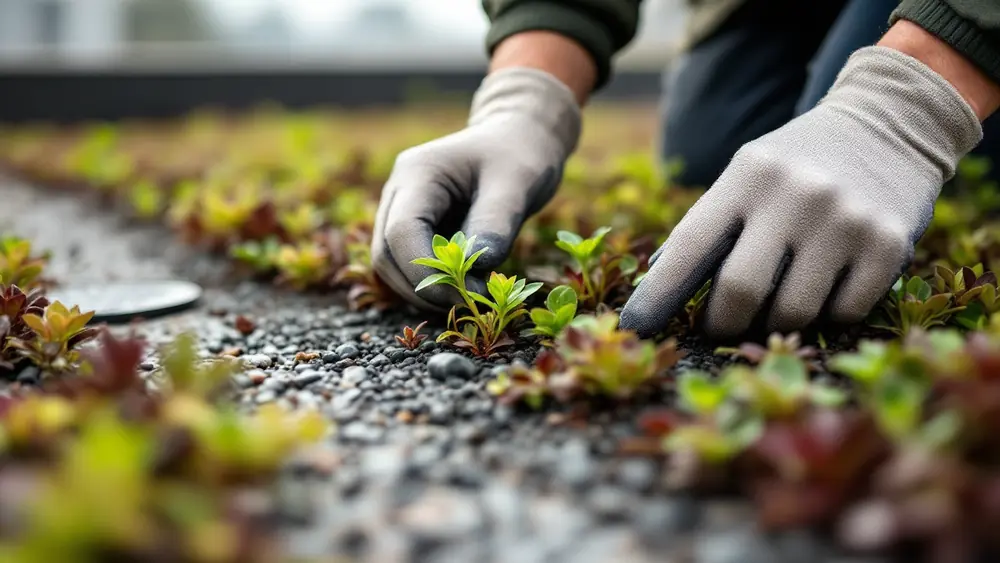
Green roof maintenance covers seven recurring jobs: weeding, clearing drains and vegetation-free zones, watering during drought, an annual soil test and spring feeding, replanting bare patches, removing dead biomass, and keeping a dated photo log. Philadelphia Water’s guidance sums it up as keeping drainage capacity and plant health intact, with every component inspected regularly for waterproofing integrity and structural stability.
The table below maps each task to its purpose and its documented frequency. Where two sources disagree, both are shown, because the right interval depends on whether you are following a regulatory minimum or a maker’s warranty protocol.
| Task | Why it matters | Documented frequency | Source |
|---|---|---|---|
| Hand weeding | Stops weeds seeding; woody seedlings can damage the membrane | Every 2 to 4 weeks in the growing season; every 2 weeks under LiveRoof’s protocol | GreenGrid guide (UNM-hosted); LiveRoof Operation Manual |
| Drain and inspection-chamber check | Blocked drains waterlog media, kill plants and can overload the structure | Every 2 weeks (LiveRoof); every 2 to 4 weeks for vegetation-free zones (Columbia Green) | LiveRoof; Columbia Green manual |
| Supplemental watering | Prevents dormancy, thinning and fire-prone dry foliage | About 1 in per week when rain is under 0.5 in in 10 to 15 days | GreenGrid guide (UNM-hosted) |
| Soil test and fertilizer | Thin plants expose media to weeds and wind scour | Soil test each spring; slow-release feed only if the test calls for it | LiveRoof warranty form; Columbia Green manual |
| Replant bare spots | Bare media is a wind-scour and weed entry point | As needed; RP-14 requires nominal cover | ANSI/SPRI RP-14 (2016), sec. 7.0 |
| Remove dead biomass | Dry foliage is rooftop fuel | At least 2 times per year | ANSI/SPRI VF-1 (2017), sec. 5.0 |
| Photo log and visit record | Warranty claims fail without proof of care | Every visit | Columbia Green; American Hydrotech |
Extensive vs intensive green roof maintenance
An extensive green roof (6 inches of growing media or less, mostly sedum) needs a short visit every few weeks in season and very little else once plants cover the media. An intensive roof (more than 6 inches, with perennials, grasses, shrubs or lawn) needs care comparable to a ground-level garden, plus irrigation upkeep. Those depth cutoffs come from the VF-1 commentary and the Columbia Green glossary.
The GreenGrid guide hosted by the University of New Mexico describes semi-intensive (6 inch) and intensive (8 inch) modules as needing care that is “more frequent and similar to ground-level landscaping.” American Hydrotech says the same about its lawn and intensive Garden Roof assemblies.
| Factor | Extensive (sedum) | Semi-intensive | Intensive (roof garden) | Source |
|---|---|---|---|---|
| Growing media depth | 6 in or less | Mix of both | More than 6 in | ANSI/SPRI VF-1 (2017), C1.0 |
| Typical system weight | 13 to 30 lb/sq ft | 25 to 40 lb/sq ft | 35 to 100 lb/sq ft | ANSI/SPRI VF-1 (2017), C1.0 |
| Weeding interval in season | 2 to 4 weeks | About 2 weeks | About 2 weeks, plus garden-style pruning | GreenGrid seasonal table |
| Irrigation | Often none after establishment in moderate climates; permanent systems advised in arid, Southeast and Gulf regions | Usually needed | Permanent system expected | GreenGrid guide; LiveRoof manual |
| Trimming | Optional; every 2 to 3 years in spring | Cut back perennials and grasses in March to April | Prune, deadhead, thin and transplant | GreenGrid guide; Living Architecture Monitor (Recover Green Roofs) |
| Who should do it | Owner or trained landscaper | Green roof maintenance contractor | Landscape crew with rooftop safety training | Columbia Green; Hydrotech FAQ |
The establishment period: years one and two
The establishment period is the first full growing season or two after planting, when plants are rooting in and need the most water and weeding. Columbia Green defines it as running through the first full growing season after planting. American Hydrotech’s vegetation warranty runs a two-year maintenance period, and the Minnesota Stormwater Manual notes the first five years of maintenance are often written into the installation contract.
Who is responsible during this window is the most common gap. Columbia Green states the installer typically covers maintenance for 30 days to 2 years under the contract documents, after which it becomes the owner’s job. Confirm the handover date in writing before the installer leaves.
How often to water new plantings
New plantings need far more water than an established roof. Cuttings need the most because they have no roots on delivery, while pre-grown mats and tiles arrive rooted. Columbia Green’s mild-weather schedule is below; hot, windy or sloped roofs need more.
| Planting method | Weeks 1 to 2 | Week 3 | Weeks 4 to 8 | Rest of establishment | Source |
|---|---|---|---|---|---|
| Sedum cuttings | Overhead water twice daily | Once daily | Once weekly | As needed, check at least weekly | Columbia Green manual |
| Plugs, pre-grown mats, tiles, trays | Once weekly | Once weekly | Once weekly in week 4, then as needed | As needed, check at least weekly | Columbia Green manual |
| Any new planting (Philadelphia guidance) | End of each day for 2 weeks | Every 4 days during dry spells of 4+ days, June to August, first year | Hand weed 4 times a year for 24 months | Philadelphia Water SMGM v3.4 | |
How much plant cover to expect
Plant cover is the yardstick for a healthy roof and for warranty claims. Hydrotech’s vegetation warranty requires at least 50 percent cover after year one and 80 percent after year two for plugs and cuttings, and 90 percent in both years for sedum carpet and tile. Columbia Green’s growth chart shows how planting density changes the timeline.
| Planting method and density | After 1 year | After 2 years | After 3 years | Source |
|---|---|---|---|---|
| 72-cell plugs, 2 per sq ft | 60% | 80% | 90% | Columbia Green manual |
| 72-cell plugs, 4 per sq ft | 80% | 95% | 95% | Columbia Green manual |
| Bulk cuttings, 10 lb per 100 sq ft | 50% | 70% | 90% | Columbia Green manual |
| Bulk cuttings, 20 lb per 100 sq ft | 80% | 90% | 95% | Columbia Green manual |
| Pre-grown sedum tiles or mats | 90% | 95% | 95% | Columbia Green manual |
| Hydrotech warranty minimum, plugs and cuttings | 50% | 80% | n/a | American Hydrotech maintenance manual |
Green roof maintenance checklist for each visit
A routine visit on an established extensive roof follows the same order every time: get on the roof safely, clear the drains, walk the vegetation-free zones, weed, check plants and media, run the irrigation, and record everything with photos. The sequence below combines the visit tasks in the LiveRoof, Columbia Green and American Hydrotech manuals.
- Check conditions and access. Stay off frozen, frosted or icy plantings, which LiveRoof and Sempergreen both warn against, and use fall protection where the work is near an unprotected edge.
- Open and clear every drain and inspection chamber. Remove leaves, media, pebbles and roots, then refit and pin the lids so wind cannot lift them, as LiveRoof’s manual specifies.
- Walk the vegetation-free zones. Pull any plant growing in the gravel or paver strips at perimeters, drains and penetrations, and sweep stray growing media back into the planted area.
- Hand-pull weeds, roots and all. Remove every tree seedling on sight. Columbia Green and Recover Green Roofs both flag woody roots as a membrane risk.
- Look for bare media and scour. Note any exposed patch, measure scoured areas, and replace media and plants, or plan cuttings from fuller areas of the roof.
- Check moisture and plant health. Push a finger into the media; wilting or reddened sedum in a dry spell means water, while soggy media means cut back irrigation.
- Run the irrigation zones. Watch each zone run, look for clogged emitters, leaking valves and broken lines, and adjust run times for the season.
- Inspect flashings and edges. Look at parapet flashings, metal edging and penetrations for loose or damaged metal and report it to the roofer.
- Record the visit. Log the date, person, hours, tasks, any fertilizer type and rate, and take wide photos of every area plus close-ups of problems.
Seasonal green roof maintenance schedule
A seasonal schedule puts the soil test and feeding in early spring, weeding and watering through summer, a leaf and drain clean-out in fall, and very little in a northern winter. The calendar below fits a cold-winter climate; LiveRoof notes the spring growth flush starts around mid-March in Tennessee and mid-April in Minnesota, so shift dates to match your region.
| Season | Tasks | Watch-outs | Source |
|---|---|---|---|
| Late winter to early spring | Soil test before the growth flush; cut back grasses and perennials; mow or string-trim dry sedum seed heads if wanted | Do not cut sedum foliage itself; set mower just above it | LiveRoof Operation Manual; GreenGrid guide |
| Spring | Slow-release fertilizer if the test shows low nitrogen; resume weeding every 2 to 3 weeks; replant gaps; start irrigation | No herbicide or pre-emergent without the maker’s or a horticulturist’s advice | LiveRoof; GreenGrid guide; Hydrotech manual |
| Summer | Weed every 2 to 3 weeks; water about 1 in per week in drought; check for pests | Glare from nearby glass and sustained wind dry roofs faster | GreenGrid guide |
| Fall | Weed every 3 to 4 weeks until snow; rake matted leaves; clear drains; drain and winterize irrigation in cold regions (GreenGrid suggests by October 15) | Fall feeding is disputed; see below | GreenGrid guide; LiveRoof; Columbia Green |
| Winter (cold climates) | Stay off frozen roofs; shovel only walkways; spread snow evenly | No salt or chemical deicers on or near plants | LiveRoof Operation Manual |
| Winter (warm climates) | Keep the 2-week weed walks going; water in warm dry spells | Weeds keep growing while sedum is semi-dormant | LiveRoof Operation Manual |
Should you fertilize a sedum roof in fall?
The makers disagree, so follow the one that supplied your plants. LiveRoof and Columbia Green both say not to fertilize in fall in cold-winter climates because it can push tender growth before a freeze. Sempergreen recommends a second feeding in early September. GreenGrid allows fall feeding only if necessary, diluted by 50 to 75 percent.
Philadelphia Water adds a stormwater limit: fertilize according to a soil test, holding soluble nitrogen between 1 and 4 parts per million, because excess nutrients wash off the roof into receiving waters.
What the fire, wind and building codes require
Green roof maintenance is not optional where the building code references the vegetative roof standards. ANSI/SPRI VF-1 and ANSI/SPRI RP-14 both state that maintenance is the building owner’s responsibility and that the designer must tell the owner so. Section 1505.10 of the 2024 International Building Code, as adopted in Utah’s 2024 code, requires vegetative roofs to be installed per VF-1, and New York City’s building code (Section 1507.16.1) requires RP-14 and VF-1 or FM Global Data Sheet 1-35.
The practical effect is that neglect can take a roof out of the condition it was designed and approved for. A roof full of dead grass is fuel, and a roof full of bare media is ballast that can blow away.
| Standard | Requirement | What it means for maintenance | Source |
|---|---|---|---|
| ANSI/SPRI VF-1 (2017), sec. 5.0 | Remove overgrown vegetation, leaves and dead material at regular intervals not less than 2 times per year; keep dry foliage to a minimum; provide water access | Spring and fall clean-outs at minimum; never let a roof brown out unwatered | SPRI |
| ANSI/SPRI VF-1 (2017), sec. 3.6 | Border zone at least 3 ft wide, free of vegetation and growing media, where plantings meet rooftop structures, joints and penetrations | Keep the gravel or paver strips weed-free and swept | SPRI |
| ANSI/SPRI VF-1 (2017), sec. 4.3 | Area dividers split large roofs into sections of 15,625 sq ft or less, no side over 125 ft | Do not let plants creep across divider strips | SPRI |
| ANSI/SPRI RP-14 (2016), sec. 2.3.1 and 7.0 | Keep nominal vegetation cover (no exposed media over 4 in across); replace media and plants in scour under 50 sq ft; upgrade the design one level for scour over 50 sq ft | Replant bare spots promptly; report large scour to the designer | SPRI |
| ANSI/SPRI RP-14 (2010), C7.0 | Inspect after any wind event and at least 2 times per year; check vegetation, media and open drains | Add storm-triggered visits to the calendar | SPRI |
SPRI released a 2023 revision of VF-1, effective April 3, 2023, which it says clarifies border zones, firebreaks and area dividers. The dimensions above are from the 2017 edition; check which edition your designer and local code used.
Drains, vegetation-free zones and leak checks
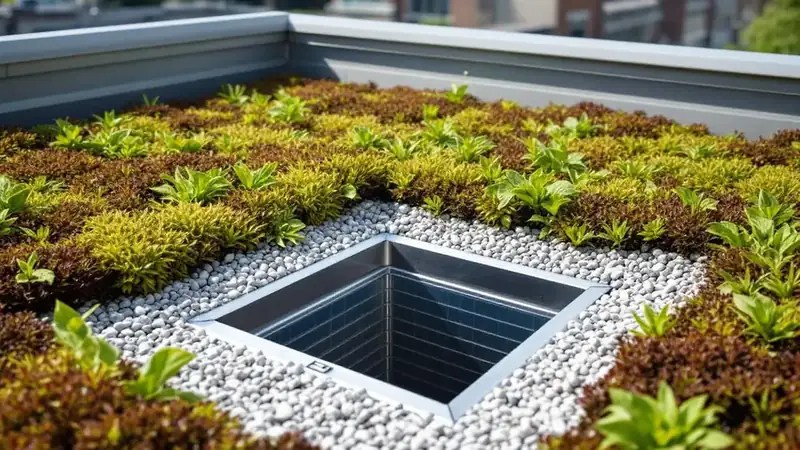
Drains are the single most important maintenance point on a green roof. Columbia Green warns that water backed up behind a blocked drain can kill plants, waterlog the media and cause serious roof damage or even structural failure, because saturated media is the heaviest load the deck carries. Clear drains on every visit and after storms. Our flat roof drainage guide explains how the outlets and slopes beneath the planting should work.
Vegetation-free zones
Vegetation-free zones are the gravel or paver strips at perimeters, drains and penetrations that keep plants and media away from flashings. VF-1 (2017) sets a 3-foot minimum border zone where plantings meet rooftop structures and penetrations, while American Hydrotech’s 2012 installation manual shows a 12 to 18 inch typical width with a 12-inch minimum. The project drawings govern; the maintenance job is to keep whatever strip exists clean.
How leaks are found under a green roof
Leaks under a green roof are found with electronic leak detection, not by digging. ASTM D7877 describes electrical conductance methods for locating breaches in “exposed or covered” membranes, including under vegetative roofs. American Hydrotech’s manual calls for a flood test or electronic field vector mapping (EFVM) before the green roof layers go down, so the membrane is proven watertight while it is still visible.
If a leak appears later, ask whether the roof has a permanent leak-detection grid and whether your warranty includes overburden removal. Hydrotech’s warranty sheet says it includes removal and replacement of Hydrotech-supplied overburden for a warranted membrane repair. LiveRoof sells a separate overburden removal warranty for 10, 15 or 20 year terms.
Warranty conditions: what makers require
Most green roof warranties are conditional on documented maintenance. LiveRoof will not issue its module warranty until the owner has had maintenance training, American Hydrotech requires an active maintenance contract plus checklists and photos, and Columbia Green says its plant warranty requires maintenance records. Skip the paperwork and a plant or overburden claim can be refused.
| Maker | Warranty coverage stated | Maintenance condition | Source |
|---|---|---|---|
| LiveRoof | Module warranted 50 years against material defects and photodegradation if soil-covered and edged; plant warranties come from growers or maintenance providers | Maintenance training required to register; form submitted within 60 days of delivery; owner acknowledges twice-monthly weeding and a spring soil test | LiveRoof warranty page; Warranty Registration Form (2021) |
| American Hydrotech | Garden Roof components up to 20 years; plant coverage warranty 2 years when the roof is properly maintained | Active maintenance contract; signed checklist and photos within 10 days of each required visit; cover judged per 1,000 sq ft grid, ignoring gaps under 0.5 sq ft | Hydrotech Warranty Offerings (2023); maintenance manual (2012) |
| Columbia Green Technologies | Standard materials warranty; optional overburden, single-source and extended plant warranties | Documented maintenance with photos at every visit; monthly reports and annual inspections | Columbia Green maintenance manual |
| GreenGrid | Plant warranty | Routine submission of maintenance logs and photos | GreenGrid guide (UNM-hosted) |
Warranty terms change and vary by project, so read the actual certificate for your roof. The membrane manufacturer’s warranty is a separate document from the green roof system warranty.
How much does green roof maintenance cost?
Green roof maintenance typically costs $0.10 to $1.00 per square foot per year for an established extensive roof in Minnesota, per the Minnesota Stormwater Manual, and Columbia Green budgets $0.45 to $0.55 with at least eight visits. A study of 10 extensive roofs in central North Carolina found $0.13 to $3.45, with the highest costs on weedy roofs that needed frequent hand watering.
The spread is driven by access, travel time, roof size, irrigation and weed pressure. Small roofs cost more per square foot because a crew’s travel and setup time is spread over fewer square feet.
| Source | Annual cost per sq ft | Scope and caveats |
|---|---|---|
| Minnesota Stormwater Manual (MPCA) | $0.10 to $1.00 | Extensive roofs in Minnesota, after the first 5 years |
| Columbia Green Technologies manual | $0.45 to $0.55 | Minimum 8 visits per year; varies with location |
| Sherk et al., HortTechnology 30(6), 2020 | $0.13 to $3.45 | 10 extensive roofs, Research Triangle, North Carolina; weeds and hand watering raised cost |
Worked example: annual budget by roof size
The table applies each published range to two roof sizes. It is a Roofing Brief estimate: roof area multiplied by the low and high figure of each source, with no allowance for irrigation water, plant replacement or the first-year establishment premium.
| Roof area | Minnesota range ($0.10 to $1.00) | Columbia Green ($0.45 to $0.55) | NC study ($0.13 to $3.45) |
|---|---|---|---|
| 2,000 sq ft (large home or small commercial) | $200 to $2,000 | $900 to $1,100 | $260 to $6,900 |
| 10,000 sq ft (mid-size commercial) | $1,000 to $10,000 | $4,500 to $5,500 | $1,300 to $34,500 |
At Columbia Green’s $0.50 midpoint and eight visits, a 10,000 sq ft roof works out to $625 per visit ($5,000 divided by 8), and a 2,000 sq ft roof to $125 per visit. A contractor’s minimum charge for a rooftop visit may exceed that on small roofs.
How much labor and water does a green roof use?
Labor and water are the two inputs you can check against a contractor’s quote. Weeding time ranges widely between makers, and watering volume follows from simple arithmetic: 1 inch of water over 1 square foot is 0.623 gallons.
| Input | Published figure | Roofing Brief arithmetic | Source |
|---|---|---|---|
| Weeding labor, roofs under 5,000 sq ft | 10 to 20 person-hours per year | At least 2 to 4 hours per 1,000 sq ft a year on a roof near 5,000 sq ft | GreenGrid guide (UNM-hosted) |
| Weeding labor, LiveRoof protocol | 30 minutes per acre every 2 weeks, about 8 hours a year in temperate areas | About 1.8 hours a year per 10,000 sq ft (8 hours divided by 4.356); a maker figure that assumes full-cover modules and strict biweekly walks | LiveRoof Operation Manual |
| One 1 in drought watering, 1,000 sq ft | 1 in per week in drought | About 623 gallons (1,000 x 1/12 ft x 7.48 gal per cu ft) | GreenGrid guide |
| One 1 in drought watering, 10,000 sq ft | 1 in per week in drought | About 6,234 gallons | GreenGrid guide |
| Establishment watering, 1,000 sq ft | 1 to 1.5 in per required visit | About 623 to 935 gallons per visit | American Hydrotech manual |
Those volumes explain why VF-1 requires a water source on the roof: hauling 6,000 gallons up by hose is not realistic. If your roof has no hose bib or irrigation tap, budget for adding one.
Safety: who should do the work
Most green roofs are low-slope roofs with an open edge, and the maintenance crew spends hours walking them. For employers, OSHA’s general industry rule at 29 CFR 1910.28(b)(13) sets fall protection by distance from the edge. OSHA rules bind employers, not homeowners working on their own roof, but the same distances are a sensible guide.
| Distance from roof edge | OSHA requirement for employees | Source |
|---|---|---|
| Less than 6 ft | Guardrail, safety net, travel restraint or personal fall arrest system | 29 CFR 1910.28(b)(13)(i) |
| 6 ft to less than 15 ft | Same systems, or a designated area for work that is both infrequent and temporary | 29 CFR 1910.28(b)(13)(ii) |
| 15 ft or more | Same systems or a designated area; none required for infrequent and temporary work if a work rule bars going within 15 ft of the edge unprotected | 29 CFR 1910.28(b)(13)(iii) |
Weeding the perimeter vegetation-free zone puts a worker within 6 feet of the edge on many roofs. Columbia Green’s manual points crews to OSHA 1910 Subpart D and 1926 Subpart M, and Hydrotech’s FAQ recommends a maintenance contract on every vegetated roof.
Common green roof problems and what to do
Most green roof problems trace back to water: too little, too much, or water that cannot leave the roof. LiveRoof’s manual says most plant issues are watering issues, and Columbia Green names blocked drains as the most damaging failure. The table pairs common symptoms with their usual cause and the fix the makers recommend.
| Symptom | Likely cause | What to do | Source |
|---|---|---|---|
| Sedum turning red or wilting | Drought stress | Water to saturation, about 1 in; then return to rainfall | Sempergreen; GreenGrid guide |
| Rotting or mushy plants | Overwatering, poor drainage | Cut irrigation; check drains and drainage layer | LiveRoof; Columbia Green |
| Thinning cover, bare media | Low nitrogen or drought | Soil test; slow-release feed; spread cuttings from full areas | LiveRoof; Living Architecture Monitor |
| Erosion channels or ponding | Drain or drainage-layer problem | Fix drainage first, then top up media and stabilize | Philadelphia Water SMGM v3.4 |
| Tree seedlings | Wind- or bird-borne seed | Remove immediately, roots and all | Columbia Green; Recover Green Roofs |
| Dead plants by walkways | Salt deicers or dog waste | Use sand instead of salt; keep dogs off sedum roofs | LiveRoof Operation Manual |
| Scoured patch over 50 sq ft | Wind uplift exceeding the design level | Call the designer; RP-14 requires a design upgrade | ANSI/SPRI RP-14 (2016) |
Which maintenance plan fits your roof?
The right plan depends on roof size, planting type, irrigation and warranty. A small sedum roof with easy access can be owner-maintained if the warranty allows it. A commercial or intensive roof, or any roof still in its warranty period, usually justifies a contract with a green roof maintenance specialist who keeps the logs the maker wants.
| If your roof is… | Then plan for… | Why |
|---|---|---|
| In its first 2 years | Installer or specialist contract, weekly to monthly visits, written handover date | Hydrotech and Columbia Green warranties hinge on establishment care |
| Established extensive sedum, under 5,000 sq ft, safe access | Owner or landscaper visits every 2 to 4 weeks in season; spring soil test | GreenGrid puts weeding at 10 to 20 hours a year at this size |
| Established extensive, commercial size | Contract of at least 8 visits a year plus storm checks | Columbia Green minimum; RP-14 wind-event inspections |
| Intensive or roof garden | Landscape crew on a garden schedule plus irrigation service | Care is comparable to ground-level landscaping |
| In an arid, Southeast or Gulf climate | Permanent irrigation and year-round weeding | GreenGrid recommends permanent irrigation in these regions |
| Under a plant or overburden warranty | Whatever schedule and paperwork the certificate names | Missing logs can void a claim |
If you are still deciding whether to build a planted roof at all, our cool roof vs green roof comparison weighs upkeep against a reflective roof. City grants and stormwater credits that can offset the cost are tracked in our green roof mandates and incentives report, and installed-area and performance data is in green roof statistics for 2026.
Frequently asked questions
What is the lifespan of a green roof?
The U.S. General Services Administration says planted roofs are expected to last twice as long as conventional roofs, because the growing media and plants shield the membrane from UV and temperature swings. The Minnesota Stormwater Manual says green roofs are expected to at least double a comparable roof’s life. That benefit assumes maintenance: blocked drains, bare media and woody weeds can shorten it.
What are the downsides of a green roof?
The main downsides are permanent upkeep, weight and harder leak repair. ANSI/SPRI VF-1 and RP-14 make maintenance the owner’s responsibility, published budgets run $0.10 to $3.45 per square foot a year, extensive systems generally weigh 13 to 30 pounds per square foot, and a leak under soil needs electronic leak detection and may require lifting the overburden to repair.
What is the 25 rule in roofing?
The 25 rule usually means Florida’s 25 percent rule. Florida Building Code, Existing Building section 706.1.1 limits repairs to 25 percent of a roof or roof section in any 12-month period unless the whole roof or section meets current code. Under Florida Statutes 553.844(5), roofs built to the 2007 code or later need only the repaired portion brought to current code.
Do sedum roofs need maintenance?
Yes. Sedum roofs are low maintenance, not no maintenance. Philadelphia Water calls for two visits a year once plants are established, VF-1 requires dead biomass removal at least twice a year, and LiveRoof’s protocol is a weed walk every two weeks while the roof is unfrozen. Drains, weeds, drought watering and a spring soil test are the core tasks.
How often should a green roof be inspected?
Inspect a green roof at least twice a year and after every major wind or rain event, per the ANSI/SPRI RP-14 commentary. That is a floor, not a target. Columbia Green budgets at least eight visits a year, LiveRoof recommends drain and weed checks every two weeks in season, and new roofs need weekly attention during establishment.
Can you walk on a sedum roof?
Yes, in moderation. Sempergreen says walking on sedum during maintenance such as fertilizing is fine, but warns against walking on frozen plants. LiveRoof’s warranty form notes that walking on plants more than once a week may cause damage. Roofs that need frequent foot traffic should have pavers or stepping stones along the routes people use.
How much does green roof maintenance cost?
Established extensive green roofs typically cost $0.10 to $1.00 per square foot a year in Minnesota, per the state stormwater manual, and Columbia Green budgets $0.45 to $0.55 with at least eight visits. A 2020 HortTechnology study of 10 North Carolina roofs found $0.13 to $3.45. At $0.50, a 2,000 square foot roof costs about $1,000 a year.
Sources
- SPRI, ANSI/SPRI VF-1 External Fire Design Standard for Vegetative Roofs (approved May 11, 2017), and SPRI notice of the 2023 revision.
- SPRI, ANSI/SPRI RP-14 Wind Design Standard for Vegetative Roofing Systems (2010 and 2016 editions).
- ASTM D7877, Standard Guide for Electronic Methods for Detecting and Locating Leaks in Waterproof Membranes.
- Philadelphia Water Department, Stormwater Management Guidance Manual v3.4, green roof maintenance guidance (Table 4.3-1).
- Minnesota Pollution Control Agency, Minnesota Stormwater Manual: cost-benefit considerations and operation and maintenance of green roofs.
- Sherk, J.T. et al., “Site Conditions, Maintenance Costs, and Plant Performance of 10 Extensive Green Roofs in the Research Triangle Area of Central North Carolina,” HortTechnology 30(6), 2020.
- U.S. General Services Administration, High-Performance Building Clearinghouse: planted roofs.
- Columbia Green Technologies, Green Roof Maintenance Manual (rev. 10.17).
- LiveRoof Global, Operation Manual (v2019-08-14), Warranty Registration Form (2021) and warranty page.
- American Hydrotech, Garden Roof installation and maintenance manual (2012) and Warranty Offerings sheet (2023).
- GreenGrid Green Roof Maintenance Guide, hosted by the University of New Mexico (2025).
- Sempergreen USA, FAQ and “The four seasons of Sedum.”
- Living Architecture Monitor, “The Importance of Proactive Green Roof Maintenance” (Recover Green Roofs, 2024).
- OSHA, 29 CFR 1910.28(b)(13), work on low-slope roofs.
Method: The Roofing Brief compiles standards, agency guidance and maker documents; we did not inspect or maintain any roof for this guide. Figures labeled Roofing Brief arithmetic or estimate are calculated from the cited inputs. Read about our standards on the masthead.