
By The Roofing Brief Team | Last reviewed: October 2026
Slate roof maintenance is mostly about the parts that are not slate. The National Park Service’s Preservation Brief 29 says a properly installed slate roof needs “relatively little maintenance” and can last 60 to 125 years or longer, but the nails, flashings and gutters under and around it wear out far sooner. A sound program is a yearly look from the ground, gutters cleaned three times a year, a slate specialist every five to seven years, broken slates replaced promptly, and nobody walking on the roof.
This guide covers the upkeep side: the schedule, what to check, how the roof should be accessed, how replacement slates should be fastened, how long each slate grade lasts, and what maintenance costs. Line-item repair prices live in our slate roof repair cost guide.
Key numbers at a glance
These are the figures a slate owner needs to plan maintenance. Each comes from the National Park Service, the Slate Roofing Contractors Association of North America (SRCA), the National Slate Association (NSA) or ASTM International, and each should be treated as a guide, since slate type, roof slope and past workmanship change the answer on any given roof.
| What it is | Figure | Source |
|---|---|---|
| Owner condition survey | Annually and after severe storms, from the ground with binoculars | NPS Preservation Brief 29 |
| Inspection by a slate professional | Every 5 to 7 years | NPS Preservation Brief 29 |
| Gutter cleaning | At least twice in fall and once in early spring | NPS Preservation Brief 29 |
| Repainting old ferrous (steel, terne) flashing | About every 5 years | SRCA Guidelines, sec. 3.2 |
| Minimum copper weight for flashing | 16 oz; 20 or 24 oz for gutters and valleys | NPS Preservation Brief 29 |
| Point where replacement usually beats repair | 20 percent or more of slates broken, cracked, missing or slipping | NPS Preservation Brief 29; NSA |
| Expected service life by grade | S1 over 75 years; S2 40 to 75; S3 20 to 40 | ASTM C406, as reproduced by the NSA |
What does slate roof maintenance include?
Slate roof maintenance includes four kinds of work: watching the roof for change, keeping water moving off it, fixing small failures early, and preserving the metal. The SRCA’s maintenance section lists replacing broken, missing or defective slates, removing faulty earlier repairs, painting ferrous flashing, and emergency repairs. The NPS adds gutter cleaning, attic checks and a written repair log.
Notice what is missing from both lists: coatings, sealers and routine washing. The slate itself needs almost nothing. The schedule below combines the NPS and SRCA guidance into one calendar a homeowner can follow.
| Task | How often | Who does it | Source |
|---|---|---|---|
| Ground survey with binoculars: broken, slipped, missing slates and flaking | Once a year and after severe storms | Owner | NPS Preservation Brief 29 |
| Attic check for water stains and rot near the roof plate, valleys and hips | Once a year and after heavy rain | Owner | NPS Preservation Brief 29 |
| Clean gutters and confirm downspouts drain | Twice in fall, once in early spring | Owner or gutter service working from ladders, not the slate | NPS Preservation Brief 29 |
| Replace broken, cracked or missing slates | Promptly, as found | Experienced slater | NPS Preservation Brief 29; SRCA sec. 3.1 |
| Paint ferrous flashing (Tinner’s Red or Tinner’s Green or similar metal paint) | About every 5 years | Slater or sheet metal contractor | SRCA sec. 3.2 |
| Close-up inspection of slates, nails, flashings and gutters | Every 5 to 7 years | Professional experienced with slate and steep slopes | NPS Preservation Brief 29 |
| Keep a log book of repairs, bills and slate samples | Ongoing | Owner | NPS Preservation Brief 29 |
How often should a slate roof be inspected?
A slate roof should get an owner survey from the ground every year and after severe storms, and a professional inspection by someone experienced with slate every five to seven years, according to NPS Preservation Brief 29. HomeAdvisor’s slate repair guide (updated June 2026) suggests a slate professional every five years. Many slate contractors, including Leeland’s Slate Roofing, recommend an annual professional visit in fall or spring.
The NPS recommends ground surveys “for safety reasons,” using binoculars or a cherry picker rather than climbing. The professional visit is different: the SRCA says a thorough evaluation requires accessing the roof and examining slates, fasteners, flashings and penetrations up close, and that it must be done by a slater with demonstrated competence in repair and restoration, not just new installs.
| Who inspects | Interval | From where | Source |
|---|---|---|---|
| Owner | Yearly and after severe storms | Ground with binoculars, attic | NPS Preservation Brief 29 |
| Slate professional | Every 5 to 7 years | Roof, using hook ladders, staging or a lift | NPS Preservation Brief 29; SRCA sec. 1.1 |
| Slate professional | Every 5 years | Roof | HomeAdvisor, slate repair cost guide (June 2026) |
| Slate professional | Yearly, fall or spring | Roof | Leeland’s Slate Roofing; The Durable Slate Company (contractor recommendations) |
Slate roof maintenance checklist for the yearly ground survey
The yearly owner survey takes under an hour and needs only binoculars, a phone camera and a flashlight. The steps below follow the NPS Preservation Brief 29 maintenance section and the NSA’s condition assessment bulletin, in the order a homeowner would do them.
- Sketch each roof slope. The NPS suggests a roof plan or sketch plus photos so problems can be located and discussed with a contractor.
- Scan every slope with binoculars. Note cracked, broken, misaligned and missing slates. Check eaves and valleys closely, since the NPS says areas with concentrated water flow and ice damming deteriorate faster.
- Look for flaking and white blotches. Paper-thin layers peeling off the face signal delamination. White blotches on Pennsylvania Soft-Vein slate mark gypsum leaching out, per the NPS.
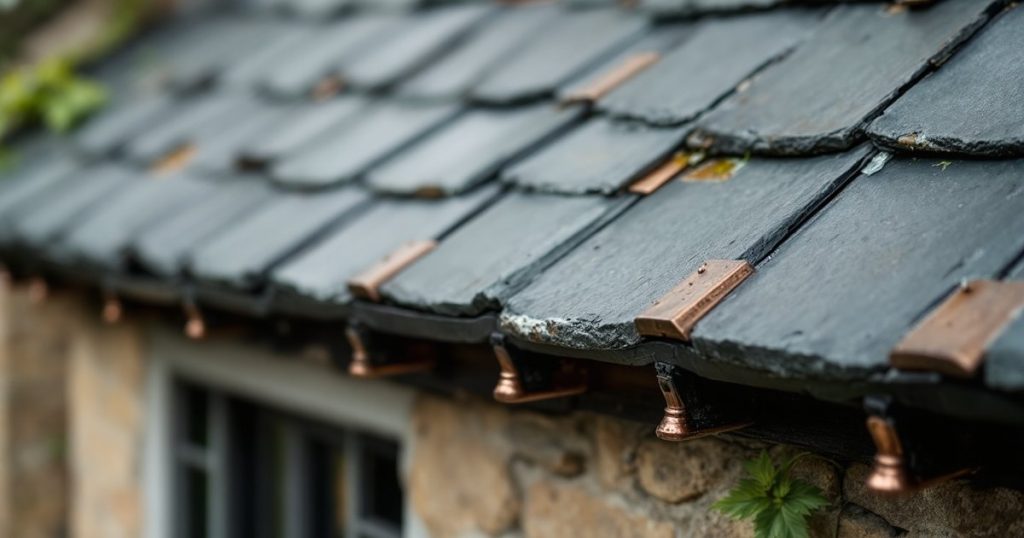
- Check the flashings. Look for pinholes, open seams, loose or misaligned pieces, rust, and tar or mastic smeared over metal.
- Check gutters and downspouts. Note broken or clogged downspouts, overflow stains and sagging hangers.
- Go into the attic. Look for water stains and rot on rafters and sheathing, especially near the roof plate and where roof planes meet at valleys and hips. The NPS guideline suggests pushing an awl into suspect wood to test for rot.
- Pick up any slate that has fallen and tap it. A full ring suggests a sound slate that fell because its nail failed; a dull thud suggests a weathered slate, per the NPS and NSA.
- Log it. Date the photos and notes and file them with past bills. The NPS calls this record keeping “an important part of maintenance.”
Can you walk on a slate roof?
You should not walk on a slate roof unless there is no alternative. NPS Preservation Brief 29 says to keep foot traffic off the roof and that anyone who must go up, including chimney sweeps and painters, should hook ladders over the ridge and walk on the ladders to spread their weight. If a slate must be stepped on, the NPS advises soft-soled shoes and stepping on the lower middle of the exposed portion.
The SRCA sets the same rule for contractors: “Workers shall not damage slates by walking on them,” with roofs staged on scaffold-grade planks and accessed by roof ladders, hook ladders, chicken ladders or lifts. The NSA’s myths bulletin notes that cracks can form as slaters walk on slate during installation, which is one reason a few slates may break in a new roof’s first year or two.
| Access method | When it fits | Source |
|---|---|---|
| Binoculars from the ground | Yearly owner survey, storm checks | NPS Preservation Brief 29 |
| Cherry picker or lift | Close looks without touching the roof, large or tall buildings | NPS Preservation Brief 29; SRCA sec. 2.4 |
| Hook ladder over the ridge | Chimney, vent or slate work on one area | NPS Preservation Brief 29; SRCA sec. 2.1 |
| Roof brackets with scaffold-grade planks | Larger repairs and flashing replacement | SRCA secs. 2.1 and 2.4 |
| Walking on the slate, soft soles, lower middle of the exposed slate | Last resort only | NPS Preservation Brief 29 |
Tell every other trade the rule before they arrive: the chimney sweeps and painters the NPS names, and satellite and gutter crews too. The NSA lists foot traffic first among the reasons individual slates need replacing.
How to clean a slate roof, and what never to put on it
A slate roof rarely needs washing, and neither NPS Preservation Brief 29 nor the SRCA guidelines list washing as routine maintenance. If moss or debris must come off, do it gently from a hook ladder or lift with low pressure. Framework, a nonprofit homeownership educator, says never to power-wash slate. The bigger risk is not dirt; it is coatings, mastic and fasteners that people add in the name of maintenance.
The SRCA’s assessment checklist states that “No brush-grade or trowel-grade coatings should be covering the slates.” The NPS says mastic and sealants on slate “will eventually harden and crack,” make later repairs harder, look bad and speed corrosion when smeared on metal flashing. For moss on a slate roof, the methods in our guide on how to remove moss from a roof apply, as long as the work is done without standing on the slate.
| Do not do this | Why | Source |
|---|---|---|
| Pressure-wash the roof | High water pressure can damage slate shingles | Framework Homeownership |
| Apply a brush or trowel coating over the slates | The SRCA treats coated slate as a sign of an improperly maintained roof | SRCA sec. 1.1 |
| Seal cracked slates with mastic or caulk on the face | Hardens and cracks, lets water in, complicates future repairs | NPS Preservation Brief 29; SRCA secs. 4.3 and 5.5 |
| Face-nail or screw a replacement slate | No exposed nail or screw heads are allowed on repaired slates, even gasketed ones | SRCA sec. 5.6 |
| Hang gutters with straps nailed through the slate | Damages slate; hangers belong under the slates on the deck or on the fascia | SRCA sec. 7.2 |
| Mix metals in flashings and gutters | Galvanic action corrodes the more electronegative metal | NPS Preservation Brief 29 |
| Patch rotted boards with plywood | Nailing bounce can loosen adjacent slates; matching boards are preferred | NPS Preservation Brief 29 |
Slate hooks vs nails: how replacement slates should be fastened
A replacement slate should be held by a hidden copper or stainless steel fastener: either a nail covered by a copper bib or a slate hook. Both the NPS and the SRCA reject face nails, exposed screws and mastic. The method matters for maintenance because every bad repair becomes a future leak, and the SRCA counts “removal and replacement of existing faulty repair work” as routine maintenance.
In the nail-and-bib method, the slater pulls the broken slate’s nails with a slate ripper, slides in a matching slate, nails it through the joint between the two slates above, and slips a copper bib over the nail head. The NPS describes the nail going about one inch below the tail of the slate two courses up, with a bib roughly 3 by 8 inches. The SRCA specifies a minimum 16-ounce copper bib at least 4 inches wide and 6 inches long that overlaps the nail head by 3 inches and runs 3 inches under the slate above.
| Fastening method | Status | Details | Source |
|---|---|---|---|
| Copper or stainless nail with copper bib | Recommended | Smooth-shank nail through the slot above; 16 oz copper bib, min. 4 in by 6 in | SRCA sec. 5.2; NPS Preservation Brief 29 |
| Copper or stainless slate hook | Accepted | Hook holds the slate’s tail; also used on ridge and hip slates | SRCA secs. 5.3 and 6.12; NSA |
| Painted aluminum bib (dark side out, min. 0.019 in) | Accepted with limits | Only when the roof has an estimated 50 years or less remaining | SRCA sec. 5.2 |
| Copper strip nailed to deck, tab folded over the slate’s tail | Not for snowy climates | Snow and ice can unfold the tab and let the slate slide out | NPS Preservation Brief 29 |
| Exposed sheet-metal strap hanger | Not allowed | Visible strap at the slate’s tail | SRCA sec. 5.4 |
| Face nail, screw, or mastic alone | Not allowed | Exposed heads leak; adhesive only under slates with mechanical fastening | SRCA secs. 5.5 and 5.6; NPS Preservation Brief 29 |
The replacement slate must also match. The SRCA calls for slates matching the existing type, length, width, thickness, shape and color, and the NSA says size matters most, because an undersized slate shortens the headlap and offset. When no match exists, the SRCA describes “roof cannibalization”: take slates from the least visible slope, use them on the rest, and re-slate that hidden slope with the closest available slate.
Flashing, gutters and copper: where slate roofs actually leak
Most slate roof leaks start at the flashing, valleys or gutters, not the slate. NPS Preservation Brief 29 calls flashings “the weakest point in any roof” and its repair guideline warns: “Do not assume the slates are leaking. Gutters, valleys and flashings are more likely candidates.” It also notes that attic condensation from poor ventilation can cause “false leaks” that look like roof failures.
Flashing upkeep depends on the metal. Copper needs little care. The NPS sets 16-ounce copper as the minimum for flashings and 20 or 24 ounce for gutters, valleys and hard-to-reach areas. Old ferrous flashing, such as terne or galvanized steel, needs painting: the SRCA recommends a coat about every five years, traditionally Tinner’s Red or Tinner’s Green. Inspect the lowest flashings first, because the SRCA says they carry the most water and wear out before the upper ones.
| Flashing or gutter metal | Maintenance it needs | Notes | Source |
|---|---|---|---|
| Copper, 16 oz | Inspect; little upkeep | Minimum weight for flashings on slate | NPS Preservation Brief 29; SRCA sec. 6.11 |
| Copper, 20 or 24 oz | Inspect; little upkeep | For gutters, valleys and limited-access areas | NPS Preservation Brief 29 |
| Lead-coated copper | Inspect | Even more durable than plain copper; common in restoration | NPS Preservation Brief 29 |
| Terne | Paint periodically | The NPS calls it less desirable for that reason | NPS Preservation Brief 29 |
| Terne-coated stainless steel | Inspect | Will not corrode if left unpainted | NPS Preservation Brief 29 |
| Old ferrous flashing (steel, galvanized, terne) | Paint about every 5 years | Seal open mortar joints with high-grade caulk; refasten loose pieces without exposed fasteners | SRCA secs. 3.2 and 3.3 |
Two slate contractors, Leeland’s Slate Roofing and The Durable Slate Company, each state that copper flashing typically lasts about 70 years; Leeland’s puts galvanized flashing at 15 to 20 years. Those are contractor statements, not test data, but they explain why valley metal is usually the first major job on an old slate roof. Chimney work follows the same pattern, covered in our guide to chimney flashing leaks.
Gutters deserve their own line on a slate roof. The SRCA notes that built-in gutters (box, Yankee, Philadelphia and pole gutters) are common on older slate roofs, and that worn linings must eventually be replaced in full, though temporary patching can buy time. Keep gutter metal galvanically compatible with the valleys and flashings, as the SRCA recommends.
How long does a slate roof last? Grades and quarry life spans
A slate roof lasts anywhere from about 20 to more than 200 years, and the slate type decides most of that range. ASTM C406, the North American standard for roofing slate, sorts slate into three grades by lab test: S1 with an expected service life over 75 years, S2 at 40 to 75 years, and S3 at 20 to 40 years. NPS Preservation Brief 29 gives a field range of 60 to 125 years for the slates most commonly used.
ASTM defines service life here as the period over which the slate “is expected to require no repair or replacement due to weathering,” according to the NSA’s history of the standard. That is a slate rating, not a roof rating: the nails, flashings and underlayment usually need work long before an S1 slate is spent. The current edition is ASTM C406/C406M-22; the table below shows the grade limits as the NSA reproduced them from the 2015 edition.
| ASTM C406 grade | Breaking load, min. | Absorption, max. | Depth of softening, max. | Expected service life | Source |
|---|---|---|---|---|---|
| S1 | 575 lb | 0.25% | 0.002 in | Over 75 years | ASTM C406/C406M-15 via NSA |
| S2 | 575 lb | 0.36% | 0.008 in | 40 to 75 years | ASTM C406/C406M-15 via NSA |
| S3 | 575 lb | 0.45% | 0.014 in | 20 to 40 years | ASTM C406/C406M-15 via NSA |
For roofs already in place, quarry region is the better guide, because few owners have test data for slate laid a century ago. The NPS gives these life spans from field history and cautions that they “should be used only as a general guide.”
| Slate type | NPS life span | Still quarried? | Source |
|---|---|---|---|
| Vermont and New York | About 125 years | Yes | NPS Preservation Brief 29; NSA (quarry status, 2022) |
| Buckingham, Virginia | 175 years or more | Yes | NPS Preservation Brief 29; NSA (quarry status, 2022) |
| Pennsylvania Soft-Vein | In excess of 60 years | Not stated by NPS | NPS Preservation Brief 29 |
| Pennsylvania Hard-Vein | Roughly 100 years | No | NPS Preservation Brief 29 |
| Peach Bottom, Pennsylvania | At least 200 years | No | NPS Preservation Brief 29 |
Slope and care move these numbers. The NPS says steeper roofs shed water faster and keep their slate longer. The NSA gives a worked example: Vermont unfading green slate laid in 1925 might have about 30 years left in 2020 on average, but could be near the end on a poorly maintained 6:12 roof, or have about 40 years left on a well-kept 14:12 roof. Our roof lifespan by material report compares slate with other coverings.
Remaining-life arithmetic for an older slate roof
Subtracting a roof’s age from its NPS guide life gives a first estimate of the years left, before any on-roof assessment. The table applies that subtraction to two installation years. It is a Roofing Brief estimate built only from the NPS figures, and a negative number means the roof has passed its guide life and needs a close assessment, not that it has failed.
| Slate type | NPS guide life | Laid 1926: age in 2026 | Years left (guide) | Laid 1966: age in 2026 | Years left (guide) | Source |
|---|---|---|---|---|---|---|
| Vermont and New York | 125 | 100 | About 25 | 60 | About 65 | Roofing Brief estimate from NPS life spans |
| Buckingham, Virginia | 175+ | 100 | About 75+ | 60 | About 115+ | Roofing Brief estimate from NPS life spans |
| Pennsylvania Hard-Vein | About 100 | 100 | About 0 | 60 | About 40 | Roofing Brief estimate from NPS life spans |
| Pennsylvania Soft-Vein | 60+ | 100 | Past guide life | 60 | About 0 | Roofing Brief estimate from NPS life spans |
The SRCA treats a correctly installed roof with at least 15 years of remaining slate life as a candidate for restoration. Below that, maintenance spending is mostly buying time while a replacement is planned.
When does maintenance stop paying? The 20 percent test
Maintenance stops paying when about 20 percent or more of a roof’s slates are broken, cracked, missing or sliding out of position. NPS Preservation Brief 29 says that at that point “it is usually less expensive to replace the roof than to execute individual repairs,” in part because even an experienced slater breaks more slates while working. The NSA applies the same rule of thumb and adds severely delaminated slates and bad past repairs to the count.
The NSA notes the rule assumes the damage is scattered. If it is concentrated, the NPS suggests replacing only the worst slope and repairing the others, which spreads the cost over years. To apply the test, a slater counts slates in a sample area. The NSA’s own example counted 72 failing slates out of 369 in one photo, or 19.5 percent.
The table shows how many slates the 20 percent line represents on a 25-square roof (2,500 square feet of roof area). Exposure uses the NPS formula, slate length minus the 3-inch standard headlap, divided by two. Slates per square are 14,400 square inches divided by width times exposure.
| Slate size | Exposure (3 in headlap) | Slates per square | Slates on a 25-square roof | 20 percent threshold | Source |
|---|---|---|---|---|---|
| 16 x 8 in | 6.5 in | About 277 | About 6,925 | About 1,385 | Roofing Brief arithmetic, NPS exposure formula |
| 18 x 9 in | 7.5 in | About 213 | About 5,325 | About 1,065 | Roofing Brief arithmetic, NPS exposure formula |
| 20 x 10 in | 8.5 in | About 169 | About 4,225 | About 845 | Roofing Brief arithmetic, NPS exposure formula |
| 24 x 12 in | 10.5 in | About 114 | About 2,850 | About 570 | Roofing Brief arithmetic, NPS exposure formula |
Counts ignore waste, starter courses and hips, so treat them as orders of magnitude. The point holds: replacing a dozen slates a year is ordinary upkeep on an old roof, while hundreds of failures is a replacement conversation. Our guide to roof repair vs replacement walks through that decision for any material. When the house is listed or in a historic district, our guide to replacing a historic slate roof covers in-kind replacement and the review rules.
What does slate roof maintenance cost?
Slate roof maintenance costs about $500 in a quiet year when every task is hired out, and roughly $1,000 in a year with slate repairs. HomeAdvisor’s slate repair guide (updated June 2026) puts a roof inspection at $130 to $360, possibly more on steep slopes, gutter cleaning at about $170 on average, and replacing one or two slates at about $400. The same guide gives an average slate repair range of $786 to $3,252.
Repair pricing by job type, including flashing, valleys and full restorations, is broken down in our slate roof repair cost guide. The table below covers only the recurring maintenance items.
| Maintenance item | Typical cost | How often | Source |
|---|---|---|---|
| Roof inspection by a slate professional | $130 to $360, more on steep slopes | Every 5 to 7 years (NPS) | HomeAdvisor (June 2026) |
| Gutter cleaning, per visit | About $170 average | Up to 3 visits a year (NPS) | HomeAdvisor (June 2026) |
| Replace one or two slates | About $400 | As needed | HomeAdvisor (June 2026) |
| Single slate replaced, with minimum call-out | $200 to $500 | As needed | The Roofing Brief slate repair cost guide |
| Ferrous flashing repainting | Quote per roof; varies with access and linear feet | About every 5 years (SRCA) | No reliable national figure found |
The arithmetic below annualizes those figures for a homeowner who hires out every task. It is a Roofing Brief estimate using HomeAdvisor’s numbers and the NPS schedule; owners who clean their own gutters from a ladder would pay far less.
| Line | Low | High | Basis |
|---|---|---|---|
| Gutter cleaning, 3 visits at $170 | $510 | $510 | NPS schedule x HomeAdvisor average |
| Professional inspection, annualized | $19 ($130 / 7 yrs) | $72 ($360 / 5 yrs) | NPS interval x HomeAdvisor range |
| Slate replacement visit (one or two slates) | $0 (no breakage) | $400 | HomeAdvisor |
| Annual total | About $529 | About $982 | Roofing Brief estimate |
For scale, our slate repair cost guide puts full slate replacement at $15 to $30 or more per square foot installed, or about $37,500 to $75,000 on a 2,500-square-foot roof. At the high-end annual figure, roughly 38 years of maintenance spending equals the low end of one replacement, which is why the NPS argues for repair “whenever possible.”
Which maintenance move fits your slate roof?
The right maintenance step depends on what the survey finds. The table maps the common findings on an older slate roof to the response the NPS, SRCA and NSA describe, so an owner can brief a slater before the visit.
| If you find | Then | Source |
|---|---|---|
| One or a few cracked or missing slates | Have a slater replace them promptly with matching slate, nail-and-bib or hooks | NPS Preservation Brief 29; SRCA sec. 5 |
| Many sound slates sliding out of position | Suspect rusting ferrous nails; salvage and re-lay the slates on non-ferrous nails | NPS Preservation Brief 29 |
| A leak but the slates look intact | Check flashings, valleys, gutters and attic ventilation before blaming slate | NPS Preservation Brief 29 |
| Rusting terne or galvanized flashing | Paint it now; plan replacement with 16 oz copper when painting no longer holds | SRCA secs. 3.2 and 6 |
| Tar, caulk or face nails from past repairs | Remove and redo those repairs properly | SRCA secs. 3.1 and 5.6 |
| Flaking, soft slates that thud when tapped | Get a condition assessment; the slate may be near end of life | NPS Preservation Brief 29; NSA |
| 20 percent or more of slates failing | Price replacement, or a slope-by-slope plan if damage is concentrated | NPS Preservation Brief 29; NSA |
| Snow sliding off in sheets | Have snow guards laid out by a qualified design professional | SRCA sec. 8.1 |
| A contractor offers to coat or seal the slate | Decline; coatings over slate are not part of proper maintenance | SRCA sec. 1.1 |
How to hire someone to maintain a slate roof
Hire a slater whose track record is in repair and restoration of natural slate, not a general shingle crew. The SRCA recommends at least five years of professional slate repair and restoration experience, with a resume of similar projects, and says the evaluation must come from someone with demonstrated competence in slate repair, not just new installs. The NSA keeps a member directory of slate contractors by state.
- Ask about experience and tools. The SRCA expects crews to use slate hammers, slate rippers, slate cutters, stakes, roof brackets and hook ladders.
- Ask how they will access the roof. The answer should be ladders, staging or a lift, not walking the field.
- Ask how they fasten replacement slates. Look for copper or stainless nails with copper bibs, or slate hooks. Face nails, exposed straps and mastic are red flags under SRCA rules.
- Ask where replacement slate will come from. New, salvaged or cannibalized from a hidden slope; the match should be discussed before work starts.
- Get a written scope and insurance proof. The SRCA calls for a detailed scope and material specs, liability and workers’ compensation coverage, and warranty terms in writing.
- Consider a service agreement. The SRCA recommends an extended service maintenance agreement beyond any warranty period.
Frequently asked questions
What is the 25 rule in roofing?
The 25 rule usually means Florida’s 25 percent rule. Florida Building Code, Existing Building section 706.1.1 limits repairs to 25 percent of a roof or roof section in any 12-month period unless the whole roof or section is brought to current code. Under Florida Statutes 553.844(5), roofs built to the 2007 code or later need only the repaired portion to meet current code.
What is a major disadvantage of a slate roof?
The major disadvantages are cost, weight and fragility underfoot. The National Slate Association puts quarter-inch slate at about 9.35 pounds per square foot and half-inch slate at about 18.70, which can exceed what standard postwar framing carries. Slate also cracks when walked on, and repairs need a slater with special tools, a trade the NSA says has fewer workers than 25 years ago.
What is the lifespan of a slate roof?
NPS Preservation Brief 29 says slate roofs last 60 to 125 years or longer depending on slate type, roof design and location. ASTM C406 rates S1 slate at over 75 years, S2 at 40 to 75 and S3 at 20 to 40. By quarry, the NPS lists Vermont and New York slate at about 125 years and Buckingham, Virginia slate at 175 years or more.
Do insurance companies like slate roofs?
There is no single insurer position on slate. Slate is noncombustible stone and can outlast the roof-age limits some carriers apply to shorter-lived roofs, which may help in underwriting. Against that, slate is costly to replace and hard to match, which can raise the dwelling coverage a home needs. Ask your carrier how it rates your specific roof before assuming a discount or surcharge.
Is it okay to power wash a slate roof?
No. Framework, a nonprofit homeownership educator, warns that high water pressure can damage slate shingles, and anyone washing a roof has to stand on it or near it. Neither NPS Preservation Brief 29 nor the SRCA guidelines include washing in routine maintenance. If moss must come off, use gentle methods from a hook ladder or lift, and never apply coatings over the slate.
How often should a slate roof be inspected?
The National Park Service recommends an owner survey from the ground with binoculars every year and after severe storms, plus an inspection by a professional experienced with slate every five to seven years. HomeAdvisor suggests a slate professional every five years, and some slate contractors recommend a yearly visit in fall or spring. Gutters should be cleaned twice in fall and once in early spring.
Can you walk on a slate roof?
Avoid it. The NPS says to keep foot traffic off slate and to hook ladders over the ridge so workers walk on the ladder, not the slate. If someone must step on slate, the NPS advises soft-soled shoes and stepping on the lower middle of the exposed part. The SRCA requires contractors to use ladders, staging or lifts rather than walking on slates.
Sources
- Jeffrey S. Levine, Preservation Brief 29: The Repair, Replacement, and Maintenance of Historic Slate Roofs, National Park Service.
- Slate Roofing Contractors Association of North America, Slate Roof Repair, Restoration, and Maintenance Guidelines, Version 1.1, September 2017.
- National Slate Association, Slate Roof Condition Assessment Surveys, Part 1; Common Myths About Slate Roofing; Slate Roof Repair.
- Jeffrey S. Levine, Origins of ASTM C406, National Slate Association, 2022.
- ASTM International, ASTM C406/C406M-22, Standard Specification for Roofing Slate.
- HomeAdvisor, Slate Roof Repair Cost, updated June 19, 2026.
- Framework Homeownership, Home Maintenance Assessment for Slate Roofs.
- Florida Statutes, section 553.844; see also our explainer on the Florida 25 percent rule.