

By The Roofing Brief Team. Last reviewed: November 2026.
Hail damage on a cedar shake roof is a fresh split or puncture caused by a hailstone, and the tell is color: the inside faces of a new split show bright, unweathered orange or tan wood, while old weathering splits are gray all the way through. Dents without a split are usually cosmetic, because the Cedar Shake and Shingle Bureau (CSSB) adjuster’s guide to hail says minor impact marks weather away, and Haag Engineering field surveys put the onset of damage at about 1.25 inch hail for cedar shingles and 1.50 inch hail for medium cedar shakes.
Key numbers at a glance
The five figures below answer most cedar hail questions, each tied to a named source with its publication date. Thresholds are onset sizes from Haag Engineering field surveys and lab tests (2002), not guarantees: wind-driven stones, older wood and unsupported shake edges can fail at smaller sizes.
| Figure | Value | Source |
|---|---|---|
| Hail size where cedar shingle damage begins | 1.25 in (half dollar) | Marshall, Herzog, Morrison and Smith (Haag), 2002, Table 3 |
| Hail size where medium cedar shake damage begins | 1.50 in (walnut, ping pong ball) | Same Haag paper, Table 3 |
| Max hail impact splits per 100 sq ft if repair is still on the table | 25 | CSSB adjuster’s guide (printed 03/2006) |
| Repair cost that justifies replacing the slope instead | 80% or more of replacement cost | CSSB adjuster’s guide |
| Installed cost of a new No. 1 Blue Label cedar shake roof | $10 to $18 per sq ft | The Roofing Brief 2026 Roofing Cost Report |
What does hail damage look like on a cedar shake roof?
Functional hail damage on cedar is a split or puncture at the point of impact, with fresh, unweathered wood exposed inside the break. The 2002 Haag Engineering paper on hail damage threshold sizes describes damaged wood shingles and shakes as having “hairline fractures” with “uniform cleavage through the wood grain” that “could be closed tight,” and interior surfaces that were “unweathered (orange).”
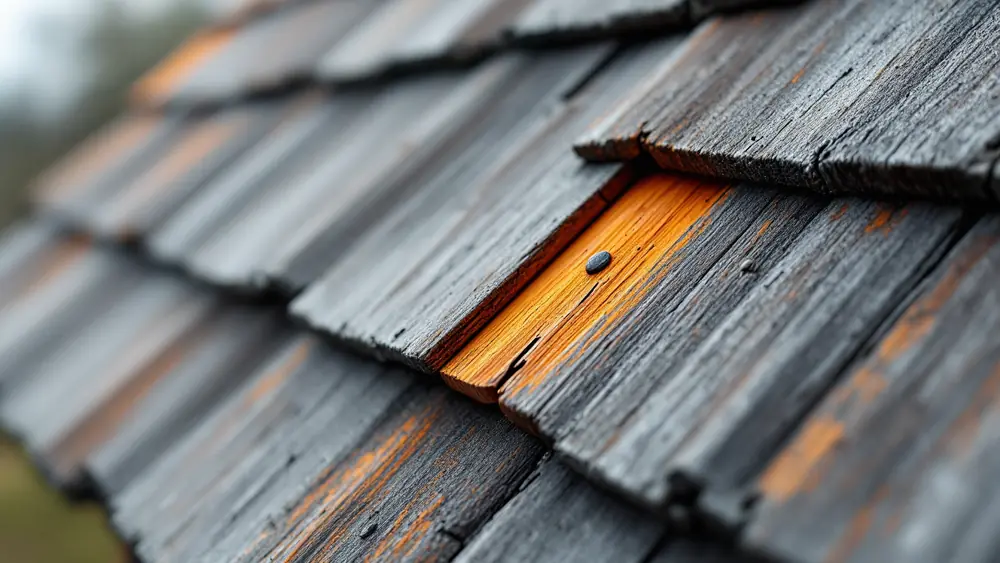
Haag’s definition of damage, borrowed from Morrison (1999), is a loss of water-shedding ability or a reduction in the expected long-term life of the roofing. A dent in a 3/4 inch heavy shake does neither, so most adjusters treat dents and small impact marks as cosmetic. The CSSB guide shows a Haag photo captioned “Many small hail impact marks, but no splits in shingle,” which is the classic no-damage case.
Hail split vs weathering split vs mechanical damage
Cedar splits on its own as it ages, so every split on the roof is not a hail split. The CSSB guide states that a shake or shingle weathers to gray within 6 to 9 months and that “a certain amount of splitting and curling is normal.” Use this comparison, built from the CSSB guide’s Haag photos and the Haag 2002 damage description, to sort what you find.
| Sign | Hail split (functional) | Weathering split (age) | Foot traffic or hammer | Source |
|---|---|---|---|---|
| Color inside the split | Bright orange or tan, unweathered | Gray, same as the surface | New cedar color (foot traffic) | CSSB guide, pp. 7, 12, 13 |
| Impact mark at the split | Dent or bruise where the split starts | None | None for footfall; repeated round marks for a hammer | CSSB guide, p. 13 |
| Split edges | Sharp, closes tight when pushed together | Gray, weathered faces with no impact point | Sharp | Haag 2002, section 4a |
| Pattern across the slope | Random distribution, often heavier on storm-facing slopes | Spread across all slopes | Regular spacing (hammer) or along walking paths | CSSB guide, pp. 8, 13 |
| Collateral evidence | Dented gutters, vents, soft metal; storm report for the date | None | None | NOAA Storm Events Database |
Timing matters for the color test. Because cedar grays in 6 to 9 months per the Cedar Shake and Shingle Bureau, a split that is still bright tan 12 months after the storm date on the claim is probably newer than that storm, and one that is already fully gray is probably older. Photograph splits with a coin or tape measure in frame within the first weeks after the storm.
What size hail damages cedar shakes and cedar shingles?
Haag field surveys of natural hailstorms put the damage onset at 1.25 inches for cedar shingles and 1.50 inches for medium cedar shakes, compared with 1.00 inch for 3-tab asphalt. Thicker heavy shakes held up better in the lab: new heavy cedar shakes took no damage from 1.25 inch ice stones and were damaged in 5 of 10 hits at 1.5 inches.
The table combines the Haag thresholds with butt thicknesses from the CSSB New Roof Construction Manual (2020) coverage tables. Shingle thickness is listed by the CSSB as butts per inch stack, so “16 in x 5/2 in” means 5 butts measure 2 inches, about 0.40 inch each.
| Product (CSSB designation) | Butt thickness | Haag field onset size | Haag lab: share of hits damaged at 1.25 / 1.5 / 1.75 / 2.0 in | Source |
|---|---|---|---|---|
| Certigrade shingle, 16 in (5/2 in) | About 0.40 in | 1.25 in | 30% / 80% / 100% / 100% (11-year-old shingles) | CSSB manual Table 1; Haag 2002 Tables 2, 3 |
| Certigrade shingle, 18 in (5/2 1/4 in) | About 0.45 in | 1.25 in (shingles as a class) | Same shingle test row | CSSB manual Table 1; Haag 2002 |
| Certigrade shingle, 24 in (4/2 in) | About 0.50 in | 1.25 in (shingles as a class) | Same shingle test row | CSSB manual Table 1; Haag 2002 |
| Certi-Split handsplit and resawn medium shake | 1/2 in | 1.50 in | Not lab tested in the 2002 paper | CSSB manual Table 3; Haag 2002 Table 3 |
| Certi-Sawn tapersawn shake | 5/8 in | Not listed separately | Not tested | CSSB manual Table 3 |
| Certi-Split handsplit and resawn heavy shake | 3/4 in | Not listed in field table | 0% / 50% / 90% / 100% (new shakes) | CSSB manual Table 3; Haag 2002 Table 2 |
Some state regulators round these numbers. The Nebraska Department of Insurance says hail generally must reach 1 1/4 inches before it damages wood shake, the same figure it gives for heavy composite shingles. For more materials side by side, see our guide to what size hail can damage a roof.
Why bigger hail is disproportionately worse
Impact energy climbs much faster than diameter. Haag’s Table 1, taken from Greenfeld’s 1969 National Bureau of Standards work, gives a 1 inch hailstone under 1 ft-lb of energy at a 50 mph terminal velocity, while a 2 inch stone carries 22 ft-lb at 72 mph. Hail sizes below use the object names in the NOAA Storm Prediction Center hail size chart.
| Hail diameter | SPC object | Terminal velocity | Impact energy | What to expect on cedar |
|---|---|---|---|---|
| 1.00 in | Quarter | 50 mph | Under 1 ft-lb | No damage to 11-year-old cedar shingles in Haag lab tests |
| 1.25 in | Half dollar | 56 mph | 4 ft-lb | Field onset for cedar shingles; 30% of lab hits split aged shingles |
| 1.50 in | Walnut or ping pong ball | 61 mph | 8 ft-lb | Field onset for medium shakes; half of hits split new heavy shakes |
| 1.75 in | Golf ball | 66 mph | 14 ft-lb | All aged shingles and 90% of heavy-shake hits damaged in lab |
| 2.00 in | Hen egg | 72 mph | 22 ft-lb | Every cedar sample in the lab was damaged |
Haag’s ice stones were solid freezer ice fired straight on, which the paper calls a “worst case scenario” because natural hail is less dense and often strikes at an angle rather than at the full 72 mph straight-down velocity listed for a 2 inch stone. The reverse can also happen: the Haag paper lists product type, age, support condition and impact location as variables, so an aged shake struck over an unsupported keyway can split at smaller sizes than the onset figures.
How to inspect a cedar roof for hail: the test-square method
The adjuster-standard method counts hail-caused splits inside a marked 10 ft by 10 ft (100 sq ft) test square on each slope. Haag added test squares and a repair difficulty factor to its assessment procedure in 1983, published as the Marshall and Herzog “Protocol for Assessment of Hail-Damaged Roofing” (1999). The CSSB guide states that damage “cannot be accurately determined from the ground, with binoculars, or from the top of a ladder.”
- Confirm the storm. Pull the date, location and reported hail size for your address from the NOAA Storm Events Database. Reports under 1.25 inches make functional cedar damage less likely per Haag Table 3.
- Check soft metals first. Look for round dents on gutters, downspouts, roof vents and flashing. Measure the largest dent in inches and compare it with the 1.25 inch and 1.50 inch cedar onset sizes.
- Walk the roof safely. Wet cedar and moss are slick, and the Cedar Shake and Shingle Bureau guide calls for proper shoes, ladders and harnesses. Footfall splits show new cedar color with no dent, so careless walking creates splits that look like fresh hail damage.
- Mark a 100 sq ft test square on every slope. Use chalk to outline 10 ft by 10 ft in an area representative of that slope, away from valleys and ridges.
- Count only qualifying splits. A split counts when it starts at an impact mark and shows orange, unweathered wood inside. Gray splits, curl and cupping do not count toward the 100 sq ft tally.
- Photograph each counted split. Include a ruler for scale and a wide shot showing the chalk square and the slope’s compass direction.
- Record the variables the CSSB worksheet asks for. Roof area, age, decking type (solid or spaced), flashing type, product type and thickness, slope (for example 4:12), and overhanging trees.
- Compare slopes. Storm-facing slopes often carry most of the splits, so a slope-by-slope count can support repairing one slope and replacing another.
A count above 25 hail splits in a 100 sq ft square crosses the CSSB guide’s ceiling for considering repair on that section. Below it, the repair cost formula in the next section decides.
Repair or replace a hail-damaged cedar shake roof?
The CSSB adjuster’s guide uses the Marshall and Herzog repair cost formula, RC = D x U x R x A, and recommends replacing the slope when repairs reach 80% or more of replacement cost. D is damaged pieces per square, U the unit cost per piece, R a difficulty factor (1 good, 1.5 fair, 2 poor condition) and A the slope area in squares.
The CSSB’s own samples used a $10 unit cost: 15 damaged pieces per square on a 20-square roof in good condition came to $3,000, and 45 per square in poor condition came to $18,000. The guide is dated March 2006, so the unit cost below is shown as an input to replace with a local contractor’s per-piece price.
Worked example: 20-square cedar shake roof
| Input or result | Light hail | Moderate hail | Heavy hail | Basis |
|---|---|---|---|---|
| D: hail splits per 100 sq ft | 8 | 20 | 25 | Test-square counts |
| U: unit cost per replaced piece (illustrative input) | $25 | $25 | $25 | Replace with a local per-piece quote |
| R: difficulty factor | 1 (good) | 1.5 (fair) | 2 (poor) | CSSB guide |
| A: roof area in squares | 20 | 20 | 20 | 2,000 sq ft roof |
| RC = D x U x R x A | $4,000 | $15,000 | $25,000 | Roofing Brief arithmetic |
| Replacement cost at $10 to $18 per sq ft | $20,000 to $36,000 | $20,000 to $36,000 | $20,000 to $36,000 | 2026 Roofing Cost Report |
| 80% replacement threshold | $16,000 to $28,800 | $16,000 to $28,800 | $16,000 to $28,800 | CSSB 80% rule |
| Outcome | Repair | Repair, close at the low-price end | Replace if replacement is priced near $20,000 to $31,250; repair if it is priced higher | RC compared with the 80% line |
The heavy-hail column shows why bids matter: $25,000 is 80% of $31,250, so the same damage count favors replacement on a lower-priced replacement bid and repair on a higher-priced one. Price hip and ridge, valleys, redecking and tear-off into the replacement figure, as the CSSB guide advises.
Shimming limit
Shimming slides a thin piece under a split shake from below instead of replacing it. The CSSB guide caps shimming at 20% of a roof area for system integrity and appearance, and says a roof that reaches the 20% limit should get new shakes in that area or a full reroof.
Which fix fits what you found?
Match your test-square results to a response using the thresholds in the CSSB guide and the Haag 2002 paper. Counts are per 100 sq ft test square on the worst slope.
| If you find | Then | Why |
|---|---|---|
| Dents and impact marks, no splits | No repair; photograph and monitor | CSSB: cosmetic marks weather away; no loss of water shedding (Haag definition) |
| Gray splits only, no impact marks | Maintenance item, not a hail claim | Normal weathering per CSSB guide p. 7 |
| 1 to 25 fresh hail splits per square, roof in good condition | Slip-in replacement of split pieces | Under the CSSB 25-split ceiling; RC usually well below 80% of replacement |
| Over 25 fresh hail splits per square on a slope | Price replacement of that slope | CSSB guide ceiling for considering repair |
| Repair estimate at 80% or more of replacement | Replace the slope or roof | CSSB 80% rule |
| Splits plus rot, missing felt or a roof past 25 to 30 years | Replace, and compare synthetic shake bids | Brittle older wood splits at smaller hail; USDA FPL life of 30+ years |
| Felt interlayment or deck visible through a split | Tarp now, repair within days | CSSB: splits matter when felt or deck is exposed |
How to replace a hail-split cedar shake
A single split shake is replaced by cutting its two nails with a shake ripper, sliding in a matching piece and face-nailing it under the course above. The steps follow the CSSB guide’s repair sequence and the 2021 International Residential Code section R905.8 fastener rules. For full detail on tools and pricing, see our cedar shake roof repair guide.
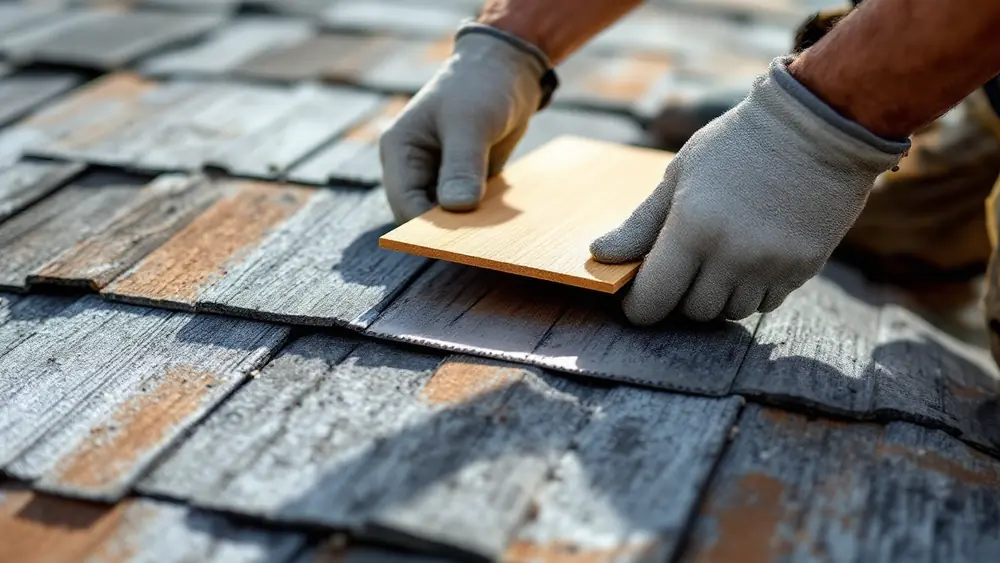
- Cut the nails. As in the Cedar Shake and Shingle Bureau repair photos, slide a shake ripper up under the split shake, hook the nail, and strike the ripper down to cut it; repeat for the second nail.
- Pull the pieces. Remove all fragments without lifting the course above more than needed; check the felt interlayment underneath for tears.
- Size the replacement. Match length and thickness (for example 24 in x 3/4 in heavy) and trim width to leave 3/8 to 5/8 inch gaps on each side, the shake spacing rule in IRC section R905.8. Shingles take 1/4 to 3/8 inch per the CSSB manual.
- Set it low. Slide the new shake up until its butt sits about 1/2 to 3/4 inch below the other butts in the course, per the CSSB guide.
- Nail at 45 degrees. Drive two nails at a 45 degree angle just below the butt of the course above, flush, never overdriven.
- Use the right fastener. IRC R905.8.6 calls for Type 304 or 316 stainless or ASTM A153 Class D hot-dipped galvanized nails, Type 316 for treated shakes or within 15 miles of saltwater, with at least 3/4 inch penetration into sheathing.
- Tap it home. Drive the butt up the last 1/2 to 3/4 inch into line, with a block of wood held against the butt so the hammer does not split the new piece.
A new shake starts tan and stands out until it grays in about 6 to 9 months, per the Cedar Shake and Shingle Bureau. That temporary mismatch is normal with cedar and is one reason the CSSB argues cedar avoids the color-lot matching problems of factory-colored products.
Will insurance cover hail damage on a cedar shake roof?
Most homeowners policies cover hail damage to a cedar roof, because the standard ISO HO 00 03 form covers the dwelling on an open-perils basis and does not exclude hail. What a claim pays depends on endorsements: cosmetic-damage exclusions, actual cash value roof schedules, and percentage wind/hail deductibles can each shrink or erase a cedar payout.
| Policy term | Effect on a cedar shake hail claim | Source |
|---|---|---|
| Cosmetic damage exclusion | Dents without splits are not paid; only splits that let water in count | Our cosmetic damage exclusion guide |
| Replacement cost (RCV) | Pays to replace, withholding depreciation until the work is done | Our recoverable depreciation guide |
| Actual cash value roof schedule | Pays depreciated value; an older cedar roof may net little after the deductible | Policy declarations page |
| Percentage wind/hail deductible | 2% of a $400,000 dwelling limit is $8,000 out of pocket | Triple-I deductible guide |
| Matching rule | On RCV losses, replaced items that do not match must be replaced in the whole area for a “reasonably uniform appearance” where a state adopted the rule | NAIC Model Regulation 902, Section 9 |
| Replacement deadline | Many policies set a window, often 180 days, to complete work and claim held-back depreciation | Nebraska Department of Insurance |
Matching arguments on cedar differ from asphalt. Because new cedar weathers to gray within 6 to 9 months per the Cedar Shake and Shingle Bureau, an insurer may argue a slip-in repair will blend, while a policyholder with discontinued shake dimensions or a pressure-treated product may argue it will not. State adoption of the NAIC matching language varies, so ask your state insurance department which version applies. Our hail damage roof insurance claim guide covers filing steps and timelines.
When the roofer and the adjuster disagree
Disputes on cedar usually come down to whether a counted split is hail-caused, so bring the evidence the Haag criteria use. Ask the adjuster to count with you inside a chalked 100 sq ft test square, and ask which splits they excluded and why: gray interior, no impact mark, or footfall. If the count still differs, many policies include an appraisal clause, and our page on how much hail damage it takes to replace a roof lists adjuster standards by material.
How much does hail repair or a new cedar shake roof cost in 2026?
A few replaced shakes typically run $100 to $400 and a full cedar shake roof $10 to $18 per sq ft installed for No. 1 Blue Label material, per The Roofing Brief’s 2026 figures. Angi’s 2026 cost page puts a typical cedar shake roof at $15,800 to $30,000, about $21,000 on average, or $6 to $15 per sq ft depending on grade.
| Job | 2026 cost | Source |
|---|---|---|
| Replace a few split shakes | $100 to $400 | Roofing Brief cedar shake repair guide |
| Section or flashing repair | $750 to $1,500 or more | Roofing Brief cedar shake repair guide |
| New No. 1 Blue Label cedar shake roof | $10 to $18 per sq ft installed | 2026 Roofing Cost Report |
| Typical full cedar shake roof (national) | $15,800 to $30,000; average about $21,000 | Angi, 2026 data |
| 20-square (2,000 sq ft) roof at $10 to $18 per sq ft | $20,000 to $36,000 | Roofing Brief arithmetic |
Hail repairs priced right after a large storm can run above these figures, because the CSSB guide notes that the size of the catastrophe pushes up local labor and the unit cost (U) in the Repair Cost Formula.
Impact-rated cedar and alternatives for hail country
Some natural cedar carries a UL 2218 impact rating. The CSSB guide says Certi-label shakes and shingles earned Class 3 and Class 4 ratings depending on product type, where UL 2218 drops 1.75 inch steel balls for Class 3 and 2 inch steel balls for Class 4 onto a 15/32 inch plywood test deck. Ratings are per product, so ask for the listing on the exact profile.
| Option | Impact rating | What to verify | Source |
|---|---|---|---|
| Certi-label cedar shakes and shingles | UL 2218 Class 3 or Class 4, by product type | The bundle label or listing for your exact profile and thickness | CSSB adjuster’s guide, pp. 11, 16 |
| Imperial Cedar Products 24 in handsplit and resawn shakes | UL 2218 Class 4 | Listing H106, effective June 29, 2004; confirm it is still current | QAI directory listing H106 |
| Certi-Last preservative-treated shakes | No product-specific class given in the 2020 CSSB manual | Ask the treater for a UL 2218 listing covering the treated product | CSSB roof manual (2020) |
| Synthetic cedar shake (for example CeDUR) | UL 2218 Class 4 per the CeDUR impact page | Insurer discount eligibility and the look up close | Our synthetic cedar shake comparison |
If a hail claim leads to replacement, a Class 4 listing may qualify for a premium credit in states that require or allow one; Texas, for example, publishes qualifying products on its TDI roofing discounts page. Ask your insurer for the exact form or certificate it accepts before ordering material. Our cedar shake roofing guide covers grades, species and fire ratings for the new roof.
How long will a cedar roof last after a hailstorm?
A cedar roof with dents but no splits keeps its normal service life, which the USDA Forest Products Laboratory puts at more than 30 years for properly installed and maintained shakes and shingles. Unrepaired hail splits shorten it, because a split lets water reach the felt interlayment and the deck, where it starts decay.
Haag’s long-term work dates to 1963, when it impacted new wood shingles and then left the test panels outdoors for ten years, examining them periodically. The CSSB guide draws the practical conclusion that cedar can “rebound from minor cosmetic hail impact,” leaving little trace after weathering. Older, thinner and drier cedar is the exception: Haag’s lab results show 11-year-old cedar shingles splitting at 1.25 inch hail. Regular cleaning and treatment keep the wood less brittle; see our cedar shake roof maintenance guide.
Frequently asked questions
What is the average lifespan of a cedar shake roof?
The USDA Forest Products Laboratory says properly installed and maintained cedar shakes and shingles should last more than 30 years, and the CSSB and many roofers cite 30 to 40 years. Hail dents without splits do not shorten that figure. Unrepaired hail splits, trapped moisture under debris and poor attic ventilation are what pull a cedar roof toward a 15 to 20 year life.
Will insurance cover roof damage from hail?
Usually yes. The standard ISO HO 00 03 homeowners form covers the dwelling on an open-perils basis and does not exclude hail. Payment on a cedar roof can still be limited by a cosmetic damage exclusion (dents without splits), an actual cash value roof schedule, or a percentage wind/hail deductible, such as 2% of a $400,000 dwelling limit, which is $8,000.
How much does it cost to replace a cedar shake roof?
A new No. 1 Blue Label cedar shake roof runs about $10 to $18 per square foot installed in The Roofing Brief 2026 Roofing Cost Report, or $20,000 to $36,000 for a 2,000 square foot roof. Angi’s 2026 data puts a typical job at $15,800 to $30,000, averaging about $21,000. Replacing a few hail-split shakes typically costs $100 to $400.
How long will a roof last after hail damage?
A cedar roof with only dents keeps its normal 30-plus year service life, because the CSSB says minor impact marks weather away. A roof with fresh splits lasts only as long as the felt and deck under those splits stay dry, so split pieces should be replaced promptly. Aged, thin cedar is weaker: Haag lab tests split 30% of 11-year-old shingles with 1.25 inch hail.
What size hail damages a cedar shake roof?
Haag Engineering field surveys published in 2002 put the onset of damage at 1.25 inch hail for cedar shingles and 1.50 inch hail for medium cedar shakes. In Haag lab tests, new 3/4 inch heavy shakes took no damage from 1.25 inch ice stones, were split by half of 1.5 inch hits and by 90% of 1.75 inch hits.
How many hail splits does it take to replace a cedar shake roof?
The Cedar Shake and Shingle Bureau adjuster’s guide says no more than 25 hail impact splits should exist per 100 square foot section if repair is being considered. It also recommends replacing a slope when the repair cost, calculated as damaged pieces times unit cost times difficulty factor times squares, reaches 80% or more of replacement cost.