
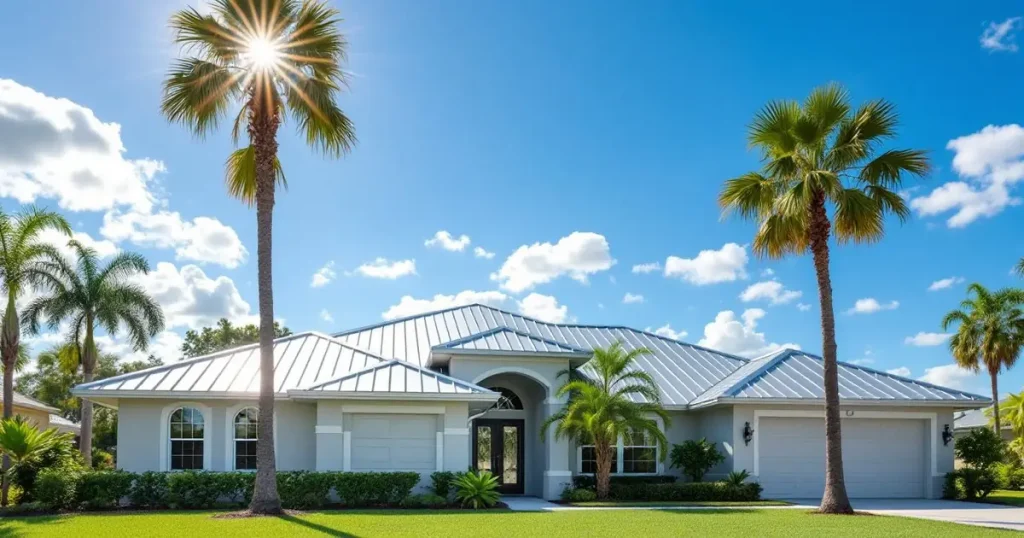
A metal roof can lower your insurance in Florida, but not because it is metal. Florida insurers must offer wind mitigation credits under section 627.0629, Florida Statutes, and those credits follow what a licensed inspector verifies on form OIR-B1-1802: a roof covering with a Florida or Miami-Dade product approval or a qualifying permit date, how the deck is nailed, how the roof is tied to the walls, and whether there is a sealed roof deck. A code-approved shingle roof can score the same roof covering answer as metal.
By The Roofing Brief Team. Last reviewed: October 2026. Statutes were read from the 2026 Florida Statutes on Online Sunshine, and the inspection form from the OIR-B1-1802 (Rev. 04/26) PDF published by Citizens Property Insurance, on October 13, 2026.
Metal roof insurance in Florida: key numbers at a glance
These are the figures that decide whether a Florida metal roof changes your premium. Each comes from a statute, a state form or an insurer document, and none of them is a promised discount. Your insurer’s approved rate filing sets the actual credit, and that credit applies only to the wind portion of the premium.
| Figure | Value | Source |
|---|---|---|
| Roof age an insurer cannot use alone to refuse or non-renew | Under 15 years | s. 627.7011(5)(b), Florida Statutes |
| Inspection result that blocks a refusal based only on age (roof 15+ years) | 5 or more years of useful life remaining | s. 627.7011(5)(c), Florida Statutes |
| Citizens roof age before proof of condition is needed | Over 25 years for shingle and other “soft” roofs; over 50 years for tile, slate, concrete or metal | Citizens Property Insurance, Roof Rule Changes bulletin (March 31, 2023) and Home Condition Requirements (03.01.23) |
| Current wind mitigation form | OIR-B1-1802 (Rev. 04/26), required for inspections on or after April 1, 2026 | Citizens Personal Lines Bulletin, March 19, 2026 |
| How long a wind mitigation form stays valid | Up to 5 years if the structure is not materially changed | OIR-B1-1802 (Rev. 04/26), page footer |
| My Safe Florida Home grant ceiling | Up to $10,000 in state funds; roof covering replacement is an eligible improvement when the program inspection recommends it | s. 215.5586(2), Florida Statutes |
Does a metal roof lower your insurance in Florida?
A metal roof may lower your Florida homeowners premium when it lets a wind mitigation inspector check better answers on form OIR-B1-1802, and when your insurer files credits for those answers. The roof covering question rewards product approval and permit dates, not material. Most of the credit comes from deck nailing, roof-to-wall connections, roof shape, a sealed roof deck and opening protection, which metal alone does not change.
Section 627.0629(1) states the rule plainly: a residential property rate filing “must include actuarially reasonable discounts, credits, or other rate differentials, or appropriate reductions in deductibles” for construction techniques shown to reduce windstorm loss, including “roof covering performance,” “roof strength” and “roof-to-wall strength.” The statute names the performance, not a material. Metal earns credit through the same doors as shingles and tile.
That is the gap most pages ranking for this question skip. MetalRoofing.com and Mid Florida Metal Roofing Supply both quote a 5% to 35% metal roof discount without citing a rate filing, study or insurer for it, and Florida’s own discount forms do not list metal as a separate line.
What Florida law makes insurers do
Florida law makes insurers file wind mitigation discounts, show the hurricane premium separately and tell you what the discounts are. Section 627.0629(4) splits every residential rate filing into a hurricane component and an all-other-perils component, and section 627.711(1) requires a state-prescribed notice of available discounts at issuance and each renewal. Since October 1, 2023, insurers must also post their hurricane mitigation discounts online.
The prescribed notice is form OIR-B1-1655 (Rev. 02/10). Two lines on it matter for anyone pricing a metal roof. First: “These discounts apply only to the hurricane-wind portion of your policy.” Second: “Discounts are not calculated cumulatively. The total discount is not the sum of the individual discounts.” Your declarations page shows the hurricane premium as its own number, and that number is the ceiling on what any roof credit can touch.
The discount schedules behind those notices are older than most metal roofs on the market. Rule 69O-170.017 still points to forms OIR-B1-1699 and OIR-B1-1700, both effective October 2006, and the Office of Insurance Regulation’s wind mitigation page lists all three discount forms as “updates pending” after a June 2024 Applied Research Associates loss study. Citizens told agents on March 19, 2026 that the new inspection form “will not result in any difference to the credits available and applied at this time.”
Where metal shows up on the OIR-B1-1802 wind mitigation form
Metal appears on exactly one line of the 2026 Uniform Mitigation Verification Inspection Form: question 4.1, the roof covering type list, where “Metal” sits beside asphalt shingle, concrete or clay tile, synthetic tile, built up and membrane. The other eight questions grade the building, the deck, the connections and the openings. A metal re-roof can still improve two of them, if the crew renails the deck and adds a sealed roof deck.
| Form question (Rev. 04/26) | What the inspector records | Does choosing metal change it? | Can a re-roof job change it? | Source |
|---|---|---|---|---|
| 1. Building code | FBC 2001/2004, FBC 2007 or later, SFBC-94 (HVHZ) or unknown, by permit date | No | No; it is the original permit | OIR-B1-1802, Q1 |
| 2. Region | HVHZ, or Region 1, 2 or 3 by ASCE 7-22 design wind speed | No | No | OIR-B1-1802, Q2 |
| 3. Roof slope | At least 6:12 or less than 6:12 on two thirds of the main roof | No | No | OIR-B1-1802, Q3 |
| 4. Roof covering | Covering type plus permit date or FBC/Miami-Dade product approval number and install year | Only the type box; the answer depends on approval and dates | Yes, any permitted, approved new covering | OIR-B1-1802, Q4.1 and Q4.2 |
| 5. Roof deck attachment | Weakest deck fastening, graded A to H by nail size, spacing and uplift (55, 103 or 182 psf) | No | Yes, if the deck is renailed to a better pattern | OIR-B1-1802, Q5 |
| 6. Roof to wall | Toenails, clips, single wraps, double wraps or structural | No | Only with a retrofit; the attic connections are separate work | OIR-B1-1802, Q6 |
| 7. Roof geometry | Hip roof (non-hip features no more than 10% of perimeter), flat or other | No | No | OIR-B1-1802, Q7 |
| 8. Secondary water resistance | Sealed roof deck by ASTM D1970 membrane, taped seams, double felt or spray foam | No | Yes, if a qualifying method goes down under the new metal | OIR-B1-1802, Q8 |
| 9. Opening protection | Weakest protection on windows, doors, skylights and garage doors | No | Only skylights, if replaced with rated units | OIR-B1-1802, Q9 |
The count is the point. Choosing metal touches one of nine questions. The re-roof itself can touch three: covering, deck attachment and secondary water resistance. That is why two homeowners who install the same metal panel can see very different credits.
The roof covering question rewards product approval, not metal
Question 4.2 on the 2026 form has four answers, and none of them names a material. Answer A applies when all roof coverings “meet the FBC with a FBC or Miami-Dade Product Approval listing current at the time of installation OR have a roofing permit application date on or after 3/1/02 OR the roof is original and built in 2004 or later.” Answer B covers Miami-Dade approvals and certain High-Velocity Hurricane Zone permits from 1994 to 2002.
Answers C and D apply when one or more coverings, or none, meet those tests. A metal roof installed without a permit, or with panels that lack a Florida or Miami-Dade approval, can land in C or D. A permitted, approved asphalt shingle roof lands in A. Section 553.842(5), Florida Statutes, puts roofing among the product categories that need statewide or local approval, so the approval number on your permit packet is the document the inspector wants. Our guide to Miami-Dade NOA roofing approvals explains how to read one.
Deck attachment and the sealed roof deck are where a re-roof earns more
Questions 5 and 8 often carry more value than the covering line, and both are decided while the old roof is off. Question 5 grades the weakest deck fastening: answer C requires 8d common nails at a maximum of 6 inches in the field on 7/16 inch or thicker sheathing, or a system with at least 182 psf mean uplift resistance. Question 8 credits a sealed roof deck, such as a fully adhered ASTM D1970 membrane or seam tape at least 3.75 inches wide under felt or synthetic underlayment.
The form adds a warning that trips up re-roof buyers: “Standard underlayment or hot-mopped felts do not qualify as an SWR.” Florida’s reroof rules already require a secondary water barrier on many older homes, and our explainer on Florida building code roof requirements covers which method satisfies the code. Ask the roofer to photograph the nailing and the barrier, because the form requires at least one photo or document for each feature checked in questions 2 through 9. Before signing, confirm the roofer holds a valid Florida roofing contractor license.
Why the roof covering credit matters most on homes built before 2002
For many Florida homes, the year the house was permitted matters more than the roof material. Form OIR-B1-1655 lists “Roof Covering (i.e., shingles or tiles) Meets the Florida Building Code” only in its table for homes built before the 2001 building code. For homes built under the 2001 Florida Building Code or later, that table carries a single minimum code discount plus shutters and roof shape.
Citizens Property Insurance describes the same structure on its discounts page: “If your building qualifies for the FBC Compliance discount, you already receive discounts for roof construction.” Citizens also notes that homes built before 2002 “that have had roofs updated to meet the 2001 Florida Building Code are eligible for the minimum FBC 2001 credit.” Its roof covering categories are “FBC-equivalent asphalt shingles,” “FBC clay tiles” and “all other FBC-equivalent roof coverings,” which is where metal falls.
| Your home | What a permitted metal re-roof can change | What it usually cannot change | Source |
|---|---|---|---|
| Permitted before March 1, 2002 (outside the HVHZ) | Roof covering answer (to 4.2 A), and possibly deck attachment and SWR if those are upgraded; may open the minimum FBC 2001 credit at Citizens | Original permit year, roof shape, roof-to-wall without a retrofit | OIR-B1-1655; OIR-B1-1802 Q1, Q4.2; Citizens Discounts page |
| Permitted under FBC 2001 or later | Little on the covering line, because the code discount already reflects roof construction; SWR and deck may still help on some carriers’ plans | The baseline code credit, which you likely already have | OIR-B1-1655; Citizens Discounts page |
| HVHZ (Miami-Dade, Broward) | Roof covering answer depends on a Miami-Dade approval or a permit after September 1, 1994 | The HVHZ region answer itself | OIR-B1-1802 Q1, Q2, Q4.2 |
How much can a metal roof save on Florida insurance?
No statewide figure exists for a metal roof alone, because Florida’s discount forms do not price metal separately and each insurer files its own plan. What you can calculate is the ceiling. Any wind mitigation credit applies only to the hurricane premium on your declarations page, and credits for several features are not added together, per form OIR-B1-1655.
The table below is a Roofing Brief illustration of that arithmetic. The premium and the credit percentages are made-up inputs chosen to show the method, not filed rates, quotes or a prediction of what you will get. Replace them with the hurricane premium from your own declarations page and the ranges on your insurer’s OIR-B1-1655 notice.
| Step | Illustrative input | Math | Result |
|---|---|---|---|
| Total annual premium | $4,000 (hypothetical) | From the declarations page | $4,000 |
| Hurricane portion shown separately | $2,400 (hypothetical) | Required by s. 627.0629(4) | $2,400 |
| Hypothetical credit, 5% | 5% of hurricane portion | $2,400 x 0.05 | $120 a year, 3% of total premium |
| Hypothetical credit, 10% | 10% of hurricane portion | $2,400 x 0.10 | $240 a year, 6% of total premium |
| Hypothetical credit, 20% | 20% of hurricane portion | $2,400 x 0.20 | $480 a year, 12% of total premium |
| Two features combined | Not 10% + 10% = 20% | Combined credit is set by the insurer’s table, not added | Ask the insurer to quote the combination |
The same percentage looks smaller against the total bill than against the hurricane line, which is one reason sales claims and real renewals disagree. A credit percentage quoted against the whole premium should prompt a question about which number it applies to.
Can a metal roof raise your Florida premium?
A metal roof can raise a Florida premium in some cases, even while wind credits pull the other way. A costlier roof can raise the home’s estimated replacement cost and therefore the Coverage A limit the insurer wants, and the premium is built on that limit. Erie Insurance notes that “coverage for metal roofs may also be limited depending on the policy form and state,” so read any roof endorsement before you sign.
The ranking pages for this keyword include a first-person account on Pro Tool Reviews titled “How Adding a Metal Roof Raised My Insurance Rate by $400.” One homeowner’s renewal is not a pattern, but it shows the mechanism: a higher dwelling value can outweigh a credit on a small hurricane line.
Florida also lets insurers add a separate roof deductible under section 627.701(10). It may not exceed the lesser of 2 percent of the Coverage A limit or 50 percent of the cost to replace the roof, and it does not apply to hurricane losses, tree falls that puncture the deck, total losses or repairs under 50 percent of the roof. The policy must include “an actuarially sound credit or premium discount” for it.
Florida roof age rules and what metal changes
Florida’s roof age statute treats metal and shingles the same way: an insurer may not refuse to issue or renew a homeowners policy “solely because of the age of the roof” when the roof is under 15 years old. At 15 years or older, you may pay for an inspection by an authorized inspector, and if it shows 5 or more years of useful life, age alone cannot be the reason to refuse or non-renew.
That rule is section 627.7011(5), created by Senate Bill 2-D in the May 2022 special session (Chapter 2022-268, Laws of Florida, approved May 26, 2022) and applied to policies issued or renewed on or after July 1, 2022. Two other 2022 bills are easy to confuse with it. Senate Bill 4-D (Chapter 2022-269) changed the 25 percent reroof rule in section 553.844, and Senate Bill 2-A from the December 2022 special session (Chapter 2022-271) amended the flood disclosure in section 627.7011(4)(b), not the roof age rule.
Chapter 2024-182 later added “a roofing contractor” to the list of authorized inspectors, effective July 1, 2024. Roof age is counted from “the last date on which 100 percent of the roof’s surface area was built or replaced,” per section 627.7011(5)(d). The statute protects against refusal based only on age; condition, damage and other lawful underwriting reasons can still apply, per section 627.7011(6)(c). For how carriers outside Florida handle aging roofs, see the homeowners insurance premiums by roof type and age report.
Citizens Property Insurance roof age rules for metal
Citizens Property Insurance gives metal a longer runway than shingles. Its new-business rules treat tile, slate, clay, concrete and metal as “hard” roofs that need proof of replacement or condition past 50 years, and shingle, built-up and other roofs as “soft” roofs with a 25-year threshold. Past the threshold, Citizens accepts a 4-Point or Roof Inspection Form, or a licensed roofer’s statement, showing at least five years of remaining useful life.
Citizens’ March 31, 2023 bulletin, issued “to comply with legislative changes enacted by Senate Bill 2-D,” added two details. Where a roof was not replaced all at once, “the roof age will be based on the oldest part of the roof.” And for qualifying roofs, coverage is extended “for a period of up to five years even if the remaining useful life shown on the inspection is greater than five years.” Private carriers set their own thresholds within the statute.
| Roof installed in 2026 | Statute: age alone no longer barred as a reason | Citizens: proof of condition needed after | Source |
|---|---|---|---|
| Metal (hard roof at Citizens) | 2041 (15 years) | 2076 (50 years) | s. 627.7011(5); Citizens Home Condition Requirements |
| Concrete or clay tile (hard) | 2041 | 2076 | s. 627.7011(5); Citizens Home Condition Requirements |
| Asphalt shingle (soft) | 2041 | 2051 (25 years) | s. 627.7011(5); Citizens Home Condition Requirements |
The years in the table are Roofing Brief arithmetic from the installation year, assuming the whole roof is replaced at once and the rules stay as written. Underwriting rules change, so recheck them at each renewal. Our roof types for insurance guide compares how materials rate outside Florida.
My Safe Florida Home: can a grant help pay for the roof?
The My Safe Florida Home program can fund roof work, including “replacing the roof covering,” when its own initial inspection recommends it, under section 215.5586(2)(e), Florida Statutes. The state pays $2 for every $1 from the homeowner, up to $10,000 in state funds; low-income applicants can receive up to $10,000 without a match. Funding depends on annual appropriations, so availability changes.
As of October 13, 2026, the program homepage at mysafeflhome.com (last updated September 16, 2026) advertises free wind mitigation inspections and grants of up to $10,000, starting with an online account and a prioritization questionnaire. The 2026 amendments to section 215.5586 came through Chapters 2026-174 and 2026-233; the Legislature’s note on the statute says the 2026-233 version expires July 1, 2027, while the identical 2026-174 version carries no repeal date.
| Grant requirement (2026 statute) | Detail | Source |
|---|---|---|
| Home type | Site-built, owner-occupied single-family home with a homestead exemption; detached, or attached up to three stories | s. 215.5586(1)(a) |
| Age of home | Built before January 1, 2008, per the county property appraiser | s. 215.5586(2)(a)4. |
| Insured value | $700,000 or less | s. 215.5586(2)(a)2. |
| Income | Low- or moderate-income person as defined in s. 420.0004 | s. 215.5586(2)(a)7. |
| Inspection | Program initial inspection within the prior 24 months, and a final inspection after the work | s. 215.5586(2)(a)3., (2)(f) |
| Deadline | Finish construction and request the final inspection within 18 months of grant approval | s. 215.5586(2)(j) |
How to get the credit after a metal re-roof
A new metal roof earns nothing on your policy until the insurer has a current OIR-B1-1802 form that reflects it. Citizens says a new inspection may be needed after “replacing a roof,” and the form is valid for up to five years only if no material changes are made. The sequence below keeps the paperwork in step with the work.
- Before signing, ask the roofer for the Florida product approval or Miami-Dade NOA number for the exact panel, clips and underlayment, and confirm the permit will be pulled.
- Write deck renailing to the 8d at 6 inch field pattern and a qualifying sealed roof deck method into the contract if your deck does not already meet them.
- Ask the crew to photograph the deck nailing, the seam tape or membrane and the panel labels while the deck is open, because the form requires proof for each feature checked.
- Keep the final permit, the paid invoice and the approval numbers together. Citizens lists roofing permits, invoices and notice-of-acceptance letters as acceptable documentation.
- Book a wind mitigation inspection with an inspector authorized under section 627.711(2) after the permit is finaled. The inspection must use the Rev. 04/26 form.
- Send the signed form to your agent and ask for a revised declarations page that shows each credit applied to the hurricane premium.
- Compare the new hurricane premium with the old one, and ask the agent to explain any increase in the Coverage A limit.
Which roof choice fits your Florida situation?
The right roof for insurance depends on when the house was permitted, what the old form says and who insures you. Use this table as a starting point, then ask your agent to price each scenario against your own hurricane premium before you choose a material. Our ranking of the best roof for hurricane zones compares the materials themselves.
| If this describes you | Then consider | Why |
|---|---|---|
| Pre-2002 home, old form shows roof covering C or D | Any permitted, approved re-roof, plus deck renailing and a sealed roof deck | Fixes question 4.2 and can improve questions 5 and 8 in one job |
| Home built under FBC 2001 or later, roof under 15 years old | Keep the roof and update a stale form instead | The code credit likely already reflects roof construction |
| Citizens policyholder with an aging shingle roof | A hard roof (metal or tile) if you plan to stay well past 25 years | Citizens’ proof-of-condition threshold is 50 years for hard roofs vs 25 for soft |
| Hip-shaped home with weak roof-to-wall connections | Ask about a roof-to-wall retrofit during the re-roof | Question 6 does not change with the covering |
| Eligible for My Safe Florida Home | Apply for the program inspection before signing a roof contract | Grants fund only improvements the program inspection recommends |
| Main goal is the lowest premium this year | Get the insurer to quote both materials with the same mitigation features | A pricier roof can raise Coverage A and offset a credit |
Roof shape is a separate credit that no covering changes. Our gable vs hip roof insurance page shows how the form’s 10 percent perimeter test works. If tile is the other hard roof on your list, compare prices in our guide to Florida tile roof cost.
How much does a metal roof cost in Florida?
HomeAdvisor’s Florida roof replacement guide, updated June 17, 2026, puts a metal roof on 2,000 square feet of roof at about $6,300 to $28,000 in its cost-by-material table, and its text gives an average near $15,225. The range runs from exposed-fastener panels to standing seam. A 2,000 square foot house usually has more than 2,000 square feet of roof once pitch and overhangs are counted, so measure the roof, not the floor.
Coastal homes may need aluminum or a coastal-rated steel product, which costs more. The full Florida breakdown by material, city and permit cost is in our Florida roof replacement cost guide. For a fuller metal price breakdown, see our guide to what a metal roof costs in Florida.
Frequently asked questions
Do insurance companies like metal roofs in Florida?
Florida’s discount rules do not single out metal. The premium credit depends on documented wind features: form OIR-B1-1802 lists metal as one roof covering type and grades it by product approval and permit date, not material. Citizens Property Insurance does give metal a 50-year age threshold before proof of condition, compared with 25 years for shingle roofs.
Is house insurance more expensive with a metal roof?
It can be. A metal roof may raise the home’s replacement cost and the Coverage A limit the insurer sets, which can raise the premium even when wind credits apply. Some policies also limit metal roof coverage by form and state, as Erie Insurance notes. Ask your agent to quote the policy before and after the roof with the same mitigation features.
How long does a metal roof last for insurance purposes?
Florida law does not set a material-specific life. Under section 627.7011(5), insurers cannot refuse or non-renew solely because a roof of any material is under 15 years old. Citizens Property Insurance treats metal as a hard roof and asks for proof of condition after 50 years. Private carriers set their own thresholds within the statute, so check your insurer’s underwriting rules.
Does a new metal roof automatically lower my Florida premium?
No. Discounts need documentation: a current OIR-B1-1802 wind mitigation form signed by an authorized inspector, plus permit and product approval records. Credits apply only to the hurricane portion of the premium and are not added together feature by feature, per form OIR-B1-1655. Send the new form to your agent after the permit is finaled.
Is the Florida 15-year roof rule from SB 4-D?
No. The 15-year roof age rule in section 627.7011(5) came from Senate Bill 2-D, Chapter 2022-268, Laws of Florida, and applies to policies issued or renewed on or after July 1, 2022. Senate Bill 4-D, Chapter 2022-269, changed the 25 percent reroof rule for roofs built to the 2007 Florida Building Code or later.
Can My Safe Florida Home pay for a metal roof?
It may help. Section 215.5586 lets grants fund roof covering replacement when the program’s initial inspection recommends it, matched $1 from the homeowner for $2 from the state, up to $10,000. The home must be built before 2008, insured for $700,000 or less, homesteaded and owned by a low- or moderate-income applicant. Funding depends on legislative appropriations.
Sources
2026 Florida Statutes (Online Sunshine, read October 13, 2026): ss. 215.5586, 553.842, 627.0629, 627.701, 627.7011 and 627.711. Laws of Florida Chapters 2022-268 (SB 2-D), 2022-269 (SB 4-D), 2022-271 (SB 2-A) and 2024-182 (CS/CS/HB 1611). Florida Office of Insurance Regulation: Form OIR-B1-1802 (Rev. 04/26), adopted by Rule 69O-170.0155, F.A.C.; Form OIR-B1-1655 (Rev. 02/10); Rule 69O-170.017, F.A.C.; Wind Mitigation Resources page. Citizens Property Insurance: Uniform Mitigation Verification Inspection Form Changes (March 19, 2026), Roof Rule Changes (March 31, 2023), Home Condition Requirements (03.01.23), Discounts, Wind Inspection Results and Updating Mitigation Features pages. My Safe Florida Home program homepage (updated September 16, 2026). HomeAdvisor, How Much Does Roof Replacement Cost in Florida? (updated June 17, 2026). Erie Insurance, All About Metal Roofs. Discounts vary by insurer and rate filing; confirm current rules with your insurer, agent or a licensed professional.