
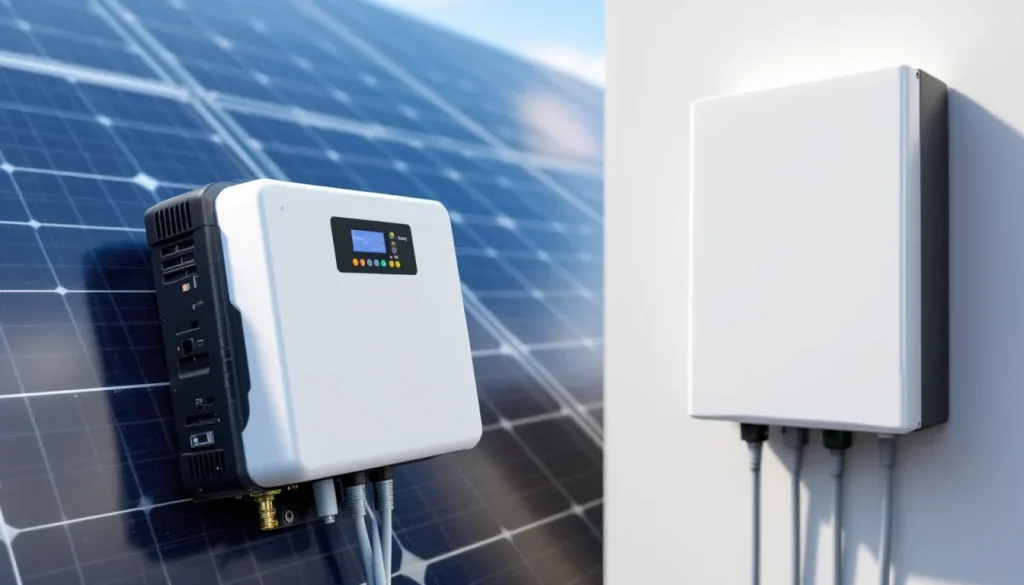
The microinverter vs string inverter (see our solar system quote breakdown) decision is the single biggest equipment choice on a residential solar install after the panel itself. String inverters are cheaper upfront and simpler to install, but a single shaded panel can drag the whole string down. Microinverters cost 15 to 25 percent more, but each panel operates independently, which makes them the right answer for any roof with partial shading, multiple orientations, or future panel-expansion plans. SolarEdge power optimizers are the third option: a string inverter with per-panel optimizers that recovers most of the microinverter performance advantage at a cost in between. Here is the real engineering tradeoff, the 2026 product lineup, and the math on when each one actually pencils out.
The short version
- String inverter: one central inverter handles a whole string of panels, cheapest option, but full-string output drops when any panel is shaded.
- Microinverter: one small inverter per panel mounted on the rail, each panel operates independently, 15 to 25 percent more expensive but better for shaded or multi-orientation roofs.
- Power optimizer + string inverter (SolarEdge): central inverter plus a small optimizer behind each panel, splits the difference on cost and performance.
- Enphase IQ8 microinverters dominate the residential microinverter market in 2026. IQ8M (330W AC), IQ8H+ (384W AC), IQ8X (480W AC for high-power modules).
- SolarEdge HD-Wave (SE3000H through SE11400H) and Fronius Primo dominate the string inverter side. SMA Sunny Boy and Sungrow round out the field.
How each architecture actually works
A solar panel produces DC electricity at roughly 30 to 50 volts and 8 to 13 amps depending on the module. To send that power to the house or grid, it has to be converted to AC at 240 volts (residential split-phase). The inverter does that conversion. The question is whether to do it once for a whole string of panels (string inverter), at every panel (microinverter), or in a hybrid arrangement (string inverter with DC optimizers).
String inverter architecture wires 8 to 16 panels in series to produce a high-DC-voltage string (typically 300 to 500 V DC), runs the string down to a wall-mounted inverter, and converts to AC at one location. The wiring is simple, the inverter is cheap because it converts in bulk, and a single failure mode (the inverter) handles the whole system. The downside: when any panel in the string is shaded or underperforming, the entire string operates at the lowest panel’s output level. This is the maximum power point tracking (MPPT) problem. A string inverter can only find one operating point, and that point is dragged down by the worst panel.
Microinverter architecture puts a small inverter at every panel, mounted to the racking rail directly behind the module. Each microinverter does its own MPPT for its single panel. The output is 240 V AC, which is combined on a trunk cable that runs to the main panel. There is no high-voltage DC on the roof, which is a code and safety advantage. Each panel operates independently of all others.
Power optimizer architecture (the SolarEdge approach) is a hybrid. A small DC-DC converter (the optimizer) sits behind every panel and does panel-level MPPT, sending optimized DC voltage to a central inverter that does the DC-to-AC conversion in bulk. The roof still has DC wiring (a code concern), but the per-panel performance advantage of microinverters is preserved.
The shading problem in real numbers
Consider a 7 kW system with 16 panels of 440W each. The roof has partial shading from a chimney that covers two panels for two hours each morning. With a string inverter, those two shaded panels operate at roughly 30 percent output, and because the string current is constrained by the worst panel, the other 14 panels also drop to roughly 30 percent output during those two hours. The system loses roughly 70 percent x 14 panels x 440W x 2 hours = 8,624 watt-hours per day during the shaded window. Over a year, that is roughly 3,150 kWh of lost production.
With microinverters or power optimizers, the two shaded panels drop to 30 percent output but the other 14 panels continue producing at their normal rate. The same two-hour window loses 70 percent x 2 panels x 440W x 2 hours = 1,232 watt-hours per day, or roughly 450 kWh per year. The microinverter system captures 2,700 kWh per year more than the string inverter system from the same array.
At a retail electricity rate of 15 cents per kWh, that 2,700 kWh is $405 per year. Over a 25-year system life, $10,125. The microinverter system cost roughly $1,500 to $2,500 more upfront. The shaded-roof scenario justifies microinverters comfortably. On a completely unshaded south-facing roof, the numbers reverse: the string inverter saves upfront cost and the shading-advantage value is zero.
The Enphase IQ8 lineup in 2026
Enphase has dominated the residential microinverter market since the IQ7 series and has extended that with the IQ8 line. As of 2026, the active products are: IQ8M (330W AC output, paired with 350 to 440W modules), IQ8H+ (384W AC, paired with 400 to 480W modules), IQ8X (480W AC, paired with 500 to 600W high-output modules), and IQ8PLUS-72-M-US (paired with 72-cell or larger modules used in some commercial applications).
The IQ8 platform’s headline feature is Sunlight Backup, which lets the system continue producing power during a grid outage even without a battery, by forming a microgrid on the AC side. This requires the Enphase IQ System Controller. The catch is that Sunlight Backup only delivers power when the sun is shining, so it is not a true backup solution for nighttime or storms. For full backup, an Enphase IQ Battery 5P paired with the system is needed.
Enphase’s monitoring is per-panel, which is the practical advantage for diagnosing problems and filing warranty claims. The Enphase App shows per-panel watt-hours at 15-minute intervals. If panel 7 starts underproducing relative to its neighbors, the app shows it within days. On a SolarEdge or string inverter system, finding the same problem requires manual investigation.
Warranty: 25 years on the microinverter unit itself. The Envoy gateway is 5 years standard. The cellular modem (used when home internet is unreliable) is 1 year and requires renewal.
The SolarEdge HD-Wave lineup in 2026
SolarEdge dominates the power optimizer market with the HD-Wave inverter family paired with S-Series and P-Series optimizers. Active inverters in 2026: SE3000H (3 kW), SE3800H, SE5000H, SE6000H, SE7600H, SE10000H, SE11400H (11.4 kW). Each inverter handles 8 to 32 optimizers depending on string configuration.
S-Series optimizers (S440, S500, S700, S1200) are the current residential lineup, supporting up to 700W per optimizer (S700) or 1200W per dual-optimizer configuration (S1200, which handles two panels per unit). P-Series optimizers are the legacy line, still available for retrofits. The S-Series adds module-level rapid shutdown compliance to NEC 690.12 without additional hardware.
SolarEdge’s standard inverter warranty is 12 years, with paid extension to 20 or 25 years for roughly $400 to $800 at install time. Power optimizer warranty is 25 years standard. The split structure means the optimizers outlast the central inverter on the standard warranty, and an inverter replacement in year 12 to 15 is a budgeted item that microinverter systems do not face on the same timeline.
The performance advantage of SolarEdge over a pure string inverter is real on shaded or multi-orientation roofs. Production gains over a string inverter range from 5 percent (lightly shaded) to 20 percent (significantly shaded or split-orientation). The performance advantage of Enphase IQ8 over SolarEdge is smaller, typically 1 to 3 percent in most real installations.
String inverter products that compete on simplicity
Fronius Primo (3.8 kW, 5 kW, 6 kW, 7.6 kW, 10 kW, 11.4 kW) is the residential workhorse from Fronius. It is a transformerless string inverter with built-in DC switch and AC switch, integrated WiFi and Ethernet for monitoring, and a 10-year standard warranty (extendable to 15 or 20). Fronius is the European standard and is widely deployed in CA and NY residential installations.
SMA Sunny Boy (3.0, 3.8, 5.0, 6.0, 7.7 kW) is the long-standing US string inverter brand, owned by SMA Solar Technology (see our types of solar energy). SMA invented Secure Power Supply, which is similar to Enphase’s Sunlight Backup. SMA’s Sunny Boy uses the OptiTrac MPPT system for slight optimization on partially shaded strings. Warranty is 10 years standard, extendable.
Sungrow has gained share in the US residential and small-commercial market since 2022 with the SG3.0RS-S through SG7.6RS-S models. Sungrow is a Chinese manufacturer with significant US installer relationships, particularly in TX and FL. Warranty is 10 years standard.
Tesla Solar Inverter (used on Tesla Solar Roof and Tesla solar panel installs) is a string inverter paired with Tesla’s panel and tile products. It includes integrated Powerwall communication and is generally only used with Tesla-installed systems. Warranty is 12.5 years standard.
The cost difference, real numbers
| Architecture | System cost adder per watt | 7 kW system adder | 10 kW system adder |
|---|---|---|---|
| String inverter (Fronius, SMA, Sungrow) | baseline | $0 | $0 |
| Power optimizers (SolarEdge S-Series + HD-Wave) | +$0.10 to $0.20/W | +$700 to $1,400 | +$1,000 to $2,000 |
| Microinverters (Enphase IQ8) | +$0.20 to $0.35/W | +$1,400 to $2,450 | +$2,000 to $3,500 |
These are the wholesale cost differences for the inverter equipment plus the additional install labor and balance-of-system components. The retail (installer-quoted) price uplift can be slightly higher, particularly with installers who prefer one architecture and price the alternative at a discouraging premium. Get quotes from at least three installers including at least one that defaults to microinverters and one that defaults to string. We get into vetting installer quotes in how to choose a solar installer.
When microinverters are the right call
Five scenarios where microinverters or optimizers consistently pencil out over pure string inverters: (1) any shading from chimney, vent pipes, dormers, or neighboring trees for more than 30 minutes per day on more than 10 percent of the array; (2) panels facing two or more different roof orientations (e.g. south plus west); (3) tile, slate, or other roof types where future panel access is hard and per-panel monitoring helps catch problems early; (4) systems where future expansion (more panels added in years 5 to 10) is planned, because microinverters scale per-panel without resizing the central inverter; (5) anywhere code requires module-level rapid shutdown (most US jurisdictions under NEC 2017+), which microinverters and SolarEdge optimizers handle natively while string inverters require additional rapid-shutdown devices.
The fifth point is the modern default. NEC 690.12 (Rapid Shutdown of PV Systems on Buildings) requires that DC conductors on a roof can be de-energized within 30 seconds of system shutdown to protect firefighters. Microinverter and SolarEdge architectures meet this requirement at the module level by design. Pure string inverter systems need module-level rapid shutdown devices (Tigo TS4 or similar) added behind every panel, which closes much of the cost gap.
When pure string inverter still wins
Two scenarios where a pure string inverter (without power optimizers or microinverters) is the right call: (1) completely unshaded south-facing single-orientation roofs where MPPT optimization gains nothing, and (2) cost-driven installs in regulatory environments where rapid shutdown is not required and the homeowner is prioritizing initial system cost over long-term granular reporting. The first case is rare in real residential installations; the second is increasingly rare as building codes catch up.
Some commercial and ground-mount applications still favor string inverters because the arrays are large enough that per-panel optimization is less valuable and the central inverter economics dominate. For residential rack-mounted solar in 2026, the practical choice is between SolarEdge optimizers and Enphase microinverters more often than between string and microinverter.
Monitoring and diagnostics: the underrated advantage
Per-panel monitoring on Enphase and SolarEdge systems lets you catch problems early. A panel that develops a hot spot from cell failure, gets shaded by a new tree branch, or is damaged by a hail strike will show up as underperforming in the per-panel data within days. On a string inverter system, the only visible signal is a small drop in total system output that is easy to attribute to weather or seasonal change. We covered the longer-term degradation patterns in the solar roof warranty guide.
Per-panel data also makes warranty claims easier. Enphase’s per-microinverter watt-hour reporting is what lets a homeowner prove that panel 12 has degraded faster than the warranty curve allows. Without that data, the claim requires a lab flash test that costs $200 to $400 per module. With it, the manufacturer can verify the underperformance from their own data and ship a replacement.
Battery integration: where the architectures diverge
If a battery is part of the system or planned for later, the inverter architecture matters. Enphase IQ Battery 5P pairs natively with Enphase microinverter systems and uses AC coupling: the battery sits on the AC side of the panel and stores energy from the household AC bus. SolarEdge offers DC-coupled batteries (SolarEdge Home Battery) that integrate with the HD-Wave inverter. Tesla Powerwall 3 has a built-in inverter and can either be AC-coupled to any solar system or DC-coupled if installed with a Tesla solar system.
Adding a battery to a string inverter system later usually means installing the battery on the AC side with its own inverter. Tesla Powerwall 3 handles this cleanly; cheaper AC-coupled batteries (e.g. Franklin WH, EG4 PowerPro) work but add hardware. Microinverter systems are easier to expand with batteries because the AC architecture is already established. We cover the broader cost picture in solar installation cost in 2026.
The bottom line
Microinverter vs string inverter is rarely a simple cost comparison. For an unshaded, single-orientation, basic install, a string inverter saves money and produces almost as much energy. For anything with shading, multiple roof faces, future expansion potential, or a battery in the plan, microinverters or power optimizers are the right answer. Enphase IQ8 leads the microinverter market in 2026. SolarEdge HD-Wave with S-Series optimizers leads the power optimizer market. Fronius, SMA, and Sungrow split the string inverter market. Pick the architecture before you pick the brand, and price all three quotes side by side before signing.
For the broader solar cost picture, see solar installation cost in 2026. For the warranty side of inverter selection, see solar roof warranty. For how net metering and inverter choice interact (TOU rate shifting), see net metering explained. For installer vetting, see how to choose a solar installer. For more on solar panel selection itself, see best solar panel brands and the broader Solar cluster in the learning hub.