
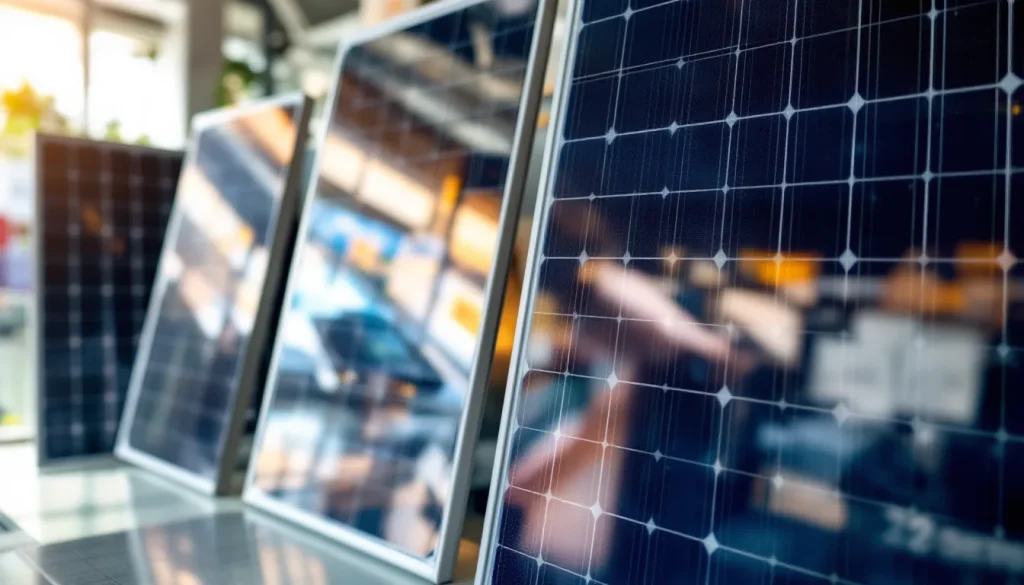
If you are shopping rooftop solar in 2026, you do not need to compare 200 panels. You need to compare about seven, because the best solar panels on the residential market right now come from a short list of manufacturers that have actually proven their cells in the field for ten years or more. Everything else is either a rebadged Tier 2 cell from a Chinese fab nobody has audited, or a brand-new entrant with no real degradation data. This guide walks through the panels that matter, why they matter, and what the spec sheets are really telling you.
The four numbers that decide a panel
Marketing tells you wattage. Engineers care about four things, in this order: efficiency, temperature coefficient, year-one degradation, and the linear degradation curve from year 2 through year 25. Wattage on a residential 60-cell or 66-cell panel in 2026 ranges from about 390W on the budget (for the full data set, see our the full 2026 Roofing Cost Report) end to 470W at the top. That difference matters less than you would think, because what you actually care about is how many kilowatt-hours you produce per square foot of roof per year, and how much of that production survives to year 25.
Efficiency is the percentage of sunlight hitting the panel (see our solar installation companies vetting) that becomes electricity. The physical ceiling for silicon is around 26% in a lab. The best production panels in 2026 sit between 22.0% and 22.8%. Below 20% is fine for cheap utility-scale ground arrays where space is free. On a small roof, every tenth of a point matters because you only have so many square feet of south-facing pitch to work with. Temperature coefficient tells you how much the panel loses per degree Celsius above 25 C. Best in class is around -0.26%/C. Worse panels run -0.34% or worse, which on a black asphalt roof in Phoenix in July can quietly cost you 8% of your nameplate output.
Year-one degradation is the upfront hit a panel takes in its first 12 months from light-induced degradation and other settling effects. Premium panels lose 1% or less. Then the linear curve takes over. The best modules in 2026 guarantee 0.25% or less degradation per year through year 25, which means a panel that started at 100% is still producing about 92% at year 25. Mid-tier panels lose 0.55%/yr, which puts them at roughly 86% at year 25. On a 20-panel array, that gap is real money.
REC Alpha Pure-R 470W
REC has been around since 1996 in Norway, and the Alpha Pure-R is the panel that put them in the residential premium conversation. The Pure-R series uses heterojunction cells with no lead, which matters if your municipality is heading toward stricter end-of-life regulations. The 470W variant lands around 22.6% efficiency on a 60-cell module that is physically the same size as a standard residential panel, so you get more watts per square foot without resizing your racking. Temperature coefficient is -0.26%/C. REC backs the Pure-R with a 25-year product, performance, and labor warranty, which is unusual because labor coverage is typically a manufacturer add-on tied to a Certified Solar Professional installer (see our solar installers near you).
The catch on REC is availability. Allocation gets tight in spring through fall, and smaller installers may not have direct distributor access. If your contractor proposes a Pure-R, ask to see the bill of lading or distributor confirmation before you sign.
SunPower Maxeon 6 440W
SunPower spun the Maxeon brand off as a standalone company in 2020, and Maxeon now makes the cells. The Maxeon 6 is the current generation, using interdigitated back-contact cells, which means all the metal busbars are on the back side of the cell instead of the front. The visible front is solid black silicon, and there is no front-side metal to corrode or shade the cell. The 440W variant hits 22.8% efficiency, the highest mainstream residential efficiency on the market in 2026. Temperature coefficient is -0.27%/C. Maxeon panels carry a 40-year product and performance warranty, the longest in the industry, with a 92% production guarantee at year 25 and 88.3% at year 40.
Maxeon panels also use copper foundation backsheets that resist corrosion in coastal salt air, which is why you see them disproportionately on California, Florida, and Hawaii rooftops. The downside is price. Per watt, Maxeon is 15-30% more expensive than the Q CELLS and REC alternatives. You are paying for the longest warranty and the most refined cell architecture in production.
Q CELLS Q.PEAK DUO BLK ML-G10+ 410W
Q CELLS is owned by Hanwha Solutions and is the most-installed residential panel brand in North America by volume. The Q.PEAK DUO BLK ML-G10+ at 410W is the workhorse: 22.3% efficiency, -0.30%/C temperature coefficient, all-black aesthetic, and a 25-year product, performance, and yield warranty. Q CELLS performance warranty guarantees 86% at year 25 with a year-one degradation cap of 2% and linear degradation of 0.5% thereafter, which is the spec everyone else has been chasing for a decade.
The value of Q CELLS is the combination of solid spec sheet and high installer familiarity. Most full-service residential solar installers are Q CELLS Authorized Installers, which means parts are easy to source, the warranty claim path is well-traveled, and replacement panels actually arrive when you need them. If your installer pitches Q CELLS, the question is not whether the panel is good. It is whether the installer is bundling them with a competent inverter and proper racking.
Q.TRON BLK M-G2+ 425W
The Q.TRON line is Q CELLS upmarket play, using TOPCon cell technology (see our types of solar energy for roofs) instead of the older PERC architecture that defines the Q.PEAK series. The G2+ variant lands at 425W and 22.4% efficiency on the same physical footprint as the Q.PEAK. Temperature coefficient drops to -0.30%/C and bifaciality is rated at 70%, meaning if you mount on a reflective roof or pergola, you can pick up an additional 5-10% from rear-side generation. The warranty matches the Q.PEAK line at 25 years and 86% production guarantee at year 25.
If your installer offers both Q.PEAK and Q.TRON at similar pricing, take the Q.TRON. TOPCon has demonstrably better low-light performance and a slightly flatter degradation curve in field studies through year 8 (the longest TOPCon track record currently available).
Panasonic EverVolt 410W
Panasonic exited solar manufacturing in 2022, but the EverVolt series is still sold under the Panasonic brand because Panasonic licensed the marque and now sources cells from select Asian fabs. The 410W variant runs 22.2% efficiency with a -0.26%/C temperature coefficient, which is genuinely competitive. Warranty is 25 years product and performance with 92% production guaranteed at year 25, which is excellent on paper.
The reason Panasonic still belongs on this list is the EverVolt brand handles warranty claims through the Panasonic Solar Premier Installer network, which has been operating for 15+ years and actually fulfills replacements. Compare that to defunct or non-responsive panel manufacturers and the value of an enduring service network becomes obvious. The risk is that Panasonic is no longer the OEM, so if Panasonic ever divests the brand entirely, the warranty backing could shift. That is not happening today, but it is the asterisk every honest installer mentions.
Silfab Prime SIL-410 HC
Silfab is a Canadian manufacturer with US production in Bellingham, Washington and Burlington, Washington. The Prime SIL-410 HC is a 410W half-cut monocrystalline panel at 22.0% efficiency, -0.34%/C temperature coefficient, and a 25-year product, performance, and labor warranty when installed by a Silfab Certified Installer. The reason Silfab matters is the Buy American provisions in the Inflation Reduction Act bonus credits. Solar projects using domestically manufactured panels qualify for the 10% domestic content adder on the federal Investment Tax Credit. Silfab is one of the few residential brands with US assembly that qualifies cleanly.
Silfab performance is one notch below REC, SunPower, and Q CELLS, but the domestic content bonus can effectively close the price gap on the bill of materials. If you are stacking incentives in a state with strong solar policy, Silfab deserves a quote.
What happened to LG
LG Electronics exited the solar panel business in June 2022. The LG NeON series was one of the most-installed premium residential panels in North America from 2014 through 2022, and there are millions of LG panels still on roofs. LG honors the original 25-year product and performance warranty through 2047 for panels manufactured before the exit date, and warranty claims are processed through LG service centers. If you are buying a home with an LG NeON array, the warranty is valid. If you are designing a new system, LG is not an option. The reason it still comes up: installers occasionally still have NeON inventory in distribution, and you should not buy it. Buy current production from a manufacturer that is still actively making panels.
The wattage trap
A 470W panel does not produce 15% more power than a 410W panel on the same roof. The 470W panel produces 15% more power than the 410W panel when measured at Standard Test Conditions (25 C, 1000 W/m² irradiance, AM 1.5 spectrum), which only exist in a lab. In the real world, what you care about is annual production in kilowatt-hours, which is the product of nameplate, efficiency under your actual irradiance, temperature derating, system losses (inverter, wiring, soiling), and degradation. A 410W Q CELLS panel installed correctly with a quality microinverter will outproduce a poorly installed 470W panel of any brand. Wattage rankings are useful for sizing how many panels fit on a 600 square foot south slope, not for picking a brand.
The bigger trap: inverter pairing
If you spend $0.65 per watt on premium panels and pair them with a budget string inverter, you have wasted the upgrade. The panels can only deliver clean DC. The inverter is what turns that DC into AC for your house and the grid. Enphase IQ8 series microinverters and SolarEdge HD-Wave with optimizers are the two competent options in 2026. Both let you monitor production at the panel level, which matters because when one panel underperforms, you want to know which one and when. The roofing decisions, the panel choice, and the inverter choice all affect each other. If you are running solar on a metal roof, the racking matters too, and our take on that is in our guide to solar panels on metal roof.
How brand quality affects roof penetrations
Mid-tier panels lose efficiency faster, which means homeowners often add panels later when production dips below household demand. Every additional panel means more roof penetrations, and every penetration is a potential leak in 12-15 years. Buying the best panel up front means fewer panels for the same kilowatt-hour output, fewer penetrations, less flashing work, and less risk to the roof underneath. The trade-off math gets sharper when you compare against solar shingles cost, which integrate the photovoltaic layer into the roof itself but trail traditional panels on dollars per watt by a wide margin in 2026.
Asphalt versus metal versus tile
Panel brand barely affects your roof material decision, but the lifecycle math does. The best panels last 25-30 years. A typical 30-year architectural asphalt shingle roof lasts 22-28 years in practice, which means a panel installed today on a roof that already has 8 years on it will outlive the roof underneath. You will pay 2-4 thousand dollars to detach and reset the array when the asphalt fails. If you are installing solar on a roof that is more than 10 years into its lifecycle, replace the roof first. The decision math between asphalt and metal is covered in our breakdown of metal vs asphalt shingle roof, and the typical service life is detailed in asphalt shingle roof lifespan.
Bifacial panels and rooftop reality
Bifacial panels generate from both front and back side. They are the dominant utility-scale technology because ground-mount arrays sit above reflective surfaces (concrete, white gravel, snow) that bounce light to the rear side. On a typical residential roof, the back of the panel sits 4-6 inches above asphalt shingles or tile, both of which are dark and reflect little light. Bifacial gain on a residential rooftop installation is typically 2-5%, not the 15-25% manufacturers advertise. Do not pay a premium for bifaciality on a standard asphalt roof.
What a fair 2026 quote looks like
A 7 kW residential system in 2026 (about 17-18 panels at 410W) installed with Enphase IQ8 microinverters and a 25-year monitoring contract should price between $2.50 and $3.30 per watt before incentives. Below $2.50, something is being cut, and it is usually the racking or the labor warranty. Above $3.30, something is being marked up, and it is usually the salesperson commission. The 30% federal Investment Tax Credit still applies through 2032 under current law, with the 10% domestic content adder bringing the effective tax credit to 40% on qualifying installations.
The 30-second decision frame
If you want the longest warranty: SunPower Maxeon 6. If you want the best balance of performance, price, and installer network: Q CELLS Q.PEAK DUO BLK or Q.TRON. If you want lead-free cells and labor coverage: REC Alpha Pure-R. If you want US-made and the domestic content tax bonus: Silfab Prime. If your installer offers a brand not on this list, that is not automatically disqualifying, but ask for the actual cell manufacturer, the warranty fulfillment path, and at least two references on roofs more than five years old.
The bottom line
The solar panel market in 2026 is small at the top and crowded at the bottom. The brands above represent roughly 80% of premium residential installations in North America, and the gap between them and the rest is real. Spend an afternoon comparing data sheets, ask your installer to show you which specific model they are quoting (not just the brand), and verify the warranty paperwork before signing. The best panel on a bad install is a bad system. A merely good panel on a great install will produce for 30 years, so it helps to see how the top solar install companies compare before you commit. Pick the installer first, then the panel, then the inverter, in that order.