
Last reviewed: September 2026.
A skylight replacement cost in 2026 runs from $500 for a small fixed tubular unit installed in an existing curb to $5,000+ for a large electric vented model with rain sensor, blinds, and full flashing kit on a complex roof. Most residential skylight replacements land between $1,200 and $3,500 all-in. The spread is driven by four variables: the unit itself (fixed, vented manual, vented electric, or tubular), the brand (VELUX dominates the install market, with Fakro, Sun-Tek, and Wasco as serious alternatives), whether the existing opening can be reused or has to be reframed, and whether the install is curb-mounted (sitting on a built-up wooden curb) or deck-mounted (sitting directly on the roof deck with a manufactured flashing kit). Below are real 2026 contractor numbers by unit type, by brand, and by install scenario, with the cost drivers that turn a $1,500 swap into a $4,000 project.
The short version
- Fixed skylight: $500 to $2,500 replaced, depending on size and brand.
- Vented manual (hand-cranked): $800 to $3,500 replaced.
- Vented electric (motorized with remote): $1,500 to $5,000+ replaced.
- Tubular (Solatube, VELUX Sun Tunnel): $500 to $1,500 replaced.
- VELUX dominates with 60%+ of the residential install market; Fakro, Sun-Tek, Wasco are alternatives.
- Curb-mount installs reuse the existing wooden curb; deck-mount installs use a factory flashing kit and are now the dominant new-install spec.
- Labor is 4 to 12 hours per skylight depending on access, complexity, and whether the opening gets reframed.
- Flashing kit (sold separately by VELUX/Fakro) is mandatory and runs $150 to $400.
2026 skylight replacement cost by unit type
The unit itself is the biggest single line item, and the four major categories sit at very different price points. Fixed skylights (no opening, just glass) are the cheapest and the most common spec on bedrooms and bathrooms where ventilation is not required. Vented manual skylights crank open with a long pole or hand crank, vent the room, and cost roughly 50% more than the same-size fixed unit. Vented electric skylights add a motor, a remote (or wall switch), a rain sensor that automatically closes the unit when it senses moisture, and frequently a battery backup. Tubular daylight devices are a different product entirely: a 10 or 14-inch reflective tube that funnels daylight from the roof down through the attic into a ceiling diffuser, ideal for closets, hallways, and small bathrooms where a full skylight will not fit.
| Unit type | 2026 unit cost | Installed cost | Typical size |
|---|---|---|---|
| Fixed, small (22×46 in) | $200 to $500 | $500 to $1,500 | 22 by 46 inches |
| Fixed, mid (30×46 in) | $300 to $700 | $700 to $2,000 | 30 by 46 inches |
| Fixed, large (46×46 in) | $500 to $1,200 | $1,200 to $2,500 | 46 by 46 inches |
| Vented manual, mid | $500 to $1,200 | $800 to $2,500 | 30 by 46 inches |
| Vented manual, large | $700 to $1,800 | $1,500 to $3,500 | 46 by 46 inches |
| Vented electric, mid | $900 to $2,200 | $1,500 to $3,500 | 30 by 46 inches |
| Vented electric, large | $1,400 to $3,500 | $2,500 to $5,000+ | 46 by 46 inches |
| Tubular (10 inch) | $200 to $500 | $500 to $1,200 | 10 inch tube |
| Tubular (14 inch) | $350 to $750 | $800 to $1,500 | 14 inch tube |
Brand pricing: VELUX, Fakro, Sun-Tek, Wasco
Four brands account for the bulk of the residential skylight install market in 2026. VELUX is the dominant player by a wide margin (60%+ of new residential installs, near-universal recognition with roofing contractors, and the broadest dealer network in North America). Fakro is the major European alternative, generally priced 10% to 20% below comparable VELUX units with similar warranty terms. Sun-Tek is the most common US-manufactured value option, priced 15% to 30% below VELUX with a shorter warranty. Wasco has a strong commercial presence and a meaningful residential lineup priced in the same band as VELUX.
| Brand | Unit price band | Warranty | Notes |
|---|---|---|---|
| VELUX | Premium | 10-yr glass, 5-yr install | Market leader. Best dealer network. |
| Fakro | Mid to premium | 10-yr glass | European, often 10-20% under VELUX. |
| Sun-Tek | Value | 10-yr glass, 5-yr seal | US-made. Common new-construction spec. |
| Wasco | Premium | 10-yr glass | Strong on commercial; residential growing. |
VELUX and Fakro both sell their own factory flashing kits, which are sized to the unit and to the roofing material (one kit for asphalt shingles, another for tile, another for low-slope membrane). Using the factory kit is what keeps the full 10-year glass warranty intact and the no-leak install warranty. Field-fabricated flashing on a brand-name skylight typically voids the install warranty and is the single biggest after-the-fact cost trap on a skylight replacement. The flashing kit runs $150 to $400 depending on size and material, and skipping it (a frequent value-engineering move) is the most common cause of premature leaks on a new install.
Curb-mount vs deck-mount: what the install actually looks like
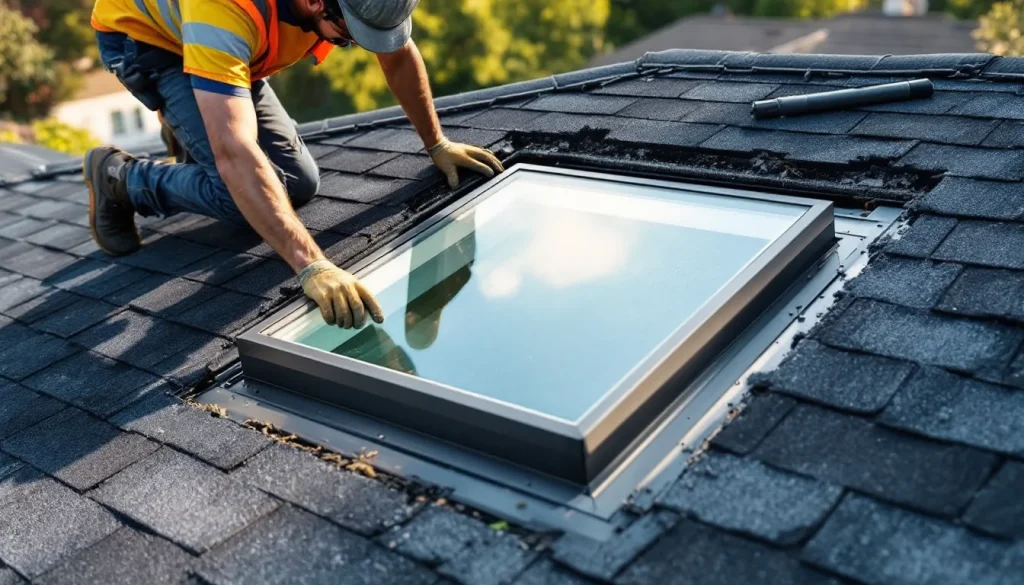
Two install styles dominate residential skylights. Curb-mount installs sit the skylight unit on top of a 2×4 or 2×6 wooden curb built up off the roof deck, with the flashing wrapping the outside of the curb. Deck-mount installs sit the unit directly on the roof deck (with the manufactured flashing kit lapping over the shingles), no curb required. New-construction installs in 2026 are nearly all deck-mount because the factory flashing kits have matured to the point where they outperform field-built curb flashing in most exposures. Replacement work splits roughly 50/50: if the existing curb is sound and the new unit is sized to match, the curb gets reused and the install is curb-mount; if the existing curb is rotten or the new unit is a different size, the install switches to deck-mount and the curb gets removed.
Curb-mount labor: 4 to 8 hours per skylight, including shingle removal, old unit removal, curb inspection (and re-flashing if needed), new unit set, and shingle reinstall. Deck-mount labor: 6 to 12 hours per skylight, including shingle removal, old curb demolition, deck patching if required, factory flashing kit install per the manufacturer instructions, and shingle reinstall. The deck-mount install takes longer but produces a lower-profile, more weathertight result that matches the manufacturer warranty terms exactly. For the diagnostic side of skylight problems before replacement see our skylight leak repair guide.
What drives the install cost beyond the unit itself
Five variables move the installed cost between the low end and the high end of the unit-type bands above. First, roof access: a walkable shingle roof with a ladder set on a driveway is the cheap scenario. A steep slope, high roof, or tile roof requiring scaffolding adds $300 to $1,500 in equipment and labor. Second, whether the existing opening can be reused. If the new unit is the same rough-opening size as the old one and the framing is sound, the install is straightforward. If the new unit is a different size (or the existing opening shows rot, sagging headers, or termite damage), the rough opening has to be reframed, which adds $400 to $1,500 in carpentry.
Third, interior finish. A skylight in a vaulted ceiling with no light shaft is simpler than a skylight with a drywalled shaft running through an attic to a flat ceiling below. Replacing the unit on a flat-ceiling install means drywall repair, paint, and often new trim, which adds $400 to $1,200 in interior work. Fourth, electrical for vented electric units: if there is no existing wiring at the skylight location, an electrician has to run new circuit, which adds $300 to $800 depending on attic access. Fifth, the flashing kit and underlayment: the factory flashing kit is $150 to $400, and proper ice and water shield under the kit perimeter adds another $50 to $150 in materials. Skipping either is the most common shortcut and the most common cause of warranty-voiding leaks. For more on the membrane underneath see our ice and water shield overview.
Replacement vs new install: which scenario you are actually in
If the existing skylight is leaking, the homeowner’s options split into three: spot-repair the existing unit (re-flash and re-seal, $300 to $900, lasts 2 to 5 years), replace the unit using the existing opening and curb (the most common scenario, $1,200 to $3,500 all-in), or full new-construction install in a new location (cutting fresh deck and framing, $2,500 to $6,000+ all-in). The middle option is what most homeowners actually choose when an existing skylight has reached end of life, which on the average residential skylight happens at 20 to 25 years for the seal and 15 to 20 years for the flashing kit. If the unit is under 15 years old and leaking, the cause is almost always the flashing perimeter rather than the unit itself, and a re-flash is the correct first step. If the unit is 20-plus years old, a full replacement is the more economical long-term call.
One factor that pushes more replacements into the full-swap category: ENERGY STAR specs and the federal residential energy efficient property credit. New skylights with low-E argon-filled glazing qualify for a tax credit under the IRA-extended Section 25C provisions in 2026, worth up to 30% of the unit cost (capped) when paired with a qualified install. The tax credit is enough to pull the net cost of a brand-name VELUX or Fakro into the same band as a Sun-Tek base unit, which is why the value play often makes less sense once the credit math runs through.
Tubular skylights: when they make sense and what they cost
Tubular daylight devices (Solatube is the brand-name leader, VELUX Sun Tunnel is the major competitor) are a different product category. Instead of a glazed opening through a deck, a tube uses a small dome on the roof (10 to 14 inches) and a reflective metal tube to funnel daylight down through the attic to a diffuser in the ceiling below. Tubular installs are cheap ($500 to $1,500), fast (a competent installer can do one in 2 to 4 hours), and require no interior finish work because the diffuser is set into a small standard ceiling box rather than a shafted opening. The trade-off is daylight only, no view, no ventilation. Tubular makes sense in closets, hallways, interior bathrooms, and stairwells where the goal is light without the cost or the finish work of a full skylight.
Replacement cost on a tubular unit is generally lower than a full skylight because the roof penetration is smaller, the flashing is a one-piece factory boot, and the interior work is minimal. A failed tubular dome (cracked from hail or aged-out) is typically a $300 to $700 fix in 2026 if the tube and diffuser are reusable.
Add-ons that push the bill up
Three popular add-ons account for most of the upcharges on a premium skylight install. Solar-powered blinds (factory VELUX or Fakro accessories, typically $300 to $800 per unit) integrate with the unit and run off a small solar panel built into the frame, no wiring required. Rain sensors on vented electric units add $100 to $300 and auto-close the skylight when moisture is detected. Smart-home integration (HomeKit, Google Home, smart hubs via the manufacturer app) adds $50 to $200 in modules and is usually field-installed with the new unit.
The other major add-on is roof work bundled with the skylight replacement. If the surrounding roof is also at end of life, replacing the skylight as part of a re-roof is significantly cheaper per unit than as a standalone (shared mobilization, single shingle tear-off, and the flashing detail can be sequenced into the new install rather than retrofitted into existing shingles). Most contractors will bundle a skylight replacement into a re-roof for $400 to $1,200 over the base shingle pricing, versus $1,200 to $3,500 as a standalone visit. Numbers track our 2026 roofing cost report for re-roof pricing and our average cost to replace roof calculator for the full-roof scope.
Flashing detail: where most skylight replacements actually fail
The unit itself is rarely the source of a future leak. The flashing perimeter is. A skylight is, geometrically, a small chimney without the masonry: a four-sided box poking through the roof deck that has to be flashed on all four sides with the same logic as a chimney (apron at the bottom, step flashing along the sides, head flashing at the top, plus the upslope diversion). Manufacturer flashing kits handle all of this with pre-formed pieces designed to weave into the surrounding shingle courses, and the install instructions are explicit about sequence and lap dimensions. Skip the kit, field-fabricate from coil stock, and you are essentially building a chimney flashing detail from scratch around a small box, with all the failure modes that go with hand-built flashing. For the underlying flashing logic see our what is flashing on a roof primer and the broader roof flashing material guide.
On larger skylights (greater than 30 inches wide measured perpendicular to the slope), the same upslope debris damming problem that drives the chimney cricket requirement under IRC R1003.20 applies in practice, even though code does not technically mandate a cricket on a skylight. Production installers building a large skylight install on a low slope roof will often frame a small saddle behind the unit to divert water and leaves around the upslope edge. The detail is identical to a chimney cricket on a smaller scale and the rationale is identical: keep debris and standing water from rotting the deck behind the unit. See roof cricket design and install for the cricket build and chimney flashing installation detail for the four-part system the skylight flashing logic mirrors.
Signs your existing skylight is approaching end of life
Three early indicators show up well before a skylight starts dripping onto the floor. First, condensation on the inside glass during cold weather, which usually means the thermal seal between the two panes has failed and moisture is now inside the IGU. The seal failure does not cause a leak by itself but indicates the unit is past 15 years and the perimeter flashing is the same age. Second, visible cracking or chalking on the rubber gaskets around the operable sash on a vented unit, which means UV degradation has reached the point where the gasket is no longer reliably sealing when closed. Third, brown staining on the drywall around the light shaft, which means water has already gotten past the flashing and is migrating along the underside of the deck before showing up inside. If any of those three are present on a unit over 15 years old, replacement is the right call rather than spot repair. For the spot-repair path on a unit not yet ready for replacement see skylight leak repair; for the broader signs that the surrounding roof is approaching end of life and the work should be bundled, see signs you need a new roof.
Bottom line
Skylight replacement in 2026 lands at $1,200 to $3,500 for a typical mid-size unit on a walkable shingle roof, with fixed units at the low end and large vented electric units at the high. VELUX leads the install market, Fakro is the value-premium alternative, and Sun-Tek and Wasco round out the lineup. Use the manufacturer’s factory flashing kit (always; the savings on field flashing are not worth the warranty voiding), reuse the existing curb if it is sound, and bundle the work with a re-roof if the surrounding shingles are within a few years of replacement anyway. The all-in cost includes the unit ($300 to $3,500), the flashing kit ($150 to $400), the labor (4 to 12 hours), and any interior finish or electrical work (often the surprise line item on a project that looked like a simple swap).
Frequently asked questions
How much does skylight replacement cost in 2026?
Most residential skylight replacements land between $1,200 and $3,500 all-in in 2026, though a small fixed tubular unit set in an existing curb can run about $500 and a large electric vented model with a rain sensor and blinds can pass $5,000. Unit type, brand, whether the existing opening is reused, and curb-mount versus deck-mount all drive the spread.
Which skylight brand dominates the residential market?
VELUX leads by a wide margin, with more than 60 percent of new residential installs and the broadest dealer network in North America. Fakro is the main European alternative, often priced about 10 to 20 percent below comparable VELUX units. Sun-Tek is a common US-made value option roughly 15 to 30 percent under VELUX, and Wasco is strong on commercial with a growing residential line.
What is the difference between curb-mount and deck-mount skylights?
A curb-mount skylight sits on a built-up wooden curb with the flashing wrapping the outside, while a deck-mount unit sits directly on the roof deck using a factory flashing kit. New construction in 2026 is nearly all deck-mount. Curb-mount labor typically runs 4 to 8 hours per unit; deck-mount runs 6 to 12 hours but produces a lower-profile, more weathertight result.
Do I need the manufacturer flashing kit on a new skylight?
In most cases yes. VELUX and Fakro sell factory flashing kits sized to the unit and to the roofing material, and using the kit is generally what keeps the full glass and no-leak install warranties intact. The kit runs about $150 to $400. Skipping it or field-fabricating flashing is the most common cause of premature leaks on a new install.
How much does a tubular skylight cost?
A tubular daylight device such as a Solatube or VELUX Sun Tunnel typically costs $500 to $1,200 installed for a 10-inch tube and about $800 to $1,500 for a 14-inch tube in 2026. These funnel daylight through a reflective tube into a ceiling diffuser and suit closets, hallways, and small bathrooms where a full skylight will not fit.
How long does a skylight replacement take?
Labor generally runs 4 to 12 hours per skylight depending on roof access, complexity, and whether the opening has to be reframed. A straightforward curb-mount swap on a sound existing curb sits at the low end, while a deck-mount install that adds old curb demolition, deck patching, and a full factory flashing kit sits at the high end.