
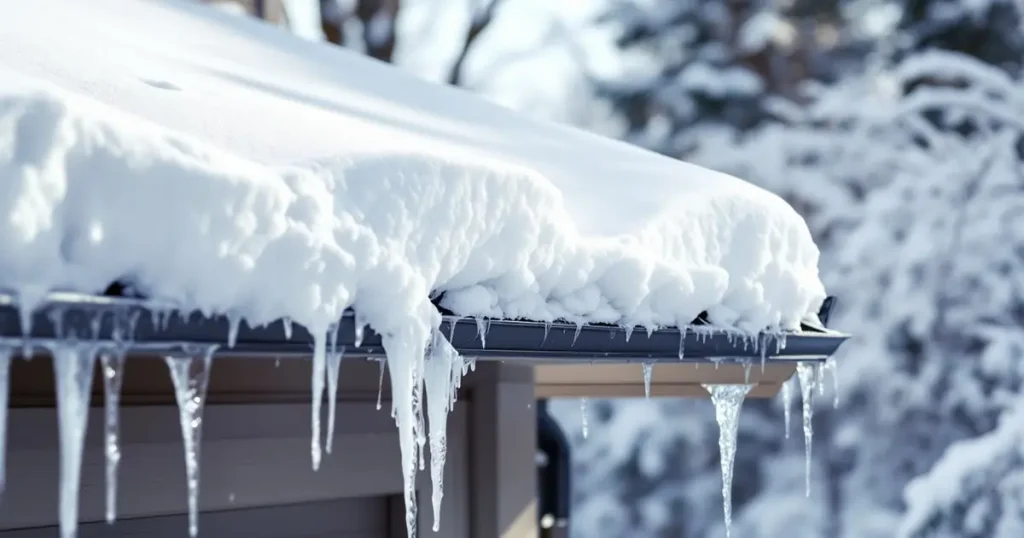
Roof snow removal cost runs about $200 to $600 per visit for a typical house in 2026, with averages of $300 to $350, according to Angi (March 2026) and HomeAdvisor (June 2026). Large or steep roofs can reach $1,000 to $3,000, and contractors who price by area quote roughly $0.20 to $0.50 per square foot. What you pay depends on roof area, height, snow depth and whether ice is involved.
This page covers the price: what each method costs, how to turn a per-square-foot quote into a dollar figure, what commercial roofs run, and when a homeowners policy may reimburse the bill. For when and how to clear a low-slope roof, see our flat roof snow removal guide. For tool picks, see our roof snow rake rankings.
By The Roofing Brief Team. Last reviewed: October 2026.
Key numbers at a glance
These are the figures most people searching roof snow removal cost need first. Each comes from a named, dated source, and every price is a national range that local markets, storm demand and roof access can push higher or lower. Treat them as a budget starting point, then compare written quotes.
| Figure | What it covers | Source |
|---|---|---|
| $200 to $600 per visit (average $350) | Professional roof snow removal on a typical home | Angi, updated March 5, 2026 |
| $200 to $700 (average $300) | Normal range for professional roof snow removal | HomeAdvisor, updated June 19, 2026 |
| $0.20 to $0.50 per sq ft | Contractors who price by roof area | Angi, March 2026 |
| $50 to $100 per hour | Hourly rate, often with a $40 to $100 minimum | HomeAdvisor, June 2026; Fixr, January 2025 |
| Up to $3,000 | Large, steeply pitched roofs | Lawn Love, updated October 5, 2026 |
| 3 to 21 lb per cubic foot of snow; about 57 lb for ice | Weight range behind every removal decision | FEMA P-957 Snow Load Safety Guide (2013) |
How much does roof snow removal cost in 2026?
Most homeowners pay $300 to $350 for one professional roof snow removal visit, inside a common range of $200 to $600. Published low ends start near $150 for light snow on a small roof, and published high ends run from $700 to $3,000 for large, tall or steep roofs. The sources agree on the middle and disagree mostly at the top.
The table below lines up every major published range with its update date. HomeAdvisor and Fixr publish the same roof-size table, so they are not fully independent sources. Lawn Love and Angi each report a wider high end for big or steep roofs.
| Source (date) | Typical range | Average | Low to high | Pricing notes |
|---|---|---|---|---|
| Angi (March 5, 2026) | $200 to $600 per visit | $350 | From about $150 | Also $0.20 to $0.50 per sq ft |
| HomeAdvisor (June 19, 2026) | $200 to $700 | $300 | $150 to $1,000 | Large two-story steep roofs $1,000 to $2,000; flat per-visit fees $150 to $1,700 |
| Fixr (January 31, 2025) | $250 to $500 | $300 | $150 to $700 | $50 to $100 per hour; about 500 sq ft cleared per hour |
| Lawn Love (October 5, 2026) | $190 to $735 per visit | Not stated | $900 to $3,000 for large steep roofs | Roof is the costliest snow removal area |
| TaskRabbit (October 1, 2026) | $200 to $500 per visit | Not stated | Not stated | Roof listed separately from driveways |
| Homewyse (January 2026) | $0.26 to $0.32 per sq ft | Not stated | 2-hour labor minimum | Basic conditions, up to 12 in of granular snow, rake method |
Roof snow removal cost by method
Ground raking is the cheapest professional method at about $100 to $250 a visit, manual shoveling runs about $200 to $400, and steam work on ice runs about $400 to $700, per Angi’s March 2026 breakdown. Steam is an ice dam service, not snow clearing, and it is priced separately. A DIY roof rake costs $30 to $120.
| Method | Typical cost | What it does | Source |
|---|---|---|---|
| DIY roof rake (tool purchase) | $30 to $120 | Clears the lower roof from the ground on reachable eaves | Lawn Love, October 2026; HomeAdvisor lists $50 to $120 |
| Professional roof raking | $100 to $250 per visit | Crew rakes the eave band or lower roof from the ground or a lift | Angi, March 2026 |
| Manual roof shoveling | $200 to $400 per visit | Crew works on the roof with plastic shovels and fall protection | Angi, March 2026 |
| Roof shoveling, Anchorage example | $495 minimum for up to 4 hours, then $115 per hour | Published rate from Alaska Premier Services (its snow plowing page lists $520 and $127) | Contractor website, checked October 2026 |
| Steam ice dam removal | $400 to $700 per visit | Low-pressure steam melts ice at the eave without chipping | Angi, March 2026 |
| Heat cable de-icing | $300 to $600 | Installed cable melts channels at eaves and gutters | Angi, March 2026 |
Ice dam steaming has its own wide price spread. Angi’s separate ice dam article (July 2026) reports an average of $1,200 and a common range of $650 to $2,400, while a Massachusetts guide from RoofVista (March 2026) lists $300 to $800 per event. Our ice dam removal guide covers steam crews, calcium chloride socks and what not to do.
Cost by roof size, height and snow depth
Roof area is the biggest price driver, followed by height and depth. Fixr and HomeAdvisor list $150 to $300 for a 1,500 sq ft roof and $450 to $700 for 3,500 sq ft. Two-story and triple-decker homes cost more because crews need ladders, lifts and fall protection, and depths past 24 inches add about $50 per extra 6 inches.
By roof size
Per-visit tables and per-square-foot rates give different answers for the same roof. The per-visit figures below come from Fixr and HomeAdvisor. The per-square-foot columns are Roofing Brief arithmetic that multiplies each size by Angi’s and Homewyse’s published rates. The gap is a reason to ask whether a quote covers the whole roof or only the lower edge.
| Roof surface area | Per-visit table (Fixr, HomeAdvisor) | At $0.20 to $0.50 per sq ft (Angi rate) | At $0.26 to $0.32 per sq ft (Homewyse rate) |
|---|---|---|---|
| 1,000 sq ft | Not listed | $200 to $500 | $260 to $320 |
| 1,500 sq ft | $150 to $300 | $300 to $750 | $390 to $480 |
| 2,000 sq ft | $200 to $400 | $400 to $1,000 | $520 to $640 |
| 2,500 sq ft | $250 to $500 | $500 to $1,250 | $650 to $800 |
| 3,000 sq ft | $350 to $600 | $600 to $1,500 | $780 to $960 |
Source note: per-sq-ft columns are a Roofing Brief estimate (area x published rate) and exclude minimum charges, emergency premiums and haul-off.
By home type and height
Height adds cost because every extra story adds access time and safety equipment. A Massachusetts cost guide from RoofVista (March 22, 2026) breaks prices out by building type, and HomeAdvisor reports $1,000 to $2,000 for a large, steep two-story roof. Emergency calls during an active storm add 25% to 50%, per the same RoofVista guide.
| Building type | Cost per visit | Typical duration | Source |
|---|---|---|---|
| Single-family, 1 story | $200 to $400 | 1 to 2 hours | RoofVista Massachusetts guide, March 2026 |
| Single-family, 2 story | $300 to $600 | 2 to 3 hours | RoofVista, March 2026 |
| Large, steep two-story roof | $1,000 to $2,000 | Not stated | HomeAdvisor, June 2026 |
| Triple-decker, 3 story | $400 to $800 | 3 to 5 hours | RoofVista, March 2026 |
| Emergency storm removal | Add 25% to 50% | Varies | RoofVista, March 2026 |
By snow depth
Depth matters less than area, but deeper and denser snow takes longer to move. Fixr prices a 2,500 sq ft roof at $250 to $350 for 12 inches, $300 to $400 for 18 inches and $350 to $500 for 24 inches, then about $50 for each additional 6 inches. HomeAdvisor’s copy of this table lists $250 to $500 at 24 inches.
| Snow depth (2,500 sq ft roof) | Cost, labor included | Source |
|---|---|---|
| 12 inches | $250 to $350 | Fixr, January 2025 |
| 18 inches | $300 to $400 | Fixr, January 2025 |
| 24 inches | $350 to $500 | Fixr, January 2025 |
| Each 6 inches beyond 24 | About $50 more | Fixr, January 2025 |
Roof snow removal cost per square foot: a worked calculator
To estimate roof snow removal cost per square foot, multiply the roof’s surface area by the contractor’s rate, compare the result with the minimum charge, and add any emergency premium. Roof surface area is larger than the house footprint on a pitched roof, so apply a pitch multiplier first. The examples below show the full arithmetic.
- Find the footprint. Use the house’s ground-floor area plus overhangs, or the square footage on a recent roofing estimate.
- Apply the pitch multiplier. Roof surface area equals footprint times the square root of 1 plus (rise/12) squared: about 1.05 for a 4/12 pitch, 1.12 for 6/12, 1.20 for 8/12 and 1.41 for 12/12.
- Decide the scope. Clearing only a 3 to 4 foot eave band for ice dam control covers far less area than a full-roof clearing for weight.
- Multiply by the quoted rate. Use the contractor’s per-square-foot rate, or hours times the hourly rate.
- Check the minimum. If the result is below the company’s minimum or flat visit fee, the minimum applies.
- Add premiums. Add 25% to 50% for storm-day emergency service if the company charges it, plus any deposit or haul-off fee.
| Example (Roofing Brief estimate) | Arithmetic | Estimated cost |
|---|---|---|
| Ranch, 1,600 sq ft footprint, 6/12 pitch, full clearing | 1,600 x 1.118 = 1,789 sq ft; x $0.20 to $0.50 (Angi rate) | $358 to $894 |
| Same ranch, eave band only (130 ft of eaves x 4 ft deep) | 520 sq ft x $0.20 to $0.50 | $104 to $260, close to Angi’s $100 to $250 raking range |
| Two-story, 2,400 sq ft roof surface, basic conditions | 2,400 x $0.26 to $0.32 (Homewyse rate) | $624 to $768 |
| Same two-story, storm-day emergency call | $624 x 1.25 to $768 x 1.50 | $780 to $1,152 |
| Anchorage roof shoveling, 6 crew hours | $495 minimum (4 hours) + 2 x $115 | $725 at the roof-page rate; $774 at the $520 and $127 rate |
What does commercial roof snow removal cost?
Commercial roof snow removal is usually bid by labor hours plus safety setup and snow disposal, so there is no reliable national per-visit average. Published guides list $500 to $1,200 for a small commercial building and $800 to $2,000 or more for a large one. A 20,000 sq ft flat roof can run several thousand dollars per clearing.
The Massachusetts figures come from RoofVista (March 2026), which lists 3 to 6 hours for a small commercial building and 4 to 8 hours for a large one. Bigger roofs need a scaled estimate. The table below brackets one with two methods, both labeled as Roofing Brief estimates because no named source publishes warehouse-scale roof snow pricing.
| 20,000 sq ft flat roof (Roofing Brief estimate) | Arithmetic | Result |
|---|---|---|
| Method A: per-square-foot rate | 20,000 x $0.20 to $0.50 (Angi residential rate) | $4,000 to $10,000 |
| Method B: labor hours | 20,000 / 500 sq ft per labor hour (Fixr) = 40 labor hours x $50 to $100 | $2,000 to $4,000 before setup and haul-off |
| Method B, storm-day call | $2,000 x 1.25 to $4,000 x 1.50 | $2,500 to $6,000 |
Commercial bids often add costs a house job does not have. FEMA P-957 tells owners to remove drifted snow first at parapets and roof steps, to avoid stockpiling snow on the roof, and to keep removed snow away from exits and downspouts, which can mean hauling it off site. OSHA requires fall protection for workers, and FEMA advises keeping a contractor on retainer because crews are hard to book once a storm starts.
Snow load context: when is removal worth paying for?
Removal is worth paying for when the snow’s weight approaches the roof’s design load or when ice dams are forming. FEMA P-957 puts fresh snow at 3 to 21 pounds per square foot per foot of depth, and ice at about 57. That equals 3 to 21 pounds per cubic foot of snow. Most roofs never reach their limit in a normal winter.
FEMA states that “most buildings are not at risk of snow induced failure” and that “more often than not, attempting to remove snow from a roof is more hazardous than beneficial.” The U.S. Department of Energy’s Building America Solution Center, citing IBHS, says most residential roofs should support about 20 pounds per square foot of snow before becoming stressed unless the structure is damaged or decayed.
| Accumulation (FEMA P-957) | Weight per sq ft per foot of depth | Load on a 1,500 sq ft footprint, 1 ft deep | Depth that reaches 20 psf |
|---|---|---|---|
| Light, dry fresh snow | 3 lb | 4,500 lb (2.25 tons) | About 80 inches |
| Wet, heavy fresh snow | 21 lb | 31,500 lb (15.75 tons) | About 11 inches |
| Ice | About 57 lb (just under 5 lb per inch) | About 7,100 lb per inch of ice | About 4 inches |
Source note: weights from FEMA P-957 (January 2013); load and depth columns are Roofing Brief arithmetic. DOE’s typical fresh-snow figure (10 to 12 inches equals about 5 psf) puts the 20 psf point near 4 feet of new snow.
How ASCE 7 sets your roof’s design snow load
Your roof’s design snow load starts from the ground snow load for your site, taken from ASCE 7 maps or the free ASCE Hazard Tool. ASCE 7-22 Equation 7.3-1 converts it to a flat roof load with pf = 0.7 Ce Ct pg. ASCE 7-22 removed the old snow importance factor and moved to strength-based maps by risk category.
Structure magazine (November 2025) notes those ASCE 7-22 maps are also used in the 2024 International Building Code, and that IRC ground snow loads use Risk Category II values. Under 2021 IRC Section R301.2.3, buildings where the ground snow load exceeds 70 psf must be designed under accepted engineering practice rather than the prescriptive tables. FEMA adds that a building constructed 40 years ago “may not have been designed for snow loads as they are understood today.” For the full conversion, drift and slope math, see our roof snow load design guide.
Does insurance cover roof snow removal?
Usually not for routine removal. A standard HO-3 homeowners policy insures direct physical loss, and clearing snow from an undamaged roof is maintenance. The policy may reimburse removal after covered damage has already happened, as a reasonable step to protect the property from further damage. Coverage depends on your exact form, endorsements and state rules.
The wording below is from the ISO-based HO-3 special form as reproduced in New Jersey Manufacturers’ HO-3 policy jacket (03/18), which incorporates ISO form HO 00 03 05 11 material. Your insurer’s form or a newer ISO edition may read differently, so check your own declarations and policy.
| Situation | Policy language that applies | Likely result |
|---|---|---|
| Preventive removal, no damage yet | The form insures “against direct physical loss to property”; no provision we found pays for clearing an undamaged roof | Usually your expense |
| Removal after covered damage, to stop more damage | Additional Coverage “Reasonable Repairs”: “We will pay the reasonable cost incurred by you for the necessary measures taken solely to protect covered property that is damaged by a Peril Insured Against from further damage.” | May be reimbursed; it does not increase your limit |
| Roof sagging under snow but still standing | Collapse coverage “does not apply to” a building “in danger of falling down or caving in” or one “standing, even if it shows evidence of cracking, bulging, sagging” | Removal to relieve the load is generally your cost |
| Abrupt collapse from snow weight | Collapse coverage applies to abrupt collapse caused by “the Perils Insured Against named under Coverage C,” which include “Weight of ice, snow or sleet” | Repair may be covered, subject to deductible and conditions |
| Owner does nothing after a loss | Duties after loss: “Protect the property from further damage” and “Keep an accurate record of repair expenses”; Neglect exclusion covers failure “to use all reasonable means to save and preserve property at and after the time of a loss” | Further damage may be denied |
TaskRabbit’s October 2026 guide reaches the same practical conclusion: insurance generally treats routine snow removal as maintenance. If removal follows a covered loss, photograph the damage, keep the invoice and tell your insurer promptly. Commercial property policies use different forms, so a building owner should ask a broker which provisions apply. Our guide to whether homeowners insurance covers roof damage explains the HO-3 structure in more detail.
DIY vs hiring a pro: fall risk data
Doing it yourself saves $100 to $600 a visit, but the danger is falls, not cost. OSHA’s hazard alert says falls cause the most worker deaths and injuries during rooftop snow removal, and CDC data show ladder falls send tens of thousands of workers to emergency rooms each year. Homeowners using ladders face the same hazard without training or fall protection.
| Finding | Figure | Source |
|---|---|---|
| Leading cause of harm in rooftop snow removal | Falls cause the most worker fatalities and injuries, based on OSHA investigations | OSHA Hazard Alert HA-3513 (December 2017) |
| Serious injuries or deaths investigated | 16 in the past 10 years; 2 Massachusetts workers killed in winter 2015 alone | New Hampshire DHHS hazard alert (2015), funded by a CDC NIOSH grant |
| Work-related ladder falls, 2011 | 113 deaths and an estimated 34,000 emergency-department injuries | CDC NIOSH, MMWR April 25, 2014 |
| All ladder injuries treated in emergency departments, 1990 to 2005 | About 136,000 per year; 97.3% in non-occupational settings such as homes and farms (where location was recorded); nearly 10% admitted or transferred | D’Souza et al., American Journal of Preventive Medicine, 2007 (NEISS data) |
| Fall protection trigger for workers | 4 feet in general industry; 6 feet in construction | OSHA HA-3513 |
OSHA’s alert also says workers “should not use a snow rake or shovel while on a ladder” and should keep people back 10 feet from where snow will fall. FEMA P-957 recommends a licensed, insured roofing contractor and advises leaving at least 2 inches of snow on the roof so tools do not damage the covering. A $30 to $120 roof rake used from the ground can pay for itself after one avoided $100 to $250 raking visit, provided the eaves are within reach.
Which option should you pick?
Match the method to the problem. Light snow on reachable single-story eaves is a ground-rake job. Out-of-reach eaves, deep wet snow and ice layers call for a crew. Structural warning signs call for evacuation and an engineer, not a quote. The table maps common situations to the usual choice and price.
| Your situation | Usual choice | Expected cost |
|---|---|---|
| Single-story home, light snow, eaves reachable from the ground | DIY roof rake, eave band only | $30 to $120 once for the tool |
| Two-story home, ice dams starting at the eaves | Professional raking of the eave band | $100 to $250 per visit |
| Wet snow near a foot deep, or an ice layer, on a low-slope roof | Professional shoveling with fall protection | $200 to $600 or more per visit |
| Ice dam already leaking into the house | Steam ice dam removal | $400 to $700 per Angi; up to $2,400 in harder cases |
| Sagging ceiling, new cracks, doors sticking | Leave the building and call a structural engineer or the fire department | Not a removal decision |
| Commercial flat roof near its design load | Contractor on retainer before the season | Several thousand dollars per clearing on large roofs |
For the full warning-sign list and safe clearing order on low-slope roofs, use the flat roof snow removal guide. If ice dams return every winter, our ice dam prevention guide covers the insulation and ventilation fixes that cut repeat removal bills.
How to budget a season and compare quotes
Budget by multiplying expected visits by your local per-visit price, then compare that total with a seasonal contract. At Angi’s $350 average, one visit costs $350, three cost $1,050 and five cost $1,750. A Massachusetts seasonal contract of $500 to $1,500 (RoofVista) can beat per-visit pricing once you expect three or more clearings.
| Visits per winter | At $350 per visit (Angi average) | At $200 to $600 per visit (Angi range) |
|---|---|---|
| 1 | $350 | $200 to $600 |
| 3 | $1,050 | $600 to $1,800 |
| 5 | $1,750 | $1,000 to $3,000 |
Source note: visit totals are Roofing Brief arithmetic. Contract offers vary by company. Alaska Premier Services, for example, lists a $190 per month eave-clearing plan with 6 visits per season that clears snow 2 feet back from the roofline.
When you collect quotes, ask the same questions of every company:
- Is the price per hour, per visit or per square foot, and what is the minimum?
- Does the quote cover the whole roof or only the eave band?
- Is there a deposit or cancellation fee? Fixr and HomeAdvisor report $50 to $100 for each.
- Does the crew carry liability and workers’ compensation insurance and use fall protection?
- Will they leave a base layer of snow, as FEMA P-957 recommends, and move removed snow off walkways?
- Is there an emergency or storm-day premium?
Hourly rates of $50 to $100 sit well above the BLS May 2025 median wage for roofers of $26.65 per hour. The gap typically covers insurance, equipment, travel and the hazard of the work, so a quote far below the norm is worth questioning.
Frequently asked questions
How much does roof snow removal cost?
Professional roof snow removal typically costs $200 to $600 per visit, with averages of $350 per Angi (March 2026) and $300 per HomeAdvisor (June 2026). Small roofs with light snow can cost about $150, while large, steep or tall roofs can reach $1,000 to $3,000. Storm-day emergency calls may add 25% to 50%.
How much does roof snow removal cost per square foot?
Contractors who price by area charge about $0.20 to $0.50 per square foot, per Angi, and Homewyse’s January 2026 estimate for basic conditions is $0.26 to $0.32. Multiply by roof surface area, not footprint: a 6/12 pitch adds about 12%. A company minimum may apply on small jobs.
Does homeowners insurance pay for roof snow removal?
Usually not for routine removal, which insurers treat as maintenance. Under the ISO-based HO-3 form, the Reasonable Repairs coverage may pay for necessary measures to protect property already damaged by a covered peril from further damage. Keep photos and invoices, and confirm with your insurer because forms and endorsements vary.
Is it a good idea to remove snow from a roof?
Only when the load nears the roof’s design capacity or ice dams are forming. FEMA P-957 says most buildings are not at risk of snow-induced failure and that removal is often more hazardous than beneficial. Wet snow weighs up to 21 psf per foot of depth, so about a foot of it can exceed the 20 psf many homes handle.
What is the best way to remove snow from a house roof?
From the ground with a non-metallic roof rake, pulling snow down the slope and leaving a base layer. FEMA P-957 advises leaving at least 2 inches and avoiding metal tools and mechanical equipment. If the eaves are out of reach or the snow is deep and icy, hire an insured contractor who uses fall protection.
Why is roof snow removal so expensive?
Roof work is slow, seasonal and dangerous. Fixr estimates about 500 square feet cleared per hour of labor, crews need ladders, lifts and fall protection, and demand spikes during storms. OSHA reports falls cause the most worker deaths and injuries in rooftop snow removal, and that risk generally shows up in insurance and equipment costs built into hourly rates.
What does commercial roof snow removal cost?
A Massachusetts guide from RoofVista (March 2026) lists $500 to $1,200 for a small commercial building and $800 to $2,000 or more for a large one. Bigger flat roofs are usually bid by labor hours; a Roofing Brief estimate for 20,000 square feet runs about $2,000 to $10,000 per clearing.
Sources
- Angi, “How Much Does Roof Snow Removal Cost?” updated March 5, 2026; Angi ice dam removal cost article, July 2026.
- HomeAdvisor, “How Much Does Roof Snow Removal Cost in 2026?” updated June 19, 2026.
- Fixr, “How much does it cost to remove snow from roof?” updated January 31, 2025.
- Lawn Love, “How Much Does Snow Removal Cost in 2026?” updated October 5, 2026.
- TaskRabbit, snow removal cost guide, updated October 1, 2026.
- Homewyse, “Cost to Clean Snow From Roof,” January 2026 estimate.
- RoofVista, “Roof Snow Removal Cost Massachusetts,” March 22, 2026.
- Alaska Premier Services, Anchorage roof shoveling and snow plowing rate pages, checked October 2026.
- FEMA P-957, Snow Load Safety Guide, January 2013.
- U.S. Department of Energy, Building America Solution Center, “Managing Snow Loads on Roofs and Decks.”
- Structure magazine, “ASCE 7-22 Flat Roof Snow Load Versus Minimum Snow Load,” November 3, 2025.
- International Code Council, 2021 International Residential Code, Section R301.2.3.
- New Jersey Manufacturers Insurance Company, New Jersey HO-3 policy (03/18), incorporating ISO HO 00 03 05 11 material.
- OSHA, Hazard Alert HA-3513, “Falls and Other Hazards to Workers Removing Snow from Rooftops and Other Elevated Surfaces,” December 2017.
- New Hampshire DHHS Occupational Health Surveillance Program, “Removing Snow from Rooftops is Dangerous!” hazard alert, 2015 (CDC NIOSH grant 5U60OH009853).
- Socias CM et al., “Occupational Ladder Fall Injuries, United States, 2011,” MMWR 63(16), April 25, 2014.
- D’Souza AL, Smith GA, Trifiletti LB, “Ladder-related injuries treated in emergency departments in the United States, 1990 to 2005,” American Journal of Preventive Medicine, 2007.
- U.S. Bureau of Labor Statistics, Occupational Employment and Wage Statistics, May 2025 (roofers).
Related: our winter roof collapse and snow-load losses report tracks what snow failures cost insurers nationally.