
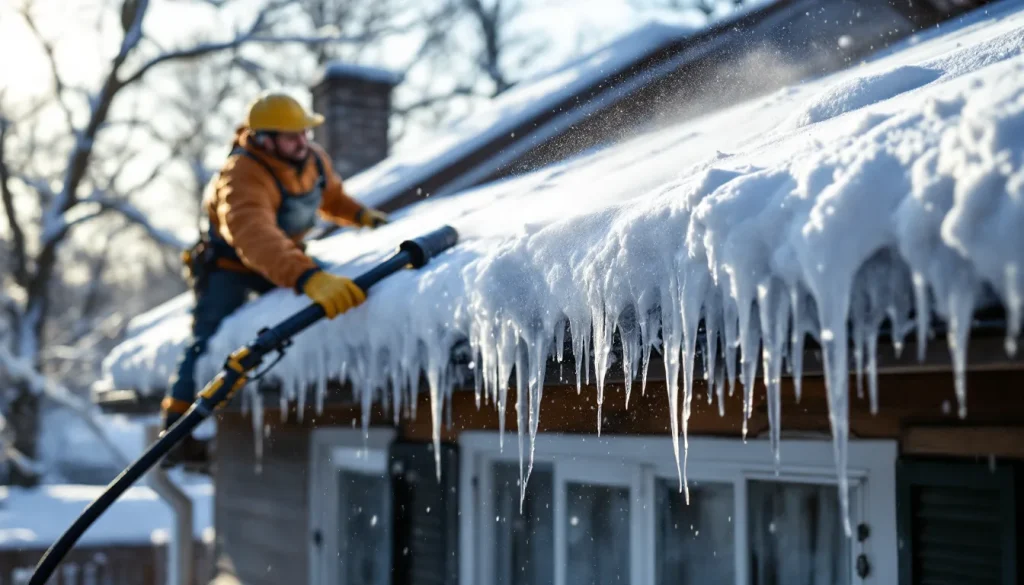
Ice dam removal in 2026 means professional steam removal at $300 to $800 per visit, NOT chipping with an axe, hammer, or hatchet, which fractures the shingle mat, knocks granules off, and voids the manufacturer warranty on most asphalt and metal roofing systems. The only DIY method that does not damage the roof is the calcium chloride sock technique, which melts a safe drainage channel through the dam without prying or pounding. Here are the safe options, what each costs in 2026, and the specific actions to skip because they will turn a $5,000 ceiling repair into a $25,000 reroof.
The short version
- Professional low-pressure steam at 200 to 240 degrees F is the only method that removes ice without damaging the shingle, flashing, or substrate. NRCA and ARMA both recommend it.
- Calcium chloride pellets in a fabric sock, laid perpendicular across the dam, melt a drainage channel in 12 to 48 hours for under $40 in materials.
- A roof rake clears the upper roof so no new meltwater feeds the dam, but it will not remove an established dam.
- Do not chip ice with a hammer, hatchet, or shovel. Do not pour hot water on the roof. Do not use rock salt or fertilizer.
- Removal cost is small versus the damage cost: $400 to $800 to steam, vs $4,000 to $12,000 for interior repair after a delayed leak.
- Insurance generally pays for the interior damage caused by the leak, not the dam removal itself. Document everything and call within 48 hours.
Short answer: safe methods vs damaging methods
Once an ice dam has already formed and water is leaking into the ceiling, you have hours to days before the wet drywall sags, the insulation collapses, and mold starts in the wall cavities. Stopping the leak fast matters more than waiting for spring. The decision is which removal method to use.
The safe methods, in order of how fast they clear the dam:
- Professional steam removal: $300 to $800 per visit. 1 to 4 hours of work. The crew uses a true steamer (not a pressure washer) that emits low-pressure 200 to 240 F steam, melting the dam off the shingle without prying. This is the only method NRCA and ARMA explicitly endorse for active dams.
- Calcium chloride socks: $20 to $40 for materials. Works in 12 to 48 hours. Lay perpendicular across the dam to melt vertical drainage channels.
- Roof rake on upper roof: $40 to $300 for the tool. Does not remove an existing dam but stops new water from feeding it.
The damaging methods, in order of how much they cost you in repairs:
- Chipping with hammer, hatchet, axe, or shovel: shatters the shingle mat under the ice and almost always voids the manufacturer warranty.
- Pressure washing: drives water under the shingles into the deck.
- Pouring hot water: refreezes within minutes, often into a bigger dam farther down the slope.
- Rock salt or fertilizer: corrodes gutters and flashings, stains shingles, and stops working at 15 F.
Professional steam removal: the only correct pro method
A roof-steaming rig is a 110,000 to 250,000 BTU diesel or propane-fired boiler on a truck or trailer that feeds 200 to 240 F low-pressure steam through a hose to a wand the crew works on the roof or from a ladder. The steam melts the bottom layer of ice in contact with the shingle, the dam slides off in plates, and the underlying shingle is left intact. Done right, no granules are knocked loose, no flashing is bent, and no nail heads are exposed.
Key facts to verify before hiring:
- It must be a steamer, not a pressure washer. A pressure washer puts out cold water at 1,500 to 3,000 PSI, which will rip granules off asphalt and force water under the shingle lap. A true steamer puts out steam at less than 300 PSI.
- Look for proper roof PPE: harness anchored to the ridge, roof brackets if needed, ground spotter in winter.
- Crew should melt down to the shingle, not down to the bare deck. Once the dam is mostly off, the last quarter inch is left to melt naturally so the wand never touches granule.
- Insurance and license: any roofer doing winter work should carry workers comp and general liability. Verify before the truck shows up.
Pricing in 2026 across the snow belt:
| Scope | Typical range | Time on site | Notes |
|---|---|---|---|
| Single eave, single-story | $300 to $500 | 1 to 2 hours | Often a 1-person crew with a small steamer |
| Full perimeter, single-story | $500 to $900 | 2 to 4 hours | Typical for ranch-style homes |
| 2-story with dormers and valleys | $800 to $1,500 | 3 to 6 hours | Multiple ladders, harness work |
| Large complex roof (3,000+ sq ft) | $1,200 to $2,500 | 4 to 8 hours | Two-person crew, ridge anchor |
| Emergency same-day surcharge | $100 to $400 | same day | Common during cold snaps |
Most reputable roofing contractors in northern markets keep a winter steam rig on call. If your usual roofer does not, ask them for a referral to a partner who does. See how to choose a roofing contractor for vetting questions to ask before you book.
Calcium chloride sock: the DIY method that works
The calcium chloride sock is the homeowner method that the University of Minnesota Extension, the University of Massachusetts Building Energy Efficiency Program, and most reputable contractors agree is safe. It is slow but it costs almost nothing and does no damage.
The technique:
- Buy a 25 to 50 lb bag of calcium chloride pellets. Hardware stores stock these from October to March in the snow belt for $15 to $40 per bag. Brand examples: Peladow, Driveway Heat, Snow Joe Calcium Chloride.
- Use a tube sock, knee-high pantyhose, or burlap sleeve. Fill about three quarters full with pellets. Tie the open end.
- Use a ladder set up on flat ground (not on snow piles, not against a loaded gutter) to access the eave. Lay the sock perpendicular to the dam, so it crosses from the upper roof, over the dam ridge, and hangs over the gutter line.
- Use one sock per 4 to 6 feet of dam. Place additional socks where the dam is widest or where water is currently leaking.
- Leave in place for 12 to 48 hours. The calcium chloride dissolves into the surrounding ice, melting a vertical drainage channel that runs water down the slope and off the eave.
What not to substitute:
- Rock salt (sodium chloride): corrodes aluminum and copper, stains shingles, stops working at 15 F.
- Magnesium chloride blends: can stain asphalt and damage some types of metal panel coatings.
- Urea / fertilizer: a folklore solution that works very slowly and feeds algae once temperatures rise in spring.
- Ice melt blends with colorant or pet-safe formulations: the colorants stain shingles.
Roof rake: prevention, not cure for an existing dam
A roof rake will not remove an established ice dam. The dam is hard ice bonded to the shingle, the rake blade slides off the top of it without removing anything. What a rake does is remove the snow on the upper roof, which stops new meltwater from feeding the existing dam while you arrange professional removal or a calcium chloride treatment.
Use the rake after every snowfall above 6 inches:
- Clear the lower 3 to 6 feet of roof. Do not try to clear all the way up.
- Pull straight down with the blade flat. Do not scrape side to side.
- Leave the last inch of snow as a buffer to avoid scraping granules.
- Never rake while standing on the roof. Never lean a ladder against a loaded gutter.
What NOT to do
The methods below cost homeowners millions of dollars in unnecessary roof damage every winter. Avoid all of them.
| Method | What goes wrong | Typical resulting cost |
|---|---|---|
| Chipping with hammer, hatchet, axe | Cracks the brittle cold shingle mat, knocks granules off, gouges the fiberglass reinforcement | $4,000 to $25,000 reroof; warranty void |
| Pouring hot water from a kettle or hose | Refreezes within minutes, often into a larger dam downhill; soaks any roof structure it lands on | $2,000 to $8,000 in expanded damage |
| Power washing | Drives water under shingle lap; strips granules at 1,500+ PSI | $3,000 to $12,000 in repairs; immediate warranty void |
| Rock salt scattered on dam | Corrodes aluminum gutters, copper flashing, galvanized fasteners; stains shingles | $500 to $3,000 in gutter and flashing replacement |
| Ice picks on a pole | Punctures shingle and underlayment; you cannot see what you are stabbing | $3,000 to $15,000 in deck and shingle repair |
| Propane torch or heat gun | Open flame on asphalt shingles is a fire risk; melts and warps polymer underlayment | Fire risk; manufacturer warranty void |
| Walking on the roof to “knock it loose” | Falls cause injury; cold shingles are brittle and crack underfoot | ER bills plus roof damage |
Cost of removal vs cost of damage
The financial logic for calling immediately is decisive. A professional steam removal job runs $400 to $800 on a typical 2-story home. The interior repair from a single bad leak that the homeowner waited a week to address can run 10 to 30 times that figure once you tally drywall replacement, paint, insulation removal, hardwood floor refinishing, and mold remediation if it sets up in the wall cavity.
| Damage scenario | Direct repair | Time to repair | Insurance complications |
|---|---|---|---|
| Steam removal at first sign of leak | $400 to $800 | 1 day | None |
| One ceiling stain, fast dry-out | $500 to $1,500 | 3 to 5 days | Often below deductible |
| One full ceiling replacement plus paint | $2,000 to $4,500 | 1 to 2 weeks | Standard claim |
| Ceiling plus exterior wall plus hardwood floor below | $6,000 to $14,000 | 3 to 6 weeks | Standard claim; possible content claim |
| Mold remediation added | $3,500 to $12,000 on top | add 1 to 3 weeks | Sublimits common; possible exclusion |
| Roof deck rot requiring partial reroof | $5,000 to $15,000 | 4 to 8 weeks (spring) | Coverage varies; possible exclusion |
| Full reroof after chipping damage | $12,000 to $35,000 | spring | Often denied; warranty void |
When to call before damage spreads
The right moment to pick up the phone is the first time you see one of these:
- A wet spot or stain anywhere on a ceiling or top-floor wall after a snowstorm.
- Icicles thicker than a wrist hanging from a single section of the eave (a sign of concentrated meltwater behind a dam).
- Ice visible inside the soffit vents.
- Water dripping from any soffit or fascia line.
- An audible drip in a wall cavity during a cold night.
Call your usual roofer first if they offer steam removal. If not, search “ice dam steam removal [your city]” and verify the crew uses a true low-pressure steamer, not a pressure washer. Expect a 24 to 48 hour wait during major cold snaps. If the leak is active, lay towels and buckets under the leak point, move furniture, and run a fan to dry the area while you wait. See ice dam prevention for what to do after the dam is off so it does not come back next month.
Insurance after ice dam damage
Standard HO-3 policies in cold climates almost universally cover sudden and accidental interior water damage from ice dam leaks. The two big exclusion buckets are:
- Dam removal itself: the $400 to $800 you pay the steam crew is generally treated as routine maintenance. Some policies reimburse it under “reasonable emergency mitigation” if you can show the work directly prevented a covered loss. Ask in writing.
- Long-term seepage: if the leak has been happening for weeks or months (matted insulation, persistent stains, rot in the deck), the adjuster may argue this is a maintenance issue. The shorter the gap between the leak and the claim, the cleaner the coverage.
Practical claims sequence:
- The day you discover the leak: take dated photos of the ceiling, walls, floor, and the icicles or dam outside.
- Call the steam crew. Get the dam off before more water gets behind the shingles.
- Call the insurance carrier and open the claim. Be specific: “active leak from ice dam, professional removal scheduled.”
- Save every receipt: removal, towels, fans, dehumidifier rental, drywall crew, paint, flooring.
- Take photos of the damage drying and the repair work as it progresses.
- Do not have the roof deck replaced until the adjuster has inspected, unless the leak is active and you have written authorization to mitigate.
If the dam damaged the roof itself (curled shingles at the eave, missing tabs, deck rot, flashing pulled away from the wall), you may have a roof replacement claim. See how much does a new roof cost for current pricing and roof flashing repair for the localized fix path.
Manufacturer warranty implications
Every major asphalt shingle manufacturer (GAF, CertainTeed, Owens Corning, Atlas, IKO, Malarkey) and most metal panel manufacturers explicitly void coverage for damage caused by improper removal of ice and snow. The phrase that appears in the warranty language is some variant of “damage caused by mechanical removal of snow or ice.” That includes:
- Chipping with any tool.
- Power washing.
- Use of de-icing chemicals other than calcium chloride or proprietary roof-safe blends.
- Walking on the roof in freezing temperatures.
Steam removal performed by a professional with a true low-pressure steamer at less than 300 PSI and less than 250 F is the only method specifically endorsed by ARMA (Asphalt Roofing Manufacturers Association) in their 2023 technical bulletin on ice dam management.
Keep the steam removal invoice. If a warranty claim ever comes up later for an unrelated issue, the manufacturer rep will sometimes ask whether ice dams were ever chipped off, and an invoice for proper professional removal is the simplest answer. Roof lifespan modeling assumes routine maintenance; if you want to maximize the years left on your asphalt, see how long does a roof last and asphalt shingle roof lifespan.
What the steam crew actually does, step by step
For homeowners who want to know what a $600 invoice covers, here is the typical sequence of a 2-hour steam call on a 2-story colonial:
- Crew arrives in a truck with a 110,000 to 250,000 BTU diesel or propane boiler on the bed, a 100 to 200 foot insulated hose, an extension ladder, fall protection harness, and a roof anchor.
- Visual inspection from the ground and roof: where is the dam, where is the active leak, are there roof penetrations or skylights to protect.
- Boiler starts. Time to operating pressure: 10 to 20 minutes.
- Lead tech sets the anchor at the ridge, ties off, and works the wand from a ladder or from the eave edge. Steam melts the bottom inch of ice in contact with the shingle. Dam slides off in plates.
- Crew works from the leak point outward to the ends of the dam, ensuring meltwater has a drain path.
- Last quarter inch of ice is left to melt naturally to protect the granules.
- Gutters and downspouts are inspected for ice blockage and cleared if needed.
- Crew documents with photos before and after, writes up the invoice, and provides a recommendation for permanent prevention.
Cost variation across the snow belt
Removal pricing in 2026 varies by city based on three factors: how concentrated the market is for winter roof crews (more competition lowers cost), travel time during snow conditions, and whether the work is daytime weekday or after-hours emergency. Typical 2026 ranges by metro for a 2-story home full perimeter steam:
| Metro | Weekday daytime | Weekend / evening | Same-day emergency |
|---|---|---|---|
| Minneapolis / St Paul MN | $500 to $750 | $650 to $900 | $800 to $1,200 |
| Boston / Worcester MA | $600 to $900 | $750 to $1,100 | $950 to $1,500 |
| Buffalo / Rochester NY | $450 to $700 | $600 to $900 | $750 to $1,200 |
| Denver CO | $500 to $800 | $650 to $950 | $850 to $1,300 |
| Burlington VT / Portland ME | $450 to $700 | $600 to $850 | $750 to $1,100 |
| Chicago IL / Milwaukee WI | $500 to $800 | $650 to $950 | $850 to $1,300 |
| Pittsburgh PA / Cleveland OH | $450 to $700 | $600 to $900 | $750 to $1,200 |
Holiday weekends (Christmas through New Year, MLK weekend) carry an additional 20 to 40 percent surcharge in most northern markets because crews are limited and demand spikes during the cold runs that follow holiday warm-ups.
FAQs
Can I rent a steamer and do it myself?
You can rent residential steamers from some rental yards, but the units rated for ice dam removal are commercial 110,000+ BTU rigs that cost $250 to $500 per day to rent and require a hot work environment to operate safely in winter. Combined with the risk of falling off a 2-story roof, the rental path almost never makes sense. Pay the $500 to $800 for a pro.
Will the steam damage my shingles?
Low-pressure steam at less than 300 PSI and 200 to 240 F does not damage standard asphalt shingles when applied by a trained crew. ARMA confirms this in their 2023 ice dam bulletin. The damage stories you hear come from pressure washers (which are not steamers) or from crews that work the wand directly on the shingle after the ice is already off.
How long after removal do I have before another dam forms?
If you do nothing else, the dam will reform the next time you get a few inches of snow plus a cold night. That is the cue to start planning the permanent fix. See ice dam prevention for the air sealing, insulation, and ventilation upgrades that stop dams from forming at all.
Is there a non-toxic alternative to calcium chloride?
Calcium magnesium acetate (CMA) is the closest non-toxic option, sold under brands like Cryotech CMA. It costs 3 to 5 times more than calcium chloride per pound, works to about 5 F, and is the best choice if runoff into a vegetable garden or a stream is a concern.
My roofer wants to chip the dam off. Should I let them?
No. Even a roofing professional with good intent will damage your shingles by chipping. Refuse the work, find a contractor with a steam rig, and document the request in writing if you need to push back. NRCA’s technical bulletins are unambiguous on this point.
The leak is in a finished cathedral ceiling. Does that change anything?
Removal is the same: steam off the dam. But the prevention path is different because cathedral ceilings have no traditional vented attic to insulate or seal. You typically need a closed cell spray foam retrofit at the deck or a complete reroof with above-deck rigid insulation. Discuss with a contractor who has done unvented assemblies before. See roof flashing for the related detail work.
I have a metal roof and an ice dam formed anyway. What now?
Metal roofs reduce but do not eliminate ice dams when the attic is leaky. The steam method still works on standing seam panels. Avoid chipping (metal panel paint systems will chip and rust). The permanent fix is the same as on asphalt: air seal and insulate the attic, balance ventilation. See metal vs asphalt shingle roof and standing seam metal roof cost.