

By The Roofing Brief Team | Last reviewed: October 2026
An RV roof vent fits a 14 x 14 in roof cutout: a MaxxAir Maxxfan Deluxe 00-05100K adds 10 speeds and a built-in rain shield for $299.95 (Nomadic Supply, October 2026), while a plain lid swap costs $15 to $25.
Key takeaways
- The standard RV roof vent opening is 14 x 14 in; Dometic’s 1400/1450 manual asks you to enlarge an opening under 14.1 in or reduce one over 14.4 in (Dometic manual Form 1413-01, Rev C, 11/21).
- The Maxxfan Deluxe fits roofs 1 1/8 to 6 1/2 in thick, needs a minimum 12 V DC, 5 A service and 8 in of clear roof behind the flange (MaxxAir installation instructions 11E90001K, 11-2017).
- Maker-stated 12 V draw runs from 1.5 A (Ventline Vanair, Dexter) and 1.6 A (Heng’s Zephyr) to under 4 A on high (Dometic 1450), or 12 to 32 Ah over an 8 hour night.
- Rain protection works two ways: the Maxxfan Deluxe runs behind a built-in rain shield, while the Dometic Fan-Tastic 3350 and 7350 close the dome on a rain sensor (Dometic 3350 page).
- Makers disagree on silicone: Dometic’s manual (Form 1413-01) says not to use silicone or oil-based sealants, while MaxxAir’s manual (11E90001K) calls G.E. Silicone II suitable and bars solvent sealants with xylene, toluene, MEK or acetone.
What are the key RV roof vent numbers?
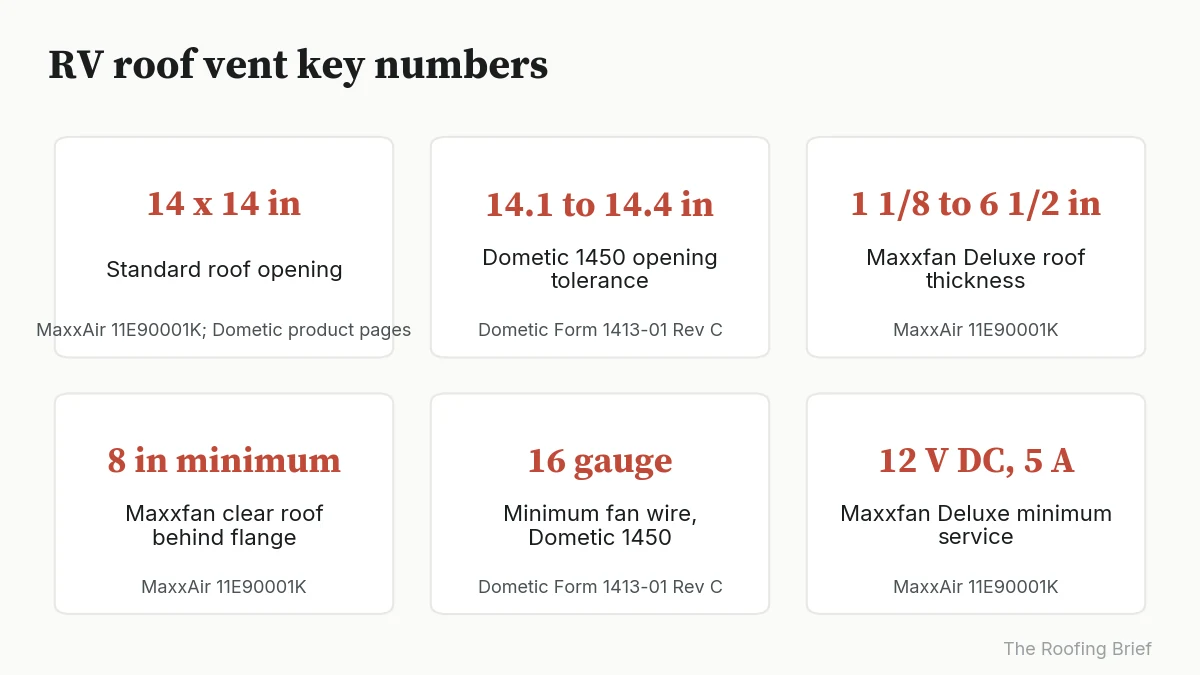
Six numbers settle most RV roof vent purchases: the 14 x 14 in opening, the opening tolerance, the roof thickness range, the clearance behind the fan, the wire size and the circuit size. Each value below comes from a MaxxAir or Dometic installation manual opened in October 2026, and the Source column names the document.
| Figure | Value | Source |
|---|---|---|
| Standard roof opening | 14 x 14 in | MaxxAir 11E90001K; Dometic product pages |
| Dometic 1450 opening tolerance | 14.1 to 14.4 in square | Dometic Form 1413-01 Rev C |
| Maxxfan Deluxe roof thickness | 1 1/8 to 6 1/2 in | MaxxAir 11E90001K |
| Maxxfan clear roof behind flange | 8 in minimum | MaxxAir 11E90001K |
| Minimum fan wire (Dometic 1450) | 16 gauge stranded copper | Dometic Form 1413-01 Rev C |
| Maxxfan Deluxe circuit | 12 V DC, 5 A minimum service | MaxxAir 11E90001K |
Which RV roof vent fan fits a 14 x 14 opening?
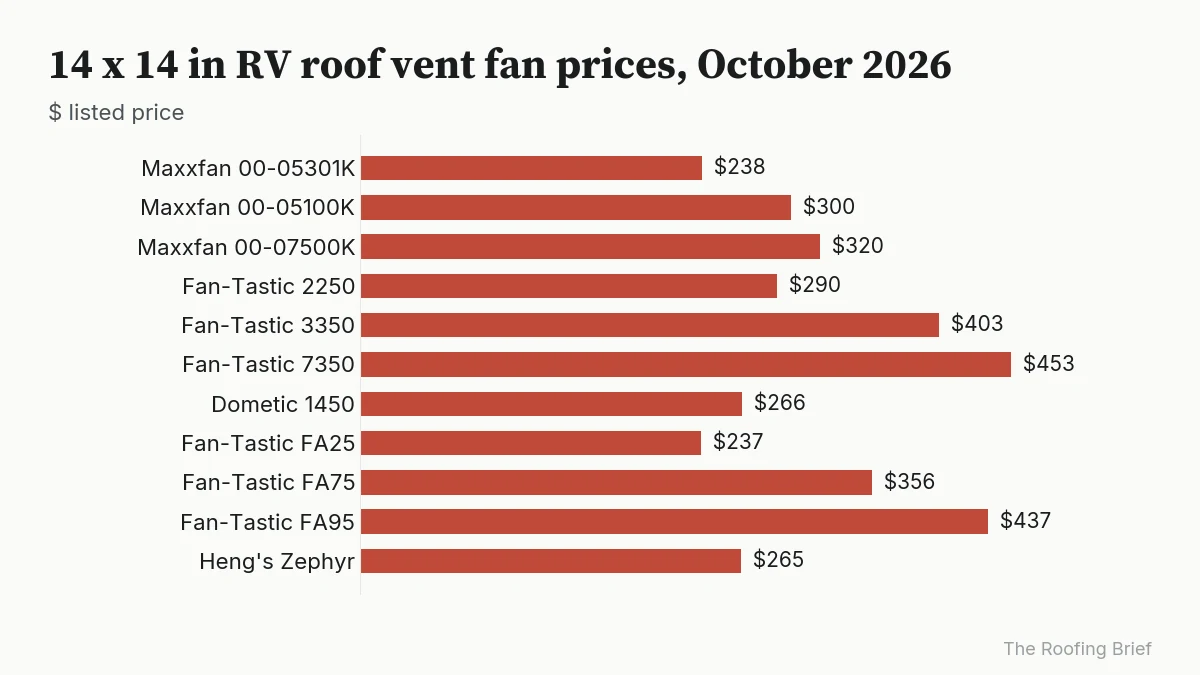
Every powered fan in the table below fits a 14 x 14 in opening, and listed prices run from $237.49 for a Dometic Fan-Tastic FA25 to $452.99 for a Fan-Tastic 7350 (October 2026). The real differences are speeds, rain handling, lid drive and how much 12 V current the maker says the fan draws, which several makers do not publish.
| Model (part number) | Speeds | Airflow as listed | 12 V draw as listed | Rain protection | Lid | Price (retailer, Oct 2026) |
|---|---|---|---|---|---|---|
| MaxxAir Maxxfan Deluxe 00-05301K | 4, exhaust only | Over 900 CFM (catalog, line) | Needs 5 A service | Built-in rain shield | Manual | $237.95 (Nomadic Supply) |
| MaxxAir Maxxfan Deluxe 00-05100K | 10, intake and exhaust | Up to 900 CFM | Needs 5 A service | Built-in rain shield | Manual | $299.95 (Nomadic Supply) |
| MaxxAir Maxxfan Deluxe 00-07500K | 10, intake and exhaust | Up to 900 CFM | Needs 5 A service | Built-in rain shield | Electric, remote | $319.95 (Nomadic Supply) |
| Dometic Fan-Tastic 2250 (9108869049) | 3, reversible | 920, labeled m³/h | Not listed | None listed | Not listed | $289.99 (Dometic) |
| Dometic Fan-Tastic 3350 (9108870059) | 3, reversible | 920, labeled m³/h | Not listed | Rain sensor closes dome | Automatic lift | $402.99 (Dometic) |
| Dometic Fan-Tastic 7350 (9108870595) | Variable, reversible | Not listed | Not listed | Rain sensor closes dome | Automatic lift, remote | $452.99 (Dometic) |
| Dometic 1450 (9600008500) | 3, reversible | Not listed | Under 4 A on high | Tabs for Ultra Breeze cover | Manual | $265.99 (Dometic) |
| Dometic Fan-Tastic FA25 Essential (9630002551) | 5, reversible | Up to 900 CFM (line) | Not listed | None | Manual | $237.49 (Nomadic Supply) |
| Dometic Fan-Tastic FA75 Complete (9630002553) | 10, reversible | Up to 900 CFM | Not listed | Rain sensor, Stormhood dome | Power lift | $356.24 (Nomadic Supply) |
| Dometic Fan-Tastic FA95 Platinum (9630002555) | 10, reversible | Up to 900 CFM | Not listed | Rain sensor, Stormhood dome | Power lift, Bluetooth remote | $436.99 (Nomadic Supply) |
| Heng’s Zephyr (SV1113-G4) | 3, reversible | Up to 920 CFM (Heng’s, Zephyr I) | 18 W, 1.6 A | Rain sensor (retailer title) | Manual | $264.95 (Nomadic Supply) |
| Ventline Vanair (Dexter) | Not listed | Not listed | 1.5 A | Not listed | One-hand open | No listing found |
Treat airflow figures as maker claims, not comparable test results. Dometic’s 2250 and 3350 pages print “920” in a field labeled m³/h, which converts to about 541 CFM, while MaxxAir states “up to 900 CFM” for select 10-speed Deluxe models and Nomadic Supply’s listings give the same figure for the Dometic FA line. We found no common test standard cited on any of these pages, so the table repeats each figure with the unit the maker printed.
Which Maxxfan Deluxe model number is which?
MaxxAir sells six Maxxfan Deluxe models for the 14 x 14 in opening, split by lid color, speed count and lid drive. The 00-05301K and 00-06401K are 4-speed exhaust-only fans; the four others run 10 speeds in both directions with a thermostat, and only the 00-07000K and 00-07500K add an electric lid and remote (MaxxAir Maxxfan Deluxe lineup, October 2026).
| Model | Lid color | Speeds | Direction | Thermostat | Lid opening | Remote | Nomadic Supply, Oct 2026 |
|---|---|---|---|---|---|---|---|
| 00-05301K | White | 4 | Exhaust only | No | Manual | No | $237.95 |
| 00-06401K | Smoke | 4 | Exhaust only | No | Manual | No | $249.95 |
| 00-05100K | White | 10 | Intake and exhaust | Yes | Manual | No | $299.95 |
| 00-06200K | Smoke | 10 | Intake and exhaust | Yes | Manual | No | $299.95 |
| 00-07000K | White | 10 | Intake and exhaust | Yes | Electric | Yes | $317.95 |
| 00-07500K | Smoke | 10 | Intake and exhaust | Yes | Electric | Yes | $319.95 |
The lid opening column comes from the feature grid in the MaxxAir 2025 catalog MXR-4042.02, which also marks every Deluxe model as able to run with the lid closed (Ceiling Fan Mode). MaxxAir’s manual sets the thermostat at 78°F from the factory and says the fan should be fully open or fully closed while the vehicle is moving.
Rain shield or rain sensor: what is the difference?
A rain shield lets the fan keep moving air in rain; a rain sensor shuts the dome when water hits it. MaxxAir says the Maxxfan Deluxe built-in rain cover “provides full time protection, while fan is on or off,” while Dometic says the 3350 and 7350 rain sensor automatically closes the dome, so air stops moving through the vent while it is shut (maker pages, October 2026).
How much 12V power does an RV roof vent fan draw?
Where makers publish it, an RV roof vent fan draws 1.5 to 4 A at 12 V: Dexter lists 1.5 A for the Ventline Vanair, Heng’s lists 18 W and 1.6 A for the Zephyr, and Dometic says the 1450 uses less than four amps on high. Over an 8 hour night that is 12 to 32 amp-hours, as the arithmetic below shows.
| Fan | Maker figure | Arithmetic, 8 h | Amp-hours | Share of a 100 Ah battery (illustrative) | Source |
|---|---|---|---|---|---|
| Ventline Vanair | 1.5 A | 1.5 x 8 | 12 Ah | 12% | Dexter Vanair page |
| Heng’s Zephyr | 1.6 A (18 W) | 1.6 x 8 | 12.8 Ah | 12.8% | Heng’s vents page |
| Dometic 1450 on high | Under 4 A | 4 x 8 | Under 32 Ah | Under 32% | Dometic Form 1413-01 Rev C |
| Maxxfan Deluxe circuit sizing | 5 A minimum service | 5 x 8 | 40 Ah ceiling, not a measured draw | 40% ceiling | MaxxAir 11E90001K |
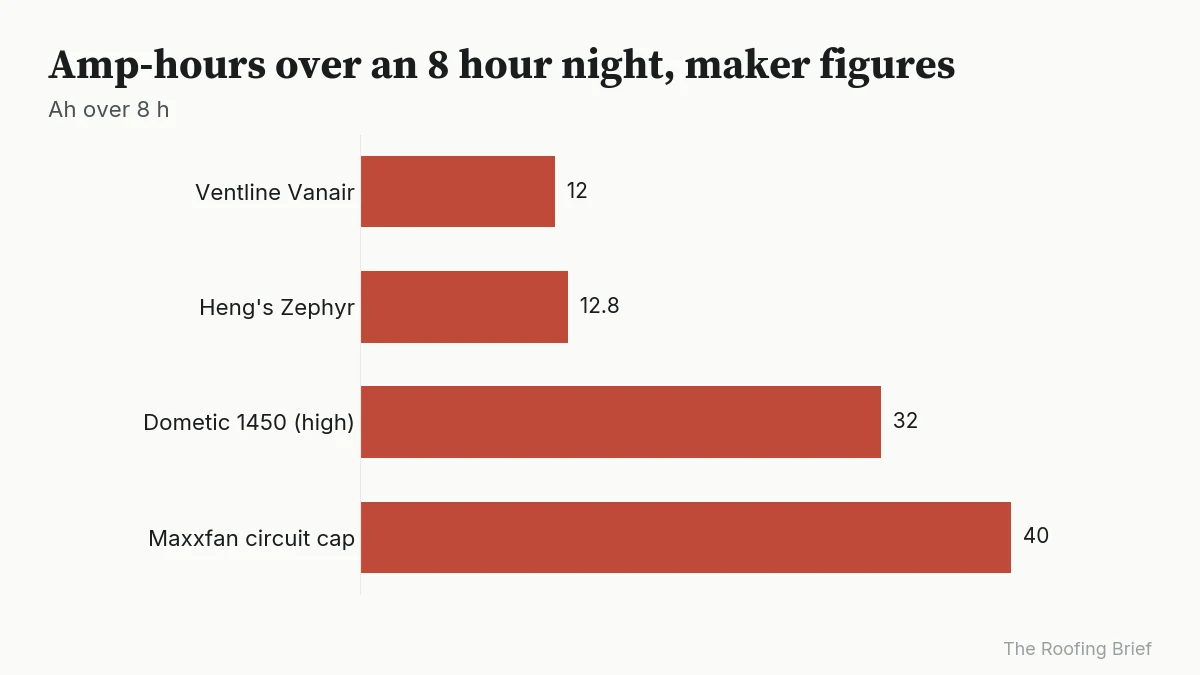
Ventline.com now redirects to Dexter’s vent pages, which is where the Vanair figure comes from. The Maxxfan row is a circuit requirement, not a running draw, so it overstates what the fan uses at low speed; MaxxAir’s manual does not print a per-speed amp figure. Wiring rules differ too: Dometic says the 1450 has no internal fuse and must go on a protected circuit with at least 16 gauge stranded copper, while MaxxAir says the Maxxfan has a self-resetting fuse on its circuit board.
Do you need an RV roof vent cover?
You need a vent cover if your vent has no built-in rain shield and you want it open in rain. MaxxAir sells the MaxxAir I+ for non-powered vents, the MaxxAir II for non-powered vents and low-powered fans, and the FanMate for high-powered fans; the Maxxfan Deluxe needs none because its rain shield is built in (MaxxAir catalog MXR-4042.02).
| Cover or lid (part number) | Fits | Maker note | Price, Camping World, Oct 2026 |
|---|---|---|---|
| MaxxAir I+ Original, translucent white (00-933051) | Non-powered roof vents | 6 year limited warranty | $33.99 |
| MaxxAir II, translucent white (00-933081) | Non-powered vents and low-powered fans | Double the vent area, per MaxxAir; 6 year warranty | $47.76 |
| MaxxAir FanMate, white (00-955001) | High-powered fans; EZClip on Maxxfan and Maxxfan Plus | 6 year limited warranty | $71.99 |
| Camco Vent Cover, white | Not stated on category listing | Not stated on listing | $38.45 |
| Dometic K1020-19 Fan-Tastic Vent Dome (smoke) | Replacement dome for Fan-Tastic vents | Dome, not a rain cover | $46.99 |
| Heng’s EZ-Change Vent Cap (90110A-C1) | Heng’s 7-Series Universal Vent | White lid | $15.26 |
| Ventline BVD0449-A01 Replacement Vent Cover, white | Ventline vents | Replacement lid | $24.56 |
| Camco replacement lid for Ventline ’08 and newer, white | Ventline 2008 and newer | Replacement lid | $22.47 |
A cracked lid on a sound base is the cheapest fix on the roof: match the lid to the base brand and year, since Camping World lists separate Camco lids for Ventline 2008 and newer, Elixir pre-1994 and Jensen metal base 1994 and up (Camping World roof vent covers, October 2026). MaxxAir’s Unimaxx lid (00-335001 white) uses a universal hinge meant for Elixir, Heng’s, Jensen and Ventline bases, per the 2025 catalog.
Will a new RV roof vent fit your roof thickness and opening?
Check three fit limits before ordering: the opening size, the roof thickness and the space around the vent. The Maxxfan Deluxe takes roofs 1 1/8 to 6 1/2 in thick and needs 8 in of clear roof behind the flange, while Dometic’s 1450 ships garnish options for roofs from 0.9 to 6.0 in and wants an opening of 14.1 to 14.4 in (maker manuals).
| Model | Opening rule | Roof thickness rule | Placement rule | Source |
|---|---|---|---|---|
| MaxxAir Maxxfan Deluxe (all models) | 14 x 14 in | 1 1/8 to 6 1/2 in; build up the ceiling opening with wood if thinner | 8 in clear behind the rear flange edge; louvers face the rear; flange clips face the sides | MaxxAir 11E90001K |
| Dometic 1400 and 1450 | Enlarge if under 14.1 in, reduce if over 14.4 in | Garnish ranges 0.9 to 1.9 in, 2.0 to 4.0 in, 4.0 to 6.0 in; clamp mount only under 4 in without a solid substrate | Lid hinge toward the front of the RV | Dometic Form 1413-01 Rev C |
| Dometic Fan-Tastic 3350 and 7350 | 13.78 x 13.78 in cutout, fits a 14 x 14 in opening | 6 in garnish included | Not stated on product page | Dometic product pages |
| Ventline Ventadome 3092 and 3094 | 14 1/4 x 14 1/4 in rough opening | Telescopic garnish for multiple roof thicknesses | Screw-in or clamp-in | Dexter Ventadome page |
| Heng’s Zephyr | 14 x 14 in | Not stated | Not stated | Heng’s vents page |
The 8 in rule rules out a Maxxfan Deluxe directly in front of an air conditioner shroud or storage box, because its louvers face the rear of the vehicle. The same 14 x 14 in hole also takes a 14 x 14 in skylight dome such as the ICON SL1414 if you would rather trade the fan for light; sizes and steps are in our RV skylight guide.
Which sealant do RV roof vent makers allow?
Follow the fan maker for the flange and the membrane maker for the roof. Dometic’s 1450 manual calls for waterproof or lap sealant, EPDM-compatible on rubber roofs, and says not to use silicone or oil-based sealants. MaxxAir’s Maxxfan manual bars sealants with solvents such as xylene, toluene, MEK, acetate or acetone, bars polysulfide, and calls G.E. Silicone II suitable.
| Document | Allowed | Not allowed | Placement rule |
|---|---|---|---|
| Dometic 1400/1450 manual, Form 1413-01 Rev C | Waterproof sealant or lap sealant; EPDM-compatible sealant on rubber roofs | Silicone; oil-based sealants | Sealant or gasket around the opening, none on top or bottom of the gasket; sealant over screw heads and flange edge |
| MaxxAir Maxxfan Deluxe manual 11E90001K | Sealant compatible with the plastic flange and the roof; G.E. Silicone II named as suitable | Xylene, toluene, MEK, acetate or acetone solvents; polysulfide (Thiokol) | Remove old sealant 2 in around the opening; sealant over screw heads and flange edge |
| Dicor 501LS self-leveling and 551LS non-sag pages | EPDM, TPO, PVC, fiberglass, aluminum | Not stated | Skins in 5 min, waterproof in 4 h at 50 to 70°F |
| Dicor butyl seal tape BT-1834 | Seams, joints, openings | Do not stretch | Apply at 30 to 110°F |
| Sikaflex-715 PDS v03.01 | EPDM, metals, plastics per Sika | Test first on plastics prone to stress cracking | Apply at 41 to 104°F; skin in 30 min |
The two manuals contradict each other on silicone, and so do generic roof guides. Our RV roof sealant guide advises against household silicone on RV roof seams, which matches Dometic’s rule. For a Maxxfan flange, read section 3 of your lap sealant’s safety data sheet and confirm it lists none of the five solvents MaxxAir names before you use it; Dicor’s 501LS page carries solvent exposure warnings without naming the solvent. If you do not know the membrane, identify it first with our RV roof membrane guide.
How do you replace an RV roof vent?
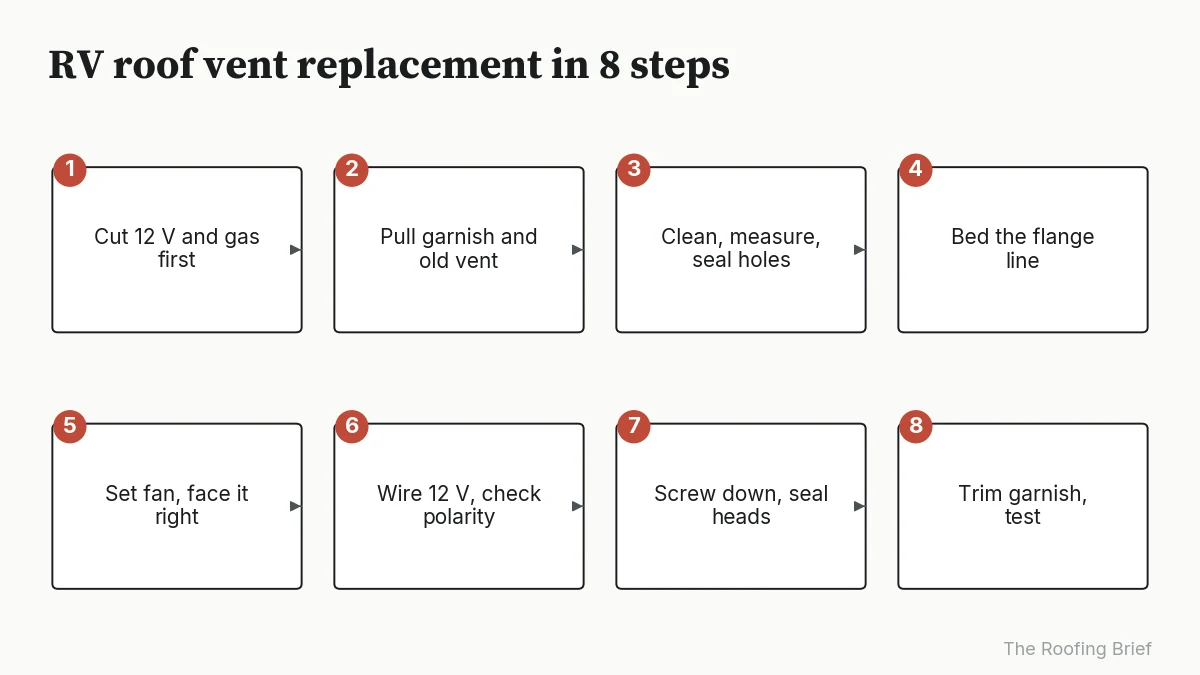
Replace an RV roof vent in eight steps: cut 12 V power, pull the garnish and old vent, clean 2 in of roof around the opening, bed the new flange, set the fan in its required direction, wire and test polarity, screw down and seal the heads, then trim the garnish. Keep rain off for 4 hours, the waterproof time Dicor lists for its lap sealant.
- Cut 12 V and gas first. Dometic’s manual says to shut off the gas supply, disconnect 115 VAC shore power and disconnect the positive 12 VDC battery terminal before cutting or drilling.
- Pull garnish and old vent. Remove the interior garnish screws, then the roof screws, and lift the old vent. Remove all old sealant for at least 2 in around the opening, the MaxxAir requirement, using a plastic scraper on EPDM or TPO.
- Clean, measure, seal holes. Measure the opening: Dometic’s 1450 wants 14.1 to 14.4 in square. Seal any unused screw holes, per Dometic step 4, and probe the deck; soft wood goes to our RV roof repair guide before any fan goes on.
- Bed the flange line. Run one unstretched band of Dicor BT-1834-1 butyl tape (1/8 x 3/4 in) or a continuous bead of sealant around the opening where the flange will sit. With a gasket, Dometic says sealant goes around its outer edge only.
- Set fan, face it right. Dometic: lid hinge toward the front of the RV. MaxxAir: flange clips toward the sides, louvers toward the rear, 8 in of clear roof behind.
- Wire 12 V, check polarity. Use at least 16 gauge stranded copper (Dometic), leave 15 in of extra wire at the opening, and confirm +12 V on a multimeter before connecting black to positive and white to ground.
- Screw down, seal heads. Dometic specifies 18 No. 8 x 1 in screws torqued evenly; MaxxAir fastens the fan to its roof flange with four 3/4 in No. 10 stainless screws. Cover every screw head and the flange edge with lap sealant, then keep water off for 4 hours.
- Trim garnish, test. MaxxAir says to cut its garnish 1/4 to 1/2 in longer than the ceiling-to-control-plate distance measured at each corner. Restore power; most Maxxfan Deluxe models beep to confirm it, except the 5301K and 6401K.
Cure continues long after the 4 hour rain window: Dicor lists 80% cure at 48 hours and full cure at 30 days for 501LS and 551LS. The full cure clock, including butyl and Sikaflex-715 timings, is laid out in our RV skylight replacement steps, and the vent flange belongs on the twice-yearly roof walk in our RV roof maintenance schedule.
What does RV roof vent replacement cost, DIY vs dealer?
DIY parts run $15.26 for a Heng’s lid to $492.44 for a Dometic Fan-Tastic 7350 with butyl tape and lap sealant, at October 2026 retail prices. A static vent to Maxxfan Deluxe 00-05100K swap on existing wiring costs $339.40 in parts. A dealer adds labor at its posted shop rate, so ask for the rate and the booked hours in writing.
| DIY job | Line items (retailer, Oct 2026) | Parts total |
|---|---|---|
| Lid only, Heng’s 7-Series | Heng’s 90110A-C1 $15.26 (Camping World) | $15.26 |
| Lid only, Ventline | Ventline BVD0449-A01 $24.56 (Camping World) | $24.56 |
| Add a cover to a static vent | MaxxAir II 00-933081 $47.76 (Camping World) | $47.76 |
| Static vent to Dometic FA25 | FA25 $237.49 (Nomadic Supply) + Dicor BT-1834-1 $28.95 (Nomadic Supply) + Dicor 501LSW-1 $10.50 (Camping World) | $276.94 |
| Static vent to Maxxfan Deluxe 00-05100K | $299.95 (Nomadic Supply) + $28.95 butyl tape + $10.50 lap sealant | $339.40 |
| Static vent to Maxxfan Deluxe 00-07500K | $319.95 (Nomadic Supply) + $28.95 + $10.50 | $359.40 |
| Static vent to Fan-Tastic 7350 | $452.99 (Dometic) + $28.95 + $10.50 | $492.44 |
Dealer labor depends on two inputs only the shop can give you: its hourly rate and the hours it books. The rows below use illustrative inputs, not quoted rates, on the $299.95 Maxxfan Deluxe 00-05100K, to show how far each input moves the bill; running a new 12 V circuit to a roof that never had a powered fan adds hours not shown here.
| Illustrative labor input | Labor | Plus fan | Dealer total |
|---|---|---|---|
| 1.5 h at $125 per hour | $187.50 | $299.95 | $487.45 |
| 2 h at $150 per hour | $300.00 | $299.95 | $599.95 |
| 3 h at $200 per hour | $600.00 | $299.95 | $899.95 |
MaxxAir’s warranty covers parts only for 2 years, with a lifetime limited warranty on the lid, and excludes the cost of removal and reinstallation, per the 11E90001K manual. Ask a dealer which sealant it will use on your membrane, whether new wiring is quoted separately, and whether it reseals the old screw holes. For house attic vents rather than RV vents, see our roof vent types comparison.
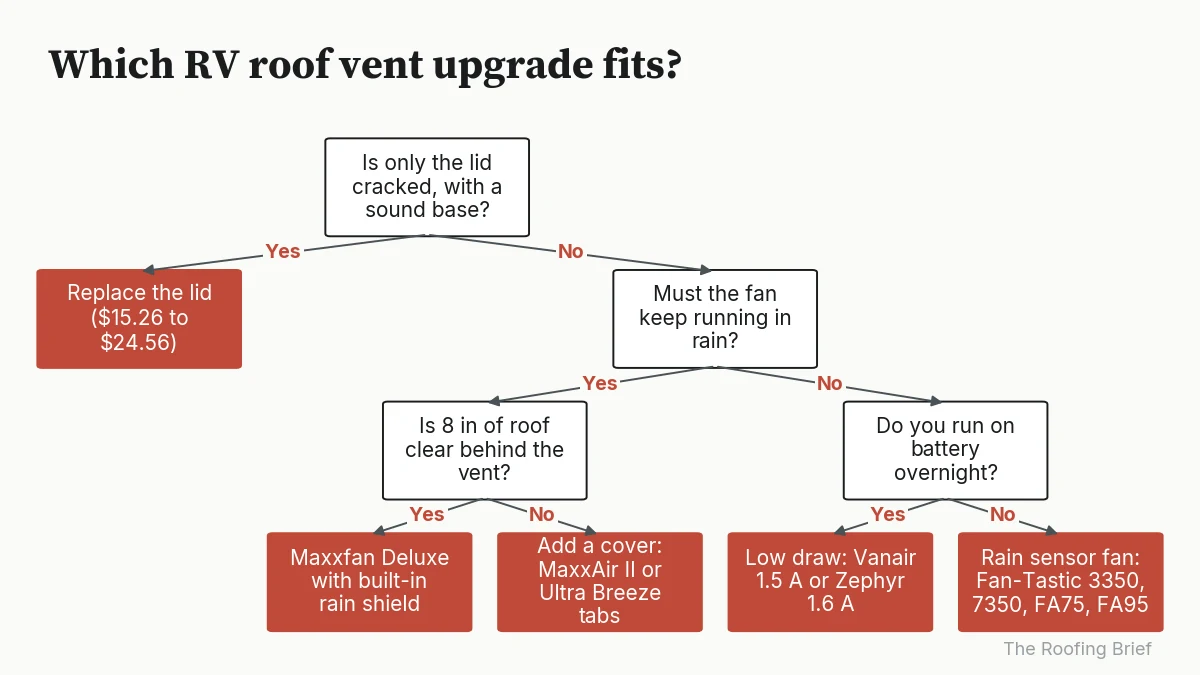
Which RV roof vent upgrade fits your situation?
Pick the fix by what failed and how you camp. A cracked lid on a sound base takes a $15.26 to $24.56 lid; a fan that must run in rain points to the Maxxfan Deluxe if 8 in of roof is clear behind it; battery-only camping favors the lowest published draw, 1.5 A on the Ventline Vanair. The table gives each threshold.
| If your situation is | Do this | Threshold source |
|---|---|---|
| Only the lid is cracked and the base is sound | Replace the lid, matched to brand and year ($15.26 to $24.56) | Camping World lid listings |
| You want the fan running in rain and have 8 in clear behind it | Maxxfan Deluxe with built-in rain shield | MaxxAir 11E90001K |
| You want rain protection but lack 8 in clearance | Add a cover: MaxxAir II for low-powered fans, or Ultra Breeze tabs on a Dometic 1450 | MaxxAir catalog; Dometic 1450 page |
| You want the dome to close itself when rain starts | Fan-Tastic 3350, 7350, FA75 or FA95 with rain sensor | Dometic pages; Nomadic Supply listings |
| You run on battery overnight | Choose a published low draw: Vanair 1.5 A or Zephyr 1.6 A | Dexter; Heng’s |
| Roof is thinner than 1 1/8 in | Build up the ceiling opening before a Maxxfan goes in | MaxxAir 11E90001K |
| Roof under 4 in with no solid substrate | Use Dometic’s clamp mount | Dometic Form 1413-01 Rev C |
If the deck is soft around 2 or more vents, or the membrane is failing at more than one fitting, a vent swap will not stop the leaks; price the whole job with our RV roof replacement cost guide before buying a fan.
How we compiled this
- We compiled this page from 30 primary documents and dated listings opened in October 2026: the MaxxAir Maxxfan Deluxe installation manual 11E90001K, the MaxxAir 2025 catalog MXR-4042.02, the Dometic 1400/1450 manual Form 1413-01 Rev C, Dometic, Dexter (Ventline) and Heng’s product pages, Dicor and Sika sealant documents, and Nomadic Supply and Camping World listings.
- Prices are the listed prices on the day we opened each page in October 2026; amp-hour and cost rows are our arithmetic on those figures.
- We did not test or install any product, and we did not measure airflow or current draw.
Frequently asked questions
Are RV roof vents a standard size?
Yes. The standard RV roof vent opening is 14 x 14 in, and every MaxxAir Maxxfan Deluxe, Dometic Fan-Tastic and Heng’s Zephyr in our comparison is sold for it. Dometic’s 1400/1450 manual sets a tolerance of 14.1 to 14.4 in square, and Ventline’s Ventadome 3092 and 3094 list a 14 1/4 x 14 1/4 in rough opening (Dexter, October 2026).
What are the different types of RV roof vents?
Four types share the 14 x 14 in opening: a static vent with a crank lid, such as Heng’s 7-Series Universal Vent; a static vent with a built-in rain shield, such as the MaxxAir Mini with its 10.5 in opening; a 12 V fan, such as the Maxxfan Deluxe or Fan-Tastic 7350; and a static vent or low-powered fan topped with a separate cover such as the MaxxAir II.
What is the best camper roof vent?
No single model wins, because makers print airflow without a common test. Match the feature you need: the Maxxfan Deluxe runs in rain behind a built-in shield but needs 8 in of clear roof behind it; the Fan-Tastic 3350, 7350, FA75 and FA95 close on a rain sensor; the Ventline Vanair (1.5 A) and Heng’s Zephyr (1.6 A) have the lowest published draw.
Should I leave the roof vent open when storing RV?
None of the maker documents we opened gives a storage rule, so leave a vent open only where rain cannot get in. MaxxAir says the Maxxfan Deluxe built-in rain cover protects while the fan is on or off, and that its I+ cover (00-933051) for non-powered vents reduces heat build-up. Without a shield or cover, close the lid; MaxxAir also says the lid should be fully open or closed while driving.
Can a MaxxAir Maxxfan Deluxe run in the rain?
Yes. MaxxAir says the Maxxfan Deluxe built-in rain cover provides full time protection while the fan is on or off, so no separate cover is needed. Every Deluxe model can also run with the lid closed in Ceiling Fan Mode, per the 2025 catalog. The manual says the lid should be fully open or fully closed while the vehicle is moving.
How many amps does an RV roof vent fan draw?
Published figures run from 1.5 A for the Ventline Vanair (Dexter) and 1.6 A for the Heng’s Zephyr (18 W) to under 4 A on high for the Dometic 1450. MaxxAir does not print a running draw for the Maxxfan Deluxe but requires a minimum 12 V DC, 5 A service. At 1.6 A, an 8 hour night uses 12.8 amp-hours.
Can I use silicone around an RV roof vent?
Only where the fan maker’s manual allows it, and the two largest makers disagree. Dometic’s 1400/1450 manual says not to use silicone or oil-based sealants and to use EPDM-compatible sealant on rubber roofs. MaxxAir’s Maxxfan manual names G.E. Silicone II as suitable but bars sealants containing xylene, toluene, MEK, acetate or acetone, and polysulfide types.
Which replacement vent lid fits my RV?
Match the lid to the base brand and year, not just the 14 x 14 in size. Camping World lists separate Camco lids for Ventline 2008 and newer ($22.47), Elixir pre-1994 and Jensen metal base 1994 and up, plus Heng’s 90110A-C1 ($15.26). MaxxAir’s Unimaxx 00-335001 uses a universal hinge for Elixir, Heng’s, Jensen and Ventline bases.
Sources
- Airxcel MaxxAir, Maxxfan Deluxe Installation Instructions and Operating Guide, P/N 11E90001K (11-2017) (accessed Oct 2026)
- Airxcel MaxxAir, 2025 Aftermarket Catalog MXR-4042.02 (accessed Oct 2026)
- MaxxAir, Maxxfan Deluxe lineup page (accessed Oct 2026)
- MaxxAir, Maxxfan Deluxe 00-07500K page (accessed Oct 2026)
- Dometic, Fan 1400/1450/4100 Installation and Operating Manual, Form 1413-01 Rev C (11/21) (accessed Oct 2026)
- Dometic, 2250 Fan-Tastic Vent Roof Fan (accessed Oct 2026)
- Dometic, 3350 Fan-Tastic Vent Roof Fan (accessed Oct 2026)
- Dometic, 7350 Fan-Tastic Vent Roof Fan (accessed Oct 2026)
- Dometic, 1450 Vent Roof Fan (accessed Oct 2026)
- Dexter (Ventline), Vanair roof vent (accessed Oct 2026)
- Dexter (Ventline), Ventadome roof vent (accessed Oct 2026)
- Heng’s Industries, Vents product page and home page (Zephyr I SV0112) (accessed Oct 2026)
- Nomadic Supply, Maxxfan Deluxe 00-05301K, 00-06401K, 00-05100K, 00-06200K, 00-07000K, 00-07500K (accessed Oct 2026)
- Nomadic Supply, Dometic FA25, FA75 and FA95 listings (accessed Oct 2026)
- Nomadic Supply, Heng’s Zephyr SV1113-G4 listing (accessed Oct 2026)
- Nomadic Supply, Dicor BT-1834-1 butyl tape (accessed Oct 2026)
- Camping World, RV roof vent covers category (MaxxAir, Camco, Dometic, Heng’s, Ventline listings) (accessed Oct 2026)
- Camping World, Dicor 501LSW-1, item 32125 (accessed Oct 2026)
- Dicor, Self-Leveling Lap Sealants and Non-Leveling Lap Sealants (accessed Oct 2026)
- Dicor, Butyl Seal Tape (accessed Oct 2026)
- Sika Corporation, Sikaflex-715 Product Data Sheet v03.01 (April 2023) (accessed Oct 2026)